

Quick Follow Up: The Exact System That Gets Replies in 2026
You sent the proposal three days ago. Radio silence. Your cursor hovers over the compose button, but you're stuck between "I don't want to be annoying" and "I need this deal to move."
Here's the thing: a quick follow up isn't pushy - it's expected. [42% of all cold email replies](https://instantly.ai/cold-email-benchmark-report-2026) come from follow-ups, not the first message. The people who don't follow up are the ones losing deals.
What You Need (Quick Version)
- Wait 3 business days before your first follow-up. This alone lifts reply rates by 31% compared to next-day nudges.
- Use a 5-step cadence: Day 0, 3, 7, 14, 21. Each email introduces a new angle - never repeat yourself. (If you want more structure, see B2B cold email sequence best practices.)
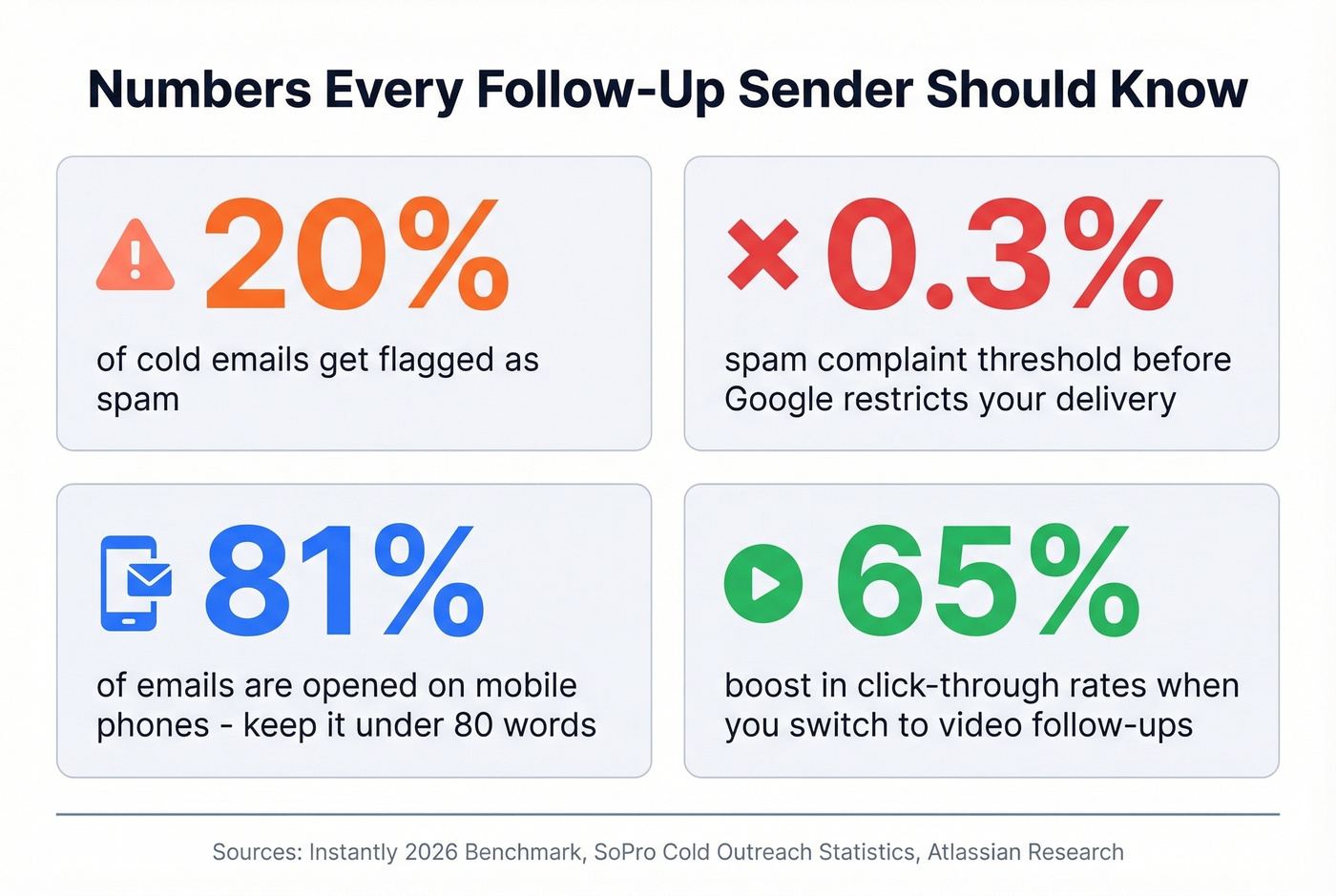
- Keep it under 80 words, plain text, mobile-friendly. 81% of emails are opened on phones. And never, ever write "just checking in." (More options: how to say just checking in professionally.)
"Follow Up" vs "Follow-Up"
Quick grammar note: follow up (two words) is the verb - "I'll follow up tomorrow." Follow-up (hyphenated) is the noun or adjective - "a follow-up email." Followup (one word) isn't standard English. Use it in a subject line and you'll look sloppy.
Do Follow-Ups Actually Work?
The data is unambiguous. Instantly's 2026 benchmark report - covering billions of cold email interactions - puts the overall average reply rate at 3.43%. Not great. But follow-ups change the math: 58% of replies come from the first email, and the remaining 42% come from subsequent touches. Skip them and you're leaving nearly half your replies on the table. (More benchmarks: follow-up email reply rate.)
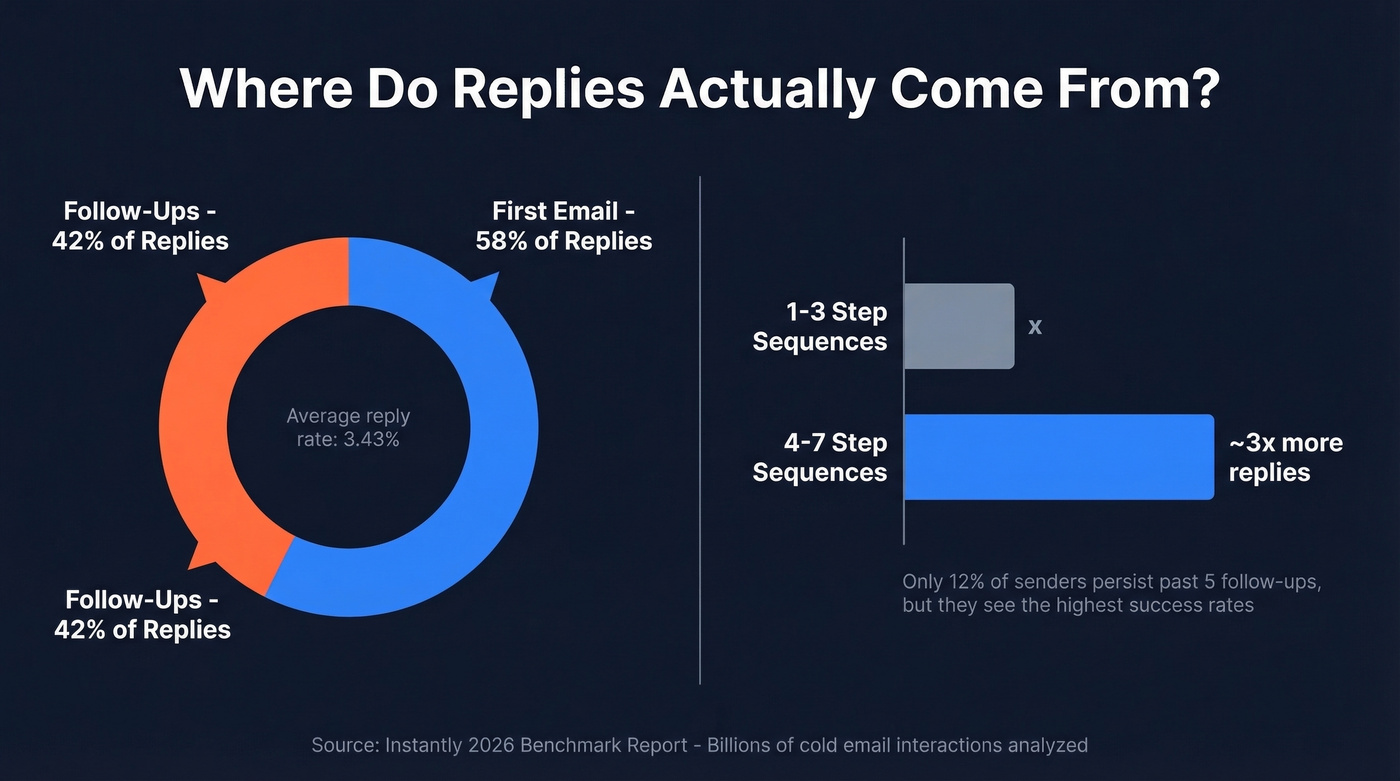
Sequence length matters too. 4-7 step sequences generate roughly 3x the replies of 1-3 step sequences. Persistence is also rarer than you'd think - Atlassian notes that 12% of people who persisted with 6-11 follow-ups were more likely to achieve success. Under four emails, you're giving up too early. We've tested this across hundreds of campaigns, and the pattern holds every time.
The takeaway isn't "send more emails." It's "send more emails that each say something different." Bumping the same thread with "any thoughts?" doesn't count. (For more angles, use these cold email follow-up templates.)
The Ideal Follow-Up Schedule
Here's the cadence we've seen work consistently across outbound campaigns:
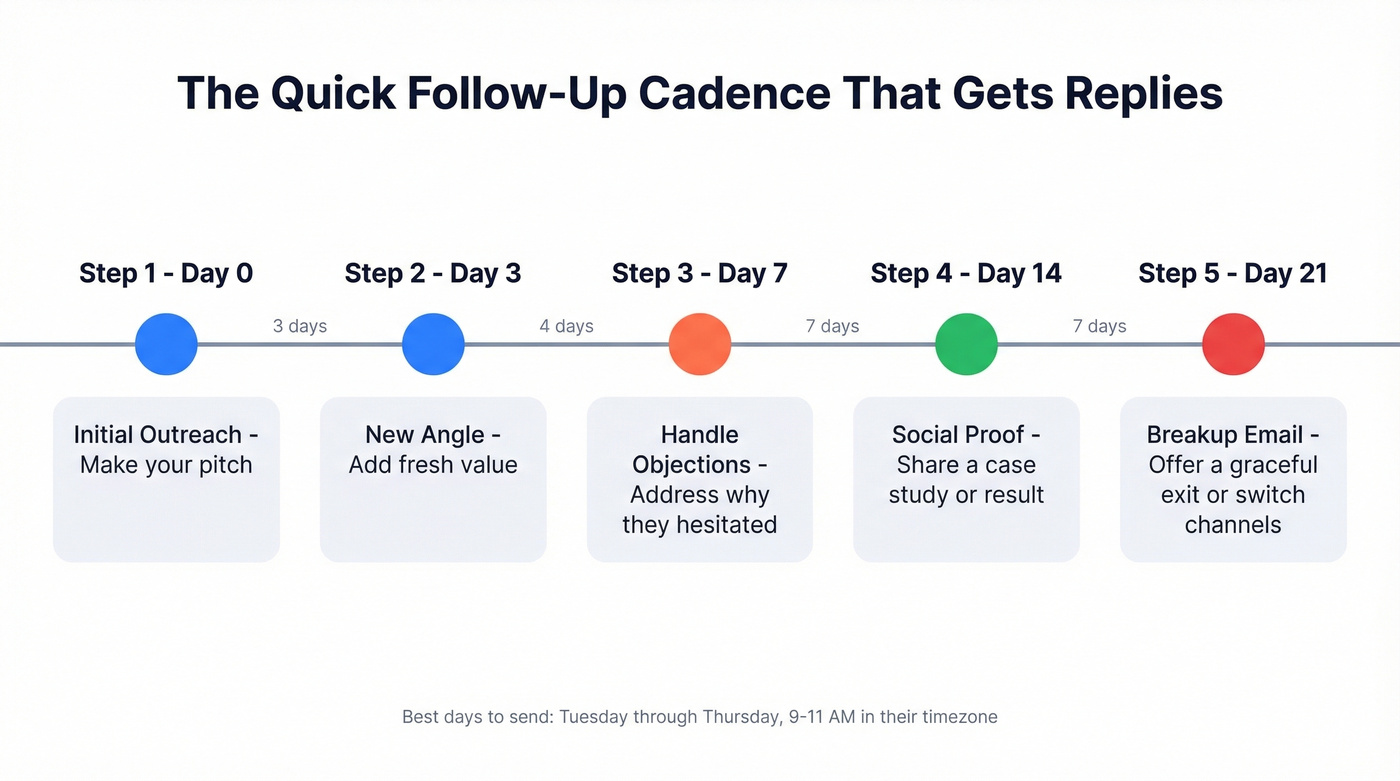
| Step | Day | Purpose |
|---|---|---|
| Email 1 | Day 0 | Initial outreach |
| Email 2 | Day 3 | New angle or value add |
| Email 3 | Day 7 | Address likely objection |
| Email 4 | Day 14 | Social proof or case study |
| Email 5 | Day 21 | Breakup / channel switch |
The three-day gap before your first follow-up isn't arbitrary. Research shows that waiting three business days yields a 31% increase in replies versus following up the next day. People need time to process, get through their own inbox backlog, and circle back. (More detail: when should I follow up on an email.)
Send Tuesday through Thursday, between 9-11 AM in the recipient's timezone. Wednesday consistently shows the highest reply rates. After Day 7, widen the gaps - you're staying on their radar without becoming noise. (Timing deep dive: best time to send cold emails.)

A perfect 5-step cadence means nothing if your emails bounce. Bad data tanks your sender reputation and sends future follow-ups straight to spam. Prospeo's 98% email accuracy and 7-day data refresh cycle mean every follow-up in your sequence reaches a real inbox.
Stop wasting follow-ups on dead addresses. Verify before you send.
Templates That Replace "Just Checking In"
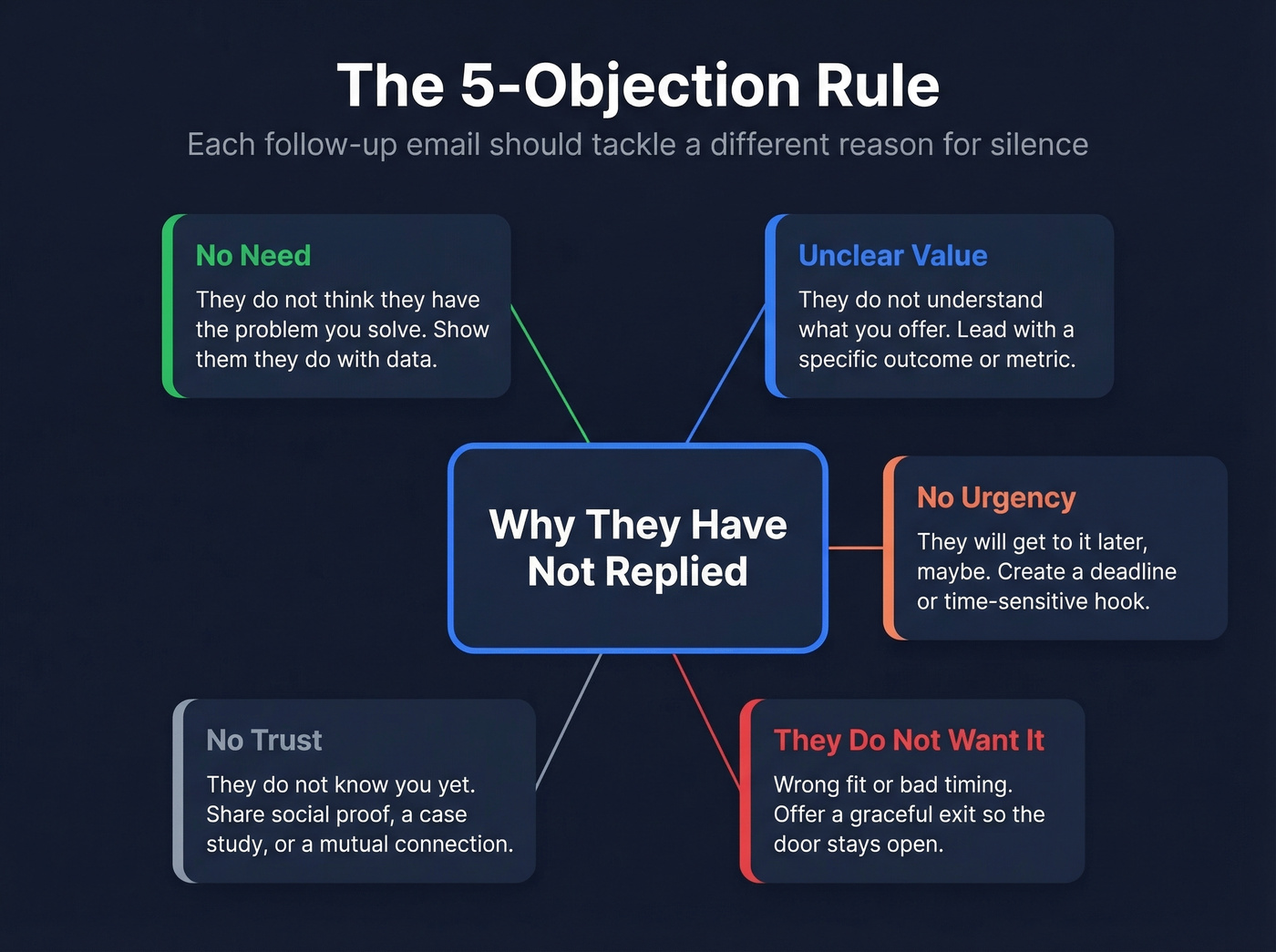
Every follow-up should give the recipient a reason to reply beyond guilt. I call it the 5-objection rule: each email should address a different reason someone hasn't replied - no need, unclear value, no urgency, skepticism, or lack of trust. (Related: importance of follow-up in sales.)
No Response (Sales)
Hi [Name], saw [Company] just [specific trigger - new hire, funding round, product launch]. We helped [similar company] solve [specific problem] and cut [metric] by [number]. Worth a 10-min call this week?
Post-Meeting Recap
This one's about accountability, not selling. Summarize what was agreed, assign next steps, and set a deadline: "Here's what we agreed on: [action item 1], [action item 2]. I'll have [deliverable] to you by [date]. Let me know if I missed anything." (More: sales meeting follow-up email.)
Post-Proposal
Bad: "Hi, just checking in on the proposal I sent last week. Let me know your thoughts!"
Good: "Hi [Name], wanted to flag that the pricing in last week's proposal holds through [date]. Happy to walk through any questions - otherwise I'll check back in Q[X]."
The difference? The good version creates urgency with a deadline and gives the recipient a graceful exit. Ask any r/sales regular and they'll tell you "just checking in" is the fastest way to get archived.
Chaser Email for Quotes and Invoices
Hi [Name], following up on invoice #[number] sent [date] - payment was due [date]. If there's a question about the amount or terms, happy to sort it out. Otherwise, can you confirm when this will be processed?
Short, specific, anchored to a concrete date and amount. The key is referencing the original document so the recipient can act immediately without digging through their inbox. (If you need more variations, see polite chaser email.)
Job Application
Send a thank-you within 24 hours. If you haven't heard back after about a week, keep it brief: "Still very interested in the [role] - happy to provide any additional information."
One practitioner phrasing from r/sales that works well for scheduling: "I'm trying to finalize my schedule for next week - wanted to know if [date] works for you?" Low friction, easy to reply to.
Subject Lines That Get Opened
Subject lines between 6-10 words hit the highest open rates. Shorter than six feels incomplete; longer than ten gets truncated on mobile. (More examples: email subject line examples.)
A few that HubSpot reps actually use: "Still any interest in this?", "[Name], quick question", "Ideas for your launch", "Let's cut to the chase." Notice none of them say "follow-up" or "checking in." Those words signal low-value email before anyone opens it.
Resist the temptation to write "a gentle follow-up on this please" in the subject line. It sounds passive and tells the recipient you've got nothing new to offer.
Five Mistakes That Kill Replies
1. Bumping without new information. "Just wanted to bump this to the top of your inbox" tells the recipient you have nothing new to say. Every message needs a fresh angle - a stat, a case study, a new question. (Frameworks: emails that get responses.)
2. Ignoring objections. Apply the 5-objection rule: no need, unclear value, no urgency, they don't want it, or they don't trust you. Each email should address a different one.
3. Over-designed emails. HTML templates with banners and buttons scream "marketing blast." Plain text, sent as a reply to the original thread, looks like a real person wrote it. That's what gets read.
4. Wrong frequency. Too fast and you're spam. Too slow and they've forgotten you. The Day 0/3/7/14/21 cadence keeps you in the sweet spot.
5. Following up with bad data. This is the silent killer of follow-up sequences. If emails bounce, your sender reputation tanks - and future messages land in spam. Nearly 20% of cold emails get flagged as spam, and Google enforces a 0.3% spam complaint threshold before restricting delivery. We've watched teams run beautiful five-step cadences that went nowhere because half their list was dead addresses. Prospeo's real-time verification catches those before you hit send - 98% accuracy on a 7-day refresh cycle, and you only pay for valid addresses. (More on deliverability: email deliverability guide.)

You just built a killer follow-up sequence. Now you need verified contact data to power it. Prospeo gives you 300M+ profiles with 30+ filters - buyer intent, job changes, funding - so your follow-ups reach decision-makers who are actually in-market. At $0.01 per email, bad data is no longer an excuse.
Find the right prospects first. Follow up with confidence.
When to Stop Emailing
RAIN Group research pegs 8 touchpoints as the average needed to generate a conversion - but that doesn't mean eight emails. Outreach's research suggests limiting email-only outreach to three attempts before switching channels: phone, video, or social. (If you’re building a full motion, see sequence management.)
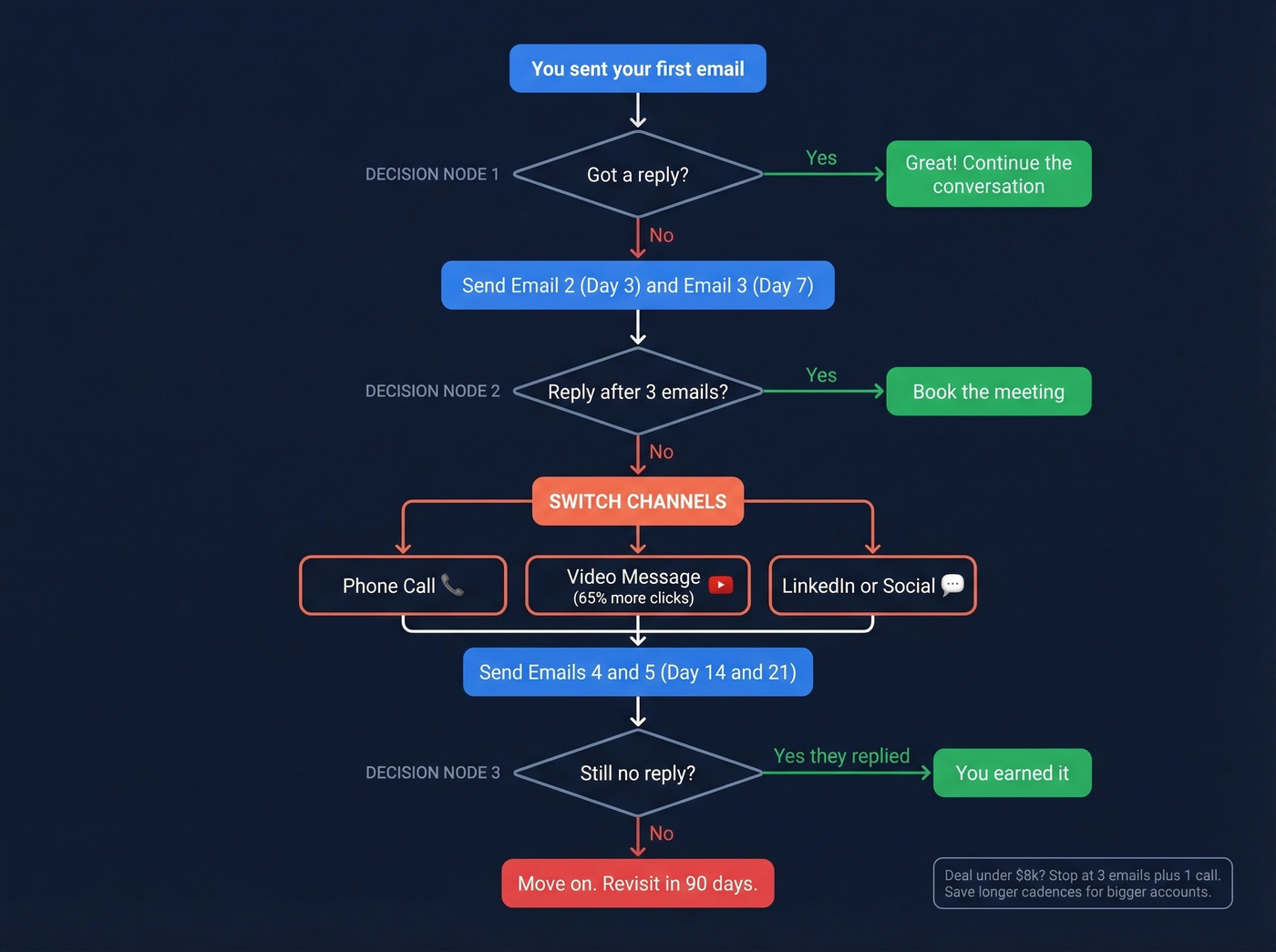
Let's be honest about deal economics: if your average deal size is under $8k, three emails and a phone call is your entire sequence. Anything more costs more in rep time than the deal is worth. Save the seven-step cadences for accounts that justify the effort.
61% of buyers prefer a rep-free experience. They're not ignoring you because they hate your product - they're ignoring email because everyone's in their inbox. A video follow-up can boost click-through rates by 65%, breaking the pattern and feeling more human than another paragraph of text.
After three emails with no response, pick up the phone or send a short video. Save emails 4 and 5 for after you've tried another channel.
FAQ
How many follow-up emails should I send?
Four to seven emails is the sweet spot - sequences in that range generate roughly 3x the replies of shorter ones. After three unanswered emails, switch to phone or video before continuing.
How long should I wait before following up?
Wait three business days before your first message. Research shows this increases reply rates by 31% compared to next-day nudges. After that, space subsequent emails about 7 days apart, widening to 14 days after the third touch.
How do I follow up without sounding pushy?
Add new value every time - a relevant stat, case study, or fresh angle. Never send "just checking in." Each email should give the recipient a reason to reply beyond guilt, and make sure you're reaching real inboxes instead of bouncing into the void.
When should I send a chaser email?
Send a chaser email when a specific action is overdue - an unpaid invoice, an unsigned contract, or a missed deadline. Reference the original document, include the exact amount or deliverable, and ask for confirmation with a clear next step. Keep it factual, not emotional.