

Quote Follow-Up Email Templates: Stop "Just Checking In" and Start Closing
You sent the quote three days ago. Radio silence. You've refreshed your inbox six times today, and every draft you type sounds like "please buy from me." Here's the reality: 90% of buyers respond within two days of their most recent message - so if you haven't heard back, your quote follow-up email matters more than the quote itself.
What You Need (Quick Version)
- Send 3-5 follow-ups over 14 days. Fewer leaves money on the table; more trains prospects to ignore you.
- First follow-up at Day 2-3. Same-day reads as desperate. Next week means you're already forgotten.
- Every follow-up needs new information, a new angle, or a clear ask. "Just checking in" is dead. (If you need alternatives, see Just Checking In Professionally.)
- Don't default to discounting - scope down first. If the price is too high, remove deliverables instead of cutting your rate. (More on anchor in negotiation helps here.)
- 1 PM is the best send time, with 11 AM as your backup. Avoid Monday. (For broader benchmarks, see best send time.)
Now let's build the emails.
Why Most Follow-Ups Fail
Three mistakes kill more deals than bad pricing ever will.
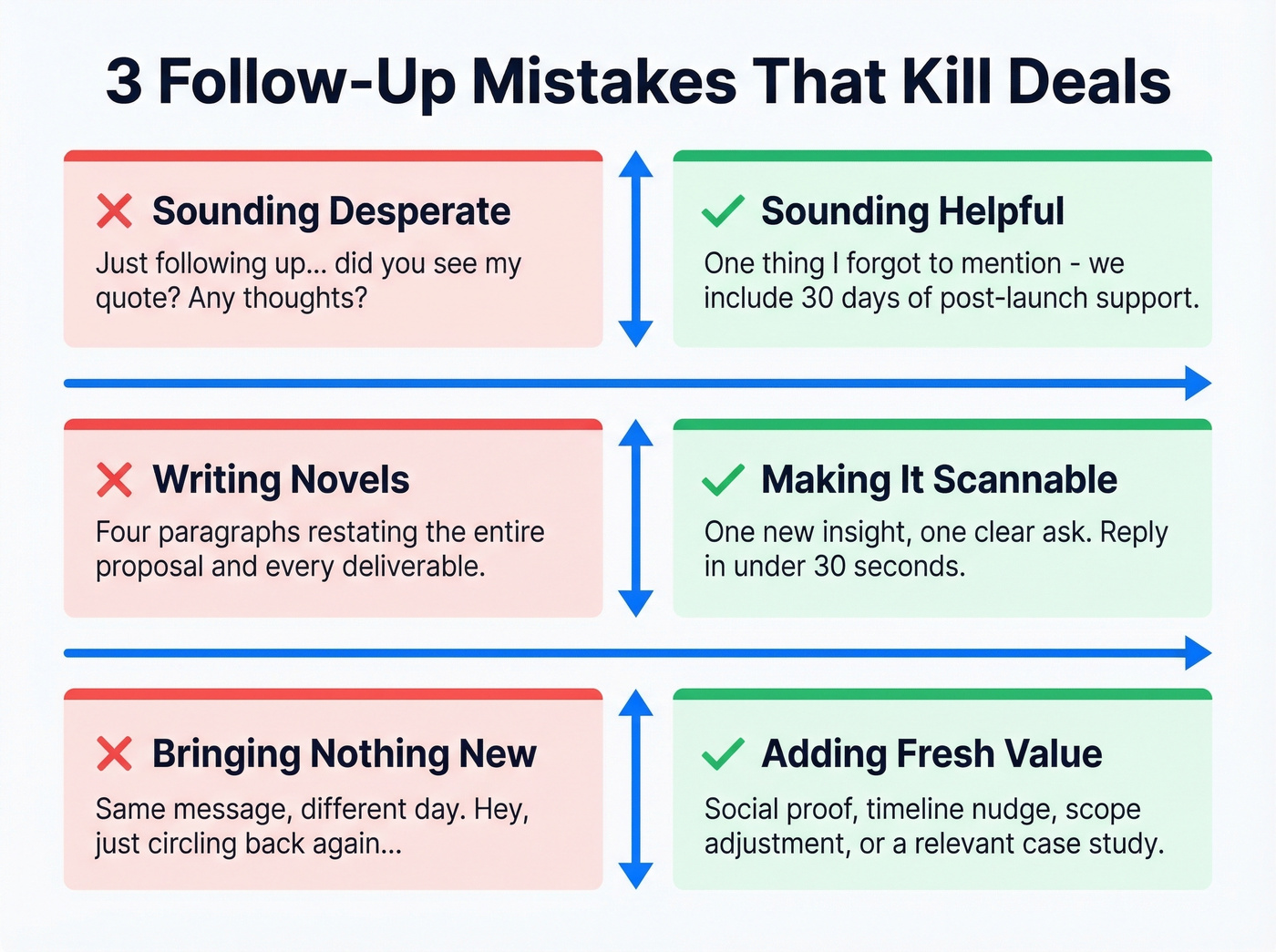
Mistake 1: You sound desperate. The consensus on r/sales is brutal - "just following up" and "did you see my quote?" read as needy. Prospects can smell commission breath through their screen. Every follow-up should sound like you're helping, not chasing. (If you want a system, use these sales follow-up templates.)
Mistake 2: You're writing novels. Yesware's research on follow-up mistakes nails this - long text hides the ask. Your prospect won't read four paragraphs restating the proposal. They need a reason to reply in under 30 seconds. (Tighten your copy with email copywriting.)
Mistake 3: You bring nothing new. If your second email says the same thing as your first, you're not following up - you're nagging. Each touchpoint needs a fresh angle: social proof, a timeline nudge, a scope adjustment, a relevant case study. (This is the core of how to add value in sales.)
The Data-Backed Cadence
Two major studies point in different directions, and that tension is actually useful.
| Study | Dataset | Finding | Our Take for Quotes |
|---|---|---|---|
| Belkins (2026) | 16.5M emails | 8.4% peak reply on email #1; 4+ emails more than triples unsubscribe and spam complaint rates | Cold outreach baseline - you have more permission than this |
| Woodpecker | 20M+ emails | 4-7 emails = 27% reply rate (3x vs. 1-3 emails) | Useful benchmark for multi-step sequences |
| Yesware | Internal data | 6 touches in ~3 weeks yields best cadence | Aggressive but effective for high-value deals |
Belkins studied cold outreach to strangers. Following up on a quote is different: you've already exchanged context, so you can be more direct and more persistent - as long as each message earns its spot.
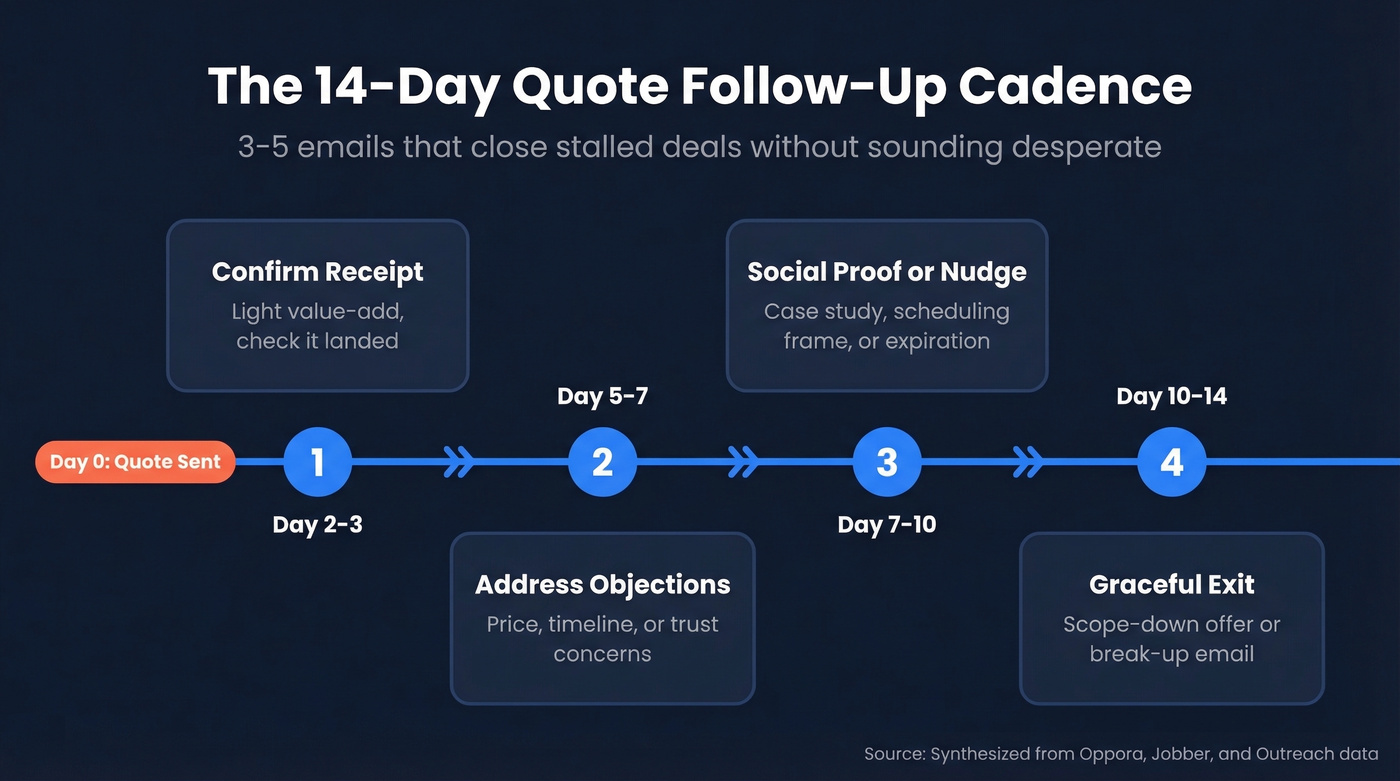
Our synthesized recommendation: 3-5 emails over 14 days, triangulated from Oppora, Jobber, and Outreach:
- Day 2-3: Confirm receipt, light value-add
- Day 5-7: Address likely objections - price, timeline, trust
- Day 7-10: Social proof or scheduling nudge
- Day 10-14: Graceful exit or scope-down offer

A perfect quote follow-up means nothing if it bounces. Prospeo delivers 98% email accuracy with 5-step verification - so every follow-up you send actually reaches the decision-maker's inbox, not spam.
Stop crafting follow-ups for email addresses that don't work.
10 Copy-Paste Email Templates
These are organized around Zig Ziglar's five buying objections - No Money, No Hurry, No Trust, No Need, No Desire - because every stalled quote traces back to at least one. We've tagged each template with the objection it addresses so you can pick the right one for your situation.
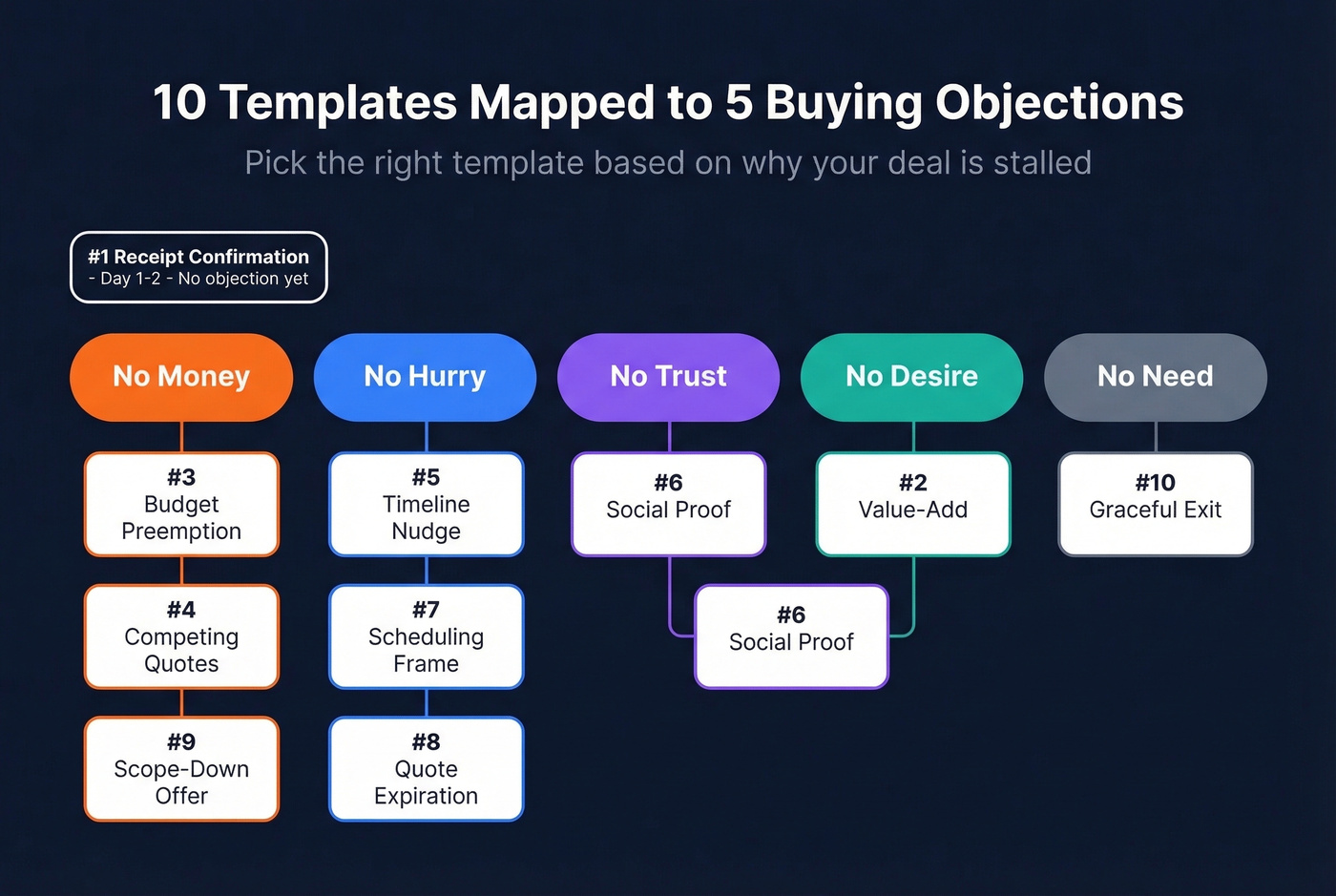
1. Receipt Confirmation (Day 1-2) - No Objection Yet
Subject: Quick question on the [Project] quote
Hi [Name],
Wanted to make sure the quote landed in your inbox and not spam. If anything's unclear on the line items, I'm happy to walk through it.
Any questions so far?
Why this works: Low-pressure, positions you as helpful. The "not spam" line gives them a face-saving reason to reply if they've been sitting on it. This is the simplest follow-up after sending a quotation - no new information needed yet, just a confirmation touchpoint.
2. Value-Add Follow-Up (Day 3-4) - No Desire
Subject: One thing I forgot to mention about [Project]
Hi [Name],
After sending the quote, I realized I didn't mention [specific benefit - e.g., "we include 30 days of post-launch support" or "the timeline includes a buffer week for revisions"].
Wanted to flag that since it's often a deciding factor.
Why this works: Adds new information instead of asking "did you see my email?" In our experience, this Day 3 value-add pulls more replies than any other touchpoint in the sequence. It's the one we tell every new rep to nail first. (If you're building a repeatable process, use sequence management.)
3. Budget Preemption (Day 5-7) - No Money
Subject: Flexible options for [Project]
Hi [Name],
If the full scope doesn't fit right now, we can prioritize [Phase 1 / core deliverable] and tackle the rest in Q2.
Want me to put together a phased option?
4. Competing Quotes (Day 5-7) - No Money
Subject: Comparing quotes for [Project]?
Hi [Name],
If you're evaluating other proposals - totally fair. A few things worth comparing: Does their quote include [specific differentiator]? What's their revision policy? What happens if the scope changes mid-project?
This one's borrowed directly from practitioner scripts on Reddit - asking comparison questions reframes the conversation from price to value.
5. Timeline Nudge (Day 7-10) - No Hurry
Subject: Timing for [Project]
Hi [Name],
Just flagging - if you're aiming for a [target date / quarter] launch, we'd need to kick off by [date] to stay on track. No pressure either way, but wanted you to have the timeline.
Creates urgency without being pushy. Makes the timeline concrete instead of abstract.
6. Social Proof (Day 7-10) - No Trust / No Desire
Subject: How [Similar Company] handled this
Hi [Name],
We recently wrapped a similar project for [company/industry]. They were dealing with [same challenge] and ended up [specific result - e.g., "cutting onboarding time by 40%"].
Thought it'd be relevant as you're evaluating.
A relevant case study is one of the most persuasive assets in a follow-up sequence. It addresses both "no trust" and "no desire" at the same time, which is why we've seen it outperform generic check-ins by a wide margin.
7. Scheduling Frame (Day 7-10) - No Hurry
Here's a before/after to show why framing matters:
❌ Before: "Just following up on the quote. Any thoughts?"
✅ After:
Subject: Finalizing my schedule for next week
Hi [Name],
I'm locking in my schedule for [next week / next month]. If you'd like to move forward, does [specific date] work for a quick kickoff call?
If the timing isn't right, no worries - just let me know.
This is the r/sales favorite - it gives a concrete reason for reaching out and a binary ask. Much stronger than "thoughts?" (If you want more options, see polite chaser email.)
8. Quote Expiration (3-5 Days Before Expiry) - No Hurry
Subject: Your [Project] quote expires [date]
Hi [Name],
Quick heads-up - the quote I sent on [date] is valid through [expiration date]. After that, pricing may shift based on [material costs / team availability / rate changes].
Want to lock it in, or do you need more time?
Legitimate urgency. If your quotes have expiration dates, this is the most natural follow-up you can send.
9. Scope-Down Offer (After Price Pushback) - No Money
Subject: A lighter version of [Project]
Hi [Name],
Here's what I'd recommend at [lower budget]: we focus on [core deliverable] and remove [secondary items]. Same quality, tighter scope.
Would that work?
Scope-down beats panic-discounting every time. I've watched reps kill deals by discounting when a scope-down would have closed it - more on this framework below. (To set boundaries, define your walk away point.)
10. Graceful Exit (Day 14+) - No Need
Subject: Should I close this out?
Hi [Name],
I haven't heard back, so I'm guessing the timing isn't right. Totally understand. I'll close out this quote on my end, but if things change down the road, I'm here.
Thanks for considering us.
Break-up emails often trigger a spike in replies because they make the next step simple: respond, or let it close. Skip this one if you're only on follow-up #2 - it only works after you've earned the right to walk away.
Subject Lines That Get Opened
64% of recipients decide to open or delete based on the subject line alone, and 69% use it to decide whether to mark you as spam.
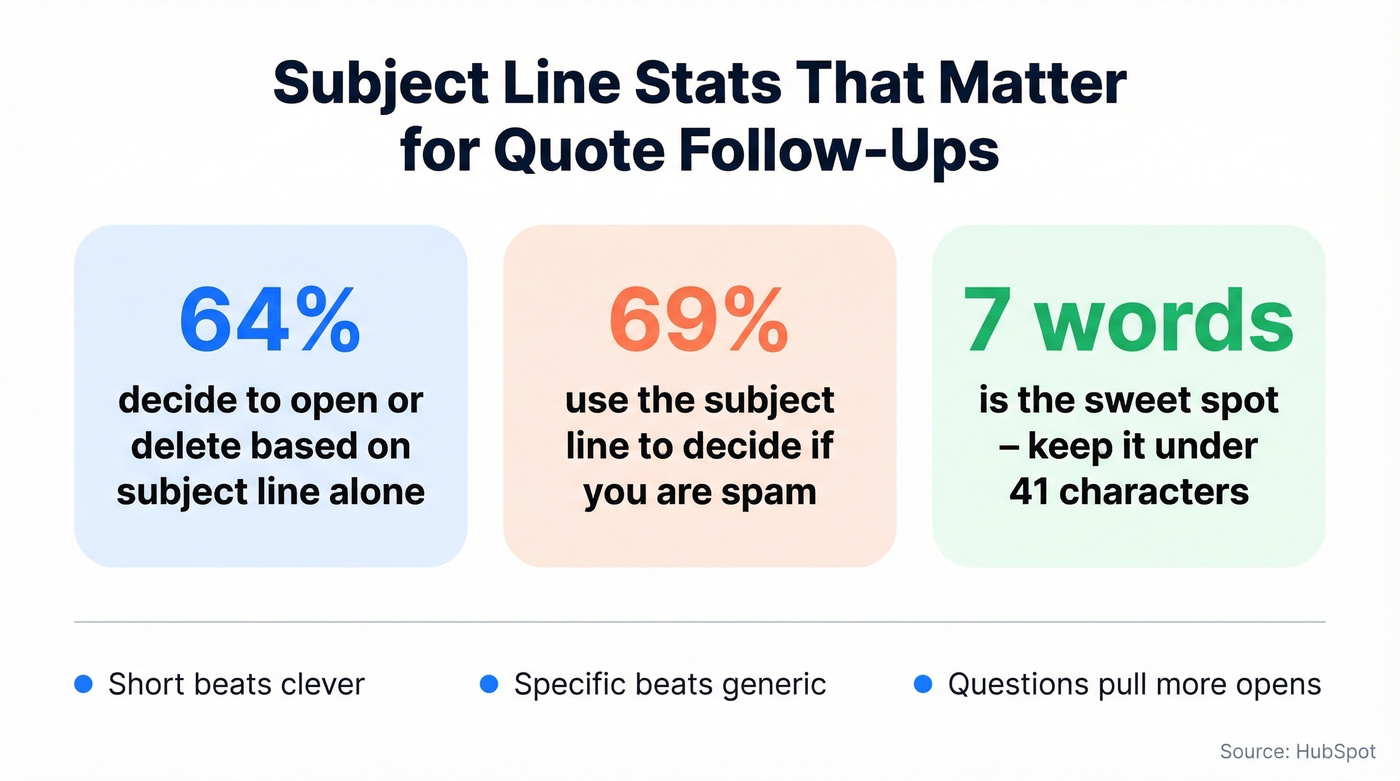
Keep subject lines under 41 characters - seven words is the sweet spot. Here are six A/B pairs to test:
| Test A | Test B | What You're Testing |
|---|---|---|
| Quick question on your quote | Questions on the [Co] quote? | Specific vs. generic |
| Flexible options for [Project] | Can we adjust the scope? | Statement vs. question |
| Your quote expires Friday | Time-sensitive: [Project] quote | Direct vs. urgency label |
| How [Similar Co] handled this | A relevant case study | Social proof framing |
| Should I close this out? | Closing the loop on [Project] | Break-up vs. neutral |
| One thing I forgot to mention | Update on your [Project] quote | Curiosity vs. informational |
Don't overthink subject lines for quote follow-ups. The prospect already knows you. Short, specific, and conversational beats clever every time. (If you want a swipe file, use these email subject line examples.)
The Scope-Down Framework
"Never lower your rate. Adjust scope instead." Non-negotiable if you want to protect your margins long-term.
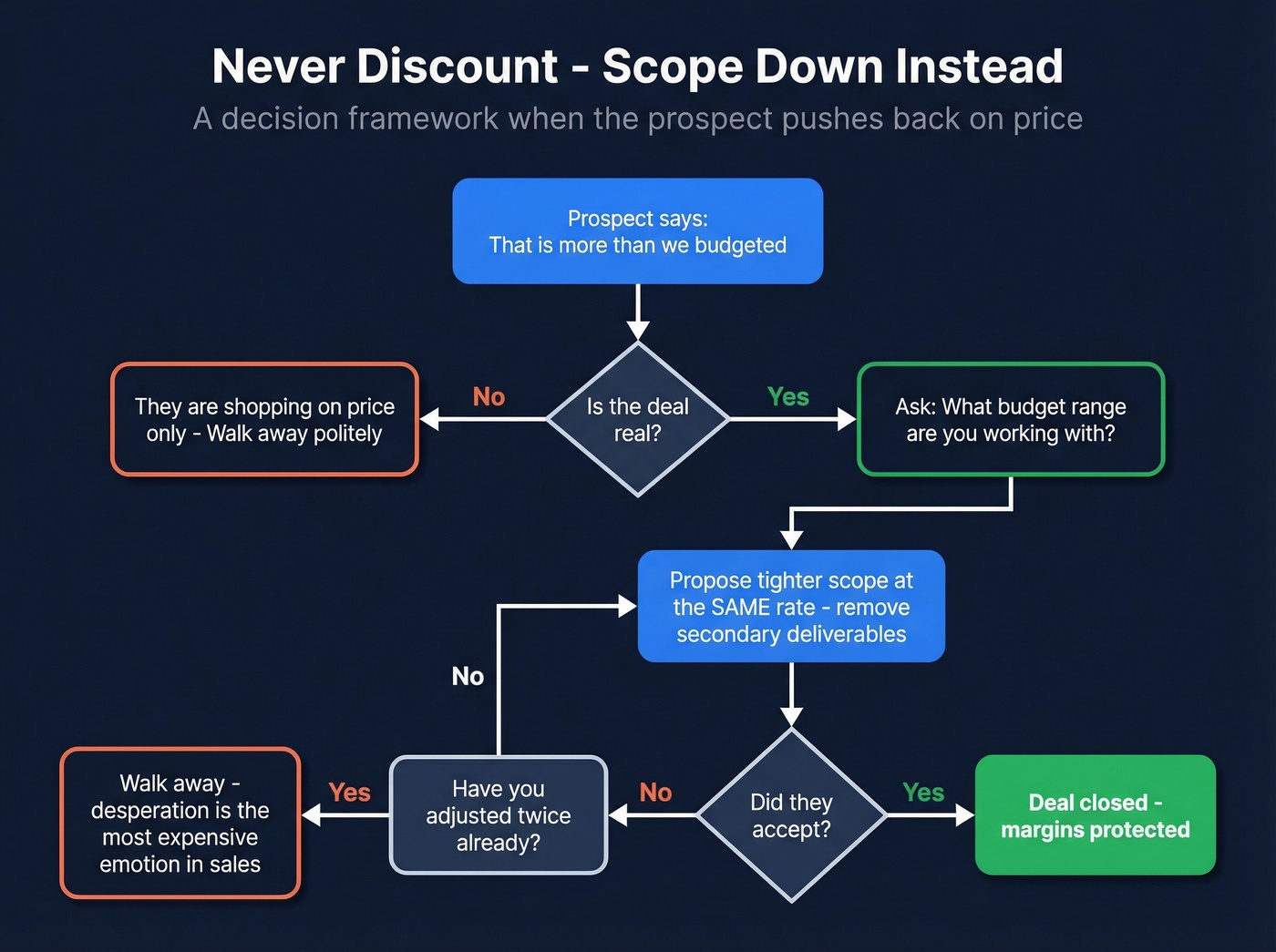
Use scope-down when the prospect says "that's more than we budgeted," asks "can you do it for $X?", or the deal is real but the number doesn't fit. The script is simple: "What budget range are you working with?" Then propose a tighter package at the same rate, as shown in Template #9 above.
Walk away when the prospect is shopping purely on price with no regard for quality, or you've already adjusted twice and they're still pushing.
Look - when they say "we got a lower quote," don't panic. Ask comparison questions: "Does their quote include [specific thing]? What's their revision policy?" Reaffirm your value in one sentence and be willing to walk away politely. Desperation is the most expensive emotion in sales.
Verify the Email Before You Follow Up
Your five-email sequence is worthless if the address is dead. Bounced follow-ups waste your time and hurt sender reputation - a metric that takes months to rebuild. (If you're troubleshooting, start with email bounce rate and email deliverability.)
Before launching any follow-up cadence, run the address through Prospeo's email verification. It catches invalid addresses, spam traps, and honeypots with 98% accuracy on a 7-day data refresh cycle. The free tier gives you 75 verifications per month - more than enough for a pipeline of active quotes. If the contact bounced, use the Email Finder to pull a verified alternative from 143M+ addresses so your carefully crafted templates actually reach someone.
FAQ
How long should I wait before following up on a quote?
Two to three business days. Same-day feels desperate; waiting a full week loses momentum. Day two or three keeps you top of mind without hovering.
How many follow-up emails is too many?
Three to five emails over 14 days is the proven range. Cold outreach data shows 4+ emails triples spam complaints, but you've already had a conversation - lean toward 4-5 touchpoints, each with new information.
What if the client says the price is too high?
Scope down instead of discounting. Ask what budget they're working with, then propose a smaller package at the same rate. Cutting price trains buyers to negotiate harder next time - removing deliverables protects your margins.
How do I follow up without sounding pushy?
Lead with new value in every message. Each email should include fresh information - a case study, a timeline reminder, or a scope adjustment - rather than simply asking "any update?" When every touchpoint earns its place, prospects read instead of ignoring.
When your quote follow-up goes unanswered, the problem might not be your copy - it might be a wrong contact. Prospeo gives you 300M+ verified profiles with direct emails and mobile numbers so you can pick up the phone when email goes silent.
Get the direct dial and skip the inbox silence entirely.