

Relationship Selling Definition: What It Actually Means (and When It Works)
96% of prospective customers do their own research before speaking with a sales professional. Meanwhile, 45% of sales professionals feel overwhelmed by the sheer number of tools in their tech stack. Buyers are self-educating. Sellers are drowning in software. The human relationship is the last real differentiator in B2B sales - but most teams get the relationship selling definition wrong, and doing it wrong is worse than not doing it at all.
What Is Relationship Selling?
Relationship selling is a sales approach focused on building and maintaining long-term relationships with profitable customers rather than optimizing for a single transaction. It evolved as a deliberate shift away from forceful, close-at-all-costs techniques toward customer orientation and mutual value - what many practitioners now call the relational selling approach.
A ResearchGate paper comparing relationship selling and the Challenger approach identifies five trust components that underpin durable sales relationships: customer orientation, honesty, dependability, competence, and compatibility. Notice "being likable" isn't on the list. This isn't about becoming your prospect's buddy. It's about earning trust through consistent, competent behavior over time, which requires genuine emotional intelligence - reading a room, adapting your communication style, knowing when to push and when to shut up and listen.
Relationship vs. Transactional vs. Consultative vs. Challenger
These four approaches get conflated constantly. Let's break them down.
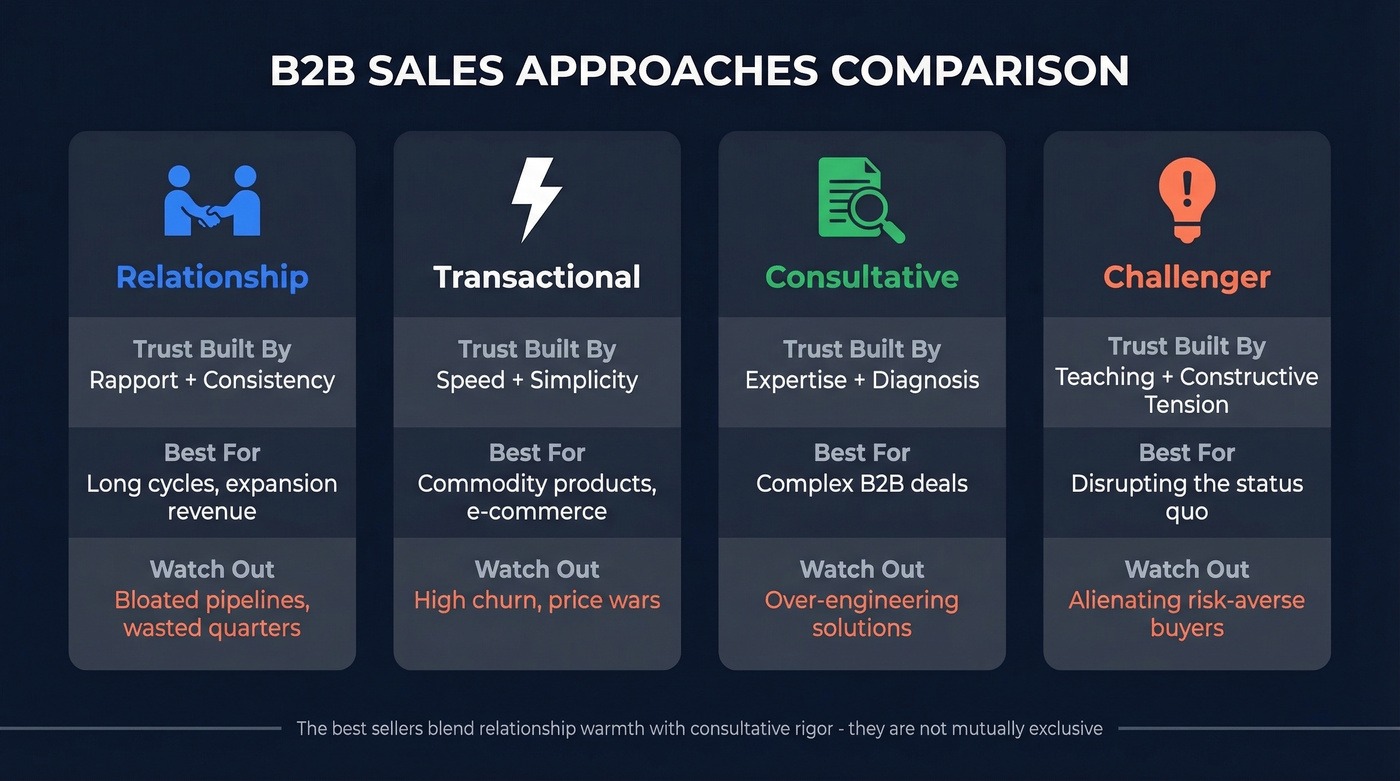
| Approach | How Trust Is Built | Best For | Watch Out For |
|---|---|---|---|
| Relationship | Rapport + consistency | Long cycles, expansion | Bloated pipelines |
| Transactional | Speed + simplicity | Commodity, e-commerce | Churn, price wars |
| Consultative | Expertise + diagnosis | Complex B2B | Over-engineering |
| Challenger | Teaching + tension | Status-quo disruption | Alienating buyers |
Here's the thing: the Challenger Sale didn't kill relationship selling. It exposed lazy relationship selling - reps who built rapport without delivering a single useful insight. The listening gap is real, too. Sales Hacker call data found the average rep talks 75% of the time while prospects talk just 25%. The best sellers blend relationship warmth with consultative rigor. If you want a structured alternative that avoids the "soft" pitfalls, the Sandler methodology is worth a look.
When to Use It (and When Not To)
Relationship selling isn't universal. It's a high-investment strategy that pays off when sales cycles run longer than 30 days, deal sizes exceed five figures, multiple stakeholders influence the decision, and revenue depends on expansion and renewals. When switching costs are high for the buyer, this approach is your strongest play.
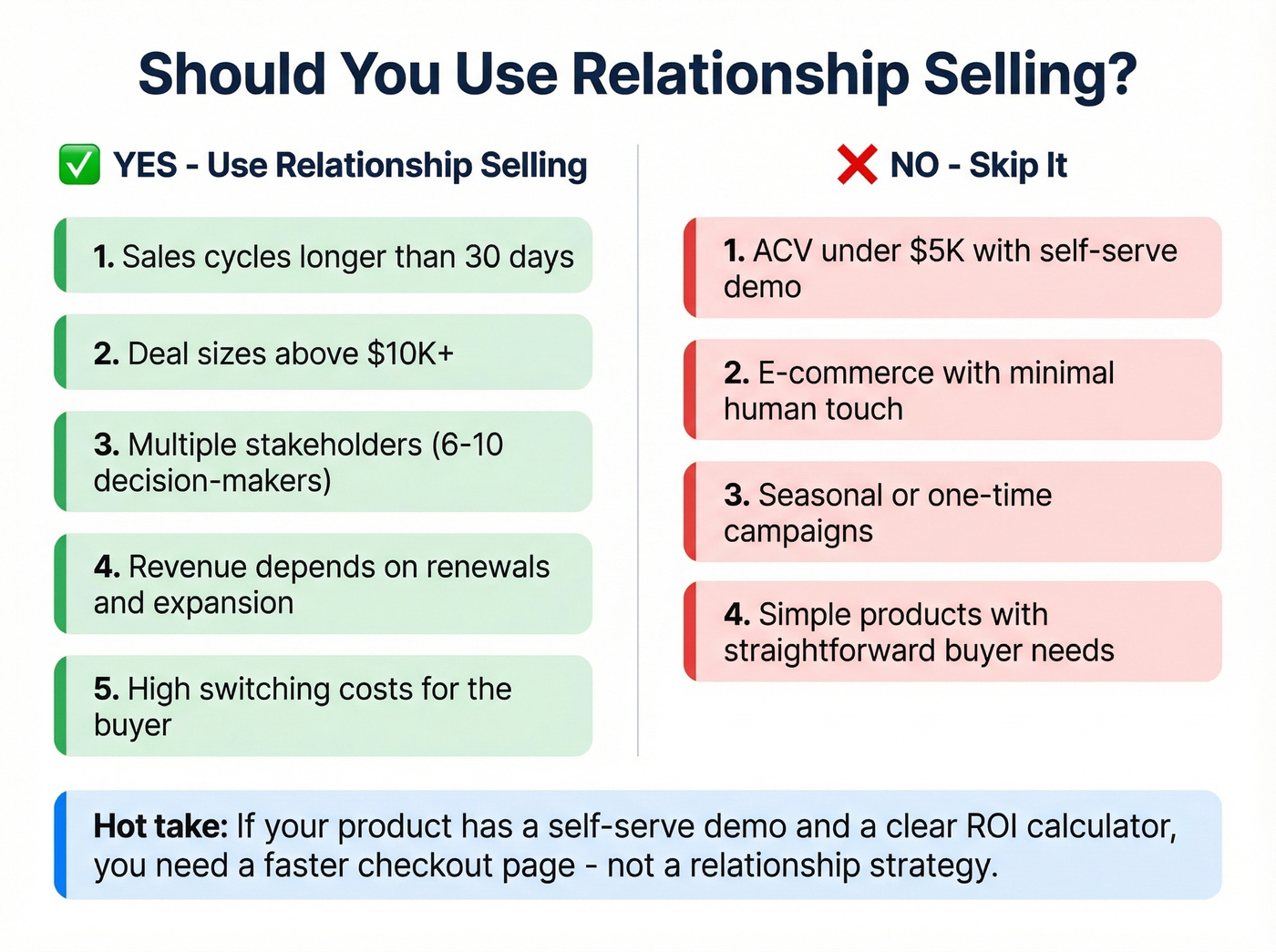
Hot take: If your average contract value is under $5K and your product has a self-serve demo, you probably don't need relationship selling. You need a faster checkout page.
Skip it for standardized SaaS with clear self-serve ROI, e-commerce with minimal touch, seasonal campaigns, or small businesses with straightforward needs and limited budgets. One important boundary worth stating plainly: relationship selling never means becoming a personal therapist or erasing professional lines. The best relationship sellers know exactly where business rapport ends and inappropriate familiarity begins.

You just read that the average B2B deal involves 6-10 decision-makers. Prospeo's database gives you 30+ filters - including department headcount, job changes, and buyer intent - so you can map every stakeholder before you invest relationship capital. 300M+ profiles, 98% email accuracy, verified mobiles.
Stop building relationships with people who can't sign the check.
The 5-Step Framework for Relationship Selling
1. Qualify Ruthlessly
Relationship selling isn't an excuse to skip lead qualification. We've seen teams waste entire quarters nurturing "great relationships" with companies that were never going to buy - warm conversations that felt productive but led absolutely nowhere. Failing to qualify leads early is one of the most expensive mistakes in sales.
If you want a more systematic way to do it, start with an Ideal Customer Profile and a clear lead scoring model.
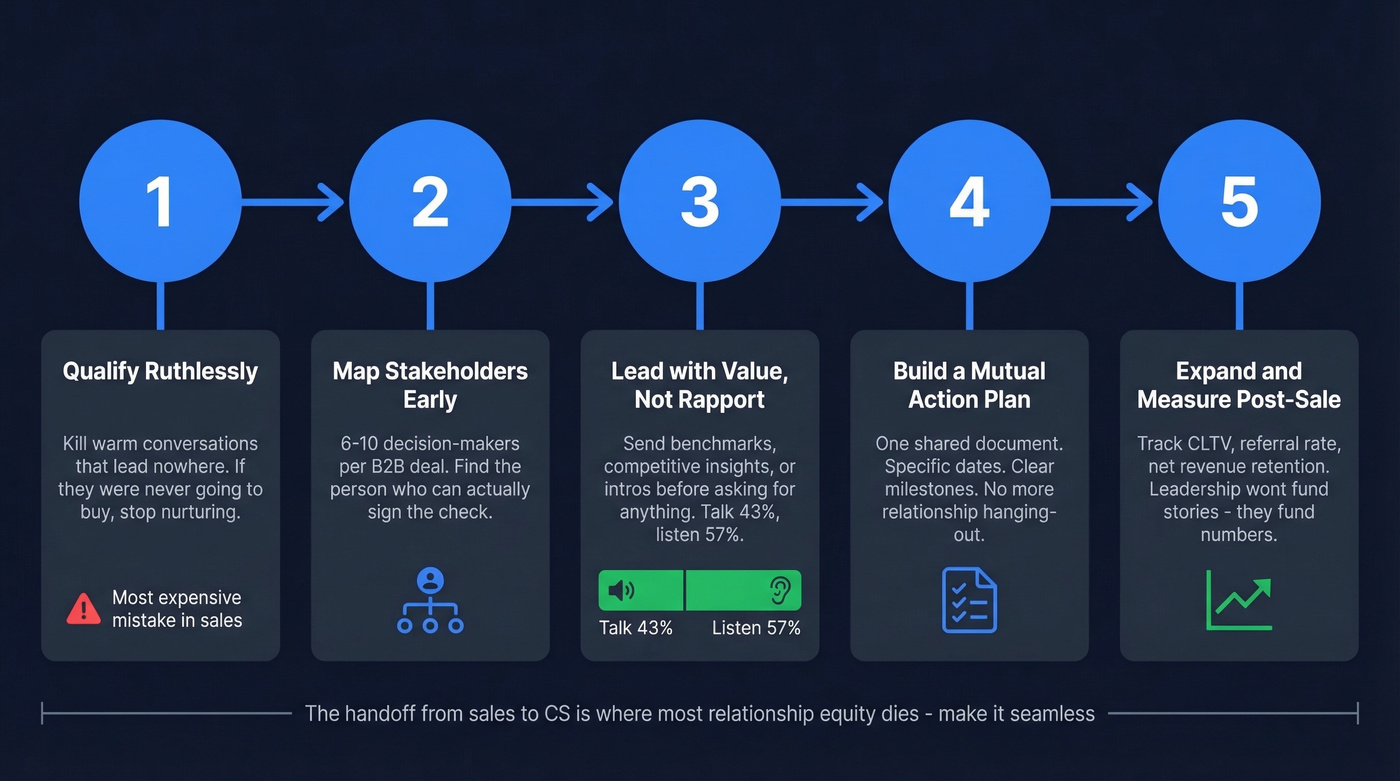
2. Map Stakeholders Early
The average B2B deal involves 6-10 decision-makers. Talking to the wrong one is how reps burn months building trust with someone who can't sign a check. Identify the actual decision-makers and influencers before you invest relationship capital. This sounds obvious, but I've watched experienced reps make this mistake repeatedly because they liked the person they were talking to.
This is also where account-based selling and team selling tend to outperform lone-wolf outreach.
3. Lead with Value, Not Rapport
Send something useful before asking for anything - a relevant benchmark, a competitive insight, an intro to someone in your network. Aim for roughly 43% talking and 57% listening. Reps who dominate conversations don't build relationships. They build resentment.
If you need ideas for what to send, borrow from proven sales follow-up templates and tighten your sales communication.
4. Build a Mutual Action Plan
Formalize the relationship into a shared timeline with clear milestones so "nice conversations" actually convert. One document. Shared ownership. Specific dates. Without this, relationship selling degrades into relationship hanging-out.
If your process is messy, it’s usually a sales pipeline challenges problem more than a “relationship” problem.
5. Expand and Measure Post-Sale
The relationship doesn't end at close. In our experience, the handoff from sales to CS is where most relationship equity evaporates - it shouldn't feel like starting over with a stranger. Track customer lifetime value, referral rate, and net revenue retention to prove ROI to leadership. Without those numbers, you're just telling stories about how much your clients like you, and leadership won't fund stories for long. Teams that master these post-sale stages consistently outperform those that treat everything after the signature as an afterthought.
To keep expansion predictable, monitor renewal rate and run a tighter churn analysis.
One Win, One Loss
A sales manager on r/sales shared a tactic that perfectly illustrates genuine relationship selling. The team identified dormant accounts that had previously done significant business. Reps learned personal details - pets, kids, favorite sports teams - then sent handwritten cards and dog bones to customers who had dogs. The explicit rule: don't mention anything about business. Those accounts reactivated and became some of their largest.
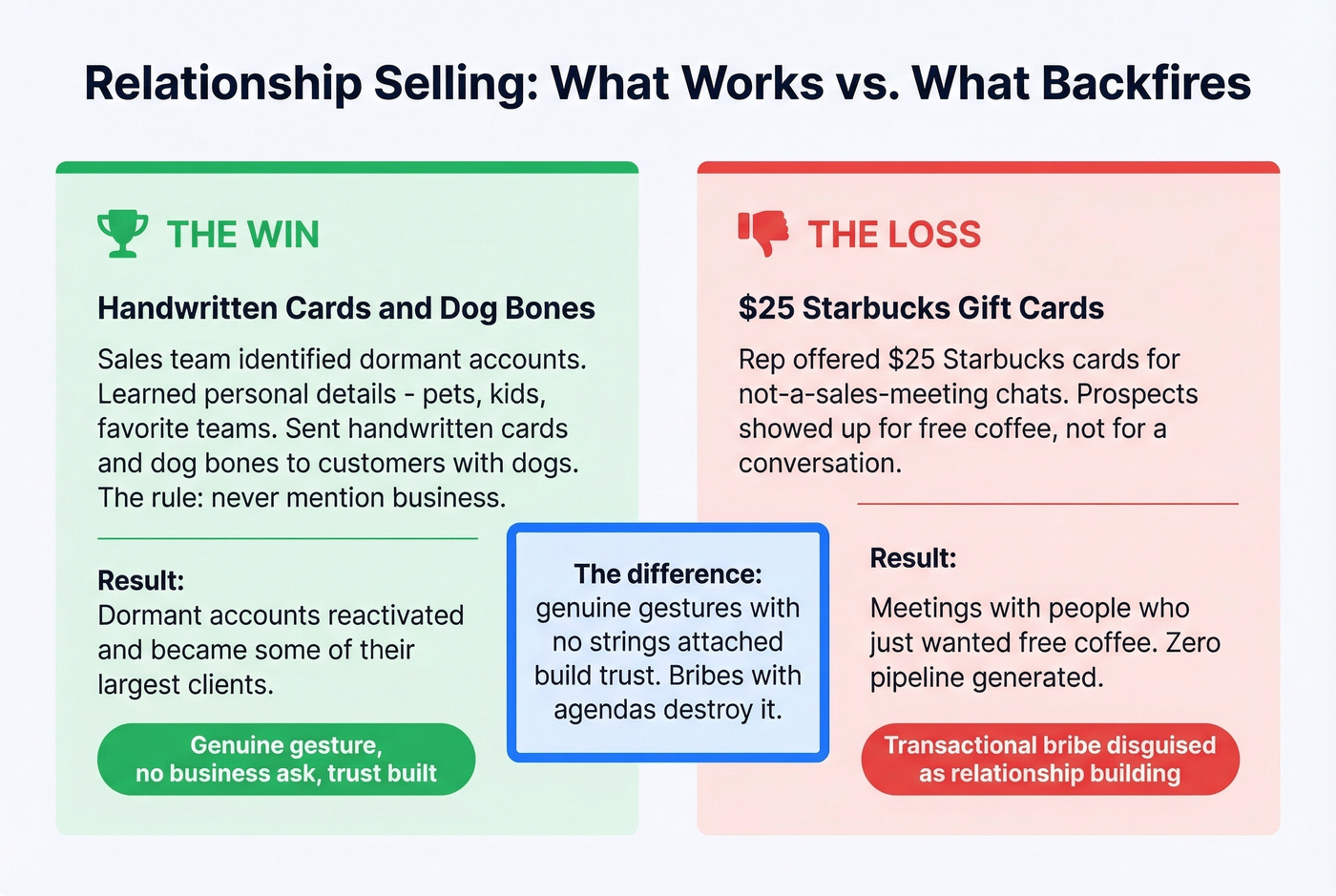
Now contrast that with a counter-example from another r/sales thread. A rep offered $25 Starbucks gift cards for "not-a-sales-meeting" chats. The result? Meetings with people who just wanted free coffee. Prospects aren't stupid. Genuine gestures with no business ask build trust. Transactional bribes disguised as relationship-building destroy it.
Tools That Support Trust-Based Selling
Look, relationship selling fails when your first email bounces or your call hits a dead number. Data quality is the invisible foundation - you can't build trust with someone you can't reach.

Your CRM is the relationship-tracking layer. But before you can track a relationship, you need accurate contact data to start one. Prospeo handles that piece with 98% email accuracy across 300M+ professional profiles and a 7-day data refresh cycle that keeps contacts current. The free tier lets you test it without a contract or a sales call - just sign up and go. Before you invest in rapport-building sequences, make sure your first message actually arrives.
If you’re auditing your stack, compare contact management software options and fix email bounce rate issues before scaling outreach.
Relationship selling fails the moment your first email bounces or your call hits a dead number. Prospeo's 5-step verification and 7-day data refresh cycle mean you're reaching real people at current roles - not ghosts from a stale database. Teams using Prospeo see bounce rates drop below 4%.
Build trust with buyers, not bounce reports.
FAQ
Is relationship selling dead in 2026?
No - but lazy relationship selling is. With 96% of buyers researching independently, the bar for genuine value-add is higher than it's ever been. Reps who combine relationship warmth with consultative rigor outperform both pure relationship sellers and pure challengers.
What's the difference between relationship and consultative selling?
Relationship selling builds trust through rapport and personal connection over time. Consultative selling builds trust through expertise and diagnosis. The best reps blend both - use consultative methods for complex B2B deals, then layer relational selling on top for retention and expansion.
How do you measure relationship selling success?
Track customer lifetime value, referral rate, net revenue retention, and NPS. These metrics separate reps who build real relationships from reps who just have long sales cycles. If your CLTV isn't climbing year over year, the relationships aren't translating to revenue.
Can relationship selling work in competitive markets?
Absolutely. In crowded markets where features and pricing converge, trust becomes a durable edge that competitors can't easily replicate. Buyers choose vendors they trust when everything else looks similar - and that trust compounds over time through renewals, upsells, and referrals.