

Revenue Management Strategy: Optimize Profit Across Every Vertical in 2026
A hotel sells out every weekend in July at $189/night - and the revenue manager gets congratulated. Meanwhile, the property down the road runs at 80% occupancy, charges $260 direct, and clears twice the gross operating profit. Most teams treat their revenue management strategy like a pricing trick. It's not. It's a profit discipline, and the gap between teams that get this and teams that don't is widening fast.
What You Need (Quick Version)
Three things separate teams that optimize profit from teams that optimize dashboards:
1. Measure profit, not volume. Track GOPPAR or net revenue retention - not occupancy, not top-line MRR. Every metric that ignores acquisition cost and margin is lying to you.
2. Fix your data before you fix your pricing. Bad inputs poison every downstream decision. If your forecasting model runs on stale competitor rates, outdated booking patterns, or bounced email lists, the output is fiction. (If you’re in B2B, start with data quality and data cleansing.)
3. Pick 3-4 strategies from this guide, implement them using the 4-pillar framework at the end, and measure results monthly. Don't try to overhaul everything at once. Sequence matters.
What Revenue Management Actually Means
Revenue management is the disciplined use of data analytics to maximize profitability - predicting customer behavior at micro-market levels and adjusting pricing, availability, and distribution accordingly. It's not yield management, which focuses narrowly on perishable inventory pricing (airline seats, hotel rooms on a specific night). The discipline is broader: it spans pricing, channel mix, customer segmentation, inventory and availability controls, forecasting, and profit optimization across every revenue stream a business touches, from hotel F&B and spa to SaaS expansion seats to CPG pack-price architecture.
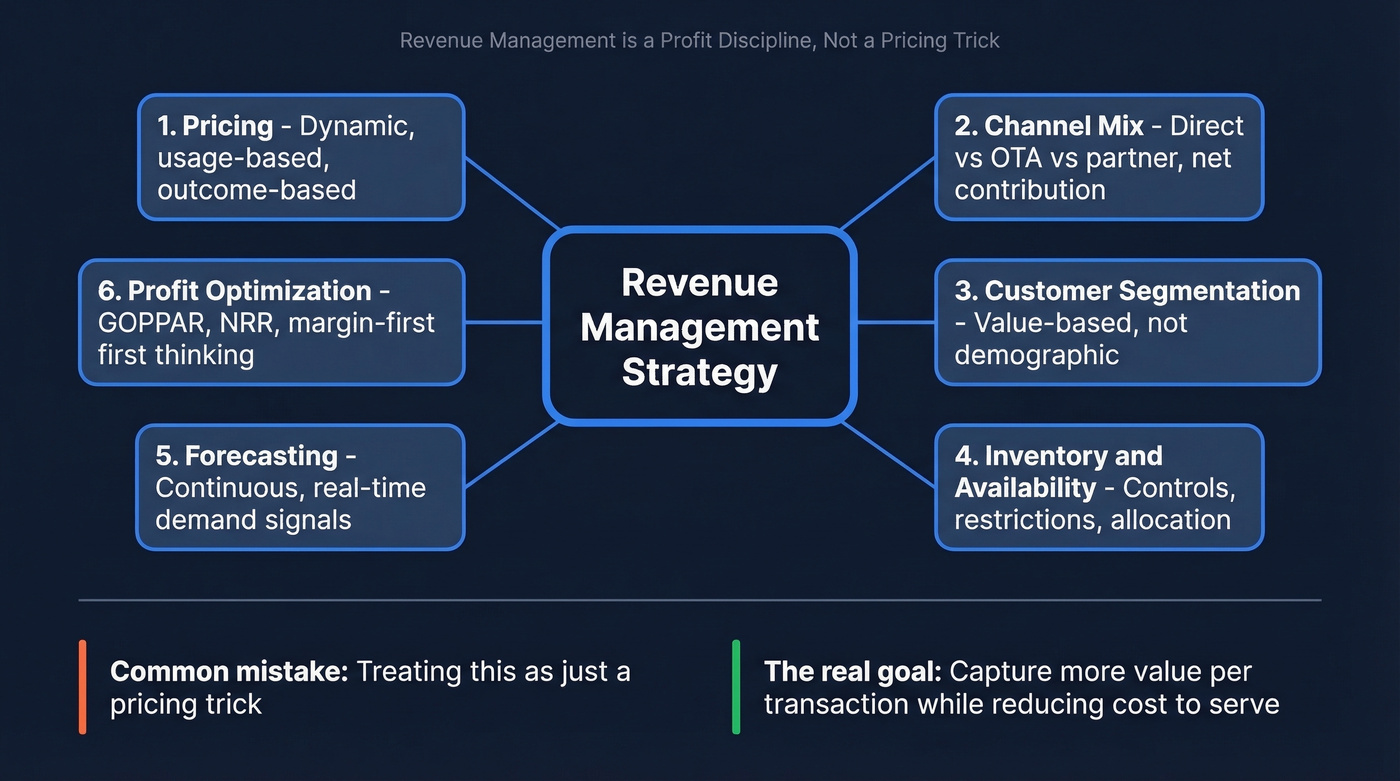
Here's the part most guides skip: revenue management is also a risk management discipline. It's not just about maximizing upside on peak nights or high-demand periods. It's about protecting against downside - managing cancellation risk, hedging against demand shortfalls, and building pricing structures that maintain margin even when conditions deteriorate. The best revenue managers think in expected value across scenarios, not just "what's the highest rate we can charge tonight."
The reframe that matters for your team: this isn't about charging more. It's about capturing more value from every transaction while reducing the cost to acquire and serve each customer (see customer acquisition cost and CAC LTV Ratio).
Why It Matters More in 2026
Three forces are converging to make disciplined revenue optimization non-optional.
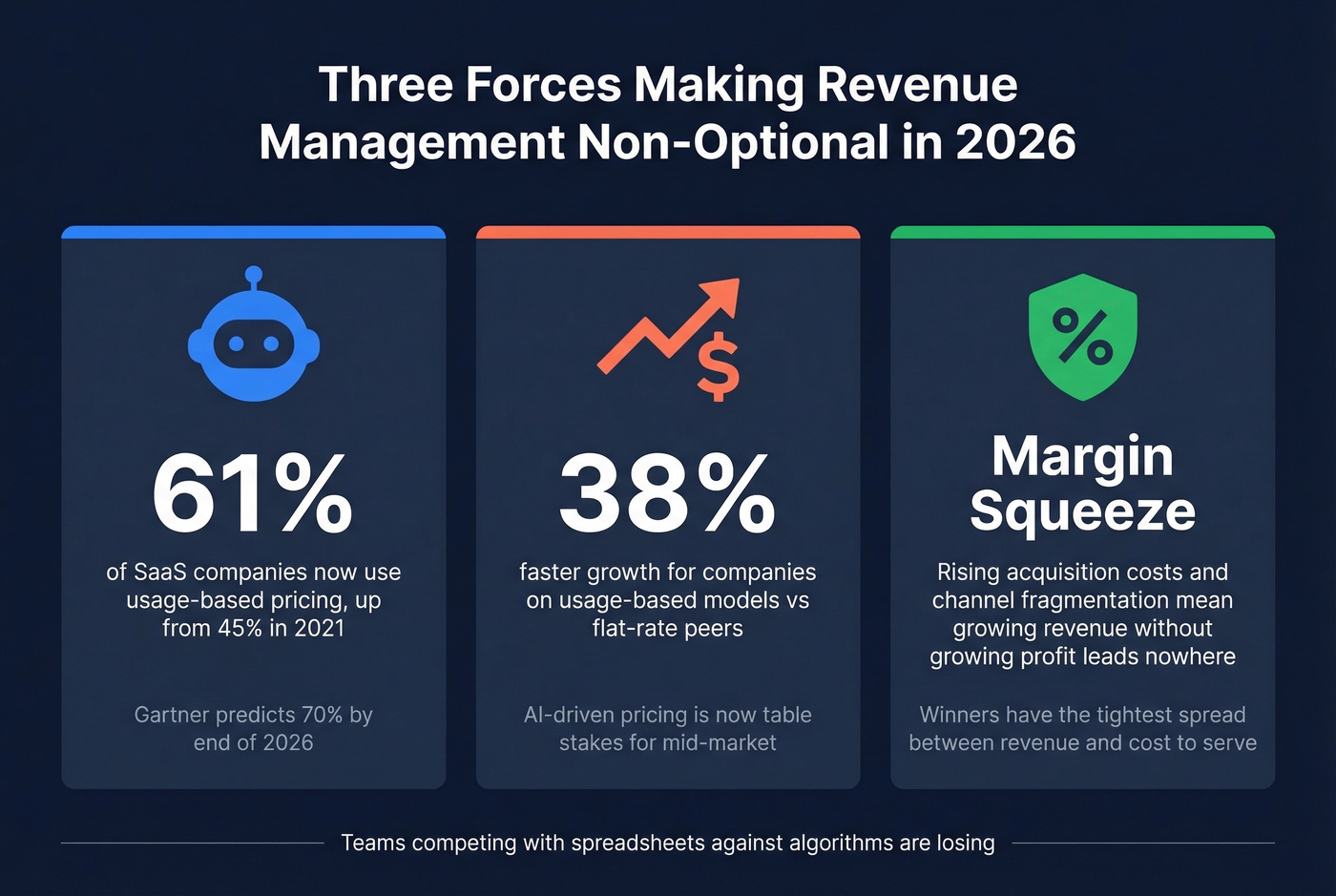
AI-driven pricing is table stakes now. Churn prediction, automated billing adjustments, and dynamic rate recommendations are standard for mid-market companies, not just enterprise. Teams that don't adopt these tools are competing against algorithms with spreadsheets. That's not a fair fight. (If you’re tightening retention, start with churn prediction.)
Pricing models are shifting underneath everyone. Across the SaaS market, usage-based pricing adoption is now cited at 61%, up from 45% in 2021. Gartner predicts 70% of businesses will prefer usage-based models by 2026. That's a structural change in how revenue gets recognized, forecasted, and optimized.
Margin pressure is relentless. Inflation, rising acquisition costs, and channel fragmentation mean that growing revenue without growing profit is a path to nowhere. The companies winning in 2026 aren't the ones with the highest top line - they're the ones with the tightest spread between revenue and cost to serve.
8 Strategies That Drive Profit
1. Optimize for Profit, Not Revenue
Picture two hotels in the same market. Hotel A runs 95% occupancy, mostly through OTAs charging 18-22% commission. Hotel B runs 80% occupancy with 60% direct bookings. Hotel B clears more gross operating profit per available room - every time.
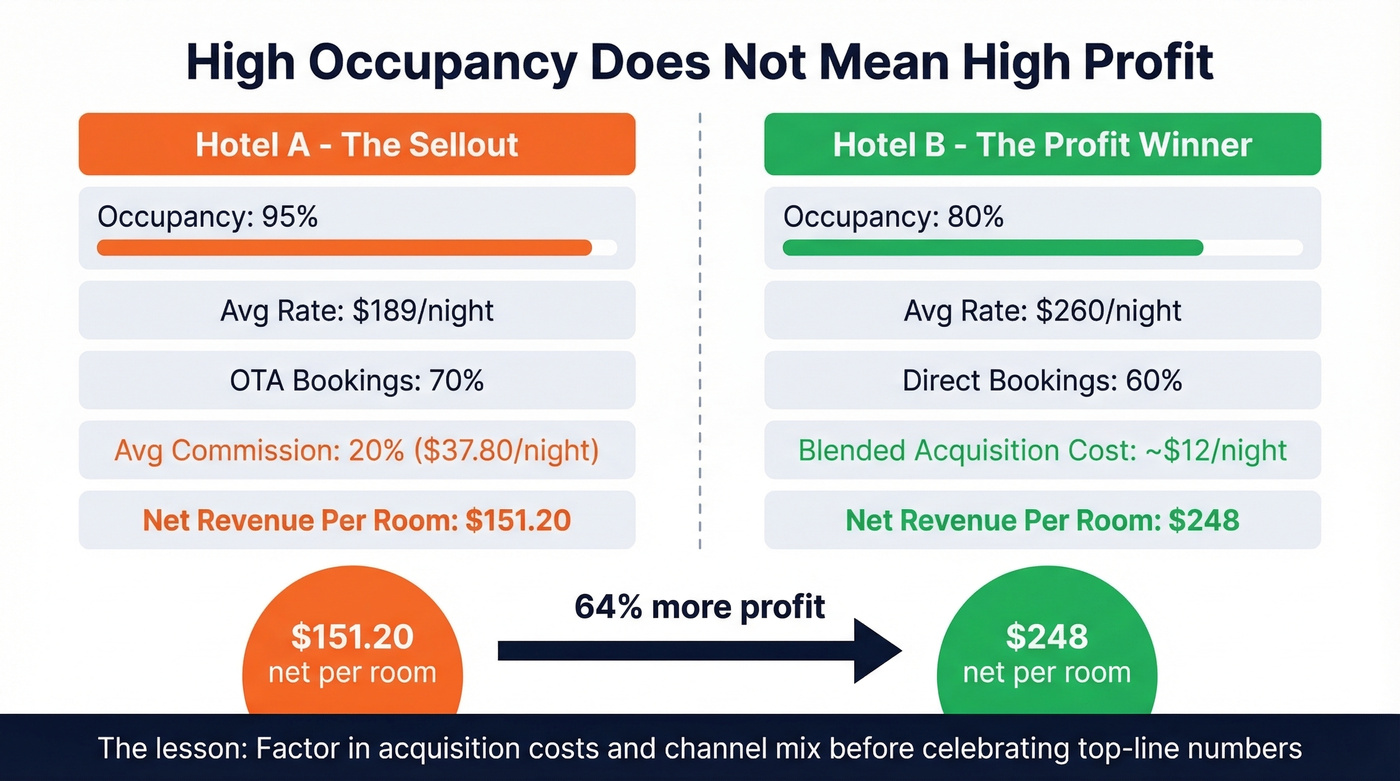
In SaaS, a customer acquired through a $500 paid campaign who churns in 3 months is worth less than an organic signup who expands over 18 months. The shift is from revenue generation to profit optimization. Factor in acquisition costs, operational efficiency, and gross operating profit before celebrating top-line numbers.
2. Dynamic Pricing With Real Inputs
Dynamic pricing algorithms process four core inputs: current occupancy or utilization, competitor rates, demand trends (events, holidays, seasonality), and booking patterns (pace, lead time, cancellation rates). The problem isn't the algorithms - it's teams feeding them garbage.
Hotels implementing a modern revenue management system typically see a 15-20% lift in RevPAR. But that lift evaporates if the inputs are stale. Compset rate-chasing is particularly dangerous - you don't know their inventory position, their strategy, or their cost structure. Your own booking, cancellation, and pickup signals are real market feedback. Competitor pricing is mostly guessing.
3. Segment by Value, Not Demographics
"One price strategy for all guests" is one of the most common revenue management mistakes, and it causes overselling discounts to premium segments or underselling value to price-sensitive ones. The fix: segment by total customer value (use an ICP framework if you’re doing this in B2B).
For hospitality, that means factoring in breakfast spend, spa usage, loyalty status, meeting room bookings, and ancillary revenue - not just room rate. For SaaS, it means tracking expansion revenue, feature adoption depth, and CLTV rather than just the initial contract value. A $500/month customer who expands to $2,000 over 18 months is worth more than a $1,200/month customer who churns at renewal. Understanding incremental sales - the additional revenue generated above what would have occurred without a specific action - helps you quantify whether a promotion actually moved the needle or just shifted demand you would've captured anyway.
4. Channel Mix Optimization
Use OTAs when you need to fill distressed inventory, enter a new market, or use their demand data for forecasting. Skip OTAs when you're displacing direct bookings that would've happened anyway, or when commission rates eat your margin on already-thin rate plans.
The concept that matters here is net contribution - what each channel actually delivers after acquisition costs. A direct booking at $200 with a $5 acquisition cost beats an OTA booking at $220 with a $44 commission. When OTAs drive your commercial decisions, acquisition costs climb without any corresponding improvement in profitability.
5. Data Unification as a Revenue Lever
Samsoe Samsoe, the Danish fashion brand, boosted average purchases by 24.6% after unifying loyalty data with ecommerce and in-store sales. The mechanism was straightforward: a single customer view enabled personalized experiences that fragmented data couldn't support. No new products, no price changes - just better data architecture.
The "single source of truth" principle applies everywhere. Hotels need PMS, RMS, CRM, and BI talking to each other. SaaS companies need billing, product analytics, and CRM unified. When your revenue team can't see the full customer picture, they're optimizing blind.
6. Continuous Forecasting
Static forecasting is dead. The teams still building quarterly forecasts and treating them as fixed are getting outmaneuvered by competitors who monitor demand signals continuously and adjust in real time. Weather shifts, event cancellations, airline capacity changes, competitor promotions - any of these can reshape demand within days.
Here's the thing: missing a key booking window by even one day can sink a promotion. A roughly right forecast updated daily beats a perfectly modeled forecast updated quarterly. Speed matters more than precision. (If you’re evaluating stacks, compare revenue forecasting tools.)
7. Usage-Based and Outcome-Based Pricing
The hybrid model - combining a base subscription with usage components - is projected to reach 61% adoption, up from 43%. Companies on usage-based models grow 38% faster than peers on flat-rate plans.
Outcome-based pricing is the next frontier. Intercom charges $0.99 per resolution. Zendesk charges $1.50-$2.00 per resolution. Gartner forecasts 40% of enterprise SaaS will include outcome-based elements by 2026. If your pricing doesn't reflect the value your product actually delivers, you're leaving expansion revenue on the table. (More on SaaS packaging in pricing for SaaS.)
8. Data Quality as a Revenue Discipline
Bad data leads to bad forecasts, which lead to bad pricing, which leads to lost revenue. The chain is that direct, and it applies to every vertical. In B2B, the damage compounds faster because bad data doesn't just produce wrong forecasts - it actively destroys your ability to execute. A 35% email bounce rate doesn't just mean missed contacts. It means damaged sender reputation, blacklisted domains, and a pipeline that collapses from the top (see email sender reputation).
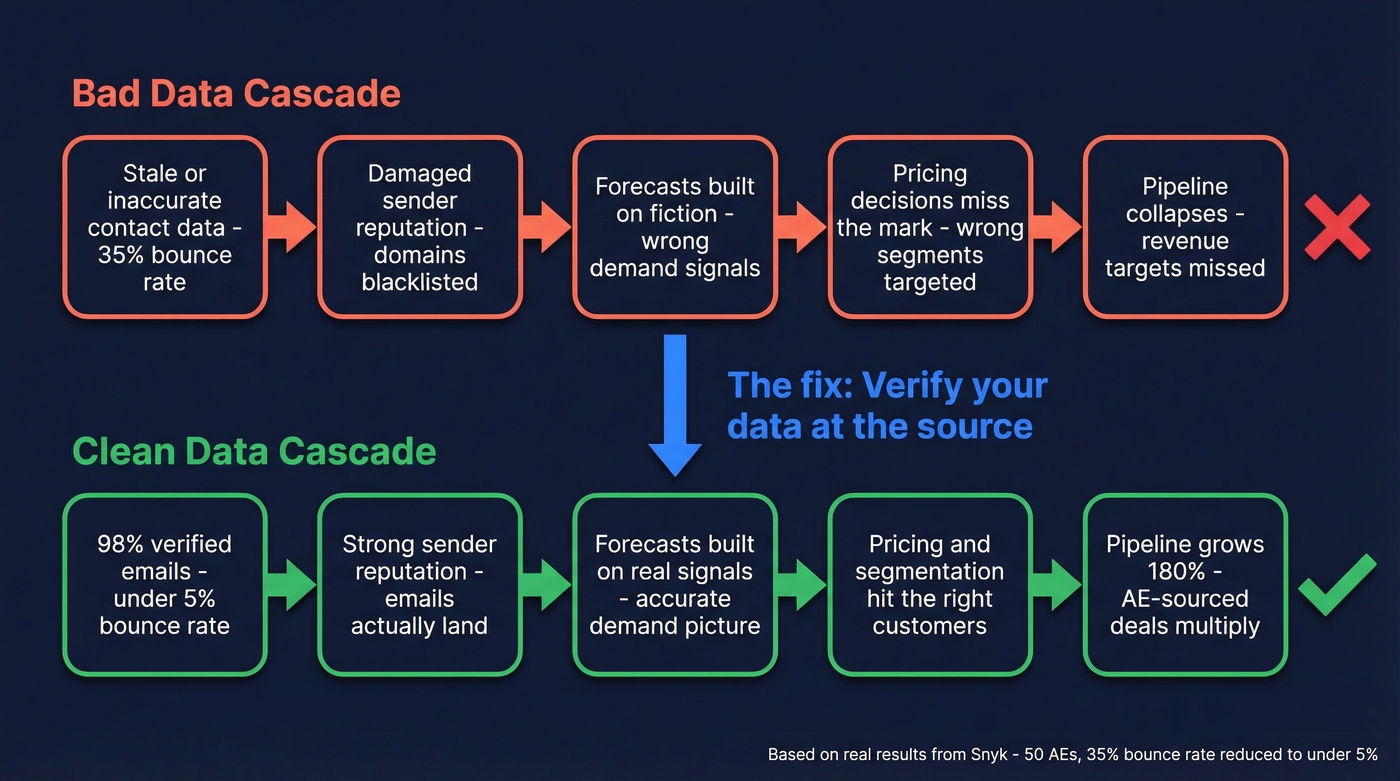
We've seen this play out with teams that switched to Prospeo. Snyk's 50-person AE team went from a 35-40% bounce rate to under 5%, and AE-sourced pipeline jumped 180%. That's not a messaging win - it's a data quality win. When 98% of your emails actually land, every downstream metric improves.


You just read it: bad inputs poison every downstream decision. Stale contact data means your revenue team optimizes blind. Prospeo delivers 98% email accuracy on 300M+ profiles with a 7-day refresh cycle - so your forecasting, segmentation, and outreach run on real signals, not fiction.
Stop feeding your revenue engine garbage data.
7 Mistakes Costing You Money
1. Celebrating sellouts. Selling out too early, at the wrong price, or to the wrong segment displaces higher-value demand. A sellout is only a win if you couldn't have captured more profit by holding inventory.
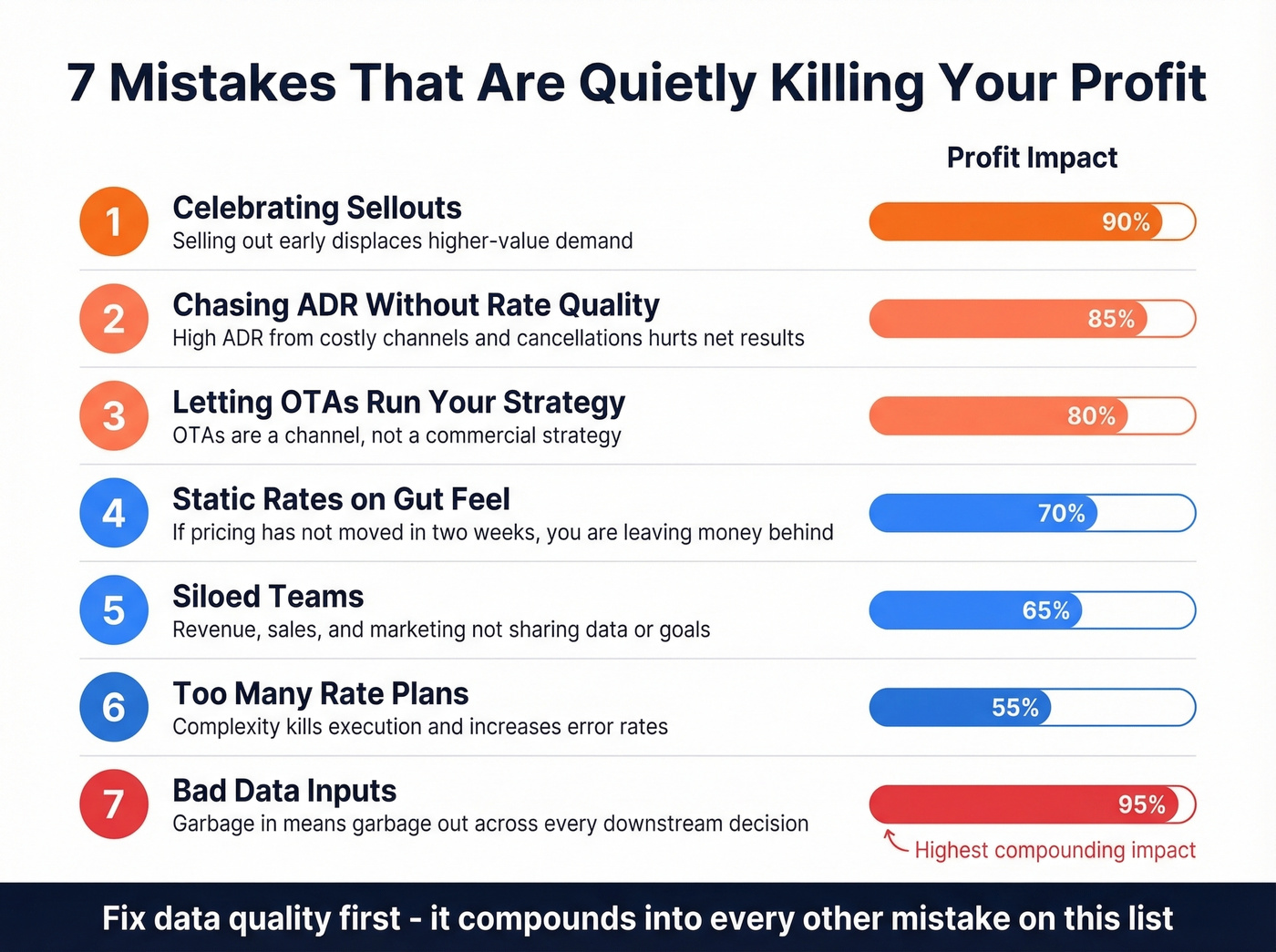
2. Chasing ADR without rate quality. A higher average daily rate driven by short stays, costly channels, or high cancellation risk hurts net results. Track net revenue per available room, not headline ADR.
3. Letting OTAs run your strategy. OTAs are a distribution channel, not a commercial strategy. Accepting OTA promotions while offering lower rates on higher-cost channels than direct is margin suicide.
4. Static rates on gut feel. Rates should change frequently to reflect real supply and demand signals. If your pricing hasn't moved in two weeks, you're leaving money on the table. When you do adjust, protect rate integrity through value-adds - flexibility, inclusions, small upgrades - rather than straight discounting. Discounts train customers to wait.
5. Siloed teams. When revenue, sales, and marketing don't share data or goals, you get conflicting promotions, misaligned incentives, and missed cross-sell opportunities. Alignment isn't a nice-to-have - it's a core revenue lever.
6. Too many rate plans. Complexity kills execution. Every additional rate plan, restriction, or rule creates operational overhead and increases the chance of errors. Simplicity is a competitive advantage.
7. Ignoring data quality. Every strategy above depends on accurate, fresh data. If your CRM is full of stale contacts, your forecasting model runs on outdated inputs, or your outbound emails bounce at 20%+, nothing downstream works.
Revenue Management KPIs Worth Tracking
Hospitality KPIs
Forget RevPAR and ADR as standalone metrics - they don't account for acquisition costs or operational expenses.
| KPI | Formula | Why It Matters |
|---|---|---|
| NRevPAR | Net room rev / rooms available | Strips out commissions |
| GOPPAR | Gross operating profit / rooms available | True bottom-line metric |
| TRevPAR | Total rev / rooms available | Captures ancillary spend |
GOPPAR is the metric that tells you whether your revenue management strategy is actually working. A hotel with lower occupancy but higher GOPPAR is outperforming one that fills every room at thin margins.
SaaS KPIs
MRR and ARR are table stakes. The metrics that separate good revenue management from great:
CLTV equals average monthly revenue per customer divided by monthly churn rate. Net revenue retention matters more than gross retention because it captures expansion. Customer churn benchmarks run 5-10% monthly for early-stage and 2-5% for mature SaaS. If you're above those ranges, fix retention before optimizing acquisition. (If you want the deeper breakdown, see net revenue retention and churn rate formula.)
Ecommerce & B2B KPIs
Ecommerce teams should obsess over average order value, cart abandonment rate (48% of carts are abandoned due to excess shipping fees and taxes surfaced late in checkout), and return rate. Each represents a revenue leak that pricing strategy alone can't fix.
For B2B, pipeline velocity, conversion rate by stage, bounce rate on outbound, and cost per qualified lead connect data quality to revenue outcomes. A 5% improvement in email deliverability cascades into measurably more pipeline within a single quarter.
Tools by Industry
Let's be honest: most mid-market teams don't need an enterprise revenue management platform. They need clean data, a pricing framework, and a monthly review cadence. The tool matters less than the discipline. That said, the right tool accelerates everything.
| Tool | Best For | Starting Price | Key Differentiator |
|---|---|---|---|
| Prospeo | B2B data quality | Free, ~$0.01/email | 98% accuracy, 7-day refresh |
| RoomPriceGenie | Small/mid hotels | ~$150-500/mo | One-click recs, PMS integrations |
| Duetto | Enterprise hotels | ~$1K-5K+/mo | Open pricing by segment/channel |
| IDeaS | Enterprise hotels | ~$500-2K+/mo | AI optimization, total revenue mgmt |
| Atomize | Mid-market hotels | ~$300-800/mo | Segmentation, competitor intel |
| Paddle | SaaS billing | 5% + $0.50/txn | All-in-one payments + tax |
| Chargebee | SaaS subscriptions | From $7,188/year | Flexible subscription + usage |
| Maxio | SaaS finance | From $599/mo | Deep SaaS financial analytics |
| Prisync | Ecommerce pricing | From $99/mo | Competitor price tracking |
| Zuora | Subscription billing | Not public | Enterprise subscription orchestration |
For hospitality, RoomPriceGenie is the obvious pick for independent hotels that don't need enterprise complexity. We've seen small hotel teams get more value from RoomPriceGenie in a week than enterprise teams get from IDeaS in a quarter - it's that intuitive. Duetto and IDeaS serve larger portfolios where segment-level and channel-level pricing optimization justifies the investment.
On the SaaS side, Paddle handles the full billing stack while Chargebee gives you more flexibility for hybrid pricing models. Maxio is the pick if your CFO cares more about SaaS financial reporting than billing mechanics.
Skip Zuora unless you're running complex subscription models across multiple product lines. For most teams, it's overkill.
Building Your Revenue Engine: A 4-Pillar Framework
Before you buy a single tool, evaluate readiness across four pillars.
Technology. Can your PMS, CRM, or billing platform share data with a revenue management tool? Are you running integrations or manual exports? If your tech stack can't talk to itself, no RMS will save you.
Data. Is your customer and transaction data clean, unified, and fresh? Can you trust the numbers your team sees every morning? If the answer is "mostly," start here. Map your end-to-end customer lifecycle and identify where data breaks down. What's your email bounce rate on outbound? What percentage of CRM records were updated in the last 90 days? (If outbound is part of your motion, pair this with email address verification.)
Process. Do you have a defined pricing review cadence? Who owns rate changes, and how fast can they execute? Revenue management isn't a one-time project - it's an ongoing discipline that requires clear workflows and accountability. When was the last time your team changed a rate in response to a demand signal within 24 hours?
People. Do you have cross-functional buy-in? Identify champions in revenue, sales, marketing, and operations. Frame the benefits in terms each department cares about - marketing wants attribution clarity, sales wants better leads, finance wants margin visibility. Plan realistic training timelines: most teams need 60-90 days to fully adopt a new revenue management workflow.
In our experience, the teams that fail at implementation almost always skip the readiness assessment. They buy the tool first and discover the data and process gaps later. It's cheaper to fix your data foundation before layering on a $2K/month platform.
Segmenting by value requires knowing who your buyers actually are. Prospeo's 30+ filters - intent data, technographics, headcount growth, funding - let you build micro-segments that match your highest-profit customer profiles. 83% enrichment match rate, 50+ data points per contact.
Build revenue segments on real buyer intelligence for $0.01 per lead.
FAQ
What's the difference between revenue management and yield management?
Yield management prices perishable inventory - airline seats, hotel rooms on a specific date. Revenue management is the broader discipline covering pricing, channel mix, segmentation, forecasting, and profit optimization across all revenue streams. Think of yield management as one tactic within the larger strategic framework.
Which KPI matters most for a revenue management strategy?
Hotels should track GOPPAR (gross operating profit per available room). SaaS companies should track net revenue retention. Ecommerce teams should watch cart abandonment and return rate. The common thread: measure profit contribution, not volume.
How long does it take to see ROI from revenue management?
Most programs pay back within 3-12 months. Hotels implementing a modern RMS see a 15-20% RevPAR lift. SaaS companies often see faster returns from usage-based pricing shifts - especially when paired with clean data that reduces churn from bad-fit customers.
Can small businesses benefit from revenue management?
Yes. Tools like RoomPriceGenie and Prisync are built for small teams with self-serve pricing. For B2B, Prospeo's free tier - 75 verified emails per month at 98% accuracy - gives small teams enterprise-grade data quality without enterprise costs. You don't need a dedicated revenue manager. You need clean data, a pricing framework, and a monthly review cadence.
What role does AI play in revenue management?
AI processes demand signals, booking patterns, and competitor data faster than any human team, enabling real-time dynamic pricing and churn prediction. But AI is only as good as the data you feed it. Think of it as the accelerant for your revenue engine - it amplifies whatever inputs you give it, which is exactly why data quality is the prerequisite, not an afterthought.