

SaaS Lead Generation: A Practitioner's Playbook With Real Numbers
You send 500 cold emails. 47 bounce. 12 land in spam. You get 3 replies - one's an auto-responder. Practitioners on r/coldemail report reply rates hovering around 2%, and most blame their sequences when the real culprit is upstream: bad data, lazy targeting, and metrics that measure activity instead of outcomes.
The gap between teams that generate pipeline consistently and teams that churn through tools every quarter comes down to three things: data quality, ICP precision, and the discipline to measure what actually converts. SaaS lead generation isn't a channel problem - it's an execution problem. The lead gen software market is projected to hit $16.2B by 2034, and most of that spend will be wasted by teams who never fix the basics.
Here's how to not be one of them.
Fix These Three Things First
SaaS lead gen fails for three reasons. Fix them in this order:
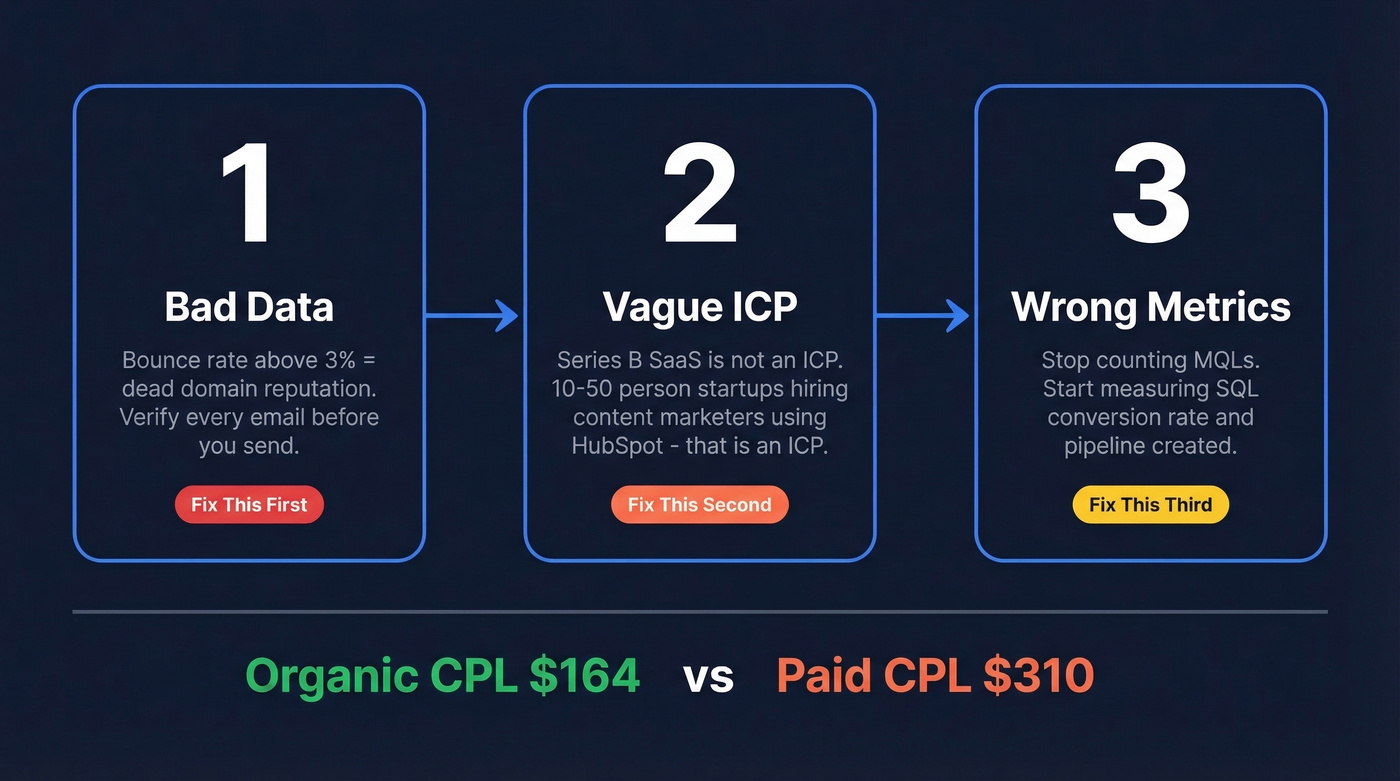
Bad data. If your email list bounces above 3%, nothing else matters. Your domain reputation tanks, deliverability craters, and every dollar you spend on sequences is wasted. Start with clean, verified data.
Vague ICP. "Series B SaaS companies" isn't an ICP. "10-50 person SaaS startups hiring content marketers, recently funded, using HubSpot" is. The tighter your targeting, the higher your reply rates.
Wrong metrics. Tracking MQLs without measuring SQL conversion rate is like counting gym memberships instead of workouts. Measure what converts, not what feels good. (If you need a tighter KPI set, start with funnel metrics.)
Here's the contrarian take - you don't need five channels. Pick two inbound motions for compounding pipeline and one outbound motion for pipeline now. Organic CPL averages $164 vs $310 for paid. Invest in both, but know which one pays back when.
The Data Quality Foundation
B2B contact data decays roughly 30% per year. People change jobs, companies restructure, phone numbers rotate. If you're pulling from a database that refreshes every 4-6 weeks - the industry average - you're working with stale records by default. (If you're layering providers, data enrichment services can help close coverage gaps.)
The consensus on r/sales about Apollo's data is blunt: it's "user-populated" and "they're not verifying anything by themselves." That's fine for a free tool you're using to build initial lists, but it's a real problem when you're sending 500 emails a day and your bounce rate is silently destroying your sender reputation.

A 10% bounce rate doesn't just waste those 50 emails. It signals to Gmail and Outlook that you're a spammer. Once that reputation drops, even your good emails stop landing. We've seen teams burn through three domains in a quarter because they skipped verification. (For the mechanics, see our email deliverability guide.)
Prospeo's proprietary email-finding system runs a 5-step verification process - catch-all handling, spam-trap removal, honeypot filtering - across 300M+ professional profiles and 143M+ verified emails. The 7-day data refresh cycle means records stay current, not stale. Snyk's results tell the story: their AE team went from a 35-40% bounce rate to under 5%, and AE-sourced pipeline jumped 180%. At ~$0.01/email, bad data costs more than good data ever will. (If you're troubleshooting bounces, start with email bounce rate.)
Define Your ICP Before Anything Else
Most teams skip this step or do it superficially. "We sell to mid-market SaaS companies" isn't targeting - it's a category. Real ICP definition layers three signal types: firmographic (company size, revenue, funding stage), technographic (what tools they use), and behavioral (hiring patterns, content engagement, recent leadership changes). (If you want a structured worksheet, use an ideal customer profile template.)
A practitioner on r/b2bmarketing nailed the specificity level you need: "10-50 person SaaS startups hiring content people, recently funded, active on professional networks." That's an ICP you can actually build a list from. Filter down to roughly 1,000 accounts before you export anything - this controls verification costs and forces you to be selective.
Inbound Strategies That Compound
Let's be honest: inbound takes 3-6 months to produce meaningful pipeline. But the payoff is significant - organic CPL runs $164 vs $310 for paid channels, and content compounds in a way that paid never does.
Content Marketing & SEO
B2B companies that blog generate 67% more leads than those that don't. Content captures search intent, drives traffic, and converts visitors into leads through gated resources, demos, or free trials. (If you're building the motion from scratch, start with what is B2B content marketing.)
The benchmarks matter here. Average visitor-to-lead conversion sits at 1.5-2.5%, with top 10% performers hitting 8-15%. If you're below 1.5%, your problem isn't traffic - it's your landing pages, CTAs, or offer. Fix the conversion layer before you invest more in content production.
Free Tools & Resources
Notion's template gallery is the modern example: demonstrate product value before anyone pays a dollar. Create something genuinely useful - a calculator, a grader, a template library - gate it lightly, and let the tool itself sell the upgrade. For product-led companies, this is the most scalable path because prospects experience value before they ever talk to sales. (Need ideas? Start with free lead generation tools.)
Communities & Dark Social
This means answering questions in r/SaaS, joining industry Slack channels like RevGenius and Pavilion, and contributing to niche forums before you pitch anything. The conversion path is slow but high-trust: people buy from names they recognize. ViB shared that about 50% of leads generated through their tech community resulted in proposals.
Spend 30 minutes a day adding value in two communities. That's it.
Webinars & Co-Marketing
Partner with complementary tools for joint webinars - your CRM vendor, your sequencing tool, your analytics platform. The audience overlap is built in, and you split the promotion cost. Gated webinar content converts at 2-5% to pipeline when the topic is specific enough to attract buyers, not just browsers.
Outbound Strategies That Work Now
Inbound compounds over months. Outbound produces qualified meetings in 30-60 days when executed correctly. Most teams butcher the execution and blame the channel.
Cold Email Done Right
A multi-touch sequence that works:
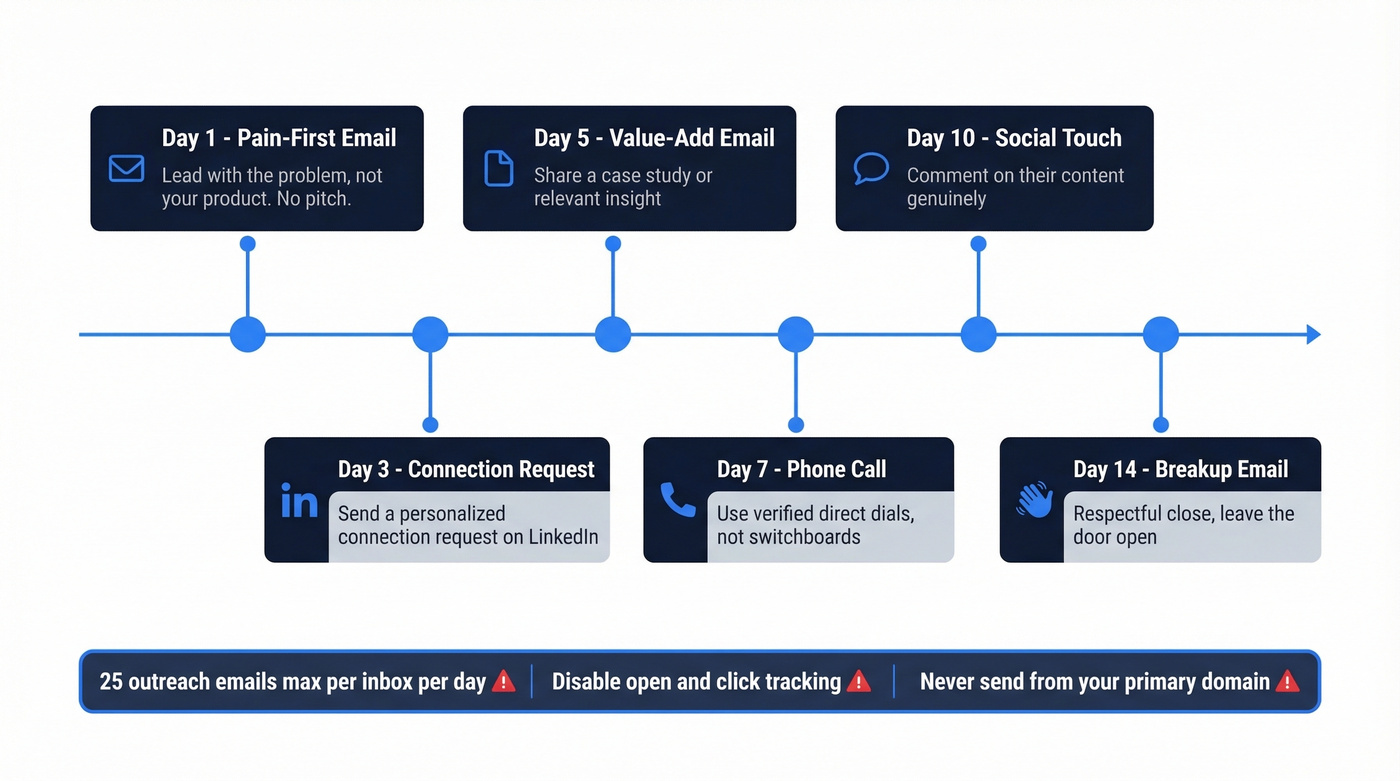
- Day 1 - Initial email, pain-first, no pitch
- Day 3 - Connection request on a professional network
- Day 5 - Value-add email with a case study or relevant insight
- Day 7 - Phone call
- Day 10 - Social message commenting on their content
- Day 14 - Breakup email
Pain-first messaging converts 3-5x better than offer-first messaging. Lead with the problem you solve, not the product you sell. (For a deeper build, see B2B cold email sequence.)
Deliverability rules that aren't optional: limit to 25 outreach emails plus 5 warm-up per inbox per day. Disable open and click tracking - it can kill deliverability. Never send from your primary domain. Use dedicated sending domains with proper SPF, DKIM, and DMARC. (If you're calibrating volume, use email velocity.)
Cold Calling
Cold calling isn't dead - it's just done badly. The channel works when you have verified direct dials, not switchboard numbers. Reddit threads consistently mention that up to 70% of phone numbers in big databases are wrong, which explains why most teams give up on the channel entirely. (If you're building the motion, start with a cold calling system.)
We've tested this across hundreds of campaigns. Verified mobile numbers are the difference between 3 conversations per hour and 1. Aim for no more than 7 call attempts per contact before moving on.
Multi-Channel Orchestration
Single-channel outbound is dead. Email alone gets ignored. Calls alone feel intrusive. The combination - email, calls, and social touches in a coordinated sequence - creates the familiarity that gets replies.
Qualify between the reply and the meeting. Use BANT as a lightweight framework: Budget, Authority, Need, Timeline. 79% of marketing leads never convert to sales - most of that waste happens because teams book meetings with unqualified prospects. Tools like Instantly (from ~$30/mo) handle inbox rotation and reply management; HeyReach (from ~$79/mo) automates social touches. (If you want a more systematic approach, see lead scoring.)
Product-Led Growth as Lead Gen
PLG isn't "offer a free trial." It's building your product so the free experience itself generates qualified leads - the product does the selling before a rep ever gets involved. For teams exploring how to generate SaaS leads without heavy sales overhead, PLG is the most scalable path.
Slack defined an activation metric: a team sending 2,000 messages was unlikely to ever churn. Dropbox's referral program worked because both sides got more storage, creating a viral loop that didn't depend on sales outreach.
Define PQL signals for your product: users from corporate email domains, number of integrations activated, feature adoption depth, team invites sent. When a free user hits those thresholds, that's when sales reaches out - not before. PQLs consistently convert at higher rates than MQLs because the prospect has already experienced the product's value.

Snyk's 50 AEs went from 35-40% bounce rates to under 5% - and AE-sourced pipeline jumped 180%. Prospeo's 5-step verification across 300M+ profiles and 7-day refresh cycle means your SaaS outbound hits real inboxes, not spam folders. At $0.01/email, bad data costs more than good data ever will.
Fix your data quality foundation before you send another cold email.
Paid Acquisition - When It's Worth It
Paid channels deliver pipeline immediately but at a premium. The math has to work, and for many early-stage SaaS companies, it doesn't.
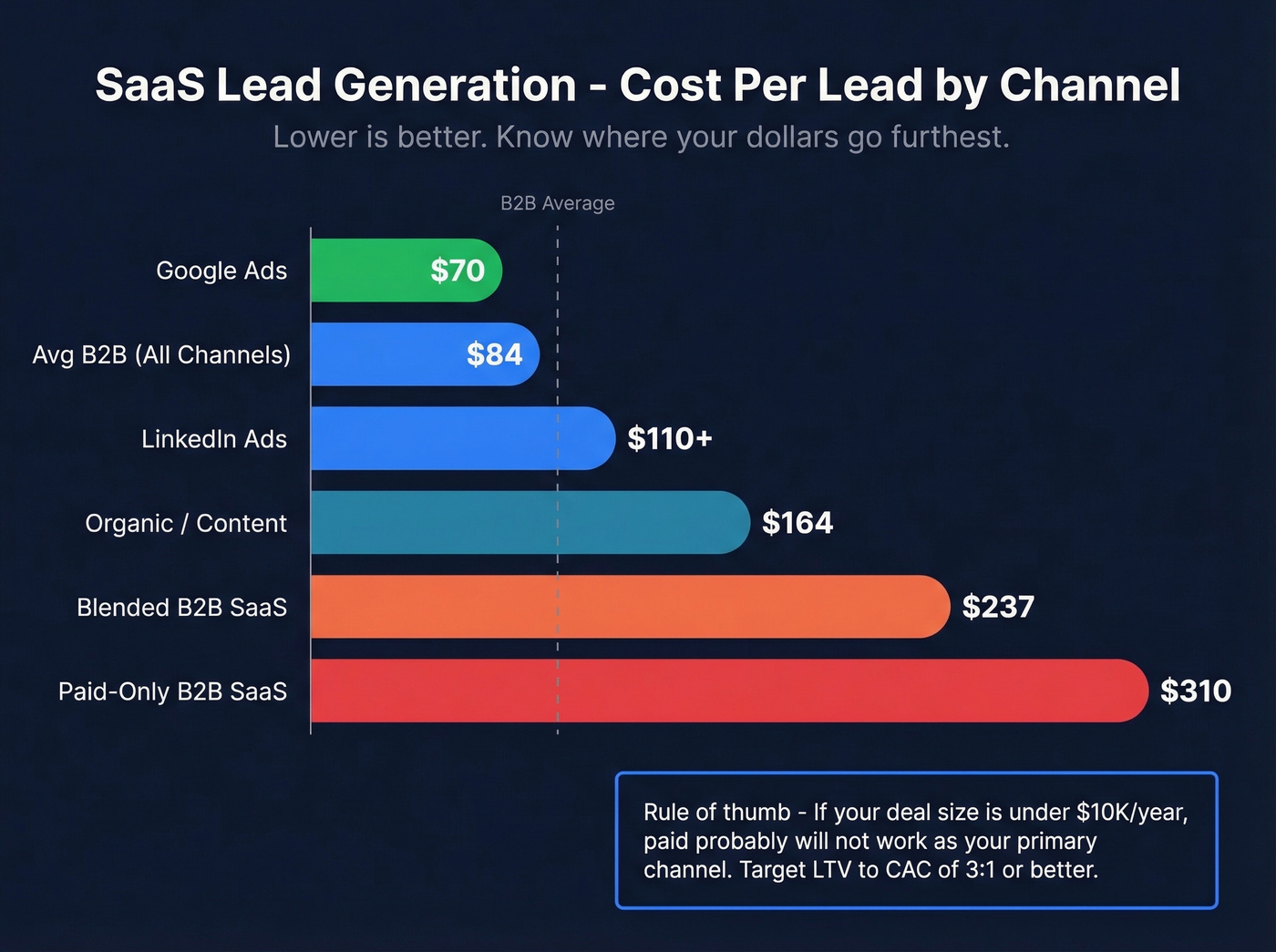
If your average deal size is under $10K annually, you probably can't afford paid as your primary channel. The benchmark to watch is LTV:CAC of at least 3:1. Below that, you're buying revenue at a loss. (If you need to sanity-check the math, see cost to acquire customer.)
| Channel | Avg CPL | Best For |
|---|---|---|
| Google Ads | ~$70 | High-intent keyword capture |
| Average B2B (all channels) | ~$84 | Baseline benchmark |
| LinkedIn Ads | $110+ | Decision-maker targeting |
| Organic/Content | $164 | Compounding pipeline |
| Blended B2B SaaS | $237 | - |
| Paid-only B2B SaaS | $310 | - |
Google Ads works best for bottom-of-funnel keywords - people searching "best CRM for SaaS" are further down the funnel than someone who sees your LinkedIn ad while scrolling. Allocate paid budget to high-intent keywords first, then expand to awareness once the unit economics prove out.
Intent-Based Prospecting
Static databases are a commodity. Every competitor has the same contacts. The edge comes from knowing when someone is in-market, not just who they are. This is what separates top-performing SaaS lead generation teams from everyone else running the same playbook with the same lists.
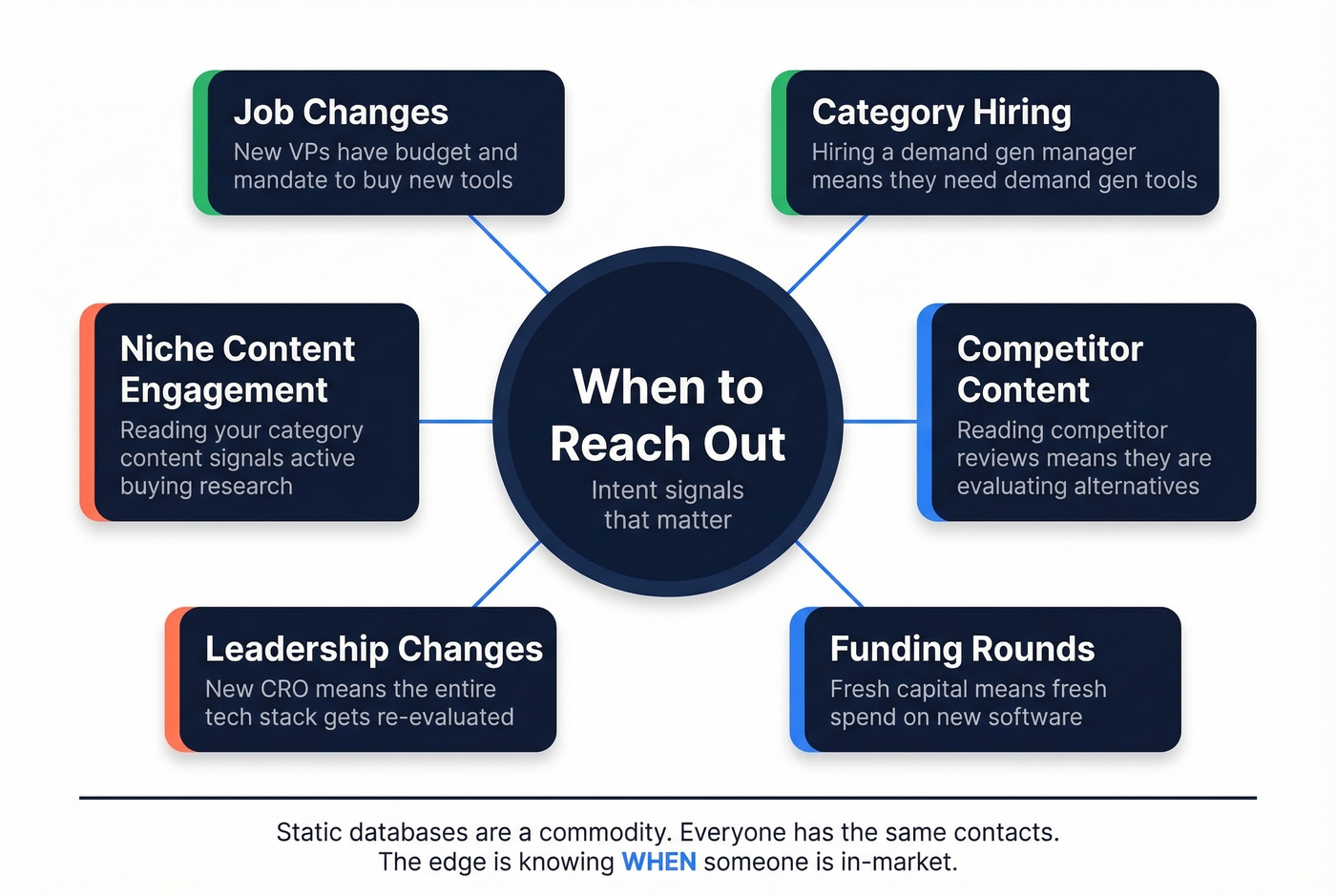
Track these six intent signals:
- Job changes - new VPs have budget and mandate to buy
- Hiring for category roles - a company hiring "demand gen manager" needs demand gen tools
- Competitor content engagement - they're evaluating alternatives
- Funding rounds - fresh capital means new spend
- Leadership changes - new CRO means a new stack evaluation
- Niche content engagement - reading your category's content signals active research
Waterfall enrichment - querying multiple data providers sequentially - pushes coverage to 80%+ vs roughly 40% from a single provider. Prospeo tracks 15,000 intent topics via Bombora and layers buyer intent with job role, company growth, and technographic filters to turn signal detection into actionable prospect lists. (For implementation, see intent based segmentation.)
Teams switching from rules-based to predictive lead scoring see a 20-30% improvement in lead-to-opportunity conversion. If you're still scoring leads with static point systems, that's the single highest-leverage change you can make this quarter.
SaaS Lead Generation Benchmarks
Numbers without context are useless. Here's the full-funnel benchmark table - if you're below these averages, it tells you exactly where to fix.
| Stage | Average | Top 10% | Time to Convert |
|---|---|---|---|
| Visitor to Lead | 1.5-2.5% | 8-15% | 1-3 days |
| MQL to SQL | 32-40% | 50%+ | 8-15 days |
| SQL to Close (SMB) | 20-25% | 30%+ | 30-45 days |
| SQL to Close (Enterprise) | 20-25% | 30%+ | ~120 days |
If your visitor-to-lead rate is below 1.5%, your problem isn't traffic - it's your landing pages. MQL-to-SQL under 32%? Your qualification criteria are too loose. SQL-to-close under 20%? Look at your sales process, not your marketing. In our experience, most teams misdiagnose the stage and throw money at the wrong fix.
Build Your Lead Gen Stack
You don't need 15 tools. You need the right five or six, integrated tightly.
| Category | Tool | Starting Price |
|---|---|---|
| CRM | HubSpot | Free; Starter ~$15/mo/user |
| CRM | Salesforce | Starter $25/user/mo |
| Prospecting | Prospeo | Free (75 emails/mo); ~$0.01/email |
| Prospecting | Clay | Free tier; from ~$149/mo |
| Prospecting | Apollo | Free tier; from ~$49/mo |
| Email Outreach | Instantly | From ~$30/mo |
| Automation | Zapier | Free; from ~$20/mo |
| Intent / ABM | Demandbase | Enterprise; ~$30K+/yr |
| Intent / ABM | 6sense | Enterprise; ~$30K+/yr |

For a Series A team building outbound for the first time, the prospecting layer matters most. You need verified data, self-serve access, and pricing that doesn't require a board-level conversation. Start with a free CRM, a verified data source, and a sending tool. Add intent and ABM platforms once you've proven the unit economics at smaller scale. (If you're evaluating options, compare outbound lead generation tools.)
Skip Demandbase and 6sense entirely until you're past $5M ARR - the $30K+ annual commitment doesn't make sense when you're still figuring out your ICP.
Stop burning through domains because 70% of your phone numbers are wrong. Prospeo gives you 125M+ verified mobile numbers with a 30% pickup rate and 143M+ emails at 98% accuracy - so your multi-touch SaaS sequences actually reach decision-makers.
Build your ICP list with 30+ filters and data that's never more than 7 days old.
Mistakes That Kill Your Pipeline
Relying on a single static database. Data decays 30% annually. If you're not refreshing or using waterfall enrichment, a third of your list is dead by year-end.
Tracking MQLs instead of SQL conversion. MQL volume is a vanity metric. Measure how many become sales-qualified and how many close. That's the number your board cares about.
Using open and click tracking. This feels counterintuitive, but disabling tracking directly improves inbox placement - which matters more than knowing who opened.
Qualifying too late. 79% of leads never convert. Most of that waste happens because reps book meetings with anyone who replies instead of qualifying before the calendar invite goes out.
One-size-fits-all messaging. A VP of Engineering and a Head of Marketing have different pain points. Segment your sequences by persona, not just by company size.
I've watched teams triple their reply rate just by splitting a single sequence into three persona-specific versions.
Not A/B testing sequences. If you're running the same subject lines and email copy for months without testing, you're leaving reply rate on the table. Test one variable at a time and let the data decide. (If you need a starting set, use these cold email subject line examples.)
Building a Full-Funnel SaaS Lead Generation Strategy
The biggest mistake teams make is treating lead generation as a single step rather than a funnel with distinct stages, each requiring different tactics and metrics. A well-structured funnel moves prospects through awareness (content, ads, communities), consideration (webinars, case studies, free tools), and decision (demos, trials, sales conversations).
Map your content and outreach to each stage, measure conversion between stages using the benchmarks above, and you'll quickly spot where prospects drop off. Each stage has a different solution, and the benchmarks tell you which one to prioritize. Don't guess - diagnose.
FAQ
What's a good cost per lead for SaaS?
B2B SaaS blended CPL averages $237, with organic channels at $164 and paid at $310. The metric that actually matters is LTV:CAC - aim for at least 3:1. A $300 CPL is fine if your average contract value is $50K. It's a disaster if you're selling a $200/month tool.
How long does SaaS lead generation take to produce results?
Outbound can generate qualified meetings in 30-60 days with clean data and tight targeting. Inbound takes 3-6 months to compound but costs roughly half per lead long-term. Most teams need both running simultaneously to maintain consistent pipeline.
How do I improve my cold email reply rate?
Verify your list first - aim for under 3% bounce rate. Use pain-first messaging instead of leading with your product pitch. Limit sends to 25 outreach emails per inbox per day. Disable open and click tracking to protect deliverability. And make sure your data source actually refreshes regularly; a 7-day cycle catches job changes and bounces before they damage your domain.
What's the difference between MQL, SQL, and PQL?
MQL means marketing-qualified - the prospect engaged with content or filled out a form. SQL means sales-qualified - confirmed budget, authority, need, and timeline. PQL means product-qualified - the prospect activated meaningfully in your free tier. SaaS companies increasingly prioritize PQLs because they convert at significantly higher rates than MQLs.
What's the best lead gen stack for an early-stage startup?
Start with three tools: a free CRM like HubSpot, a verified data source like Prospeo (free tier includes 75 emails/month at 98% accuracy), and a sending tool like Instantly. That covers your entire outbound workflow for under $100/month. Add intent data and ABM platforms once you've closed enough deals to justify the spend.