

The 7 SaaS Sales Pipeline Stages (With Exit Criteria and 2026 Benchmarks)
Only 14% of SaaS commercial leaders rate their pipeline-building efforts as highly effective. B2B sales cycles have lengthened 22% since 2022, and the average buying committee has swelled to 6.8 stakeholders. Here's the thing: most SaaS sales pipeline stages aren't broken because of bad strategy. They're broken because stages are labels without teeth - no exit criteria, no verifiable conditions, no forecasting integrity.
This article lays out the seven stages we've seen work across SMB, mid-market, and enterprise SaaS, with the specific exit criteria and benchmarks that turn a CRM full of wishful thinking into something you can actually forecast against (and improve with better pipeline health discipline).
The 7 Stages Explained
Seven stages. Median B2B SaaS cycle: 84 days. Opportunity-to-Closed-Won conversion: roughly 7%. The single thing separating a forecastable pipeline from fiction? Exit criteria at every stage.
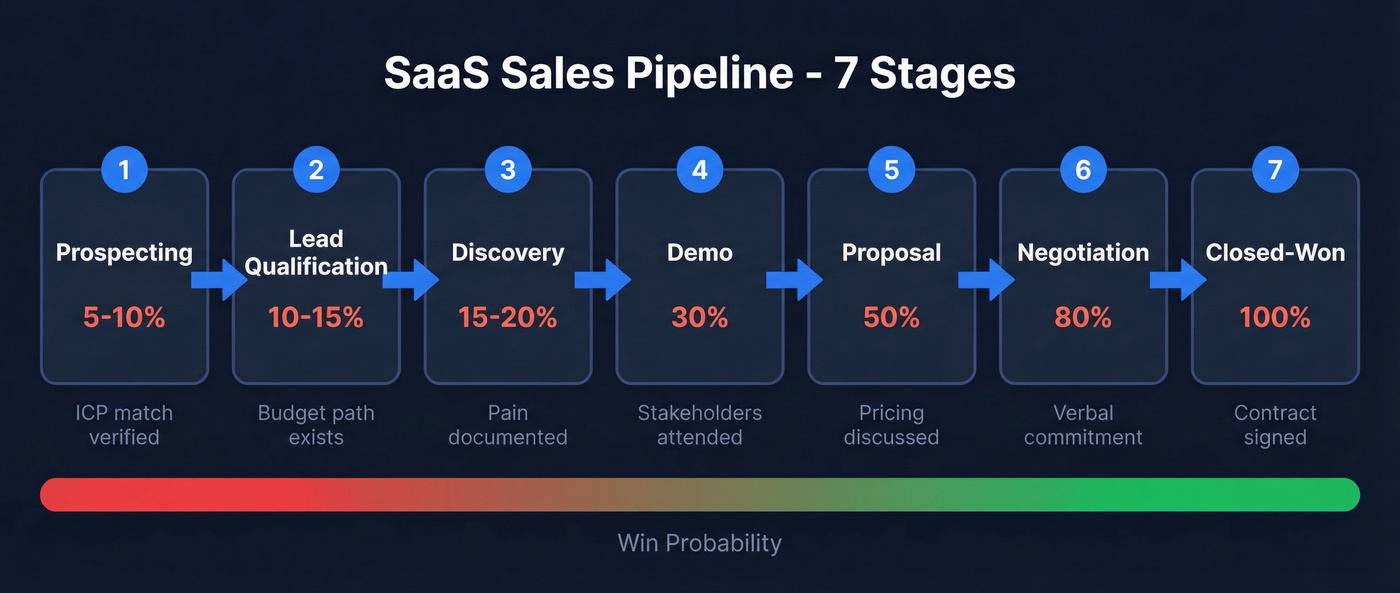
Stage 1: Prospecting
If your prospect list runs a 35% bounce rate, every downstream metric is garbage. Meritt was running exactly that before switching to Prospeo's email finder - bounce rates dropped to under 4%, and pipeline tripled from $100K to $300K per week. We've seen this pattern repeatedly across our customers: fix Stage 1 data quality, and the entire funnel improves (especially when you apply modern sales prospecting techniques).
Exit criteria: ICP match confirmed. Valid contact info verified. Prospect sequenced or assigned.
Probability: 5-10%

Stage 2: Lead Qualification
The framework depends on deal complexity. For deals under $25K ACV, BANT works as a fast screen. Enterprise deals with procurement layers need MEDDIC to map decision processes and identify champions. Some teams run SPICED for early discovery, then layer MEDDIC once they hit approval stages (and tighten lead scoring so MQLs don’t inflate your forecast).
Exit criteria: Framework completed. Budget path exists. Decision-maker identified. Explicit disqualifiers checked - RFP filler, ghosting after two touches, champion inaccessible = out.
Probability: 10-15%
Stage 3: Discovery
Discovery isn't a demo preview. It's where you map the prospect's current state, desired state, and what's blocking the gap. Skipping it leads to mis-scoped demos, misaligned proposals, and lower win rates - and we've watched teams lose six-figure deals because a rep jumped straight to a product walkthrough without understanding the buyer's actual workflow (use a consistent set of discovery questions).
Exit criteria: Pain documented. Success criteria defined by the prospect. Competitive landscape understood. Demo scheduled with stakeholders.
Probability: 15-20%
Stage 4: Demo
Probability: ~30%
The demo answers one question: "Does this solve my specific problem?" Tailor it to discovery findings. Generic feature tours kill deals here. If you're running the same demo for a 10-person startup and a 500-person enterprise team, something's wrong (a simple product demo checklist helps keep demos tied to exit criteria).
Exit criteria: Key stakeholders attended. Solution confirmed against requirements. Technical objections surfaced. Follow-up timeline agreed.
Stage 5: Proposal
A thread on r/founderledsales nails this: overcomplicating proposals is one of the most common early-stage SaaS mistakes. Buyers care about their problem, your solution, and the price. That's it.
Exit criteria: Proposal reviewed by economic buyer. Pricing discussed. Legal/procurement requirements identified. Decision timeline confirmed.
Probability: ~50%
Stage 6: Negotiation
Negotiation-to-close eats 35-40% of total cycle time in enterprise deals. The reason? Reps negotiate with champions who can't sign. Map to the economic buyer before this stage or watch your deal stall for weeks while your champion "checks with leadership" three times in a row (see technical buyer vs economic buyer for a clean way to split stakeholders).
Exit criteria: Terms agreed. Legal/security review in progress. Verbal commitment from economic buyer. Contract sent.
Probability: ~80%
Stage 7: Closed-Won
Sales and success teams drive 58% of upsells; product-led expansion accounts for only 10%. Closing isn't the finish line - it's the start of expansion revenue (where upsell vs cross-sell in SaaS becomes a real growth lever).
Exit criteria: Contract signed. Onboarding scheduled. Account assigned to CS. Expansion triggers defined (usage thresholds, renewal dates, upsell signals).
2026 SaaS Pipeline Benchmarks
Stage Conversion Rates
| Stage Transition | Benchmark Rate |
|---|---|
| Lead to MQL | 22% |
| MQL to SQL | 15% |
| SQL to Opportunity | 11% |
| Opportunity to Closed-Won | 7% |
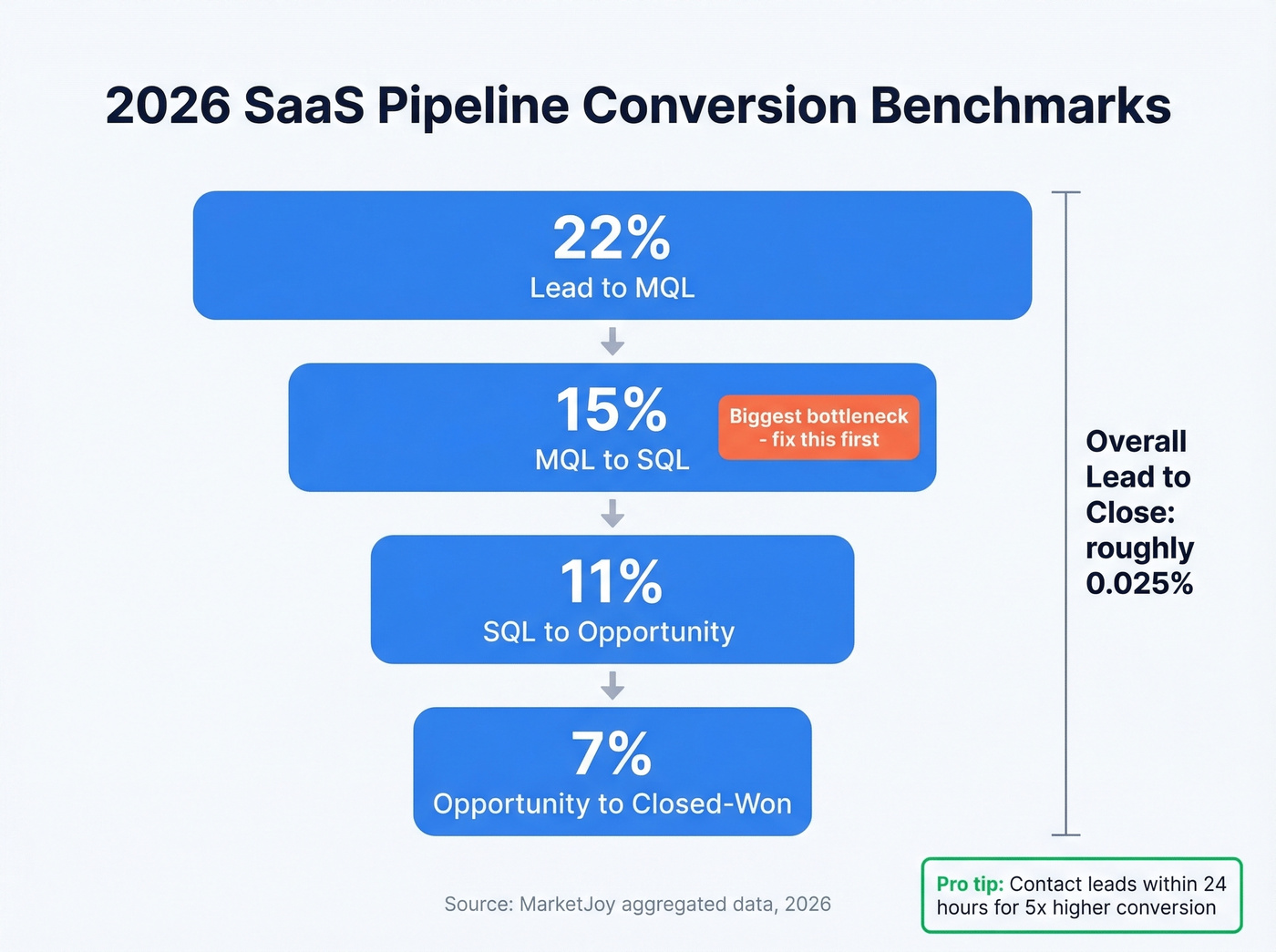
MarketJoy aggregated data backs these numbers. The MQL-to-SQL transition is where most teams lose the plot - it's the most actionable bottleneck. If your number sits well below 15%, fix qualification criteria and lead scoring before blaming closers. One more data point worth knowing: contacting leads within 24 hours increases conversion by 5x (and it’s easier to operationalize with strong sequence management).
Sales Cycle Length by ACV
| ACV Range | Typical Cycle |
|---|---|
| Under $5K | ~30 days |
| Under $25K | ~90 days |
| Under $100K | 90-180 days |
| Over $100K | 3-9 months |
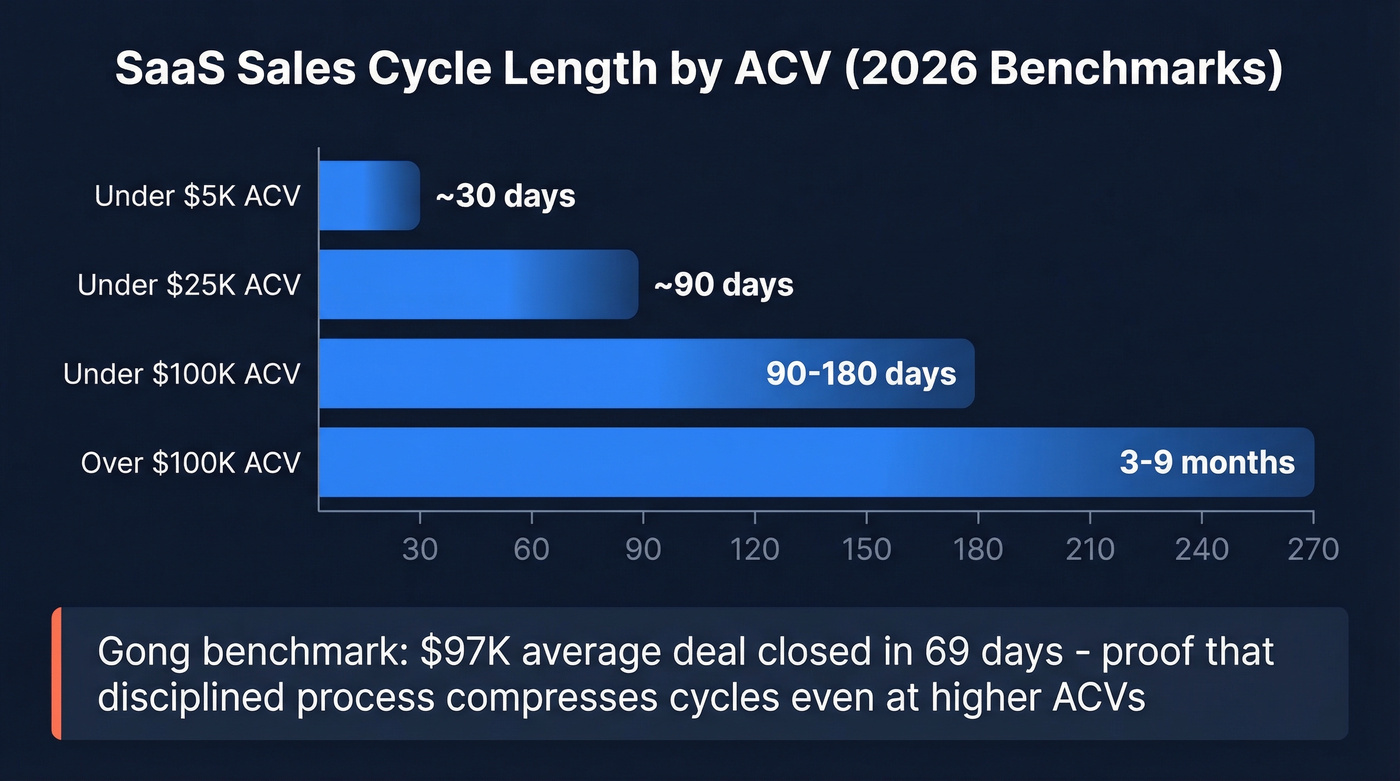
Gong's data via SaaStr shows a $97K average deal closing in 69 days - proof that a disciplined process compresses cycles even at higher ACVs.
Stage Duration by Segment (Won Deals)
| Stage Transition | SMB | Mid-Market | Enterprise |
|---|---|---|---|
| Discovery to Demo | 3-5 days | 5-10 days | 10-20 days |
| Demo to Proposal | 1-3 days | 5-15 days | 15-30 days |
| Proposal to Negotiation | 3-7 days | 10-20 days | 20-40 days |
| Negotiation to Close | 2-5 days | 10-20 days | 30-60 days |
This is the table your CRM should benchmark against. If your enterprise deals are hitting Proposal-to-Close in under 50 days, you're either selling below your weight class or your reps are skipping negotiation steps.
Let's be honest about one thing most RevOps teams miss: track win rates by opportunity-creation cohort, not just rolling averages. A 30% win rate means nothing if last quarter's cohort is closing at 18% while you're coasting on legacy deals from six months ago. Cohorted win rates are the single best forecasting upgrade most teams aren't running (and a good sales process optimization project usually starts here).

A 35% bounce rate doesn't just waste emails - it poisons every pipeline stage after prospecting. Prospeo delivers 98% email accuracy with a 7-day data refresh cycle, so your pipeline stages measure real buyer engagement, not stale contacts. Meritt tripled pipeline from $100K to $300K/week after switching.
Stop forecasting against dead leads. Start with verified data.
Pipeline Coverage Ratios
Standard advice says 3-4x pipeline-to-bookings. But a 4x pipeline that's 77% low-fit deals is functionally 1x. Fullcast's benchmarks found high-ICP accounts represent only 23% of total pipeline for many orgs.
Use weighted coverage instead. Multiply pipeline dollars per stage by historical win probability, then sum. SMB teams with short cycles may need only 1.5-2x. Enterprise teams should target 4-5x. Skip the vanity metric of raw pipeline dollars - it'll mislead your board and your forecast (if you need more reference points, compare against broader sales pipeline benchmarks).
Pipeline Mistakes That Kill Forecasts
Selling to everyone is the most expensive mistake in SaaS. No sub-niche means reps waste cycles on prospects who'll never close. Pick a beachhead and own it before expanding (start with a tight ideal customer profile).
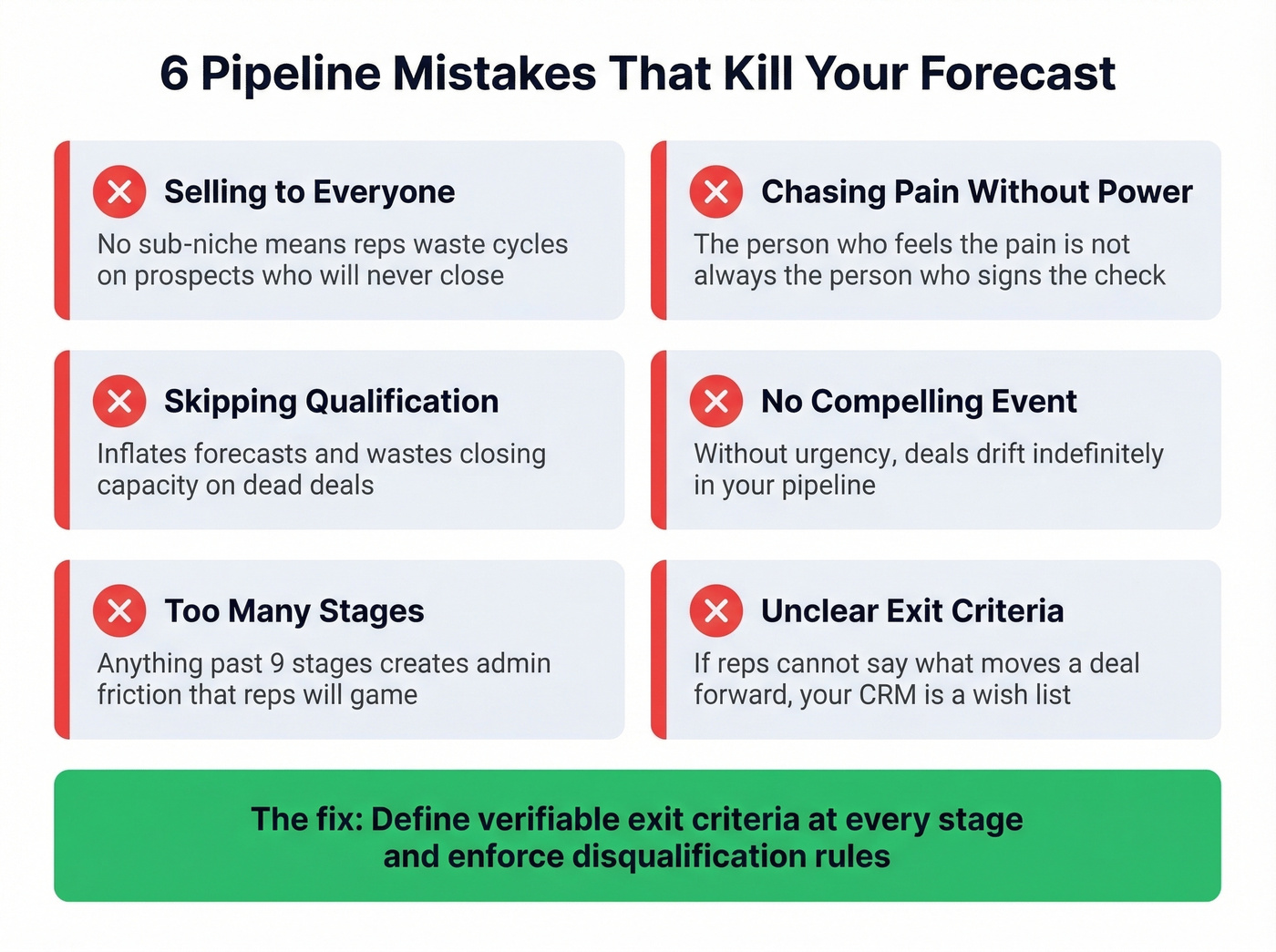
Chasing pain without power is the second. The person who feels the pain isn't always the person who signs the check. Map to the economic buyer early - buying committees averaging 6.8 stakeholders means consensus without a champion is impossible.
The remaining killers: skipping qualification (inflates forecasts, wastes closing capacity), no compelling event (without urgency, deals drift indefinitely), too many stages (anything past nine creates admin friction reps will game), and unclear exit criteria. If reps can't articulate what moves a deal forward, your CRM is a graveyard of optimistic probabilities. I've reviewed pipelines where 60% of "Stage 5" deals hadn't had a single conversation with the economic buyer. That's not a pipeline - it's a wish list.
Stages by GTM Motion
Product-led (ACV under $5K): Pipeline starts at signup. Stages look like Trial, Activation, PQL, Sales-Assisted, Close. The traditional seven-stage model doesn't apply here - don't force it.
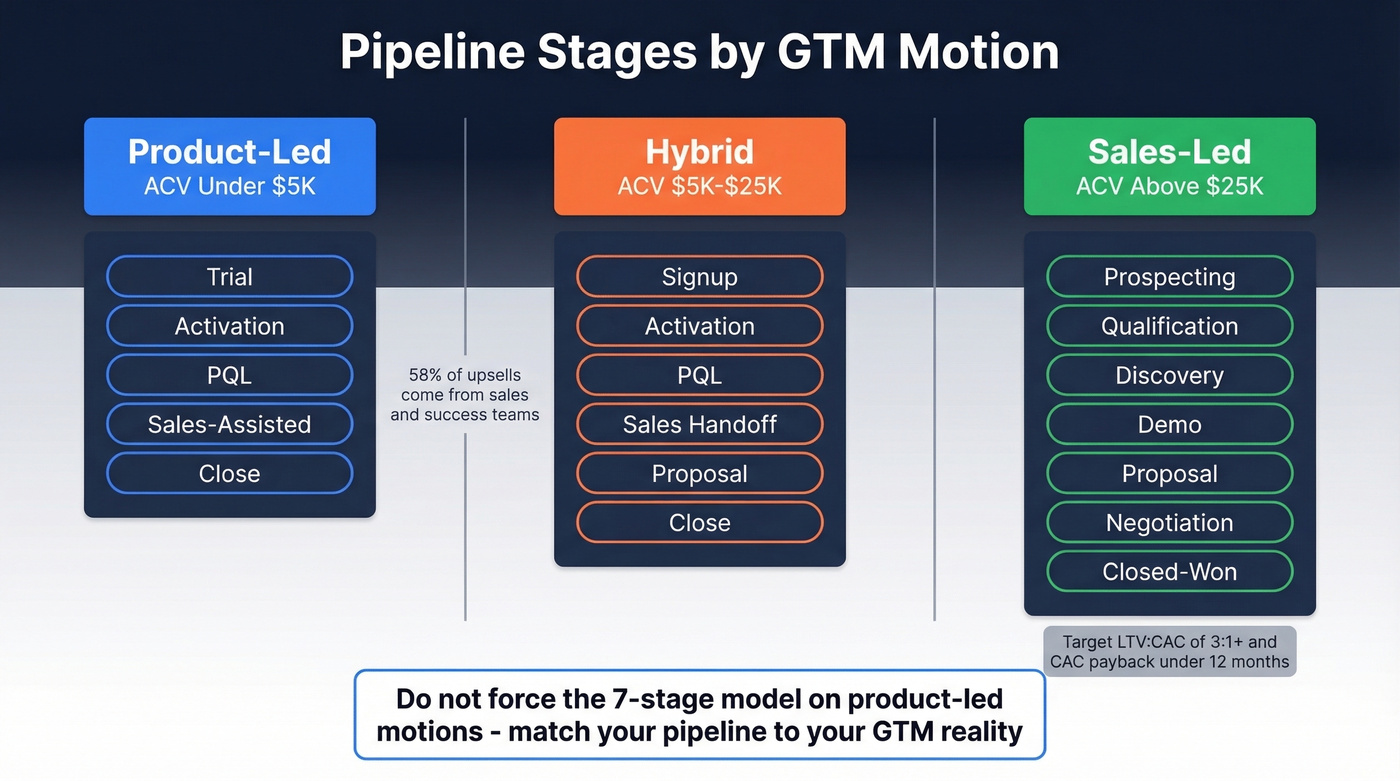
Hybrid ($5K-$25K): PLG handles acquisition; sales assists expansion. Sales and success teams drive 58% of upsells in hybrid models, making the handoff from self-serve to sales-assisted the most critical transition to get right.
Sales-led (above $25K): The full 7-stage model applies. Enterprise motions layer in stakeholder mapping and security reviews on top of the core software sales pipeline stages. Target LTV:CAC of 3:1+ and CAC payback under 12 months (more context in our SaaS sales guide).
Weighted pipeline coverage only works when your contact data connects reps to real decision-makers. Prospeo's 300M+ profiles with 30+ filters - buyer intent, technographics, headcount growth - let you fill every stage with high-ICP prospects at $0.01/email. No contracts, no sales calls.
Fill your pipeline with buyers who actually pick up the phone.
FAQ
How many stages should a SaaS pipeline have?
Five to eight is the sweet spot. Fewer than five hides where deals stall; more than nine creates CRM friction reps will game. Start with seven and merge or split stages once you've got 90+ days of conversion data telling you where the real bottlenecks are.
What's a good pipeline-to-bookings ratio?
3-4x weighted by stage probability is the standard target. SMB teams with sub-30-day cycles may need only 1.5-2x, while enterprise teams closing $100K+ deals should carry 4-5x to absorb longer sales cycles and lower win rates.
How do I fix a low MQL-to-SQL conversion rate?
Audit your lead scoring model and ICP definition first - a rate below 10% usually signals qualification criteria are too loose, not that closers are underperforming. Tighten firmographic filters, verify contact data before sequencing, and enforce disqualification rules at the MQL stage. Bad data at the top poisons everything downstream.