

Sales Behaviors That Actually Drive Revenue (And How to Coach Them)
Your SDR team made 500 dials last week and booked 3 meetings. Your manager's response? "We need more dials." That's the wrong answer - and it's why most sales orgs plateau. The fix isn't more activity. It's better sales behavior.
If you only change three things this quarter, make them these: prospect based on intent signals instead of alphabetical lists, listen more than you talk in every discovery call, and verify your contact data before you dial. The research backs all three. Let's break down the data, the measurement system, and the coaching playbook.
Why Sales Behavior Matters Now
B2B buying has shifted in ways that make behavior - not effort - the differentiator. 61% of B2B buyers now prefer a rep-free buying experience, according to a Gartner survey of 632 buyers. That doesn't mean reps are irrelevant. It means the bar for when a rep adds value has gone way up.
The stat that should keep every sales leader awake: 73% of B2B buyers actively avoid suppliers who send irrelevant outreach. Not "prefer to avoid." Actively avoid. Nearly three-quarters of your addressable market is filtering you out before you get a chance to pitch.
Volume-based sales motions - more dials, more emails, more social messages - don't just have diminishing returns. They actively damage your brand with the majority of buyers. What matters now is the quality of each interaction, the relevance of your timing, and the accuracy of your targeting. Those are selling behaviors, not activities. And they're coachable.
Behaviors vs. Activities vs. Results
Most sales orgs conflate three things that should be tracked separately: behaviors, activities, and results. Techniques are the tactical moves - objection handling scripts, closing frameworks - while behaviors are the underlying habits that determine whether those techniques get applied consistently.
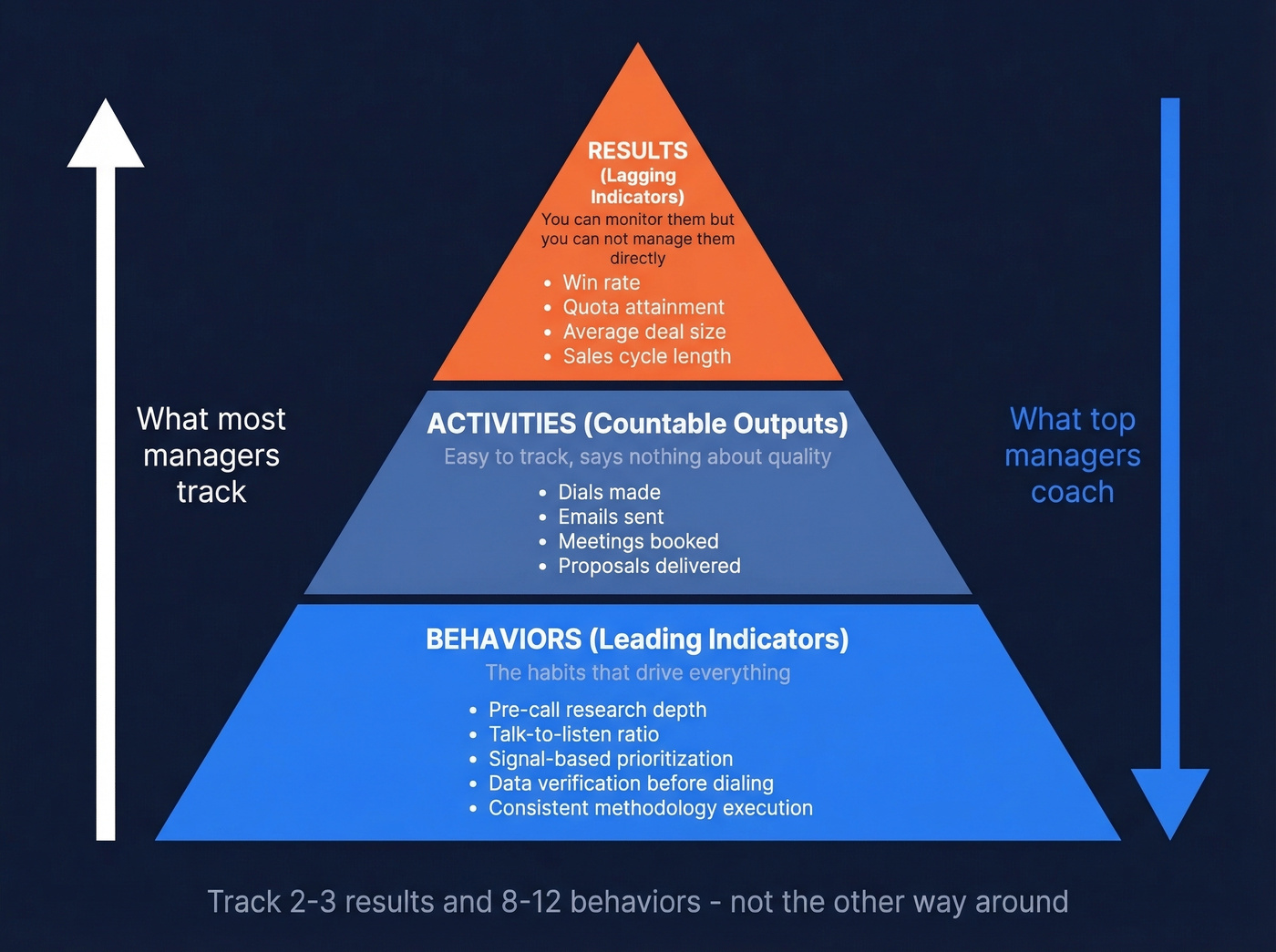
Results are lagging indicators - win rate, quota attainment, average deal size, sales cycle length. You can monitor them. You can't manage them directly.
Activities are the countable outputs - dials made, emails sent, meetings booked. Easy to track, but they tell you almost nothing about quality. (If you need a clean list to start from, use these sales activities as a baseline.)
Behaviors are the leading indicators that drive everything else. How a rep researches before a call. Whether they listen or pitch in discovery. How they prioritize their prospect list. Whether they verify data before loading a sequence. The best sales managers we've worked with track 2-3 results and 8-12 behaviors - a framework SBI has advocated for years.
The 5 Seller Behavior Profiles
The Challenger Sale research - originally CEB, now housed at Gartner - remains one of the most useful behavioral taxonomies in B2B sales. They segmented sellers into five profiles based on observable behaviors:
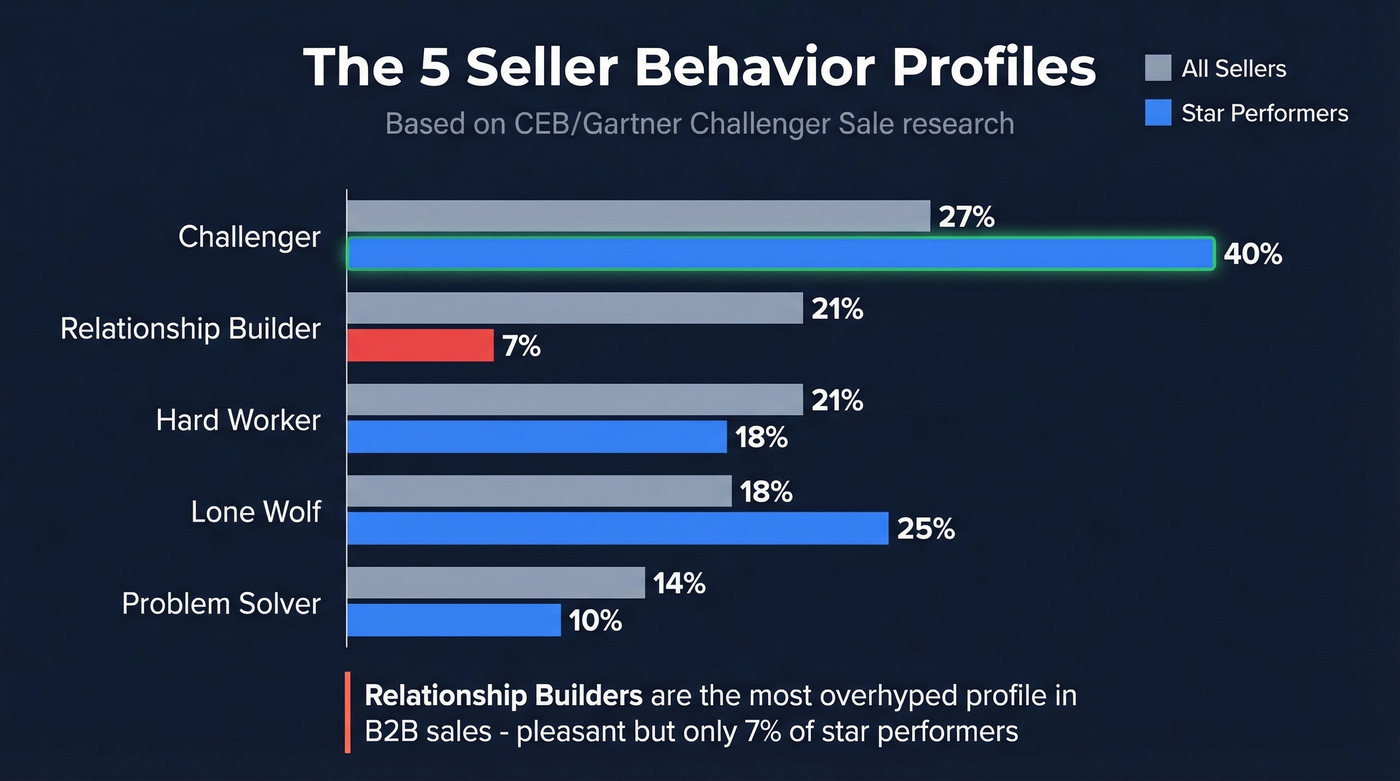
| Profile | % of All Sellers | % of Star Performers |
|---|---|---|
| Problem Solver | 14% | Low |
| Lone Wolf | 18% | Moderate |
| Hard Worker | 21% | Moderate |
| Relationship Builder | 21% | 7% |
| Challenger | 27% | ~40% |
Roughly 40% of star performers in complex sales are Challengers. Relationship Builders - the profile most sales orgs hire for and reward - produce just 7% of star performers.
Here's the thing: Relationship Builders are the most overhyped seller profile in B2B. They're pleasant. Buyers like them. But pleasantness doesn't close complex deals. Challengers win because they teach buyers something new, tailor their message to the stakeholder, and take control of the commercial conversation. The CEB research found that 53% of customer loyalty comes down to the quality of the sales experience - not the product, not the price, not the brand. The behavior of the seller is literally the majority of what drives loyalty.
Winning Habits That Drive Revenue
These are the behavior clusters that separate top performers from the middle of the pack. If you want to replicate winning patterns across your team, start with these five.
Signal-Based Prospecting
About 69% of buyers engage a salesperson only after they've already made their decision. If you're cold-calling a prospect who hasn't started evaluating solutions yet, you're early. If you're calling after they've decided, you're late. The window is narrow.
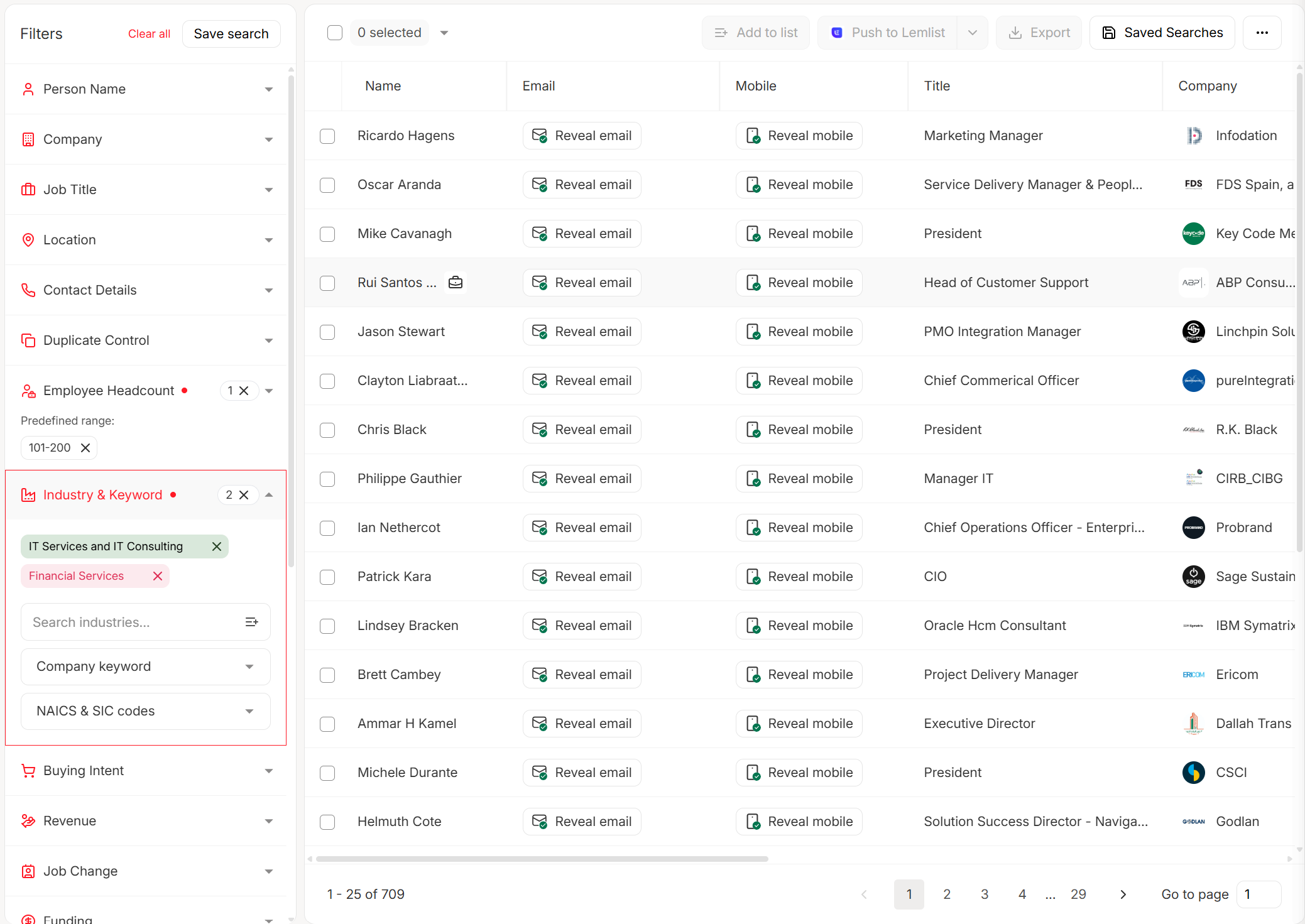
Signal-based prospecting solves this. Instead of working a static list top-to-bottom, top reps prioritize accounts showing buying signals - intent surges, job-change alerts, funding rounds, technology adoption. Prospeo's intent data tracks 15,000 Bombora topics, so you can filter by who's actively researching your category right now rather than guessing. (If you want more ways to systematize this, see these sales prospecting techniques and a practical guide to identifying buying signals.)
Active Listening in Discovery
The benchmark from Janek Performance Group is simple: top reps maintain a talk-to-listen ratio better than 60/40, meaning they listen more than they talk.
This isn't about being quiet. It's about asking the right questions and then actually processing the answers. The behavior to coach isn't "talk less." It's "ask better questions, then shut up." (Use a consistent bank of discovery questions to make this coachable.)
Value Messaging Tied to ROI
57% of buyers expect positive ROI within three months of purchase. That's a brutal timeline, and if your reps can't articulate a concrete business case with a payback period, they're losing to competitors who can.
The behavior here is preparation. Top reps build ROI narratives before the call, tailored to the prospect's industry and role. They don't wing it with generic value props. They walk in with numbers. This is where the 53% loyalty stat matters most practically - since the sales experience drives the majority of customer loyalty, a rep who shows up with a tailored ROI case isn't just closing deals. They're building retention from the first conversation. (If your team struggles here, start with a tighter sales communication standard.)
Data Hygiene Before You Dial
Data hygiene is a selling discipline, not an ops task. If your team is cold-calling from a list that hasn't been recently verified, you're burning hours on dead contacts and damaged sender reputation. The rep who runs their list through a verification tool before loading a sequence - checking for bounces, catching spam traps, confirming deliverability - books more meetings than the rep who trusts a stale CRM export. One of our clients, Meritt, saw bounce rates drop from 35% to under 4% after switching to weekly-refreshed verified contacts, and their pipeline tripled. (If you want the mechanics, see our email deliverability guide and benchmarks for email bounce rate.)
Internal Networking
Most people don't expect this one. HBR research found that the size and quality of a salesperson's internal network is a stronger predictor of performance than time spent with customers. Reps who build relationships with SEs, CSMs, product managers, and marketing get better deal support, faster answers, and more referrals. The lone-wolf rep who "doesn't need help" is leaving money on the table. (This is a core idea in team selling.)
Consistent Methodology Execution
A Highspot/ValueSelling survey of 150+ B2B sales leaders found that top performers scored 7.5 on consistent methodology usage versus 5.4 for everyone else. The behavior isn't "follow a script." It's "execute a repeatable framework for qualification, discovery, and closing - every time, not just when you feel like it." (If you need a simple structure, start with these steps to close a sale.)

Signal-based prospecting only works if you have the signals. Prospeo tracks 15,000 intent topics via Bombora so your reps prioritize accounts actively researching your category - not guessing from stale lists.
Stop dialing alphabetically. Start dialing based on buyer intent.
Bad Habits That Kill Deals
Let's flip it. Here are the anti-patterns that consistently destroy pipeline.
Prospecting only when motivated. Inconsistent outreach means you miss low-competition windows and create feast-or-famine pipeline cycles. The best reps prospect daily regardless of how their pipeline looks. (A simple 30-60-90 day plan for sales reps helps lock in the habit.)
Talking more than listening. Janek calls it being "hypnotized by your own voice." If your discovery calls are rep-heavy, you're not discovering anything - you're presenting.
Sending irrelevant, generic outreach. Remember: 73% of buyers actively avoid suppliers who do this. A "just checking in" email to someone who never expressed interest isn't persistence. It's spam. (If you need better touchpoints, use these sales follow-up templates.)

Ignoring data quality. Every bounced email chips away at your domain reputation. Every wrong number wastes a call block. This damage compounds fast - the consensus on r/sales is that most reps don't realize how much bad data costs them until their domain gets flagged and reply rates crater overnight. (If you're troubleshooting, start with how to improve sender reputation.)
Over-relying on marketing for leads. Reps who wait for inbound are building someone else's pipeline. Gartner found that 69% of buyers report inconsistencies between website info and what sellers say, and this often traces back to reps who didn't research the account because "marketing qualified" it.
If you recognize three or more of these patterns on your team, skip the new tool purchase. The fix is behavior coaching.
What Separates Top Performers
The gap between top performers and everyone else isn't talent. It's measurable, coachable behavior. The Highspot/ValueSelling survey quantified this across 150+ sales leaders:
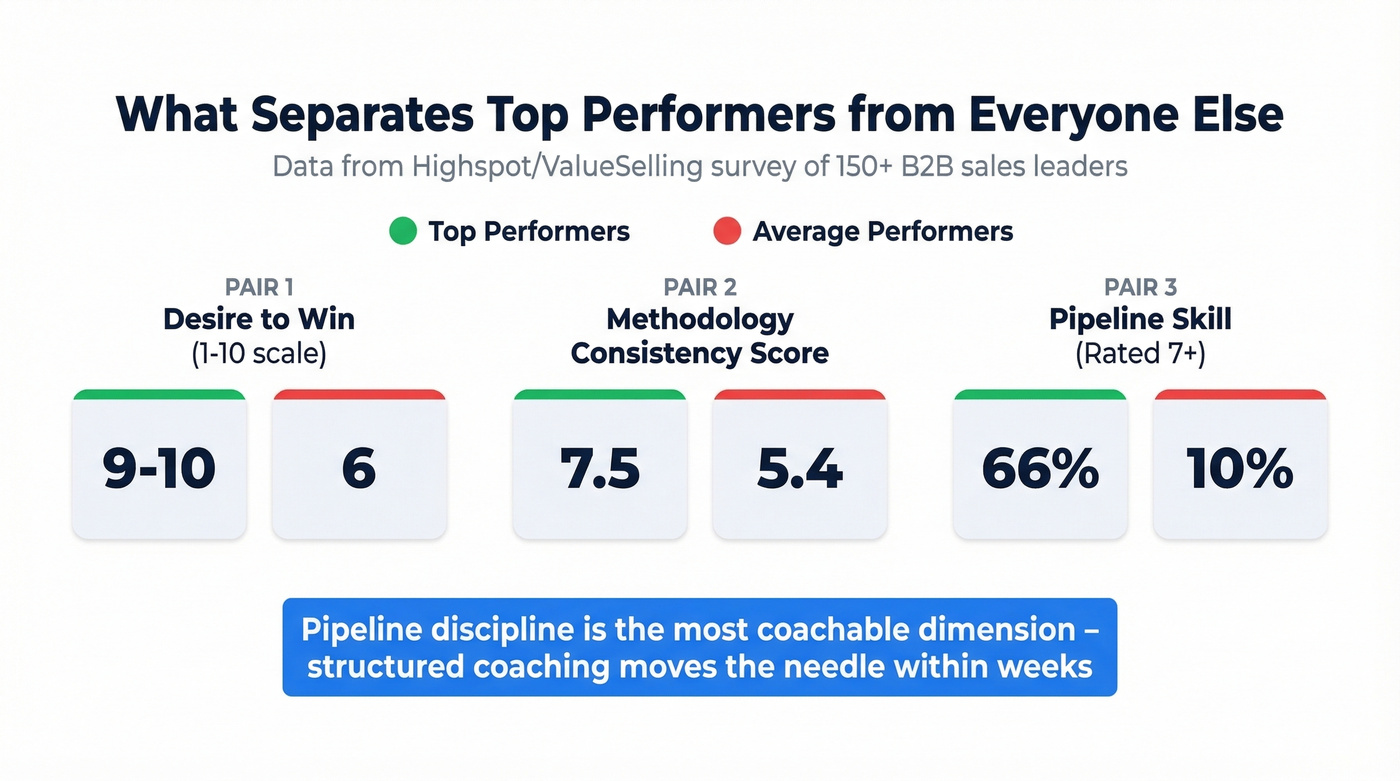
| Dimension | Top Performers | Average Performers |
|---|---|---|
| Desire to win (1-10) | 9-10 | 6 |
| Methodology score | 7.5 | 5.4 |
| Pipeline skill (rated 7+) | 66% | 10% |
That pipeline skill gap is staggering. Two-thirds of top performers are rated 7+ on pipeline building, while only 10% of average performers hit the same bar. In our experience, pipeline discipline is the most coachable of the three dimensions - desire is hard to teach, but structured coaching moves the needle on pipeline habits within weeks. The real challenge is figuring out how to scale winning habits across your entire sales floor, not just your top three reps. (If you want a measurement layer for this, use a pipeline health scorecard.)
On the hiring side, SalesFuel surveys show 29% of sales managers say mindset and motivation outweigh skill set when hiring, and 46% use behavioral assessments before making offers. The industry is slowly catching up to what the data has been saying: behaviors predict performance better than resumes.
How to Measure Sales Behaviors
You can't coach what you can't see. Here's a practical KPI framework separating leading indicators from lagging ones.
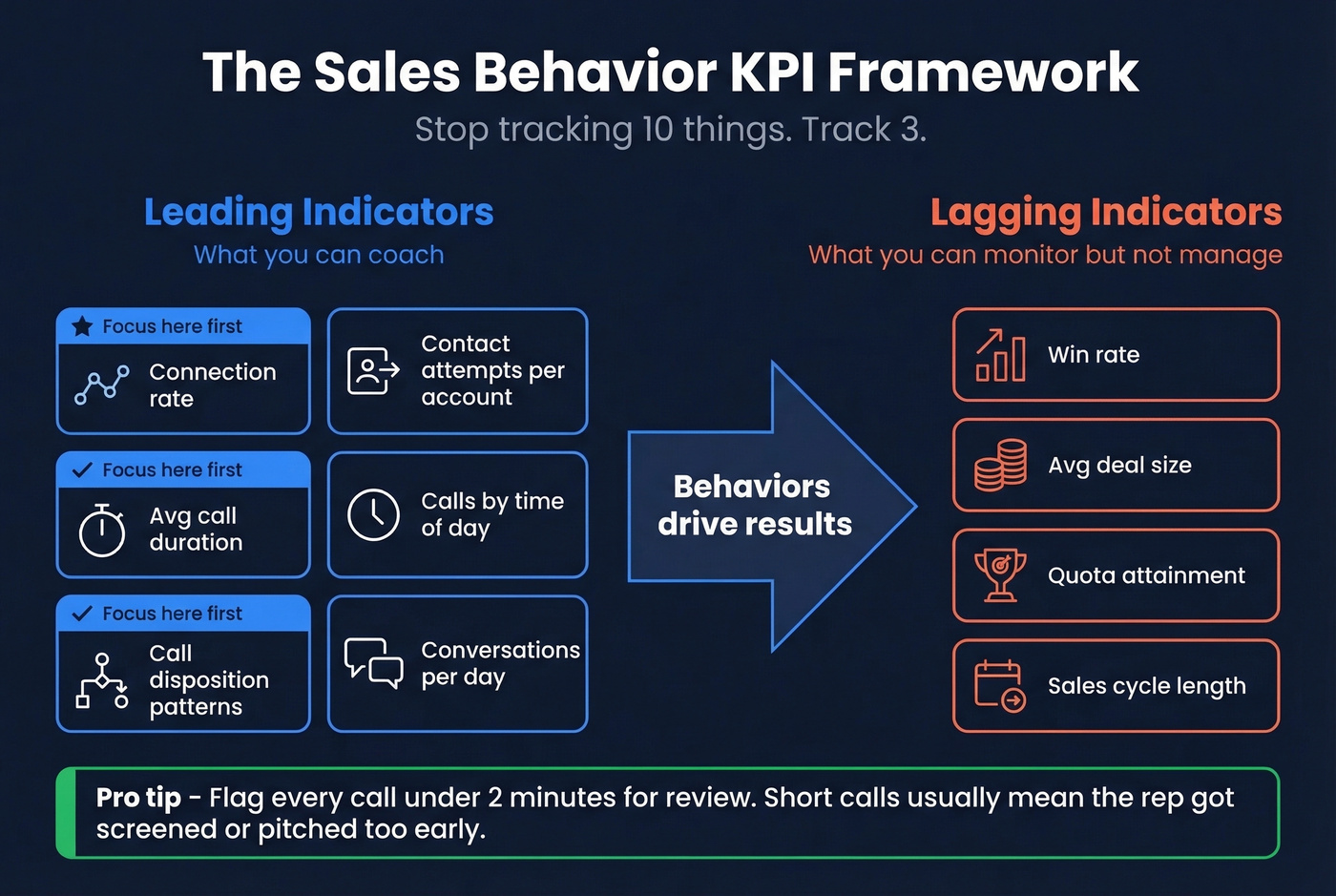
| Metric | Type |
|---|---|
| Dials per day | Leading |
| Emails per day | Leading |
| Conversations per day | Leading |
| Avg call duration | Leading |
| Contact attempts per account | Leading |
| Calls by time of day | Leading |
| % dials to connection | Leading |
| Call disposition tracking | Leading |
| Win rate | Lagging |
| Avg deal size | Lagging |
| Quota attainment | Lagging |
| Sales cycle length | Lagging |
Stop tracking 10 things. Track 3.
Pick the three leading indicators most correlated with your lagging results, and coach those relentlessly. For most outbound teams, that's connection rate, average call duration, and call disposition patterns. Everything else is noise until those three are healthy.
A practical tip: flag every call under 2 minutes for review. Short calls usually mean wrong number, gatekeeper rejection, or a rep who didn't earn the first 30 seconds. Disposition tracking tells you which one - and each has a different coaching fix.
Driving Behavior Change in Sales Teams
Most sales coaching is just pipeline interrogation. "When is this closing?" and "What's the next step?" aren't coaching questions. They're audit questions.
Real behavior coaching starts with a diagnostic. Lewin's equation - B = f(P, E) - is the simplest useful framework: behavior is a function of the person and their environment. When a rep isn't executing, ask two questions. Is this a skill gap? Or is this an environmental barrier - tools, process, incentives?
A rep who doesn't verify contact data before outreach might not know how, might lack a verification workflow, or might have no incentive because nobody tracks it. Each requires a different intervention. Most managers default to "try harder," which addresses none of the three.
Once you've diagnosed the gap, the execution framework is Measurement + Feedback + Positive Reinforcement. Measure the behavior (not just the result), give feedback within 24 hours, and reinforce immediately when you see it done right. Positive, immediate, certain reinforcement drives behavioral change faster than any training program. Vague future consequences - "you might miss quota next month" - barely register.
We've seen teams stabilize new behaviors in 4-8 weeks when managers reinforce daily. Your top rep just left and nobody can replicate their results? That's a sign you were managing outcomes, not coaching behaviors.
One more thing worth saying plainly: if your deals close in under two weeks, you probably don't need a complex methodology. You need three things - verified data, a tight 30-second opener, and the discipline to prospect every single day. The behavioral science frameworks matter most for complex, multi-stakeholder deals. For transactional sales, consistency beats sophistication every time.
Data hygiene is a sales behavior, not an ops afterthought. Prospeo's 7-day refresh cycle and 98% email accuracy mean your reps never burn hours on dead contacts. Meritt cut bounce rates from 35% to under 4% and tripled pipeline.
Verify before you dial. Every email costs just $0.01.
FAQ
What's the difference between sales behaviors and sales activities?
Activities are countable outputs - dials, emails, meetings booked. Behaviors are the qualitative how behind those outputs: researching before a call, listening in discovery, verifying data before outreach. Activities measure volume; behaviors measure quality. Coach both, but prioritize behaviors for lasting performance gains.
How long does it take to change a sales behavior?
Four to eight weeks with weekly coaching and consistent positive reinforcement. Immediate feedback is the key variable - change stalls when managers only review performance in monthly one-on-ones instead of reinforcing daily. Teams using daily 5-minute check-ins see 2x faster adoption of new habits.
What are the most important sales behaviors for SDRs vs. AEs?
SDRs should focus on signal-based prospecting, data verification before outreach, and consistent daily cadence. AEs benefit most from active listening in discovery, ROI-based value messaging, and methodology execution. Both roles improve with stronger internal networking.
How do you measure sales behaviors in a CRM?
Track connection rate, average call duration, contact attempts per account, and call disposition. Flag calls under 2 minutes for coaching review. Aim for 8-12 behavioral metrics feeding into 2-3 result metrics - more than that creates dashboard fatigue without improving outcomes.
What role does data quality play in sales performance?
Data quality is the foundation every other selling habit sits on. Bad data means bounced emails, wrong numbers, and damaged domain reputation. One client saw bounce rates drop from 35% to under 4% after switching to weekly-refreshed verified contacts, and their pipeline tripled in the same period. Clean data turns outreach from a liability into a pipeline engine.