

Sales Best Practices Backed by Data, Not Platitudes
84% of reps didn't hit quota last year. The largest group of teams sat in the 21-25% win-rate bracket. And 96% of your buyers have already researched your product before you ever get a conversation.
The generic advice - "build rapport and follow up" - isn't cutting it. It probably never was.
Meanwhile, 69% of cold email senders report performance declining year-over-year. Spam filtering is tighter, buyers are more skeptical, and AI-generated content fatigue is compressing results across every channel. What actually moves numbers is specific, measurable, and sometimes counterintuitive. The practices below come from real datasets: 150,000+ analyzed deals, 11M+ cold emails, 35,000+ sales calls studied, and benchmarks from Outreach, Bain, Corporate Visions, HubSpot, Salesforge, and OMG.
The Five-Minute Version
If you read nothing else, do these five things:
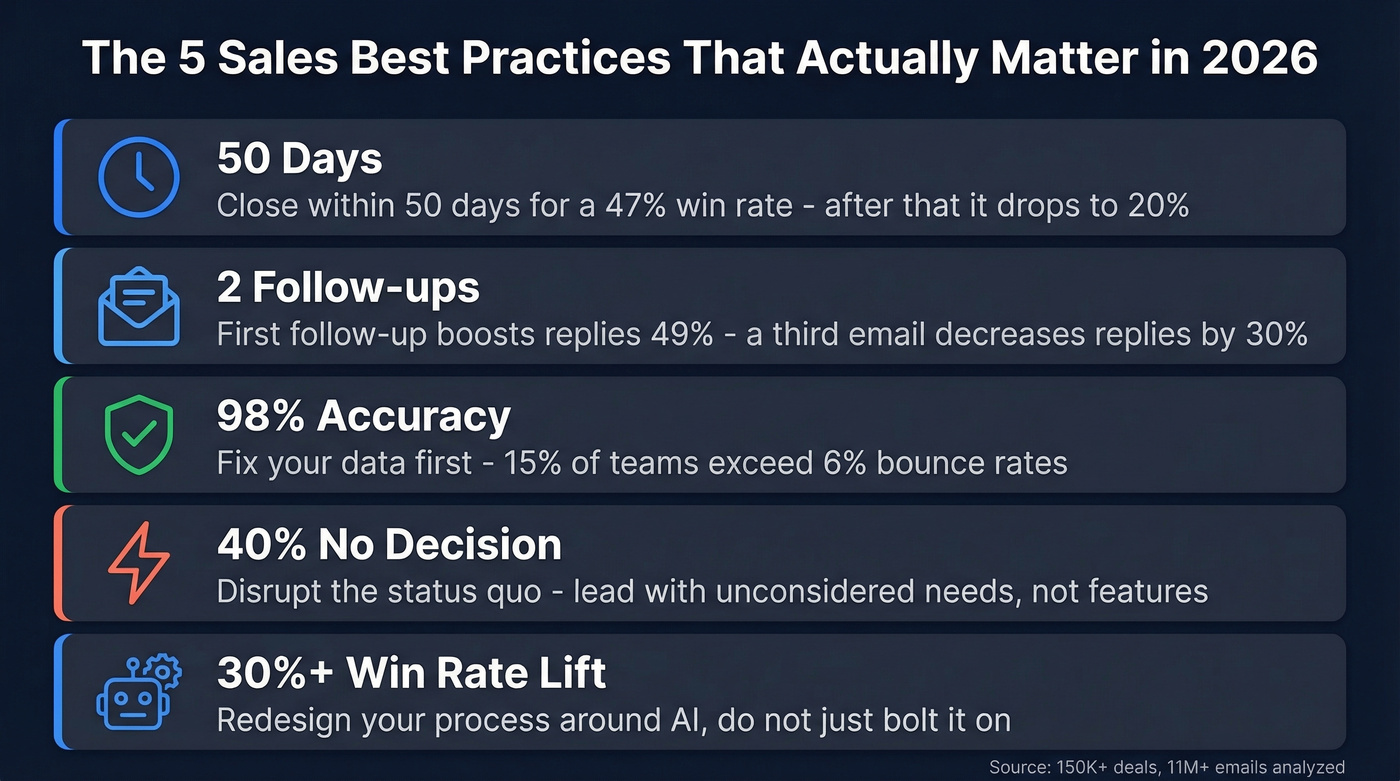
- Close within 50 days. Opportunities that close in under 50 days hit a 47% win rate. After that, you're looking at ~20% or lower.
- Send two follow-ups, not five. The first follow-up boosts reply rates by 49%. A third follow-up actually decreases your chances by 30%. (If you need copy, use proven follow-ups.)
- Fix your data first. 15% of teams exceed a 6% bounce rate. Verify every list before sequencing - bad data silently destroys everything downstream. Use an email deliverability checklist, not vibes.
- Disrupt the status quo. 40% of your pipeline will end in "no decision." Lead with unconsidered needs, not feature comparisons.
- Let AI redesign the process. Early adopters report 30%+ win-rate improvements, but only when they rethink the workflow end-to-end, not just bolt on automation.
12 Practices That Move Numbers
Know What Your Buyer Already Knows
96% of prospects research your company before they ever talk to a rep. 71% actively prefer independent research over a sales conversation. By the time you get on a call, your buyer has already read your pricing page, skimmed your case studies, and compared you to two competitors.
Stop repeating what's Googleable. Map every piece of public information about your solution and prepare insights they can't find on their own - internal benchmarks, implementation nuances, industry-specific use cases. That's where the conversation should start.
Pick a Framework and Use It
Some experienced reps argue frameworks are overrated - and they're half right. Frameworks without implementation are theater. But frameworks with discipline are the difference between repeatable success and winging it.
SPIN Selling was built from 35,000+ sales calls across 20+ countries. The Challenger Sale came from research on 6,000 reps across 90 companies. MEDDIC has been the enterprise qualification standard for decades. Match framework to deal complexity: SPIN for consultative sales, Challenger for competitive markets with skeptical buyers, MEDDIC for enterprise deals with multiple stakeholders. Then create question banks per persona and drill them in role-plays. The framework doesn't matter nearly as much as whether your team actually uses it consistently, which is where most organizations fall apart.
Close Fast or Lose Slowly
The data is unambiguous: opportunities closed within 50 days show a 47% win rate. Past that threshold, win rates crater to ~20% or lower. In our experience, deals that stall past 50 days rarely recover - they just consume forecast space.
Set a 50-day pipeline hygiene checkpoint. Every deal that crosses that line gets re-qualified or killed. This feels brutal, but it frees your reps to work opportunities with actual momentum. Add pipeline visibility into your weekly reviews: if a deal has no next step scheduled, it's already dead.
Master the Follow-Up Curve
The first follow-up email boosts reply rates by 49%. The second adds a marginal 3%. And a third follow-up actually decreases your chance of a reply by 30%.
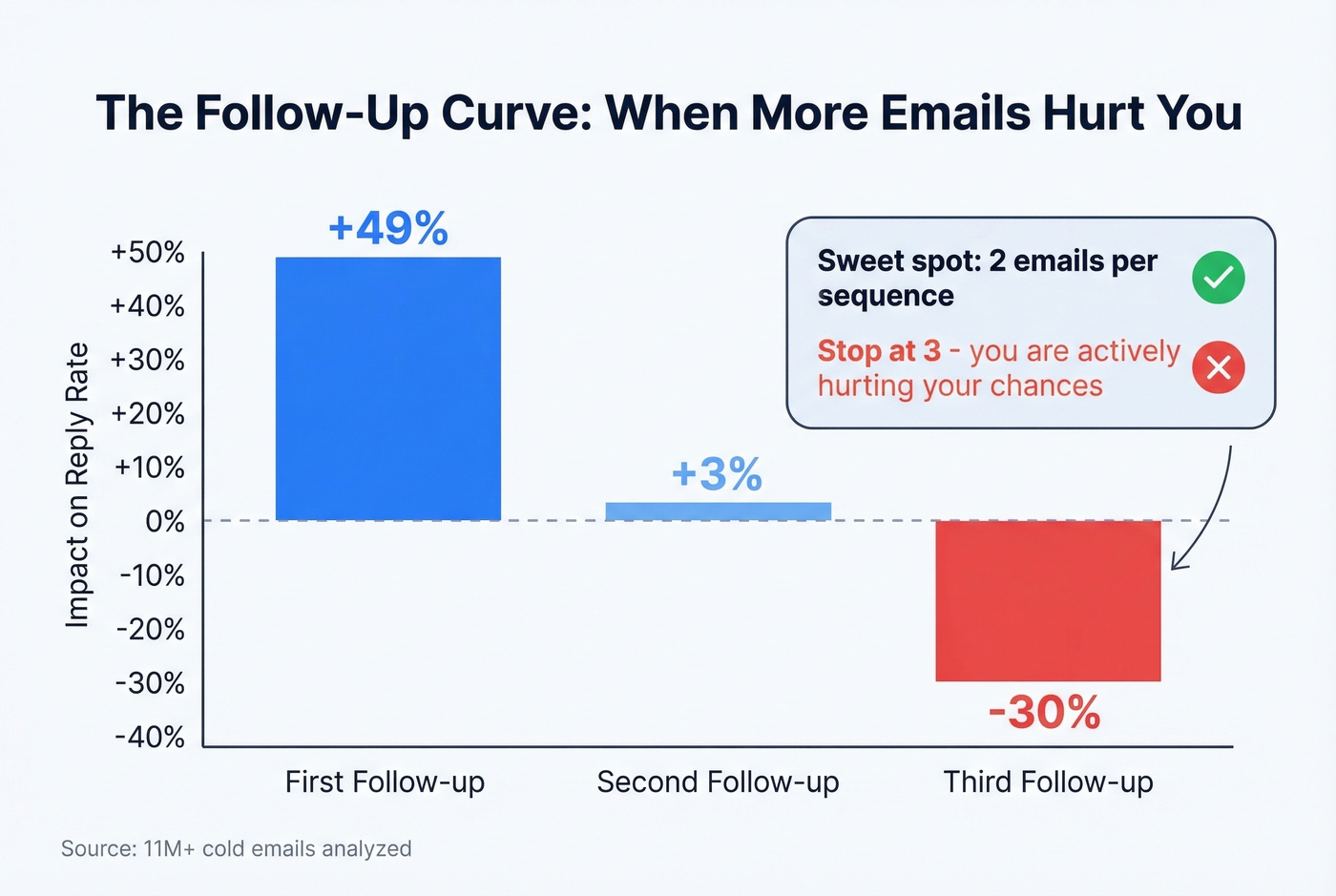
That's not a typo.
Two emails per sequence is the right cadence for most outbound. After that, redirect energy to new prospects instead of hammering the same inbox. Your time is better spent opening new doors than knocking harder on closed ones. (If you're benchmarking, track your follow-up email reply rate by segment.)
Fix Your Data Before Anything Else
Every other practice on this list falls apart if you're emailing bounces. 48% of teams report 2-5% bounce rates, and 15% exceed 6%. Domain reputation damage is cumulative - once mailbox providers flag your sending domain, deliverability tanks across every campaign.
We've seen teams triple their pipeline just by fixing bounce rates. Prospeo's 98% email accuracy and 7-day refresh cycle catch bad addresses, spam traps, and honeypots before they hit your sequences. One customer, Meritt, went from a 35% bounce rate to under 4% after switching, and their pipeline tripled from $100K to $300K per week. Treat data quality as sales enablement infrastructure, not a nice-to-have. (If you need a baseline, start with email bounce rate benchmarks and fixes.)

Personalize at Scale Without Overdoing It
71% of decision makers ignore cold emails that aren't relevant. Only 5% of senders personalize every email individually - the rest use segment-based templates, which is the right call. But there's a ceiling.
Reply rates drop when your segmented list exceeds 100 people. More than 5 personalization variables actually backfires - the email starts feeling like a Mad Lib instead of a message. Keep segments under 100, use 2-3 personalization variables max, and remember that recipients spend about 5-7 seconds scanning before they decide to engage or delete. You're earning the next 5 seconds, not writing a novel. (For a system, use intent based segmentation.)
Go Omnichannel or Go Home
61% of decision makers prefer cold email. 10% prefer cold calls. Cold call connect rates hover around 3% in 2026, while multi-channel sequences consistently outperform single-channel approaches.
Build sequences that layer email, calls, and social touches. Adjust the channel mix by vertical and buyer preferences - strict industries like cybersecurity often respond better to tighter, email-first cadences. The consensus on r/sales is pretty clear: grinding a single channel is a losing strategy when buyers are spread across multiple platforms and have different communication preferences depending on their role and seniority. (If you need more ideas, pull from these sales prospecting techniques.)
Use Custom Domains for Outbound
Emails from custom domains get almost twice the reply rate compared to generic Gmail addresses. This is one of the highest-return, lowest-effort changes you can make.
Set up dedicated sending domains - yourcompany-outreach.com, not your primary domain. Warm them up properly: 25 outreach emails plus 5 warm-up messages per day is a solid starting ratio. Stick with credible TLDs like .com, .io, and country-code domains, which outperform unusual extensions. (Also watch your email velocity so you don't spike risk.)
Disrupt the Status Quo
At least 40% of pipeline deals end in "no decision" - not a competitor win, not a budget cut, just inertia.
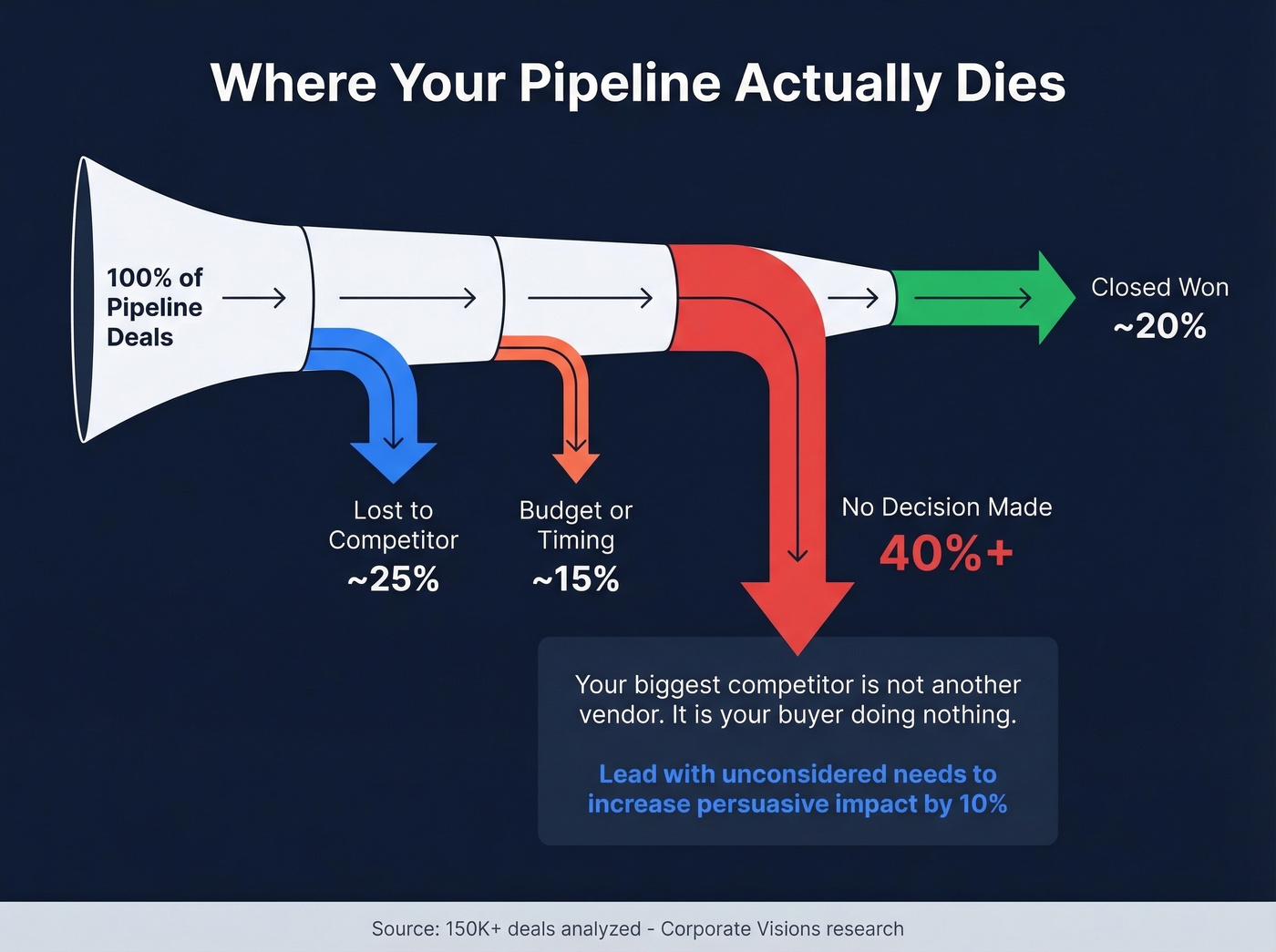
Here's the thing: if your average deal size is under five figures, "no decision" is probably killing more deals than any competitor on your battlecard. Research across 150,000+ deals shows that introducing "unconsidered needs" - problems the buyer hasn't identified yet - increases persuasive impact by 10% versus validating needs they already know about. Lead with contrast. Quantify the cost of doing nothing. Make the status quo feel riskier than change. (This is where strong sales communication wins deals.)
AI: Redesign, Don't Automate
45% of teams already use a hybrid AI-SDR model. Sellers using AI tools cut research and personalization time by 90%. But most teams go wrong by automating a broken workflow and just producing broken results faster.
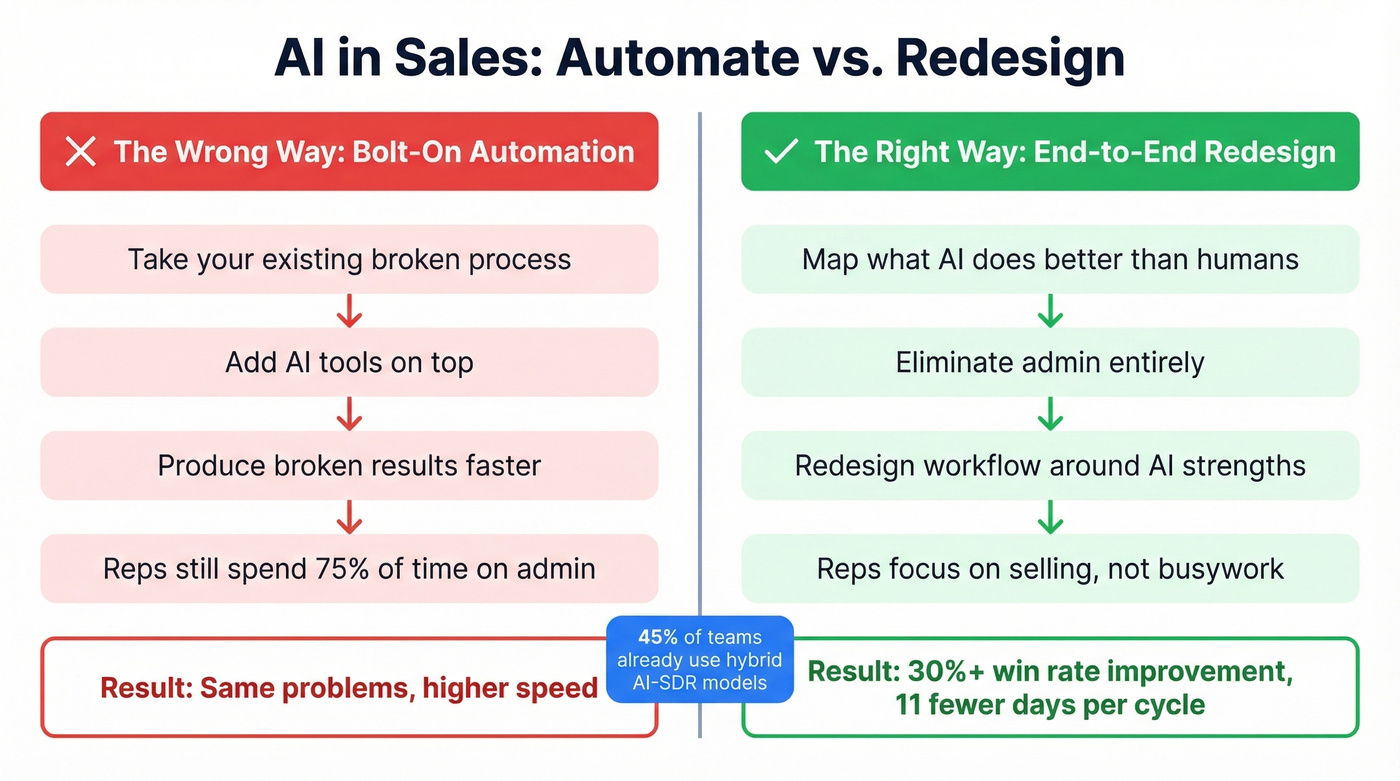
Bain's research is clear: meaningful gains come from reimagining end-to-end sales processes, not bolting AI onto existing ones. Sellers currently spend only about 25% of their time actually selling. The opportunity isn't "make reps faster at admin" - it's "eliminate the admin entirely and redesign around what AI does well." Early adopters who've done this report 30%+ win-rate improvements and 11 days shaved off average sales cycles. Skip this practice if your team hasn't nailed the basics yet - AI amplifies whatever process you already have, good or bad. (If you're building the stack, start with an AI sales follow-up workflow.)
Invest in Training
For every $1 spent on sales training, companies see $4.53 in return. Yet average spend sits below $2,000 per rep. Meanwhile, 30% of teams rely on a single salesperson for more than half their revenue, and the performance spread between top and bottom producers runs 10x.
That concentration risk is a ticking time bomb. Structured onboarding cuts ramp time by up to 34% and retains 50% more new hires. Budget $2K+ per rep minimum - and if you're serious, the math supports spending far more. Moving a mediocre rep from $300K to $600K in annual production justifies significant investment. (Pair this with a real 30-60-90 day plan for new reps.)
Build Trust, Not Urgency
Fake scarcity, manufactured urgency, aggressive social proof - these tactics backfire with sophisticated B2B buyers. One sales leader documented replacing urgency-based CTAs with data-backed proposals and tailored value maps. The result: a 20% win-rate lift over two quarters.
Only 18% of buyers believe salespeople are well-prepared. The bar is embarrassingly low. Show up with research, listen before you pitch, and replace pressure with proof. Trust compounds. Manipulation doesn't.

You just read it: 15% of teams exceed 6% bounce rates, and bad data silently kills every practice on this list. Prospeo's 98% email accuracy and 7-day refresh cycle caught what other providers missed - Meritt went from 35% bounces to under 4% and tripled pipeline to $300K/week.
Fix the foundation before you optimize anything else.
What to Stop Doing
Stop trusting open and click tracking. Open/click tracking hurts deliverability for cold outbound. Practitioners on r/sales consistently flag this - the metrics look good while your domain reputation quietly tanks. Turn them off for cold sequences. (If you want the technical why, read about the email tracking pixel.)
Stop sending three-plus follow-ups. The data says the third email hurts you. Two touches, then move on.
Stop pitching before listening. Sending a pitch deck two minutes into a call is the fastest way to lose a deal. Establish context, ask questions, then present your solution.
Stop relying on fake urgency. "Only 3 spots left" and "offer expires Friday" trigger skepticism in sophisticated B2B buyers. Lead with value, not pressure.
Stop talking to the wrong stakeholder. Deals involve more decision-makers than ever. If you're pitching the end user but the economic buyer is someone else entirely, you're burning cycles on a deal that'll stall at the finish line. Map the buying committee early or pay for it later.
Quick-Reference Table
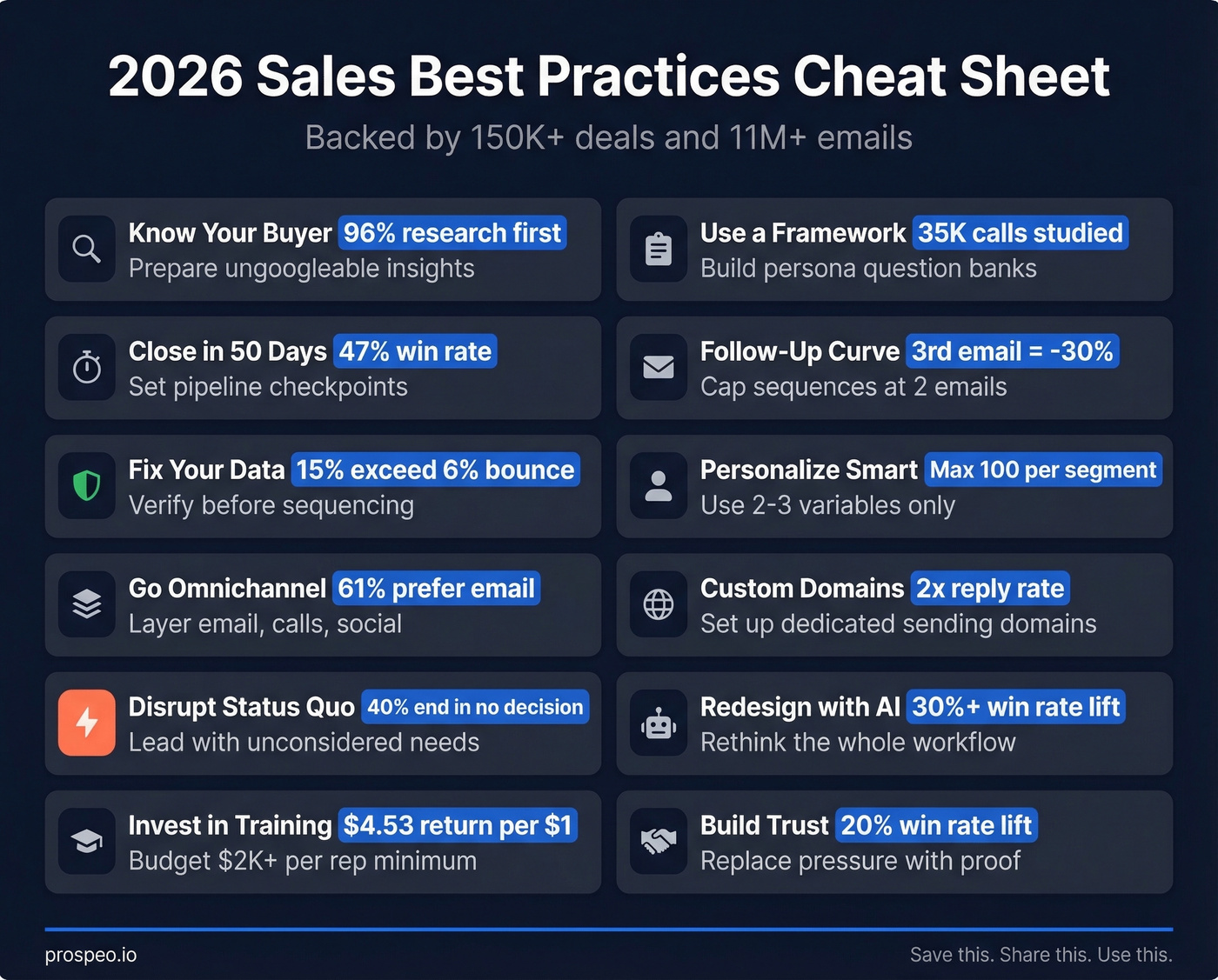
| Best Practice | Key Stat | One Action |
|---|---|---|
| Know your buyer | 96% research first | Prepare ungoogleable insights |
| Use a framework | SPIN: 35K calls studied | Build persona question banks |
| Close within 50 days | 47% vs ~20% win rate | Set pipeline checkpoints |
| Follow-up curve | 3rd email = -30% replies | Cap sequences at 2 emails |
| Fix your data | 15% exceed 6% bounce | Verify before sequencing |
| Personalize smartly | 71% ignore irrelevant | Segments under 100 |
| Go omnichannel | 61% prefer email | Layer email + call + social |
| Custom domains | ~2x reply rate | Warm up dedicated domains |
| Disrupt status quo | 40% end in "no decision" | Lead with cost of inaction |
| AI process redesign | 30%+ win-rate lift | Redesign, don't just automate |
| Invest in training | $4.53 per $1 spent | Budget $2K+ per rep |
| Build trust | 20% lift dropping urgency | Replace pressure with proof |
Closing within 50 days requires reaching real buyers fast. Prospeo gives you 300M+ profiles with 30+ filters - buyer intent, job changes, technographics - so reps spend time selling, not hunting. Teams book 26% more meetings versus ZoomInfo at 90% lower cost.
Stop losing deals to slow prospecting and stale contact data.
FAQ
What's the most important practice for outbound teams?
Data quality. Your cadence, script, and value prop don't matter if 15% of your emails bounce. Verify every list before sequencing - tools with multi-step verification catch spam traps and honeypots before they damage your sending domain. Everything else builds on clean data.
How many follow-up emails should I send?
Two. The first follow-up boosts reply rates by 49%, the second adds 3%, and a third actually decreases your chances by 30%. Redirect that energy to new prospects instead of hammering contacts who aren't responding.
Which sales methodology should I use?
Match to deal complexity. SPIN Selling works for consultative sales where discovery drives the deal. Challenger fits competitive markets with skeptical buyers. MEDDIC is the standard for enterprise deals with multiple stakeholders and long qualification cycles.
Does AI actually improve sales outcomes?
Yes - early adopters report 30%+ win-rate improvements per Bain's research. But only when AI redesigns the process end-to-end. Automating a broken workflow just produces broken results faster. Start by eliminating admin work, not speeding it up.
How fast should I close deals?
Aim for under 50 days. Opportunities closed within that window hit a 47% win rate. Past that threshold, win rates drop to ~20% or lower. Set pipeline hygiene checkpoints to kill or re-qualify stalled deals before they drag down your forecast.