

The Complete Sales Deal Guide: From First Touch to Signed Contract
Closing is maybe 10% of a sales deal. Qualification, discovery, and data quality are the other 90% - and most reps have it backwards. 84% of sales reps missed quota last year, sales cycles are running 21% longer than they were in 2020, and the average rep spends only a third of their time actually selling. The deals that close aren't won by slick closing techniques. They're won by reps who run a disciplined process from first touch to signed contract.
A sales deal is the full journey from first contact to signed contract. Most B2B deals take 60-120 days. The biggest lever is qualification - MEDDIC users see 20-30% higher close rates. The biggest killer is bad data upstream: bounced emails and disconnected numbers mean the deal never starts.
What Is a Sales Deal?
A sales deal is the structured process of moving a buyer from initial interest to a signed agreement. It's not just the moment someone says "yes" - it's every interaction, qualification step, and negotiation that gets you there.
Deals come in different shapes. One-time transactional deals - a single software license, a consulting engagement - close fast and involve fewer stakeholders. Recurring deals, the SaaS bread and butter, require proving ongoing value and often involve procurement, legal, and finance. Enterprise deals layer on complexity with multiple decision-makers, custom scoping, security reviews, and contract redlines that can stretch timelines past six months.
For context on deal size, the median private SaaS deal lands around $26,265. SMB deals typically run in the low four-to-five figures, mid-market sits in the mid five figures, and enterprise deals regularly clear six figures. The size of the deal dictates everything downstream - cycle length, stakeholder count, and how much process you need to wrap around it.
The Deal Lifecycle: Six Stages
Every deal follows roughly the same arc, whether you're selling a $5k tool or a $500k platform. The stages compress or expand based on deal complexity, but the sequence holds.
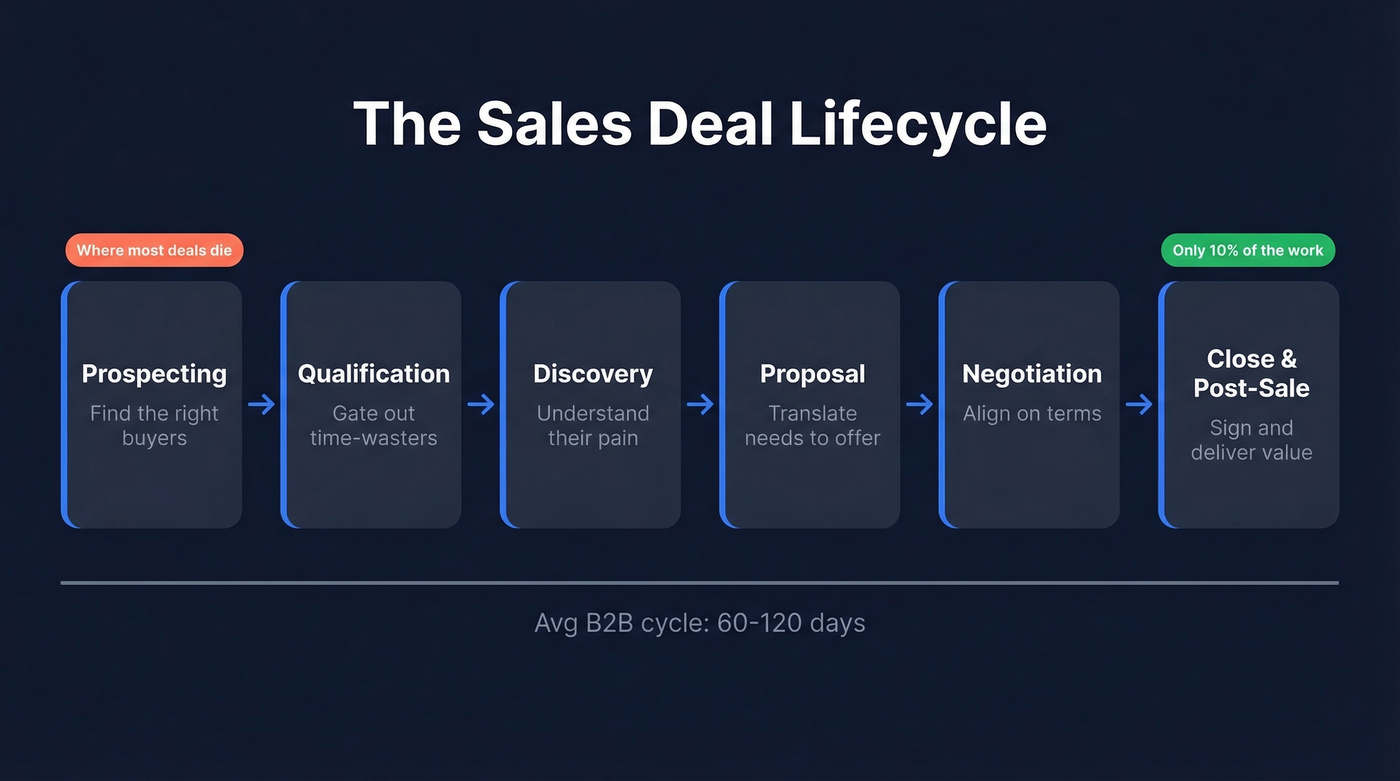
Prospecting
This is where deals are born - or never born at all. Prospecting means identifying potential buyers who fit your ICP and getting their attention through cold outreach, inbound response, or warm introductions. The quality of your prospect list determines everything downstream. If you're reaching out to the wrong people with bad contact data, you're burning cycles before the opportunity even exists.
Top prospecting teams use intent signals, job-change alerts, and technographic filters to prioritize accounts that are actually in-market. Spray-and-pray died years ago. If you want a tighter system, start with proven prospecting techniques.
Qualification
Not every prospect deserves a demo. Qualification is the gate that separates real opportunities from time-wasters, and it's where frameworks like BANT and MEDDIC earn their keep - they give you a structured way to assess whether a prospect has the budget, authority, need, and timeline to actually buy.
Here's the thing: 28% of prospects say the sales process takes too long. Qualification isn't just about protecting your time. It's about respecting theirs. For enterprise motions, use a dedicated MEDDIC sales qualification workflow.
Discovery
Discovery is where you earn the right to propose a solution. The goal isn't to pitch - it's to understand the prospect's pain, their current state, and what success looks like. 57% of the buying journey is completed before a prospect ever talks to sales, so by the time you're in a discovery call, they already have opinions. Your job is to uncover what those opinions are and where the gaps exist.
Top closers speak about 43% of the time versus 65% for average performers. We've watched reps blow six-figure deals by delivering a 20-minute monologue when the buyer just wanted to be heard. Use sharper discovery questions to keep the call buyer-led.
Proposal
The proposal stage is where you translate discovery into a concrete offer - scope, pricing, timeline, and expected outcomes. A common mistake: sending a proposal into a vacuum. If you haven't confirmed the decision criteria, identified the economic buyer, and aligned on next steps, your proposal is just a PDF sitting in someone's inbox. The proposal-stage win rate across industries averages 47% - meaning more than half of deals that reach this stage still die.
Negotiation
Negotiation doesn't start when procurement sends a redline. It starts in discovery, when you frame budget expectations and position value. By the time you're at the contract stage, the negotiation should be about details - not whether the deal makes sense. If you want a deeper breakdown, the concept of an anchor in negotiation is one of the highest-leverage skills to master.
Close & Post-Sale
Closing is the formal act of getting the signature. But the deal doesn't end there. Post-sale onboarding, time-to-value, and early wins determine whether this becomes a renewal, an expansion, or a churn stat. The best reps stay involved through implementation because a smooth handoff protects the relationship and often protects expansion and renewal outcomes down the line.
How to Qualify Deals With BANT and MEDDIC
If you're spending all your energy on closing techniques and none on qualification, you're treating symptoms. Qualification is where deals are actually won or lost.
BANT: The Baseline
BANT - Budget, Authority, Need, Timeline - is the simplest qualification framework and works well for velocity deals. Does the prospect have budget? Can they make the decision? Do they have a real problem? Is there a timeline driving urgency? If you can't answer yes to at least three of these, the deal probably isn't real.
BANT is fast and practical for SMB and mid-market deals. For anything with multiple stakeholders or a six-figure price tag, you need more structure.
MEDDIC: The Enterprise Standard
MEDDIC originated at PTC in the 1990s and has become the default qualification framework for complex B2B sales. The components: Metrics - the quantified business impact. Economic Buyer - the person with budget authority. Decision Criteria - how they'll evaluate options. Decision Process - the steps to get a deal signed. Identify Pain - the specific problem driving urgency. Champion - your internal advocate.
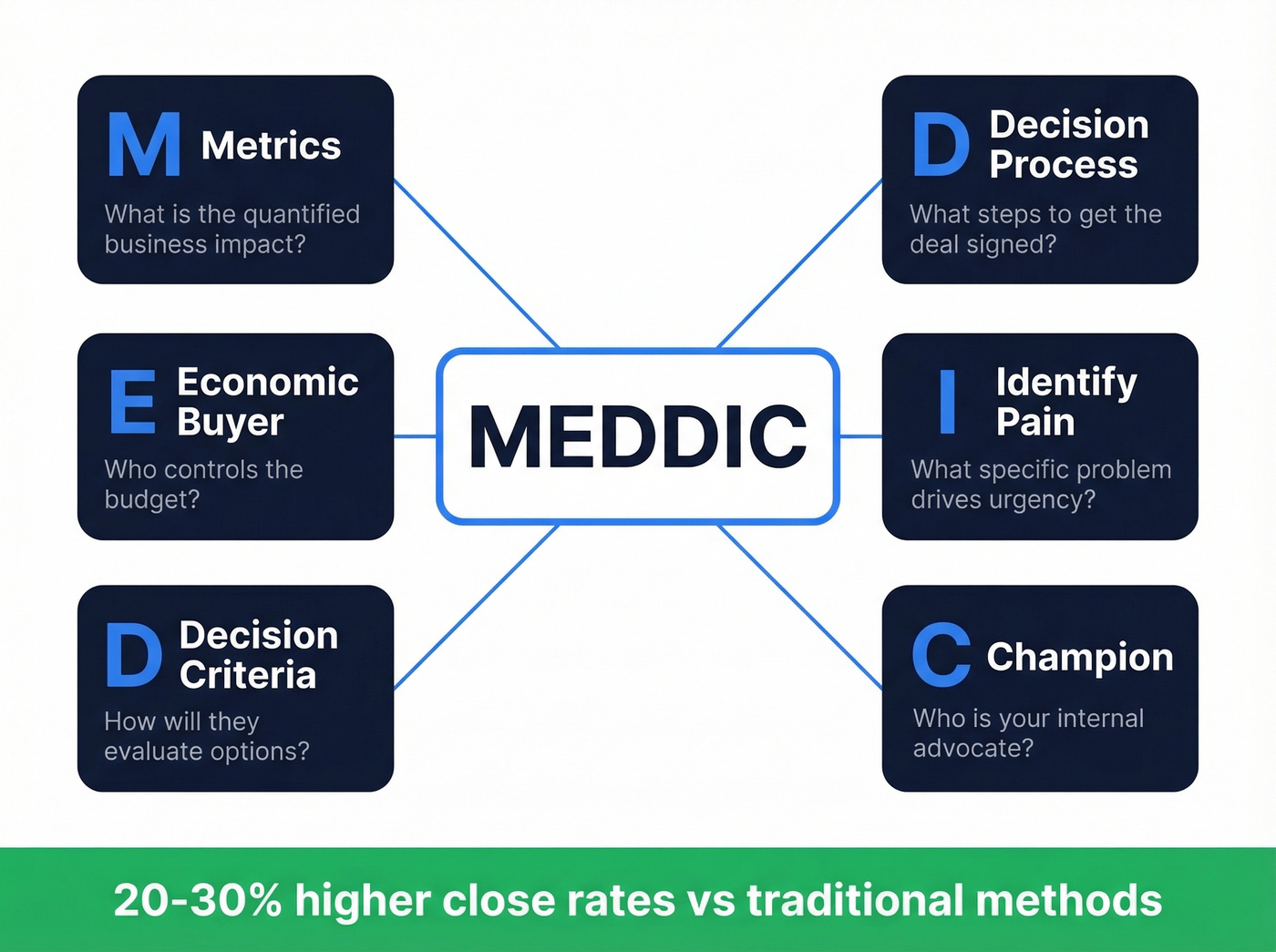
MEDDIC isn't optional for enterprise deals. Companies adopting it report 20-30% higher close rates versus traditional methods, and some SaaS companies saw 15% win-rate increases within the first year of implementation. If you need prompts for calls, keep a bank of MEDDIC discovery questions.
The most common failure mode we see: reps who can fill in the MEDDIC fields on paper but haven't actually validated them with the prospect. Knowing the economic buyer's name isn't the same as having a relationship with them.
Benchmarks: Cycle Length & Close Rates
These benchmarks pull from multiple published datasets so you can sanity-check your forecasts and spot where deals are getting stuck.
Cycle Length by Industry
Cycle-length benchmarks sourced from Focus Digital's dataset.
| Industry | Avg. Total Days |
|---|---|
| Retail | 70 |
| Software | 90 |
| Manufacturing | 130 |
| Energy | 155 |
| Non-Profit | 162 |
Software deals move fastest because buyers are familiar with the evaluation process and procurement is lighter. Manufacturing and energy deals involve technical validation, compliance reviews, and longer procurement cycles.
Cycle Length by Company Size
| Prospect Size | Avg. Total Days |
|---|---|
| 1-10 employees | 38 |
| 11-200 employees | 55-70 |
| 201-1,000 employees | 80-100 |
| 1,001-10,000 employees | 120-150 |
| 10,001+ employees | 185 |
More employees means more stakeholders, more approvals, and more time. A deal with a 10-person startup and a deal with a Fortune 500 company aren't the same sport.
Cycle Length by Deal Size (ACV)
| ACV Range | Avg. Total Days |
|---|---|
| Under $1k | 25 |
| $1k-$10k | 40 |
| $10k-$50k | 75 |
| $50k-$100k | 120 |
| $100k-$500k | 180 |
| Over $500k | 270 |
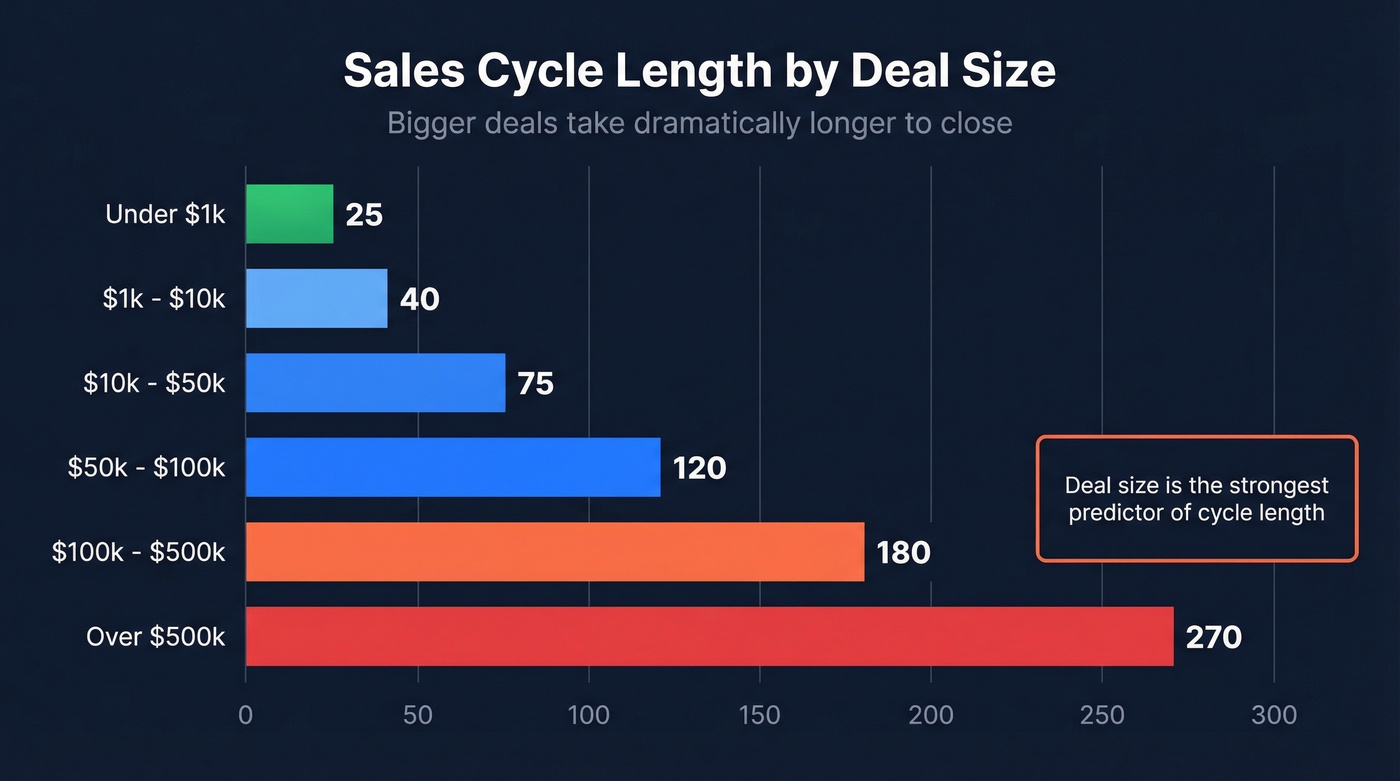
Deal size is the single strongest predictor of cycle length. If you're forecasting a $200k deal to close in 45 days, you're kidding yourself.
Close Rates by Industry
| Industry | Close Rate |
|---|---|
| Finance | 19% |
| Computer Software | 22% |
| Computers/Electronics | 23% |
| Business/Industrial | 27% |
The typical B2B win rate falls between 20-30%. That means you need 3x-5x pipeline coverage against quota to hit your number. If your pipeline coverage is below 3x, you don't have a closing problem - you have a pipeline problem. To pressure-test your numbers, compare against sales pipeline benchmarks.

Bad contact data kills deals before qualification even starts. Prospeo gives you 98% verified emails and 125M+ direct dials so every deal in your pipeline begins with a real conversation - not a bounced email.
Stop losing deals at the prospecting stage. Fix your data first.
Why Deals Die
Deals die from specific, preventable causes. Only 5% of B2B buyers say salespeople exceed expectations - most deals die from process failures, not product shortcomings. Here are the killers we see over and over:
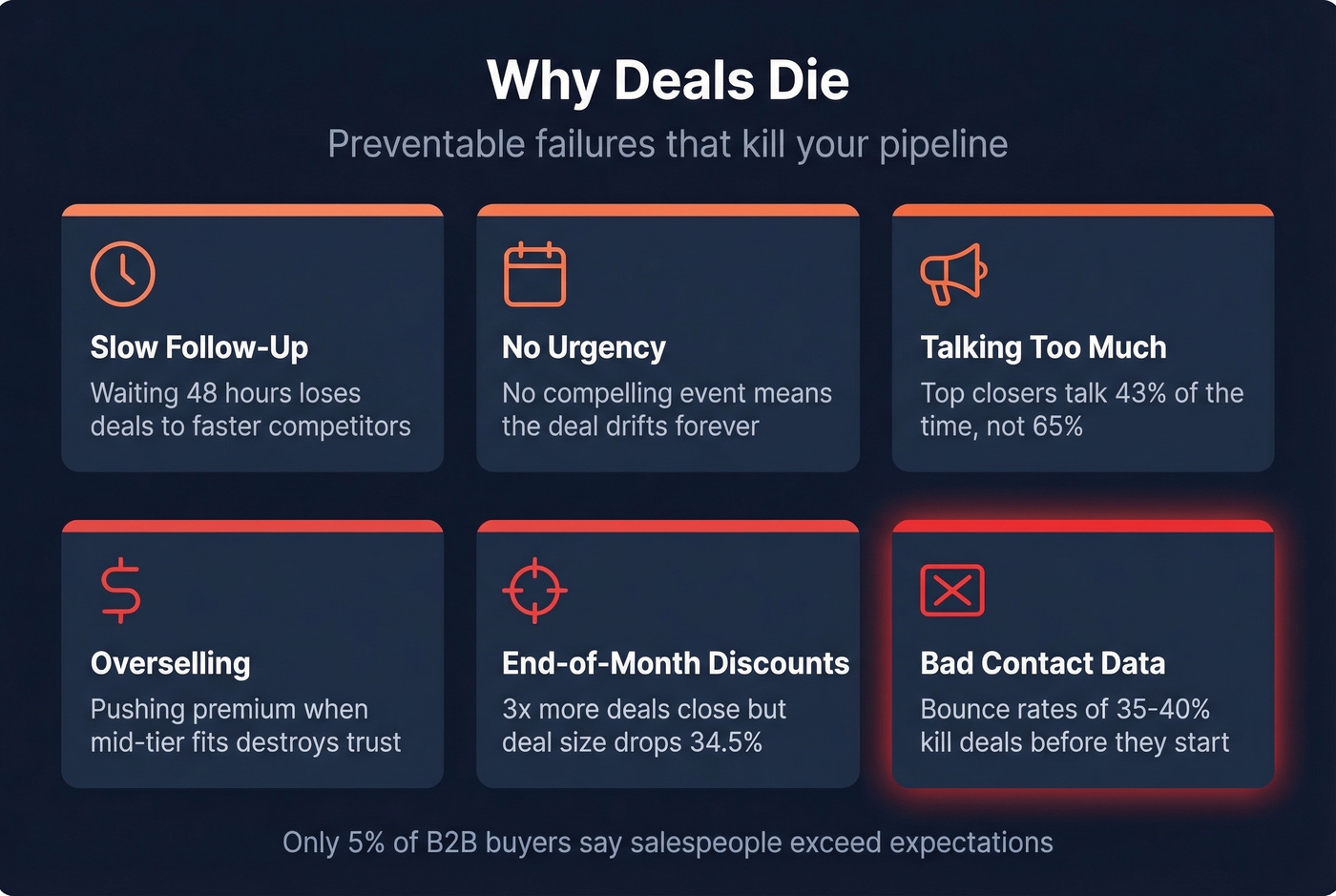
Slow follow-up. A prospect asks for pricing on Tuesday. You send it Thursday. By then, they've talked to your competitor. If you need copy you can deploy fast, keep sales follow-up templates ready.
No urgency. If there's no compelling event - a contract expiration, a board deadline, a budget cycle - the deal will drift. Your job is to find or create that urgency.
Talking more than listening. Reps who talk 65% of the time lose to reps who talk 43% of the time. Every time.
Overselling. Pushing the most expensive option when the prospect needs the mid-market package destroys trust faster than anything else.
Not knowing the competition. If a prospect mentions a competitor and you can't articulate your differentiation in 30 seconds, you've lost credibility. This is where a real competitive intelligence strategy pays off.
The end-of-month discount sprint. Reps close 3x as many deals at end of month, but average deal size drops 34.5%. You're training buyers to wait you out.
Let's be honest about the silent killer, though: bad contact data. Your rep books 40 meetings, 12 are no-shows, and 8 had wrong contact info. That's 20 wasted slots - half the calendar - before qualification even begins. When Snyk's 50-person AE team cleaned up their data pipeline, their bounce rate dropped from 35-40% to under 5%, and AE-sourced pipeline jumped 180%. None of the frameworks above matter if your outreach never lands. If you're seeing deliverability issues, start by tracking and fixing your email bounce rate.
Skip the six-figure data platform and the 12-step methodology if your average contract value sits below $10k. You need accurate contact data, a tight qualification framework, and a rep who can run a 30-minute demo without a script. Overengineering kills velocity deals just as surely as underengineering kills enterprise ones.
Anatomy of a Winning Deal
If you audit your closed-won deals from the last two quarters, you'll find the same elements present in every one. And if you audit your closed-lost deals, you'll find at least two missing. The pattern is that consistent. Every high-quality opportunity shares these non-negotiable traits:
A clearly identified economic buyer who has confirmed budget and timeline. An internal champion who is actively selling on your behalf when you're not in the room. Quantified pain - the prospect can articulate the cost of inaction in dollars, hours, or risk. A mutual action plan with concrete next steps and deadlines that both sides have agreed to. Multi-threaded relationships across at least two departments, so the deal doesn't die when one contact goes on vacation or changes roles.
Our team has found that the single best predictor of a deal closing is whether the champion can articulate your value proposition without you in the room. If they can't, you haven't done your job in discovery.
Negotiation Tactics That Protect Margins
Most reps treat negotiation as the uncomfortable conversation that happens when procurement sends a redline. That's too late. Negotiation starts in discovery, when you set budget expectations and position value against alternatives.
RAIN Group's research quantifies the gap: top negotiators are 12.5x more likely to be satisfied with outcomes and 3.1x more likely to achieve target pricing. The difference isn't talent - it's preparation.
I've watched reps give away 20% discounts in the first five minutes because they panicked. The antidote is knowing your walk-away point before the conversation starts. Four principles that consistently work:
Trade, don't cave. Every concession comes with a reciprocal ask - longer contract term, case study rights, faster payment terms.
Be willing to walk. Desperation is visible and kills leverage.
Build value before discussing price. Anchor to their pain and the cost of inaction, not to your list price.
Lead the negotiation. Set the agenda, propose terms, control the timeline. The person who frames the conversation wins it.
Closing Techniques That Work
Closing isn't magic. It's the natural conclusion of a well-run process.
The summary close. Recap every agreed-upon point, then ask for the signature. This works because it reminds the buyer of all the reasons they said yes throughout the process.
The assumptive close. Skip "would you like to move forward?" and go straight to "I'll send the contract this afternoon - should I CC legal?" Confidence is contagious.
The question close. "Is there anything preventing us from moving forward this week?" This surfaces hidden objections without being pushy.
The trial close. "Let's start with a 30-day pilot. If it doesn't deliver, we part ways." Lowers risk and gets the product in their hands.
The direct close. "Ready to sign?" Don't overthink it.
On timing: Tuesday is the best day to close, with ~20% higher success rates. Calls between 9-10am see 45% higher success. Schedule your closing conversations accordingly. If you want the full sequence, follow these steps to close a sale.
Tools That Keep Deals Moving
Every sales deal needs infrastructure. Here's what the stack looks like for most B2B teams.
CRM. Salesforce plans start around $25/user/month and scale up by edition. HubSpot has a free CRM, with paid Sales Hub tiers that scale by seat. Pipedrive runs around $15-$100/user/month depending on tier. If you're evaluating options, see real examples of a CRM.
Sales engagement. Outreach and Salesloft handle sequencing and activity tracking. Gong records and analyzes calls - invaluable for coaching reps on talk-to-listen ratios.
Data. This is where most teams underinvest, and it's the piece that makes or breaks everything upstream. Your CRM is only as good as the data inside it. Prospeo covers 300M+ profiles with 98% email accuracy and a 7-day data refresh cycle, starting free at roughly $0.01 per email with no annual contracts. Its 30+ search filters - including buyer intent powered by Bombora, technographics, and job-change signals - let you build prospect lists that actually match your ICP instead of spraying into the void. If you're comparing vendors, start with data enrichment services.

MEDDIC only works when you can actually reach the economic buyer. Prospeo's 30+ filters - including buyer intent, job changes, and department headcount - help you identify and connect with every stakeholder in a complex deal.
Reach every decision-maker in the deal for $0.01 per email.
FAQ
What's the average length of a B2B sales deal?
Most B2B deals close in 60-120 days, with the median SaaS cycle around 84 days. Enterprise deals with legal review often exceed 180 days. ACV is the strongest predictor - deals over $100k average 180 days.
What's a good close rate?
Typical B2B win rates fall between 20-30%. At the proposal stage, the average is 47%. If you're consistently above 30%, your qualification is either excellent or too conservative - meaning you're leaving pipeline on the table.
What is MEDDIC in sales?
MEDDIC is a deal qualification framework: Metrics, Economic Buyer, Decision Criteria, Decision Process, Identify Pain, Champion. Companies using it report 20-30% higher close rates versus traditional methods. It's the standard for complex enterprise deals with multiple stakeholders.
Why do deals fall through?
The most common killers are slow follow-up, no compelling event driving urgency, poor qualification, and bad contact data upstream. Fixing data quality alone - getting bounce rates under 5% and ensuring direct dials actually connect - eliminates the failures that kill deals before they start.
How can I shorten my sales cycle?
Qualify harder upfront with MEDDIC, multi-thread into multiple stakeholders early, use a mutual action plan with firm deadlines, and ensure your contact data is accurate so no meetings are lost to bounced emails or disconnected numbers. Teams that fix data quality alone often cut cycle times by 15-20%.