

The Sales Development Strategy Guide Most SDR Teams Actually Need
A real sales development strategy answers harder questions than "define your ICP" and "set SMART goals." It tells you how many touches before you're wasting time, what a ramped SDR actually costs per meeting, and whether AI agents should replace half your team.
Here's the thing most content gets wrong: sales strategy covers the full revenue cycle from prospecting to close, business development strategy focuses on partnerships and market expansion, but sales development is narrower and more tactical. It's the system that turns cold prospects into qualified pipeline for your closers. SDRs own top-of-funnel prospecting and qualification. AEs close deals. BDRs sometimes overlap with SDRs, sometimes focus on outbound-only motions. If your org doesn't have clear lines between these roles, that's your first problem. Let's fix the rest.
What You Need (Quick Version)
If you're short on time, here's the framework in five bullets:
- Set benchmarks before hiring. The median SDR books 8-10 qualified meetings per month. If you're expecting 20 from day one, you'll churn reps.
- Build a multi-channel cadence. 10-14 touches over 30 days is a proven outbound structure, and multi-touch cadences convert 2-3x better than single-channel outreach.
- Fix your data before coaching your reps. A connect rate below 5% is a data problem, not a people problem.
- Run the cost math. An in-house SDR costs $9.8K-$14.2K/mo fully loaded. Outsourced and AI models exist for a reason.
- Use a 30-60-90 ramp plan with weekly allocation shifts, not a "buddy system" and a prayer.
Hot take: if your average deal closes under $10K, you probably don't need a full SDR team at all. An AI agent plus a strong AE can cover that motion at a fraction of the cost. The rest of this guide is for teams where the math justifies human reps - or a hybrid of both.
SDR Benchmarks for 2026
Most SDR leaders track activity. Fewer track the right activity at the right thresholds.
Activity by Quartile
| Metric | Top | Median | Bottom |
|---|---|---|---|
| Calls/day | 70-80 | 50-60 | 30-40 |
| Emails/day | 45-55 | 30-40 | 15-25 |
| Social touches/day | 25-35 | 15-20 | 5-10 |
| Total activities/day | 140-170 | 95-120 | 50-75 |
The average SDR runs about 104 activities per day, but only 18% of those lead to a meaningful two-way exchange. Volume matters. It's just not the whole story. (If you need a cleaner definition of what counts, start with sales activities.)
Conversion to Meeting by Channel
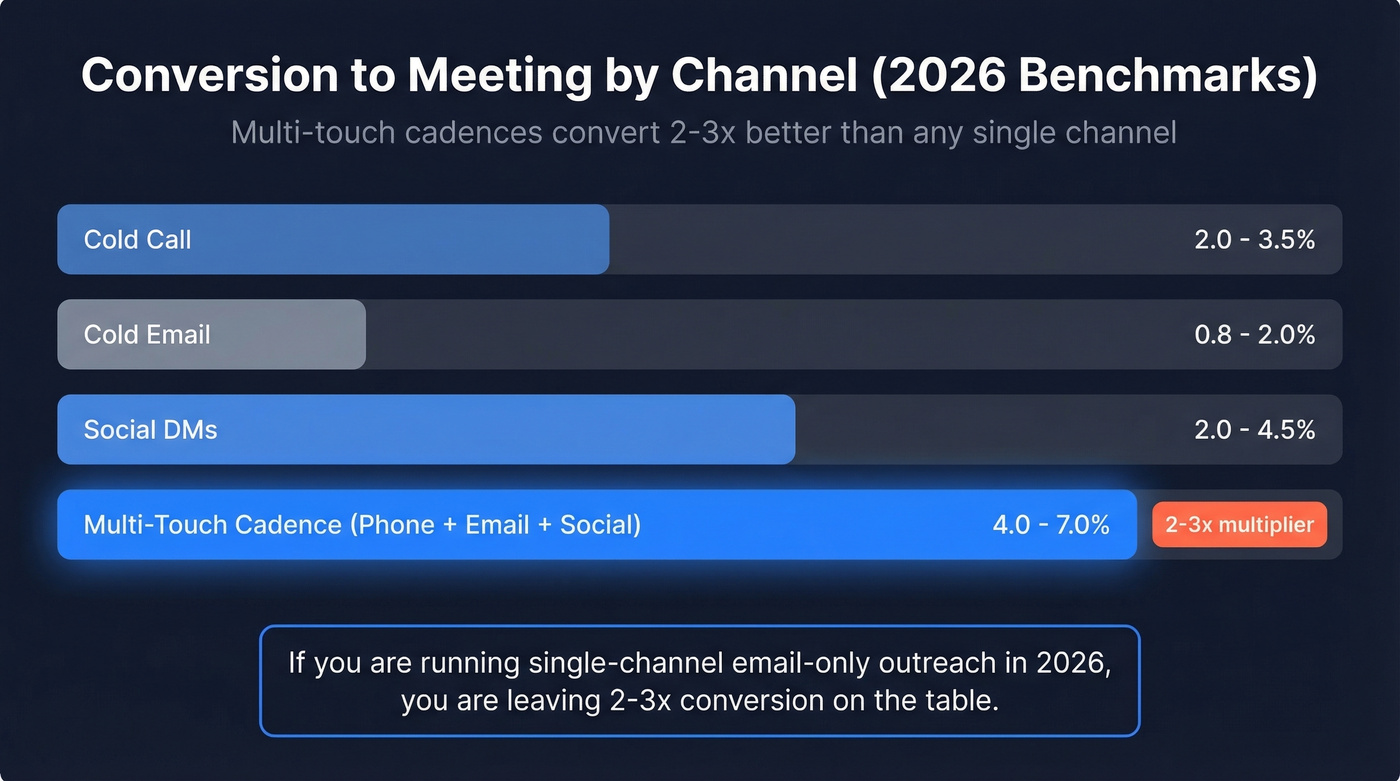
Cold calls convert at 2.0-3.5%. Cold email sits at 0.8-2.0%. Social DMs run 2.0-4.5%. Multi-touch cadences - phone, email, and social combined - convert at 4.0-7.0%. That's the 2-3x multiplier that justifies the complexity of running a real cadence.
Meetings and Pipeline Math
Elite SDRs (top 10%) book 18+ qualified meetings per month. Top quartile hits 12-15. Median lands at 8-10. Bottom quartile struggles at 4-6. Inbound SDRs working warm leads typically hit 20-25, which is why blending the two in your reporting is a mistake that sets outbound reps up to fail.
The pipeline benchmark worth anchoring to: a median SDR generates roughly $3M in pipeline per year, though this varies by ACV and market. The best SDRs maintain a 1:3 to 1:5 meeting-to-opportunity ratio.
Here's how to reverse-engineer your headcount from a revenue target. Say you're aiming for $6M in new business and your average deal size is $50K - that's 120 closed deals. At a 25% close rate, you need 480 opportunities. At a 1:4 meeting-to-opportunity ratio, that's 1,920 meetings, or 16 SDRs at median productivity. Run this math before you post a single job req.
One structural shift worth noting: 80% of BDRs now report to Sales, up from 60% in 2022. If your development reps still sit under Marketing, you're in the minority and likely dealing with misaligned incentives.
The Connect Rate Diagnostic
Start with your connect rate. Below 5%? Stop coaching and start auditing your data source.
A healthy connect rate runs 8-12%. Below that threshold, your reps aren't failing - they're dialing dead numbers and emailing invalid addresses. We've seen this pattern dozens of times: a manager blames rep performance when the real culprit is a contact database that hasn't been refreshed in two months. Prospeo's 7-day refresh cycle and 98% email accuracy exist to solve exactly this problem, and teams using it have cut bounce rates to under 4%. Fix the data layer first; everything else compounds from there. (If you want the deeper playbook, see data enrichment and email bounce rate.)

6sense's benchmark survey shows SDRs now average 21 attempts per contact across 53 days, up from 17. Cadences are getting longer and wider. Plan accordingly.
Building Your Outbound Cadence
The framework that keeps proving itself: 10-14 touches over 30 days, spread across phone, email, and social. The 30MPC team popularized this structure, and it holds up because it solves a real behavioral problem - 80% of sales require 5+ touchpoints, but most reps stop after 2-3.
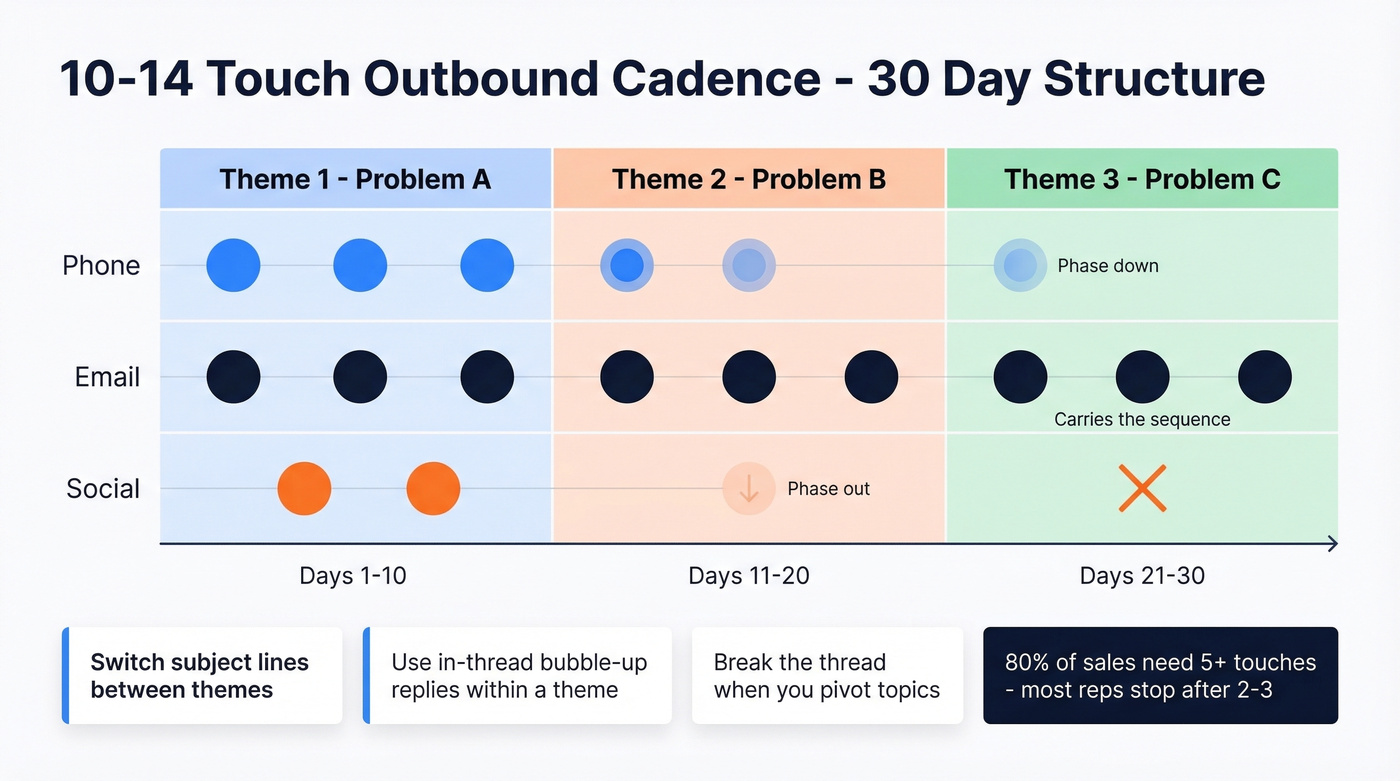
Focus each theme on a single problem. When you switch themes, change the subject line. Use in-thread "bubble-up" replies within a theme, then break the thread when you pivot. (For subject line patterns that actually work, use these email subject lines.)
Channel phasing is where most teams get this wrong. Social touches have diminishing returns after the first theme - phase them out by theme two. Phone calls follow a similar curve; phase down by theme three. Email carries the sequence through to the end because it's the lowest-friction channel for both sides.
Timing claims are everywhere, and most are directional at best. The general pattern: weekday afternoons between 3-7 PM tend to produce higher phone pickup rates, while Tuesday through Thursday mornings work better for email engagement. But the consensus on r/techsales keeps reinforcing the same point - there's no magic pitch or magic time slot. Outcomes depend on your product, your territory, and your timing relative to the buyer's problem. The cadence structure gives you enough at-bats to find the right moment. (If you want a tighter breakdown, see best time to send cold emails.)
If you're running a single-channel email-only approach in 2026, you're leaving 2-3x conversion on the table. Multi-touch isn't optional anymore.
When to Launch Sales Development
Knowing when to launch is as important as knowing how to run the motion. Getting the timing wrong burns cash fast.
Matching Strategy to Market Stage
Not every company needs SDRs on day one. Your approach should match where your product and revenue engine actually sit, not where you hope they'll be in 18 months.
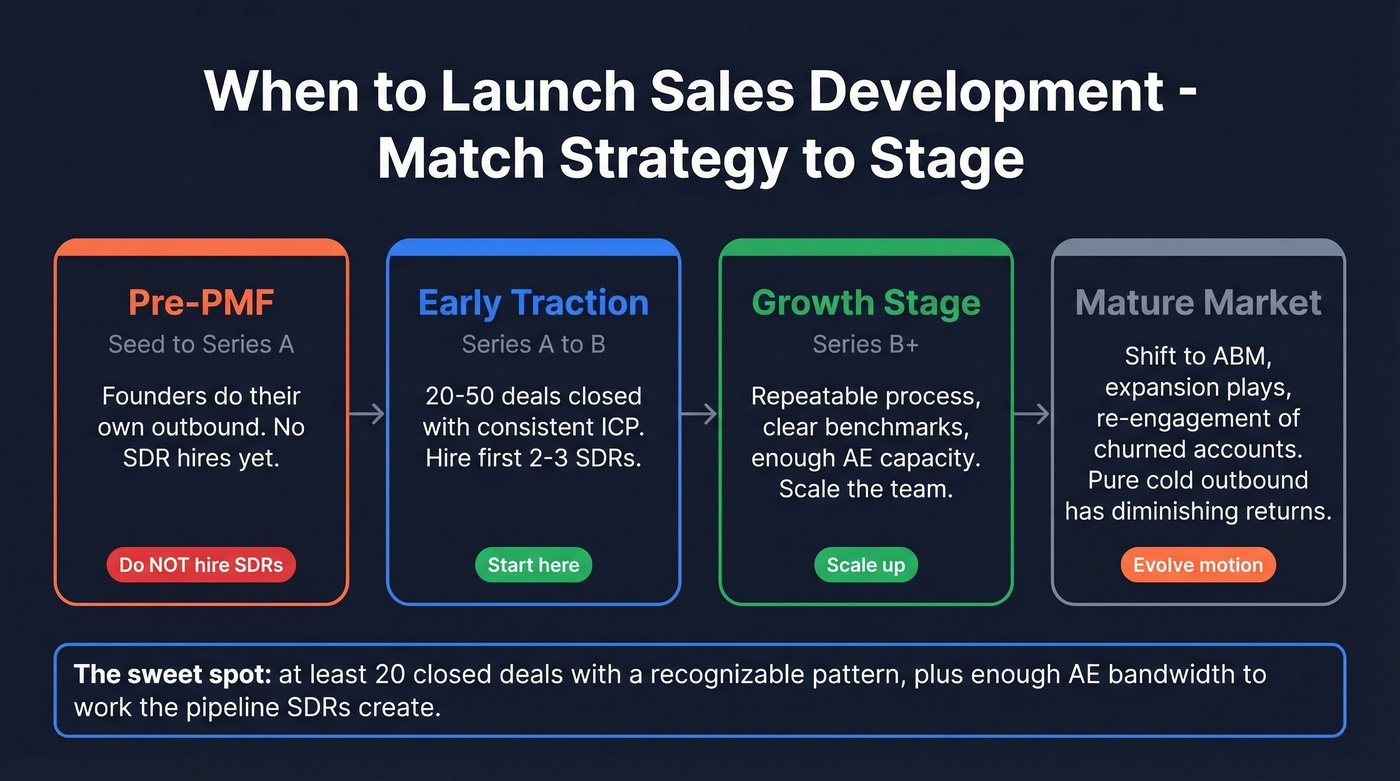
Pre-product-market fit (seed to Series A). Founders should be doing their own outbound. Hiring SDRs before you can articulate a repeatable value prop wastes headcount and creates misleading pipeline data.
Early traction (Series A to B). You've closed 20-50 deals with a consistent ICP. This is the right time to hire your first 2-3 SDRs and test whether outbound can scale the motion founders built.
Growth stage (Series B+). Repeatable sales process, clear conversion benchmarks, and enough AE capacity to handle the pipeline SDRs generate. Scale the team here.
Mature market. SDR teams shift toward account-based motions, expansion plays, and re-engagement of churned accounts. Pure cold outbound yields diminishing returns.
Skip SDR hiring entirely if you haven't closed at least 20 deals with a recognizable pattern. Hiring too early means reps churn before you learn anything useful. Hiring too late means competitors own the accounts you should have been warming for months. The sweet spot is when you have enough closed-won data to define a real ICP and enough AE bandwidth to work the pipeline SDRs create.

You just read it: a connect rate below 5% is a data problem, not a people problem. Prospeo's 7-day refresh cycle and 98% email accuracy have cut bounce rates to under 4% for teams like Snyk (50 AEs, 200+ opportunities/month) and Meritt (pipeline tripled to $300K/week).
Stop coaching reps on bad data. Fix the source.
The 30-60-90 Day SDR Ramp
The "buddy system" onboarding approach - pair the new hire with a senior rep and hope for osmosis - doesn't scale and doesn't produce consistent results.
Phase Targets
| Phase | Quota Target | Focus |
|---|---|---|
| Days 1-30 | 0-20% | Training, shadowing, practice |
| Days 31-60 | 60-80% | Increasing live activity |
| Days 61-90 | 90-110% | Full productivity |
Weekly Time Allocation
The shift from training to live activity should be deliberate, not accidental. (If you want a full template, use this 30-60-90 day plan.)
Weeks 1-4: 50% training, 20% shadowing, 20% practice, 10% live calls. By weeks 3-4, new reps should be hitting 40-60 calls per day and booking 1-2 meetings per week.
Weeks 5-8: 60% live activity. Month 2 targets 40-60% of quota.
Weeks 9-12: 85% live activity. Month 3 targets 70-90%, with full productivity expected by Month 4.
One pattern that compresses this timeline dramatically: give new reps verified prospect data from day one. GreyScout cut rep ramp time from 8-10 weeks to 4 weeks by giving new hires pre-built, verified prospect lists instead of making them wait for ops to pull data manually. When reps spend their first week prospecting real accounts instead of learning a clunky data tool, they hit quota faster. That's not a coaching insight - it's an infrastructure decision. (More on the mechanics in sales prospecting techniques.)
SDR-to-AE Handoff Protocol
When an SDR books a meeting, the AE should confirm within 24 hours. The SDR's notes need to include ICP fit, identified pain, trigger event, stakeholders, and a clear next step. Track meeting rejection reasons - if AEs are rejecting more than 15% of meetings, your qualification criteria need tightening. If 20-30% of booked meetings no-show, you have a confirmation process problem; target under 15%.
SDR Economics: Build vs. Buy vs. Automate
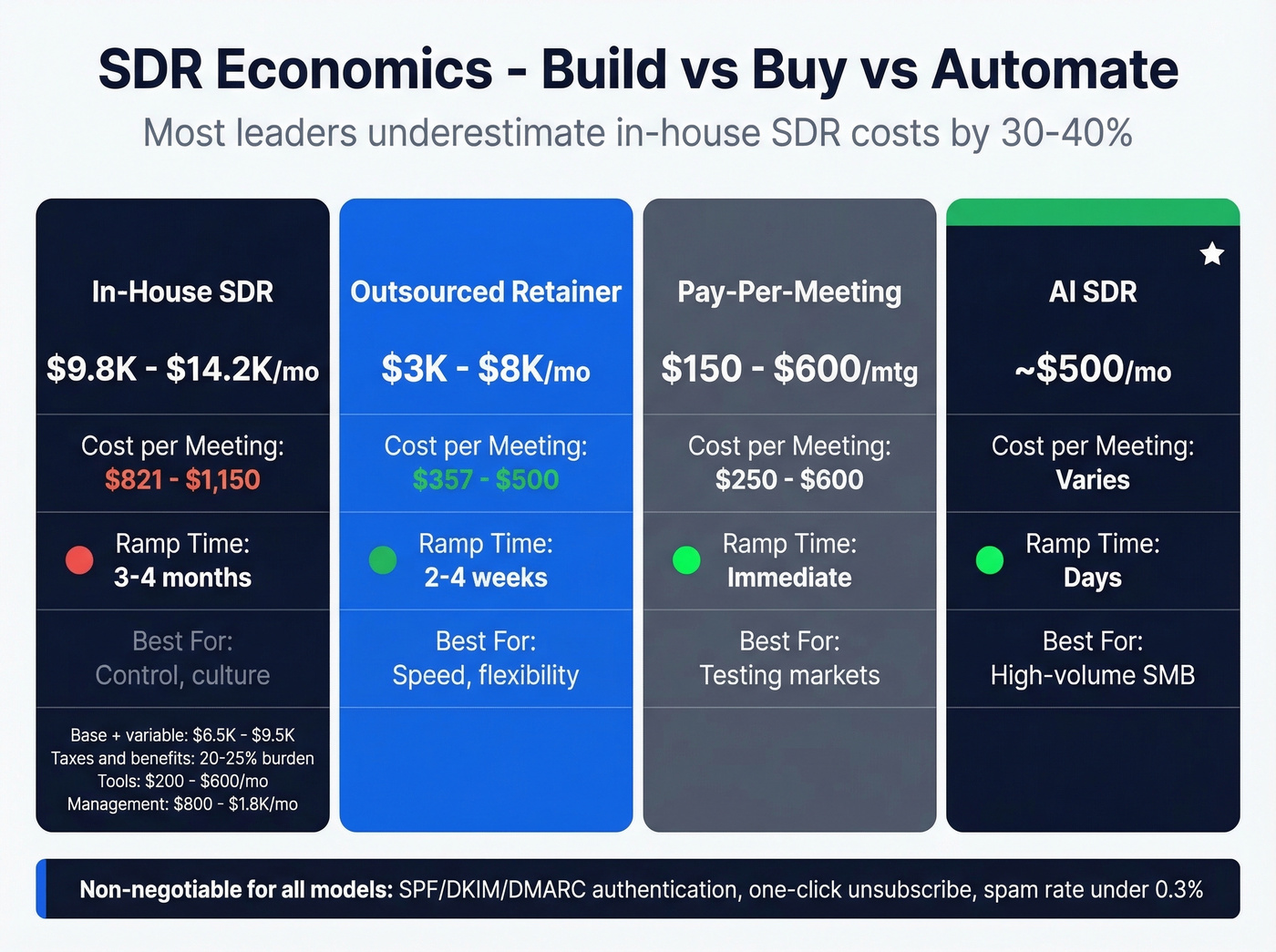
Before you hire, run the math. Most leaders underestimate the fully loaded cost of an in-house SDR by 30-40%.
| Model | Monthly Cost | Cost/Meeting | Ramp Time | Best For |
|---|---|---|---|---|
| In-house | $9.8K-$14.2K | $821-$1,150 | 3-4 months | Control, culture |
| Outsourced retainer | $3K-$8K | $357-$500 | 2-4 weeks | Speed, flexibility |
| Pay-per-meeting | $150-$600/mtg | $250-$600 | Immediate | Testing markets |
| AI SDR | ~$500/mo | Varies | Days | High-volume SMB |
That in-house number includes base plus variable comp ($6.5K-$9.5K), employer taxes and benefits at a 20-25% burden rate, tools at $200-$600/mo, and management overhead at $800-$1.8K/mo. And it doesn't produce meetings until month 3-4.
Every model shares one non-negotiable: deliverability compliance. Gmail and Yahoo's authentication requirements mean you need SPF/DKIM/DMARC authentication, one-click unsubscribe, opt-out processing within 48 hours, and spam rates well under 0.3%. Ignore this and your outbound channel dies regardless of how good your reps are. (If you need the checklist, start with email deliverability and DMARC alignment.)
AI SDRs in 2026: Where They Work
The AI SDR market hit $4.12B in 2025 and is projected to reach $15.01B by 2030 - a 29.5% CAGR. Already, 22% of teams have fully replaced human SDRs with AI agents, and 83% of AI-adopting teams report higher revenue growth than non-adopters.
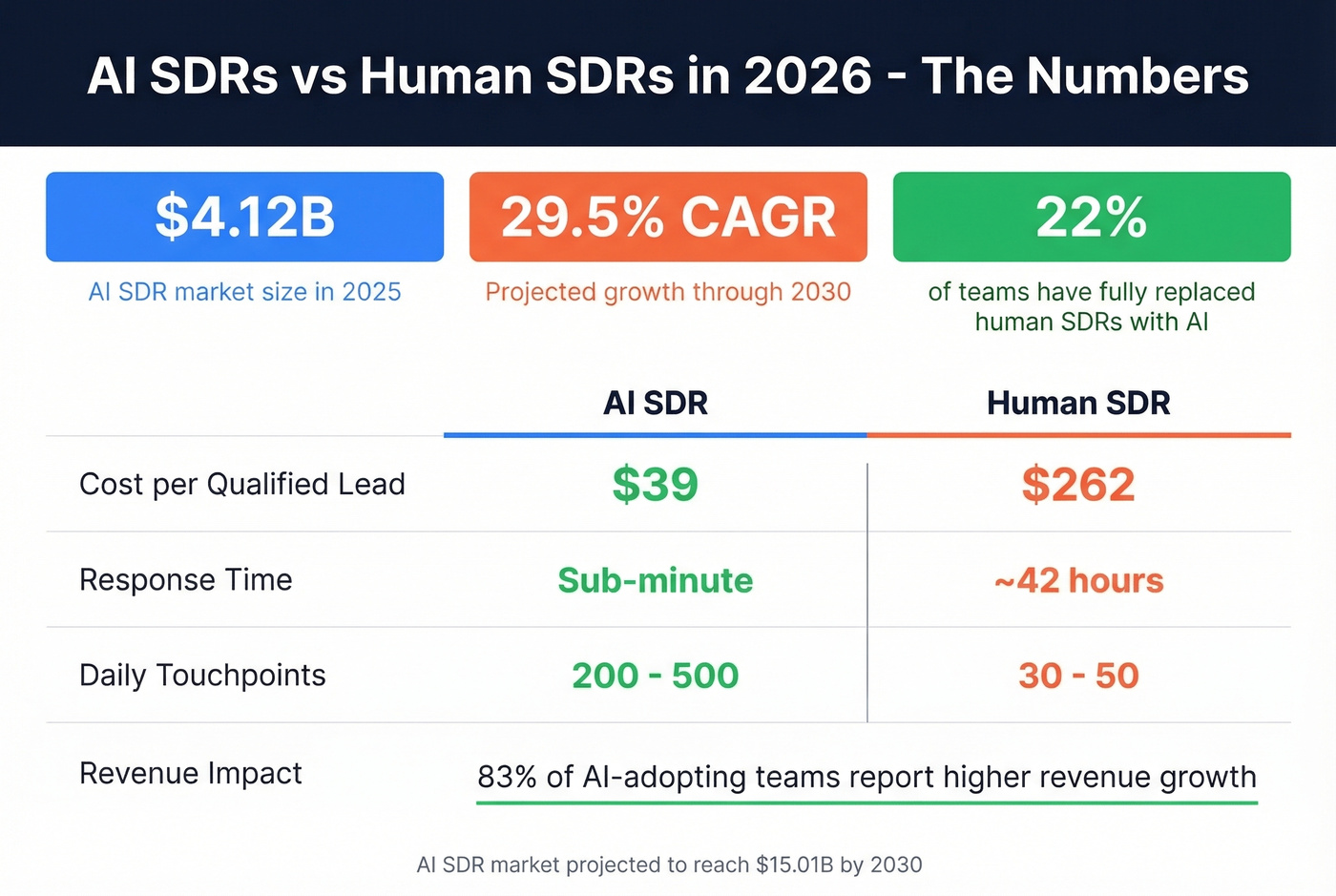
The cost advantage is real. AI systems run about $39 per qualified lead with sub-minute response times, compared to $262 and roughly 42 hours for human SDRs. AI can manage 200-500 personalized touchpoints per day versus 30-50 for a human before quality drops.
The catch: in a head-to-head experiment running July 2025 through January 2026, AI was 54x cheaper - but the human SDR generated $147K in revenue versus $56K for AI. Meeting show rates ran 71% for human-booked meetings versus 52% for AI-booked. Cheaper meetings, but worse ones.
Let's break this down into a simple decision rule. AI works best for SMB, high-volume motions with deal sizes under $25K. Humans win for enterprise sales, complex objections, and multi-stakeholder navigation. Jason Lemkin put it well - AI agents are better than "mid-pack" SDRs but can't match your best performers.
The smart play for most teams is hybrid. Let AI handle initial outreach, qualification, and follow-up consistency - AI hits 98-100% follow-up rates versus 65-75% for humans. Then route qualified conversations to human reps for discovery and meeting setting. (If you’re building this motion, start with AI cold email outreach.)
The SDR Tech Stack
Most SDR tech stack conversations start with the engagement platform. That's backwards. Your stack should be built in this order.
Layer 1 - Data and enrichment. Start here. Everything downstream depends on contact accuracy. If half your emails bounce, your engagement platform is just an expensive way to tank your domain reputation. Prospeo gives you 300M+ professional profiles with 98% email accuracy and 125M+ verified mobile numbers at a 30% pickup rate, all on a 7-day refresh cycle. It integrates natively with Salesforce, HubSpot, Outreach, and Salesloft - no manual CSV juggling. At roughly $0.01 per email with no contracts, it's a fraction of what enterprise data providers charge. The Snyk team - 50 AEs prospecting 4-6 hours per week - dropped their bounce rate from 35-40% to under 5% and now generate 200+ new opportunities per month after switching their data layer. (If you’re comparing options, see B2B company data providers.)

Layer 2 - CRM. HubSpot for SMB, Salesforce for mid-market and up. This isn't a controversial take. (If you need examples to sanity-check your choice, see examples of a CRM.)
Layer 3 - Sales engagement. Outreach or SalesLoft, typically ~$100-$200/user/month. Add this after your data is clean and your CRM is configured.
Skip dedicated dialers, intent platforms, and conversation intelligence until later. Those are layer 4-5 additions that only matter once your foundation is solid.
At $0.01 per verified email, Prospeo costs less than a single SDR's daily coffee. 300M+ profiles, 125M+ verified mobiles with a 30% pickup rate, and 30+ filters to nail your ICP before your reps dial a single number.
Run the cost math - then give your team data that actually connects.
Mistakes That Kill SDR Teams
We've watched enough SDR orgs stumble to see the same patterns repeat.
Generic hiring screens. Internal recruiters often can't evaluate sales aptitude. Build a sales-specific scorecard with role-play components. If your hiring process doesn't include a live objection-handling exercise, you're guessing.
Buddy-system onboarding. It feels warm and collaborative. It produces wildly inconsistent results. Replace it with structured ramp plans that include product quizzes, mock calls, and AI-simulated objection handling within the first five days. Fail fast, not slow.
Tracking dials but not pitch quality. Activity dashboards are necessary but insufficient. Use call recordings and AI simulation tools to evaluate whether reps are actually running good discovery or just checking boxes. I've sat in on pipeline reviews where a team was hitting 120% of activity targets and 40% of quota - the volume was there, the conversations were garbage.
No redundancy planning. Overhire by 20-30% during ramp periods. SDR attrition is a when, not an if - US-based SDRs churn every 12-15 months. Burnout is the silent killer behind that number. Rotate territories, vary task types, and create visible promotion paths. If you're not promoting at least 30% of SDRs annually, your retention will crater. SDR purgatory is real, and r/sales will remind you that the SDR-to-AE path isn't guaranteed - which is exactly why you need to build one that is.
Ignoring deliverability. A bounce rate above 5% doesn't just waste rep time - it damages your domain reputation, which compounds over weeks. Fix the data source before you optimize anything else.
FAQ
How many meetings should an SDR book per month?
The median outbound SDR books 8-10 qualified meetings per month; top quartile hits 12-15, and elite performers book 18+. Inbound SDRs working warm leads typically reach 20-25. Set targets based on your motion - blending inbound and outbound numbers into one quota creates unrealistic expectations for outbound reps.
Should I hire SDRs or use AI agents?
AI SDRs work best for high-volume motions where deal sizes sit under $25K - they're 54x cheaper but generate lower-quality meetings with worse show rates (52% vs. 71%). Human SDRs win for enterprise and multi-stakeholder deals. Most teams in 2026 run hybrid models: AI for initial outreach and follow-up, humans for discovery and closing conversations.
What's the most important tool in an SDR tech stack?
Your data source. If half your contacts bounce, sequencing software just burns your domain reputation. Start with verified, frequently refreshed data, then layer on CRM and engagement tools.
What's the difference between sales development and sales strategy?
A sales strategy covers the entire revenue cycle from lead generation through negotiation and close. A sales development strategy is a subset focused on top-of-funnel prospecting, outbound cadences, lead qualification, and pipeline generation - the system that feeds your closers. Business development strategy, by contrast, centers on partnerships, channel expansion, and new market entry.
How do approaches differ by company stage?
Enterprise teams lean on account-based, human-driven outbound with longer cadences. Mid-market orgs often run hybrid models pairing AI volume with human complexity handling. SMB-focused companies increasingly automate the entire top-of-funnel motion. The right approach depends on your ACV, sales cycle length, and whether you've hit repeatable product-market fit.
Start Here
A sales development strategy that works in 2026 comes down to five moves: set benchmarks grounded in real data, fix your contact accuracy before you coach reps, build a multi-channel cadence with 10-14 touches, run the cost math on build vs. buy vs. automate, and ramp new hires on a structured 30-60-90 plan.
That's the strategy. Everything else - the AI tools, the intent signals, the conversation intelligence platforms - is optimization on top of a solid foundation. Get the foundation right first.