

15 Sales Follow-Up Email Templates Backed by 304K Emails of Data
You just sent a follow-up that said "just checking in." So did 10,000 other reps today. A 304K-email analysis found that "bubble-up" emails - the ones that say "just making sure you saw this" - are 15x less likely to book a meeting. With 4.48 billion email users worldwide, your follow-up isn't competing with silence. It's competing with every other lazy template in the inbox.
The problem isn't that you're following up. It's that you're using phrases that actively kill your meeting rate. Here's how to fix that - 15 follow-up templates organized by scenario, backed by data, stripped of every word that doesn't earn its place.
The Quick Version
- Replace "thoughts?" and "bubble-up" lines with a specific value statement or an interest CTA. The 304K-email analysis from Gong shows "thoughts?" decreases meetings booked by 20%, and bubble-up emails are 15x less likely to book one.
- Keep follow-ups tight (roughly 50-125 words), send Tue-Thu mornings, and cap your sequence at 4-6 emails before switching channels (see sequence management).
- Verify your prospect list before sending. High bounce rates crush deliverability and make even perfect templates useless (use an AI email checker).
Phrases That Kill Meetings
Most follow-up guides hand you a template and call it a day. Let's start with what not to say, because the data is brutal.
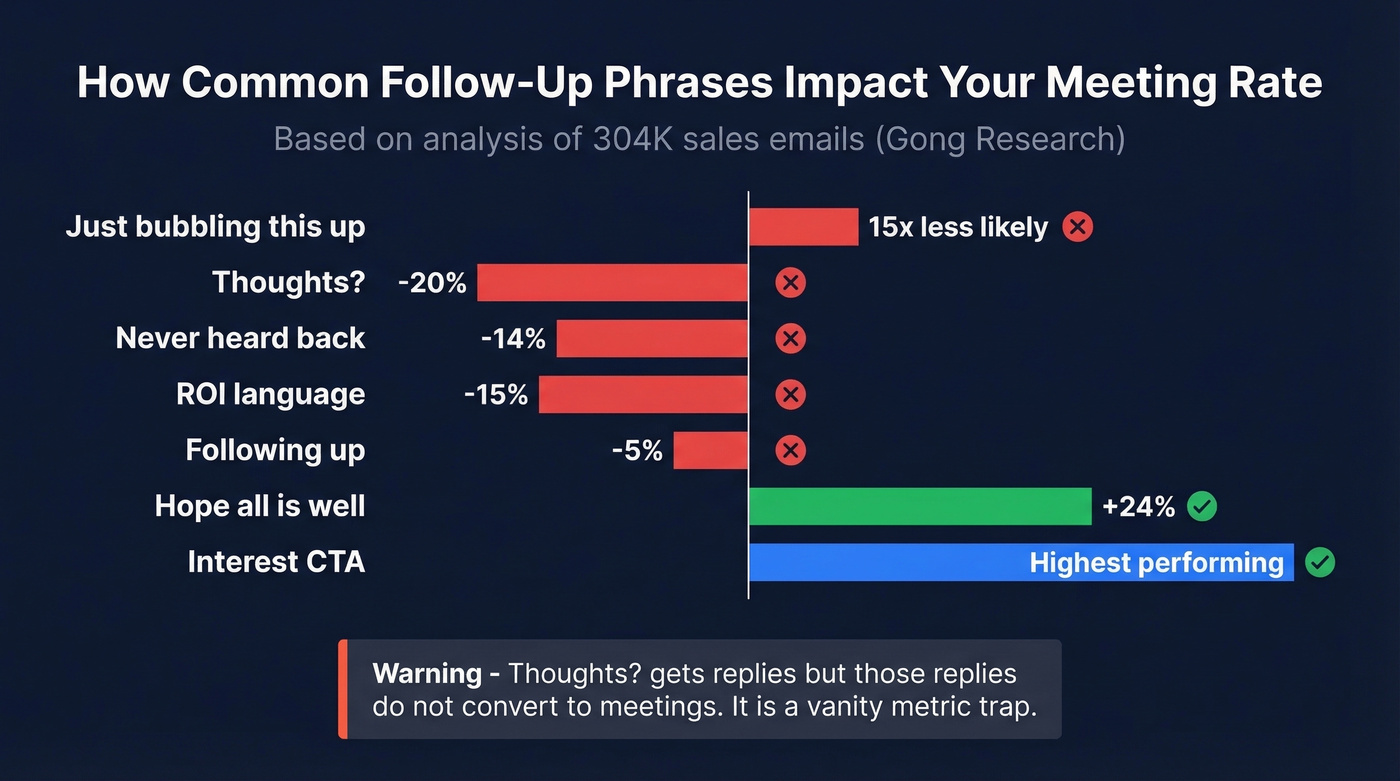
| Phrase | Effect on Meetings | Verdict |
|---|---|---|
| "Just bubbling this up" | 15x less likely | Avoid |
| "Thoughts?" | -20% | Avoid |
| "Never heard back" | -14% | Avoid |
| "Following up" | -5% | Avoid |
| ROI language | -15% | Avoid in cold email |
| "Hope all is well" | +24% | Use (with personalization) |
| Interest CTA | Highest-performing | Use |
The surprise is "Hope all is well." It works - but only when paired with something personal. A naked "Hope all is well, just following up" is still dead weight.
The real takeaway is CTA type. Interest CTAs - asking if they're interested vs. asking for a specific time - outperform meeting-time asks in Gong's cold email analysis. They give the prospect a low-friction way to engage without committing to a calendar slot (more on building CTAs in email call to action).
Here's the thing: "Thoughts?" gets replies. But those replies don't convert to meetings. Same with "Following up" - it boosts response rates while your pipeline stays empty. It's a vanity metric trap.
How Many Follow-Ups to Send
RAIN Group's research across 489 sellers and 488 buyers representing $4.2B in purchases found the average is 8 touchpoints to get an initial meeting. Top performers need just 5. Better messaging - starting with a strong follow-up template - reduces the number of touches required (see importance of follow-up in sales).
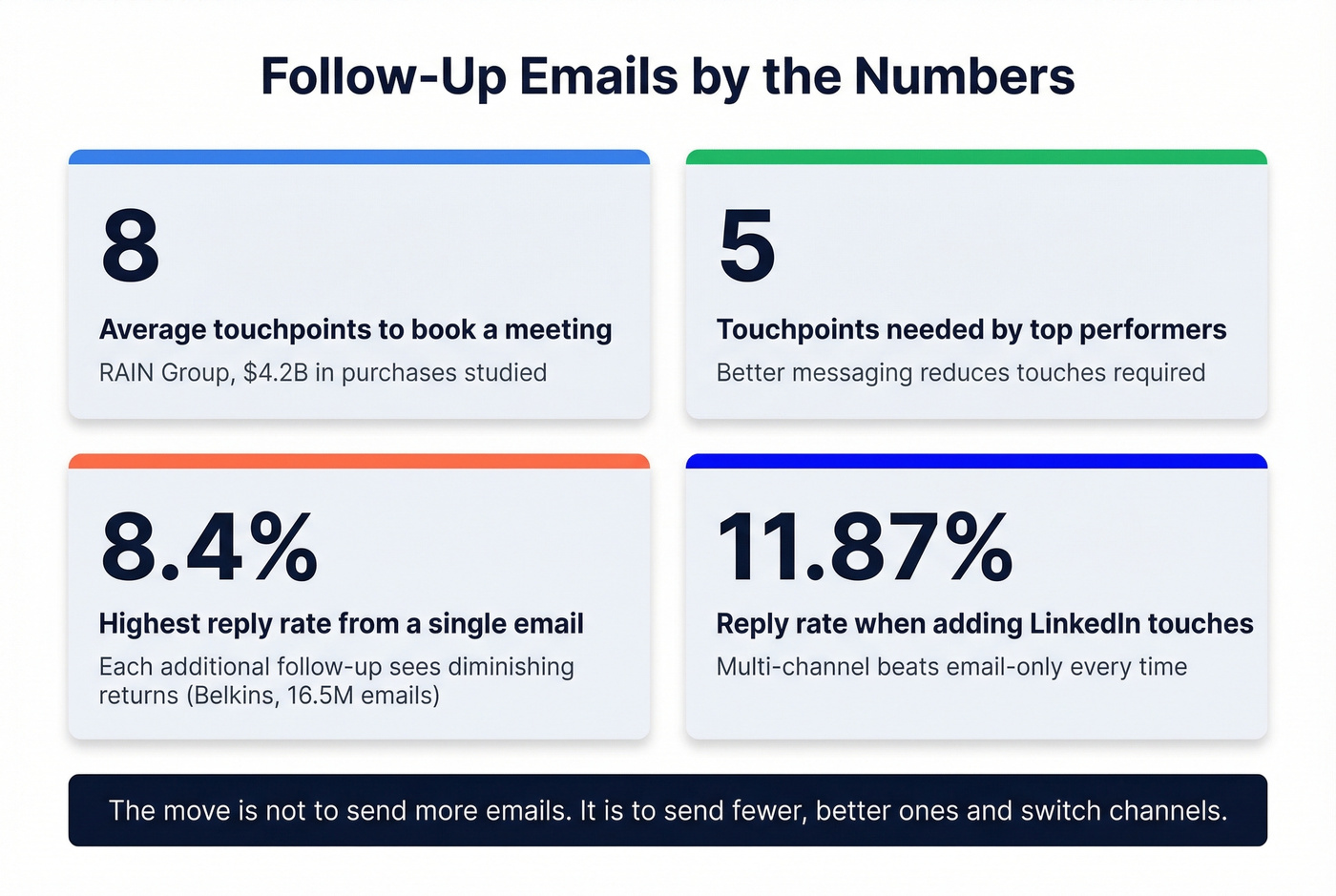
But more isn't always better. Belkins' analysis of 16.5 million cold emails found the highest reply rate (8.4%) comes from a single email. Each additional follow-up sees diminishing returns, and 4+ emails in a sequence more than triples unsubscribe and spam complaints. Instantly's data pushes back - their numbers suggest 4-7 steps generate 3x the replies of shorter sequences - but only if each step adds genuine value. Enterprise prospects at 1,000+ employees are especially intolerant of persistence either way.
Our take: The move isn't to send more emails. It's to send fewer, better ones and switch channels. Adding LinkedIn touches to your sequence can push reply rates to 11.87% - far above email-only performance. We've seen teams cut from 7 emails to 4 emails plus 2 LinkedIn touches and get better results with fewer complaints every time.
The Ideal Follow-Up Cadence
- Day 0: Initial email
- Day 3: First follow-up (add new value, don't just bump)
- Day 7: Second follow-up (switch angle)
- Day 14: Third follow-up (social proof)
- Day 21: Fourth follow-up or LinkedIn touch
- Day 30: Breakup email
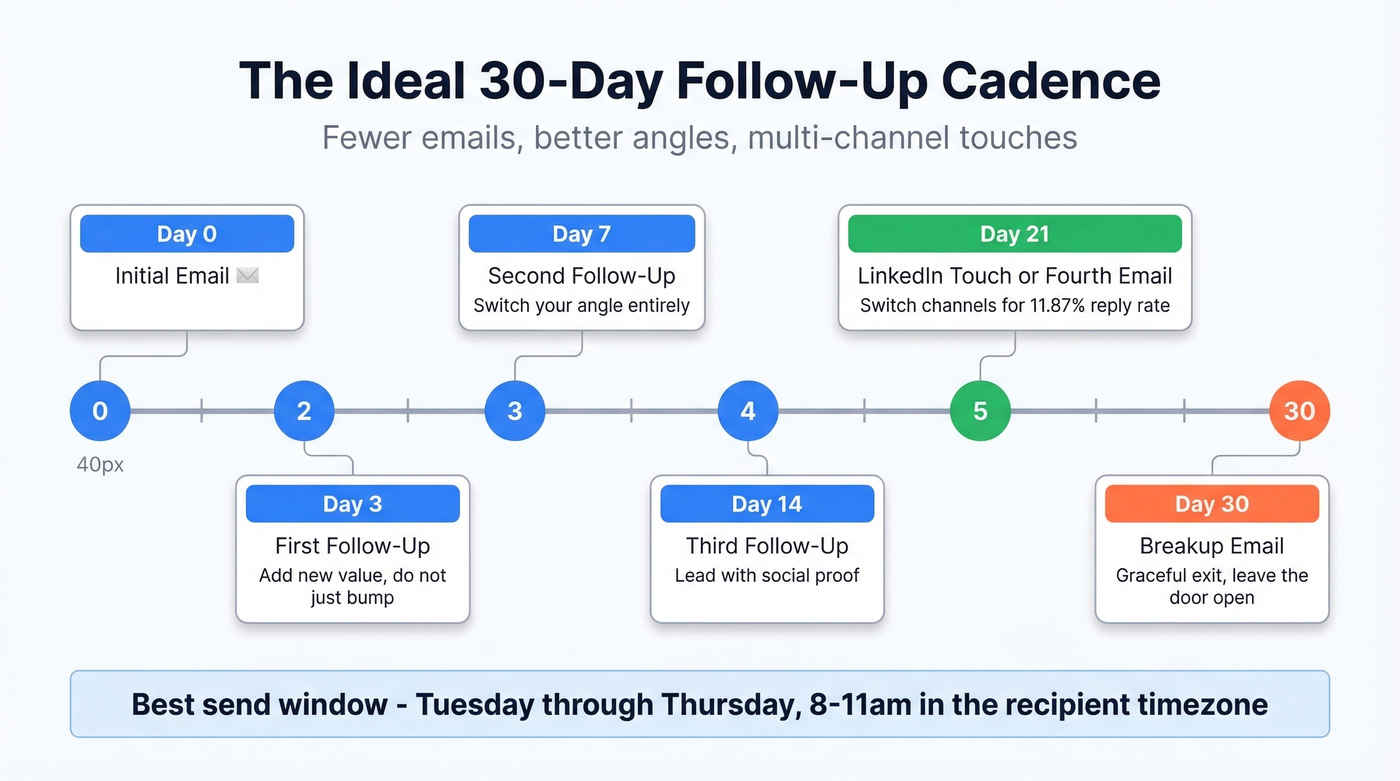
Send Tuesday through Thursday, 8-11am in the recipient's timezone. One founder documented a 16% improvement in opens after restricting sends to this window during a 62-day test across 7 sending domains.
On infrastructure: Google's spam complaint threshold is 0.3%. Stay under it by rotating across multiple sending domains and keeping daily volume low per domain - one founder capped at 26 emails per domain per day (see email velocity). These are the guardrails that keep your domain alive (use an email deliverability guide).

A perfect follow-up template sent to a dead email address books zero meetings. Prospeo's 98% email accuracy and 7-day data refresh mean your carefully crafted sequences actually reach real inboxes - not bounce logs.
Stop writing follow-ups that never arrive. Start with verified data.
15 Templates by Scenario
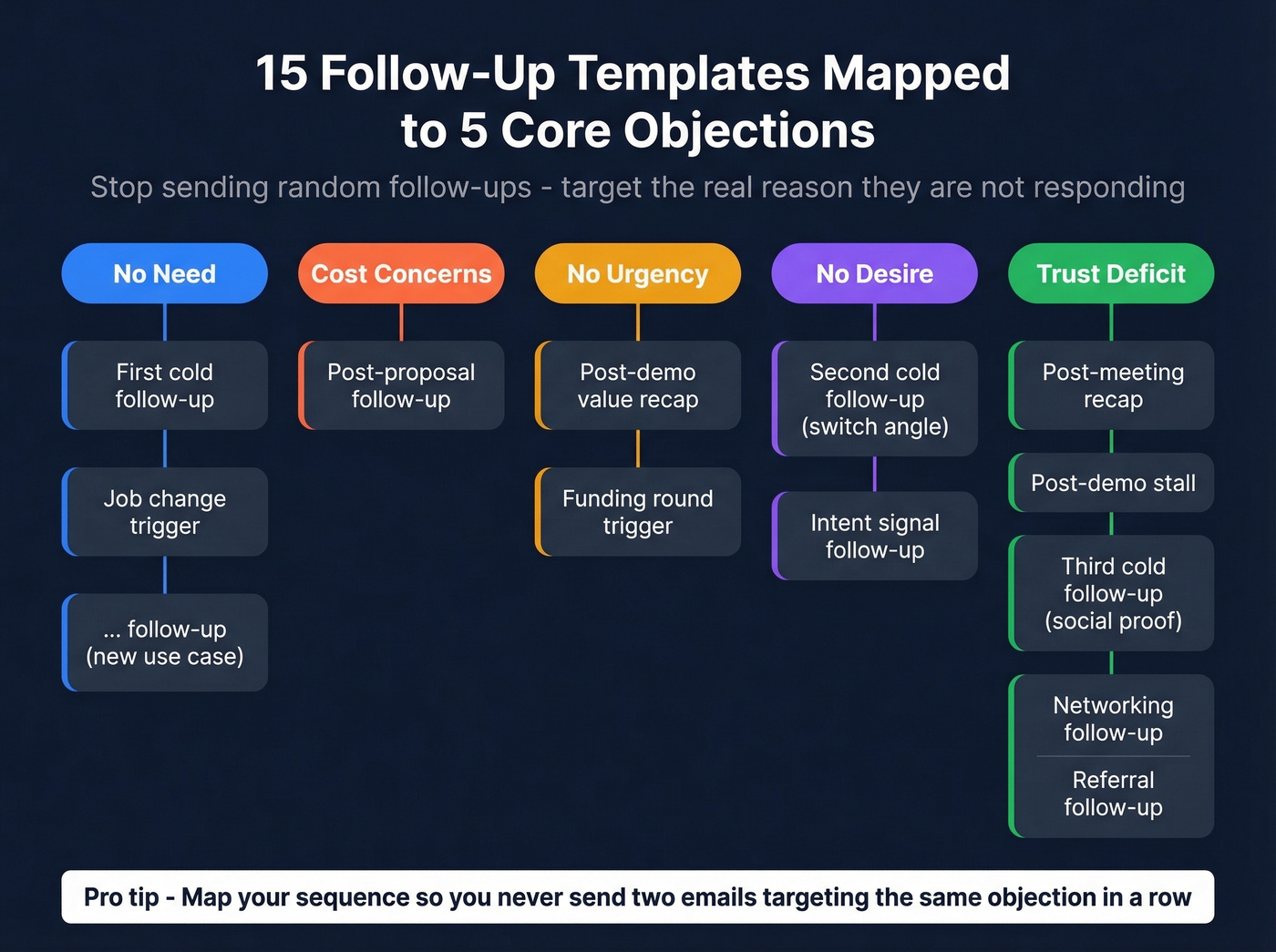
Each template addresses one of five core objections prospects carry: no need, cost concerns, no urgency, lack of desire, or trust deficit. Most email bodies stay under ~100 words. The objection each template targets is tagged so you can map your sequence deliberately instead of sending four feature-pitch emails in a row (see sales follow-up templates).
After a Meeting or Call
Post-meeting recap (send within 24 hours) - Objection: trust
Subject: Next steps from our call
Hi {{FirstName}},
Great speaking today. Three things stood out: {{key_pain_point}}, {{timeline}}, and {{decision_criteria}}.
I've attached {{relevant_resource}} that addresses {{specific_challenge}}. The next step is {{concrete_action}} - does {{day}} work?
Proves you were actually listening, which builds trust. The attached resource adds value beyond the meeting itself.
Post-demo value recap - Objection: no urgency
People hate losing more than they love gaining. This template puts a number on what inaction costs, making the status quo feel expensive.
Subject: The {{specific_metric}} we discussed
Hi {{FirstName}},
Wanted to recap the numbers: based on your current {{process}}, we estimated {{projected_outcome}} within {{timeframe}}.
{{Champion_name}} mentioned wanting to share this with {{stakeholder}}. Happy to put together a one-pager that makes that conversation easier. Worth it?
When the Deal Stalls
Post-demo stall - Objection: trust
This language comes straight from a practitioner on r/salestechniques who shared it after a deal went cold. It probes for the real objection without being pushy.
Subject: One question before you decide
Hi {{FirstName}},
Totally understand needing time to align internally. As you're discussing, what's the biggest concern coming up? I'd rather address it head-on now than have it linger.
No pressure - just want to make sure you have everything you need.
Post-proposal / quote sent - Objection: cost
If you gave a verbal proposal, follow up within 24 hours. If you sent the proposal by email, wait 24-48 hours.
Subject: Quick thought on the proposal
Hi {{FirstName}},
Wanted to flag one thing - {{specific_section}} is where most teams like yours see the fastest impact. If the overall number feels high, we can phase the rollout starting there.
Would a 15-minute call to walk through options make sense this week?
Cold Outreach Follow-Ups
First follow-up (3-5 days after initial) - Objection: no need
Subject: {{Company}} + {{your_company}} - one more thing
Hi {{FirstName}},
Didn't want my last note to get buried. Since then, I came across {{new_insight_about_their_company}} and thought it was relevant.
We helped {{similar_company}} solve a similar challenge - {{one_sentence_result}}. Interested in hearing how?
Adds new value instead of bumping. Uses an interest CTA - the highest-performing CTA type in cold email (see cold email follow-up templates).
Second follow-up (switch angle) - Objection: no desire
Most reps send: "Just following up on my last two emails. Would love to connect." That's dead on arrival. Here's what works:
Subject: Different angle on {{pain_point}}
Hi {{FirstName}},
I realize my first emails focused on {{original_angle}}. But teams in {{their_industry}} often care more about {{different_benefit}}.
If that resonates, I can share a 2-minute case study. If not, no hard feelings.
Reframing the value proposition addresses the "I don't want this" objection that a third bump never will.
Third follow-up (social proof) - Objection: trust
Subject: How {{similar_company}} handled this
Hi {{FirstName}},
{{Similar_company}} was in a similar spot - {{one_sentence_problem}}. After implementing {{solution}}, they saw {{specific_result}} in {{timeframe}}.
Worth a quick conversation to see if the same approach fits {{their_company}}?
Naming a specific company and result is far more persuasive than "our customers love us."
Trigger-Event Follow-Ups
Job changes, funding rounds, and intent signals like pricing page visits or content downloads are strong trigger events in B2B. The key is speed - send within 24 hours of the trigger, not two weeks later (see how to track sales triggers).
Job change or promotion - Objection: no need
Subject: Congrats on the new role
Hi {{FirstName}},
Saw you just moved to {{new_role}} at {{company}} - congrats. New roles usually mean inherited tech stacks and fresh priorities.
If {{specific_pain_point}} is on your radar, happy to share what we're seeing work. No pitch - just context.
Funding round / company news - Objection: no urgency
Subject: Saw the news about {{company}}
Hi {{FirstName}},
Congrats on the {{Series_X / acquisition / expansion}}. Growth like that usually means {{specific_operational_challenge}}.
We've helped {{similar_stage_company}} navigate that exact transition. Would a 15-minute call be useful, or is the timing off?
Intent signal (content download, pricing page visit) - Objection: no desire
Subject: Noticed you're researching {{topic}}
Hi {{FirstName}},
Looks like {{topic}} is on your radar. We just published a breakdown of how {{similar_company}} approached it - thought it might save you some research time.
{{Link}}. Happy to walk through it if anything resonates.
Relationship-Based Follow-Ups
Networking / event follow-up - Objection: trust
Subject: Good meeting you at {{event}}
Hi {{FirstName}},
Enjoyed our conversation about {{topic}} at {{event}}. You mentioned {{specific_challenge}} - I wanted to share {{resource_or_idea}}.
Would love to continue the conversation. Coffee or a quick call next week?
Send within 1-2 days while the event is fresh. Specificity proves it's not a mass blast.
Referral - Objection: trust
Subject: {{Referrer_name}} suggested I reach out
Hi {{FirstName}},
{{Referrer}} mentioned you're the right person to talk to about {{topic}} at {{company}}. They thought there might be a fit based on {{specific_reason}}.
Worth a 15-minute call to find out? If I've got the wrong person, happy to be redirected.
The "redirect me" line makes it easy to say no, which paradoxically increases response rates.
Re-engagement after going cold - Objection: no urgency
Subject: Still relevant?
Hi {{FirstName}},
Apologies for going quiet on my end. We spoke {{timeframe}} ago about {{topic}}. Things have changed since then - {{new_feature_or_result}} - and I wanted to check if {{original_pain}} is still a priority.
If the timing's better now, I'd love to reconnect. If not, no worries at all.
"Still relevant?" is honest and low-pressure. The tactical apology resets the relationship without blame.
Closing Sequence
Multi-thread (looping in a colleague) - Objection: trust
Subject: Looping in {{colleague_name}}
Hi {{FirstName}},
I wanted to connect you with {{colleague_name}}, our {{role}}, who can speak directly to {{specific_question}} you raised.
{{Colleague_name}} - {{FirstName}} is evaluating {{solution}} for {{use_case}}. Can you share how {{similar_company}} handled {{specific_concern}}?
Multi-threading increases deal velocity. Bringing in a specialist shows investment, not just a chase for a signature.
Breakup / final attempt - Objection: all five
Subject: Should I close your file?
Hi {{FirstName}},
I've reached out a few times and haven't heard back - totally fine. I don't want to be the person clogging your inbox.
If {{pain_point}} becomes a priority again, I'm here. Otherwise, I'll assume the timing isn't right and stop reaching out. Either way, no hard feelings.
Breakup emails often get the strongest reply rates in a sequence. Removing pressure creates space to respond.
Post-close onboarding handoff - Objection: trust (post-sale)
Subject: Your onboarding plan
Hi {{FirstName}},
Thrilled to have you on board. I'm introducing {{CSM_name}}, who'll be your main point of contact going forward.
{{CSM_name}} has your implementation plan ready - first milestone is {{specific_deliverable}} by {{date}}. They'll reach out today to schedule your kickoff.
A clean handoff prevents the post-sale silence that kills retention.
Subject Lines That Get Opens
Subject lines make or break your follow-up before the body copy matters. Keep them under 7 words and 41 characters. "Quick question" hit 39% opens in a 62-day test across 7 sending domains. Subjects that include the company name average 33% opens. "Partnership opportunity" tested below 19% - generic subjects signal generic emails, and prospects skip them (for more options, see email subject line examples).
Top performers by category:
- Question-based: "Quick question about {{priority}}" / "Still exploring {{solution_category}}?"
- Value-driven: "{{Metric}} improvement for {{company}}" / "How {{similar_company}} solved this"
- Personalized: "{{Company}} + {{your_company}}" / "Congrats on {{trigger_event}}"
- Urgency / curiosity: "One thing I missed" / "Should I close your file?"
Skip the clever wordplay. The consensus on r/sales is that straightforward subject lines consistently outperform "creative" ones - prospects aren't looking for entertainment, they're scanning for relevance.
Fix Your Data Before Your Sequence
Look, your templates don't matter if half your emails bounce. One Reddit founder documented their entire rebuild - bounce rate dropped from 11% to under 2%, and reply rates doubled from 3% to 6%. The infrastructure changes that drove it: scaling from 3 to 7 sending domains, capping at 26 emails per domain per day, and verifying every single address before sending (see email bounce rate).
Before you launch any sequence, run this checklist:
- Verify every email address. Prospeo's 5-step verification catches invalid addresses, spam traps, and honeypots at 98% accuracy for roughly $0.01 per verification. One customer, Meritt, saw bounce rates drop from 35% to under 4% after switching - and their pipeline tripled.
- Set up SPF, DKIM, and DMARC. These authentication protocols tell inbox providers you're legitimate (see DMARC alignment).
- Rotate sending domains. Three minimum, seven if you're doing volume. Each gets its own warmup and daily cap.
- Send plain text, as replies. HTML templates with tracking pixels scream "mass email." Plain text in a reply thread looks like a real person following up.
- A/B test quarterly. Run subject line and CTA variants every quarter - what worked six months ago is probably burned out by now.
In our experience, the teams with the worst follow-up performance almost always have a data quality problem, not a copywriting problem. Fix the data first.
You just cut your sequence from 7 emails to 4. Now make every send count. Prospeo gives you 143M+ verified emails at $0.01 each - so your bounce rate stays under 3% and your domain stays alive.
Fewer emails, better data, more meetings booked.
Mistakes That Kill Follow-Up Emails
Bumping with no new info. "Just making sure you saw this" adds zero value. Every follow-up needs a new angle, resource, or insight.
Ignoring the real objection. Map your sequence to the five core objections: no need, cost, urgency, desire, and trust. If you're sending four emails that all pitch features, you're only addressing one (see sales prospecting techniques).
Emails that don't look real. HTML templates, embedded images, and tracking pixels trigger spam filters and prospect skepticism. Plain text wins.
Wrong frequency. Too aggressive and you get spam complaints. Too slow and they forget you. The Day 0/3/7/14/21/30 framework balances both.
Misleading subject lines. "Re: our conversation" when you've never spoken is a trust-killer. Prospects remember, and they don't forgive.
Not switching channels. After 2-3 unanswered emails, move to LinkedIn, phone, or a different contact at the company. Email-only sequences have a ceiling - and it's lower than most reps think.
FAQ
How long should a follow-up email be?
Aim for 30-150 words. For cold outreach, one founder saw better results after cutting emails to under 56 words. Three short paragraphs max - if it doesn't fit on a phone screen without scrolling, it's too long.
When's the best time to send a follow-up?
Tuesday through Thursday, 8-11am in the recipient's timezone. One practitioner documented a 16% improvement in open rates after restricting sends to this window. Avoid Mondays (inbox overload) and Fridays (checked-out prospects). If you're sending internationally, segment by timezone - a 9am send in your timezone hits London at 5pm.
What's the best approach after no response?
Switch angles instead of bumping harder. Introduce a new value proposition or piece of social proof rather than restating your original pitch. Use an interest CTA instead of "thoughts?" - it's the highest-performing CTA type in cold email. Pair that with verified contact data so your emails actually reach the inbox, and you're ahead of 90% of reps.
How many emails should be in a follow-up sequence?
Cap it at 4-6 emails. Each one should target a different objection - no need, cost, urgency, desire, or trust - so you're not repeating the same pitch. After 2-3 unanswered emails, layer in LinkedIn or phone touches. The goal isn't more emails; it's the right message matched to where the prospect is in their decision process.