

Sales Fundamentals That Actually Move Pipeline in 2026
Your third month as an SDR is when reality hits. The onboarding energy is gone, the scripts feel stale, and you're staring at a CRM full of prospects who won't return your calls. Here's the uncomfortable part: salespeople forget 84% of what they learned in training within 90 days. That stat explains why so many reps plateau - and why nailing sales fundamentals matters more than any advanced tactic you'll ever learn.
Whether you're a new SDR, a technical person who just stumbled into selling, or a rep whose training didn't stick, these are the sales basics worth drilling until they're reflexive.
What "Fundamental" Actually Means
There's a useful distinction most people skip. "Basic" implies something beneath you - something you've graduated from. "Fundamental" means essential, the kind of thing elite performers still practice daily. The best closer on your team isn't above prospecting discipline. They're better at it.
If you came from support or engineering and just closed your first deal, these core selling principles are your operating manual, not a remedial course.
And they aren't motivational platitudes or $397 courses from influencers who haven't carried a quota in a decade. The consensus on r/sales is clear: reps want proven frameworks and repeatable skills, not hype. That's what we're covering - the mechanics that generate and close pipeline.
10 Principles That Move Pipeline
The first five are about creating opportunities - getting in front of the right people with the right message. The second five are about capturing those opportunities once they exist. Most reps over-index on one side and neglect the other.
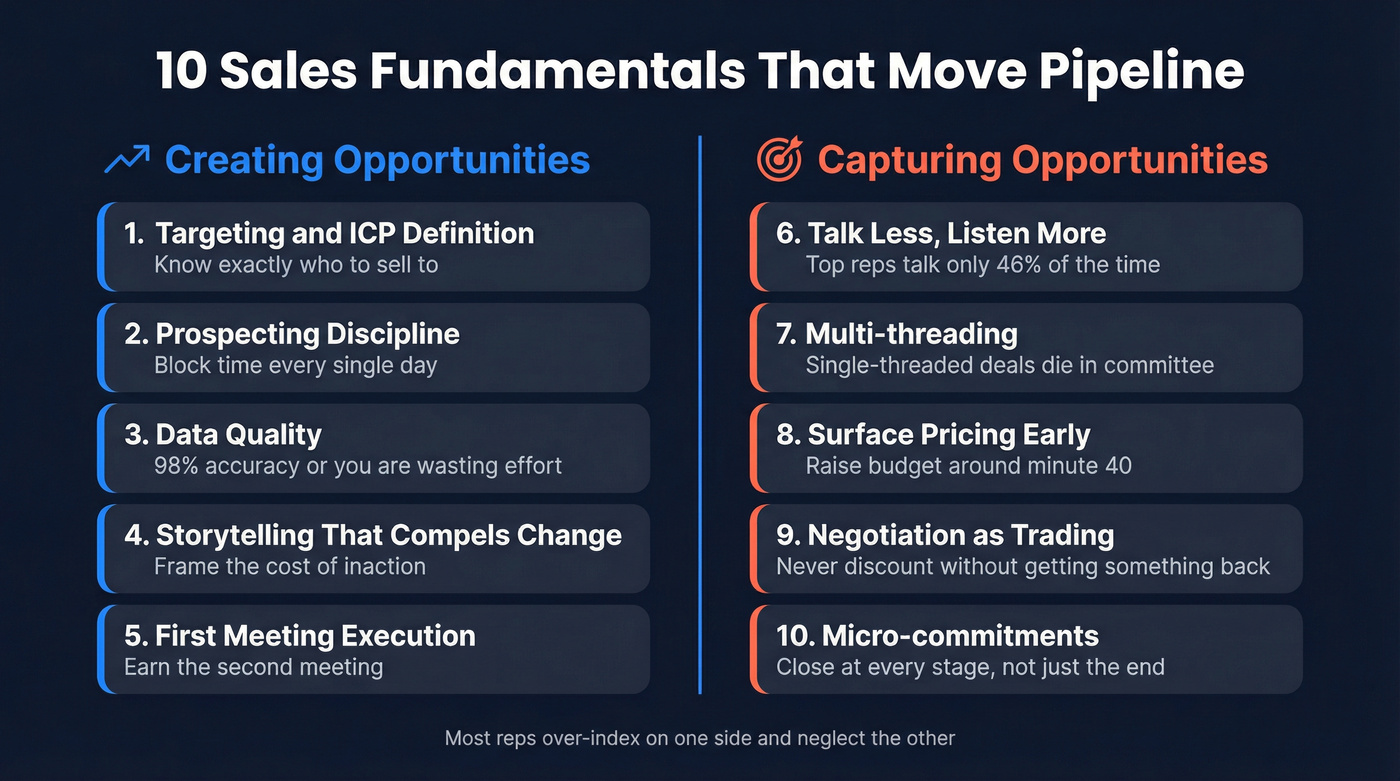
Creating Opportunities
Targeting and ICP definition. Everything downstream depends on this. If you're prospecting into accounts that don't match your ideal customer profile, your conversion rates will be terrible regardless of skill. Define your ICP by industry, company size, tech stack, and buying triggers - then actually stick to it. A tight list of 200 perfect-fit accounts beats a spray-and-pray list of 5,000 every time.
Prospecting discipline. Block time for prospecting every single day. Not "when I get around to it." Not "after I finish my follow-ups." Dedicated, non-negotiable blocks. The reps who consistently hit quota treat prospecting like a meeting they can't cancel. No pipeline, no deals. Full stop. (If you need a system, start with these sales prospecting techniques.)
Data quality. The best pitch doesn't matter if your email bounces. We've seen teams burn weeks of outbound effort because 30% of their list was invalid. Run your prospect list through a verification tool before you launch anything - Prospeo's 5-step verification process delivers 98% email accuracy and refreshes its 300M+ profiles every 7 days, which is roughly 6x faster than the industry average. The free tier gives you 75 verified emails per month plus 100 Chrome extension credits to test whether your current data is actually reaching anyone. (If you're troubleshooting bounces, use these email bounce rate benchmarks and fixes.)

Storytelling that compels change. Buyers don't care about your product. They care about the gap between where they are and where they need to be. Your job is to make that gap feel urgent - frame every conversation around the cost of inaction, not the features of your solution. True 1:1 personalization drives 2-3x better response rates, yet only 5% of reps do it well. That gap is your competitive advantage. (For a tighter narrative, borrow a few sales deck storytelling patterns.)
First meeting execution. You earned 30 minutes. Don't waste them on a 20-slide deck about your company history. Open with a sharp observation about their business - something that proves you've done your homework - then ask a question that gets them talking. The first meeting has one job: earn the second meeting. End with a specific, calendar-confirmed next step. (Use a simple product demo checklist so you don’t wing it.)
Capturing Opportunities
How much are you talking? AI analysis of 25,000+ B2B sales calls found top performers talk just 46% of the time. Average reps hit 68%. Low performers ramble at 72%. Discovery is where most deals are won or lost - not in the close. Deep discovery means understanding root causes, not just surface symptoms. What's broken? What have they tried? What happens if they do nothing? (If you want a repeatable structure, keep a bank of discovery questions.)
Multi-threading. How many contacts do you have in your top deal right now? If the answer is one, you're gambling. Modern B2B deals involve 6-10 stakeholders on the buying side, sometimes more. Closed-won deals have roughly 2x as many buyer contacts as lost deals, and for deals over $50K, multi-threading boosts win rates by 130%. Single-threaded deals die in committee rooms you never knew existed. (This is also a core part of enterprise B2B sales.)
Determining investment early. Don't wait until the proposal to talk money. The most successful reps first raise pricing around 40-42 minutes into an hour-long conversation - early enough to qualify, late enough to have established value. Sticker shock at the proposal stage kills deals that should've been disqualified weeks earlier.
Negotiation. Negotiation isn't about discounting. It's about trading. Every concession you make should come with something you value in return - a longer contract, a case study commitment, a faster signature timeline. Reps who default to "let me see what I can do on price" are leaving money and credibility on the table. (If you want one concept to drill, learn anchor in negotiation.)
Closing and gaining commitments. Here's the thing: closing isn't a single moment at the end of a deal. It's a series of micro-commitments throughout the entire sales process - committing to a second meeting, agreeing to loop in the CFO, scheduling a technical evaluation. If you're not gaining commitments at every stage, you don't have a deal. You have a conversation. (For a clean sequence, follow these steps to close a sale.)
Three Frameworks Every Rep Should Know
Frameworks give you structure when a deal gets complex or a conversation goes sideways. You don't need all of them, but you should know what each one does.
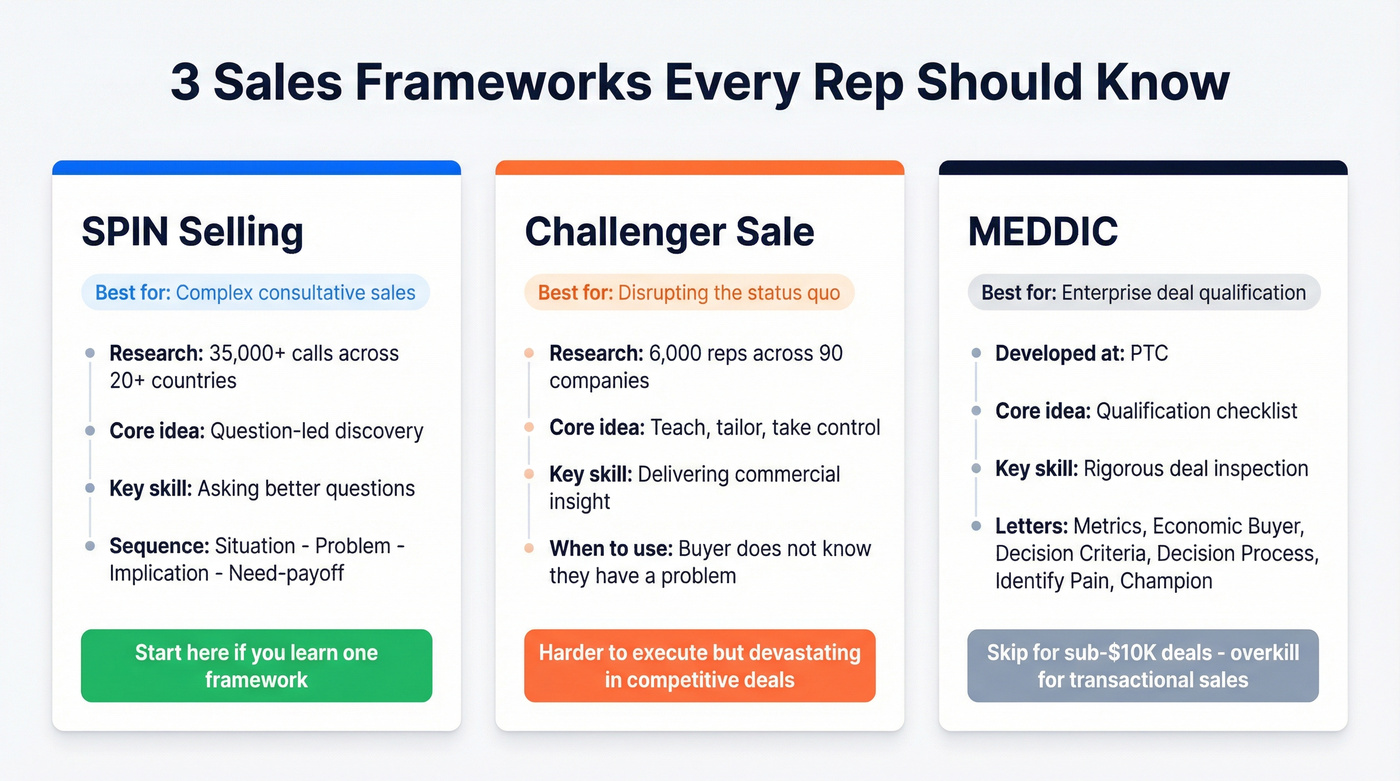
| SPIN | Challenger | MEDDIC | |
|---|---|---|---|
| Research basis | 35,000+ calls, 20+ countries | 6,000 reps, 90 companies | Developed at PTC |
| Core approach | Question-led discovery | Teach, tailor, take control | Qualification checklist |
| Best for | Complex consultative sales | Disrupting status quo | Enterprise deal qualification |
| Key skill | Asking better questions | Delivering commercial insight | Rigorous deal inspection |
SPIN Selling
If you learn one framework, learn SPIN. It's built on the largest empirical study of sales conversations ever conducted - 35,000+ calls across 20+ countries. The core idea is deceptively simple: move through Situation, Problem, Implication, and Need-payoff questions in sequence. It teaches you to stop pitching and start diagnosing. Most reps who struggle with discovery are actually struggling with question sequencing, and SPIN fixes that directly. We've recommended it to dozens of early-career reps, and the ones who actually practice the question types for 30 days see a noticeable shift in how prospects engage with them.
The Challenger Sale
Challenger works when your buyer doesn't know they have a problem - or doesn't think it's urgent enough to act on. Based on research across 6,000 reps and 90 companies, it found that the highest-performing reps "teach, tailor, and take control." They bring commercial insight the buyer didn't have, then frame the conversation around that insight. It's harder to execute than SPIN, but devastating in competitive deals where you need to reframe the evaluation criteria.
MEDDIC
MEDDIC isn't a selling methodology - it's a qualification framework. Metrics, Economic Buyer, Decision Criteria, Decision Process, Identify Pain, Champion. Use it to pressure-test every deal in your pipeline. If you can't fill in each letter, you don't understand the deal well enough. (If you want prompts you can use immediately, pull from these MEDDIC discovery questions.)
We've watched teams cut their pipeline in half with MEDDIC and actually close more revenue because they stopped wasting cycles on deals that were never real. Skip this one if you're selling sub-$10K deals with short cycles - it's overkill for transactional sales.
Sales Psychology - The Invisible Layer
Gerald Zaltman's research at Harvard found that 95% of purchase decisions happen in the subconscious mind. The logical ROI case you're building is necessary but not sufficient. You also need to understand what's driving the decision beneath the surface.
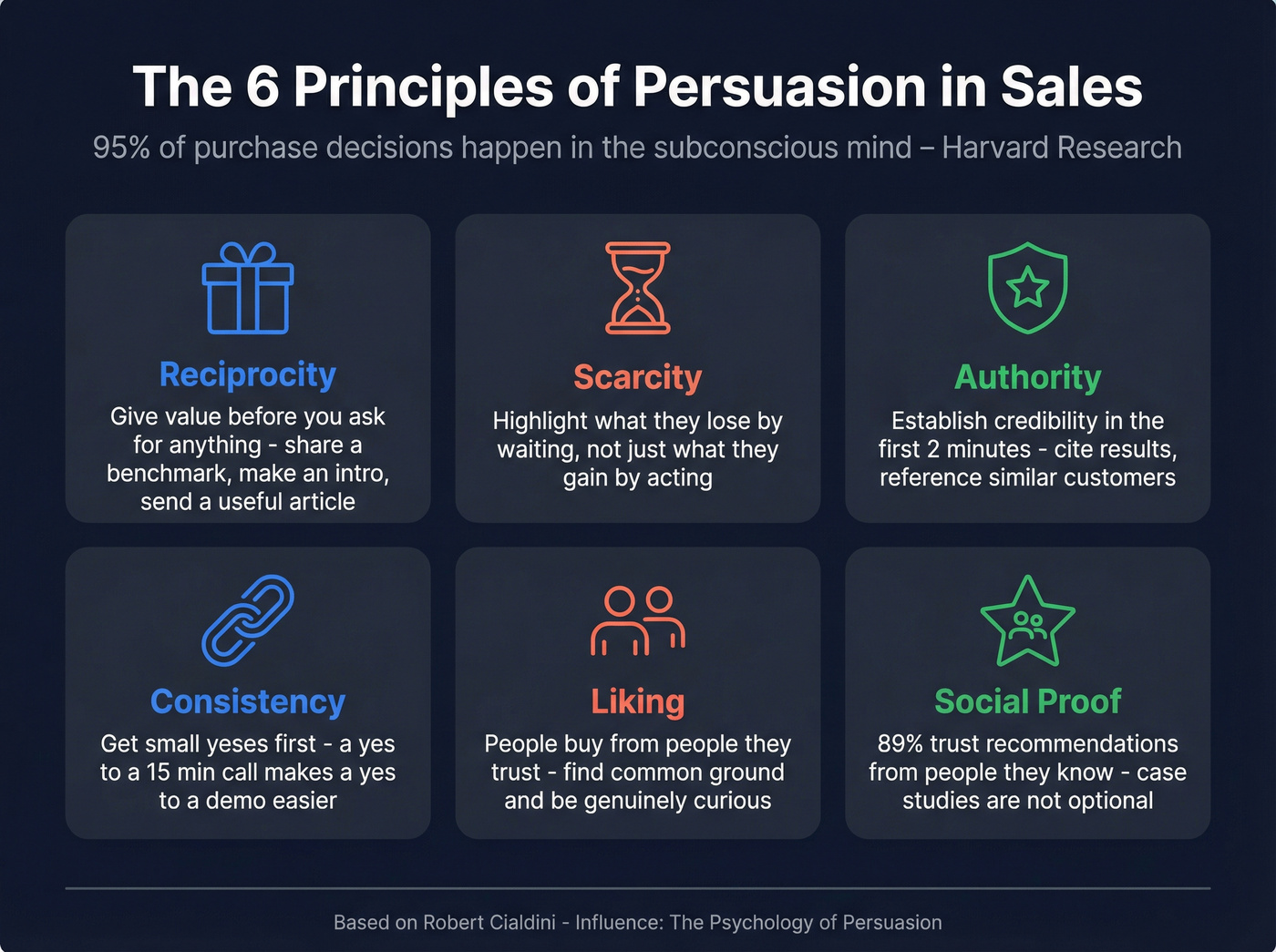
Cialdini's six principles of persuasion give you a practical toolkit. Reciprocity means giving value before asking for anything - share a relevant benchmark, make an introduction, send a useful article. The instinct to reciprocate is powerful. Scarcity works by highlighting what they'll lose by waiting, not just what they'll gain by acting: limited-time pricing, closing implementation windows, competitive pressure.
Authority requires establishing credibility early - reference similar customers, cite specific results, demonstrate domain expertise in the first two minutes. Consistency is about getting small commitments first. A "yes" to a 15-minute call makes it easier to get a "yes" to a full demo, and each micro-commitment builds momentum toward the close.
Liking is straightforward: people buy from people they trust and relate to, so do your research, find common ground, and be genuinely curious about their world. Social proof is non-negotiable - Nielsen research found 89% of consumers trust recommendations from people they know more than any other channel. Case studies, testimonials, and "here's what companies like yours did" stories aren't optional. They're essential.

Data quality is the fundamental most reps ignore - and it tanks everything downstream. Prospeo's 5-step verification delivers 98% email accuracy across 300M+ profiles, refreshed every 7 days. Teams using Prospeo book 35% more meetings than Apollo users.
Stop letting bad data sabotage your prospecting discipline.
7 Mistakes That Kill New Reps
Talking too much. The data is unambiguous. Top performers talk 46% of the time on discovery calls. If you're above 55%, you're pitching when you should be listening. Record your next five calls and check.
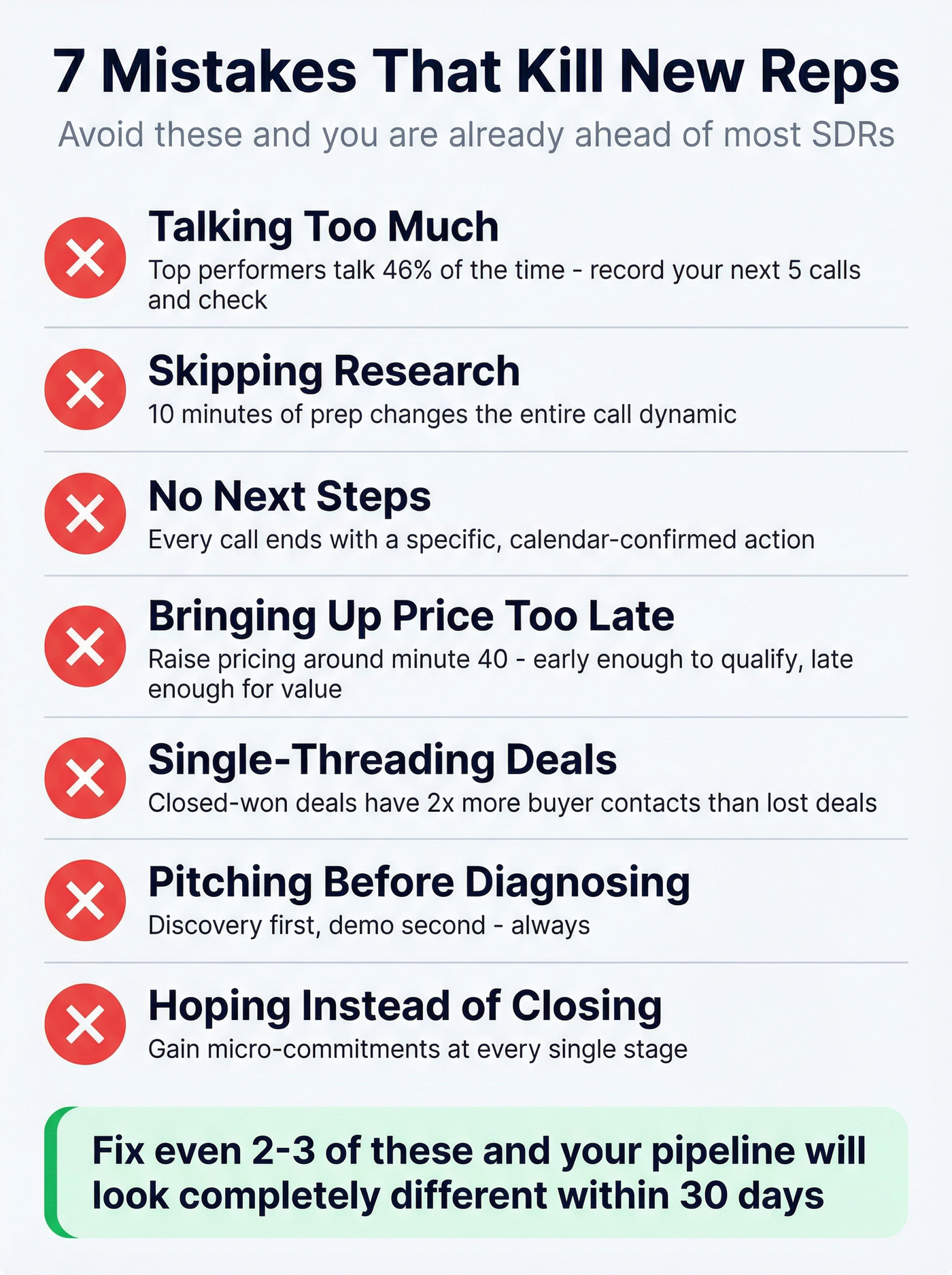
Skipping research. Showing up to a call without knowing the prospect's company size, recent news, or tech stack signals that you don't value their time. Ten minutes of prep changes the entire dynamic.
No next steps. Every call should end with a specific, calendar-confirmed next action. "I'll follow up next week" isn't a next step - it's a hope. (If you need words that actually land, use these sales follow-up templates.)
Bringing up price too late. Waiting until the proposal to discuss budget creates sticker shock. Get a sense of investment expectations mid-conversation, not on the final slide.
Giving up too early. Most deals require multiple touches across multiple stakeholders. If you're abandoning prospects after two unanswered emails, you're leaving pipeline on the table.
Neglecting existing customers. Your current customers are your warmest pipeline. Referrals, expansions, and renewals are easier than cold outbound. Make one referral ask per week a non-negotiable habit.
Running on bad data. I can't stress this enough - invalid emails, spam traps, and catch-all domains tank your sender reputation and waste your prospecting blocks. Verify before you send. (If you’re seeing deliverability issues, start with this email deliverability guide.)
2026 Benchmarks - What "Normal" Looks Like
Before you beat yourself up over a tough quarter, let's calibrate what "normal" actually looks like in B2B sales right now.
| Metric | Benchmark | Context |
|---|---|---|
| Average win rate | 20-21% | 4 out of 5 deals don't close |
| Average quota attainment | ~43% | Percentage of quota achieved |
| Reps hitting quota | 51% | Up from 28% in 2023 |
| AE ramp time | 5.7 months | Per Bridge Group data |
| Buying committee | 6-10 stakeholders | Enterprise deals hit 15-17+ |
| Multi-threading impact | 2x contacts in won deals | 130% win rate boost for >$50K |
| SMB sales cycle | 2-6 weeks | Lower ACV, fewer stakeholders |
| Mid-market cycle | 1-3 months | More procurement involvement |
| Enterprise cycle | 6-12+ months | Multiple budget cycles, legal |
These numbers aren't targets - they're baselines. If your win rate is at 20%, you're average. The goal is to use these fundamentals to push above the median, not to feel good about matching it. (To pressure-test your funnel, track pipeline health weekly.)
If your average deal is under $10K and your sales cycle is under two weeks, you probably don't need MEDDIC or multi-threading playbooks. You need faster prospecting, tighter messaging, and more at-bats. Don't over-engineer a process for a deal size that doesn't warrant it.
How AI Changed the Game in 2026
Reps spend 70% of their time on admin and non-selling tasks. AI is eating into that number, and that's genuinely good news.
But let's be honest about the tradeoffs. Cold email reply rates dropped 15% year-over-year, from 6.8% to 5.8%. That's partly because AI made it trivially easy to send more email - which means more noise, lower response rates, and a higher bar for standing out. Personalization and relevance matter more now, not less. (If you’re building sequences, this AI cold email outreach playbook is a solid baseline.)
About 60-70% of the buying process happens online before a rep gets a meeting. Your buyer has already researched you. AI handles the admin - research summaries, call transcription, CRM updates, quote drafting. You handle the trust, the discovery, and the negotiation. That division isn't going away.
| AI Play | What It Does | Guardrail |
|---|---|---|
| Account battlecards | Auto-generated research briefs | Require citations, human review |
| Call intelligence | Transcription, talk ratios, CRM notes | AI misses tone - use for coaching |
| Quote/proposal drafting | First-draft proposals and RFP responses | Keep pricing and legal approvals human |
The playbook itself is shifting too. Static playbooks - PDFs updated quarterly, disconnected from your CRM - are being replaced by dynamic, CRM-embedded systems with real-time updates and usage analytics. If your team is still passing around a Google Doc labeled "Sales Playbook v7_FINAL_v2," it's time to modernize.
| Static Playbook | Dynamic Playbook | |
|---|---|---|
| Format | PDF or Google Doc | CRM-embedded platform |
| Update cycle | Quarterly (if ever) | Real-time, triggered by data |
| Personalization | Generic, one-size-fits-all | Tailored by deal stage and persona |
| Analytics | None | Usage tracking, adoption metrics |
Your Daily Fundamentals Checklist
You'll forget 84% of this in 90 days. This checklist is how you don't.
- Prospecting block - 60-90 minutes, calendar-blocked, non-negotiable
- ICP review - Are today's targets actually in your ideal customer profile?
- Discovery questions prepped - Write 3-5 questions before every call
- CRM updated - Log every interaction same-day, not "when I get to it"
- One referral ask - Ask one happy customer or warm contact for an intro
- Pipeline review - Check your top 5 deals: what's the next step for each?
- One skill drill - Practice one fundamental for 15 minutes (objection handling, opening statements, question sequencing)
Print this. Tape it to your monitor. The reps who run this daily outperform the ones who rely on talent and memory.
Multi-threading boosts win rates by 130%, but only if you can actually reach those 6-10 stakeholders. Prospeo gives you verified emails and 125M+ direct dials so you never single-thread a deal again - all for roughly $0.01 per contact.
Build multi-threaded pipeline with contacts that actually connect.
Recommended Resources
Four books worth your time:
SPIN Selling by Neil Rackham - The single best book on asking questions in sales. Read it first, practice it immediately.
Fanatical Prospecting by Jeb Blount - The mindset and mechanics of consistent pipeline generation. Especially useful if you're struggling with prospecting discipline.
Never Split the Difference by Chris Voss - Negotiation tactics from an FBI hostage negotiator, adapted for business. The mirroring and labeling techniques work in discovery calls too.
The Challenger Sale by Dixon and Adamson - Best for reps selling into complex organizations where the buyer doesn't know they need to change.
Stop consuming and start practicing. Pick one fundamental from this guide and drill it for 30 days.
FAQ
What are the most important sales fundamentals for beginners?
Discovery, prospecting, and closing commitments - master those three before anything else. They keep your pipeline full and deals moving forward. If you're looking for a starting point, those three disciplines cover roughly 80% of what determines whether a new rep sinks or swims.
How long does it take to learn core selling skills?
Most AEs ramp in about 5.7 months, but you can internalize core frameworks like SPIN and MEDDIC in 30-60 days of deliberate, daily practice.
What's the best sales framework for new reps?
SPIN Selling - it's backed by 35,000+ call studies and teaches you to ask better questions instead of pitching harder. Pair SPIN with the ten principles outlined above for a complete foundation.
Do these principles change with AI?
The admin changes, the human skills don't. AI handles research and note-taking. You still handle trust, discovery, and negotiation - those remain the highest-leverage skills in any selling motion.
What's the minimum tool stack for practicing outbound?
A CRM like HubSpot's free tier, a verified data source for clean prospecting lists, and a sequencing tool for outbound. That's the minimum viable stack - you can run real campaigns on under $100/month.