

The Sales Funnel Template Guide That Actually Includes the Numbers
Every "free sales funnel template" article gives you a blank spreadsheet and then immediately tries to sell you a $50/month CRM. Here's the thing: the spreadsheet works fine for most teams. What you actually need are benchmarks to know whether your funnel is healthy - and verified contact data to fill it.
96% of visitors aren't ready to buy on their first visit. A blank template doesn't fix that. Knowing your stage-by-stage conversion rates does.
What You Need (Quick Version)
- Free spreadsheet template with auto-updating insights - grab the Salesflare Google Sheets template.
- Lightweight CRM without CRM pricing - use a Notion or Airtable pipeline template.
Skip to conversion benchmarks by industry →
Sales Funnel vs. Sales Pipeline
These terms get swapped constantly, and using the wrong template wastes your time.
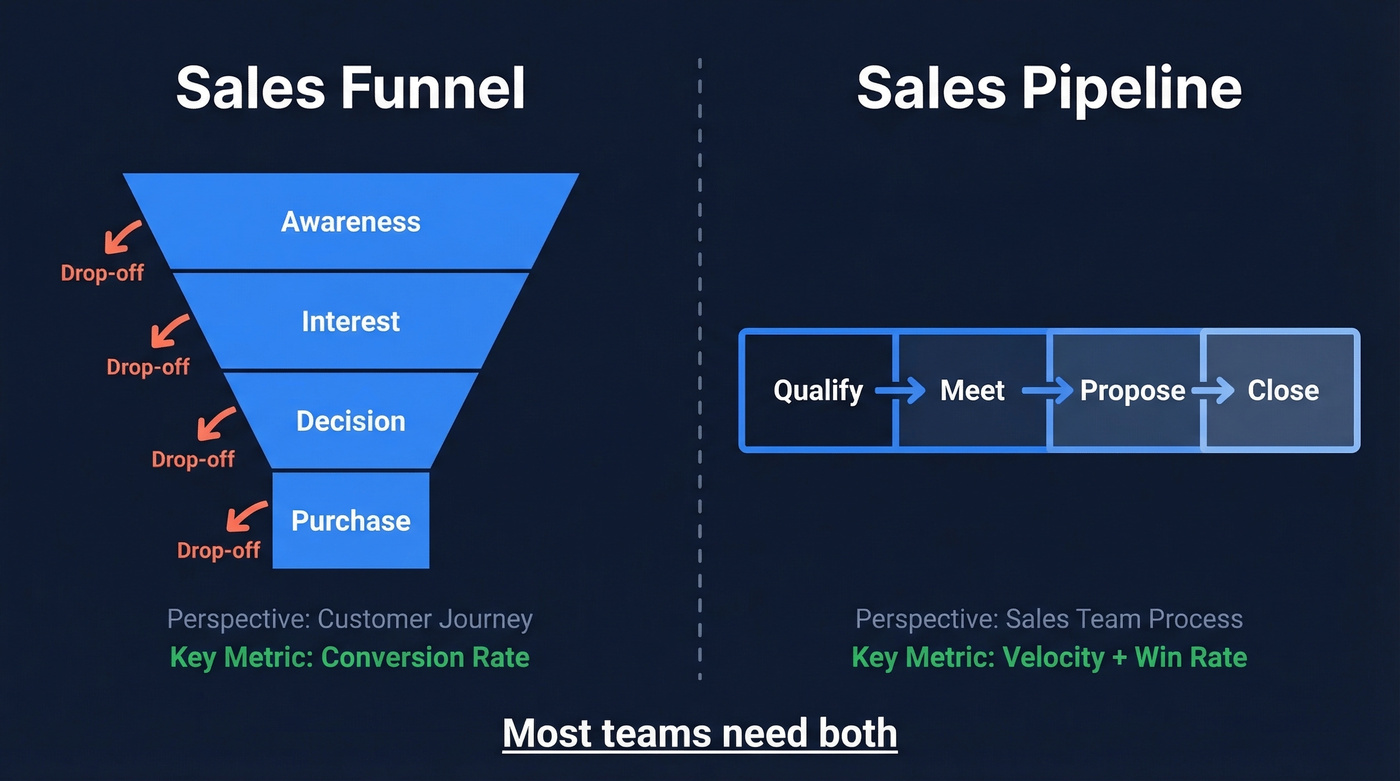
| Sales Funnel | Sales Pipeline | |
|---|---|---|
| Perspective | Customer journey | Sales team process |
| Measures | Drop-off between stages | Rep activity per stage |
| Shape | Narrows (people leave) | Stays flat (deals move) |
| Key metric | Conversion rate | Velocity + win rate |
A sales funnel models the whole customer journey - awareness through purchase - and tracks where people drop off. A sales pipeline models your team's internal process: qualifying, meeting, proposing, closing. Different questions, different spreadsheets, different columns.
If you're tracking drop-off rates, you need a funnel template. If you're tracking rep activity and deal velocity, you need a pipeline template. Most teams need both. If you want a deeper breakdown of Sales Funnel vs. Sales Pipeline, the key is whether you're measuring customer drop-off or rep execution.
Sales Funnel Stages Explained
Most funnel guides overcomplicate this. You need 4-5 stages, not 12. The exact labels depend on whether you're B2B or B2C, but the logic is the same: people enter at the top, and fewer come out the bottom. A good template maps each level to a specific gate and KPI so nothing is left to guesswork. If you want a more structured framework, the AIDA sales funnel model is a useful reference.
B2B Funnel Stages
The standard B2B model runs five stages: Lead → MQL → SQL → Opportunity → Closed Won.
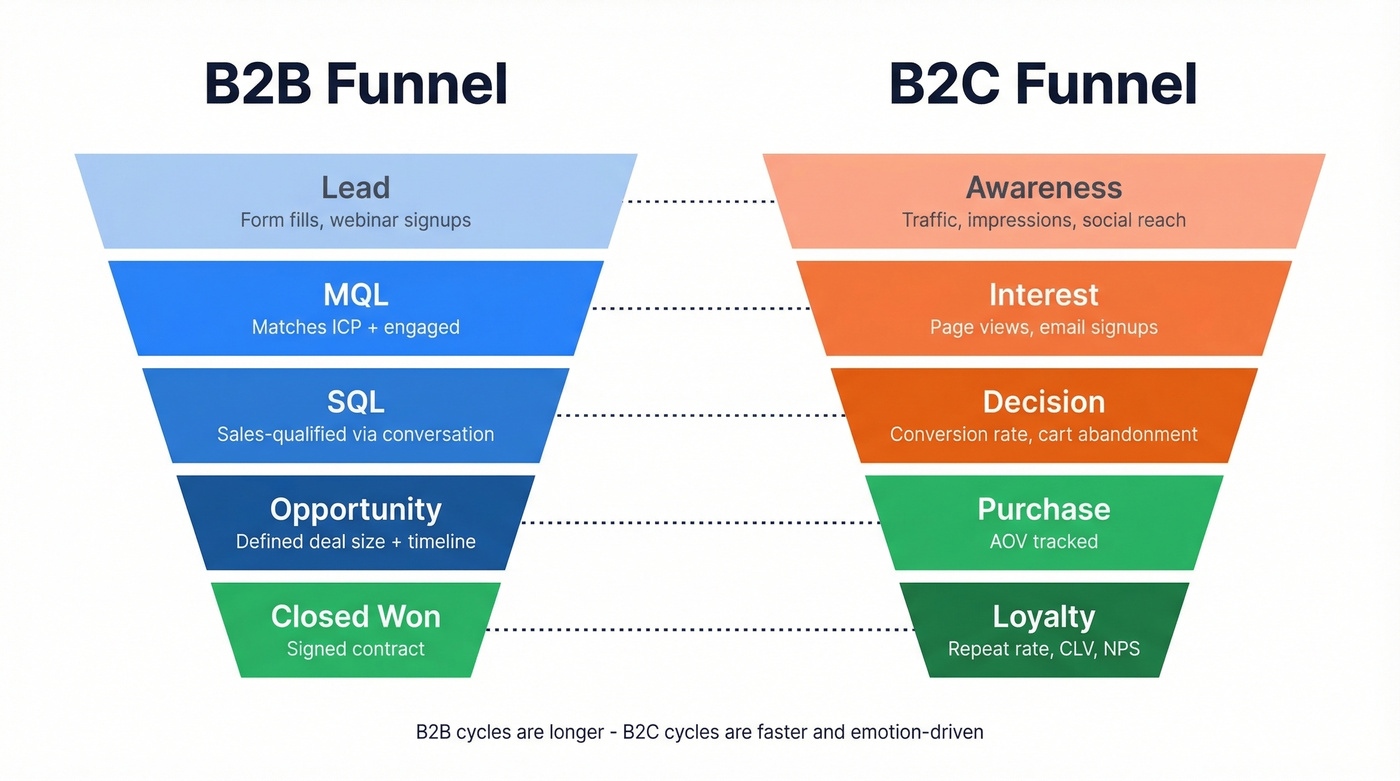
Leads are anyone who's entered your system - form fill, webinar signup, inbound request. MQLs are leads that match your ICP and show engagement. SQLs are MQLs that sales has qualified through a conversation. Opportunities have a defined deal size and timeline. Closed Won means a signed contract - not first payment, which is an important distinction when you're measuring conversion rates.
Track per stage: lead volume, MQL-to-SQL conversion rate, average days in stage, and win rate at the bottom. If you need to tighten qualification, use a formal lead scoring model.
B2C Funnel Stages
B2C funnels are faster and more emotion-driven. The standard model is four stages: Awareness → Interest → Decision → Purchase, with a fifth Loyalty stage if retention matters to your business. (It should.)
Awareness tracks traffic, impressions, and social reach. Interest measures product page views and email signup rate. Decision watches conversion rate and cart abandonment. Purchase tracks AOV. Loyalty measures repeat purchase rate, CLV, and NPS.
Conversion Benchmarks by Industry
A template without benchmarks is just a to-do list. You need to know what "good" looks like at each stage so you can spot leaks before they drain your pipeline. In our experience, teams that start tracking stage-by-stage conversion rates find their first leak within two weeks. For a full KPI list, see our guide to funnel metrics.
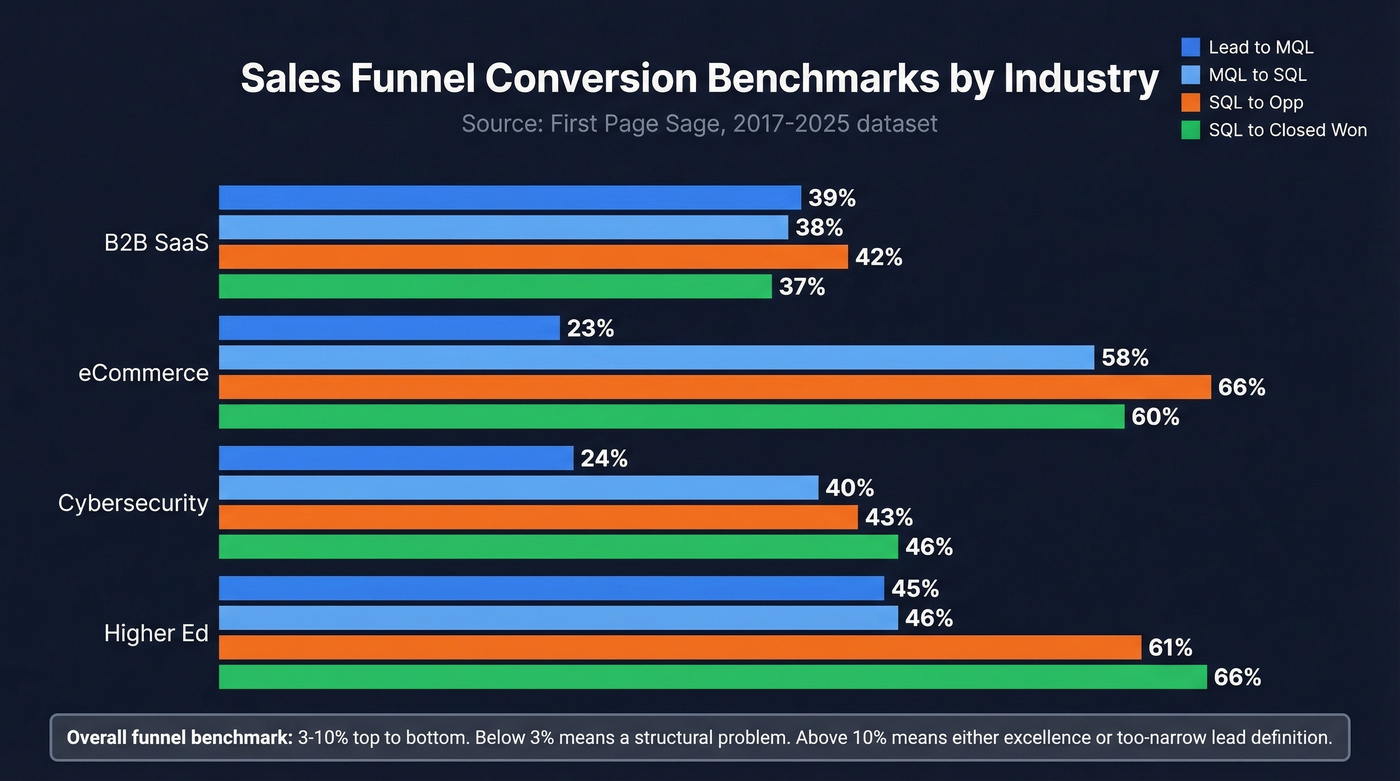
These benchmarks come from First Page Sage's dataset spanning 2017-2025 across a client mix that's roughly 65% B2B, 20% B2C, and 15% both:
| Industry | Lead→MQL | MQL→SQL | SQL→Opp | SQL→Closed Won |
|---|---|---|---|---|
| B2B SaaS | 39% | 38% | 42% | 37% |
| eCommerce | 23% | 58% | 66% | 60% |
| Cybersecurity | 24% | 40% | 43% | 46% |
| Higher Ed | 45% | 46% | 61% | 66% |
These are post-visitor benchmarks - they start after someone becomes a lead. The visitor-to-lead conversion happens earlier and runs notably lower.
For a broader baseline, VWO's ranges work if you don't fit neatly into one industry:
- Visitor → Lead: 1-5%
- Lead → MQL: 25-35%
- MQL → SQL: 13-26%
- SQL → Opportunity: 50-62%
- Opportunity → Closed Won: 15-30%
Overall, most funnels convert 3-10% from top to bottom. Below 3%, you've got a structural problem. Above 10%, either your funnel is genuinely excellent or your definition of "lead" is too narrow.
Plug these numbers into your template's Insights tab. When your actual rates deviate by more than 10 points from the benchmark, that's where to investigate first. If you also track pipeline execution, compare against sales pipeline benchmarks.

Benchmarks tell you where your funnel leaks. Bad contact data is usually the cause. Prospeo's 98% verified emails and 7-day data refresh mean fewer bounces, higher connect rates, and more leads actually making it from MQL to Closed Won.
Stop losing deals to outdated data - fill your funnel with contacts that convert.
What a Good Template Includes
Let's use the Salesflare template as a reference model - it's free, works in both Google Sheets and Excel, and nails the three-tab structure that separates useful templates from glorified contact lists.
The Sales Funnel Tab
This is your working sheet. Each row is a deal. Minimum fields: deal name, company, contact, deal size, expected close date, sales rep, current stage, and next action date. Salesflare lets you add or remove columns, which matters - your funnel isn't identical to anyone else's.
The Settings Tab
This is where you customize stages, team members, targets, and follow-up reminders. Salesflare includes a configurable reminder for stale deals - a small detail that prevents opportunities from going cold. OnePageCRM takes this further with color-coded due dates and pre-built views like Focus Mode and per-rep filters.
The Insights Tab
The Insights tab auto-updates based on your data entry. It should include revenue forecast, rep performance, and - critically - conversion rates between stages. Without this tab, you're just maintaining a list. With it, you're running a funnel. If forecasting is a priority, consider dedicated sales forecasting solutions.
The minimum viable template needs all three layers: data entry, configuration, and reporting. If the template you're evaluating doesn't have an insights or dashboard component, skip it.
Choose Your Template Format
| Format | Best For | Price | Limitation |
|---|---|---|---|
| Google Sheets | Solo founders, <5 people | Free | No automations at scale |
| Notion | Small teams wanting flexibility | Free-~$10/user/mo | No native email integration |
| Airtable | Linked records + automations | Free-~$20/user/mo | Free tier record limits |
| HubSpot CRM | Graduating from spreadsheets | Free-$15/user/mo | Feature-gated free tier |
| Pipedrive | Sales-focused teams | $14/user/mo | Paid-only for core features |
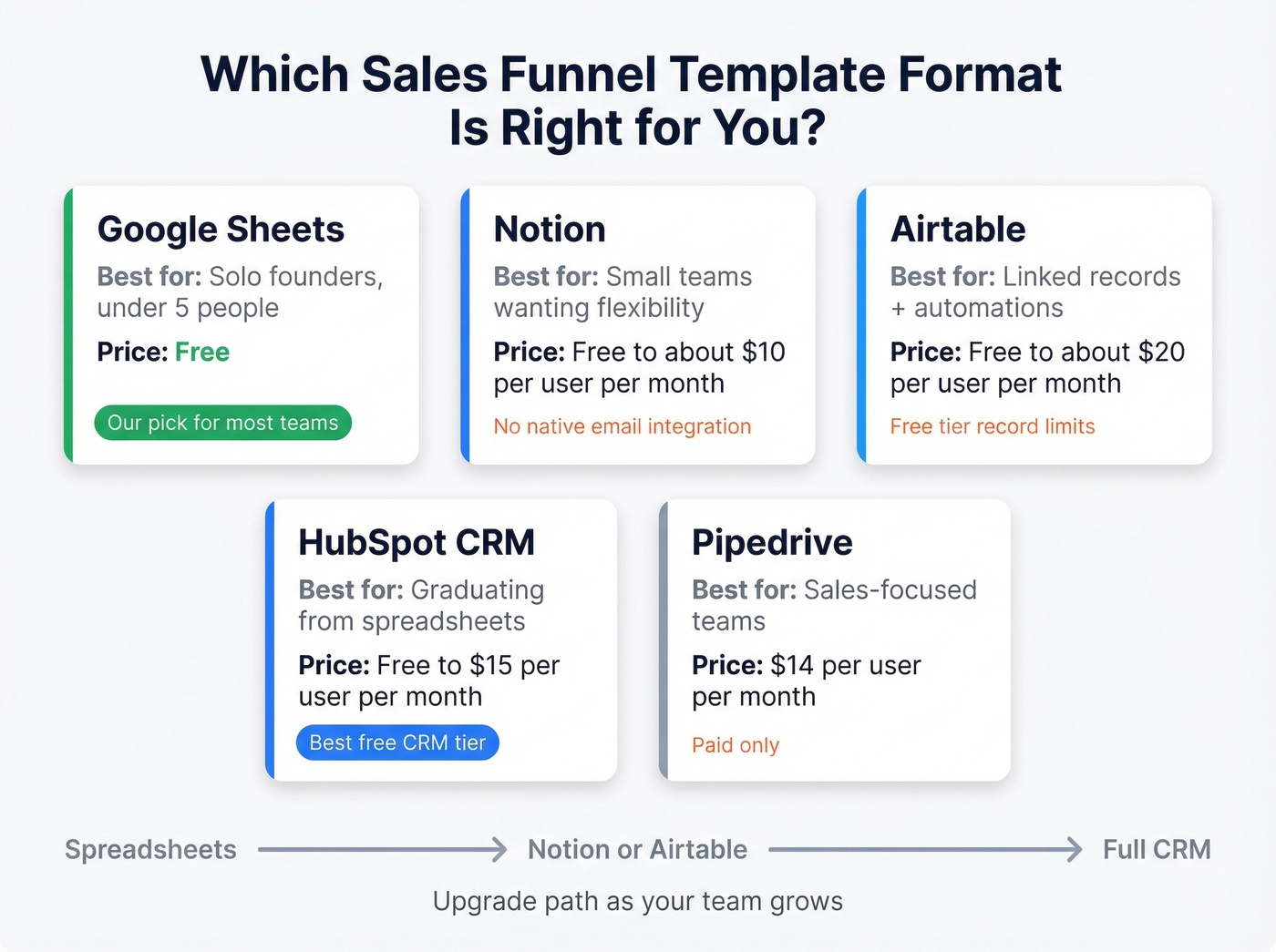
Our pick for most teams: Google Sheets until you hit 5 people, then HubSpot's free tier. Spreadsheets are the default for teams under 10 for good reason - they're free, everyone knows how to use them, and templates like Salesflare's give you auto-updating insights without any setup. If you’re evaluating tools, here are more examples of a CRM with real pricing.
When Sheets Break Down
Once you have multiple reps editing the same sheet, things fall apart. No permissions, no automations, no audit trail. That's your signal to move to a CRM. If you're seeing process issues, these sales pipeline challenges are usually the root cause.
Notion and Airtable: The Middle Ground
Notion is underrated for small teams who hate CRM pricing. The template ecosystem includes 49 sales templates with Kanban views and drag-and-drop pipeline management. The tradeoff: no native email or phone integrations.
Airtable sits between a spreadsheet and a database. Linked tables for Accounts, Contacts, and Deals, plus Kanban views and basic automations. The free tier has record limits that are fine early on, but you'll hit a wall as your pipeline grows.
CRM-Native Options
When spreadsheets stop working - usually around 5 reps - it's time for a real CRM. HubSpot offers a genuinely useful free tier with pipeline management and basic reporting. monday.com CRM starts at $12/user/month. Pipedrive starts at $14/user/month. Start with HubSpot's free tier and only pay when you hit the feature gates.
Customize by Business Type
B2B SaaS Funnel
Longer sales cycles, multiple stakeholders, demo-driven. Your template needs MQL and SQL stages - skipping them means you can't diagnose where the marketing-to-sales handoff breaks down. Add fields for deal stage, number of stakeholders involved, and demo date. Track days-in-stage religiously; if SQLs sit for more than 14 days without movement, your qualification criteria are probably too loose. If you need a tighter handoff, use a documented lead generation workflow.
B2C / eCommerce Funnel
Shorter cycles, higher volume, emotion-driven. The critical metric is cart abandonment, which averages 70.19%. Your template needs a Loyalty stage - Bain's research shows a 5% increase in retention drives 25-95% higher profits. Track AOV, repeat purchase rate, and recovery email performance alongside standard conversion rates.
Webinar Funnel
Four stages: Registration → Attendance → Offer → Close. The metric most teams miss is registration-to-attendance rate, which typically runs 30-45%. Below 30%, your reminder sequence is broken. Add columns for registration source, attendance status, and post-webinar follow-up date. For follow-up, keep a set of proven sales follow-up templates handy.
Seven Funnel Mistakes That Kill Conversions
1. One-step checkout when two-step works better. Splitting your checkout into two steps - contact info first, payment second - lifts conversions 20-40%. Once someone enters their email, they're more committed to finishing.
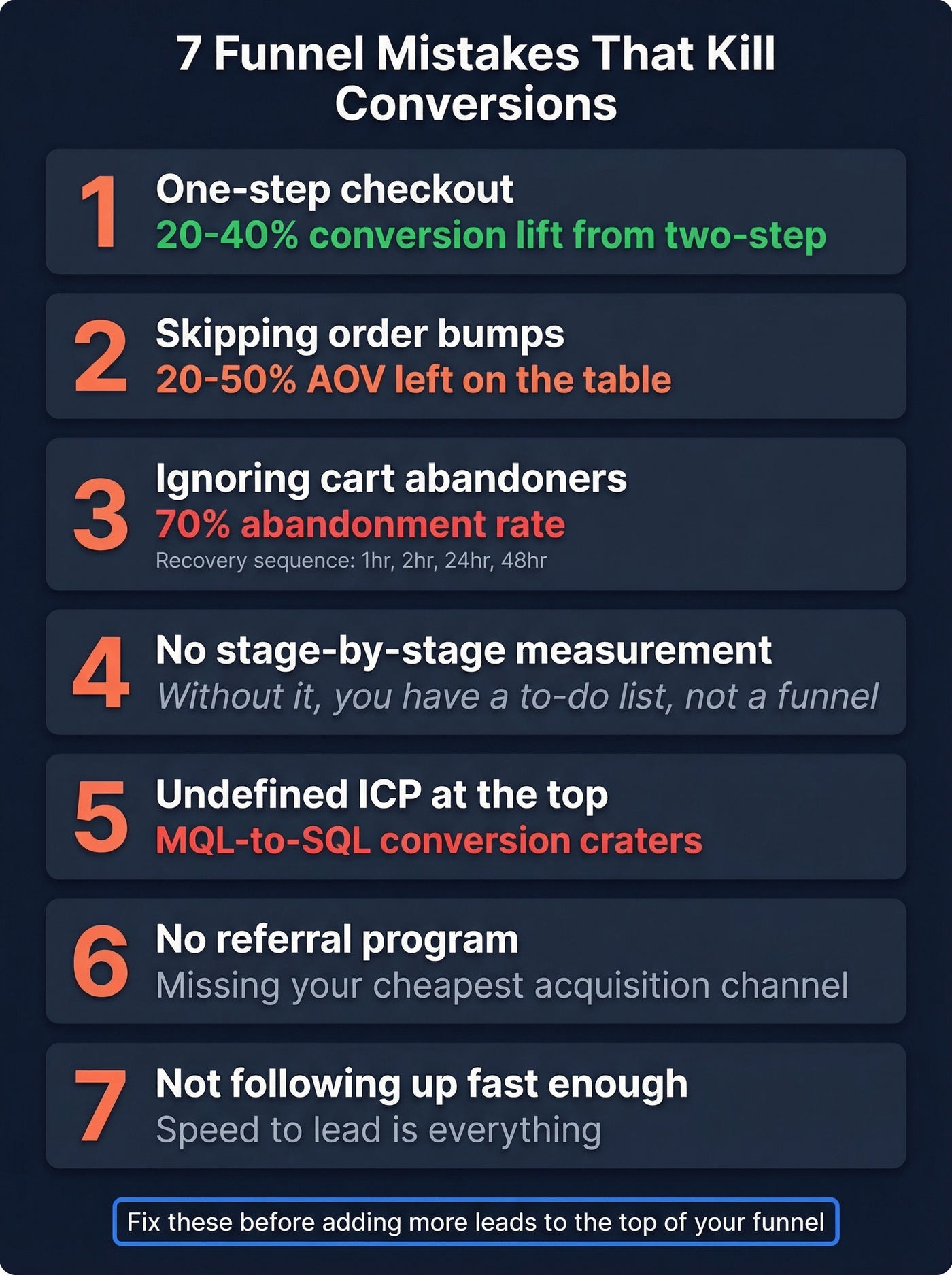
2. Skipping order bumps and upsells. This leaves 20-50% of potential AOV on the table. Even a simple "add X for $Y" checkbox on the checkout page moves the needle.
3. Ignoring cart abandoners. With a 70% abandonment rate, recovery emails aren't optional. The sequence that works: 1 hour (reminder), 2 hours (social proof), 24 hours (incentive), 48 hours (urgency). We've seen teams recover 10-15% of abandoned carts with this exact cadence.
4. No stage-by-stage measurement. If you're not measuring conversion rates between stages, you don't have a funnel - you have a to-do list. Plug the benchmarks from the table above into your template and compare monthly.
5. Undefined ICP at the top. Pouring leads into a funnel without a clear Ideal Customer Profile means your MQL-to-SQL conversion will crater. Define your ICP by industry, company size, job title, and budget range before you build a single list. Every stage downstream depends on this. If you need a starting point, use an Ideal Customer Profile template.
6. No referral or expansion motion. Most teams treat Closed Won as the finish line. It's not. Without a referral system or expansion playbook, you're leaving the cheapest pipeline source untapped. Add a post-close stage to your template and track referral-generated leads separately.
7. Bad prospect data at the top. Bounced emails and wrong numbers don't just waste time - they tank your domain reputation and poison every sequence downstream. Forrester's research shows strong lead nurturing produces 50% more sales-ready leads at 33% lower cost, but that math only works if your contact data is accurate from the start. If bounces are a recurring issue, start with email bounce rate benchmarks and fixes.
Let's be honest: most teams spend 80% of their time redesigning funnel stages and 20% on the data that fills them. Flip that ratio. A five-stage funnel with accurate prospect data will outperform a twelve-stage masterpiece fed by garbage contacts every single time.
Fill Your Funnel With Real Prospects
The template takes 10 minutes. Finding accurate prospect data to fill it takes 10 hours - unless you automate it. Prospeo's B2B database covers 300M+ professional profiles with 30+ search filters including buyer intent, technographics, and job changes. The data quality is what matters here: 98% email accuracy, 125M+ verified mobile numbers with a 30% pickup rate, and a 7-day refresh cycle. Export to CSV, push directly to HubSpot or Salesforce, or use the enrichment API for automated workflows. If you’re comparing vendors, see our roundup of data enrichment services.

A template with great benchmarks still needs real prospects at the top. Prospeo gives you 300M+ profiles with 30+ filters - buyer intent, technographics, funding, headcount growth - so every lead entering your funnel already matches your ICP. At $0.01 per email, scaling your pipeline costs less than your spreadsheet software.
Build a funnel worth measuring - start with data that actually connects.
FAQ
How many stages should a sales funnel have?
Four to six. B2B typically uses five (Lead, MQL, SQL, Opportunity, Closed Won). B2C uses four (Awareness, Interest, Decision, Purchase). Add a Loyalty stage if retention drives your revenue model.
What's a good overall funnel conversion rate?
Most funnels convert 3-10% from top to bottom. B2B SaaS trends toward 3-5%, while eCommerce with strong retargeting can hit 7-10%. Below 3% signals a structural leak worth investigating immediately.
When should I switch from a spreadsheet to a CRM?
When your team exceeds five reps editing the same sheet. HubSpot's free tier is the natural first step - it offers pipeline management and basic reporting at no cost.
How do I find prospect data to fill my funnel?
Use a B2B data platform to search by job title, industry, company size, and buyer intent. Prospeo's free tier includes 75 verified emails per month - export directly to your spreadsheet or CRM and start testing conversion rates right away.