

Sales Introduction Email Templates That Actually Get Replies (2026)
The average cold email reply rate right now is 3.43%. That means 96 out of 100 prospects ignore you. Elite performers hit 10%+, and the gap between them and everyone else isn't better copy - it's infrastructure, list quality, and brevity.
Prospects are drowning in outreach. What worked last year is dead. Templates matter, but only after you've earned the right to land in someone's inbox.
Before You Touch a Template
Handle these four things first:
- Verify your list. Bounce rate must stay under 2%. One bad send can torch your sender reputation for weeks.
- Set up SPF, DKIM, and DMARC plus RFC 8058 one-click unsubscribe - mandatory now.
- Warm your domains. Start at 5-10 emails/day, ramp over 4-6 weeks. No shortcuts.
- Send short emails under 80 words using the templates below.
58% of all replies come from email #1. Make sure it actually lands in the inbox.
What Is a Sales Introduction Email?
A sales introduction email is the first message a prospect receives from you or your company. Cold intros go to people with no prior relationship. Warm intros come through a mutual connection - someone vouches for you before the prospect reads a word.
Warm introductions convert at 4X the rate of cold outreach. The best SDRs treat intro requests as a core workflow, not a nice-to-have. Use cold intros when you've got no path in. Use warm intros whenever you can manufacture one.
2026 Benchmarks: What Good Looks Like
Here's the thing: most teams don't know what "good" actually means for cold email. They send 500 emails, get 8 replies, and have no idea if that's terrible or decent.
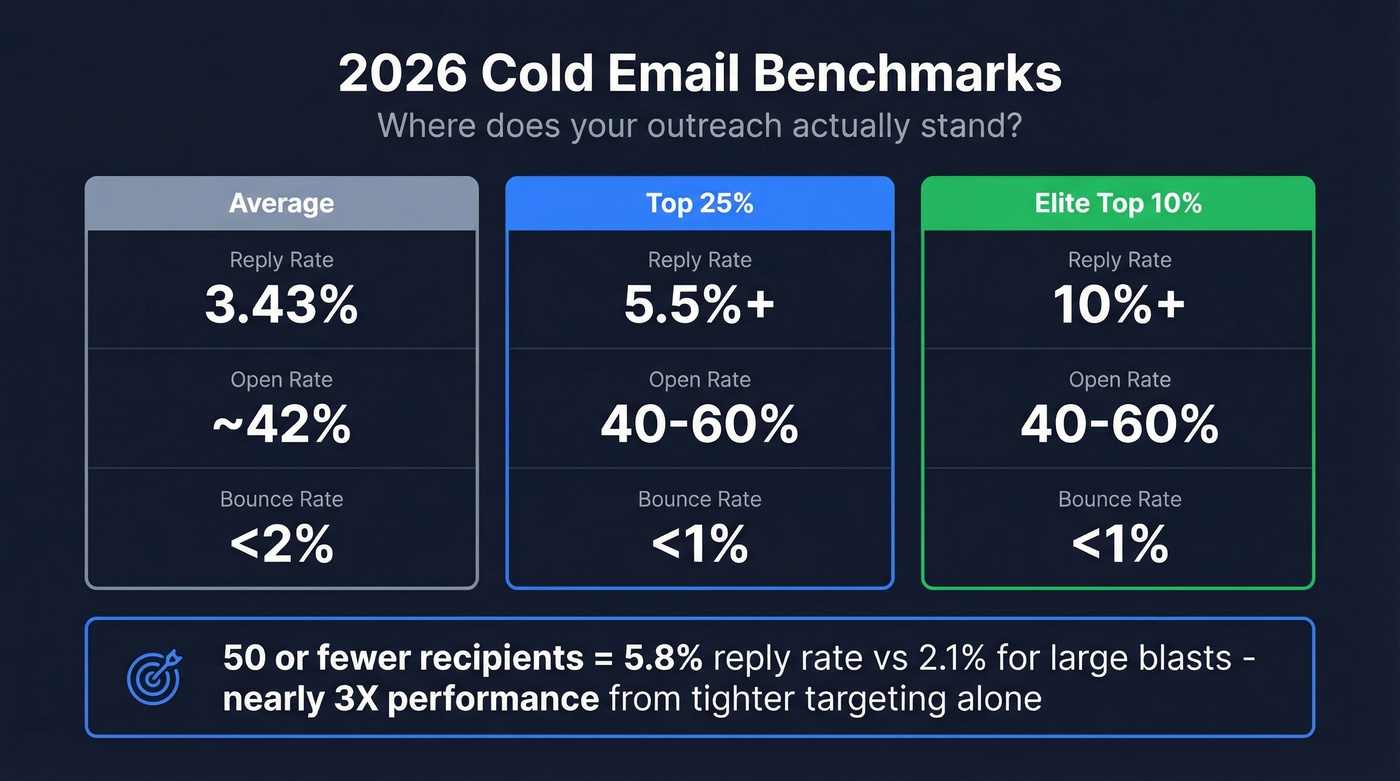
| Metric | Average | Top Quartile | Elite (Top 10%) |
|---|---|---|---|
| Reply rate | 3.43% | 5.5%+ | 10%+ |
| Open rate | ~42% | 40-60% | 40-60% |
| Bounce rate | <2% | <1% | <1% |
The most underrated data point in cold email: campaigns targeting 50 or fewer recipients average a 5.8% reply rate versus 2.1% for larger blasts. That's nearly 3X the performance just from tighter targeting. In our experience, teams that nail email deliverability and send smaller batches consistently land in the top quartile - no copywriting genius required.
Best days to send: Tuesday and Wednesday. A strong send window is 8-11 AM in the recipient's timezone (more data here: best time to send).
Deliverability and List Quality
Real talk: this is where 80% of cold emailers fail, and it has nothing to do with copywriting.
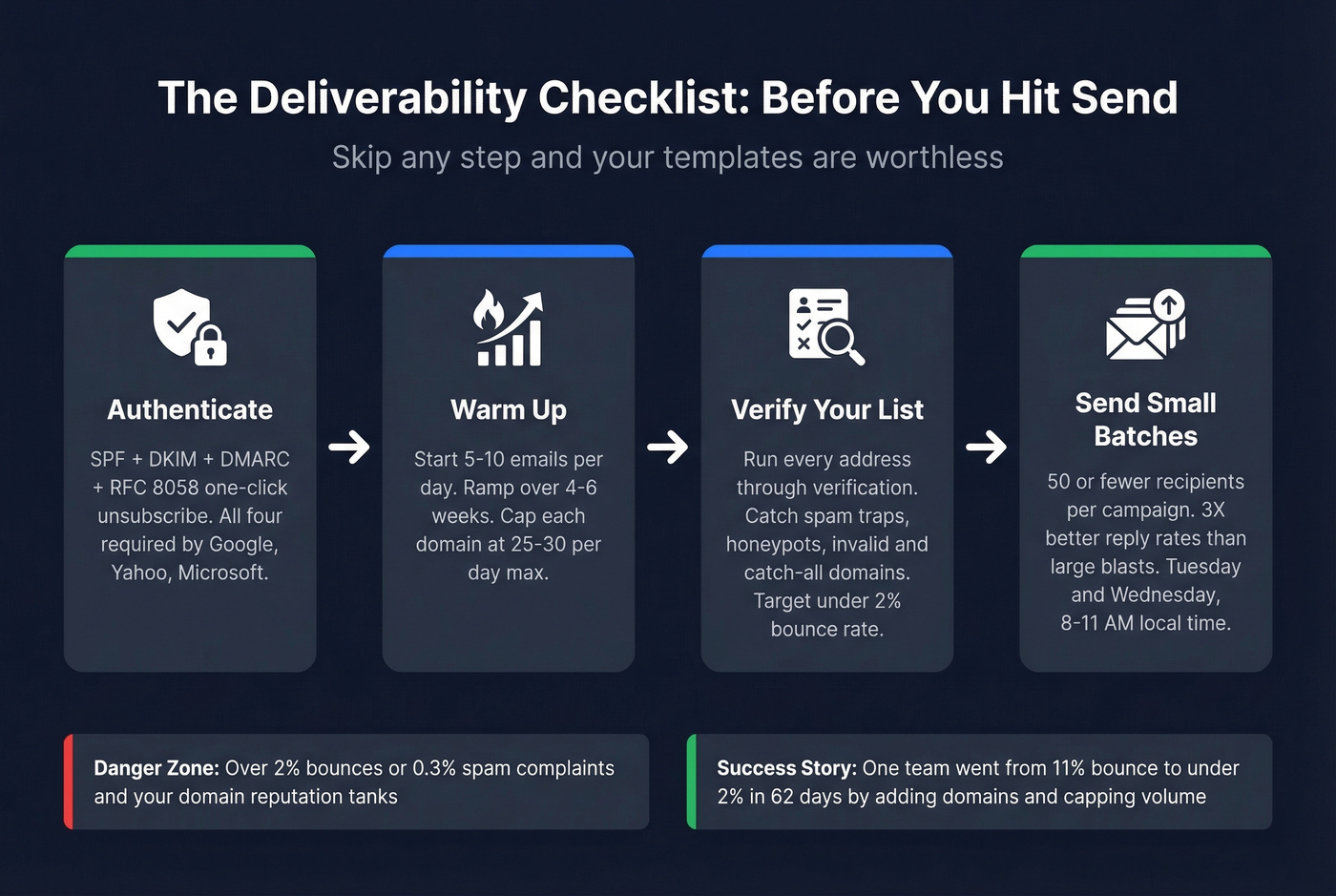
Authentication is table stakes. Google, Yahoo, and Microsoft now require SPF, DKIM, DMARC, and RFC 8058 one-click unsubscribe for bulk senders. Miss any of these and your emails land in spam before a human ever sees them. Keep spam complaints under 0.3% and bounces under 2% (see email bounce rate benchmarks and fixes).
Warm-up isn't optional. New domains need 4-6 weeks of gradual ramp-up starting at 5-10 emails per day. One practitioner on r/Entrepreneur shared their rebuild: they went from 3 domains to 7, capped each at 26 emails/day, and watched their bounce rate drop from 11% to under 2%. Their reply rate doubled over 62 days (more on safe sending limits: email velocity).
Verification is the foundation. Before any campaign goes out, run your list through an email verification tool. Prospeo's 5-step verification catches invalid addresses, spam traps, honeypots, and catch-all domains at 98% accuracy - the free tier handles 75 verifications per month, enough to test your first campaigns before scaling. If you’re comparing tools, start with these email reputation tools and spam trap removal basics.

Every template above is worthless if your emails bounce. Prospeo's 5-step verification catches spam traps, honeypots, and invalid addresses at 98% accuracy - keeping your bounce rate under 2% so your intro emails actually reach the inbox. Start with 75 free verifications per month.
Fix your list before you fix your copy.
Subject Lines That Get Opens
A Belkins study of 5.5 million emails gives us real numbers instead of guesswork. If you want more options to test, pull from these cold email subject line examples.
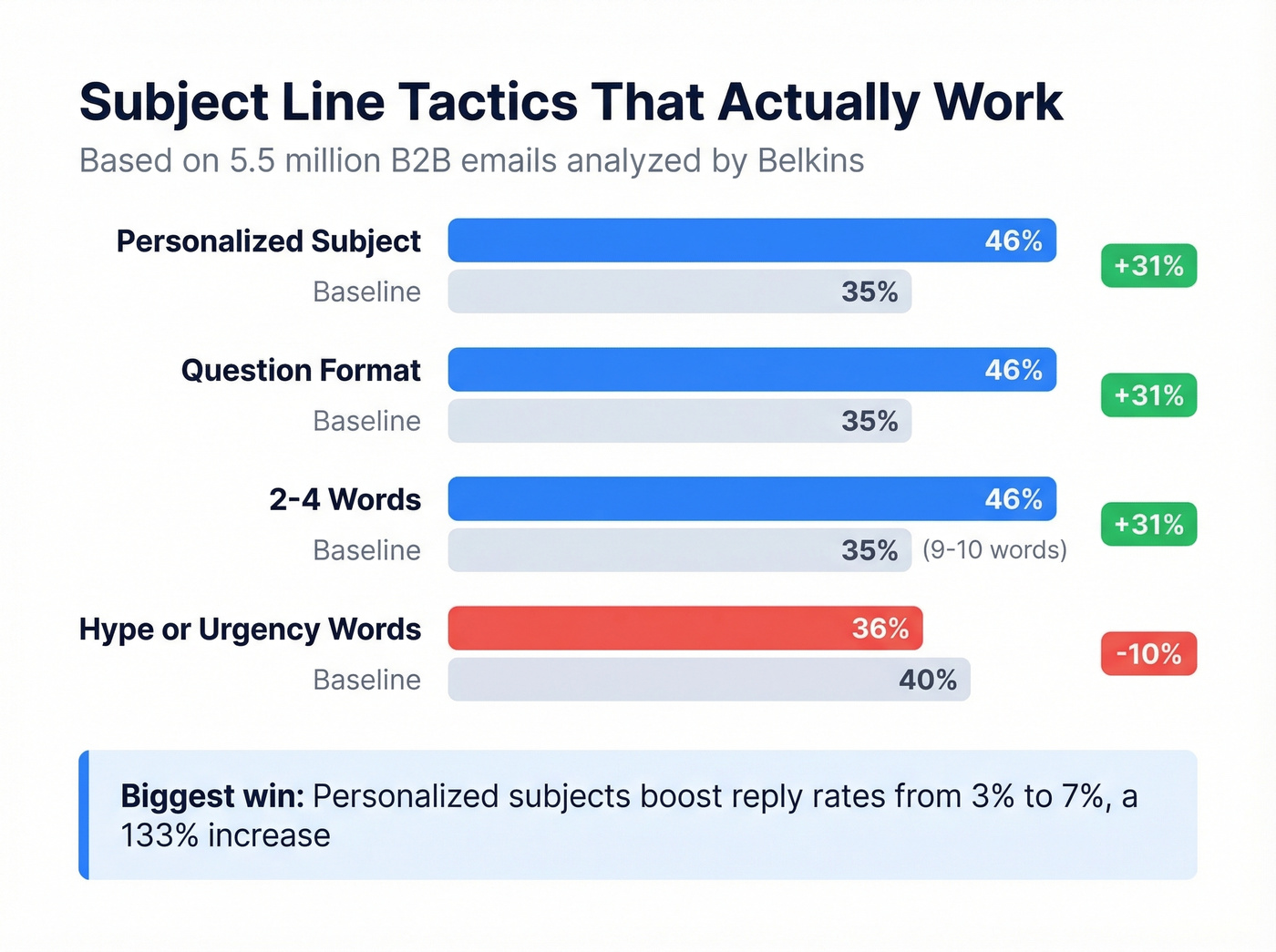
| Tactic | Open Rate | Baseline |
|---|---|---|
| Personalized subject | 46% | 35% |
| Question format | 46% | ~35% |
| 2-4 words | 46% | 35% (9-10 words) |
| Hype/urgency terms | <36% | ~40% without them |
Personalized subject lines don't just lift opens by 31% - they boost reply rates from 3% to 7%, a 133% increase. That's the single highest-leverage change you can make. I've tested dozens of subject line formats, and questions win every time. One practitioner reported "Quick question" pulling 39% opens while "Partnership opportunity" limped in under 19%.
Keep subject lines to 2-4 words. Avoid "free," skip urgency terms like "ASAP," and don't bother with numbers - they actually hurt slightly.
Writing Rules for Every Sales Intro Email
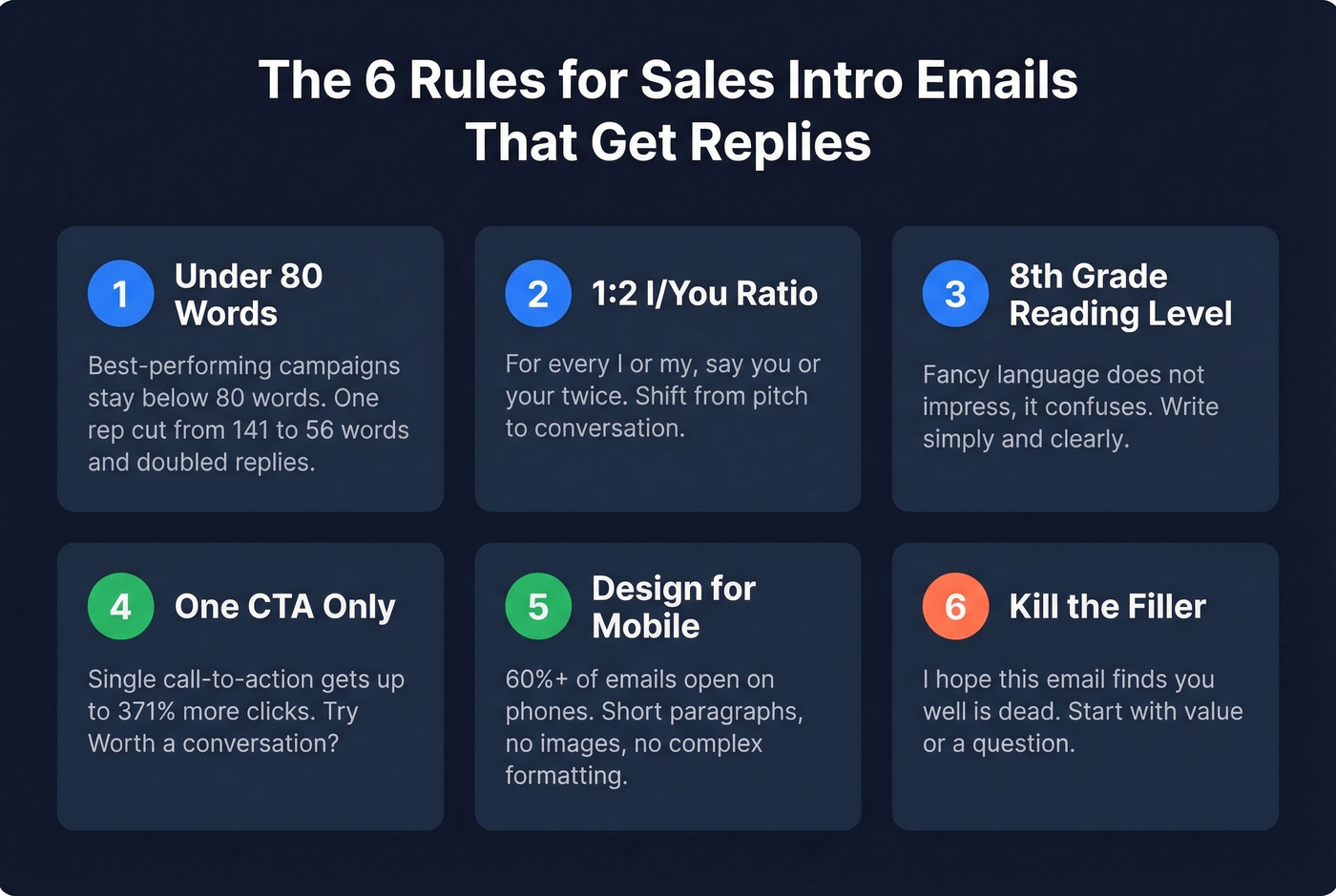
- Stay under 80 words. Instantly's 2026 benchmark confirms the best-performing cold campaigns stay below that threshold. One practitioner cut from 141 words to under 56 and watched their reply rate double.
- Use a 1:2 I/you ratio. For every "I" or "my," say "you" or "your" twice. This shifts the frame from pitch to conversation (more frameworks in our email copywriting guide).
- Write at an 8th-grade reading level. Fancy language doesn't impress - it confuses.
- One CTA only. Emails with a single call-to-action see up to 371% higher click-through rates. "Worth a conversation?" beats "Book a 30-minute demo" every time (see email call to action rules).
- Design for mobile. 60%+ of emails open on phones. Short paragraphs, no images, no complex formatting.
- Kill "I hope this email finds you well." Everyone knows it's filler. Start with value or a question.
If your average deal size is under five figures, you probably don't need elaborate multi-touch sequences. A tight 4-7 touchpoint cadence with verified data will outperform a 12-step cadence built on garbage contacts every single time (here’s a full B2B cold email sequence breakdown).
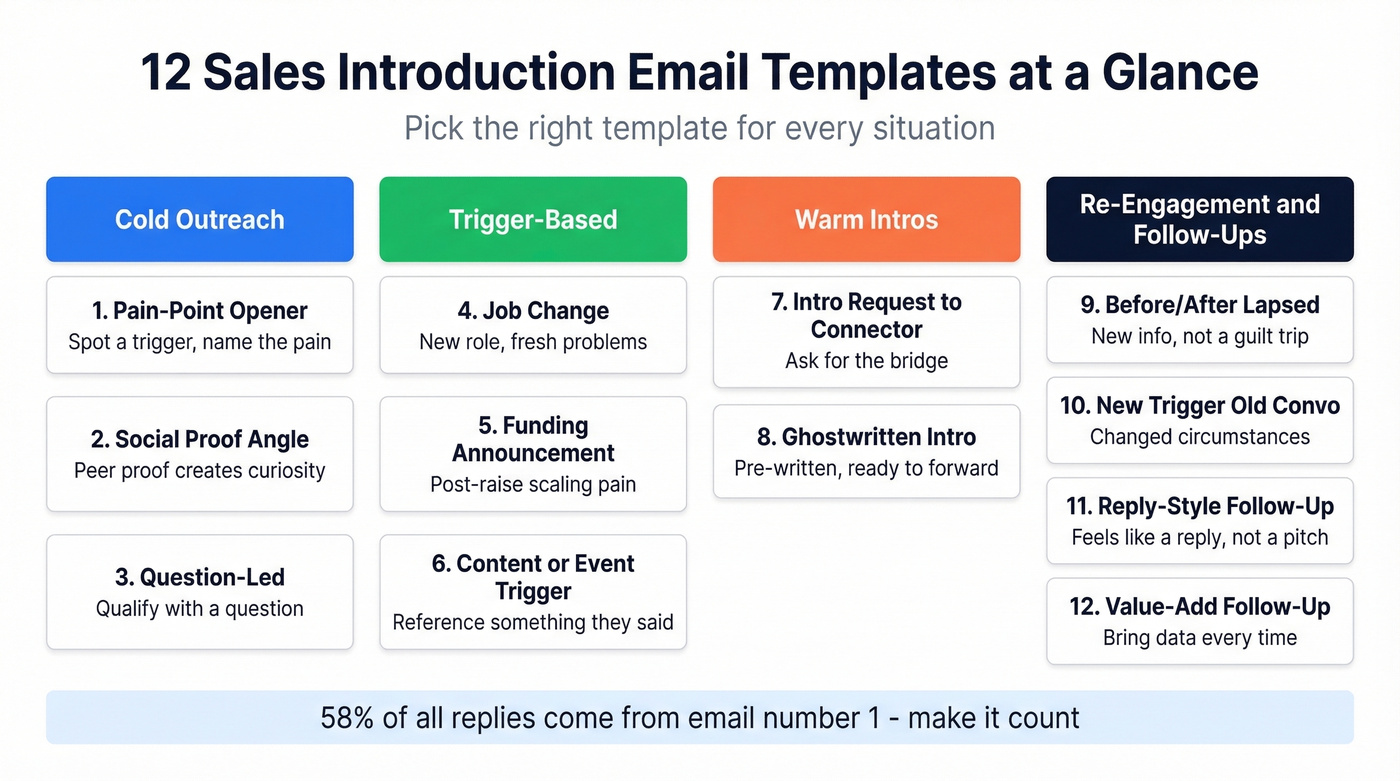
12 Sales Intro Email Templates
Cold Outreach
Template 1: Pain-Point Opener
Subject: hiring 4 SDRs?
Hey Sarah,
Saw Dataline's posting for 4 new SDRs. When teams scale outbound that fast, bounce rates usually spike before anyone notices - and suddenly half the team's emails are hitting spam.
We helped a similar-sized SaaS team cut bounces from 35% to under 4% in three weeks.
Worth a quick look?
- James
Use when you've spotted a specific trigger. Specific observation + concrete result + soft CTA. 52 words.
Template 2: Social Proof Angle
Subject: what Acme did differently
Hi Marcus,
Three fintech companies your size switched their outbound data provider last quarter. The common thread: their reps were spending more time cleaning lists than selling.
Happy to share what changed for them if it's relevant to your team.
- Priya
Use when you have relevant case studies in the prospect's industry. Peer proof creates curiosity without making claims about the prospect's situation.
Template 3: Question-Led
Subject: quick question
Hi Dana,
Is your team verifying prospect emails before sequences go out, or relying on the data provider's accuracy?
Asking because we've seen bounce rates vary 3-10X depending on the answer.
- Alex
Question subject lines hit 46% open rates. The question itself qualifies the prospect - if they don't verify, they'll feel the sting.
Trigger-Based
Template 4: Job Change
Subject: congrats on the new role
Hi Rachel,
Congrats on the VP Sales move to Brightpath. The first 90 days usually mean inheriting a CRM full of stale data and a pipeline that needs rebuilding.
If cleaning up contact data is on the list, I can show you how one VP cut that project from 6 weeks to 3 days.
- Tom
Template 5: Funding Announcement
Subject: post-Series B outbound
Hi Kevin,
Saw the $18M round - congrats. Most teams at this stage triple outbound volume before their data infrastructure can handle it.
Worth 10 minutes to make sure your lists scale with your team?
- Mia
Template 6: Content/Event Trigger
Subject: your SaaStr panel
Hi Jordan,
Caught your panel on outbound at scale. You mentioned bounce rates being a "silent killer" - couldn't agree more.
We've got data on exactly how much pipeline bad emails cost per rep. Happy to share if useful.
- Chris
Warm Introductions
Warm intros work differently. Instead of one email, you're orchestrating two: the ask to your connector, and the message they forward.
Template 7: Intro Request to Connector
Subject: Introduction: Lisa <> Mark
Hey Lisa,
I'm trying to connect with Mark Chen at Vantage - his team's scaling outbound and I think we could help with their data quality.
Would you be open to making an intro? Happy to draft something you can forward so it takes zero effort on your end.
Totally fine if the timing's off.
- Nate
This follows the 5-step intro request structure: clear subject, one-sentence purpose, value for prospect, simple ask, easy out.
Template 8: Ghostwritten Intro (Ready to Forward)
Send this to your connector pre-written. They copy, paste, and hit send.
Subject: connecting you with Nate
Hey Mark,
Wanted to connect you with Nate Rivera from [Company]. His team helps sales orgs fix bounce rates and data quality - figured it might be relevant given your outbound push.
I'll let him take it from here.
- Lisa
Re-Engagement
Template 9: Before/After - Lapsed Prospect
Most reps send "just checking in" and wonder why nobody replies. Here's the fix (more options: how to say just checking in professionally):
❌ "Hi Sam, just checking in on our conversation from March. Let me know if you'd like to reconnect."
✅ Subject: still relevant?
Hi Sam,
We talked in March about your bounce rate issues. Since then, we've helped two companies in your space cut bounces by 80%.
If the problem's still there, happy to pick it back up.
- Jess
The difference: new information, not a guilt trip.
Template 10: New Trigger, Old Conversation
Subject: saw the new VP hire
Hi David,
We spoke last year when your team was 5 reps. Looks like you just hired a VP of Sales and two more SDRs - different ballgame now.
Want to revisit the data conversation with fresh eyes?
- Anika
Follow-Ups
Template 11: Reply-Style Follow-Up
Subject: Re: quick question
Hey Dana,
Bumping this - the question about email verification still stands. We just published a benchmark showing teams that verify pre-send get 2-3X the reply rates.
Worth a look?
- Alex
The "Re:" prefix and conversational tone make it feel like a reply, not a new pitch. Reply-style follow-ups outperform formal ones by roughly 30% (more cold email follow-up templates here).
Template 12: Value-Add Follow-Up
Subject: data you might want
Hi Sarah,
Following up with something concrete: we ran the numbers on bounce rates for SaaS companies scaling from 5 to 15 SDRs. The average spike is 340%.
Here's the one-pager if it's useful: [link]
- James
Never "just check in." Bring new information every time.
Follow-Up Sequence Framework
The sweet spot is 4-7 touchpoints. Since 58% of replies come from email #1, your first message carries the most weight - each subsequent touch has diminishing returns, and 69% of prospects unsubscribe because they get too many emails.
Space your first two follow-ups 2-3 days apart. After touch #3, stretch to 5-7 days between messages. Every follow-up should add new value - a relevant stat, a case study, a question - not just "circling back." Reply-style follow-ups with a casual tone outperform formal ones by roughly 30%. Beyond 7 touches, you're burning goodwill unless each message delivers something genuinely new (see sales follow-up templates for more patterns).
Mistakes That Kill Reply Rates
Multiple CTAs. Every additional ask dilutes the first one. A single CTA can boost click-through by up to 371%. Pick one action and commit.
Emails over 80 words. We've seen this pattern repeatedly: teams rewrite their templates from 120+ words down to 50-60 and watch reply rates jump. Brevity isn't laziness - it's respect for the reader's time.
Unverified lists. This is the fastest way to torch your sender reputation. One agency cut their bounce rate from 35% to under 4% after switching to verified contact data. That single change unlocked everything else.
Single-domain, high-volume sending. Split across multiple domains, cap each at around 25-30 sends per day. Skip this and you'll burn through domains faster than you can buy them.
Surface-level personalization. {First Name} isn't personalization. Referencing a specific trigger - a job change, a funding round, a podcast appearance - is. The Belkins data shows personalized subject lines alone lift reply rates by 133% (more on personalized outreach).
Smaller batches hit 5.8% reply rates - but only with verified contacts. Prospeo gives you 30+ filters to build hyper-targeted lists of 50 prospects, then verifies every email at 98% accuracy for $0.01 each. No contracts, no sales calls.
Send fewer emails. Reach more buyers.
FAQ
How long should a sales introduction email be?
Under 80 words. Instantly's 2026 benchmark confirms the best-performing cold campaigns stay below that threshold. One practitioner cut from 141 to 56 words and doubled their reply rate - brevity signals respect for the reader's time.
What's a good reply rate for cold emails in 2026?
Average is 3.43%. Top-quartile teams hit 5.5%+, and elite performers exceed 10%. If you're below 3%, fix deliverability and list quality before rewriting copy - bad data is almost always the bottleneck.
When's the best time to send a sales intro email?
Tuesday and Wednesday between 8-11 AM in the recipient's timezone consistently outperform other windows. One practitioner reported a 16% open-rate lift just from tightening their send schedule to those hours.
How many follow-ups should I send?
Three to six follow-ups for a total of 4-7 touches. Since 58% of replies come from email #1, each subsequent message has diminishing returns. Every follow-up must add new value - a stat, a case study, or a question.
How do I verify my prospect list before sending?
Run every list through an email verification tool before each campaign. Keep bounce rate under 2% to protect sender reputation. Most tools offer free tiers so you can test before committing - Prospeo's covers 75 emails per month with its 5-step verification process.