

Sales Lead Generation in 2026: The System That Actually Works
A RevOps lead we know ran three lead gen tools side by side last quarter. The "best" database bounced 35% of emails on the first sequence and nearly torched their domain reputation. The cheapest tool had better deliverability and higher reply rates. When the average cold email reply rate hovers around 2% and buyers need 70+ touchpoints across six channels before they'll trust you, the margin for error is zero.
Sales lead generation is a system problem, not a tool problem. Most teams get the system wrong.
What You Need (Quick Version)
Three things separate teams booking meetings from teams burning budget. First, verified data before anything else - bad emails kill campaigns before a single prospect reads your subject line. Second, infrastructure that protects your domain: dedicated sending domains, proper authentication, and warm-up math that actually adds up. Third, a scoring model that routes leads to sales at the right moment, not too early and not after they've gone cold.
What Is Sales Lead Generation?
It's the process of identifying potential buyers and moving them into your pipeline. Everything else - the tools, the sequences, the ABM plays - is execution.
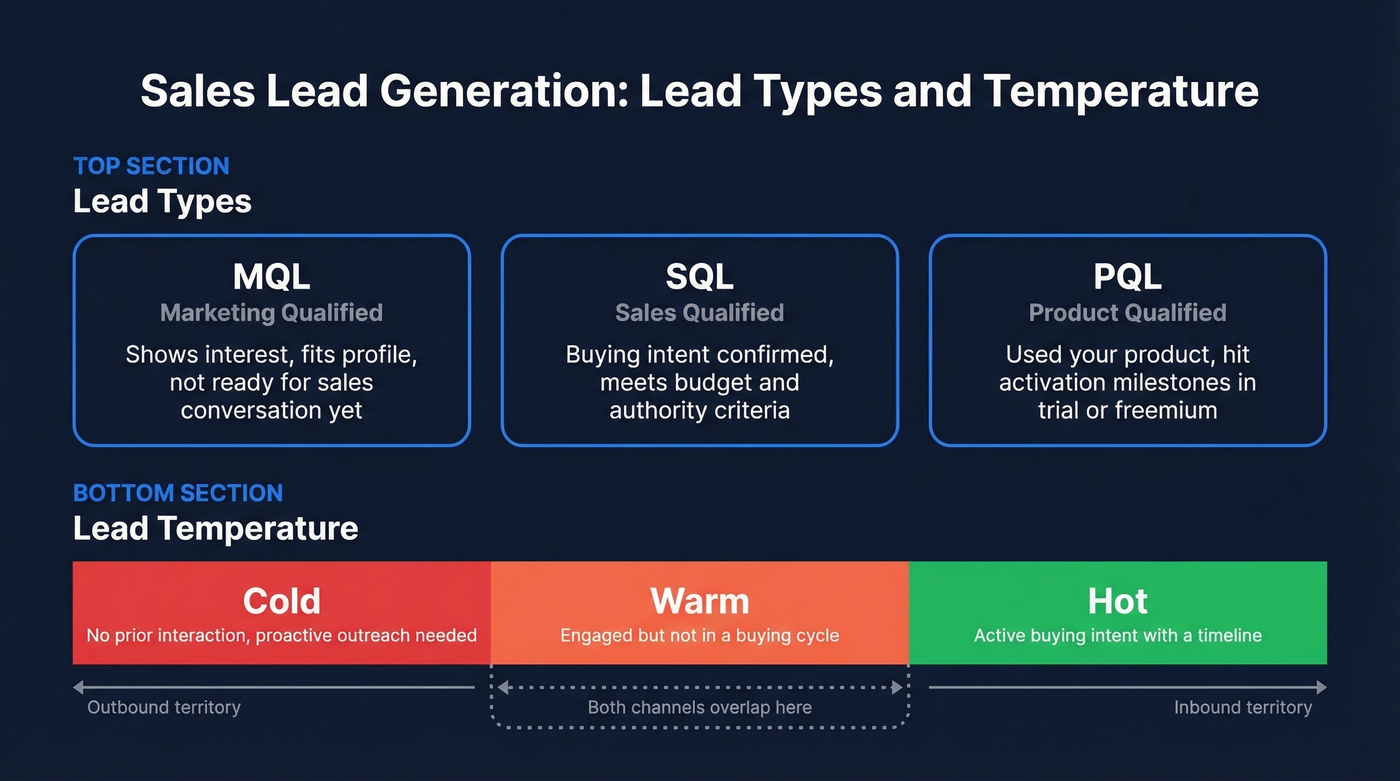
The leads themselves break into types. An MQL (marketing-qualified lead) has shown interest and fits your profile but isn't ready for a sales conversation. An SQL (sales-qualified lead) has demonstrated buying intent and meets qualification criteria like budget and authority. A PQL (product-qualified lead) has used your product - a free trial signup who's hit activation milestones, for example.
You'll also hear leads described by temperature. Hot leads have active buying intent and a timeline. Warm leads are engaged but not yet in a buying cycle. Cold leads haven't interacted with you at all - they're the ones you're reaching out to proactively. Inbound generates warm and hot leads through content, SEO, and ads. Outbound goes after cold and warm leads through email, calls, and social. Most B2B teams need both to build a predictable pipeline.

The article makes it clear: 35% bounce rates destroy sender reputation and kill pipeline. Prospeo's 5-step email verification delivers 98% accuracy on a 7-day refresh cycle - so every email you send reaches a real inbox. At $0.01 per email, you protect your domain without burning budget.
Stop building pipeline on bad data. Verify before you send.
The 5-Step Process That Builds Pipeline
Every team that consistently books meetings follows some version of this process. The steps aren't revolutionary - the details inside each one are where teams either build pipeline or waste budget.
Define Your ICP Beyond Personas
"We sell to VPs of Marketing at mid-market SaaS companies" isn't an ICP. It's a starting point. Real ICP work means sub-segmenting your market and ranking segments by ease of selling, strategic fit, and growth potential - a framework Belkins outlines in their 2026 strategy breakdown.
Map the buying committee for each segment. Most B2B deals involve around five key stakeholders, and your messaging needs to speak to each one differently. The CFO cares about ROI and payback period. The technical buyer cares about integrations and security. Sending the same email to both is how you get ignored.
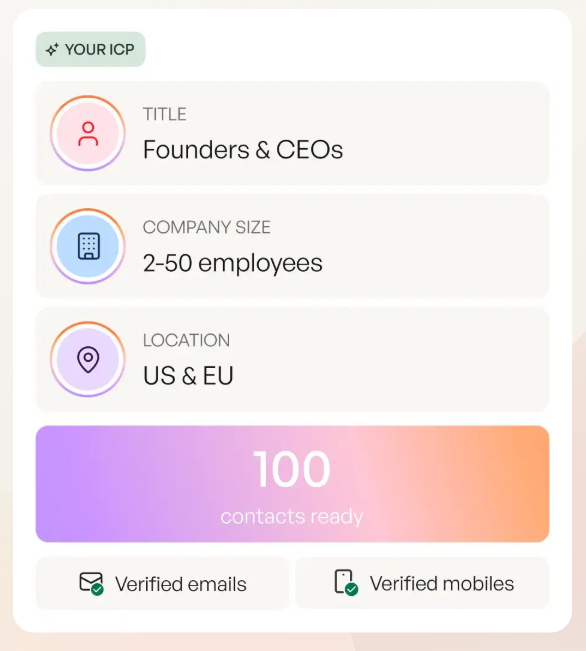
Here's a practical outbound tactic we've seen work well, and it echoes advice from r/sales: build a tight, researched list of ~1,000 contacts rather than blasting 10,000 generic prospects. Rank your segments before you build a single list. Which verticals close fastest? Which have the highest expansion revenue? Which ones churn? This ranking determines where your outbound team spends its first 90 days, and it's the single highest-leverage decision in your entire lead generation system.
Build Outbound Infrastructure First
This is where most teams skip ahead and pay for it later. Before you send a single cold email, your infrastructure needs to be locked down. Follow this sequence:
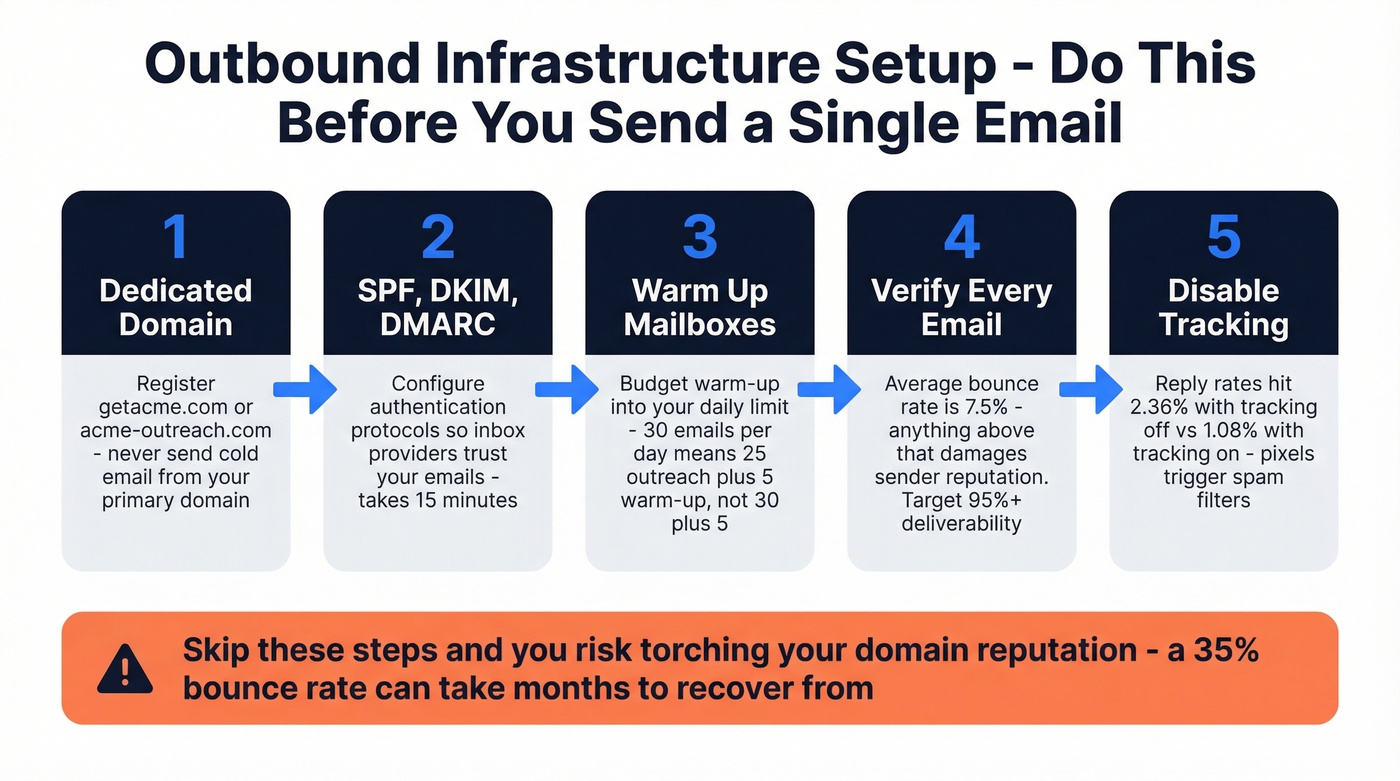
Set up a dedicated outbound domain. Never send cold email from your primary domain. If your company is acme.com, register something like getacme.com or acme-outreach.com. This protects your main domain's reputation if anything goes sideways.
Configure SPF, DKIM, and DMARC. These authentication protocols tell inbox providers your emails are legitimate. Without them, you're starting with a deliverability handicap. Most email platforms walk you through this in 15 minutes.
Warm up your mailboxes. Warm-up engines simulate real email engagement to build sender reputation. The math matters: if you're sending 30 emails per day total, budget 25 for actual outreach and 5 for warm-up. Don't treat warm-up volume as "free" sends on top of your outreach - it counts against your daily limit.
Verify every email before sending. This is mandatory. The average cold email bounce rate sits at 7.5%, and anything above that starts damaging your sender reputation. Good deliverability means 95%+ of your emails actually reaching an inbox. If you want to go deeper on bounce thresholds and what they mean, see our email bounce rate guide.
Turn off open and click tracking. This one surprises people. An analysis of 44M+ emails found that reply rates hit 2.36% with tracking disabled versus 1.08% with tracking on. Tracking pixels trigger spam filters. The data isn't worth the deliverability hit (and it’s worth understanding how email tracking pixels work before you decide).
Snyk's sales team saw this firsthand: they were running bounce rates of 35-40% before switching, which dropped to under 5%. Their AE-sourced pipeline jumped 180%, and they now generate 200+ new opportunities per month across 50 AEs. The verification step is the foundation everything else sits on.
Teams that book meetings consistently don't just have good sequences - they have verified contact data, buyer intent signals, and a scoring model that works. Prospeo gives you 300M+ profiles with 30+ filters including intent data, technographics, and job changes, so you build the tight 1,000-contact lists that outperform 10,000 generic blasts every time.
Build the list that actually converts. No contracts, no sales calls.
Strategies That Work in 2026
Modern buyers need 70+ touchpoints across six channels before they'll buy. No single channel carries the load anymore.
Content marketing and SEO remain the lowest-CPL channel for most B2B companies. The catch is timeline - you're building an asset that compounds over months, not days. But once it's working, it's the most efficient pipeline source you'll have. If you’re building this channel seriously, our guide on what is B2B content marketing breaks down what to prioritize.
Cold email still works, but only with the infrastructure prerequisites above. Average response rates sit around 5.1%, with a 27.7% open rate for B2B. A 2-email sequence yields a 6.9% response rate - reply rates jump 49% after a single follow-up. The consensus on r/sales is clear: cold email isn't dying, but lazy cold email is dead. For a step-by-step build, use our B2B cold email sequence framework.
Social selling means building relationships on professional networks before you ever pitch. It's slower than cold email but produces warmer conversations. Pair social with direct outreach for an omnichannel approach that hits prospects from multiple angles (more on personalized outreach here).
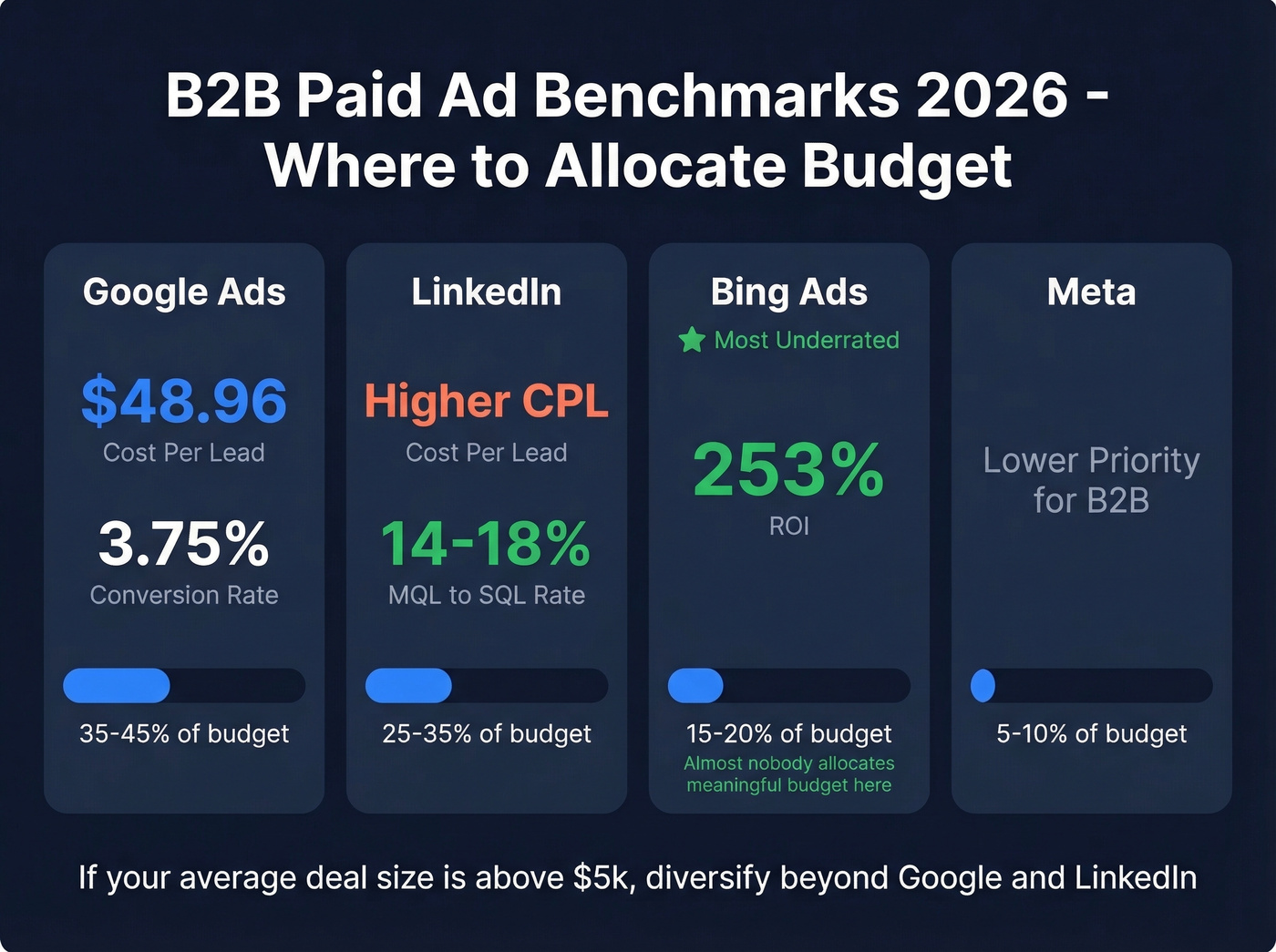
Paid ads offer speed but vary wildly by platform:
| Platform | Benchmark | Lead Quality | ROI | Budget Share |
|---|---|---|---|---|
| Google Ads | $48.96 CPL | 3.75% conv. rate | - | 35-45% |
| Higher CPL than Google | 14-18% MQL-to-SQL | - | 25-35% | |
| Bing Ads | - | - | 253% ROI | 15-20% |
| Meta | - | - | - | 5-10% |
Let's be honest: Bing is the most underrated B2B ad platform right now. A 253% ROI, and almost nobody's allocating meaningful budget there. If your average deal size is above $5k and you're dumping everything into Google and LinkedIn, you're leaving money on the table.
Referrals convert at the highest rate of any channel but don't scale predictably. Build a formal referral program, but don't make it your primary pipeline source.
Intent-based prospecting targets buyers who are actively researching solutions like yours. This is where layering intent signals on top of firmographic and technographic filters makes a real difference - you're reaching companies already in-market, not just companies that match your ICP on paper. (If you want a practical setup, see intent based segmentation.)
ABM and multi-threading means running coordinated outreach to multiple stakeholders at the same account. It's resource-intensive but significantly increases win rates for deals above five figures. For a full playbook, see account-based selling best practices.
Score Your Leads - A Copyable Model
Not all leads deserve a sales rep's time. Lead scoring assigns point values to signals so you can prioritize automatically. There are four model types - demographic, behavioral, predictive, and hybrid - but hybrid models that combine fit and intent signals outperform everything else in practice.
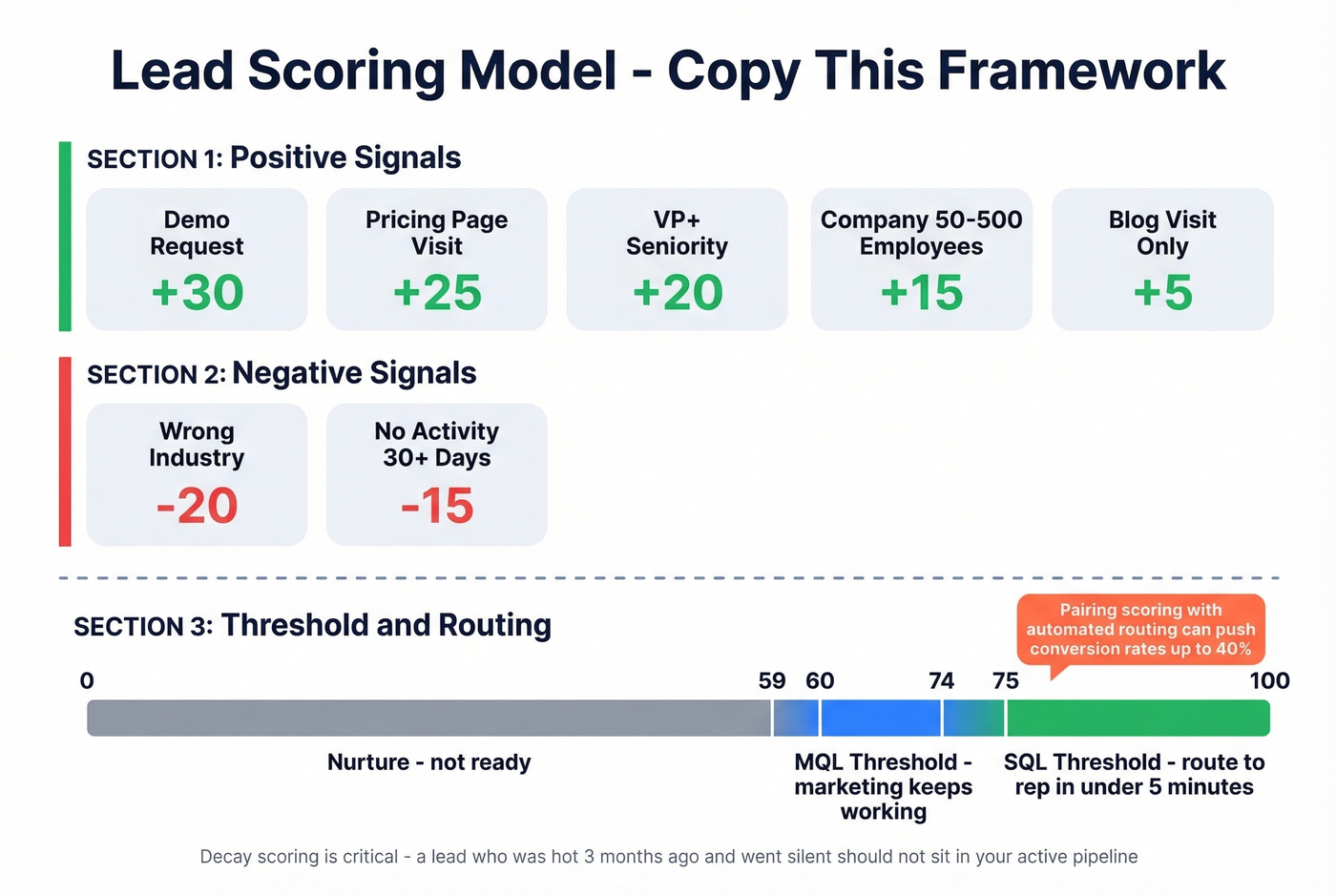
Here's a scoring framework you can adapt:
| Signal | Points | Example |
|---|---|---|
| VP+ seniority | +20 | VP Sales, CRO, CMO |
| Company 50-500 employees | +15 | Mid-market ICP fit |
| Pricing page visit | +25 | High buying intent |
| Demo request | +30 | Strongest intent signal |
| Blog visit only | +5 | Early awareness |
| No activity 30+ days | -15 | Decay / disqualification |
| Wrong industry | -20 | Outside ICP |
Set your MQL threshold at roughly 60-80 points. SQLs typically need 75+ with explicit buying signals like a demo request or pricing page visit. Negative scoring for inactivity is critical - a lead who was hot three months ago and has gone silent shouldn't sit in your active pipeline.
Pairing scoring with automated routing can push conversion rates up to 40%. When a lead crosses your SQL threshold, it should hit a rep's queue within minutes, not days. The handoff speed matters as much as the score itself.
Qualify and Hand Off (MQL to SQL)
The average MQL-to-SQL conversion rate is 13%. Top-performing teams hit 25-35%. The gap comes down to qualification rigor and handoff speed.
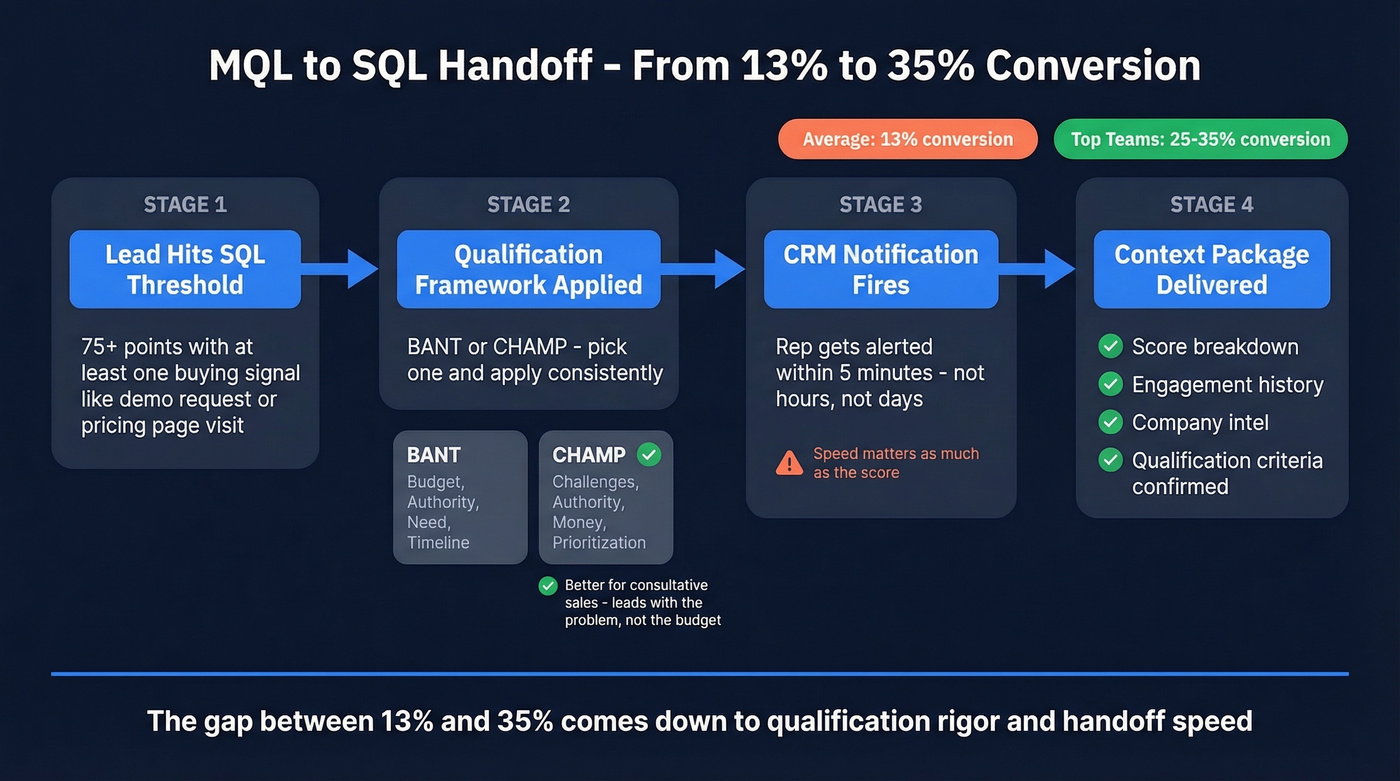
Use BANT (Budget, Authority, Need, Timeline) or CHAMP (Challenges, Authority, Money, Prioritization) as your qualification framework. CHAMP works better for consultative sales because it leads with the prospect's problem rather than their budget. Either way, pick one and apply it consistently.
Qualification handoff checklist:
- Lead score hits SQL threshold (75+ points with buying signal)
- BANT or CHAMP criteria confirmed
- CRM notification fires to assigned rep within 5 minutes
- Full context package attached: score breakdown, engagement history, company intel
Here's the thing - teams lose qualified opportunities simply because the routing took 48 hours instead of 48 minutes. Automate your CRM handoffs. When a lead hits SQL status, the assigned rep should get a notification with full context, not a bare name and email address.
Test your channels for 60-90 days before making major budget shifts. That's enough time to see real patterns in conversion rates and CPL without overreacting to early noise.
Benchmarks: What Good Looks Like
Numbers without context are useless. Here's what "good" actually looks like across the metrics that matter.

Cost per lead by industry (First Page Sage, 2026):
| Industry | Blended CPL | Paid CPL | Organic CPL |
|---|---|---|---|
| B2B SaaS | $237 | $310 | $164 |
| Cybersecurity | $406 | $411 | $404 |
| Financial Services | $653 | $761 | $544 |
| Higher Education | $982 | $1,143 | $821 |
| eCommerce | $91 | $98 | $83 |
The average CPL across all industries and channels is $391.80. If you're in B2B SaaS and paying more than $300 blended, your channel mix probably leans too heavily on paid.
Cold email benchmarks: Open rate (B2B) is 27.7%. Response rate runs 5.1% for a single email and 6.9% for a 2-email sequence. Keep your bounce rate under the 7.5% threshold and target 95%+ deliverability. If you’re troubleshooting inboxing, start with our email deliverability guide.
Funnel conversion: MQL-to-SQL averages 13%, with top performers hitting 25-35%. If your MQL-to-SQL rate is below 10%, the problem is usually upstream - either your lead definition is too loose or your scoring model isn't filtering aggressively enough.
Tools You Actually Need
You don't need 20 tools. You need four or five that work together: a data and verification platform, a CRM, a sequencer, and an automation layer. Everything else is optimization.
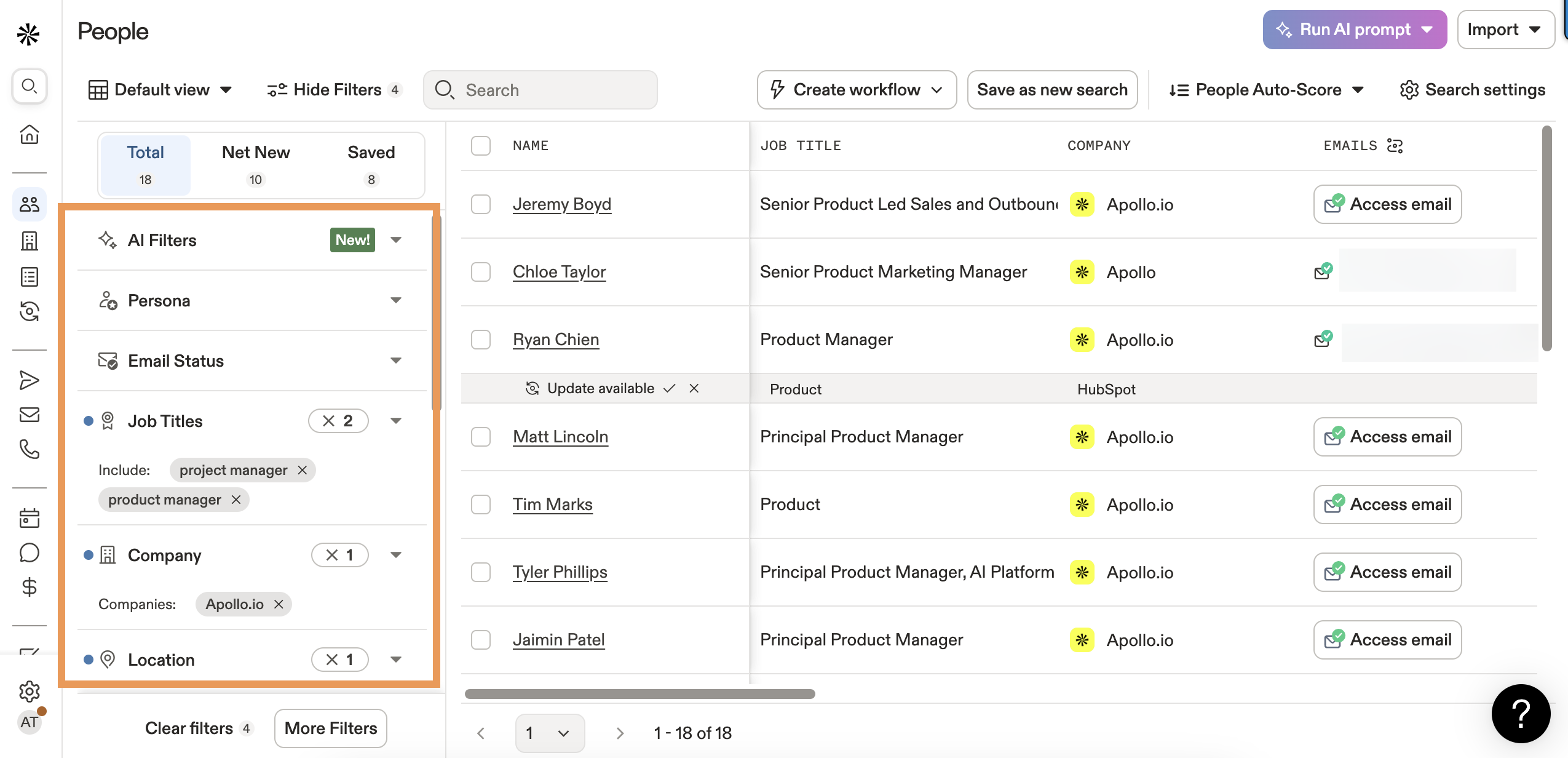
Prospeo handles prospecting and verification in one platform. 300M+ profiles, 30+ search filters including buyer intent and technographics, and email verification at $0.01 per email. The free tier gives you 75 verified emails per month - enough to test data quality before committing. In our experience, teams that have been burned by bad data from other providers see the difference immediately when bounce rates drop from 30%+ to under 5%.
Apollo is the obvious starting point for teams that want an all-in-one prospecting and sequencing tool on a budget. Free tier available, paid plans from ~$49-99/mo per user. The tradeoff: Apollo's data is partly community-sourced, which means verification rates aren't as reliable as dedicated data platforms. One seller on r/sales put it bluntly - Apollo is "jack of all trades, master of none" for data accuracy. Export your lists and verify them separately before sending. Skip Apollo's built-in dialer too; it uses VoIP numbers that get flagged as spam easily.
HubSpot covers CRM for most teams under 200 people. Plans range from $15-$3,600/mo depending on tier. The free CRM is genuinely useful; the marketing hub is where costs escalate. If you’re comparing options, see these examples of a CRM.
Smartlead and Instantly are the two sequencers worth evaluating. Both handle email warm-up, rotation across multiple sending accounts, and basic personalization. Smartlead runs ~$39-94/mo; Instantly starts around $30/mo. Pick whichever integrates better with your data source.
Clay is popular for enrichment workflows - it chains together multiple data providers and automates research at scale. Powerful, but it gets expensive fast at volume. Plans start around $149/mo. Worth it for teams running complex, multi-source enrichment; overkill if you just need verified emails. If you’re doing this at scale, our breakdown of data enrichment services can help you pick the right approach.
Zapier ties everything together. Paid plans from $19.99/mo. Use it to push verified leads into your CRM, trigger sequences when intent signals fire, and sync data across your stack without engineering time.
FAQ
What's the difference between inbound and outbound lead generation?
Inbound attracts leads through content, SEO, and ads - prospects come to you. Outbound reaches out directly via cold email, calls, and social. Most B2B teams need both channels running simultaneously to build a predictable, diversified pipeline.
How many leads should an SDR generate per month?
Expect 150-300 outbound touches per week producing 8-15 qualified meetings per month in a typical B2B motion. Enterprise SDRs skew toward fewer, higher-quality conversations with larger deal potential.
Is cold email still effective in 2026?
Yes. A well-targeted 2-email sequence hits 6-7% response rates when you use verified data, proper domain infrastructure, and disable tracking pixels. Lazy, unresearched blasts are what's dead, not the channel itself.
What's a good cost per lead?
B2B SaaS averages $237 blended CPL, eCommerce $91, and Financial Services $653 (First Page Sage, 2026). If your blended CPL exceeds your industry average by more than 25%, audit your channel mix - you're likely over-indexed on paid.
What's a free tool for verifying emails before sending?
Prospeo's free tier includes 75 verified emails per month with the same 98% accuracy and 5-step verification as paid plans. That's enough to validate a test list and measure bounce rates before scaling outbound spend.