

What Is a Sales Leader? Skills, Salary, KPIs & the Mistakes Nobody Warns You About
Friday afternoon, you get the call. You're being promoted. Monday morning, you walk into a room full of reps who used to be your peers, a forecast that's already behind, and a Salesforce dashboard you're now supposed to "own." Nobody hands you a playbook. Nobody tells you the job you just accepted has almost nothing in common with the one you were great at.
Some leaders never figure that out. They become the "dashboard monkey" their reps complain about on r/sales - refreshing reports and asking "when will number go up?" with no plan, no strategy, and no support infrastructure. This is the operating manual for every new sales leader who refuses to let that happen.
The Short Version
A sales leader builds capability. A sales manager maintains activity. The three skills to develop first: coaching, forecasting, hiring. The biggest trap: getting promoted because you were the best closer, then assuming everyone should sell the way you did. The KPI you actually own is win rate improvement, not activity volume.
What "Sales Leader" Actually Means
A sales leader is the person responsible for the strategic direction, capability development, and revenue outcomes of a sales organization. That's the textbook version. The practical version is simpler: this person makes everyone around them better at selling.
This matters more now than it did five years ago. 96% of prospects research companies before engaging a sales rep, and according to Gong data, 81% of revenue leaders say deals are more complex than ever. Buyers are more informed, sales cycles are longer, and the margin for error on every deal is thinner. The days when a charismatic VP could wing it on gut instinct and a Rolodex are gone.
The demand for the role isn't slowing down either. The Bureau of Labor Statistics projects about 49,000 openings for sales managers each year on average over the decade, with 5% projected growth and roughly 29,000 net new positions. There's no shortage of seats - there's a shortage of people ready to fill them well.
A sales leader sets the destination: which markets to attack, which segments to prioritize, how to position against competitors. They build the systems that let reps execute consistently. They coach, they hire, they protect their team's time. And critically, they own the outcomes that compound over quarters, not just the activity that fills a weekly report.
The title doesn't make you a leader. Plenty of VPs of Sales are really just senior managers with a bigger budget.
Sales Leader vs. Sales Manager
This distinction isn't academic - confusing the two costs real revenue. When organizations treat management as leadership, three failure patterns emerge: short-termism dominates where every decision optimizes for this quarter at the expense of next year, a risk-avoidance culture takes root where reps chase safe deals instead of strategic ones, and talent erodes because top performers don't stick around to be micromanaged.
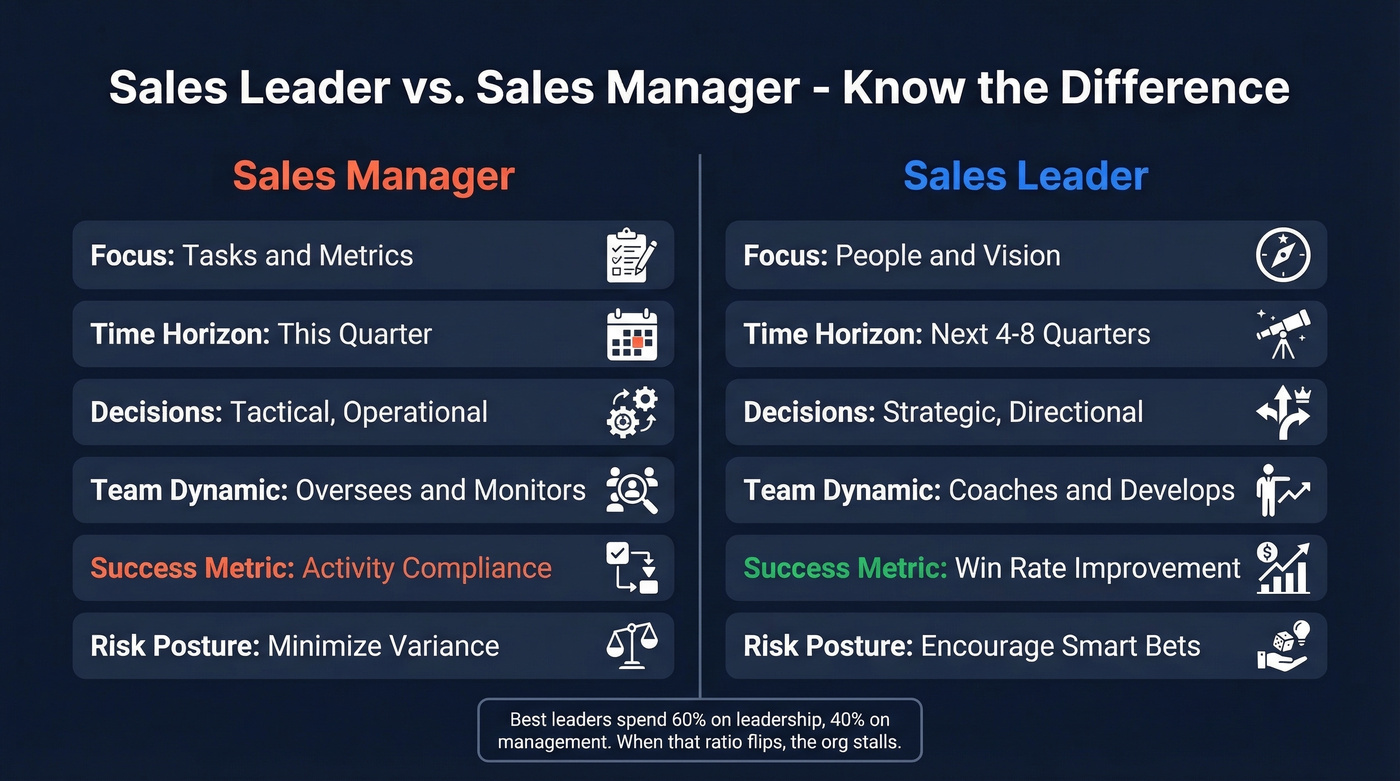
The root cause is usually promotion bias. The best closer gets the title. Nobody asks whether they can coach, forecast, or build a process.
| Dimension | Sales Manager | Sales Leader |
|---|---|---|
| Focus | Tasks & metrics | People & vision |
| Time horizon | This quarter | Next 4-8 quarters |
| Decisions | Tactical, operational | Strategic, directional |
| Team dynamic | Oversees & monitors | Coaches & develops |
| Success metric | Activity compliance | Win rate improvement |
| Risk posture | Minimize variance | Encourage smart bets |
Both roles matter - you need someone making sure the CRM is clean and forecasts are submitted. But if that's all your senior sales hire does, you've got a $200K administrator.
A useful rule of thumb: the best leaders spend about 60% of their time on leadership activities - coaching, strategy, hiring - and 40% on management. When that ratio flips, the org stalls. (If you want a deeper operational breakdown, see how to manage a sales team.)
What the Day Actually Looks Like
If you've spent any time on Reddit threads about sales leadership, you've seen two extremes. There's the bitter rep who describes their VP as someone who sits at home refreshing Salesforce with no plan. Then there's the actual day-in-the-life posts from leaders: pipeline reviews at 8am, a reporting fire at 9, cross-functional meetings with unclear ownership from 10 to noon, a client escalation that only the leader can handle, two coaching sessions squeezed in between, and an inbox that never stops.
Sales reps spend 60% of their time on non-selling tasks. For their leaders, that ratio is worse. (More benchmarks like this: 100+ Sales Stats for 2026.)
The job is fundamentally about navigating organizational complexity so your team doesn't have to - pipeline reviews, forecast calls, cross-functional alignment with marketing and CS, executive reporting, comp plan disputes, territory redesigns, client escalations. The "dashboard monkey" anti-pattern is what happens when a leader has no strategic agenda. Without a clear vision for where the team is going, the default behavior is monitoring. Monitoring isn't leading. The best leaders treat the dashboard as a diagnostic tool, not a destination.
Skills That Matter in 2026
72% of sellers feel overwhelmed by the number of skills required for their job. Leaders feel it too. Cold email reply rates fell 15% between 2023 and 2024, dropping from 6.8% to 5.8%. Quota attainment has stalled between 43% and 47%. Meanwhile, 91% of companies see AI transforming their workforce but only 38% have built an enterprise skills library to respond.
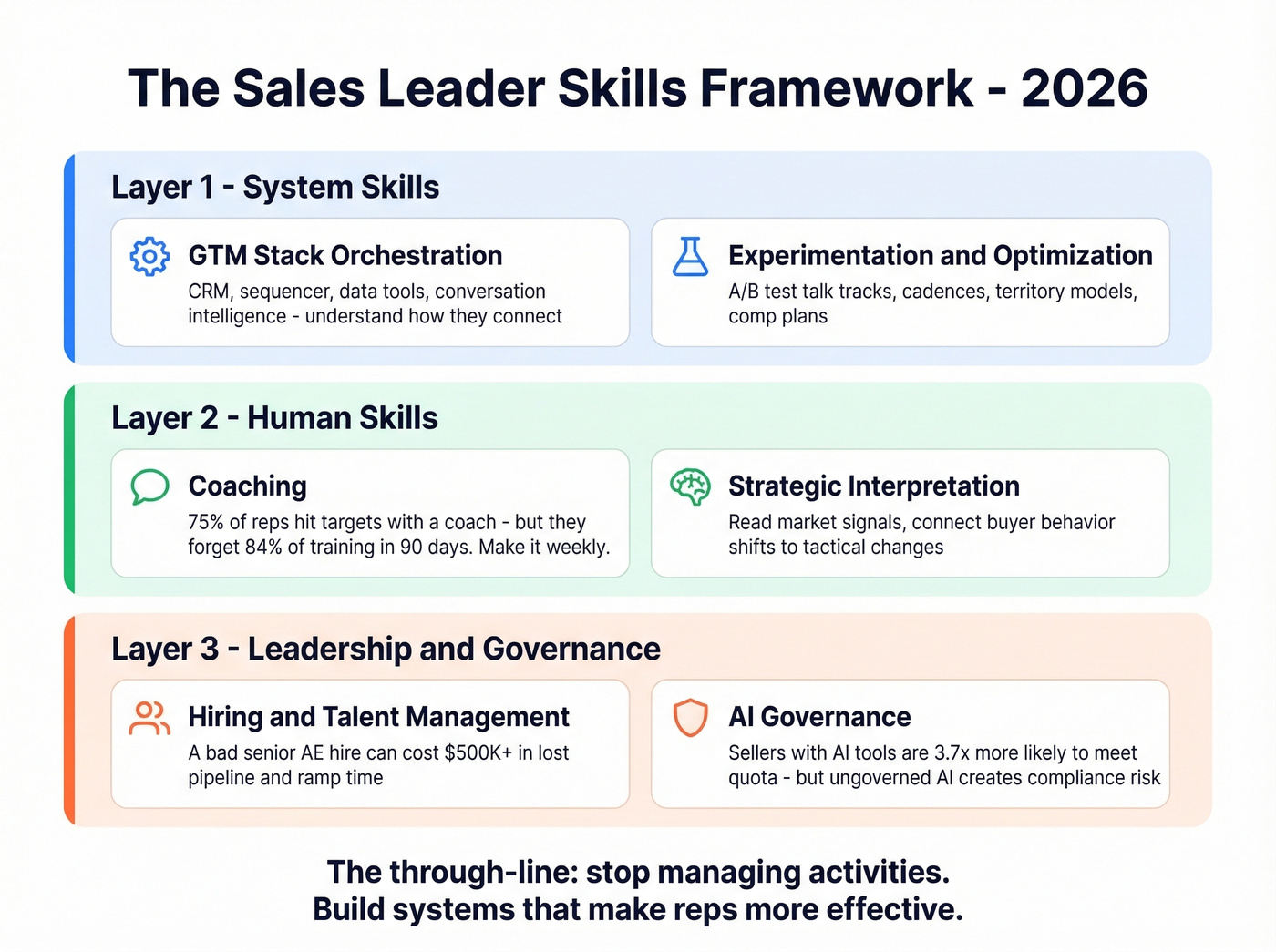
Here's a practical framework in three layers.
System Skills
GTM stack orchestration. You don't need to be an admin, but you need to understand how your CRM, sequencer, data tools, and conversation intelligence platform connect. Broken integrations create broken pipelines. (If you're evaluating vendors, start with this list of sales intelligence tools.)
Experimentation and optimization. A/B testing isn't just for marketing. Effective leaders run experiments on talk tracks, cadence structures, territory models, and comp plans - then measure what moves win rates.
Human Skills
Coaching. This is the single highest-leverage activity in the role. 75% of sales reps say they're more likely to hit targets with a coach or mentor. And here's why it can't be a one-time event: salespeople forget 84% of new knowledge after just 90 days. Coaching isn't a quarterly offsite. It's weekly call reviews, deal strategy sessions, and role plays - repeated until the skill sticks. (Use these sales role playing scenarios to make coaching concrete.)
Strategic interpretation. Reading market signals, understanding why deals are stalling, connecting buyer behavior shifts to tactical changes. AI can surface patterns, but a human has to decide what they mean.
Leadership & Governance
Hiring and talent management. Your team is your product. Getting hiring wrong is the most expensive mistake you can make - a bad senior AE hire can easily cost $500K+ in lost pipeline and ramp time. (For interview structure, see how to interview sales candidates.)
AI governance. Sellers with AI tools are 3.7x more likely to meet quota. Gartner predicts 65% of B2B sales organizations will shift to data-driven decision-making by 2026. But ungoverned AI usage creates compliance risk, hallucinated outreach, and brand damage. Leaders need to set guardrails, not just buy licenses.
The through-line across all six skills: leaders who treat their role as "making sure reps do activities" will lose to leaders who build systems that make reps more effective. (Related: the B2B sales skills that most directly drive revenue.)

You said it: a sales leader's job is making everyone around them better at selling. Hard to do when your team is burning hours on bad data. Prospeo gives your reps 98% accurate emails, 125M+ verified mobiles, and a 7-day refresh cycle - so they spend time closing, not cleaning lists.
Stop being the dashboard monkey. Arm your reps with data that converts.
Sales Leadership Styles
There's no single "right" style. But there's a default that works for most B2B teams: coaching-first, with situational shifts based on team maturity and market conditions.
| Style | Core approach | Best when... |
|---|---|---|
| Coaching | Skill development, questions | Building a young team |
| Transformational | Vision, inspiration | Entering new markets |
| Transactional | Structure, rewards | Short-term turnarounds |
| Authoritative | Clear direction, decisiveness | Crisis or restructuring |
| Democratic | Consensus, team input | Experienced, senior team |
| Strategic | Long-term planning, data | Scaling from SMB to mid-market |
Most new leaders default to either transactional (because it feels productive) or democratic (because they want to be liked). Neither works as a permanent setting. Transactional leadership drives short-term results but burns people out. Democratic leadership feels inclusive but stalls when hard decisions need to happen fast. (More on this in sales management styles.)
Start with coaching as your baseline - invest heavily in rep development, run weekly 1:1s focused on skill gaps, review calls together. Then flex into authoritative mode when the quarter is at risk, or strategic mode when it's time to redesign territories. Style should flex with context. Rigidity in any direction is the real failure mode.
KPIs Sales Leaders Own
Not every metric on the dashboard belongs to you. Understanding which numbers you're accountable for is one of the most important expectations to set with your executive team early.
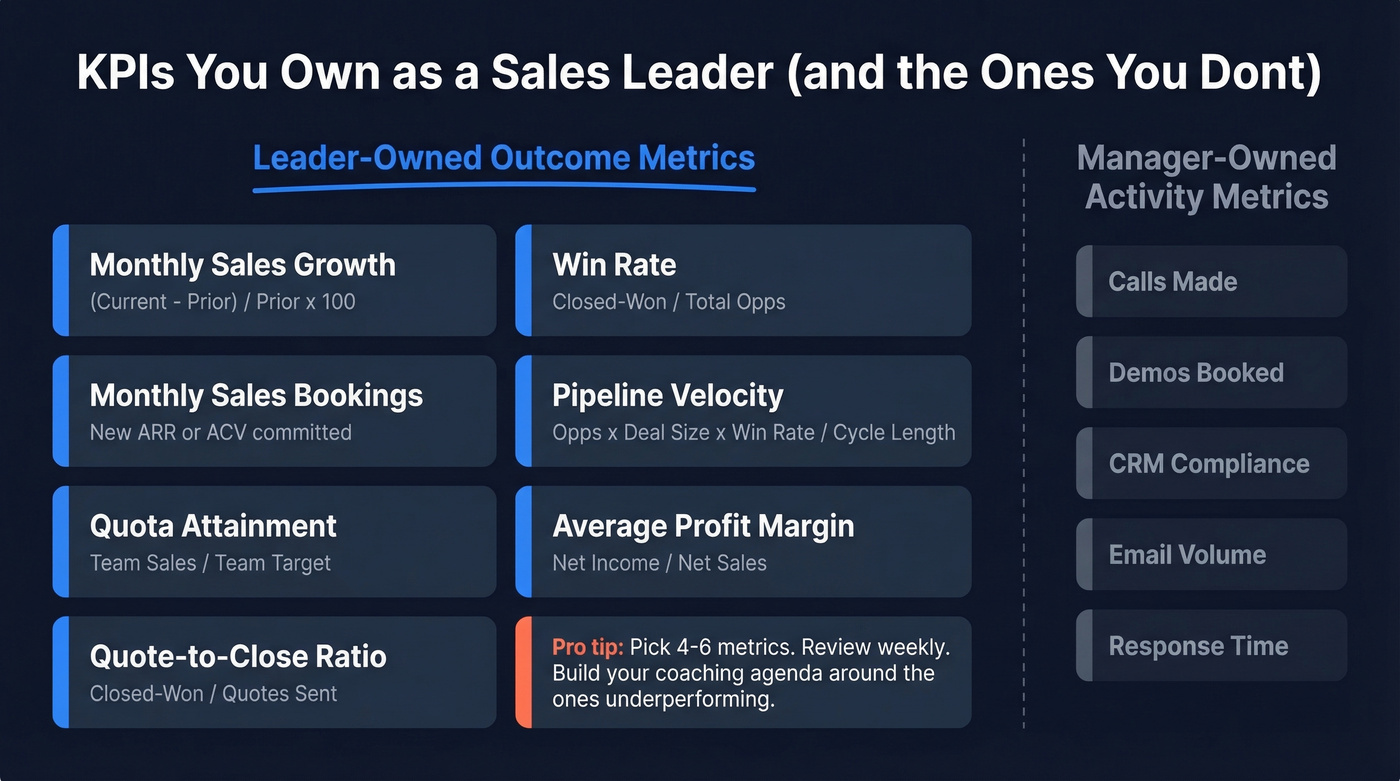
Leader-owned outcome metrics:
- Monthly sales growth - current month revenue minus prior month, divided by prior month, times 100
- Win rate - closed-won divided by total opportunities
- Monthly sales bookings - total new ARR or ACV committed in the period
- Pipeline velocity - opportunities multiplied by average deal size and win rate, divided by sales cycle length
- Quota attainment - total team sales divided by team target
- Average profit margin - net income divided by net sales
- Quote-to-close ratio - closed-won divided by quotes sent
Manager-owned activity metrics include calls made, demos booked, CRM compliance, email volume, and response time. These matter, but they're inputs. Leaders own the outputs. (If you need a tighter list, use these sales productivity metrics.)
One distinction worth internalizing: pipeline and funnel aren't the same thing. Your pipeline tracks active deals and their movement through stages - it tells you what revenue is coming and where deals are stuck. Your funnel tracks conversion rates across the entire buyer journey - it tells you where prospects drop off. Leaders need visibility into both, but pipeline health is the one that keeps you employed.
The trap is tracking everything. Pick four to six metrics, review them weekly, and build your coaching agenda around the ones that are underperforming. (For a clean weekly cadence, use a pipeline review template.)
Salary & Compensation
Here are current ranges for SaaS sales leadership roles, based on recruiting benchmarks:
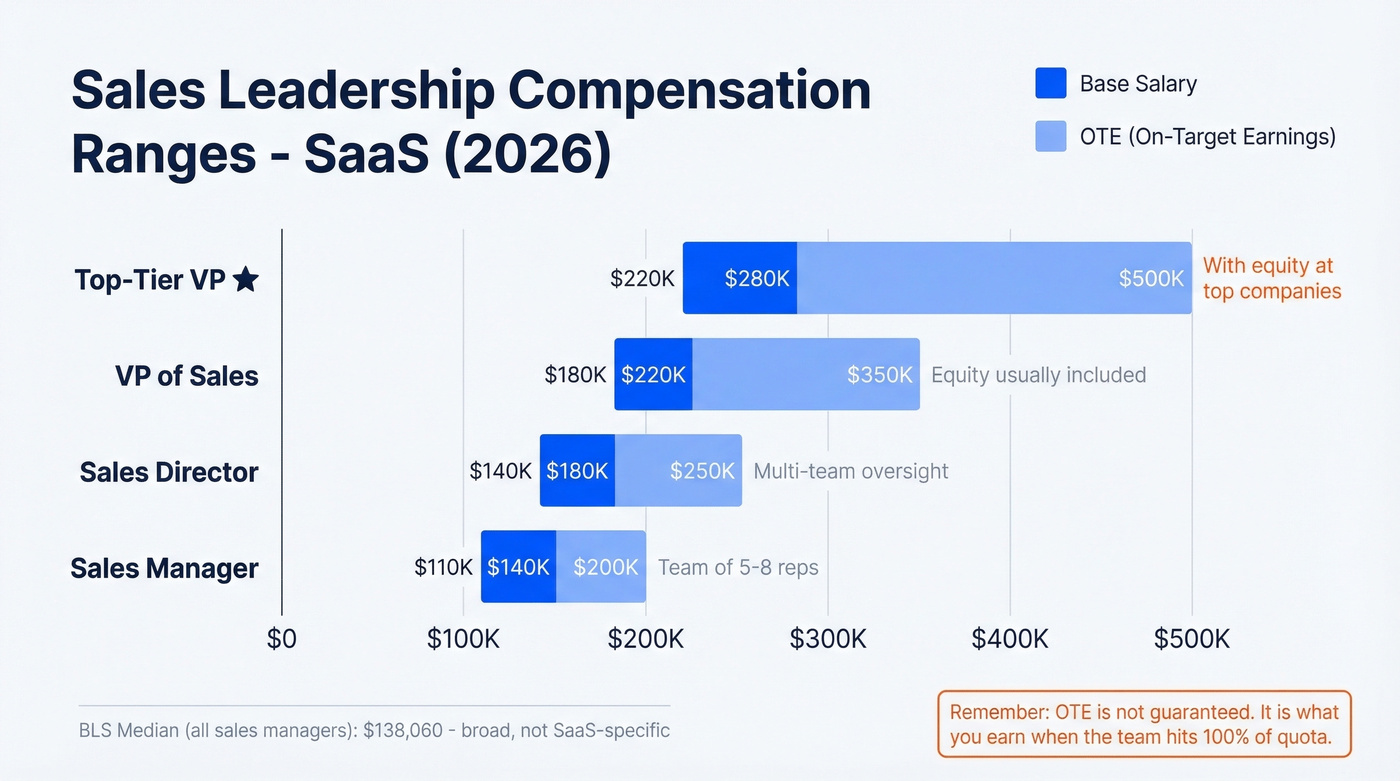
| Role | Base salary | OTE | Notes |
|---|---|---|---|
| Sales Manager | $110K-$140K | $160K-$200K+ | Team of 5-8 reps |
| Sales Director | $140K-$180K | $200K-$250K+ | Multi-team oversight |
| VP of Sales | $180K-$220K | $250K-$350K+ | Equity usually included |
| BLS median (all) | $138,060 | Varies | Broad, not SaaS-specific |
At top-tier companies, VP OTE can reach $400K-$500K+ when equity is factored in. But OTE isn't guaranteed - it's "on-target earnings," meaning what you'd make if the team hits 100% of quota. Before accepting any offer, ask two questions: what percentage of the team hit quota last year, and what was median attainment? If the answer is "40% of reps hit plan" and median attainment was 72%, your realistic comp is significantly below OTE.
Accelerators matter enormously. Most plans offer 1.5-2x commission rates once the team surpasses 100% of quota. The difference between a team that hits 95% and one that hits 115% can be $50K+ in the leader's pocket. Outside SaaS, expect ranges to compress 15-25% on base, with less variable upside.
Mistakes That Destroy New Leaders
Here's the thing: the most common trap isn't strategic. It's personal. Anthony Iannarino captures it perfectly: "believing everyone worked like me." You got promoted because you were a great seller. The instinct is to assume your work ethic, your talk track, your deal strategy should be the template. It shouldn't. Leadership requires adapting to each rep's strengths, not cloning yourself across the team.
Hot take: If your average deal size is under $10K, you probably don't need a VP of Sales yet. You need a player-coach who can close deals and build a repeatable process simultaneously. Hiring a $250K leader before you have product-market fit in your sales motion is the most expensive mistake founders make - and it happens constantly. (If you're earlier-stage, read First Sales Hire.)
We've seen a few patterns wreck new leaders over and over:
Failing to protect your team. Non-selling distractions - support escalations, internal projects, cross-functional meetings with no clear agenda - eat rep productivity alive. Your job is to be a shield. If you're not actively blocking low-value work from reaching your reps, you're complicit in their underperformance.
Poor onboarding. The "they'll figure it out" approach to new hire ramp is shockingly common. Only 14% of companies have a documented sales process. Without one, new reps are guessing at ICP, buyer journey, and what good looks like. Ramp time doubles, and early attrition spikes. (Steal this sales onboarding plan and adapt it.)
No real coaching. "Hit your numbers or else" isn't coaching. It's a threat. Coaching means reviewing calls together, diagnosing skill gaps, building development plans, and following up. It's time-intensive. It's also the single highest-ROI activity in the role.
Ignoring data quality. This one's subtle but devastating. Sales leaders estimate that 19% of company data is inaccessible, and bounce rates silently kill outbound before anyone notices. If your team's email bounce rate is above 5%, your domain reputation is degrading and pipeline is evaporating. One of the fastest wins for a new leader: audit your team's contact data. Prospeo delivers 98% email accuracy on a 7-day refresh cycle, so your reps prospect with verified contacts instead of stale lists that torch deliverability. (If you need the mechanics, see email reputation.)
No documented process. "Go sell stuff" isn't a strategy. Without a repeatable process - defined stages, exit criteria, qualification frameworks - every rep invents their own approach. Forecasting becomes guesswork, coaching has no common language, and scaling is impossible.
The Tech Stack You Should Own
The stack matters, but how you govern it matters more. Here's what a modern sales organization should have in place:
- CRM - Salesforce or HubSpot. The foundation everything else depends on.
- Conversation intelligence - Gong, Chorus, or similar. You can't coach what you can't observe.
- Forecasting - Clari, BoostUp, or native CRM forecasting for smaller teams. (If you're comparing options, use these revenue forecasting tools.)
- Prospecting data - This is where most stacks quietly fail. Your outbound team is only as good as its data. Skip this if your org is purely inbound, but for anyone running outbound at scale, bad contact data is the silent pipeline killer.
- Enablement - Highspot, Seismic, or a well-organized content library.
94% of sales leaders with AI agents say they're essential for meeting business demands. And 74% of sales teams using AI prioritize data hygiene to support it - because AI built on bad data produces bad outputs.
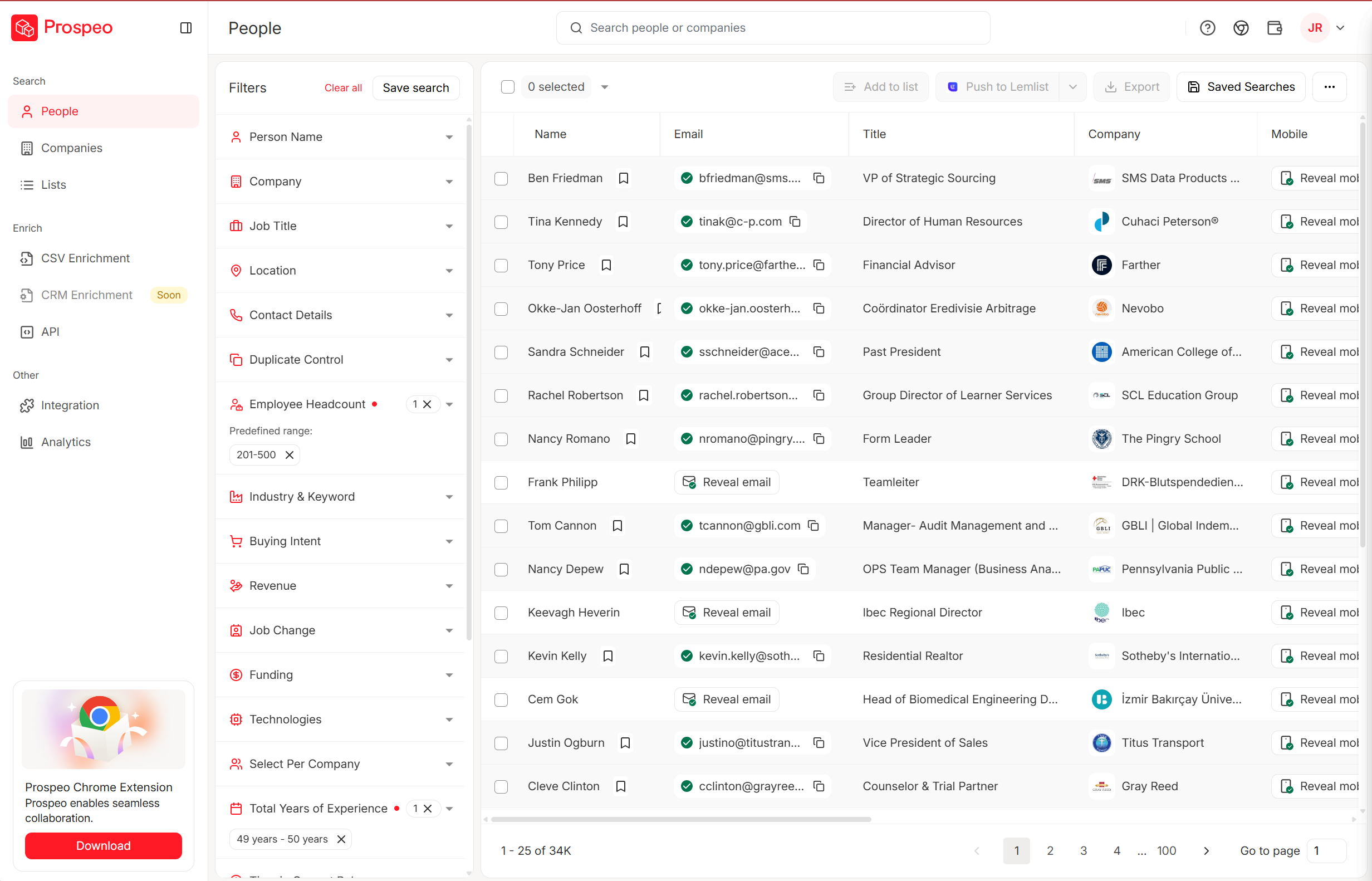
You own the data environment your team operates in. If reps are spending time cleaning lists or working around bad numbers, that's a leadership failure, not a rep failure. In our experience, the single fastest diagnostic a new leader can run is pulling bounce rates from the last 30 days of outbound sequences - if they're above 5%, you've found your first fire to put out.
Win rate improvement is the KPI you actually own. Teams using Prospeo book 26% more meetings than ZoomInfo and 35% more than Apollo - at $0.01 per email. No contracts, no sales calls, no six-figure commitment to find out if the data works.
Lead with better data. Your reps will follow.
The Job Never Stops Evolving
The markets shift, the tools change, the reps grow - or they don't. What stays constant is the core responsibility: make the people around you better at selling than they'd be without you. Every successful sales leader starts with coaching, builds systems that compound, and never confuses monitoring with leading. (For a broader playbook, see sales leadership strategies.)
Let's be honest - most of the advice out there about sales leadership reads like it was written by someone who's never had to fire a rep or explain a missed quarter to a board. The real job is messier, harder, and more rewarding than any job description captures. If you're stepping into the role for the first time, start with coaching, protect your team's time, and fix your data. Everything else follows.
FAQ
What's the difference between a sales leader and a VP of Sales?
VP of Sales is a title on the org chart; sales leader is a capability. You can be a VP without leading - plenty are glorified forecast consolidators. And you can be a frontline manager who leads exceptionally well. The best VPs embody both the title and the capability, but don't confuse having the role with doing the work.
How long does it take to become a sales leader?
The typical path runs 5-8 years: two to three years as a rep, two to three as a senior AE or team lead, then a promotion into management. Tenure matters less than readiness - the real gates are coaching ability, process thinking, and forecasting skill. Some reps are ready in four years. Some never are.
What's the biggest mistake new sales leaders make?
Assuming their selling style is the template for the entire team. The behaviors that made you a top rep - your cadence, your talk track, your deal strategy - won't transfer to every personality and territory. Leadership means adapting your approach to each rep's strengths, not expecting ten people to become copies of you.
Do sales leaders still carry a personal quota?
At smaller companies running a player-coach model, yes. At scale, the leader's "quota" is the team's number. Carrying a personal book while managing a team creates competing priorities - you'll always default to closing your own deals instead of developing reps. Above 8-10 direct reports, a personal quota signals broken org design.
How can leaders fix bad prospecting data fast?
Audit bounce rates across your outbound sequences - anything above 5% means your data source is the problem. Switch to a verified provider with a short refresh cycle, then make data hygiene a recurring leadership review. Bad data compounds silently until domain reputation collapses and pipeline disappears.