

Sales Meeting Request Emails That Actually Get Replies
61% of B2B decision-makers say they prefer hearing from sellers via cold email. Yet 71% ignore messages that feel irrelevant. That gap between "yes, email me" and "not like that" is where most sales meeting request emails go to die.
Here's the thing: the typical SDR sends 200 emails a week and gets two replies, both "unsubscribe." The instinct is to rewrite the subject line or try a new template. But the real problem is upstream. 17% of cold emails never reach the inbox, and the ones that do land compete with 121+ other messages sitting there. Your copy matters less than your data, your CTA type, and your follow-up cadence.
What the Data Says
These numbers should shape every meeting request template you write.
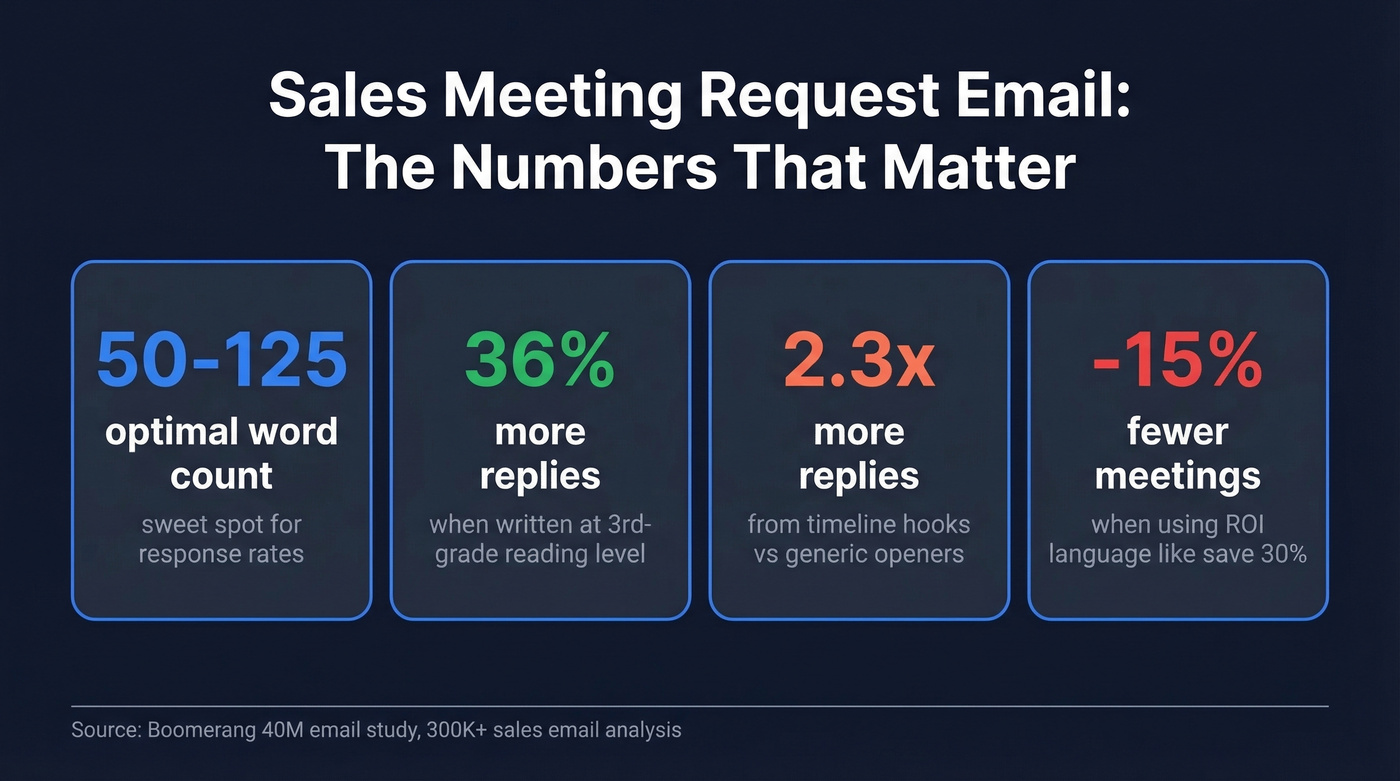
Length and readability. Emails between 50-125 words hit the sweet spot for response rates. Writing at a 3rd-grade reading level lifts replies 36% over college-level writing, per Boomerang's study of 40 million emails. Short sentences, one question, no jargon.
CTA type beats CTA wording. An analysis of 300K+ sales emails found that interest CTAs ("Is this worth exploring?") outperform time CTAs ("Do you have 15 minutes Thursday?") for cold outreach. ROI language like "save 30%" or "increase revenue" actually decreases success by 15%. It triggers the sales-pitch filter instantly. If you want more examples, borrow from these best email call to action examples.
Tone isn't neutral. Slightly positive or slightly negative emails get 10-15% more responses than flat, neutral ones. A little personality goes a long way.
Timeline hooks win. Hooks tied to a specific event ("before Q3 planning kicks off") generate 2.3x more replies than generic problem hooks. Specificity signals you've done your homework.
Subject Lines That Get Opens
33% of recipients decide to open or delete based solely on the subject line, and 70% will mark you as spam from the subject line alone. The stakes are brutal.
Over 60% of emails are opened on mobile, so aim for under 50 characters to avoid truncation. For executives, 2-6 words. One underused tactic: including the meeting duration boosts acceptance 20-30%. If you want a deeper breakdown, see our email subject line length guide.
Three formulas that work:
- Duration + topic: "15 Min: [Their Pain Point] Fix"
- Name + question: "[First Name], quick question on [initiative]"
- Relevance + timeline: "[Company] + [your solution] before Q3"
Also worth testing: your sender name format. "Sarah at Acme" outperforms "Sarah Johnson" in most B2B contexts because it immediately signals who you are and why you're reaching out. For more tested options, use these sales email subject lines.
5 Templates You Can Steal
Template 1: Cold Outreach (First Touch)
Subject: 15 min: [pain point] before Q3
Hi [Name],
You handle [function] at [Company], so I bet [specific timeline event] is on your radar. We helped [similar company] [specific result] in [timeframe].
Worth exploring?
[Your name]
This structure - "you handle X, so I bet you care about Y" - comes from a framework that top-performing SDRs on r/sales swear by. It uses the timeline hook (2.3x more replies) and an interest CTA. Under 90 words. If you want more variations, start with a sample outreach email.
Template 2: Warm / Inbound Follow-Up
Subject: Following up - [topic from their action]
Hi [Name],
You [downloaded/attended/requested] [specific thing] last week. Most teams looking at this are trying to solve [problem].
Does Thursday at 2 PM or Friday at 10 AM work for a 15-minute call?
[Your name]
For warm leads already in-cycle, specific time CTAs outperform open-ended asks. The prospect has already raised their hand - remove friction, don't rebuild intrigue. If you need more options, use these email templates for lead generation.
Template 3: Executive / C-Level Request
Subject: [2-6 words, their initiative]
[Name],
[One sentence: specific, relevant observation about their company]. We helped [peer company CEO] [result].
Worth a quick look?
Under 50 words. Never send a CEO a Calendly link on first touch - hard CTAs like "book 30 minutes" get 50% lower response rates from executives. "Worth a quick look?" or "Thoughts?" doubles response. For more exec-specific phrasing, see our executive introduction email.
Template 4: Follow-Up After No Response
Subject: Re: [original subject]
Hi [Name],
Circling back on my note from [day]. Since then, [new relevant data point or trigger event].
Still make sense to connect?
Reference the original email and add new value - a stat, a case study, a trigger event. Don't just "bump" the thread. That's how you get archived. If you want more follow-up language, use these sales follow-up templates.
Template 5: Re-Engagement (Gone Cold)
Subject: Should I close this out?
Hi [Name],
I've reached out a few times about [topic]. Totally fine if the timing's off - should I close this out, or is it worth revisiting in [timeframe]?
The permission-based close flips the dynamic. Prospects respond to close the loop. We've seen this template revive conversations that were dead for weeks. If you need a re-engagement email that works on cold leads, test this one first. For more breakup-style options, see our sales breakup email template.

These templates only work when they reach real inboxes. 17% of cold emails never arrive - usually because the data is bad. Prospeo's 5-step email verification delivers 98% accuracy and refreshes every 7 days, so your meeting requests land with the right decision-makers, not bounce into the void.
Stop perfecting copy that bounces. Fix the data first.
Choosing the Right CTA
Your CTA matters more than your opening line, your subject line, and your social proof combined. Most reps obsess over the wrong 10% of the email. Let's break this down by scenario.
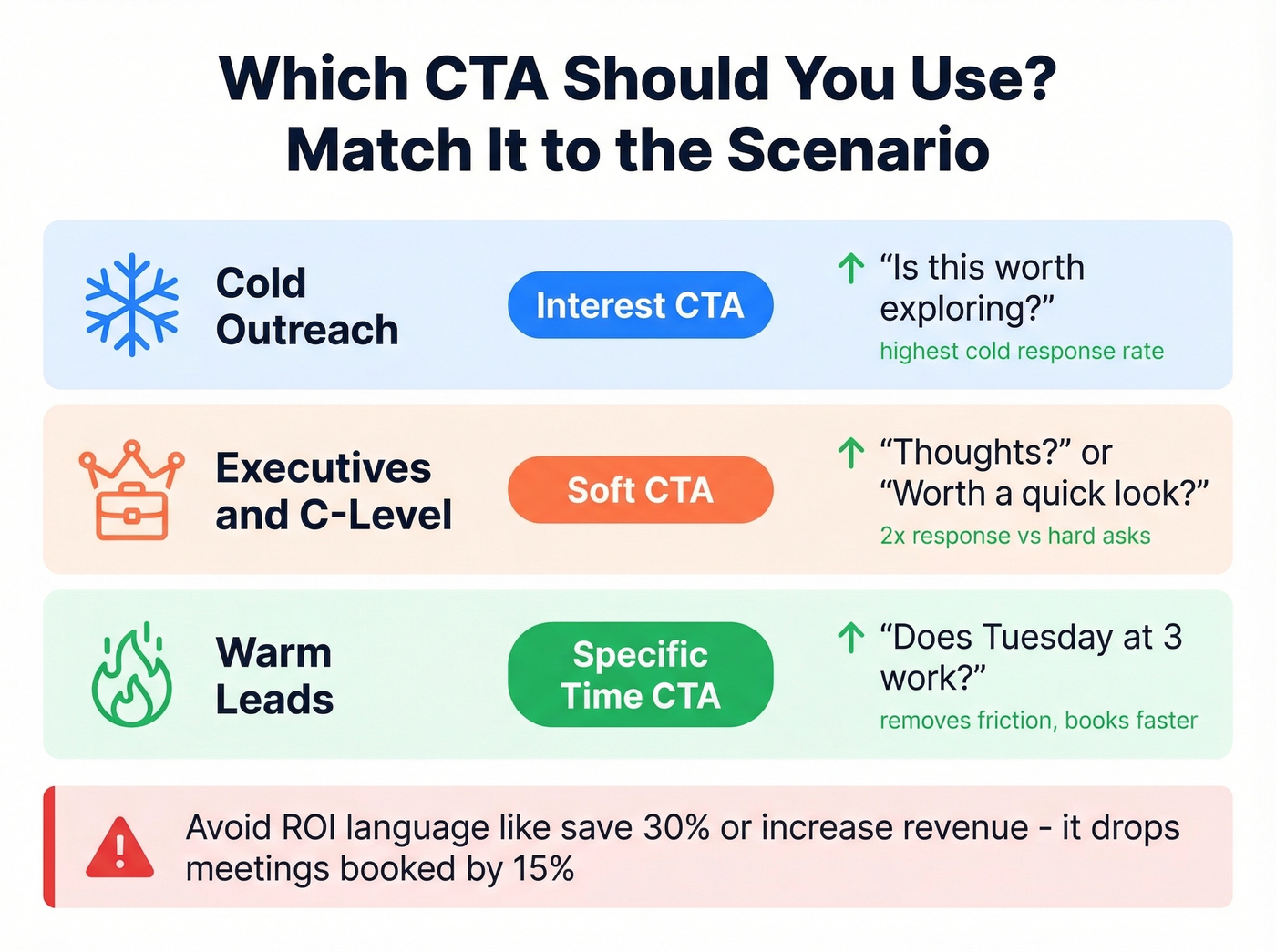
Cold outreach: interest CTAs. "Is this worth exploring?" or "Worth a look?" You're selling the conversation, not the meeting. For a full framework, see email call to action.
Executives: soft CTAs only. "Thoughts?" and "Worth a quick look?" double response rates compared to hard asks. Executives don't respond to pressure - they respond to relevance.
Warm deals: specific time CTAs. "Does Tuesday at 3 work?" Once someone's engaged, removing friction wins.
Skip ROI language entirely. "We'll help you save 30% on X" correlates with a 15% drop in meetings booked. It sounds like every other pitch in their inbox.
Follow-Up Cadence
48% of reps never send a second email. Meanwhile, follow-ups generate 42% of all campaign replies. The math is obvious, and yet half the profession ignores it.
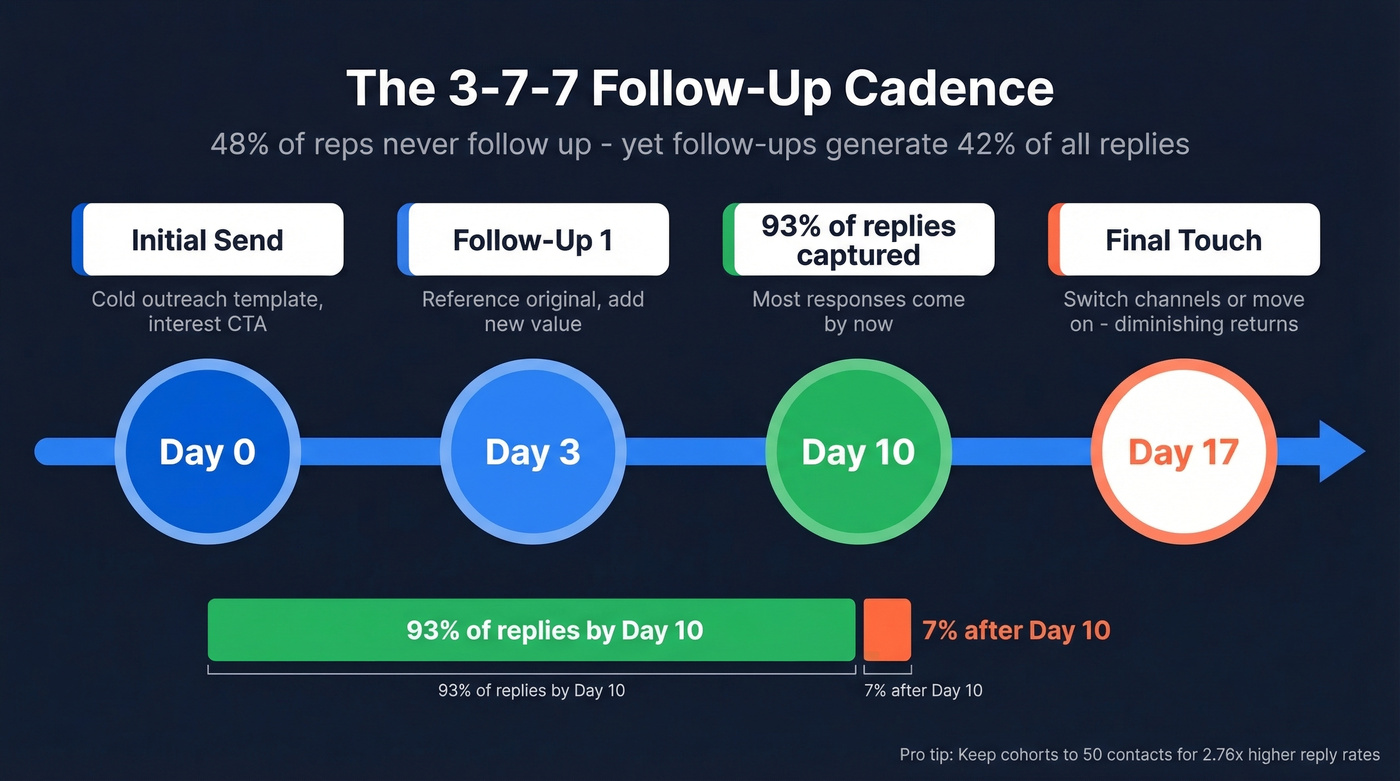
Use the 3-7-7 cadence: send on Day 0, follow up Day 3, Day 10, Day 17. This captures 93% of replies by Day 10. After Day 17, you're in diminishing returns territory, so move on or switch channels.
Keep your outreach cohorts to 50 contacts or fewer. Segmented campaigns can see 5x higher open rates, and smaller-batch cohorts generate 2.76x higher reply rates than mass blasts. Real personalization doesn't scale to 500-person lists - the best meeting request emails are built around tight segments, not massive sends. If you're building sequences, use this follow up email after no response playbook.
Before You Hit Send
Your sales meeting request email doesn't matter if it bounces. As of 2026, major email providers hard-reject messages without proper DMARC, DKIM, and SPF authentication.
The consensus on r/coldemail is blunt: "Infrastructure is where almost everyone screws up." They're right.
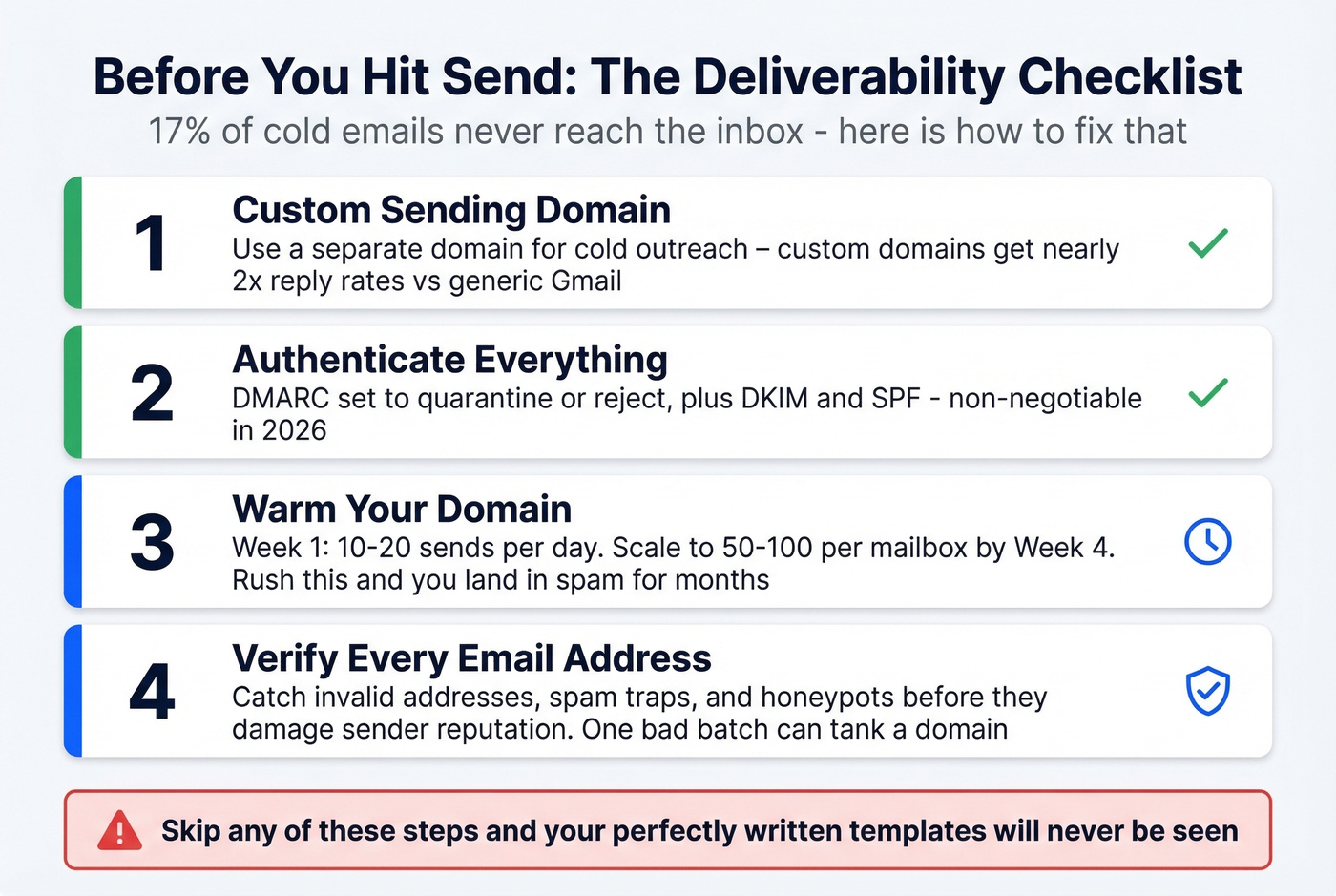
Use a custom sending domain. Custom domains get almost 2x the reply rate of generic Gmail addresses. Protect your primary domain's reputation by keeping cold outreach separate.
Authenticate everything. DMARC set to quarantine or reject, plus DKIM and SPF. Non-negotiable in 2026. (If you need setup help, start with SPF Record DNS.)
Warm your domain first. Start at 10-20 sends per day in Week 1, scaling to 50-100 per mailbox by Week 4. Rush this and you'll land in spam for months. If you’re choosing tooling, compare options in our domain warm up tool guide.
Verify every email address. That 17% inbox failure rate is largely preventable. We run every list through Prospeo's 5-step verification before any campaign goes out - it catches invalid addresses, spam traps, and honeypots before they damage sender reputation. One bad batch can tank a domain you spent weeks warming.
Small-batch, personalized cohorts of 50 contacts get 2.76x more replies. But building those tight segments takes hours - unless you have 30+ filters for buyer intent, job changes, headcount growth, and technographics. Prospeo gives you all of that across 300M+ profiles at $0.01 per email.
Build your next 50-contact outreach list in under 5 minutes.
A Note on Scope
This guide covers sales prospecting emails specifically. For client check-in messages, internal meeting requests, or networking intros, the frameworks here still apply - but the CTA data is calibrated for cold and warm sales outreach. For non-prospecting scenarios, use these email template for client meeting examples.
FAQ
How long should a meeting request email be?
Aim for 50-125 words written at a 3rd-grade reading level. Boomerang's 40M-email study confirmed this range yields the highest response rates. If it takes more than 10 seconds to read, cut it down.
What's a good reply rate for cold outreach?
2-4% is realistic at scale. With a 3-7-7 cadence, verified data, and 400 daily sends across 4-5 rotated mailboxes, expect 90-100 meetings per month. Above 5% means your targeting is dialed in.
How do I keep my emails out of spam?
Set up DMARC, DKIM, and SPF on a separate sending domain and warm it for at least 14 days before scaling. Verify every address before sending - one bad batch can tank your domain reputation for months.
What CTA works best for booking sales meetings?
For cold prospects, use interest CTAs like "Worth exploring?" - they outperform time-based asks by 15%. For warm leads already engaged, switch to specific time CTAs ("Does Tuesday at 3 work?") to reduce friction. Executives respond best to soft closes like "Thoughts?"