

The Practitioner's Guide to Sales Motions - Real Numbers, Real Examples, and a Playbook You Can Use
Quota attainment sits at 43.14%. Most reps are missing number. And here's the uncomfortable part: most of those teams don't actually have a sales motion. They have a collection of activities - some cold calls, a few sequences, maybe an inbound form - and they call it a strategy.
That's not a strategy. That's improvisation.
Meanwhile, 69% of buying decisions are made before a buyer ever talks to a rep. If you don't have a deliberate, repeatable system for how you find, engage, and close your specific buyer, you're leaving pipeline to chance. We've seen this pattern play out dozens of times across the teams we work with, and the fix is almost always the same: stop doing a little of everything and commit to one motion that fits your deal size, your team, and your buyer.
What Is a Sales Motion?
A sales motion is the path a sales team takes to reach prospects, move them through the cycle, and close - as Dock's resource library puts it cleanly. Think of it as the operational layer between your high-level GTM strategy and the day-to-day activities your reps execute.
It's not a tactic. It's not a single channel. It's the entire repeatable pattern: who you target, how you reach them, what tools you use, how you qualify, and how you measure success. Your GTM strategy says "we sell to mid-market fintech companies." Your motion defines whether you do that through outbound sequences, product-led growth, field sales, or some combination - and exactly how each function contributes.
Motion vs. Process vs. Play vs. Methodology
These terms get used interchangeably, and that's where confusion starts. They're a nested hierarchy.
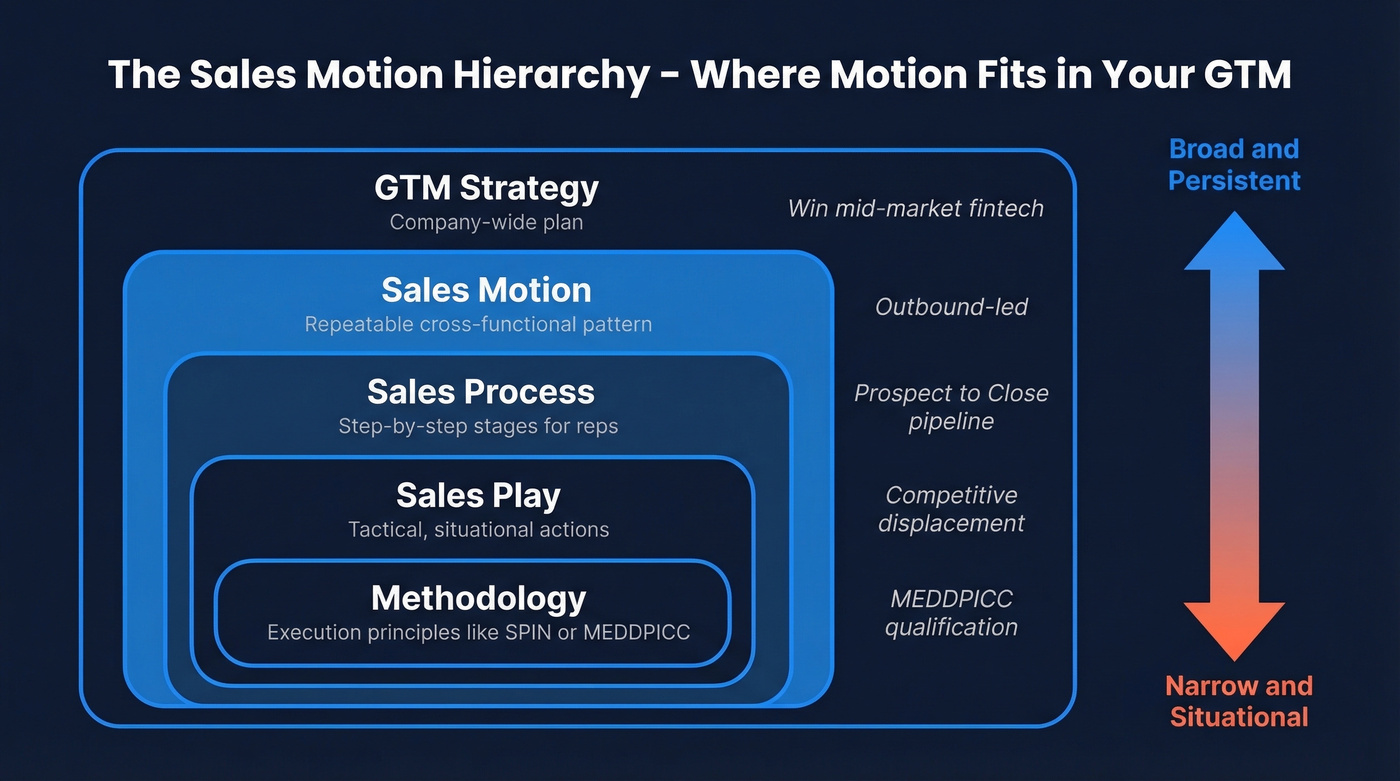
| Term | What It Is | Scope | Example |
|---|---|---|---|
| GTM Strategy | High-level plan | Company-wide | "Win mid-market fintech" |
| Sales Motion | Repeatable pattern | Cross-functional | Outbound-led, PLG |
| Sales Process | Step-by-step stages | Rep-level | Prospect → Qualify → Close |
| Sales Play | Tactical action | Situational | "Competitive displacement" |
| Methodology | Execution principles | Overlays process | SPIN, MEDDPICC |
The motion sits between strategy and execution. It's persistent and repeatable - you run an outbound motion for quarters or years. A play, by contrast, is tactical and situational: you run a competitive displacement play when a specific trigger fires.
Methodologies like SPIN or MEDDPICC overlay how reps execute within the process. They aren't motions themselves. A team can run an enterprise motion using MEDDPICC qualification and a Challenger selling style. The motion is the what; the methodology is the how.
8 Types of Sales Motions
Inbound
HubSpot built a billion-dollar company on this motion. Inbound attracts buyers through content, SEO, paid search, and brand - then routes them to sales when they raise their hand. The critical insight: 81% of buyers already have a preferred vendor by the time they first talk to sales. Your inbound motion isn't just about capturing demand. It's about creating preference before the form fill happens.
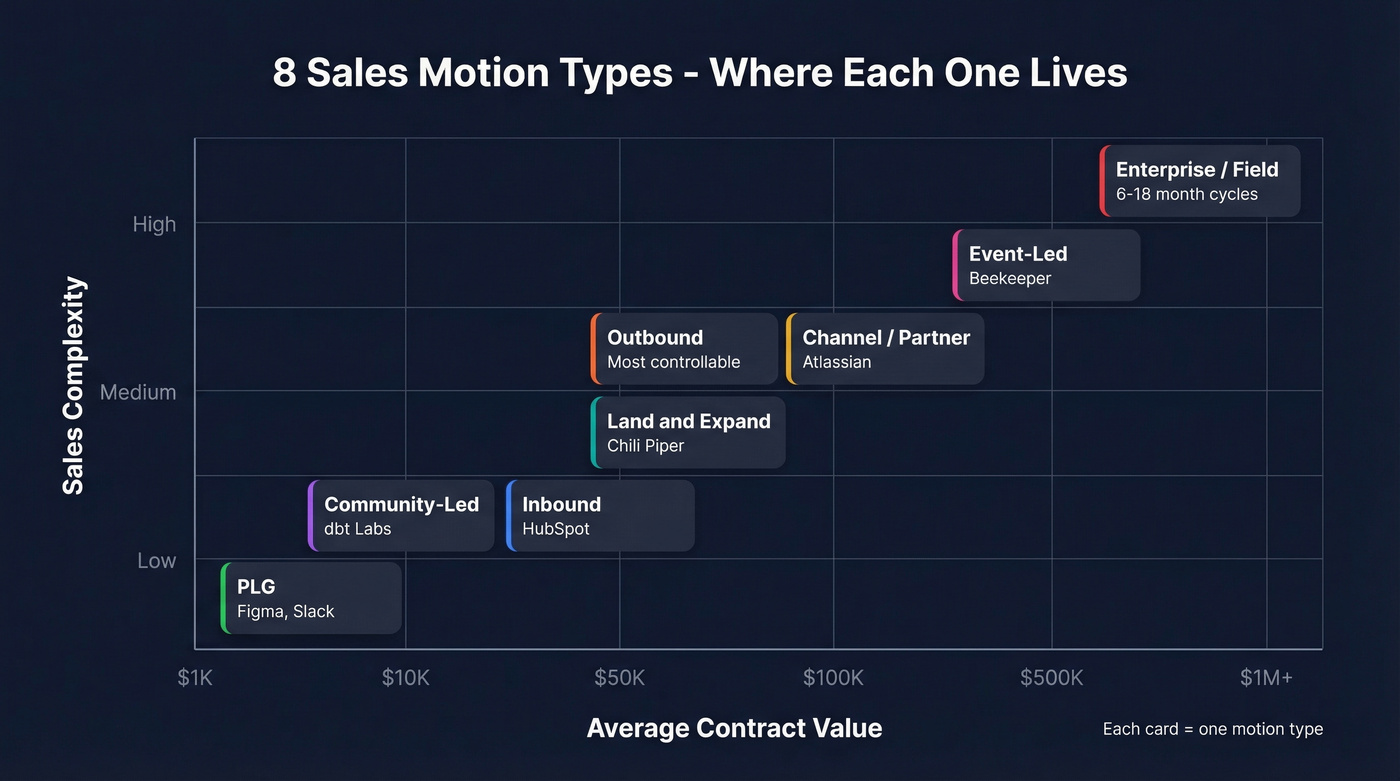
Best for teams with strong content engines and ACV in the $5K-$50K range. Speed-to-lead is the metric that matters most - if your response time exceeds 5 minutes, you're losing deals.
Outbound
Outbound is the most controllable motion. You pick the accounts, you write the messaging, you set the volume. It's also the motion most likely to fail from bad fundamentals.
Here's the thing: your outbound motion is only as good as your data. If a third of your emails bounce, your domain reputation tanks and the whole thing stalls before it starts. One tactical benchmark worth knowing - leaving a voicemail doubles reply rates from 2.73% to 5.87% on initial outreach. Multi-channel still wins.

Best for teams selling $15K+ ACV deals where you can identify and target specific accounts. Top SaaS SDR teams book 8-15 meetings per rep per month with 2-5% reply rates. If you're tightening fundamentals, start with sales prospecting techniques and a clean sequence management system.
Product-Led Growth (PLG)
Figma is the textbook example. Users adopt the free product, hit specific in-app actions that signal upgrade intent, and sales engages accounts showing those signals. The results: 4M+ users, $200M to $400M ARR with 100% year-over-year growth, and 150% net dollar retention.
PLG companies grew roughly 2x faster than those without a PLG focus, per Bain's research - and were nearly 3x more likely to have gained market share. The ACV sweet spot for pure PLG is $10-$5,000 per seat per year, where time-to-value is measured in minutes, not months.
Enterprise / Field Sales
You're looking at 6-18 month sales cycles, buying committees of 8-12 stakeholders (Forrester pegs it at 13 in recent research), and ACV from $50K to $2M+. Every deal requires multi-threading across exec sponsors, business owners, end users, IT, security, procurement, legal, and finance.
Best for complex products where implementation itself is a significant workstream. If your buyer needs a security review, a legal redline, and a 90-day implementation plan before they can say yes, you're running an enterprise motion whether you've named it or not. For deeper tactics, see enterprise B2B sales and how to sell to the technical buyer vs economic buyer.
Land-and-Expand
Chili Piper runs this well. They land with a single flagship use case - converting inbound leads to qualified demos - then expand by selling additional teams: sales management, RevOps, CS, finance.
Across SaaS, expansion ARR represents 40% of total new ARR in 2026, up from prior years. If you aren't measuring net revenue retention and expansion pipeline separately, you're missing a growth engine that's driving a huge share of new ARR. (If you want the retention math, start with renewal rate.)
Channel / Partner
Atlassian is the example everyone points to - a massive ecosystem of solution partners, resellers, and marketplace integrations that sell on their behalf. Channel motions work best for broad horizontal products where partners can add implementation value and reach geographies or verticals you can't cover directly. The tradeoff is control: your messaging, pricing, and deal qualification are filtered through a partner.
Best for companies past $10M ARR with a product proven enough for partners to bet their reputation on.
Event-Led
Beekeeper runs a sophisticated event-led motion targeting frontline HR buyers. They combine executive visits with customized demo environments that mirror the prospect's actual use case - not generic booth demos. Post-sale, they deploy onsite activation support with onboarding specialists, CSMs, and AMs.
Event-led motions are expensive per touch but high-conversion. If your average deal size is under $25K, the unit economics don't work.
Community-Led
dbt Labs built a 40,000+ member community of analytics engineers before most of them ever became paying customers. Community-led motions build trust over months or years before a purchase conversation happens. They're best for developer tools and technical platforms where the end user has significant influence over the buying decision.
The timeline is long and attribution is hard to pin down, which makes this motion tough to justify on a quarterly board deck. But for the right product and audience, community-led creates a moat that outbound can't replicate.
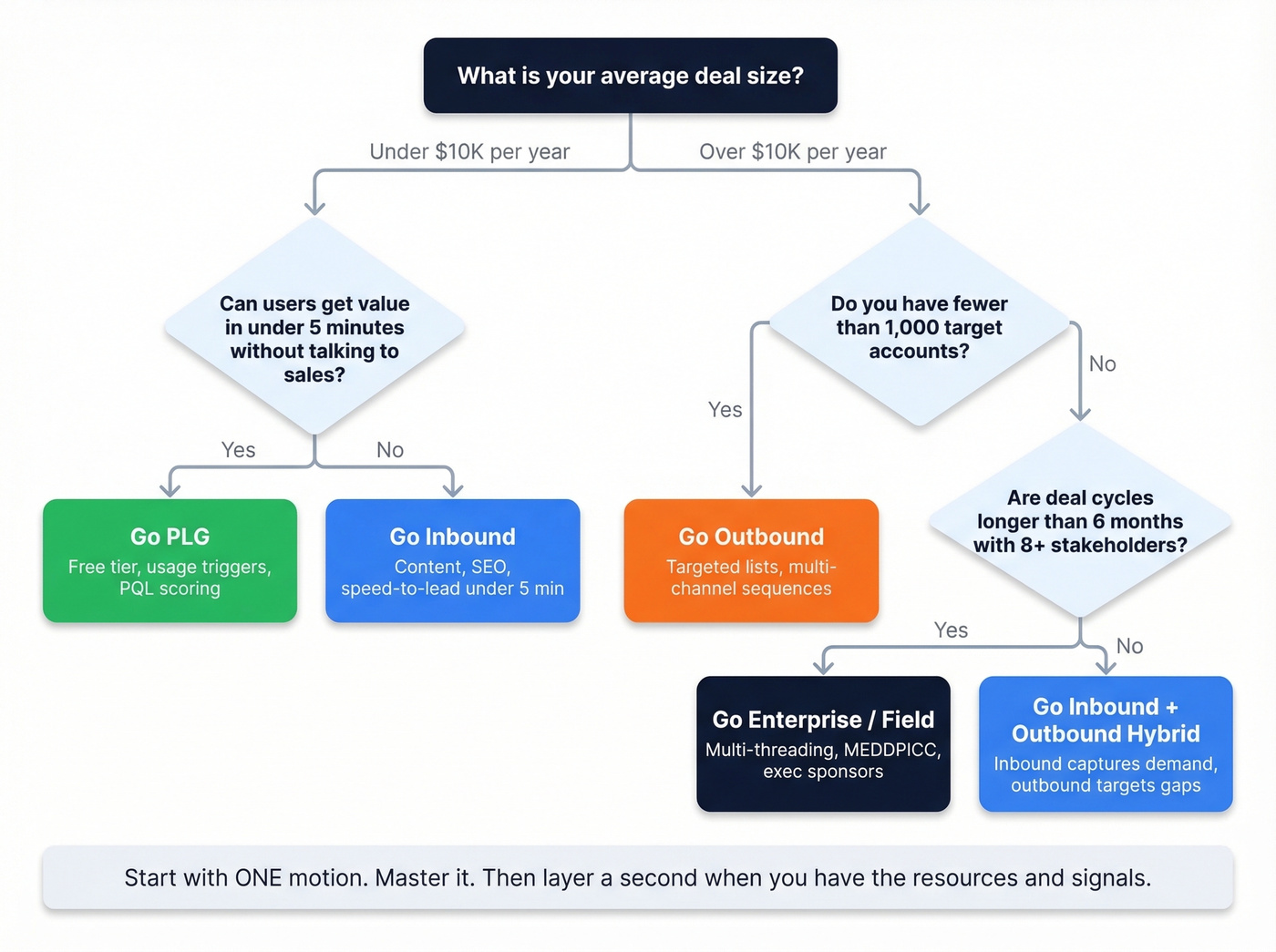
How to Choose the Right Motion
Don't overthink this. Start with one motion. Master it. Then layer a second when you have the resources and the signals.
| Motion | ACV Range | Team Size | Complexity | Best Stage |
|---|---|---|---|---|
| Inbound | $5K-$50K | 5-20 reps | Low | Post-PMF |
| Outbound | $15K-$100K+ | 3-50 reps | Medium | Any |
| PLG | $10-$5K/seat | 1-5 sales | Low | Post-PMF |
| Enterprise | $50K-$2M+ | 5-30 reps | High | Growth+ |
| Land & Expand | $5K-$50K land | 5-20 reps | Medium | Growth+ |
| Channel | $10K-$100K+ | Partner team | Medium | Scale |
| Event-Led | $25K-$500K+ | Field team | High | Growth+ |
| Community-Led | Varies | DevRel team | Low | Early-Growth |
The biggest mistake we see is teams trying to run three or four motions simultaneously with a five-person sales team. Each motion requires dedicated process, tooling, and measurement. One motion done well beats three done poorly every time.
Let's be honest: if your average contract value is under $10K, you probably don't need a dedicated outbound motion at all. The math doesn't work - the cost per meeting will eat your margins. Go PLG or inbound and save outbound for when your deal sizes justify the investment.

You read it above: outbound is the most controllable motion, but it stalls when a third of your emails bounce. Prospeo delivers 98% email accuracy with a 7-day data refresh cycle - so your sequences actually reach real buyers. Teams using Prospeo book 26% more meetings than ZoomInfo users.
Fix your outbound data before you fix anything else.
How to Build a Sales Motion From Scratch
A common early-stage scenario: a founder has most revenue coming from word-of-mouth, no structured outbound, and no idea where to start with their first BD hire. That's what happens without a defined go-to-market motion.
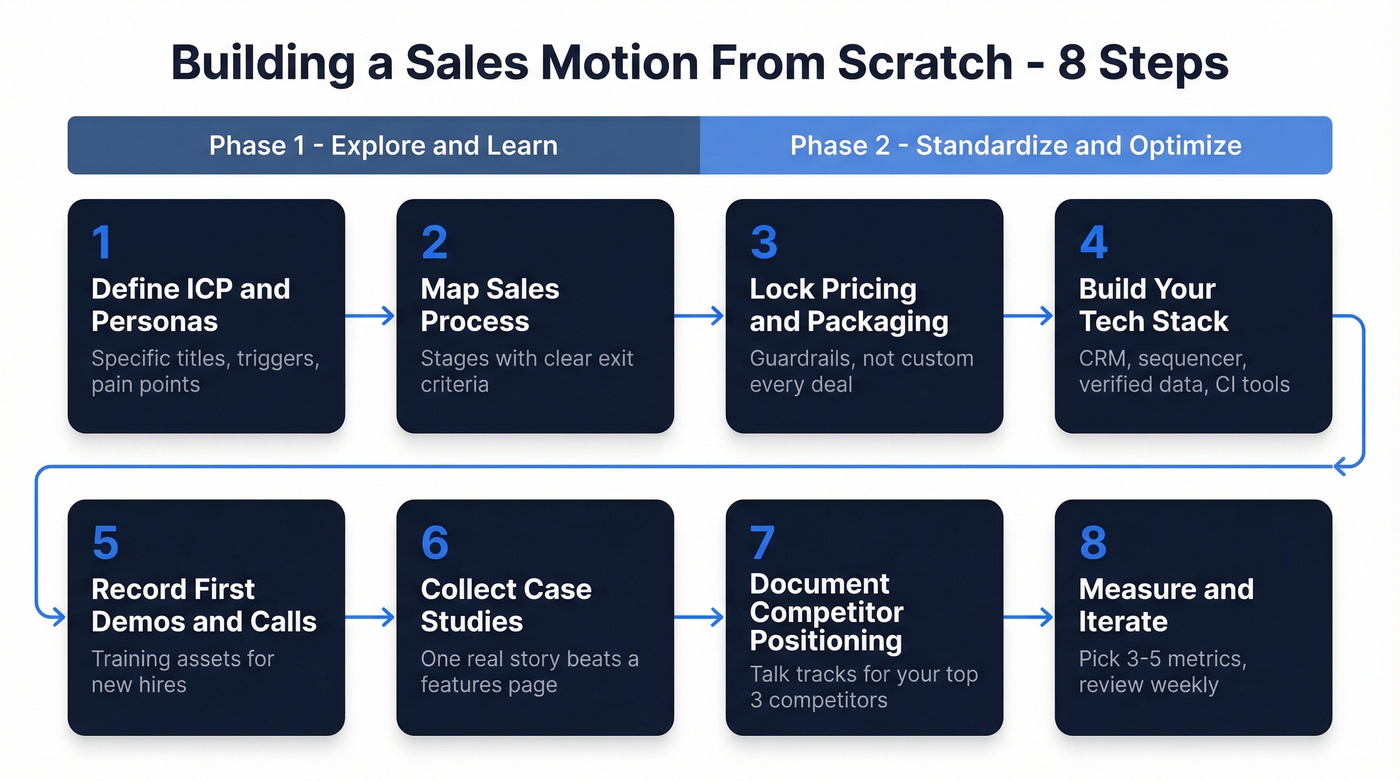
The fix follows a natural progression: "Explore & Learn" first through founder-led selling with tight feedback loops, then "Standardize & Optimize" once you've closed 10-20 deals and know what repeats.
1. Define your ICP and buyer personas. Not "mid-market SaaS companies" - specific titles, company sizes, triggers, and pain points. Narrow beats broad. (Use an ideal customer profile template if you want a scoring rubric.)
2. Map your sales process and stages. Prospect, Qualify, Demo, Proposal, Negotiate, Close. Define exit criteria for each stage so reps know when to advance or disqualify. If you're tightening stage discipline, sales process optimization is the fastest win.
3. Lock your pricing and packaging. Your motion can't be repeatable if every deal is custom-priced. Even enterprise motions need pricing guardrails.
4. Build your tech stack. CRM (HubSpot or Salesforce for most teams), sequencer (Outreach, Salesloft, or Instantly), a verified data platform like Prospeo for building targeted lists with intent and technographic filters, and conversation intelligence for coaching. The stack should accelerate your motion, not add complexity. If you're evaluating list quality, start with data enrichment services and firmographic and technographic data.
5. Record your first demos and calls. These become training assets for new hires.
6. Collect case studies and social proof. Even one customer story with specific results is more powerful than a features page.
7. Document competitor positioning. Your reps will face the same three competitors in 80% of deals. Give them the talk track.
8. Measure and iterate. Pick 3-5 metrics that map to your motion type and review them weekly.
When to Layer or Transition Motions
You don't decide to shift from PLG to enterprise - your customers do. Watch for these signals:
- Customers requesting enterprise features like SSO, security controls, and admin dashboards
- Teams organically growing within accounts past a usage threshold
- Inbound requests for larger contracts or custom terms
The triggers are specific. Twilio engages enterprise sales when an account hits $100K ACV. Dropbox triggers when 3% or more of a customer's employees already use the product. Calendly watches for executive-level users connecting their calendar to Salesforce - that integration signal indicates enterprise intent.
The payoff is real. One PLG company increased its annual growth rate by 5+ percentage points in the two years after launching an enterprise sales team. But the pitfalls are equally real: resource allocation conflicts between self-serve and enterprise, homepage CTA confusion (free trial vs. "talk to sales"), and product/engineering trade-offs between simplicity and customization. Plan for these tensions before they become crises.
5 Mistakes That Kill Pipeline
1. Outsourcing sales too early. Founders must build the initial feedback loop between product, business model, and customer. Hiring a VP of Sales before you've closed 10-20 deals yourself means you're outsourcing learning, not just labor.
2. Chasing enterprise before product-market fit. Start SMB. Shorter cycles, faster feedback, more capital-efficient. Enterprise deals feel impressive but they'll mask product gaps for 12 months before the churn hits.
3. Running too many motions at once. We've watched teams try to run outbound, inbound, PLG, and partner motions simultaneously with eight people. Every motion was underfunded. None produced results.
4. Mistaking pilots for customers. "Death by 1,000 pilots" is a real pattern. A pilot isn't revenue - it's an extended evaluation. If your pipeline is full of pilots that never convert, your motion has a qualification problem, not a top-of-funnel problem.
5. Ignoring data quality. A 35% bounce rate doesn't just waste sequences - it destroys your sender domain reputation and makes every future outbound touch less likely to land. Data quality is the foundation your outbound motion sits on. Snyk saw bounce rates drop from 35-40% to under 5% after switching to Prospeo, with AE-sourced pipeline climbing 180%. If you're troubleshooting deliverability, start with email bounce rate and how to improve sender reputation.
Running an enterprise motion with 8-12 stakeholders per deal? You need verified direct dials, not switchboards. Prospeo gives you 125M+ verified mobile numbers with a 30% pickup rate and 30+ filters to multi-thread into every account on your target list.
Reach the full buying committee - not just the gatekeeper.
Measuring Your Sales Motion
Every motion needs its own scorecard. The universal benchmarks paint a sobering picture: quota attainment is 43.14%, average ramp time runs 3.2 months, and most sales cycles span 1-2 full quarters. Expansion ARR now represents 40% of total new ARR - if you're only measuring new logo acquisition, you're ignoring nearly half the growth engine.
Motion-specific benchmarks to calibrate against: outbound positive reply rates land between 1-3%, with meeting set rates around 0.5-1.5% per sequence. PLG trial-to-paid conversion ranges from 10-25% depending on product complexity and price point. Enterprise win rates vary wildly, but teams using intent data report 25-35% higher conversion rates and 30-40% shorter cycles.
Pick the 3-5 metrics that map to your specific motion and review them weekly. Not quarterly. If you need a tighter scorecard, use pipeline health metrics to spot issues early.
FAQ
What is a sales motion example?
Figma's PLG motion is a clear one: users adopt the free design tool, product-qualified leads trigger based on in-app actions correlated with upgrade intent, and sales engages accounts showing those signals. Result: 150% net dollar retention and 100% year-over-year ARR growth from $200M to $400M. The motion combines self-serve adoption with targeted sales engagement at the right moment.
What's the difference between a sales motion and a sales strategy?
A strategy is the high-level plan - who you sell to, why you win, and where you compete. A sales motion is the repeatable operational pattern that executes that strategy: the specific combination of channels, process, tools, team structure, and measurement that turns strategy into revenue. Strategy says "win mid-market fintech." The motion defines whether you do that through outbound, PLG, or field sales.
How many motions should a company run?
Start with one. Master it. Then layer a second when you have clear signals - like inbound enterprise requests or organic account expansion hitting a threshold. Most early-stage companies fail by running three or four motions simultaneously with a small team. Each requires dedicated process, tooling, and measurement. One well-executed motion consistently outperforms three underfunded ones.
What tools do you need to run an outbound sales motion?
At minimum: a CRM (HubSpot or Salesforce), a sequencer (Outreach, Salesloft, or Instantly), and a verified data platform. Bad data is the most common reason outbound motions fail, so your data source matters more than your sequencer. Look for 98%+ email accuracy, fresh data (weekly refresh cycles beat the industry-standard 6-week lag), and intent signals so you're reaching buyers who are actually in-market.