

Sales Motivation Tips: Stop Reading Quotes, Start Fixing Systems
A rep posted on r/sales something that stopped me cold: "It's like watching your identity slowly slip away." Former top performer. Hadn't hit quota in a year. Same activities, same discipline - different results.
That's not a motivation problem. That's a systems problem wearing a motivation mask. The best sales motivation tips don't start with mindset - they start with environment.
The short version: Most advice tells you to set goals and stay positive. Here's what actually works. If you're a rep in a slump, fix your data, book a structured 1:1 with your manager, and set one micro-goal for tomorrow. If you're a manager, close the coaching gap - weekly 1:1s with specific feedback, not generic "keep grinding" platitudes.
The 2026 Motivation Crisis, by the Numbers
The scale of disengagement right now is staggering. 52% of sales leaders rate their team's overall engagement as "very low" - and that's the leaders admitting it. Burnout prevents 70% of sales staff from reaching high engagement in the first place.
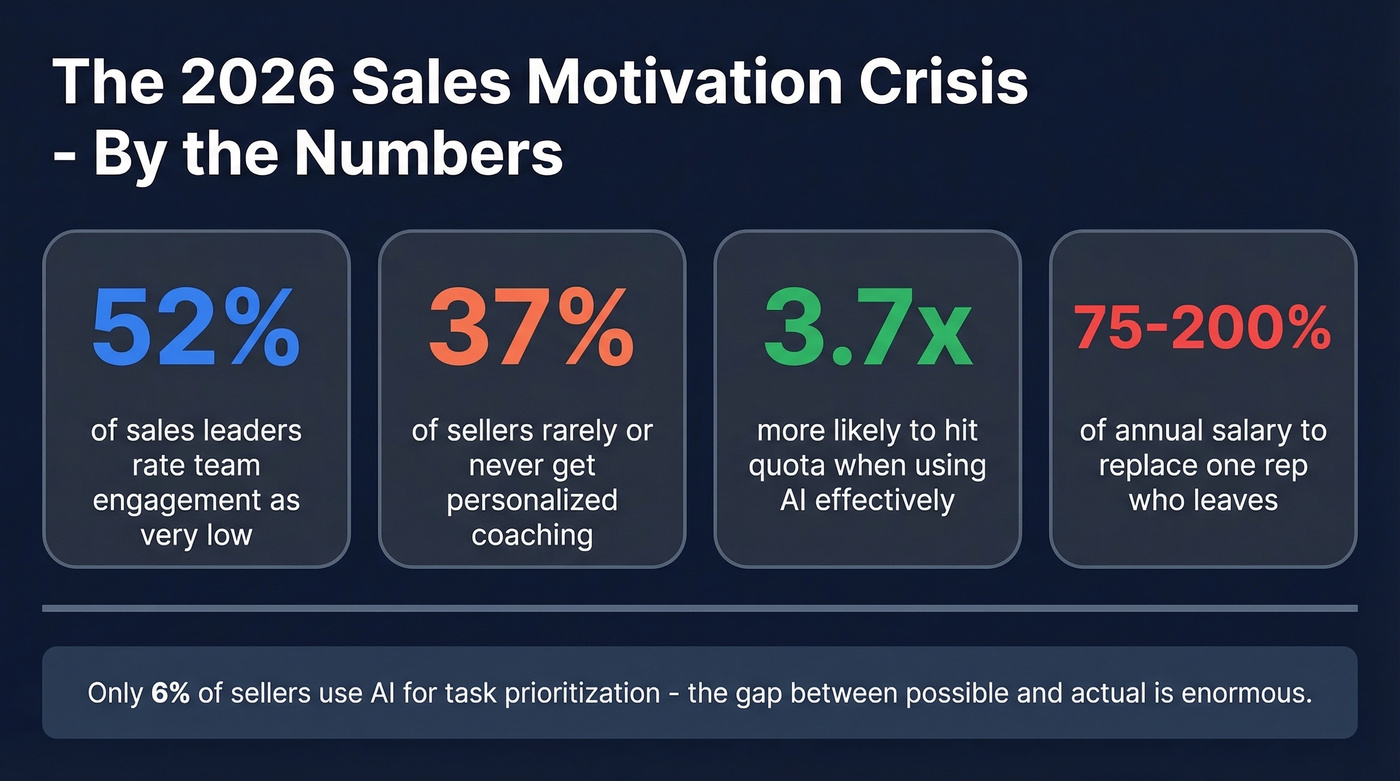
The coaching gap makes it worse. A Salesloft survey found 94% of managers say regular coaching is part of their process, but 37% of sellers report they rarely or never receive personalized feedback. That's not a perception gap. That's two different realities existing in the same org.
Here's the stat that should terrify every VP of Sales: sellers who use AI effectively are 3.7x more likely to hit quota, yet only 6% of sellers use AI for task prioritization. The gap between what's possible and what's happening is enormous.
And when reps do leave? Replacing a salesperson costs 75-200% of their annual salary. Fixing motivation is always cheaper than fixing turnover.
Why Most Motivation Advice Fails
We've read dozens of "sales motivation" articles while researching this piece. They all say the same thing: set goals, celebrate wins, stay positive. That advice is incomplete to the point of being useless because it treats symptoms while ignoring the underlying psychology.
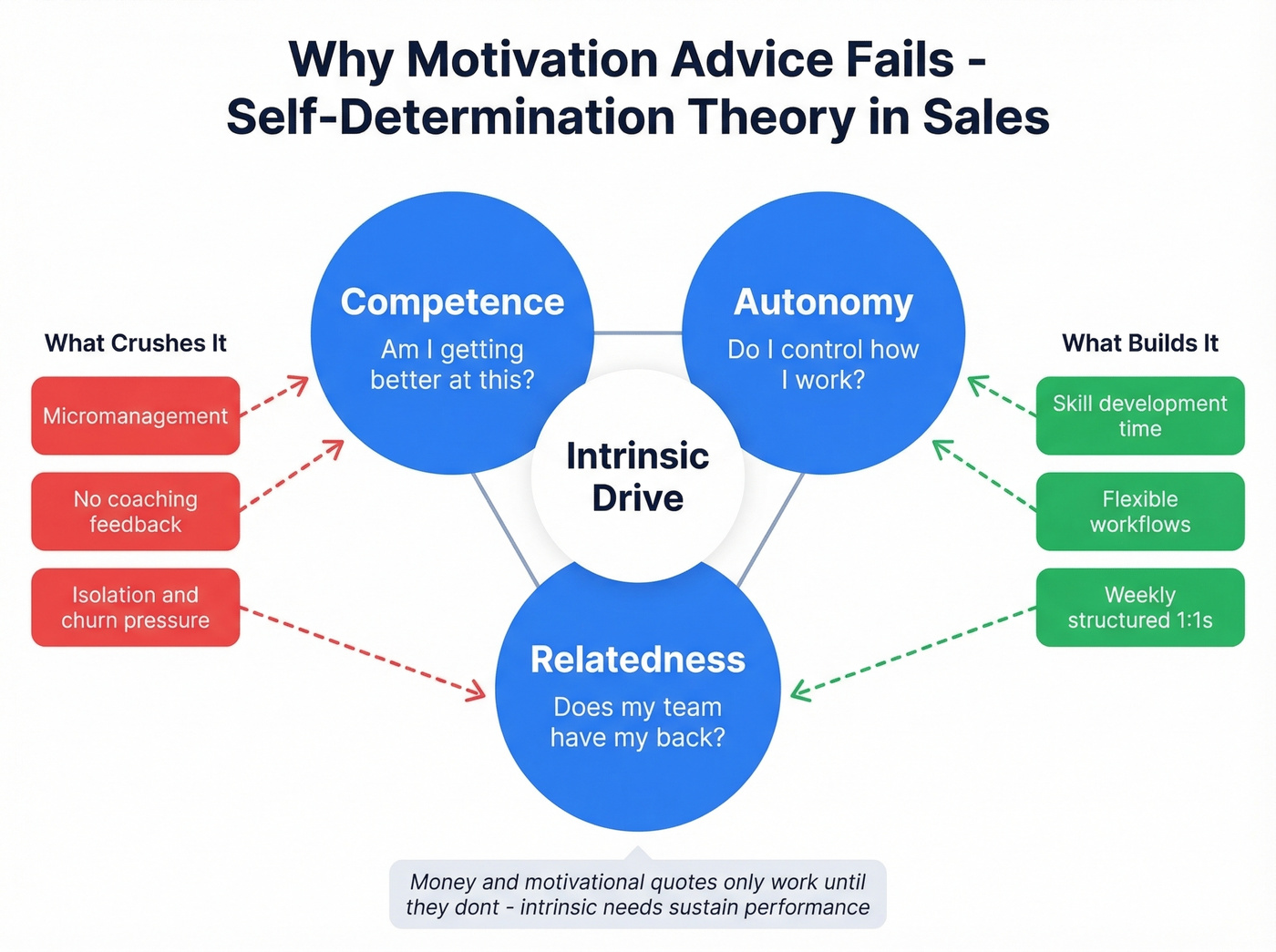
Self-determination theory has decades of meta-analytic research behind it. The core idea: humans need three things to stay motivated - competence, autonomy, and relatedness. When those needs are met, people perform better, burn out less, and stick around longer. When they're crushed by micromanagement, bad coaching, or isolation, no amount of motivational quotes will compensate.
Money stops working too. One rep on Reddit put it plainly: "I used to be really money hungry... But that's not enough... because I don't see where this will take me." Another top performer who'd been fueled by spite and ego found that motivation evaporated once they'd outperformed their peers and hit financial security. Extrinsic drivers have a ceiling. Once you hit it, you need something deeper or you stall.
What Actually Kills Sales Motivation
Before we talk about fixes, let's name the real killers. Most of these aren't about attitude.
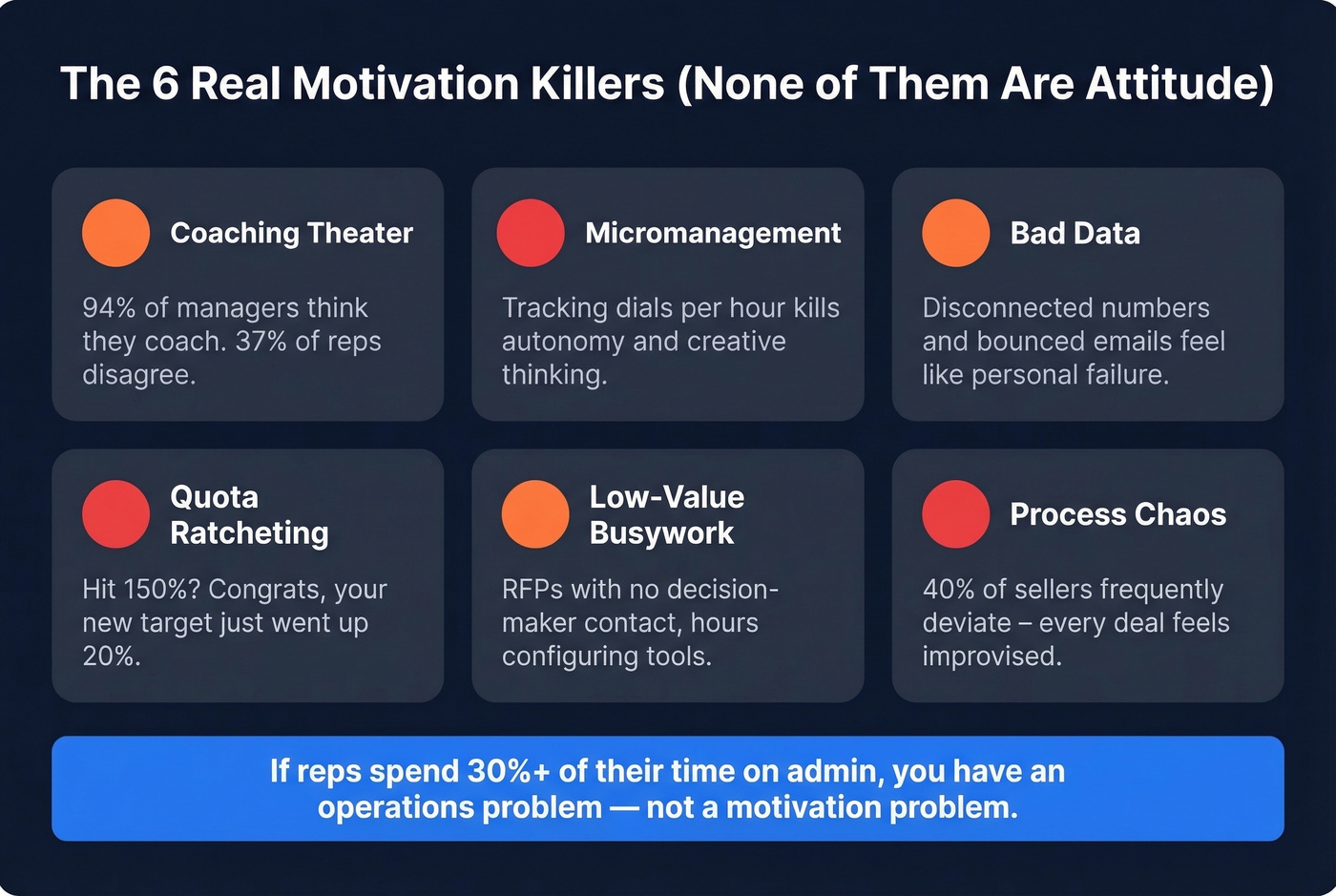
Coaching theater. 94% of managers think they're coaching. 37% of reps say they rarely get personalized feedback. Someone's wrong, and it's probably not the reps.
Micromanagement. Tracking dials per hour and penalizing bathroom breaks destroys the autonomy that drives intrinsic motivation. Reps stop thinking and start performing for the dashboard.
Bad data. Fifteen dials into your call block and every number is disconnected. Your email sequence bounced hard on the first send. That's not a motivation problem - it's a data problem that feels like one. (If you're diagnosing this, start with email bounce rate and email deliverability.)
Quota ratcheting and commission caps. Nothing kills drive faster than punishing success. Hit 150% this quarter? Congrats, your target just went up 20%.
Chasing low-value work. Responding to RFPs where you've never spoken to a decision-maker. Spending hours configuring sales tech instead of selling. Taking on bad-fit clients who churn in 90 days. These are motivation killers disguised as productivity. (If this is your reality, it’s usually a sales pipeline challenges issue, not a rep issue.)
Process chaos. 40% of sellers frequently deviate from the sales process. When there's no repeatable playbook, every deal feels like improvisation - and improvisation is exhausting over months. If you need a baseline, use a sales process optimization checklist.
Here's the thing: if your average deal size is under $15k and your reps are spending more than 30% of their time on admin, you don't have a motivation problem. You have an operations problem cosplaying as one.

Bad data is the silent motivation killer this article warns about. When 35% of your emails bounce, every rep feels like they're failing - but the system failed them first. Prospeo's 98% email accuracy and 7-day data refresh mean your team dials real numbers and lands in real inboxes.
Stop blaming effort when the problem is your data provider.
For Reps - Techniques That Actually Work
Build a Non-Negotiable Routine
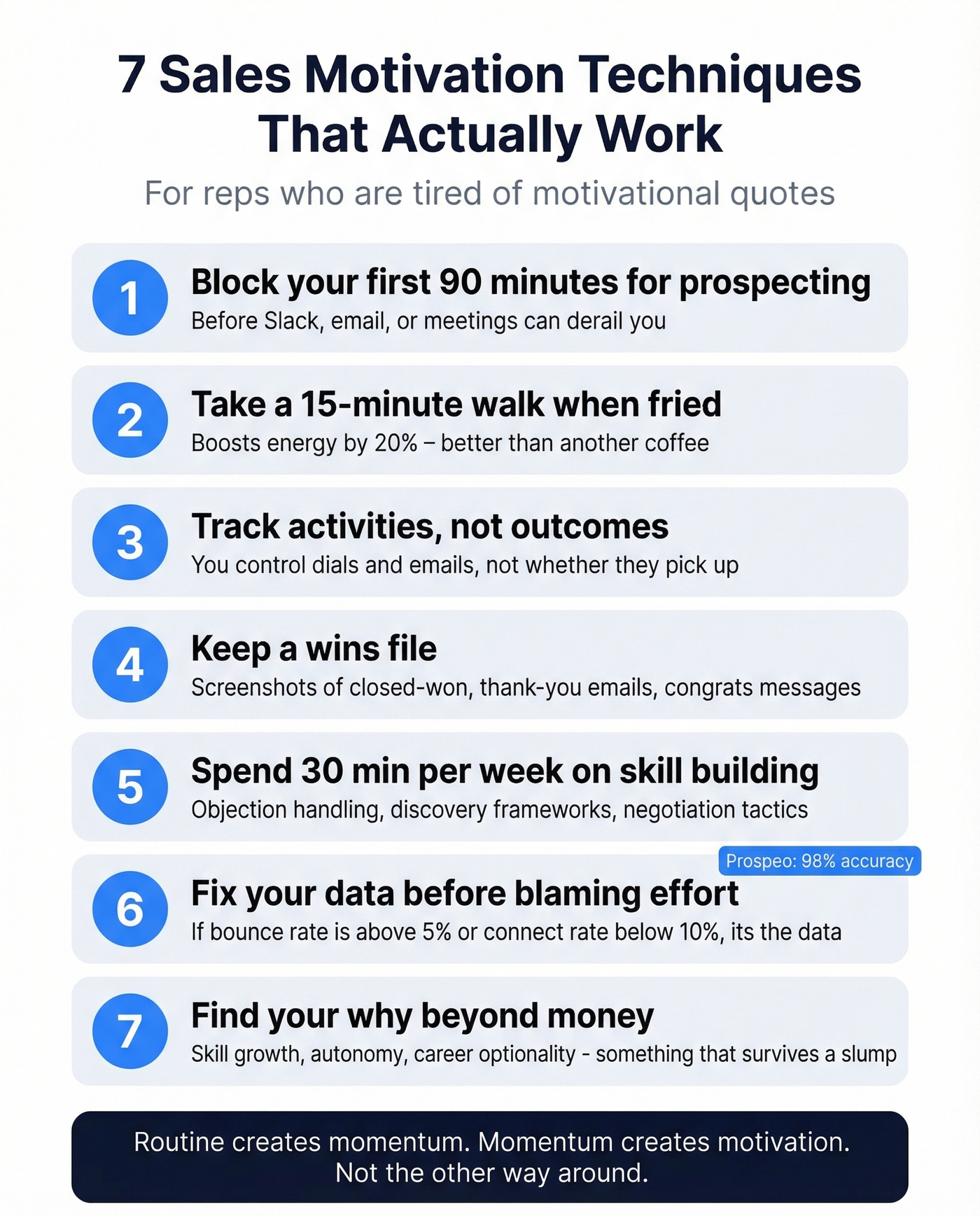
Don't wait for motivation to show up before you start working. Routine creates momentum, and momentum creates motivation - not the other way around. Block your first 90 minutes for prospecting before Slack, email, or meetings can derail you. Also worth knowing: Tuesday is statistically the worst day for making contact, and Thursday performs dramatically better for reaching leads. (If you want the data-backed timing playbook, see best time to send cold emails.)
The 15-Minute Reset
Picture this: it's 2pm on a Thursday. You're three hours into a call block. Your brain is fried, your voice is flat, and your last four calls went to voicemail. Here's what we've seen work better than another coffee - a 15-minute walk outside. A walk boosts energy levels by up to 20%. Sounds trivial. It isn't. Your nervous system needs the reset more than your pipeline needs one more zombie dial.
Focus on Activities, Not Outcomes
You can't control whether a prospect picks up. You can control how many dials you make, how many personalized emails you send, and how many follow-ups you execute. Track what you do, not what happens to you. This is one of the most reliable sales motivation techniques because it shifts your locus of control back to where it belongs - on your own effort. The outcomes follow. (Need a clean list of what to track? Use these sales activities examples.)
Use Your Last Win as an Anchor
When confidence is low, your brain forgets you've ever closed anything. Keep a "wins file" - screenshots of closed-won notifications, thank-you emails from customers, congratulations from your manager. Pull it up when imposter syndrome gets loud.
Build Competence Deliberately
Skill compounds. Hustle doesn't.
Spend 30 minutes a week studying objection handling, discovery frameworks, or negotiation tactics. Stop responding to low-value RFPs where you've never spoken to a decision-maker - that's busywork masquerading as pipeline activity. The reps who invest in competence don't just perform better; they feel more confident, which feeds motivation directly. (If you want a structured approach, start with discovery questions and a tighter steps to close a sale flow.)
Fix Your Data Before Blaming Effort
If your email bounce rate is above 5% or your connect rate is below 10%, the problem isn't your pitch - it's your data. Prospeo verifies emails with 98% accuracy and refreshes data every 7 days compared to the 6-week industry average, so every dial and every send has a real shot at connecting. The free tier gives you 75 verified emails a month, enough to test whether data quality is the bottleneck. (If you’re evaluating vendors, compare data enrichment services and best B2B company data.)
Find Your "Why" Beyond Money
Money gets you started. It won't keep you going through month six of a slump. Figure out what sales actually gives you - skill development, autonomy, the ability to build something, career optionality. I've watched reps survive brutal slumps because they'd anchored to something deeper than the commission check. The ones who hadn't? They quit. If you're trying to figure out how to stay motivated in sales long-term, anchoring to purpose is the single most durable strategy we know of.
You just read that reps spending 30%+ of their time on admin have an operations problem, not a motivation problem. Prospeo's Chrome extension (used by 40,000+ reps) finds verified emails and direct dials in one click - no list building, no manual research, no bounced sequences torching your domain.
Give your reps their selling time back for $0.01 per verified email.
For Managers - How to Motivate a Sales Team
Start Every Meeting with Wins
The first five minutes of any team meeting should be wins - deals closed, great discovery calls, creative objection handling, even a prospect who laughed at a cold email. This isn't cheerleading. It's priming your team's brain to associate the meeting with progress, not pressure.
Close the Coaching Gap
Here's a question every manager should ask themselves: when was the last time you gave a rep feedback on a specific call, not just a pipeline number?
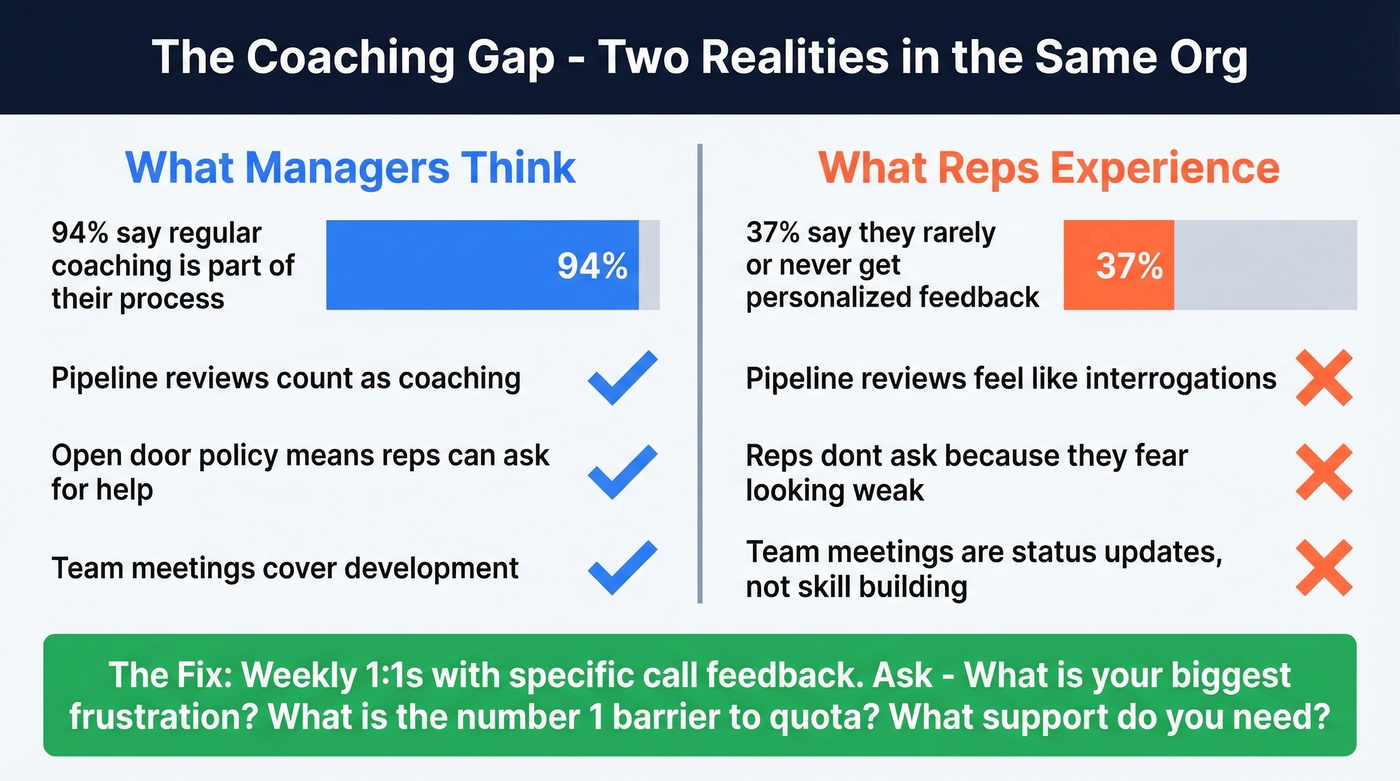
Weekly 1:1s need specific feedback. Not "how's your pipeline?" but "I listened to your call with the Acme VP - here's what worked and here's one thing to try differently." The Vouris framework nails the right questions: What's your biggest frustration? What's the #1 barrier to hitting quota? What support do you need that you're not getting? This directly feeds the competence and relatedness needs from self-determination theory. Reps who feel coached - not monitored - stay motivated longer. (If you’re rebuilding the cadence, use a 30-60-90 day plan for sales reps to make it stick.)
Gamify with Real Structure
Done right, gamification works. Microsoft's contact center program saw a 12% drop in absenteeism and 10% increase in calls per shift, with 78% of agents reporting they felt more empowered. IBM's digital badge pilot drove a 226% increase in course completions.
The key is concrete structure: award 10 points per quality discovery call, 50 for a competitive intel report, 100 for a closed-won deal. Make leaderboards visible and rewards meaningful. One counterintuitive approach we love: reward the rep who collects the most "no's" in a week. It normalizes rejection and encourages more outreach. Skip this if your contests always crown the same top rep - poorly designed competitions demotivate everyone else. (If rejection is the bottleneck, build a cold call rejection system.)
Recognize Effort, Not Just Outcomes
If you only celebrate closed deals, you're telling 80% of your team they don't matter most of the time. We've seen teams transform when managers switch from outcome-only recognition to effort-based recognition. Celebrate the rep who booked 15 meetings even if none closed yet. Celebrate the one who rebuilt their territory list after a bad quarter. Effort-based recognition feeds the competence and relatedness needs that sustain long-term drive.
Give Autonomy
If you're tracking dials per hour and penalizing reps who step away from their desks, you've already lost. Set clear outcomes, provide the tools and coaching, then get out of the way. Micromanaging activity metrics destroys the very autonomy that drives intrinsic motivation.
Fix Compensation Design
Remove commission caps. Simplify plans so reps can calculate their own earnings without a spreadsheet. If your comp plan requires a 30-minute explanation, it's too complicated to motivate anyone. The best plans are simple, uncapped, and reward overperformance disproportionately.
Use AI to Kill Busywork
Only 6% of sellers use AI for task prioritization - which means 94% of teams have a free productivity lever they haven't pulled. Help your team automate CRM updates, email drafts, and lead scoring. Every hour saved on admin is an hour back for selling, and selling is what keeps reps engaged. (If you want practical workflows, start with AI sales follow-up.)
The Emergency Slump Playbook
When the whole team is down, don't start with a pep talk. Start by listening.
A sales leader at Vouris shared a story that captures this perfectly. Their SDR team broke the "most meetings booked in a day" record twice in four days. They finished the month just one meeting short of their target. Instead of dwelling on the miss, the team carried that momentum into what became their biggest month ever.
The pattern: listen first, rally second. Ask what's broken. Fix the fixable things fast - bad data, unclear targets, process friction. Then set micro-KPIs for the next 48 hours, not the next quarter. "Book three meetings by Thursday" beats "hit 120% this quarter" when confidence is fragile. Small wins rebuild the belief that effort leads to results.
That rep from the opening - the one who felt their identity slipping away? The fix isn't a motivational poster. It's a manager who listens, a system that works, and data that doesn't waste their time. Replace the broken coaching cadence, clean the contact list, simplify the comp plan - then watch what happens when reps can finally focus on selling. That's the difference between sales motivation tips that sound good and ones that actually change behavior.
FAQ
What are the most effective sales motivation tips?
Fix systems first: close the coaching gap, eliminate bad data, and remove commission caps. Reps stay motivated when the environment stops working against them - self-determination theory confirms that competence, autonomy, and relatedness drive sustained performance.
How do you motivate a sales team that keeps missing quota?
Audit systems before attitudes. Check whether coaching is actually happening, whether data quality is tanking connect rates, and whether comp plans punish overperformance. Teams that cut bounce rates below 4% with verified data often recover 10-15% of lost pipeline activity just from cleaner outreach.
What's the difference between intrinsic and extrinsic motivation in sales?
Extrinsic comes from commissions, bonuses, and contests. Intrinsic comes from competence, autonomy, and purpose. Extrinsic gets reps started; intrinsic keeps them performing through six-month slumps when commission checks shrink.
Do sales contests actually work?
Structured contests do - Microsoft saw 12% less absenteeism and 10% more calls per shift. Design for broad participation with activity-based scoring, not just top-performer dominance. Reward "most no's collected" to normalize rejection.
How do you stay motivated in sales during a slump?
Shrink your focus to controllable activities and set one micro-goal for tomorrow. Review your wins file. Check your data - if half your dials hit disconnected numbers, the slump is a data problem, not a willpower problem.