

Sales Objections: Data-Backed Guide for 2026
It's the third call of the morning and you've already heard "We're happy with our current vendor" twice. The SDR next to you just got hit with "Send me some info" - the polite version of "go away." You've read the blog posts. You know you're supposed to "listen, empathize, respond." But here's the question nobody answers about sales objections: what do top reps actually do differently when the pushback lands?
Only 43.5% of reps are hitting quota right now. Win rates have dropped 18% compared to 2022. The average B2B deal involves 7.4 decision-makers, and reps spend roughly 30% of their time actually selling - the rest vanishes into admin, CRM updates, and chasing bad numbers.
Buyers have changed too. Nearly 70% of the buyer's journey happens before they talk to a rep, and 61% of B2B buyers say they'd prefer no rep involvement at all. Yet 50-60% still prefer phone contact during the sales process. Call-based objection handling skills matter more now, not less. Sellers who handle objections well close at rates up to 64%. Let's talk about what separates them from everyone else.
Three Changes That Matter Most
If you change three things and nothing else, you'll handle pushback better than most of your peers.
Stop monologuing. Analysis of 67,149 sales calls found that average reps launch into a 21.45-second speech after hearing an objection. Top reps pause, then ask one clarifying question. That's it.
Fix your data. A lot of the "objections" reps face aren't objections at all - they're brush-offs from the wrong person at a disconnected number. Clean contact data eliminates upstream friction before scripts ever matter. If you're auditing your list quality, start with data enrichment and a clear lead enrichment workflow.
Pick one framework and drill it. LAARC is the simplest. Practice it on every call for two weeks and it becomes muscle memory. You don't need four frameworks. You need one you can execute under pressure.
80% of sales require 5+ follow-ups, but 92% of reps quit after 4 attempts. Persistence matters - but only if you're persisting with the right person about the right concern. (If you need copy you can deploy fast, keep sales follow-up templates handy.)
What's an Objection (and What Isn't)?
An objection and a brush-off are fundamentally different animals.
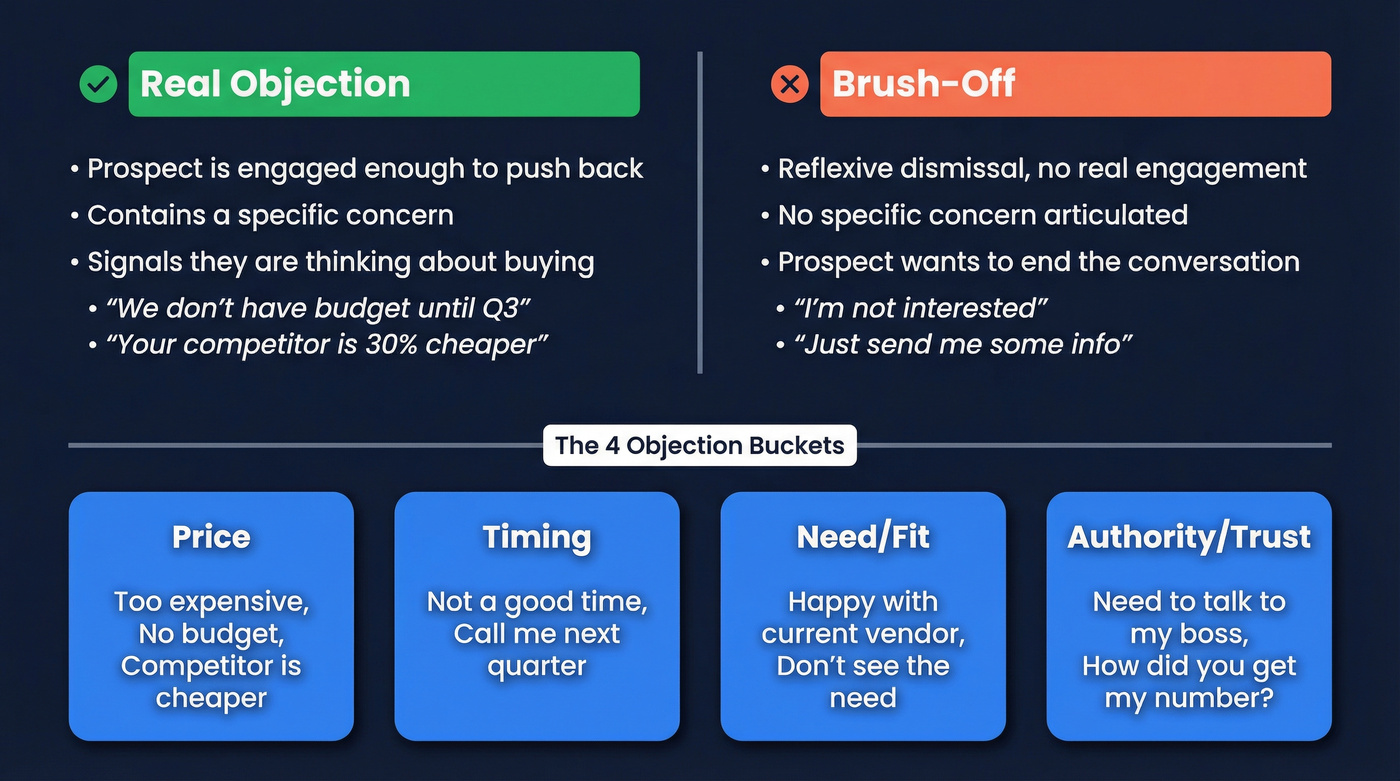
An objection is a specific concern - price, timing, fit, authority - that the prospect articulates because they're engaged enough to push back. "We don't have budget until Q3" is an objection. "Your competitor is 30% cheaper" is an objection. These are good. They mean the prospect is thinking about buying.
A brush-off is a reflexive dismissal. "I'm not interested" on a cold call, "just send me some info," or the classic hang-up. The prospect hasn't engaged enough to form a real concern. Treating a brush-off like an objection - pulling out your SPIN questions and probing for pain - wastes everyone's time.
The concerns fall into four buckets. Price - "too expensive," "no budget," "competitor is cheaper." Timing - "not a good time," "call me next quarter." Need/fit - "we're happy with what we have," "I don't see the need." Authority/trust - "I need to talk to my boss," "how did you get my number?" Knowing which bucket you're in determines which response works.
What 67,149 Calls Reveal
Gong Labs analyzed 67,149 recorded demos to isolate what top performers do differently when objections hit. The findings contradict most sales training.
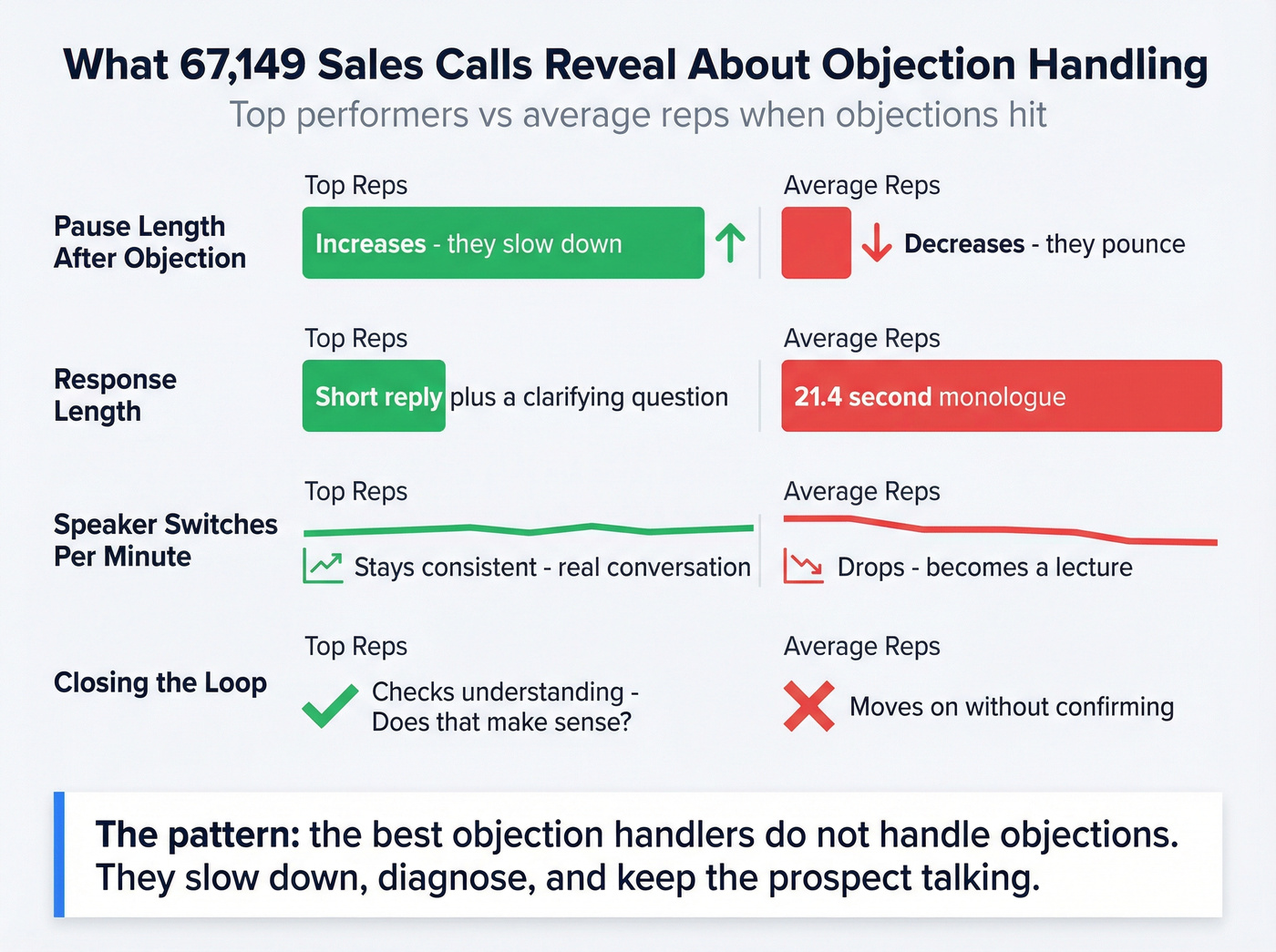
Top reps pause longer. There's a metric called "Patience Score" - the length of pause after a prospect raises a concern. Top reps' pause length increases during objections. Average reps' pause length drops. They pounce. They interrupt. They can't help themselves.
Fewer words win. The average rep responds with a ~21.45-second monologue. Top reps keep it short and ask a clarifying question instead of launching into a defense. That instinct to "handle" the concern with a prepared speech is exactly what kills deals.
The back-and-forth stays steady. "Speaker switches per minute" measures how often the conversation bounces between rep and prospect. During objections, average reps' switch rate drops - the conversation becomes a lecture. Top reps maintain the same conversational pace they had before the pushback.
"Does that make sense?" works. Top reps close the objection loop by checking understanding. It's not a magic phrase. It's a signal that you're treating the concern as a conversation, not a battle.
The pattern is clear: the best objection handlers don't handle objections. They slow down, diagnose, and keep the prospect talking.
Preventing Objections Before They Start
The most underrated objection handling technique isn't handling anything at all. It's prevention.
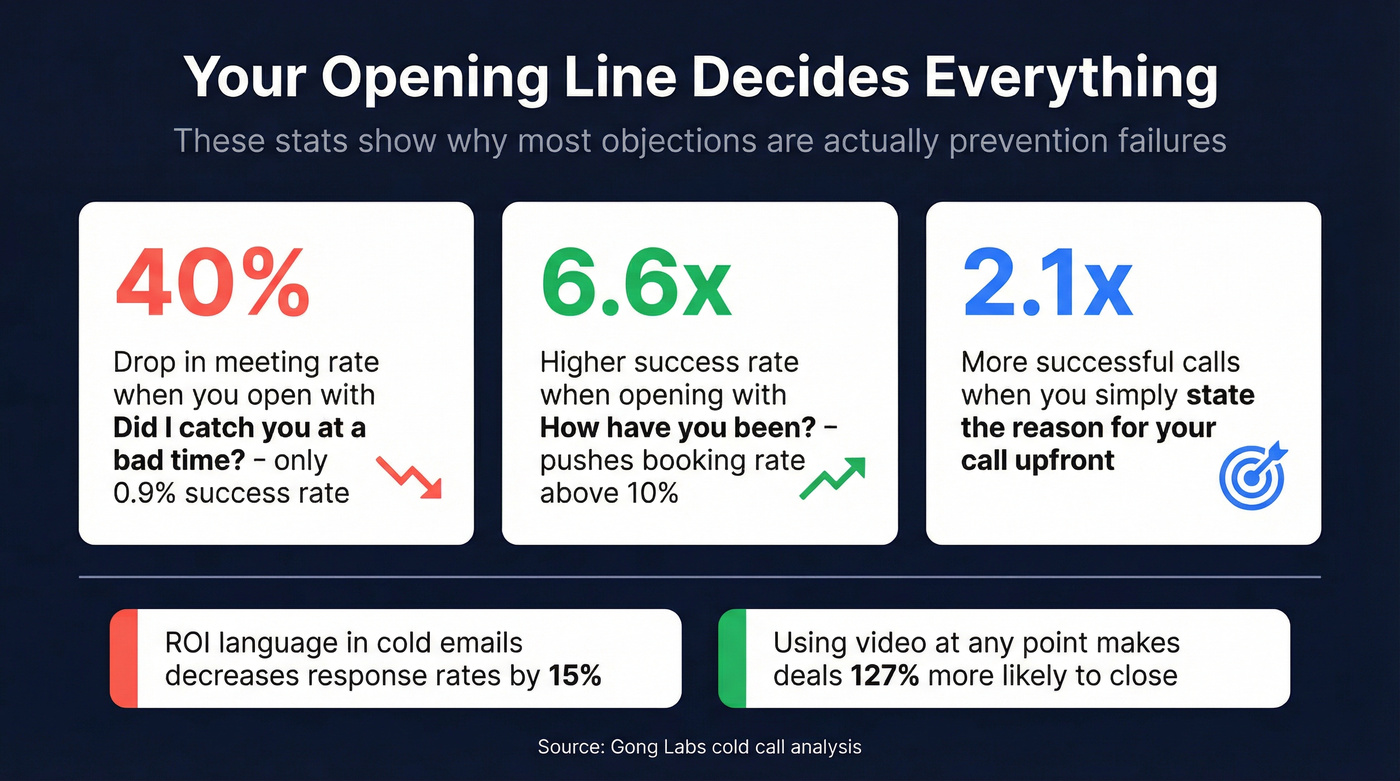
Cold-call data tells a striking story. Opening with "Did I catch you at a bad time?" drops your meeting-booking rate by 40% - calls using that opener succeeded just 0.9% of the time. Opening with "How have you been?" produced a 6.6x higher success rate, pushing meeting-booking above 10%. Simply stating the reason for your call increases success by 2.1x. And using ROI language in cold emails decreases response rates by 15%.
These aren't objection-handling techniques. They're objection-prevention techniques. The words you choose in the first 10 seconds determine whether you get a real conversation or a brush-off. Deals are also 127% more likely to close when video is used at any point in the process, so sending a 90-second Loom instead of a PDF when someone says "send me some info" is a legitimate prevention move (here’s a deeper Loom video cold email playbook).
But there's an upstream problem that gets ignored entirely: you can nail your opener and still lose if you're calling the wrong person. We've watched teams burn 45 minutes dialing through a list only to hit 8 disconnected numbers, reach 3 people who left the company months ago, and connect with someone who has zero buying authority. Every one of those calls generates a "brush-off" that looks like an objection in the CRM. It's not an objection. It's a data problem.
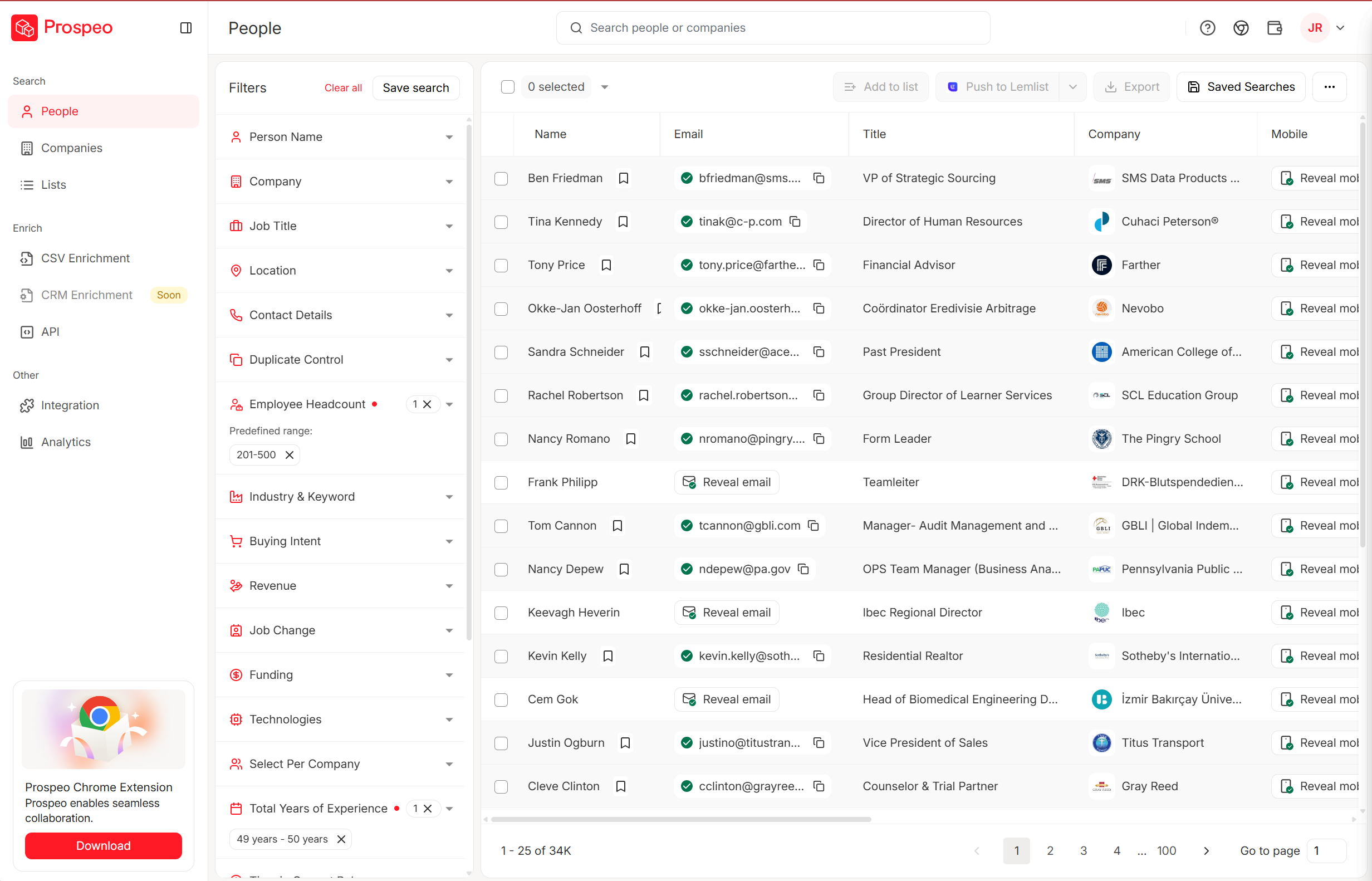
When Meritt switched to Prospeo for their contact data, their bounce rate dropped from 35% to under 4% and their connect rate tripled to 20-25%. That's the difference between reps spending their day on real conversations with decision-makers versus chasing dead leads and logging fake "objections." (If you’re rebuilding your outbound motion, pair this with proven sales prospecting techniques.)

Most objections never need to happen. When your list is full of disconnected numbers and people who left the company, every dial generates a fake objection. Prospeo's 7-day data refresh and 98% email accuracy mean your reps spend time on real conversations with real decision-makers - not logging brush-offs from wrong contacts.
Stop handling objections that shouldn't exist. Start with clean data.
The 12 Most Common Sales Objections
Each objection below gets a diagnostic question, a response, and a note on what kills the deal. Bookmark this section.
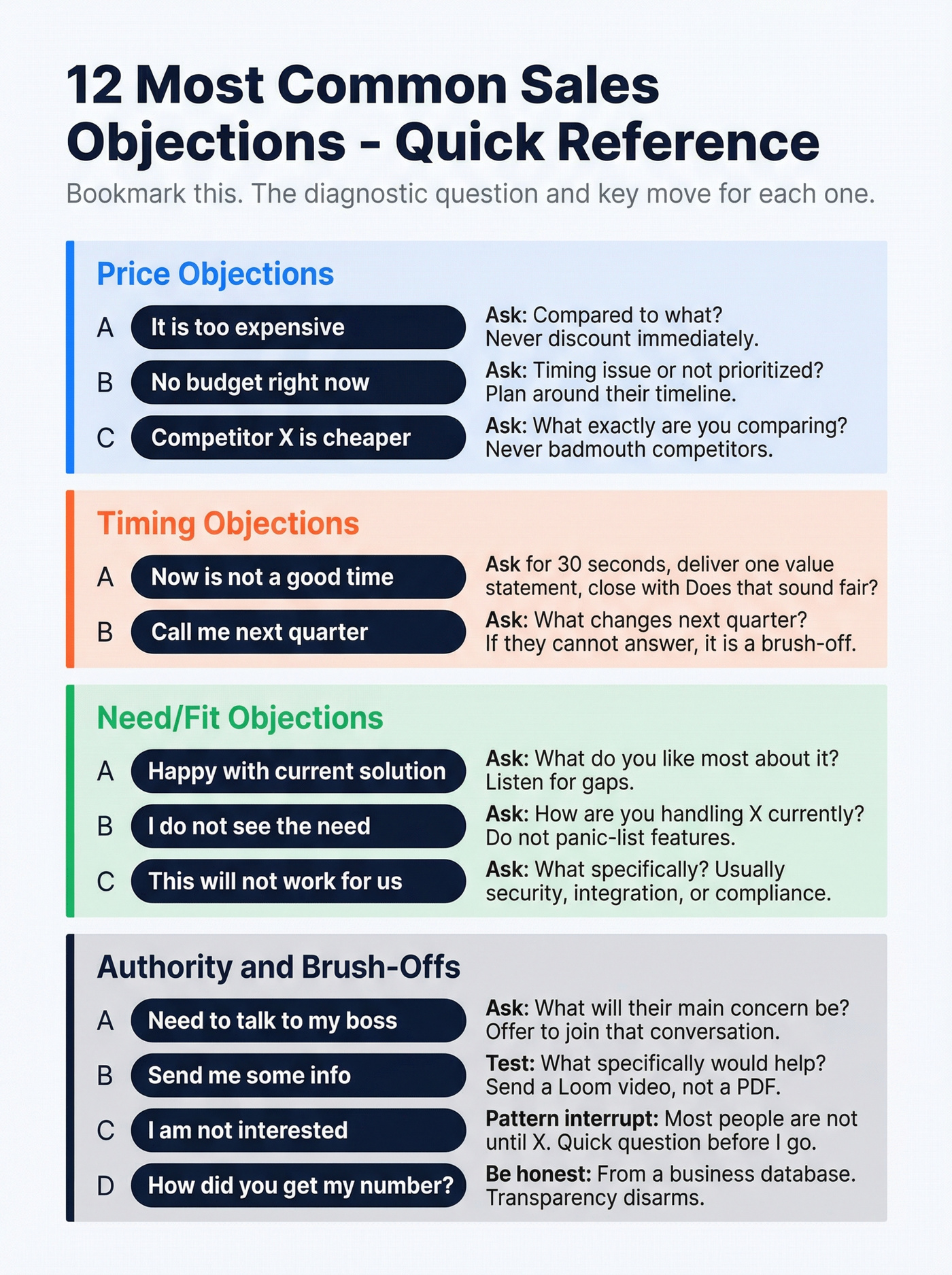
Price Objections
"It's too expensive."
This is the most common objection across virtually every industry and deal size. Diagnostic: "Compared to what?" Response: "Most of our customers felt the same way initially. When they mapped out the cost of [specific problem you solve], the math shifted. Can I walk you through that?" Never immediately offer a discount - that confirms the price was inflated. (If you want a structured way to use pricing psychology, study anchor in negotiation.)
"We don't have budget right now."
Diagnostic: "Is this a timing issue, or is this project not prioritized this year?" Response: "If budget opened up next quarter, would this be something you'd move on? I'd rather plan around your timeline than push something that doesn't fit." Never argue that they should "find" budget. You'll lose every time.
"Competitor X is cheaper."
Don't badmouth the competitor. HubSpot's research confirms derogatory competitor talk kills deals. Instead, ask: "What specifically are you comparing? I want to make sure we're looking at the same scope." Then: "The question is whether the gap in [specific capability] matters for your use case."
Timing Objections
"Now's not a good time."
You haven't earned enough interest to justify their attention. Morgan J. Ingram's approach: ask for 30 seconds, deliver one specific value statement, close with "Does that sound fair?" If yes, you've earned the conversation. If no, you've qualified out fast.
"Call me next quarter."
Diagnostic: "What's changing next quarter that would make this a better fit?" If they can't answer, it's a brush-off. If they can, you've just learned their buying timeline. Either way, you win.
Need/Fit Objections
"We're happy with our current solution."
Diagnostic: "What do you like most about it?" Then listen for gaps. Response: "Most of our customers were happy with their previous solution too. The switch usually happens when [specific trigger event] makes the gap visible. Has anything like that come up?"
"I don't see the need."
Diagnostic: "How are you currently handling [specific problem]?" Response: "The teams that get the most value from us are dealing with [specific symptom]. If that's not on your radar, this might not be the right fit." Resist the urge to panic and list every feature.
"This won't work for us."
This is one of the best objections to get - it's specific and addressable. Ask: "What specifically wouldn't work?" In SaaS, this usually means a security or integration concern. In financial services, it's often compliance. Once you know the blocker, you can either solve it or disqualify honestly.
Authority Objections
"I need to talk to my boss."
Diagnostic: "What do you think their main concern will be?" Then offer to join that conversation or provide materials that address the boss's likely objections. The fatal mistake is letting them walk away without understanding what the boss cares about. (If you’re selling into complex orgs, it helps to map the MEDDPICC economic buyer early.)
"Send me some info."
90% of the time, this is a polite exit. Test it: "Happy to - what specifically would be most useful?" If they can't answer, it's a brush-off. If they say something specific like "pricing for a 20-person team," you've got a real next step. Send a 60-second Loom video instead of a PDF - it's harder to ignore and easier to forward.
Cold-Call Brush-Offs
"I'm not interested" / "How did you get my number?"
These aren't objections. They're reflexes. For "I'm not interested," pattern-interrupt: "Totally fair - most people aren't until [specific trigger]. Quick question before I go: are you currently [specific pain point]?" You're not overcoming anything. You're earning 10 more seconds. (For more scripts like this, see cold call rejection.)
For "How did you get my number?" - respond honestly: "From a business database. I'm reaching out because [one-sentence reason]. If this isn't relevant, I'll take you off my list." Transparency disarms. Defensiveness escalates.
Same Objection, Four Methodologies
Take one objection - "We're happy with our current solution" - and run it through four established methodologies.
| Methodology | Approach to "We're Happy" | Core Move | Best For |
|---|---|---|---|
| MEDDIC | Identify gaps in champion/economic buyer alignment | Surface unmet metrics | Complex enterprise deals |
| Challenger (Dixon & Adamson) | Reframe status quo as risky | Teach something uncomfortable | Commoditized markets |
| Sandler (David Sandler) | Enforce mutual commitment | "If I show X, will you commit to Y?" | Transactional/mid-market |
| SPIN (Neil Rackham) | Implication questions | Surface hidden costs of staying put | Consultative/technical sales |
MEDDIC treats this objection as a discovery gap. If the prospect says they're happy, you haven't identified the right champion or quantified the right metrics. Ask: "Who else evaluates tools like this?" and "How are you measuring success with your current solution?" You're looking for gaps between what they measure and what they should measure. (If you want a tighter question set, use MEDDIC discovery questions.)
Challenger reframes the status quo. Instead of accepting "we're happy," a Challenger rep teaches the prospect something uncomfortable - revenue leakage they haven't quantified, scalability risks they haven't considered, or competitive gaps they can't see from inside. The goal is to make "happy" feel like "complacent." Dixon and Adamson's research showed this approach outperforms relationship-building in complex B2B sales.
Sandler goes straight to mutual commitment. "I appreciate that. If I could show you [specific outcome] in 15 minutes, would it be worth exploring? And if not, I'll respect that and move on." Direct, respectful, forces a real answer.
SPIN uses Rackham's implication questions to make the prospect articulate the cost of inaction themselves. "What happens when your current solution can't handle [growth scenario]?" "How much time does your team spend on [manual workaround]?" The prospect sells themselves on the problem.
Here's the thing: most reps don't need all four. If your average deal size is under $30k, pick Sandler or LAARC and get ruthlessly good at it. The teams we've seen improve fastest are the ones that pick one methodology and drill it relentlessly - not the ones who dabble in all four.
Pick Your Framework
For the mechanics of responding to pushback, here are the frameworks worth knowing.
| Framework | Steps | Best For |
|---|---|---|
| LAARC | Listen, Acknowledge, Assess, Respond, Confirm | General-purpose B2B; simplest to learn |
| Feel-Felt-Found | "I understand how you feel / others felt the same / here's what they found" | Relationship-driven, mid-market sales |
| ARC | Acknowledge, Respond, Close | Fast-cycle deals; transactional sales |
| BANT | Budget, Authority, Need, Timeline | High-velocity inbound triage |
For most B2B teams, LAARC is the best starting point. It forces you to assess before you respond - the exact behavior that separates top reps from average ones in the call data. Feel-Felt-Found works in relationship-heavy sales but sounds formulaic if overused. ARC is fast and clean for shorter sales cycles. BANT isn't an objection framework per se, but it's the fastest way to determine whether a prospect's pushback is a real concern or a qualification gap.
Skip the framework debates on Reddit. The consensus on r/sales is pretty consistent: the best framework is the one your team will actually use on every call. Pick one, drill it for two weeks, then evaluate.
Your Objection-Handling Tech Stack
Frameworks and scripts are the software. Here's the hardware.
Conversation Intelligence: Gong is the gold standard for analyzing talk ratios, objection patterns, and monologue length across your team's calls. Expect enterprise pricing, often $1,200-$2,500+ per user/year depending on seats and modules. Clari Copilot offers similar capabilities at enterprise-tier pricing. These tools turn anecdotal coaching into data-driven coaching.
AI Coaching: ChatGPT ($20/mo for Plus) is genuinely useful for rehearsing objection scenarios. Feed it your product context, tell it to play a skeptical VP of Engineering, and practice. It's not perfect, but it's available at 11 PM the night before a big demo. Some conversation intelligence platforms now offer real-time coaching prompts during calls - worth testing if your team runs high call volume.
Data Verification: Prospeo gives you 98% verified emails and 125M+ direct dials with a 7-day refresh cycle versus the 6-week industry average. Your reps reach real decision-makers instead of dialing dead numbers. Free tier available at 75 emails/month. (If you’re comparing options, start with best sales prospecting databases.)
Sequencing & CRM: HubSpot CRM (free tier) or Salesforce ($25-$100+/user/month depending on edition) for tracking objection patterns across deals. Smartlead or Instantly ($30-$100+/month depending on plan and seats) for automated follow-up sequences - because if 80% of sales require 5+ follow-ups, you need a system that doesn't rely on reps remembering. (If you’re standardizing process, see sequence management.)
In our experience, the teams that close the most deals aren't the ones with the best scripts. They're the ones reaching the right person, asking the right question, and knowing when to shut up.
Meritt cut their bounce rate from 35% to under 4% and tripled their connect rate to 20-25% with Prospeo. When reps actually reach decision-makers on the first dial, they face real objections they can handle - not reflexive hang-ups from bad numbers. 125M+ verified mobiles with a 30% pickup rate changes the math entirely.
Triple your connect rate and face objections worth handling.
FAQ
What's the difference between an objection and a brush-off?
An objection is a specific concern - price, timing, fit - that can be addressed with information or reframing. A brush-off is a reflexive dismissal before the prospect has engaged enough to form a real concern. Brush-offs need pattern interrupts or honest disqualification, not scripted rebuttals.
How many follow-ups should I send after an objection?
Research shows 80% of sales require 5+ follow-ups, but 92% of reps quit after 4. After a genuine objection, follow up 2-3 times with new information that directly addresses the specific concern raised. "Just checking in" emails don't count.
What's the best framework for handling price objections?
LAARC works well because it forces you to diagnose whether the concern is about budget, perceived value, or timing before you respond. Feel-Felt-Found is a solid alternative for relationship-driven sales where social proof carries weight. Having a practiced response ready beats improvising every time.
Can AI help with objection handling?
Yes. Conversation intelligence tools like Gong analyze talk ratios, objection frequency, and monologue length across your team's calls to pinpoint coaching gaps. ChatGPT is useful for rehearsing scenarios before calls at $20/month. Some platforms now offer real-time prompts during live conversations.
How does bad contact data create fake objections?
Calling wrong numbers, reaching people who left the company, or pitching someone without buying authority all generate brush-offs that look like objections in your CRM. Clean, frequently refreshed data means reps spend time on real conversations - Meritt saw their connect rate triple to 20-25% after fixing this problem.