

Sales Pipeline: The Practitioner's Operating Manual for 2026
It's Monday morning. Your CRM says $4.2 million in pipeline. Your gut says half of it is stale - wrong contacts, ghosted demos, deals that should've been marked lost six weeks ago. You're not wrong. One enterprise sales leader managing 150 reps on Reddit put it bluntly: their sales pipeline was realistically inflated by about 60%, and leadership had stopped trusting the numbers entirely.
That gap between what your CRM reports and what's actually closeable is where forecasts die and quotas get set wrong. Organizations that track and optimize pipeline KPIs shorten sales cycles by 28% and increase win rates by 23% within 12 months. What follows is the stages, the conversion benchmarks nobody else publishes, the velocity formula with actual math, and a review cadence you can implement this week.
What Is a Sales Pipeline?
A sales pipeline is a structured, visual representation of where every active deal sits in your sales process. Each deal occupies a stage, and each stage has a clear next action that moves it forward - or kills it. Deals flow downstream. Any upstream blockage (bad prospecting, weak qualification) creates problems at every stage below.
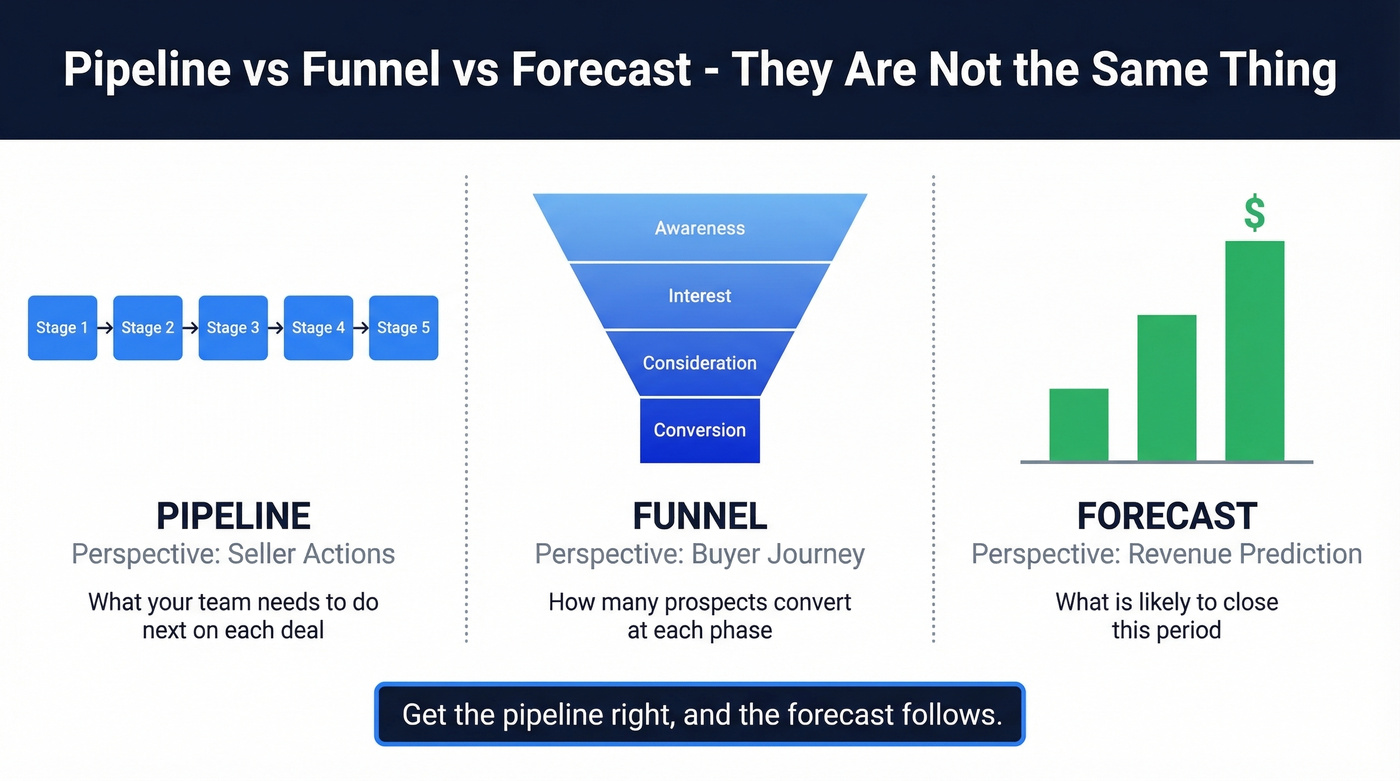
People confuse pipelines with funnels and forecasts constantly. They're related but distinct.
| Concept | Perspective | What It Measures |
|---|---|---|
| Pipeline | Seller actions | Where each deal is now |
| Funnel | Buyer journey | How many convert at each phase |
| Forecast | Revenue prediction | What's likely to close this period |
The pipeline is your seller-action view - what your team needs to do next on each deal. The funnel is the buyer-mindset view, showing how prospects narrow from awareness to purchase. The forecast is the financial output of both. Get the pipeline right, and the forecast follows.
Why Pipeline Matters More in 2026
The B2B buying environment has gotten structurally harder. The average deal now involves 13 decision-makers, and 80% of buyer interactions happen digitally. More than half of large B2B purchases flow through digital self-serve channels, which means your pipeline has to account for buyers who are researching, comparing, and building consensus without ever talking to your rep.
Here's the thing: [77% of sellers](https://www.gartner.com/en/newsroom/press-releases/2023-11-02-gartner-survey-finds-77-percent-of-sellers-struggle-to-complete-their-assigned-tasks-efficiently) struggle to complete their assigned tasks efficiently. That tracks with what we see in the field - reps drowning in 40+ active deals, toggling between HubSpot and Gong, feeling reactive instead of strategic. Sales pros using AI tools save about 2 hours and 15 minutes per day on manual tasks, and 89% of revenue organizations now use AI in some capacity. But AI can't fix a pipeline built on bad data and undefined stages. That's still on you.
The 7 Pipeline Stages
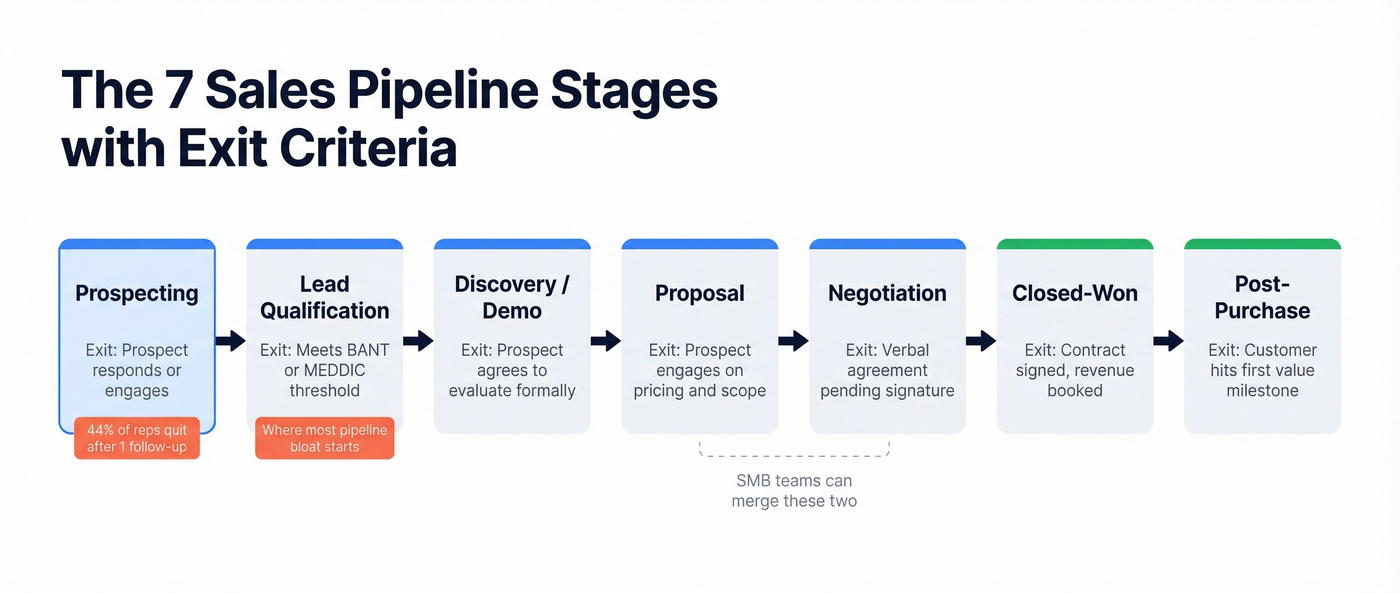
Most guides list seven stages. Most teams should actually use five or six - every stage you add creates friction and ambiguity for reps. Here's the full framework with exit criteria. Trim what doesn't fit your motion.
Prospecting
Finding and reaching out to potential buyers. Exit criteria: the prospect responds or engages - opens email, accepts meeting, replies. This is where 44% of reps already give up after a single follow-up, which means the majority of your team is abandoning deals before they even form. Source verified contacts before they enter your CRM, or you're building on sand. If you need a tighter system, use these sales prospecting techniques to keep top-of-funnel consistent.
Lead Qualification
Determining if the prospect fits your ICP and has budget, authority, need, and timeline. Exit criteria: prospect meets minimum qualification threshold using BANT or MEDDIC.
This is where most pipeline bloat starts. Reps skip qualification because an empty pipeline feels worse than a bloated one. It shouldn't. A lead list full of unqualified deals is worse than a small set of real ones. If your team’s “fit” definition is fuzzy, start with an Ideal Customer Profile you can actually score against.
Discovery / Demo
Understanding the prospect's pain, showing your solution, and confirming fit. Exit criteria: prospect confirms the problem is worth solving and agrees to evaluate your solution formally. One Reddit thread captured the common failure mode perfectly - an AE managing 40 deals who spent all their time context-switching between discovery calls instead of advancing the 10 deals that actually mattered. A structured discovery questions bank helps keep calls consistent across reps.
Proposal and Negotiation
These two stages are where deals stall or accelerate. In the proposal stage, you're presenting pricing, scope, and terms - exit criteria being that the prospect engages on specifics, asks questions, requests changes, or involves procurement. Negotiation picks up from there: working through pricing, legal, and contract terms until you reach verbal agreement pending signature. Many SMB sales motions can collapse these into a single stage without losing visibility. If negotiation is where deals die, revisit your anchor in negotiation strategy.
Closed-Won
Deal signed, revenue booked. Contract executed, handoff to onboarding or customer success. No ambiguity here.
Post-Purchase
Onboarding, expansion, and renewal. This stage matters because it feeds your next round of opportunities - upsells, cross-sells, and referrals. Exit criteria: customer reaches first value milestone. If you're not tracking post-purchase as a pipeline stage, you're leaving expansion revenue on the table. (For SaaS teams, this ties directly to renewal rate and expansion motion.)
B2B vs. B2C: B2B pipelines typically run 6+ stages over 6-18 month cycles with multiple stakeholders. B2C pipelines compress to 3-4 stages over days or weeks. If you're selling to consumers, cut stages aggressively.
Stage-by-Stage Conversion Benchmarks
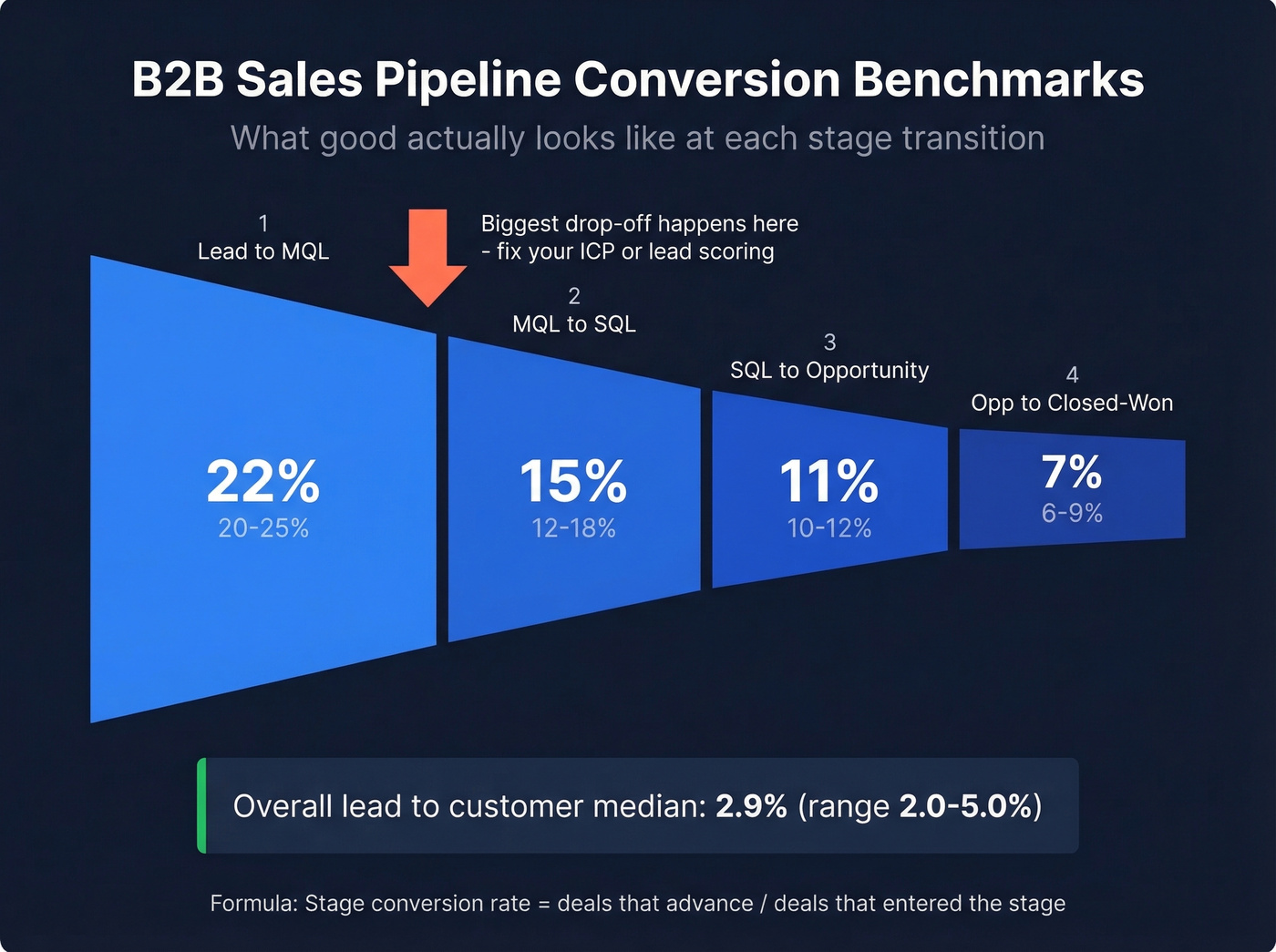
Every guide tells you to "track conversion rates." None of them tell you what good actually looks like. Here's what we've found, based on MarketJoy's aggregated B2B data:
| Stage Transition | Benchmark Range | Median |
|---|---|---|
| Lead to MQL | 20-25% | 22% |
| MQL to SQL | 12-18% | 15% |
| SQL to Opportunity | 10-12% | 11% |
| Opportunity to Closed-Won | 6-9% | 7% |
Higher-velocity SMB and PLG motions skew toward the top of each range, while enterprise cycles with 6-18 month timelines compress these numbers further.
The formula for each stage is straightforward: Stage conversion rate = deals that advance / deals that entered the stage. If 50 deals enter Discovery and 20 reach Proposal, that's 40%. Track this monthly per stage and you'll spot bottlenecks before they crater your quarter. (If you want more reference points, see these sales pipeline benchmarks.)
The biggest drop-off happens at MQL to SQL. That's where marketing-qualified leads hit the reality of sales qualification - and most don't survive. If your MQL to SQL rate is below 10%, the problem is almost certainly upstream: either your ICP definition is too broad or your lead scoring model rewards the wrong signals.
The median overall B2B conversion rate from lead to customer is 2.9%, with a typical range of 2.0-5.0%.

You just read that 44% of reps abandon deals after one follow-up - often because they're reaching the wrong person. Prospeo gives you 300M+ verified profiles with 98% email accuracy and 125M+ direct dials, so every deal entering your pipeline starts with a real decision-maker.
Stop building pipeline on sand. Start with verified contacts.
Pipeline Velocity Formula
This is the single most important metric for a sales leader. Pipeline velocity tells you how much revenue moves through your pipeline per day. The formula:
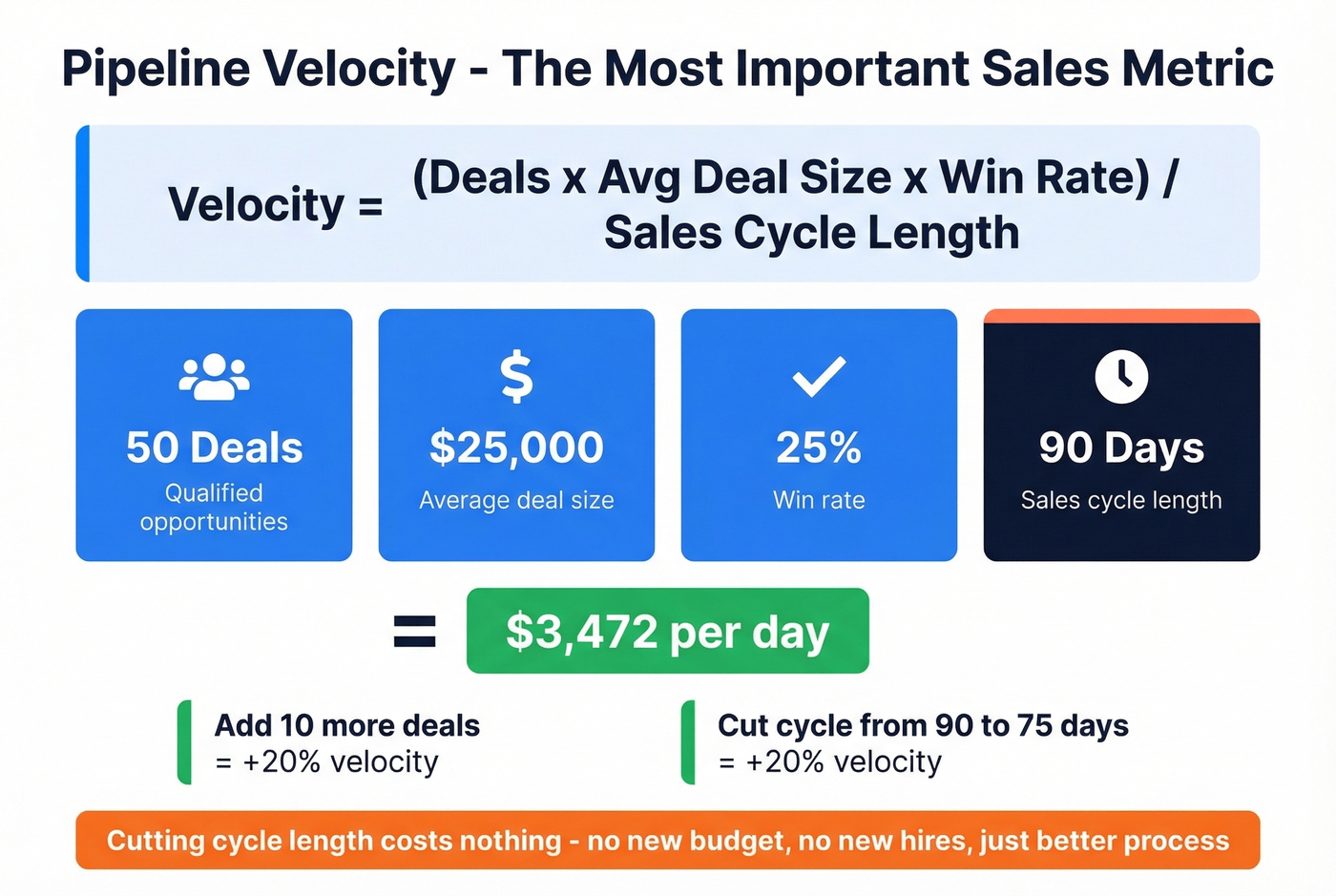
Velocity = (Number of Deals x Average Deal Size x Win Rate) / Average Sales Cycle Length
Let's run the math. Say you have 50 qualified opportunities, your average deal is $25,000, your win rate is 25%, and your average sales cycle is 90 days:
(50 x $25,000 x 0.25) / 90 = $3,472/day
Four levers, each independently tunable. Adding 10 more qualified deals increases velocity by 20%. Cutting your sales cycle from 90 to 75 days increases it by 20%. The compounding effect of improving two or three levers simultaneously is where real revenue acceleration happens.
Most teams obsess over deal count - adding more leads at the top. But cutting cycle length is almost always the faster win. Shortening your sales cycle requires no additional budget, no new hires, and no marketing campaigns. It just requires better pipeline hygiene and faster follow-up. If your average contract value is under $25k, you should be closing in under 45 days. If you can't, the problem isn't lead volume - it's process. (More on fixing the system in sales process optimization.)
Measure velocity monthly or quarterly. Weekly measurement creates noise. You need enough data to spot meaningful trends, not overreact to a single slow week.
How to Build a Pipeline from Scratch
Step 1: Define ICP and Source Contacts
Start with a tight ideal customer profile - industry, company size, job titles, geography. Then source contacts that match. We've had good results using Prospeo's 30+ search filters (buyer intent, technographics, headcount growth) to build targeted lists without stitching together three different tools. The 7-day data refresh cycle and 98% verified email accuracy mean contacts are current before they ever hit your CRM.

Step 2: Set Stages with Exit Criteria
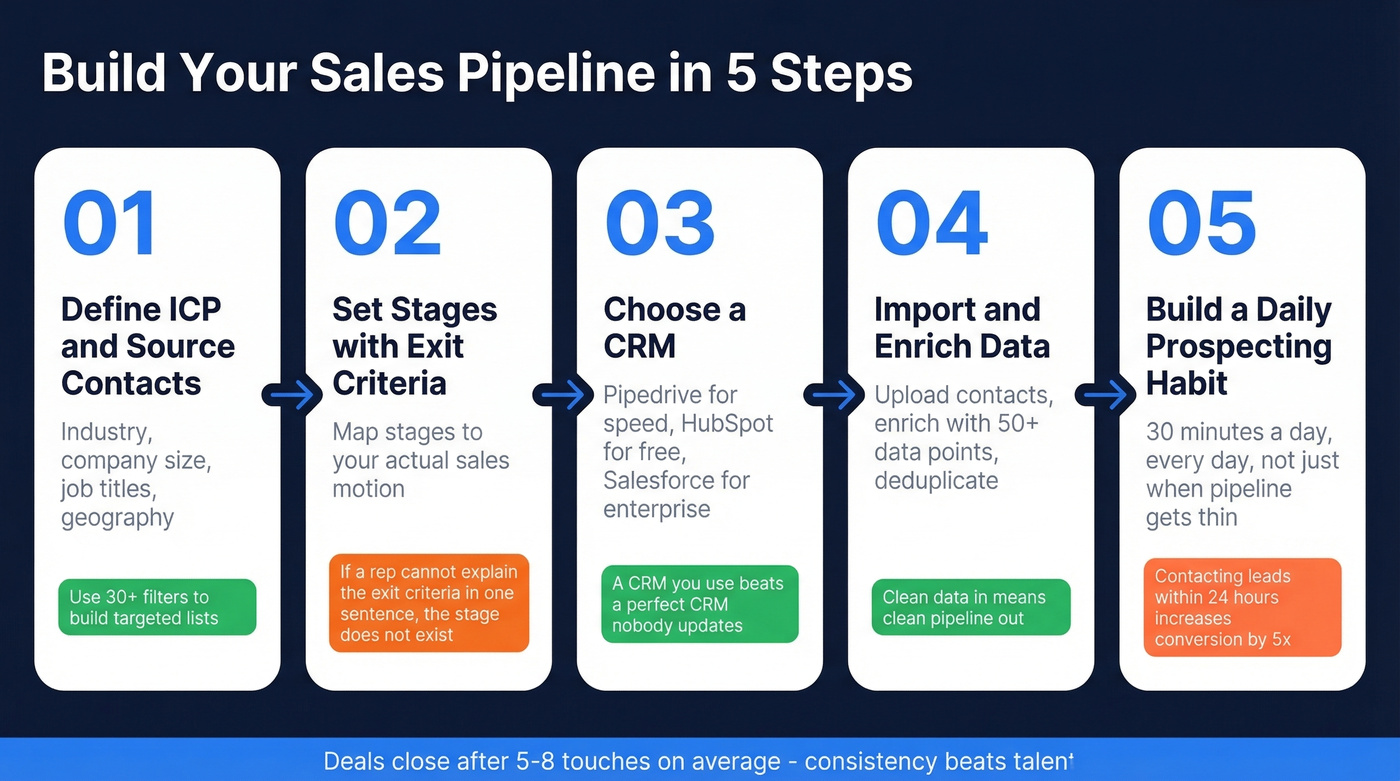
Map your stages to your actual sales motion. Define what moves a deal forward and what kills it. Write these down. If a rep can't explain what moves a deal from Discovery to Proposal in one sentence, the stage boundary doesn't exist.
Step 3: Choose a CRM
Pick one that matches your team size and complexity. Pipedrive for speed, HubSpot for a free starting point, Salesforce if you're enterprise. Don't overthink this - a CRM you actually use beats a perfect CRM nobody updates. If you’re comparing options, start with these examples of a CRM.
Step 4: Import and Enrich Data
Upload your contact list, enrich it with verified data points, and deduplicate. Clean data in means clean pipeline out. CRM enrichment tools that return 50+ data points per contact - job title, direct dial, company revenue, tech stack - save hours of manual research and keep your stages honest. (If you’re evaluating vendors, see data enrichment services.)
Step 5: Build a Daily Prospecting Habit
Thirty minutes a day, every day. Not when pipeline gets thin - every day. Contacting leads within 24 hours increases conversion by 5x, and 44% of reps give up after a single follow-up. The reps who build consistent deal flow aren't more talented. They're more disciplined about top-of-funnel activity. If you need copy you can deploy fast, use these sales follow-up templates.
Deals often close after 5-8 touches. If your team stops after one follow-up, you're not "being efficient" - you're leaking revenue.
For context on what "good" looks like: median outbound SDR pipeline contribution at companies in the $250M-$1B range runs about $3M per year. That gives you a benchmark for what a single dedicated prospector should generate.
How to Run Pipeline Reviews
73% of forecast misses trace back to poor pipeline reviews. That stat should terrify every sales leader running 15-minute "any updates?" check-ins and calling them reviews.
| Review Type | Frequency | Duration | Focus |
|---|---|---|---|
| Rep-manager 1:1 | Weekly | 30-45 min | 3-5 high-value/at-risk deals |
| Team review | Bi-weekly | 60-90 min | 2-3 deals, shared learning |
| Forecast review | Monthly | 90-120 min | Commit, slippage, coverage |
| Pipeline planning | Quarterly | Half-day | Strategy + resource allocation |
For deal inspection, use a structured framework - BANT or MEDDIC - and demand evidence of progression, not just rep optimism. "The champion said they're interested" isn't evidence. A scheduled next step with a decision-maker is.
Salesforce actually recommends canceling teamwide pipeline reviews entirely and doing 1:1s instead. Their argument: team reviews waste time for everyone except the rep whose deal is being discussed. We've seen this work well for teams under 20 reps. Above that, the bi-weekly team review still has value for cross-pollination and coaching.
Gut-based forecasting produces 20-30% error rates. Structured reviews with defined criteria cut that significantly.
Mistakes That Kill Your Forecast
Skipping qualification. Use BANT or MEDDIC as a gate, not a suggestion. Empty pipeline feels bad; bloated pipeline is worse.
No exit criteria between stages. If deals sit in "Discovery" for 90 days without a clear next step, your stages are labels, not process.
Ignoring pipeline hygiene. That 60% inflation number isn't unusual. Make it policy: any deal with no activity in 30 days gets flagged, and 60 days gets archived. Our team learned this the hard way after a quarter where "committed" deals evaporated because nobody had verified whether the contacts were even still at the company. If you want a tighter diagnostic set, track pipeline health metrics alongside stage aging.
One-size-fits-all stages. An inbound demo request and a cold outbound prospect shouldn't enter at the same stage. Skip this rule if your deal volume is under 20/month - at that scale, simplicity wins.
Giving up after one follow-up. 44% of reps do this. Deals close after 5-8 touches. The consensus on r/sales is that most reps dramatically underestimate how many touches it takes, and the data backs that up.
No review cadence. If you only look at pipeline when the forecast is due, you're managing by rearview mirror.
Feeding pipeline with unverified data. Bad emails, disconnected phones, and outdated job titles inflate your numbers and corrupt every downstream metric. This is the most fixable problem on the list, and it's the one teams ignore longest.
Pipeline Tools and Costs in 2026
Your CRM is the pipeline's home. Here's what the major options cost:
| Tool | Starting Price | Top Tier | Best For |
|---|---|---|---|
| Pipedrive | $14/user/mo | $99/user/mo | Fast setup, small teams |
| HubSpot Sales Hub | Free | $150/user/mo (Enterprise) | Free start, marketing alignment |
| monday CRM | $9/seat/mo | Custom | Visual workflows |
| Salesforce Sales Cloud | $25/user/mo | $330/user/mo | Enterprise, complex orgs |
| Zoho CRM | Free | ~$20-$60/user/mo | Budget, deep customization |
Pipedrive is the fastest to set up and the most intuitive for small teams. HubSpot's free tier is genuinely useful if you're starting from zero. Salesforce is the enterprise default - powerful but expensive to implement and maintain. PCMag gave Zoho CRM its Editors' Choice for the combination of price and customization depth.
None of these CRMs fix bad data on their own. For data quality, the stack that matters: Prospeo (free tier with 75 emails/month, paid plans at ~$0.01/email), ZoomInfo ($15-40k/year depending on seats and modules), Apollo (free tier, paid from ~$49/mo per user), and Cognism (~$1,000-3,000/mo for small teams). For conversation intelligence and deal execution, look at Gong and Outreach. If you’re building a modern outbound stack, start with these SDR tools.
Pipeline bloat starts with bad data - wrong emails, outdated titles, contacts who left the company months ago. Prospeo refreshes every record on a 7-day cycle (not the 6-week industry average), so your CRM reflects reality, not last quarter's org chart.
Kill pipeline bloat at the source with data that's never more than 7 days old.
FAQ
What's a sales pipeline vs. a funnel?
A pipeline tracks where each deal sits from the seller's perspective - stages and next actions. A funnel measures how many prospects convert at each phase from the buyer's side. Use the pipeline to manage deals and the funnel to diagnose where you're losing volume.
How many pipeline stages should I have?
Most B2B teams perform best with 5-6 stages. Every stage you add creates friction and ambiguity. If reps can't explain what moves a deal forward in one sentence, you have too many.
What's a good pipeline conversion rate?
The median B2B lead-to-customer rate is about 2.9%. Stage-by-stage: 20-25% Lead to MQL, 12-18% MQL to SQL, 10-12% SQL to Opportunity, 6-9% Opportunity to Closed-Won.
How often should I review my pipeline?
Weekly 1:1s between reps and managers at 30-45 minutes are the minimum. Add a monthly forecast review at 90-120 minutes focused on commit deals and coverage ratios. Teams that skip structured reviews see 20-30% forecast error rates.
How does data quality affect pipeline accuracy?
Bad contact data inflates your pipeline and corrupts every downstream metric from conversion rates to forecast accuracy. Verified emails and a short data refresh cycle eliminate stale records before they enter your CRM - compared to the 6-week industry average that lets bad data compound for over a month.