

12 Sales Pitch Templates That Actually Get Replies
The average professional receives 121 emails a day. The average reply rate across industries? 3.43%. Meanwhile, buyers complete 70% of their purchase journey before they'll even talk to a rep, and 61% say they'd prefer a rep-free experience entirely. The sales pitch templates that worked three years ago don't land anymore. Your pitch isn't competing with other pitches. It's competing with silence.
If you came here expecting slide deck tools like Canva or Pitch.com, that's a different problem. This is about the actual words - the scripts, emails, and call openers that get prospects to respond.
What follows are 12 templates that work right now, plus the frameworks, role-specific adjustments, and data hygiene practices that separate pitches earning replies from pitches getting archived.
What You Need (Quick Version)
You don't need 27 templates. You need three great ones. Master these before you touch anything else:
- PAS Cold Email - Problem, Agitate, Solve. Name the prospect's pain, twist the knife with a consequence, offer a path forward. Under 150 words. One clear CTA. This is the most reliable persuasive email format in any outbound playbook.
- Pattern-Interrupt Cold Call Opener - Skip "How are you?" and "Did I catch you at a bad time?" Open with something that earns the next 15 seconds.
- Value-Add Follow-Up - Don't just "check in." Bring something new: a relevant stat, a case study, a resource. Give them a reason to reply that isn't guilt. (If you need more options, steal from these sales follow-up templates.)
The rest of this guide gives you 9 more for specific channels and situations, the frameworks that make them work, and the mistakes that quietly destroy your pipeline.
Why Most Pitch Templates Fail
Here's the thing: the problem isn't that reps use templates. It's that they're using the same templates as everyone else, with the same "[FIRST NAME], I noticed your company..." opener, and prospects can smell it instantly.
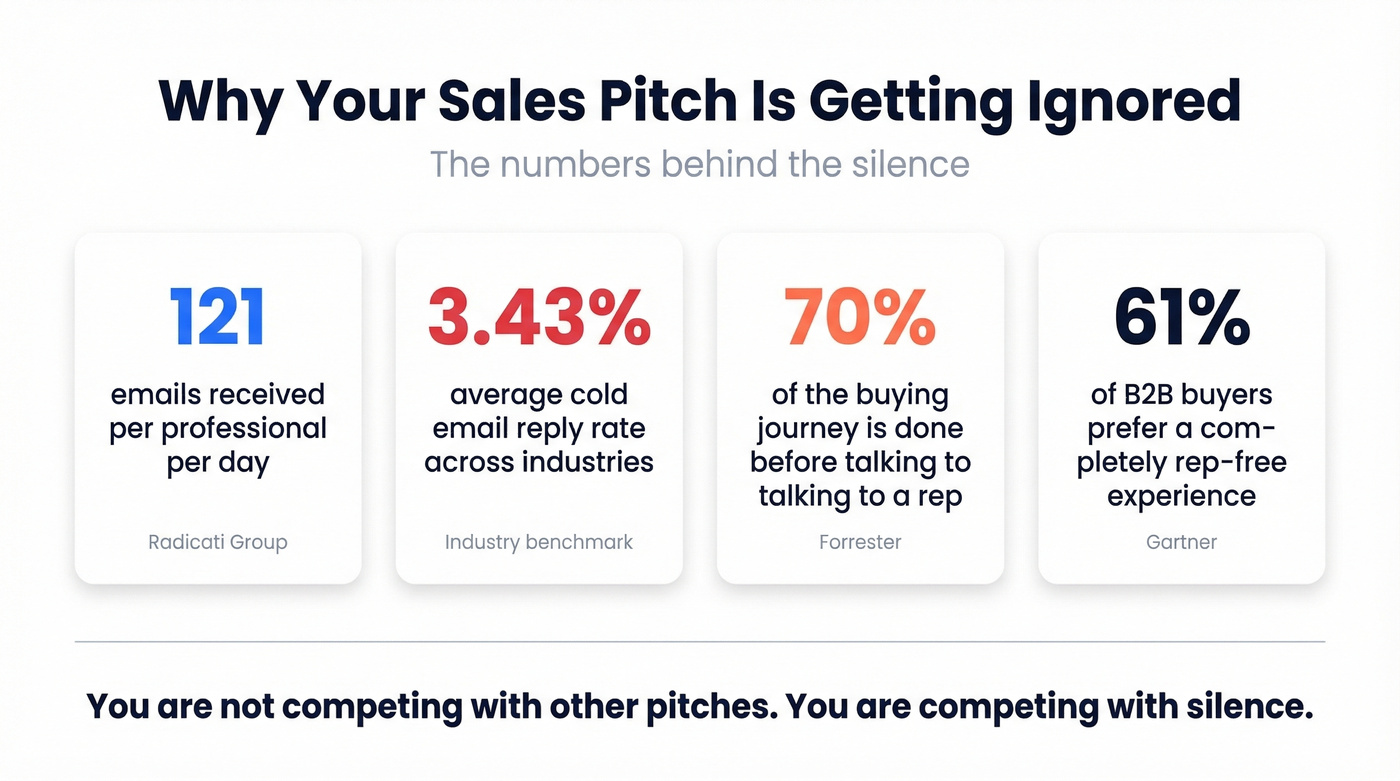
Three forces have made generic templates nearly useless. First, AI-generated outreach has flooded every inbox. When the emails hitting a VP's inbox read like they were written by the same language model, anything that sounds even slightly templated gets deleted on reflex.
Second, buyers are more self-educated than ever. Forrester's research shows they're 70% through the decision process before they engage a rep - and 96% conduct independent research before speaking with sales at all. They don't need your pitch to learn what your product does. They need it to prove you understand their specific situation.
Third, Gartner found that 61% of B2B buyers actively prefer a rep-free experience. You're not just competing with other vendors. You're competing with the buyer's desire to not talk to anyone at all.
The templates that still work share three traits: they're short, they're specific to the prospect's world, and they make the next step feel low-risk. Everything below is built on those principles.
3 Frameworks Behind Every Great Pitch
Every effective pitch maps to one of three frameworks. Knowing which one to use - and when - is the difference between a template that converts and one that just sounds professional.
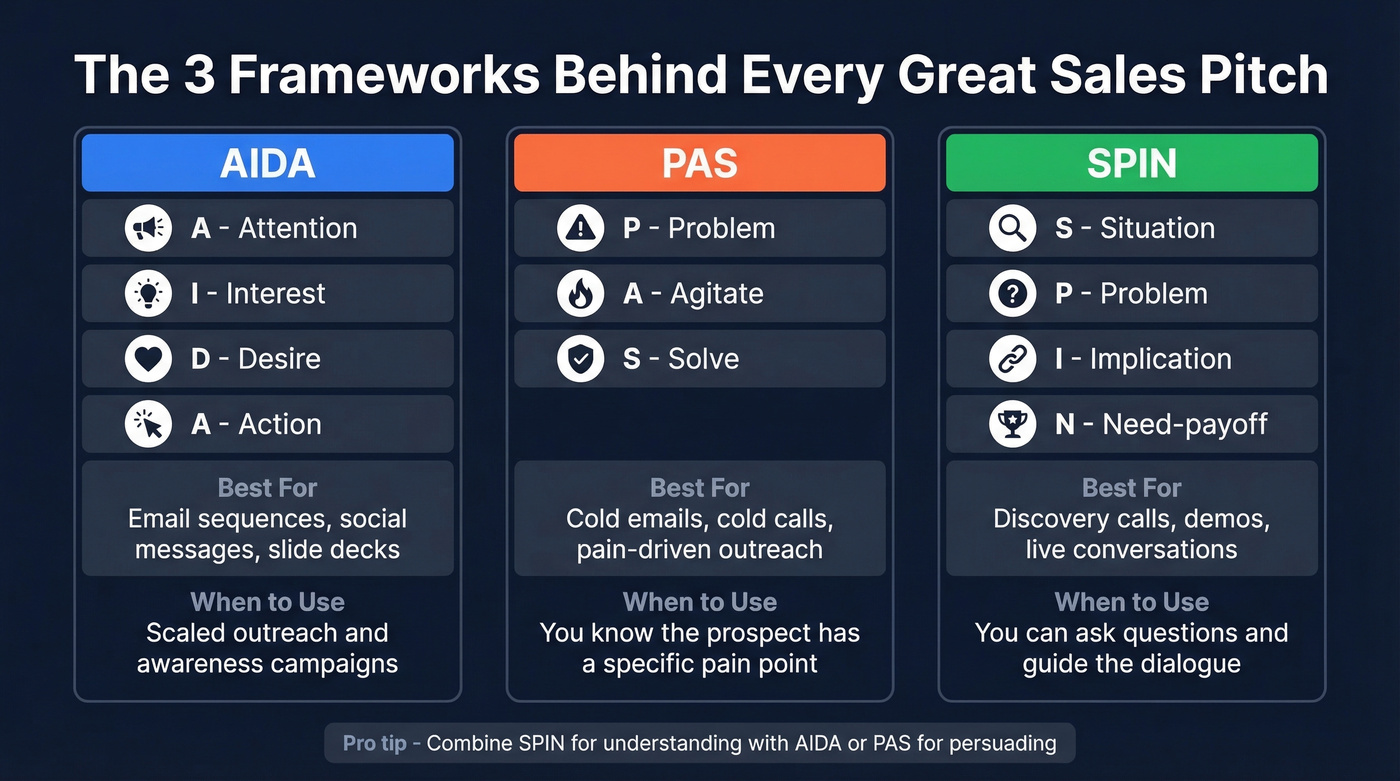
| Framework | Best Channel | When to Use |
|---|---|---|
| AIDA | Email, social, decks | Scaled outreach, awareness |
| PAS | Email, cold calls | Pain-point-driven outreach |
| SPIN | Calls, demos, discovery | Live conversations |
AIDA (Attention, Interest, Desire, Action) works best for scaled communication. It drives email sequences, social messages, and presentation decks where you're guiding someone from awareness to action in a linear flow. (If you want to go deeper, see the full AIDA sales funnel.)
PAS (Problem, Agitate, Solve) is the workhorse for pain-point-driven outreach. You name the problem, make the consequences feel real, then position your solution as the path out. It's direct, it's empathetic, and it works especially well in cold emails where you've got 150 words to earn a reply. Most persuasive outreach scripts you'll find online are variations of PAS, and for good reason.
SPIN (Situation, Problem, Implication, Need-payoff), developed by Neil Rackham, is a questioning technique built for live conversations. You don't use SPIN in an email - you use it in discovery calls and demos where you can guide the prospect through their own reasoning. The best reps we've worked with combine SPIN for understanding with AIDA or PAS for persuading. (For more, use these discovery questions.)
SDR vs AE Pitches
An SDR pitch and an AE pitch solve different problems. Using the wrong format for your role is one of the fastest ways to lose a prospect's attention. If you're building your stack, start with the right SDR tools.
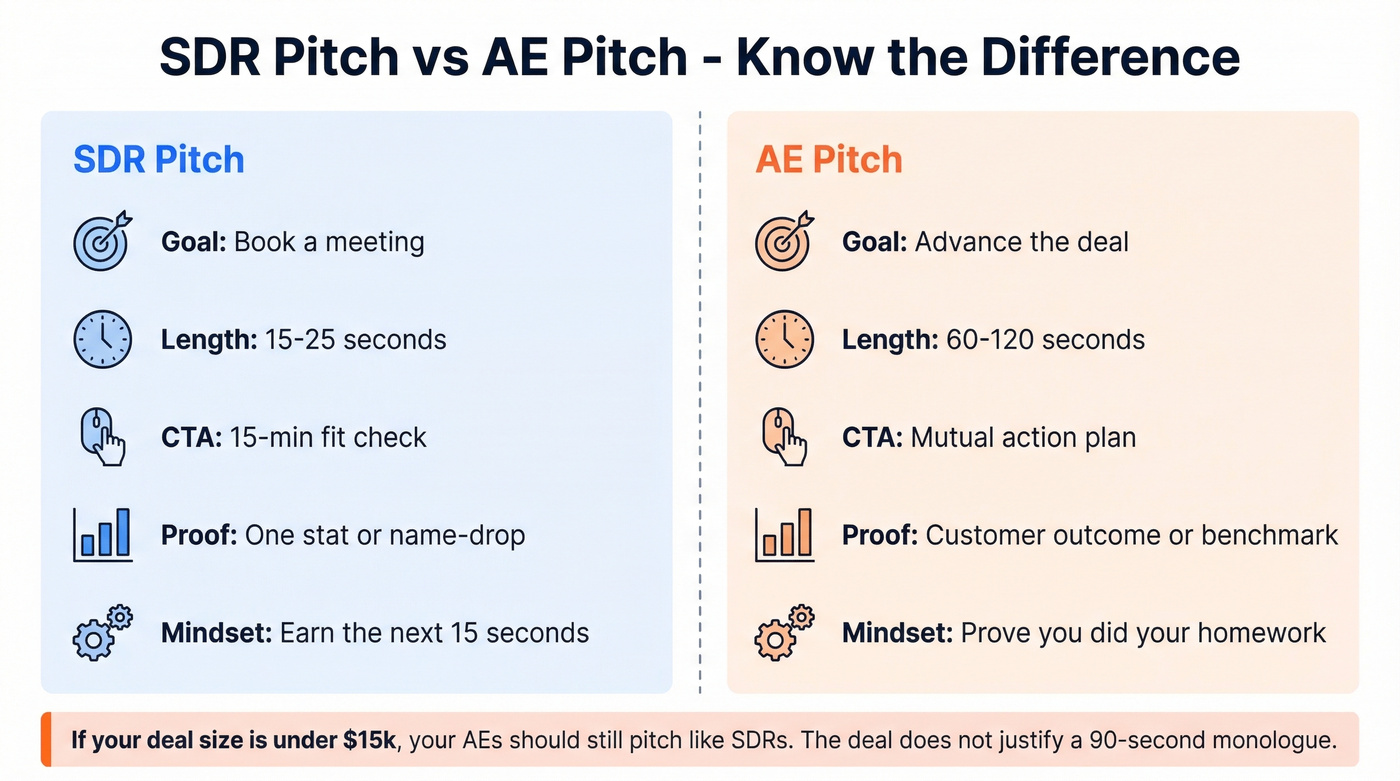
| Element | SDR Pitch | AE Pitch |
|---|---|---|
| Goal | Book a meeting | Advance the deal |
| Length | 15-25 seconds | 60-120 seconds |
| CTA | "15-min fit check" | "Mutual action plan" |
| Proof type | One stat or name-drop | Customer outcome/benchmark |
SDRs need to earn the next 15 seconds, then the next 60, then a calendar invite. Everything is compressed. AEs have more room because the prospect has already opted in - but that room comes with higher expectations. An AE pitch that sounds like an SDR pitch signals you haven't done your homework. An SDR pitch that sounds like an AE pitch signals you're going to waste their time.
If your deal size is under $15k, your AEs should still pitch like SDRs. The deal doesn't justify a 90-second monologue. Get to the point, prove value fast, close faster. The "consultative sale" is overrated at low ACVs.

The best sales pitch template in the world won't get replies if it lands in the wrong inbox - or bounces entirely. Prospeo gives you 98% verified emails and 125M+ direct dials so every pitch reaches a real decision-maker, not a dead end.
Stop perfecting pitches that bounce. Fix the data first.
12 Pitch Scripts by Channel
Cold Call Openers
Cold calling has a meeting-set rate of roughly 1-2%. That sounds brutal, but it means the bar is low - most reps are terrible at it. And 57% of C-level buyers favor phone contact, so the channel works if you do. If you're getting shut down fast, fix your cold call rejection patterns first.
Template 1: Pattern Interrupt
"Hey [Name], this is [Your Name] from [Company]. I know you weren't expecting this call - I'll be quick. We help [role/company type] solve [specific problem]. Is that on your radar right now, or am I way off base?"
This works because it acknowledges the interruption honestly, which disarms the reflex to hang up. The "or am I way off base?" gives the prospect an easy out, which paradoxically makes them more likely to engage. Whatever you do, don't open with "Did I catch you at a bad time?" - Gong's data shows that phrase makes you 40% less likely to book the meeting.
Template 2: Trigger-Based
"Hi [Name], [Your Name] from [Company]. I saw [Company] just [trigger event - new funding round, leadership hire, expansion]. When that happens, teams usually run into [specific challenge]. Curious if that's something you're dealing with?"
The trigger event proves you're not dialing from a list. It gives you a legitimate reason for calling, and stating that reason increases your success rate 2.1x according to Gong's research. In our experience, this is the highest-converting cold call format - the only hard part is finding the triggers fast enough. (Here’s a full system for how to track sales triggers.)
Template 3: Earned-Insight Opener
This one flips the script entirely. Instead of pitching, you lead with a pattern you've observed and invite the prospect to react.
"[Name], quick question - I've been talking to a lot of [role] at [industry] companies this quarter, and the pattern I keep hearing is [insight]. Does that resonate, or is your world different?"
The prospect gets to either validate or correct you - either way, you're in a conversation, not a monologue. Use this when you genuinely have an industry insight worth sharing. If you're faking it, they'll know.
Cold Email Templates
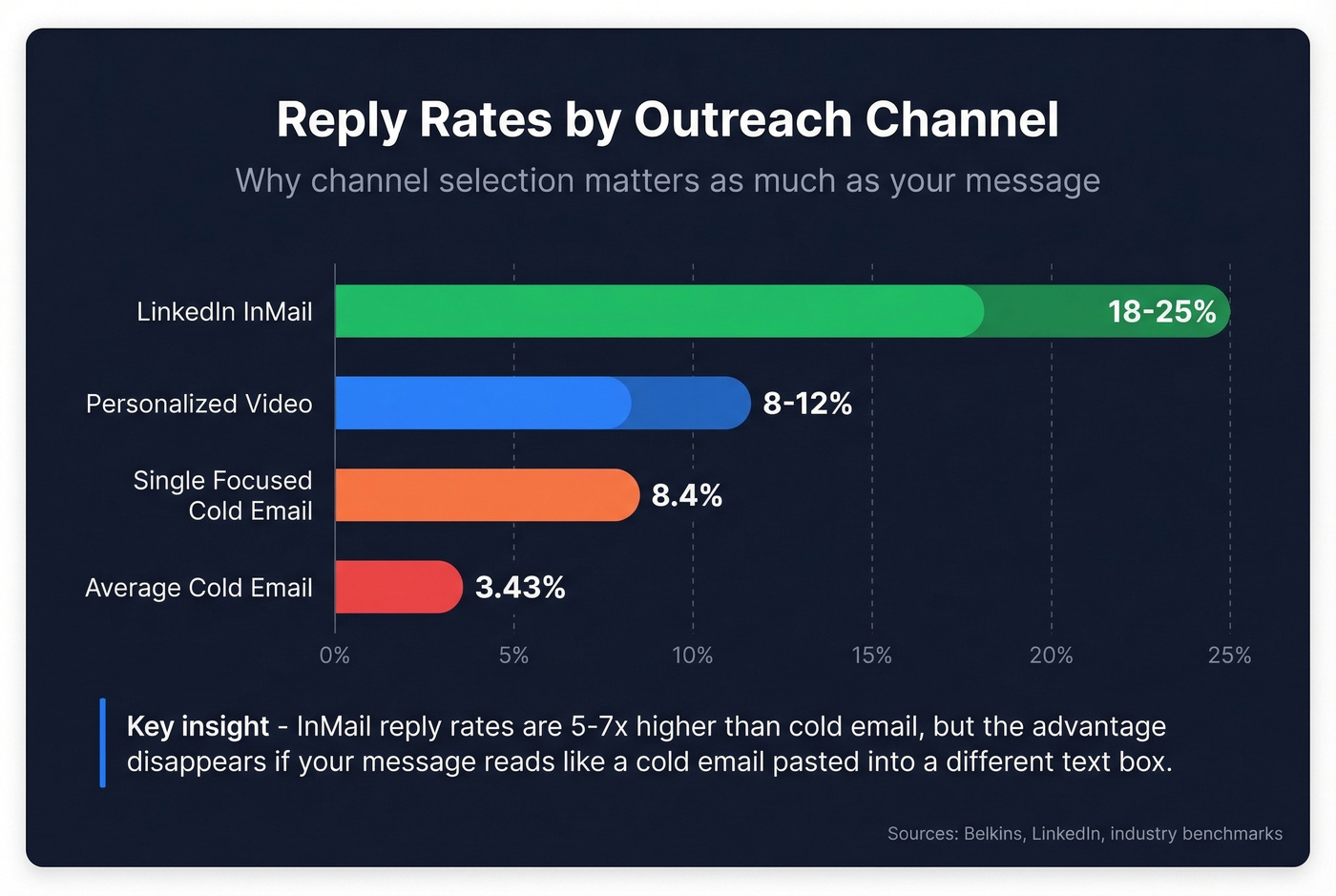
A Belkins analysis of 16.5 million cold emails found that the highest reply rate - 8.4% - came from a single, focused email. Performance declined with each additional follow-up in the same thread, and sending 4+ emails more than tripled unsubscribe and spam rates. Make your first email count. (For more structure, build a B2B cold email sequence.)
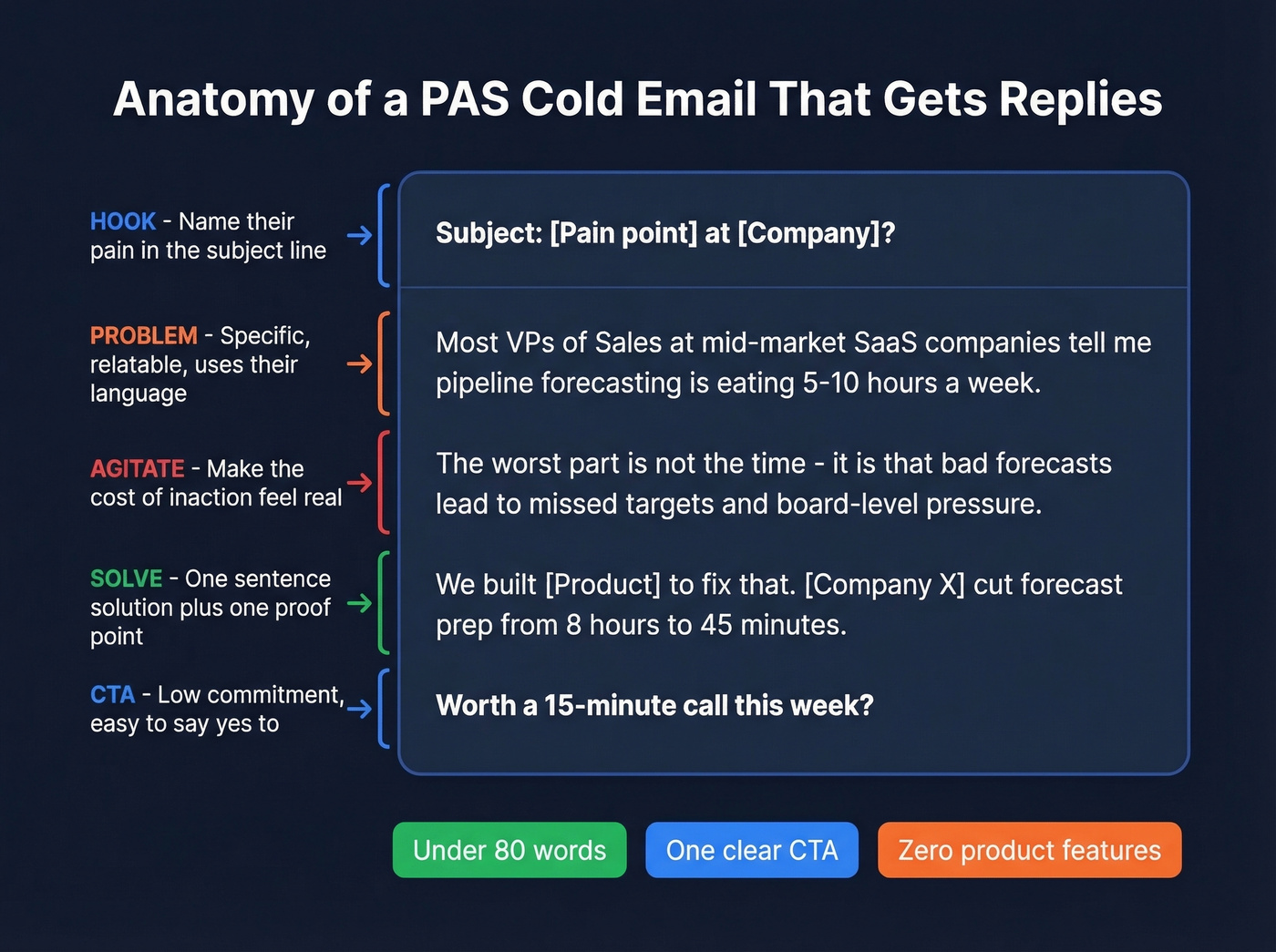
Template 4: PAS Framework Email
Subject: [Pain point] at [Company]?
Hi [Name],
Most [role]s at [company type] tell me [specific problem] is eating 5-10 hours a week. The worst part isn't the time - it's that [consequence of inaction].
We built [Product] to fix that. [One-sentence solution + one proof point].
Worth a 15-minute call this week?
Opens with their pain, not your product. The agitation line makes the cost of inaction concrete. Under 80 words. This is the persuasive email template I'd use if I could only send one email to a cold prospect.
Template 5: Social Proof Email
Subject: How [Similar Company] solved [problem]
Hi [Name],
[Similar Company] was dealing with [same problem you suspect prospect has]. After switching to [Product], they [specific result with numbers].
I think we could do something similar for [Prospect's Company]. Open to a quick chat?
The subject line does the heavy lifting - it promises a relevant case study, not a pitch. The body delivers on that promise in three sentences. This social proof format consistently outperforms feature-focused messages because prospects trust peer results more than vendor claims.
Template 6: Value-First Email
Subject: [Relevant resource] for [Company]
Hi [Name],
I put together [resource - benchmark, analysis, comparison] specifically for [industry/company type]. Thought it might be useful given [context about their situation].
[Link to resource]
Happy to walk through it if anything stands out. No pitch, just context.
You're giving before you're asking. The "no pitch" line lowers the barrier. The resource itself becomes your proof of competence. The consensus on r/sales is that this approach works best when the resource is genuinely useful and not a thinly disguised product brochure - so make it real.
One more thing on cold emails: keep them under 150 words and personalize beyond [FIRST NAME]. Use enrichment tools to pull job title, company size, tech stack, and recent funding so your template references something the prospect actually cares about. (If you need vendors, start with these data enrichment services.)
Social, InMail & Video
InMail reply rates run 18-25%, compared to roughly 3% for cold email. The channel advantage is real, but it disappears fast if your message reads like a cold email pasted into a different text box. If you want a system for doing this well, use a personalized outreach workflow.
Template 7: Common-Ground Message
"Hey [Name] - saw your post about [topic]. [One specific reaction or question about their point]. We're working on something related at [Company] and I'd love to get your take. Worth connecting?"
Template 8: Compliment-Plus-Question
"[Name], really liked what you shared about [specific thing]. Quick question - how are you handling [related challenge] right now? We've been helping [similar companies] with [approach] and I'm curious if it maps to your situation."
Both work because they lead with the prospect's content, not yours. The compliment isn't generic flattery - it references something specific enough to prove you actually read it.
Don't sleep on video. Personalized video outreach lifts reply rates to 8-12%, and embedding a video thumbnail in an email increases click-through by 7x. Record a 30-second Loom addressing the prospect by name, reference one thing about their company, and state your ask. It's harder to ignore a face than a wall of text. (More tactics here: Loom video cold email.)
Follow-Up Templates
80% of sales require 5+ follow-ups, but 92% of reps quit after 4 attempts. Even more striking, 44% of salespeople make just one follow-up before giving up. The gap between "persistent" and "average" is where deals live. And 35-50% of sales go to the vendor that responds first. Speed and persistence aren't nice-to-haves. They're the whole game.
Template 9: After-No-Response Follow-Up
Subject: Re: [Original subject]
Hi [Name],
I know [time of year/quarter] is hectic. Wanted to share one thing that might be relevant: [new data point, case study, or industry insight].
[One sentence connecting it to their situation].
Still happy to chat if the timing works. If not, no hard feelings.
You're not "just checking in." You're bringing something new. The closing line respects their time without being passive.
Template 10: After-Meeting Follow-Up
Subject: Next steps from our call
Hi [Name],
Thanks for the time today. Here's what I took away:
- [Key pain point they mentioned]
- [Outcome they're looking for]
- [Agreed next step]
I'll have [deliverable] over to you by [date]. Let me know if I missed anything.
This proves you listened. Leads are 9x more likely to convert when contacted within 5 minutes, and a first follow-up email increases reply rate by 50%. Send this within the hour - not tomorrow, not end of day. Within the hour.
Elevator Pitch
You've got 30 seconds. That's roughly 75 words. If you want more variations, use these sample elevator pitches.
Template 11: Four-Part Elevator Pitch
"I'm [Name] - I work with [role/company type] who are dealing with [problem]. Most of them tell me [empathy statement about the frustration]. What we do is [one-sentence solution]. If that sounds relevant, I'd love to grab 15 minutes this week."
Structure: Humanize, Empathize, Show how you help, CTA. Don't try to close in an elevator pitch. The goal is a conversation, not a contract.
Breakup Email
Template 12: The Respectful Close
Subject: Should I close your file?
Hi [Name],
I've reached out a few times and haven't heard back - totally understand if the timing isn't right.
I'll stop following up for now, but if [problem] becomes a priority, I'm here. Just reply to this thread.
The subject line creates just enough urgency without being manipulative. Short, respectful, door left open. Breakup emails often generate replies - people respond when the pressure is off.
Sales Presentation Template
When you move from email and phone to a full presentation, the stakes change. Salesforce research shows 87% of businesses expect reps to act as trusted advisors, not product walkers. Your deck needs to reflect that. If you want to tighten the narrative, use these sales deck storytelling frameworks.
A 6-slide structure that works across industries:
- Problem - Name the specific challenge your prospect faces. Use their language, not yours.
- Cost of Inaction - Quantify what happens if they do nothing. Lost revenue, wasted time, competitive risk.
- Solution - Your product, positioned as the answer to slides 1 and 2. Not a feature tour - a capability map.
- Proof - One case study with real numbers. "[Company] went from X to Y in Z months."
- ROI - Project what the prospect's results would look like. Make it specific to their scale.
- Next Step - One clear action. Not "let us know what you think." A date, a deliverable, a decision.
One team we know rebuilt a deck around this structure and moved close rate from 6% to 39%. The old deck was 22 slides of features. The new one was 6 slides of outcomes.
The biggest mistake in sales presentations? Treating the deck as a script instead of a conversation guide. The best AEs use slides as visual anchors while running a SPIN-style dialogue. The deck supports the conversation. It doesn't replace it.
The Data Problem Nobody Talks About
You can have the best pitch template in the world, and it won't matter if the email bounces. If you’re seeing issues, start by benchmarking your email bounce rate.
This is the upstream problem that quietly kills outbound campaigns. Salesforce's State of Sales report found that inside reps spend just 30% of their time actually selling - the other 70% goes to admin, data entry, and prospecting. Reps spend 40% of their time just looking for the right prospects to contact. When they finally find someone, a bad email address means the pitch never arrives.
Bounced emails don't just waste time - they damage your domain reputation, which sends future emails to spam even when the addresses are valid. One team running outbound at scale, Meritt, was dealing with a 35% bounce rate. After switching to Prospeo's verified data, their bounce rate dropped to under 4% and their pipeline tripled from $100K to $300K per week. With 143M+ verified emails refreshed on a 7-day cycle and 98% accuracy, the platform catches bad addresses before they torch your sender reputation.
Let's be honest: your pitch template is a multiplier. But it's multiplying whatever your data quality gives it. Bad data times a great pitch equals zero.
Trigger-based pitches convert 2.1x better - but only if you can find the triggers fast enough. Prospeo tracks job changes, funding rounds, and headcount growth across 300M+ profiles with a 7-day refresh cycle, so your outreach hits while the trigger is still warm.
Find the right prospect before your competitor's pitch lands.
7 Pitch Mistakes That Kill Deals
1. Talking more than listening. The best discovery calls have the prospect talking 60%+ of the time. If you're monologuing through your pitch, you're not learning what actually matters to the buyer.
2. Leading with price over value. Price is a feature. Value is the outcome. If you lead with "we're 40% cheaper," you've anchored the conversation on cost instead of results - and you'll lose to whoever anchors on ROI.
3. Using urgency and scarcity tactics in B2B. "This offer expires Friday" works for consumer flash sales. In B2B, it damages trust. One sales leader found that replacing urgency-based CTAs with data-backed proposals increased their win rate by 20% over two quarters.
4. Pitching the wrong stakeholder. The typical B2B purchase now involves 7.4 decision-makers. If you're pitching the person who can't sign, you're building a champion at best and wasting time at worst. Map the buying committee before you pitch.
5. Drowning prospects in jargon. Technical language signals expertise to technical buyers. To everyone else, it signals you don't know how to communicate value simply. Match your language to your audience.
6. Not preparing for objections. Every pitch gets objections. The reps who handle them well aren't improvising - they've mapped the top 5 objections for their product and rehearsed concise, evidence-backed responses.
7. Quitting after one or two follow-ups. 44% of salespeople make just one follow-up attempt. Meanwhile, 80% of sales require 5+ touches. The math is simple: most reps stop before the deal starts.
FAQ
How long should a sales pitch be?
Cold call openers: 15-25 seconds. Cold emails: under 150 words. Elevator pitches: 30 seconds. Full presentations: 5-7 minutes of content, leaving room for dialogue. Shorter consistently outperforms longer across every channel.
What's the best framework for cold email pitches?
PAS (Problem, Agitate, Solve) outperforms other structures for cold outreach. Belkins' analysis of 16.5M emails confirms that single, focused emails beat multi-touch sequences. Keep it under 100 words, lead with the prospect's pain, and end with one clear CTA.
How many follow-ups should I send?
Five or more, but vary channels - email, then call, then social - rather than hammering one inbox. Each touchpoint should bring something new. "Just checking in" isn't a follow-up. It's noise.
Does contact data quality affect pitch performance?
Absolutely. Bounced emails damage your domain reputation, pushing future messages to spam even when addresses are valid. Prospeo's 5-step verification catches invalid addresses, spam traps, and honeypots before you send. One bad list can tank deliverability for months - verify first so your carefully crafted pitch actually reaches the inbox.
What tools help personalize pitch templates at scale?
Use enrichment platforms to pull job title, company size, tech stack, and recent funding data before writing. Look for tools that return 50+ data points per contact at high match rates, so you can swap generic [FIRST NAME] personalization for references to the prospect's actual situation - the kind of specificity that earns replies.