

How to Build a Sales Plan That Your Team Will Actually Use
84% of sales reps missed quota last year. Not because they couldn't sell - because the sales plan behind them was either a 30-page shelf document or a napkin sketch that fell apart by February. The difference between teams that hit number and teams that don't isn't talent. It's the operating system underneath.
A good plan turns revenue targets into daily activities your reps can actually execute. Here's how to build one that survives contact with reality, plus a filled-in example you can steal.
The quick version: A sales plan has seven components - mission, targets, ICP, methodology, team structure, activity metrics, and review cadence. Calibrate your targets against real benchmarks: average win rates run 21%, pipeline coverage needs to be 3-4x your revenue goal, and 84% of reps are missing quota entirely. Review quarterly, not annually. If you want to skip the theory, jump to the filled-in example below.
What Is a Sales Plan?
A sales plan is an operating document that connects revenue targets to daily activities. It answers three questions: how much do we need to close, who are we selling to, and what does each rep need to do this week to get there?
It's not a business plan - that's for investors and board decks. It's not a sales strategy either, because strategy defines how you win through positioning, methodology, and competitive approach. The plan translates that strategy into targets, activities, timelines, and accountability. Think of it as the bridge between "we need $5M this year" and "each AE needs 12 discovery calls per week."
The best plans fit in 3-5 pages. If yours requires a table of contents, you've built a document nobody will read.
Types of Sales Plans
Not every team needs the same format. The right structure depends on what you're solving for.
| Plan Type | Best For | Time Horizon | Key Focus |
|---|---|---|---|
| Revenue-based | Forecasting accuracy | Quarterly/annual | Conversion improvements |
| Market-based | Multi-segment teams | Annual | Separate plans per segment |
| Goals-based | Scaling orgs | Annual | Hiring, onboarding, process |
| New product | Launch teams | 6-12 months | Positioning, enablement |
| 30-60-90 day | New hires/territories | 90 days | Ramp to productivity |
Revenue-based plans work best when your motion is established and you're optimizing conversion rates and pipeline velocity. Market-based plans make sense if you're selling into both SMB and enterprise - those are fundamentally different motions that need separate playbooks. You'll also want to decide your GTM motion mix here: what percentage of pipeline comes from inbound, outbound, partner-led, or product-led growth? That ratio shapes everything downstream, from headcount and content needs to territory design and comp plans.
The 30-60-90 day plan deserves special attention. Up to 20.5% of new hires quit within their first three months, and companies with effective onboarding see 10% higher sales growth. The structure is simple: days 1-30 learn, 31-60 start selling, 61-90 close deals. If you're not giving new AEs a 30-60-90, you're gambling with a 3.2-month ramp window. (If you need a ready-to-run version, use this 30-60-90 structure.)
How to Create a Sales Plan
Eight steps, each with the math and benchmarks you need to make real decisions. Whether you're building a strategic plan for the full year or a focused Q4 push, the process is the same.
Audit Last Year's Performance
Before you plan forward, look backward. Pull these metrics for the last four quarters:
- Win rate - the cross-industry average sits at 21%
- Sales cycle length - typically 1-2 quarters for B2B
- Stage-to-stage conversion rates from meeting through opportunity to close
- Average deal size (ACV)
- Retention and expansion revenue
- Activity-to-outcome ratios like calls per meeting and meetings per opportunity (see more sales activities to track)
Once you have the numbers, build a truth table: what do we continue doing, what do we stop, and what do we change? This framework, borrowed from Salesfolks' planning approach, forces honest assessment instead of optimistic hand-waving. If your win rate was 18% last year, don't plan for 35%. Plan for 22% and build the activities to get there.
Define Revenue Targets
Start with the number and work backward. Say your target is $2M in new ARR with a $40K average deal size. That's 50 closed deals. At a 21% win rate, you need 238 qualified opportunities to close 50. If your meeting-to-opportunity conversion is 40%, that's roughly 595 meetings.
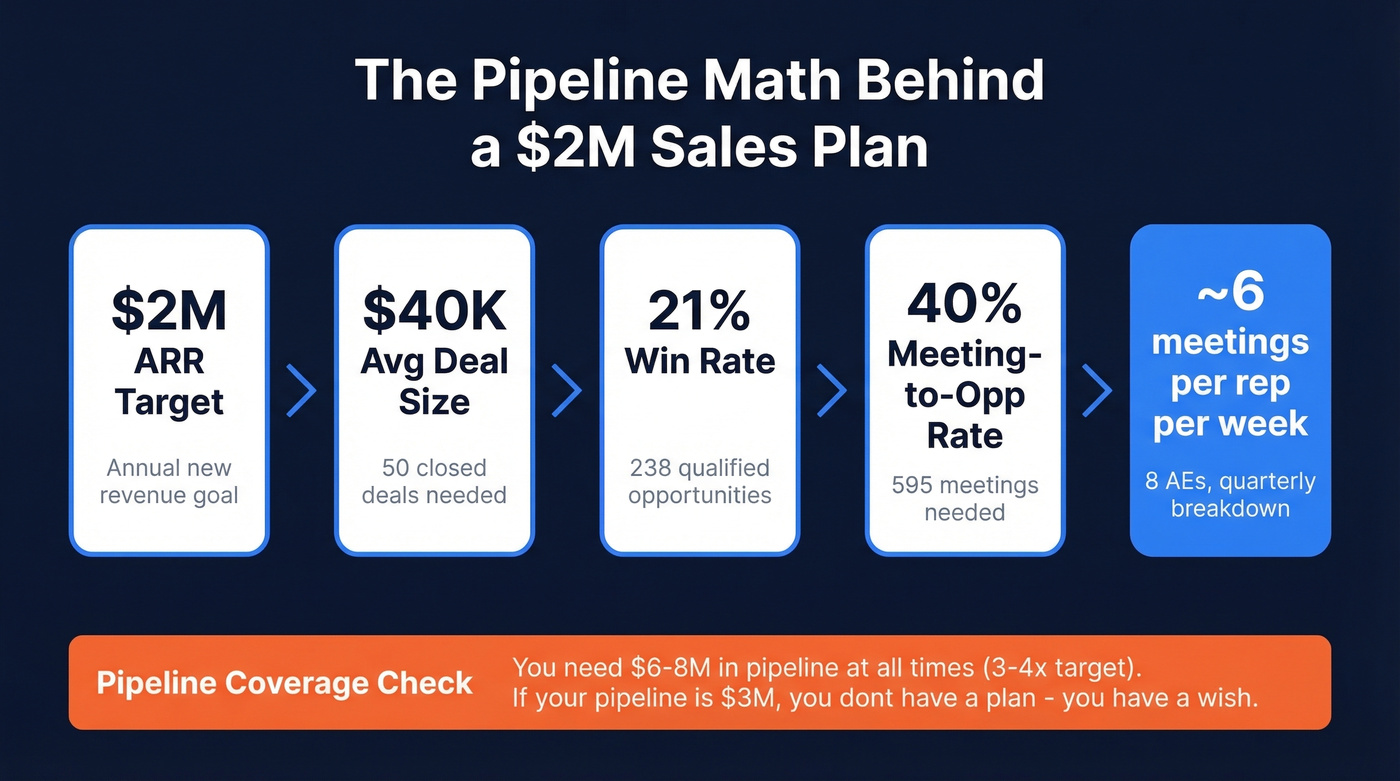
The critical check is pipeline coverage. You need 3-4x your revenue target in qualified pipeline at any given time. For a $2M target, that means $6-8M in pipeline. If your current pipeline is $3M, you don't have a plan - you have a wish. (If you want more benchmarks, compare against these sales pipeline benchmarks.)
Identify Your ICP and Territory
Segment your market by industry, company size, and buying triggers. The ICP definition should be specific enough that a new SDR can read it and know exactly who to call - not "mid-market SaaS companies" but "B2B SaaS companies with 50-500 employees, Series A-C, using Salesforce, with a VP of Sales or CRO in place." (If you need a scoring rubric, use an ideal customer profile template.)
Use TAM, SAM, and SOM to size the opportunity realistically, and layer in territory design so reps aren't tripping over each other. Assign territories by geography, vertical, or account size - whichever matches your motion.
Your plan structure changes dramatically by segment. Startup deals often involve direct access to the CEO with three or fewer stakeholders. Enterprise deals involve 12+ stakeholders, multi-deck presentations for finance, IT, and legal, and cycles that stretch across quarters. Your activity targets, content needs, and rep allocation should reflect this reality, not paper over it. (For enterprise-specific nuance, see enterprise B2B sales.)
Choose Your Methodology
A popular take on r/sales argues that all methodologies basically reduce to four fundamentals: need, budget, stakeholders, and timeline. There's truth in that. But the right framework gives your team a shared language and a repeatable process for complex deals.
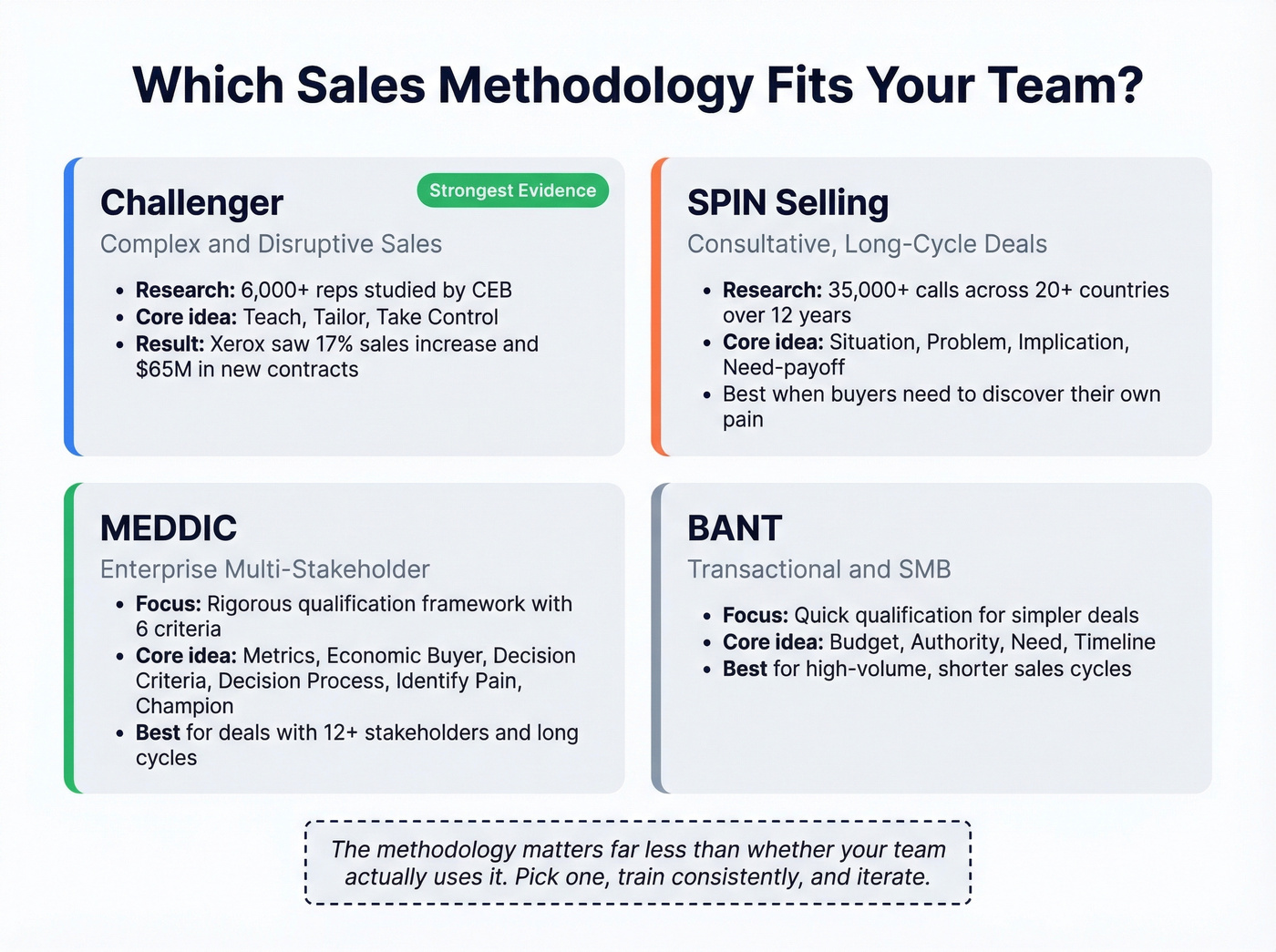
| Methodology | Research Base | Best For | Core Mechanics |
|---|---|---|---|
| Challenger | 6,000+ reps (CEB) | Complex/disruptive sales | Teach, Tailor, Take Control |
| SPIN | 35,000+ calls, 20+ countries | Consultative, long-cycle | Situation, Problem, Implication, Need-payoff |
| MEDDIC | Enterprise SaaS | Multi-stakeholder deals | Qualification framework (6 criteria) |
| BANT | Transactional/SMB | Quick qualification | Budget, Authority, Need, Timeline |
Challenger has the strongest evidence base - Xerox reported a 17% increase in sales and $65M in contract value after implementing it. SPIN's research spans 35,000+ calls across 12 years. We've seen teams overthink this choice. Pick one that matches your deal complexity, train on it consistently, and iterate. The methodology matters far less than whether your team actually uses it. (If you're running MEDDIC, these MEDDIC discovery questions help standardize calls.)
Map Team Capacity
Your plan needs to account for real selling capacity, not theoretical headcount. Reps spend only about 30% of their time actually selling - the rest goes to admin, CRM updates, internal meetings, and prospecting prep.
Here's the capacity formula: available selling hours per rep x productivity factor x number of reps = total selling capacity. If you have 8 AEs, each with 40 hours per week, and only 30% is selling time, you've got 96 selling hours per week across the team. Plan accordingly.
Team structure matters too. Most orgs default to the "island" model where each rep handles the full cycle from prospecting to close. That works for small teams, but as you scale, consider an assembly line model with specialized SDRs, AEs, and CSMs - or a pod model where small cross-functional teams own specific segments or territories. The pod model is gaining traction because it creates natural accountability and faster feedback loops. (More on scaling execution in sales execution.)
Model three scenarios: base case, optimistic (+20%), and conservative (-20%). If your conservative case still requires 6 AEs, you know your headcount plan is solid. If it only needs 4, you've got a buffer. Build in attrition contingency too - your best AE quits in Q2, now what? With a 3.2-month average ramp time for a replacement, you're looking at a full quarter of reduced capacity. A good plan accounts for this with a pipeline buffer or a bench strategy, not panic hiring.
Set Activity Targets
Reverse-engineer from your revenue math. If you need 595 meetings to generate 238 opportunities to close 50 deals, and you have 8 AEs each responsible for roughly 74 meetings per quarter, that's about 6 meetings per rep per week. How many calls and emails does it take to book one meeting? Use your historical data to set the cascade. (If you need more outbound ideas, use these sales prospecting techniques.)
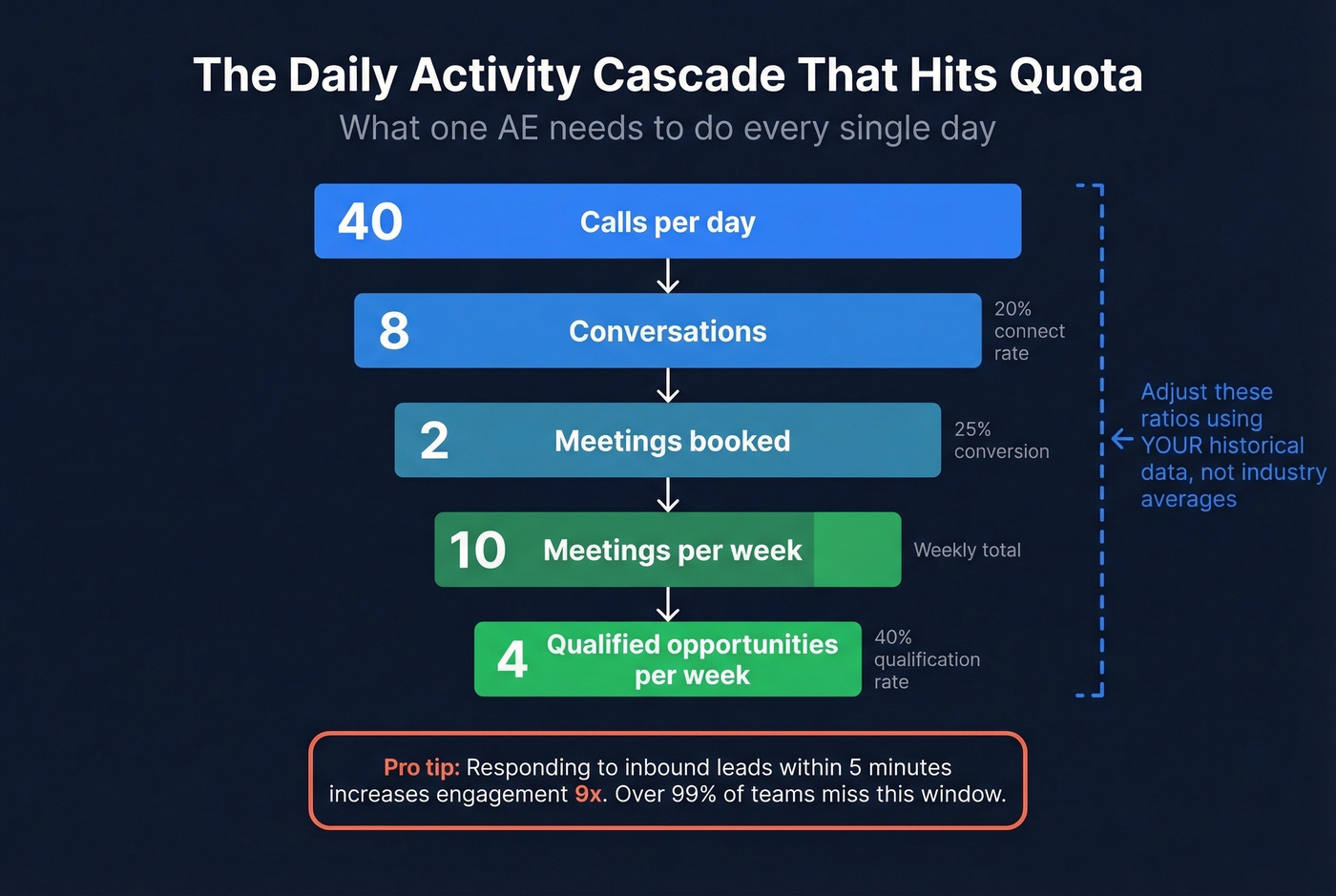
A typical activity cascade looks like this: 40 calls/day lead to 8 conversations, which produce 2 meetings booked, giving you 10 meetings/week and 4 qualified opportunities/week. Adjust based on your actual conversion data, not industry averages.
One benchmark worth building into your plan: responding to inbound leads within five minutes increases engagement 9x. Over 99% of teams don't hit that window. If you can, it's a genuine competitive advantage.
Build Your Prospect List
This is where planning meets execution - and where most plans quietly fall apart. You've defined your ICP, set your activity targets, and mapped your team's capacity. Now you need actual contacts to call and email. (If you're building lists at scale, this lead generation workflow helps prevent leaks.)

The math is simple. Bad data wastes the 70% of rep time already spent on non-selling activities. Good data protects it. (If you're cleaning/enriching records, compare data enrichment services.)
Define Your Review Cadence
Stop writing annual plans. The teams we've seen hit number consistently run a rolling quarterly plan with monthly reviews and weekly pipeline check-ins. Annual plans set direction; quarterly plans drive execution.
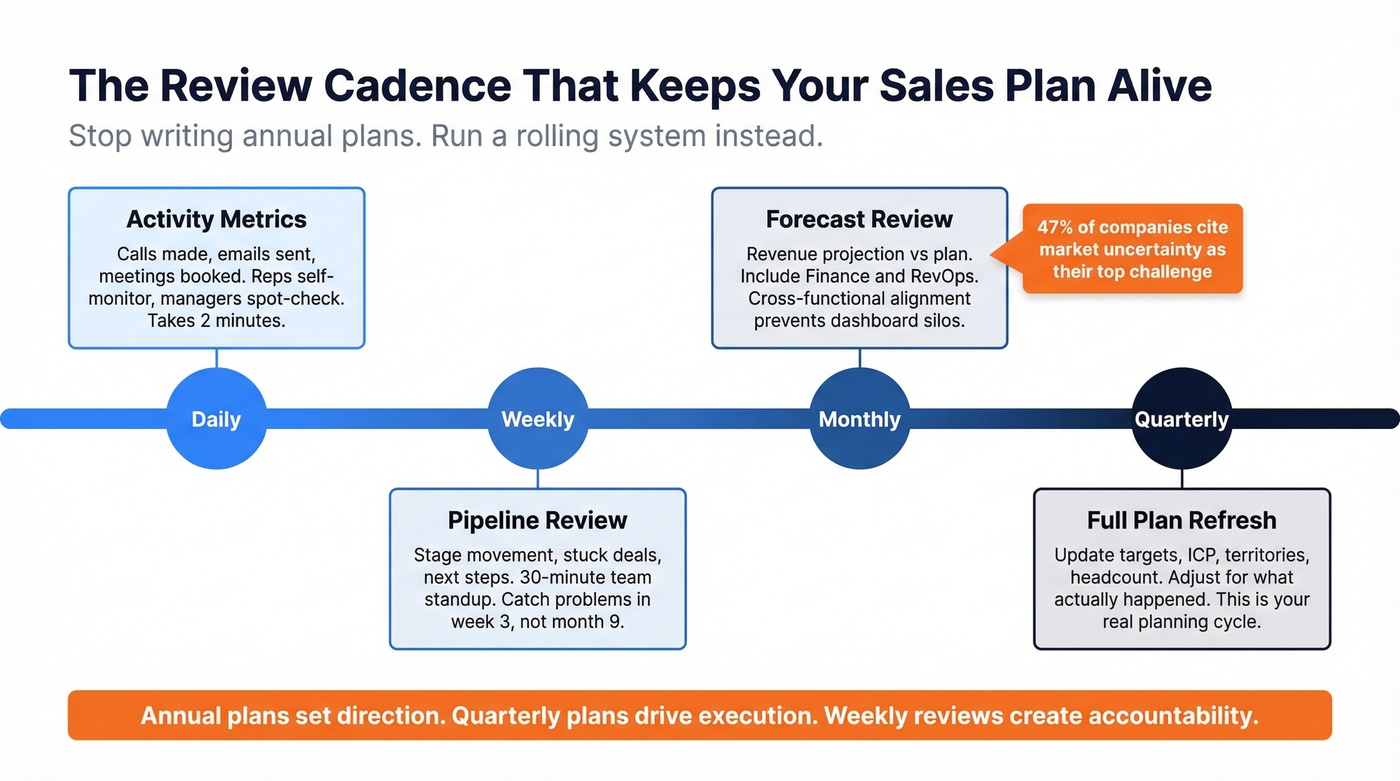
The cadence that works: activity metrics reviewed daily, pipeline reviewed weekly, forecast reviewed monthly, full plan refresh quarterly. This isn't bureaucracy - it's the feedback loop that lets you catch problems in week 3 instead of month 9. (If you formalize quarterly reviews, use these QBR questions.)
Cross-functional alignment matters here too. Finance and RevOps should be in the monthly review. Plans built in silos fail - 47% of companies cite market uncertainty as their top challenge, and you can't navigate uncertainty if Sales, Finance, and Ops are looking at different dashboards.

You just calculated that a $2M target needs 238 qualified opportunities and 595 meetings. That math only works if you can actually reach the right people. Prospeo gives you 300M+ profiles with 30+ filters - buyer intent, technographics, headcount growth, funding - so your ICP definition translates directly into a callable list with 98% accurate emails.
Turn your pipeline math into real conversations at $0.01 per verified email.
Sales Plan Example
Here's a filled-in plan for a mid-market SaaS company - not a template with blanks, but actual numbers you can benchmark against. Most sales plan examples floating around online are either too generic or too complex. This one is designed to be usable on day one.
Company: CloudOps Pro (mid-market infrastructure monitoring, Series B)
Revenue target: $3.6M new ARR (Q1-Q4 2026)
Average deal size: $36K ACV
Deals needed: 100 closed-won deals (25/quarter)
Win rate (current): 19% - Target: 24%
Pipeline required: 417 qualified opportunities (100 / 0.24) = $15M in pipeline value (4.2x coverage)
ICP: B2B SaaS and fintech companies, 200-2,000 employees, Series B+, using AWS or GCP, with a VP of Engineering or CTO as primary buyer.
Team: 1 Sales Manager, 6 AEs (2 ramping), 3 SDRs
Capacity assumption: 4 fully productive AEs + 2 at 50% (ramping) = 5 FTE equivalents
Activity targets per SDR: 50 calls/day, 30 personalized emails/day, 8 meetings booked/week
Activity targets per AE: 10 discovery calls/week, 6 demos/week, 3 proposals/week
Methodology: MEDDIC (multi-stakeholder deals, 3-5 month cycles)
Tech stack: Salesforce (CRM), Prospeo (prospecting data), Outreach (sequences), Gong (call intelligence)
Review cadence: Daily standups (activity), weekly pipeline review (Thursday), monthly forecast + plan review (first Monday), quarterly plan refresh
Scenario planning: Base case $3.6M, conservative $2.9M (-20%), optimistic $4.3M (+20%). Conservative case still requires 5 AEs - headcount plan holds.
Key risk: 2 AEs ramping simultaneously - if either leaves before month 3, Q2 target is at risk. Mitigation: maintain 1 qualified candidate in pipeline at all times.
This plan fits on two pages. Every number connects to the one above it. That's the point.
If you want to adapt this for a different company stage, apply the same math framework to your own numbers - the structure scales from seed-stage startups to enterprise orgs.
Why Sales Plans Fail
Most plans don't fail because the strategy was wrong. They fail because of execution breakdowns that were preventable.
Built in silos. Sales writes the plan, Finance sets different targets, Marketing generates leads for a different ICP. By Q2, everyone's working from a different playbook. The fix: get Finance and RevOps in the room during planning, not after. (If you're defining ownership, this RevOps manager breakdown helps clarify responsibilities.)
Bad data underneath. Teams manually cobble together prospect lists from multiple sources, transfer data between spreadsheets, and end up with duplicates, stale contacts, and bounced emails. Define your terms upfront - what counts as a "qualified lead"? Run routine audits, and enforce validation rules in your CRM.
Wrong timing on rollout. Roll out too early in November and reps ignore it because they're closing Q4 deals. Roll out too late in February and you've already lost alignment with headcount plans and budget cycles. The sweet spot is a draft in early December, finalized by January 15.
No volatility buffer. Only 30% of companies say their compensation strategy is prepared for economic shifts, and 37% of employees say greater visibility into goals would improve their performance. These are two sides of the same coin. Build scenario models - what happens if win rates drop 5 points or your top vertical goes into a buying freeze? And make sure reps can see how their daily activities connect to the quarterly number. If they can't, the plan is a management document, not an operating system.
Here's the thing: most plans fail not because they're wrong, but because they're too ambitious. If 84% of reps are missing quota, the problem isn't lazy salespeople - it's leaders setting targets disconnected from the pipeline math. A plan your team can actually hit and then exceed builds more momentum than an aspirational number that demoralizes everyone by March.
Benchmarks to Calibrate Your Plan
Use these as starting points, not gospel. Your industry and deal complexity will shift the numbers, but planning without benchmarks is guessing.
| Metric | Current Benchmark (2026) | Planning Target |
|---|---|---|
| Win rate | 21% | 28% |
| Pipeline coverage | 3-4x revenue | 4x minimum |
| Sales cycle | 1-2 quarters | Reduce 15% |
| Ramp time | 3.2 months | Maintain or improve |
| Selling time | 30% of week | 40%+ |
| Lead response | 99%+ miss 5 min | Under 5 min = 9x engagement |
The gap between "current benchmark" and "planning target" is where your plan lives. If you're at 21% win rate and targeting 28%, your plan needs to specify how - better qualification? Stronger discovery? Tighter ICP? A number without a mechanism is just optimism. (To diagnose bottlenecks, use these funnel metrics.)
Tools to Execute Your Plan
A sales plan is a document. These tools turn it into a system.
CRM: Salesforce runs $25-165/user/month and handles enterprise teams with complex workflows. HubSpot ranges from free to $150/user/month and works well when you want marketing alignment baked in. Pipedrive at $14-99/user/month suits activity-driven sales orgs. Close at $29-149/user/month is built for inside sales teams that live on the phone. (If you're comparing options, see examples of a CRM.)
Prospecting data: Prospeo gives you 300M+ professional profiles, 143M+ verified emails with 98% accuracy, and 125M+ verified mobile numbers on a 7-day refresh cycle. It integrates with Salesforce, HubSpot, Smartlead, Instantly, Lemlist, Clay, Zapier, and Make. Credit-based pricing with a free tier - 75 emails + 100 Chrome extension credits per month, no contracts, cancel anytime.
Sales planning template: For teams that want a head start, use a planning template that mirrors the structure above - revenue targets, ICP definition, activity cascade, team capacity, and review cadence. Keeping a consistent format across quarters makes it easy to onboard new managers into the process without starting from scratch each time.
Forecasting: For most teams under 50 reps, your CRM's native reporting handles forecasting fine. Salesforce and HubSpot both offer pipeline-weighted forecasting out of the box. Skip a separate forecasting tool until your pipeline complexity outgrows what dashboards can show. (If you're evaluating dedicated platforms, see best sales forecasting tools.)
Reps spend only 30% of their time selling. Bad data makes it worse - every bounce, wrong number, and dead-end eats into that window. Prospeo's 7-day data refresh cycle and 125M+ verified mobile numbers (30% pickup rate) mean your team spends ramp time closing, not chasing outdated contacts. One customer cut rep ramp from 10 weeks to 4.
Stop wasting selling time on stale data. Get contacts that connect.
FAQ
How long should a sales plan be?
Three to five pages for a focused operating plan. If it doesn't fit in a short deck, it's too complex to execute. The best plans are referenced weekly - not filed away after the kickoff meeting.
How often should you update it?
Run a rolling quarterly plan with monthly reviews and weekly pipeline check-ins. Annual plans set direction; quarterly cadences drive execution. The market shifts too fast for a December document to stay accurate through August.
What's the difference between a sales plan and a sales strategy?
A sales strategy defines how you win - methodology, positioning, competitive approach. A sales plan translates that strategy into targets, activities, timelines, and accountability. Strategy is the "why" and "how." The plan is the "who does what by when."
What's the biggest mistake in sales planning?
Setting targets without doing the pipeline math. If you need 50 deals at a 21% win rate, you need 238 qualified opportunities. If you can't show where those come from - by channel, by rep, by month - you don't have a plan. You have a hope.
What tools help execute a sales plan?
You need a CRM like Salesforce, HubSpot, or Pipedrive, a prospecting data platform for verified emails and direct dials, and a sequencing tool such as Outreach, Instantly, or Lemlist. Layer in call intelligence if your average deal size justifies the spend.