

Sales Plays: How to Build, Deploy, and Measure Plays That Actually Get Used
Your top rep just left. She took her deal instincts, her objection-handling tricks, and her mental map of every competitive landmine with her. The rest of the team? They're winging it. 84% of sellers missed quota last year, and 17% of reps still deliver 83% of the revenue. That gap isn't a talent problem - it's a systems problem. Sales plays are how you close it.
The Short Version
- Start with 3-5 plays, not 16. Cold outbound, competitive displacement, and lost-deal reactivation cover most high-leverage moments.
- Each play needs a trigger, a bill of materials, and a success metric. Missing any of those? It's a suggestion, not a play.
- Store plays where reps already work. A beautiful Notion wiki nobody opens is worse than a messy Google Doc that gets used.
- Measure adoption, not existence. A play that lives in a folder isn't a play. It's a document.
What Is a Sales Play?
Dave Kellogg nails the definition: a sales play is "[a series of steps to make in a given situation to help you win a deal.](https://kellblog.com/2023/10/16/does-your-startup-need-a-sales-playbook-or-just-a-few-plays/)" Three words matter - steps, situation, and win. A play isn't a vague strategy. It's a concrete sequence tied to a specific scenario with a clear objective.
Most teams conflate "play" with "playbook." A playbook is a collection of plays plus the processes and policies that tie them together. Plays are the atomic unit. Trying to build a playbook on day one is like writing a cookbook before you've perfected a single recipe - you'll end up with a 60-page document that nobody reads and everyone resents.
Stop building playbooks. Build plays. One at a time. Test them. Refine them. After six months, you'll look up and realize you have a replicable playbook - one that reflects how your team actually sells, not how a consultant thinks you should sell.
Why Standardized Plays Matter Now
The selling environment has shifted underneath most teams. Per Gartner, 80% of B2B interactions now happen in digital channels, most deals require 5-12 touchpoints before a buyer engages, and up to 50% of sales go to the first vendor that responds. Winging it doesn't scale in that world.
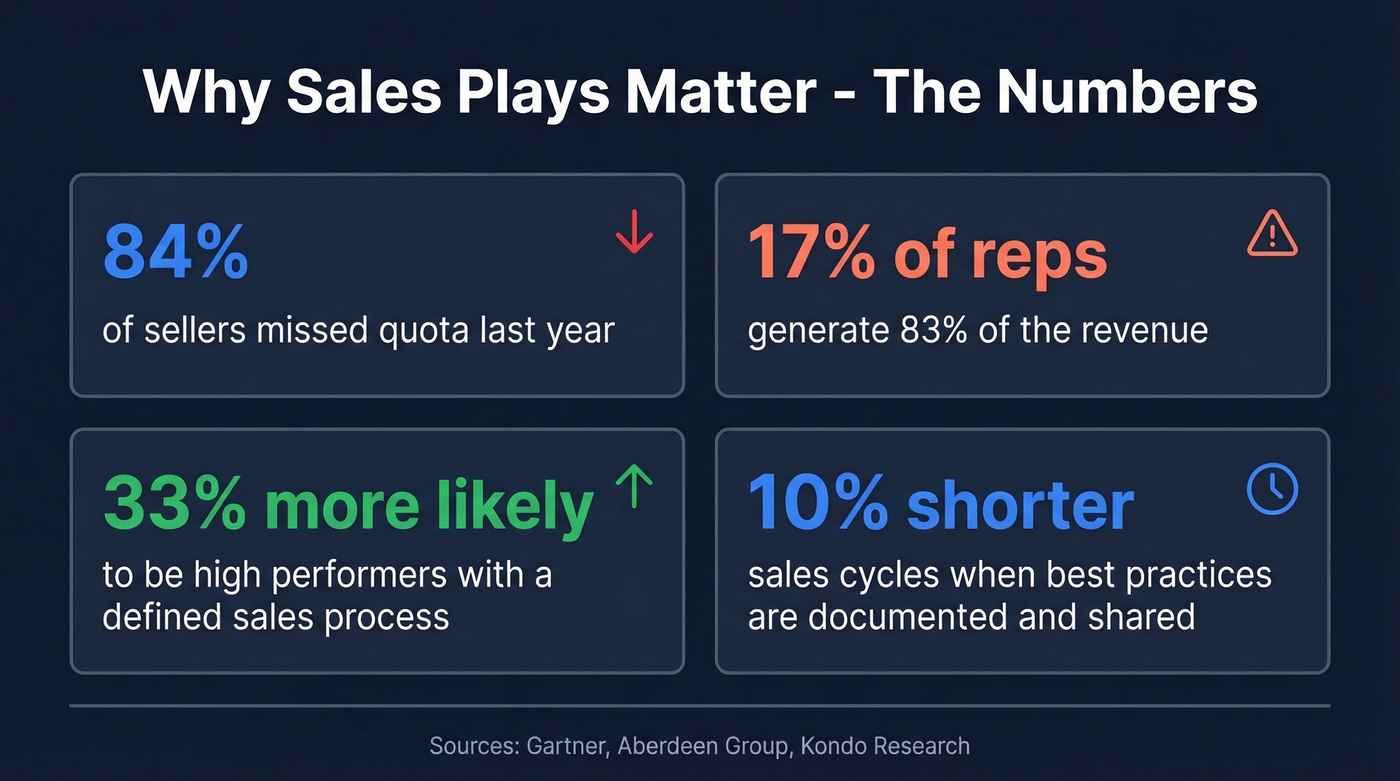
Aberdeen Group research found that teams who document and distribute high-performer best practices see sales cycles 10% shorter, 4% higher quota attainment, and 7.9% better revenue growth than peers. Companies with a well-defined sales process are 33% more likely to be high performers. Four out of five B2B deals are lost somewhere in the sales process, not because the product was wrong - the process failed. A play doesn't guarantee a win, but it cuts the ways a deal can die from neglect, bad timing, or a rep who didn't know what to do next.
Here's the thing: if 17% of your sellers generate 83% of revenue, you don't have a hiring problem. You have a knowledge-transfer problem. Stop running another hiring cycle and start encoding what your best reps do instinctively. Repeatable, documented plays are the mechanism for that.
Anatomy of an Effective Play
Every effective play has three layers. Miss one, and the play either never fires, fires without the right ammunition, or fires without anyone knowing whether it worked.
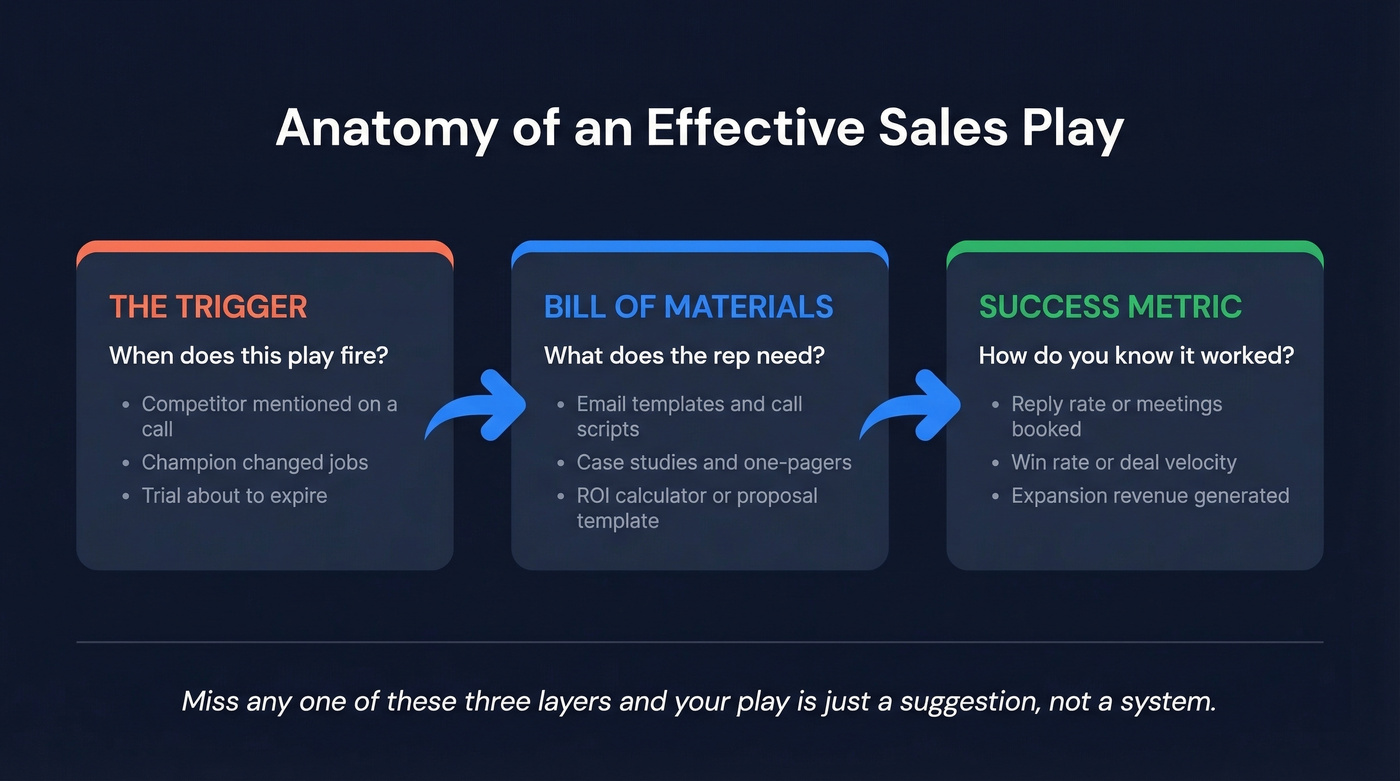
Some frameworks break plays into five elements - Hook, What to Know, What to Say, What to Show, What to Do. That's fine for mature enablement teams. But the three-layer model below is more operationally useful because it forces accountability: every play must have a clear trigger, the materials to execute, and a way to prove it worked.
The Trigger
When does this play fire? A trigger is the specific event or condition that tells a rep "run this play now." A competitor mentioned on a discovery call. A champion who changed jobs. A trial about to expire. An inbound lead from a target account. Without a defined trigger, the play is just a document sitting in a folder. Reps need to know the exact moment it becomes relevant. If you want a repeatable way to operationalize this, use a system for tracking sales triggers.
The Bill of Materials
What assets does the rep need? SalesPlayX frames this as the BOM - the bill of materials. A complete BOM typically includes:
- Tailored messaging (email templates, call scripts, objection responses)
- A prospecting sequence
- Relevant slides or a one-pager
- Customer stories that match the scenario
- Supporting content like a case study or ROI calculator
- A proposal template
The key word is "relevant." Don't dump every asset your marketing team has ever created into the BOM. Curate ruthlessly.
The Success Metric
How do you know it worked? Every play needs a measurable outcome - reply rate, meetings booked, win rate, deal velocity, expansion revenue. If you can't measure it, you can't improve it, and you definitely can't prove to leadership that the play was worth building. To pick the right KPIs, align to your funnel metrics and baseline your sales conversion rate.
Blank Play Template
Before the filled-in examples, here's the skeleton. Copy it, fill it in, and you've got a working play in 20 minutes.
PLAY NAME: [Descriptive name   -   e.g., "Competitive Displacement: Competitor X"]

OWNER: [Name of the person responsible for maintaining this play]

LAST UPDATED: [Date]

TRIGGER: [Specific event or condition that activates this play]

ICP: [Title, company size, segment, or other qualifying criteria]

TALK TRACK: [2-3 sentences on the core message and framing]

ASSETS (Bill of Materials):
- [ ] Email sequence
- [ ] Call script / objection doc
- [ ] One-pager or slide deck
- [ ] Customer story
- [ ] ROI calculator or supporting content
- [ ] Proposal template

SUCCESS METRIC: [Primary KPI + target threshold]

NOTES FROM THE FIELD: [Updated monthly   -   what's working, what's not]
Assign a play owner - someone who isn't actively carrying a quota - to keep each play current. This is the single most overlooked governance step. Without an owner, plays rot within 90 days. (If you need to formalize ownership, this is often a RevOps Manager or a sales enablement manager.)

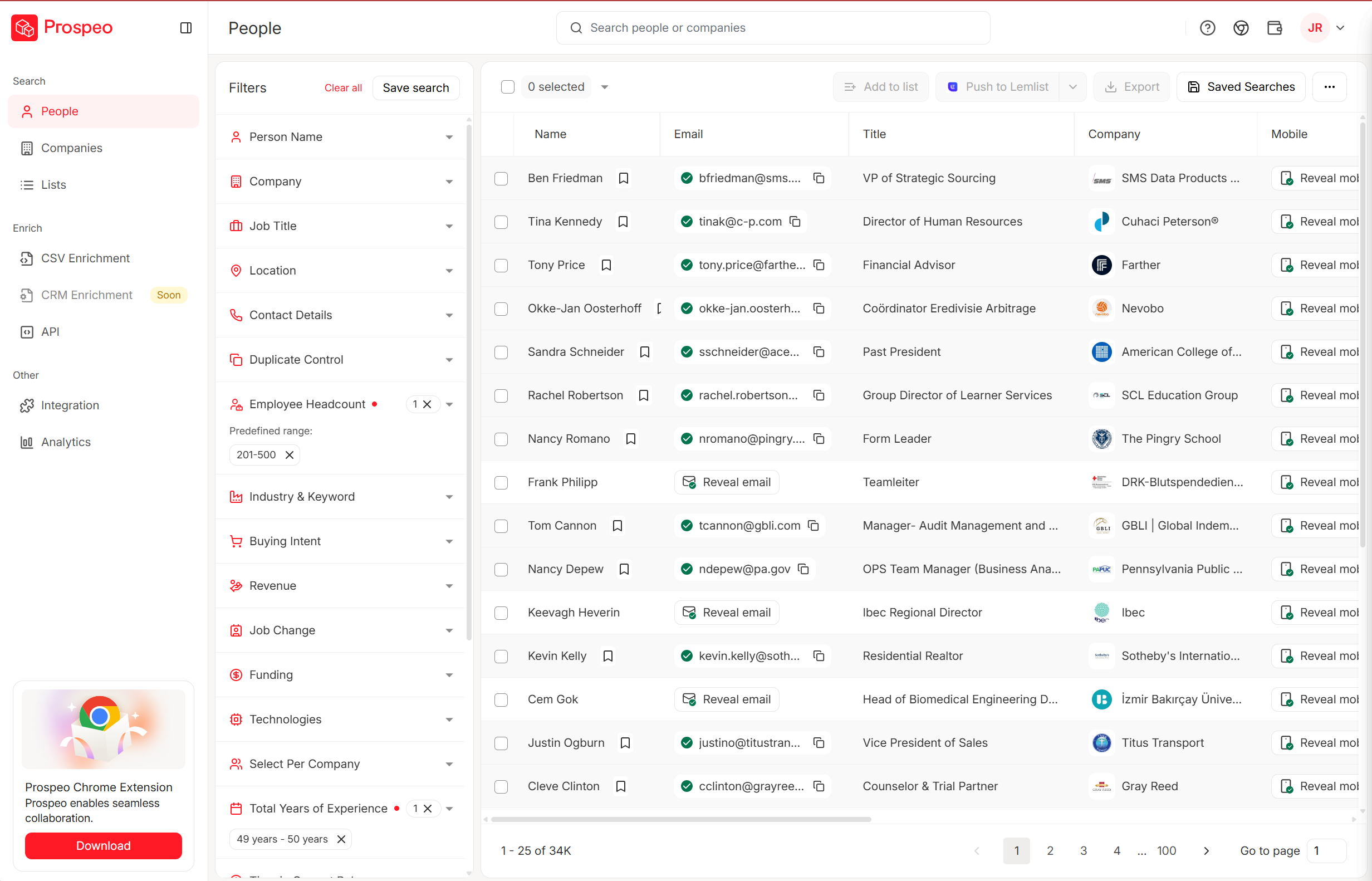
Every play in this article needs one thing to fire: verified contact data. Prospeo gives you 300M+ profiles with 30+ filters - buyer intent, technographics, funding, headcount growth - so your plays hit the right person at the right trigger. 98% email accuracy. 7-day refresh. No stale data killing your sequences.
Build the prospect list your plays actually need.
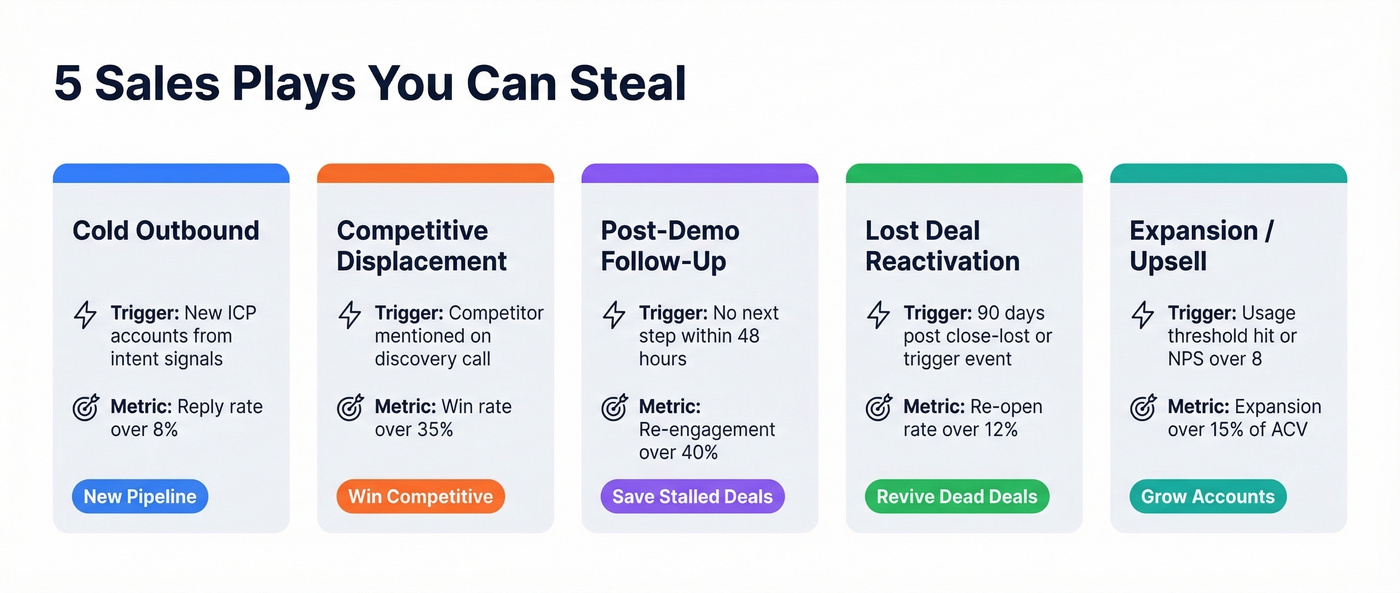
Five Sales Play Examples You Can Steal
These aren't theoretical frameworks. Each one is a filled-in template you can adapt today.
1. Cold Outbound Play
Trigger: New ICP-fit accounts identified through intent signals, funding announcements, or territory assignment.
ICP: VP/Director of Sales or RevOps at B2B SaaS companies, 50-500 employees, Series A-C. (If your ICP is fuzzy, use an ideal customer profile template.)
Talk Track: Lead with a specific pain point relevant to their stage. "Most Series B teams we talk to are still running outbound off a spreadsheet their first AE built. That breaks around rep #4." Avoid product features until the second touch.
Assets: 5-step email sequence, ICP-specific case study, ROI one-pager, objection doc for "we already have a tool," verified prospect list built with Prospeo's database and its 30+ search filters.
Metric: Reply rate >8%, meetings booked per 100 contacts >3. (If you need more angles, pull from these sales prospecting techniques.)
2. Competitive Displacement Play
Trigger: Prospect mentions a specific competitor during discovery, or intent data shows them researching alternatives.
ICP: Current users of Competitor X approaching renewal after 12+ months on the platform.
Talk Track: Don't trash the competitor. Reframe the evaluation criteria. If the competitor wins on feature breadth, shift the conversation to security, admin overhead, or TCO. Run a counter-demo focused on the 2-3 areas where you're genuinely stronger. (A structured competitive intelligence strategy makes this much easier.)
Assets: Competitive battle card, counter-demo script, "switching cost" calculator, 2 customer stories from companies that switched. If you don't have one yet, build lightweight sales battle cards first.
Metric: Win rate against Competitor X >35%, average deal size 10%+ higher than non-competitive deals.
3. Post-Demo Follow-Up Play
This is the play most teams need but nobody builds. The demo went great. The prospect said "this looks awesome." Then... silence. Forty-eight hours pass. A week. The deal is dying, and the rep sends "just checking in."
That email has never saved a deal in the history of B2B sales.
Trigger: Demo completed, no next step scheduled within 48 hours.
Talk Track: Reference something specific from the demo - a question they asked, a feature they reacted to. Send a 90-second recap video addressing their top concern, paired with a relevant case study.
Assets: Personalized video template (Loom or Vidyard), demo recap email, case study matched to their industry, mutual action plan template. If you want plug-and-play copy, use these sales follow-up templates.
Metric: Re-engagement rate >40% within 5 business days.
4. Lost Deal Reactivation Play
Trigger: 90 days post-close-lost, or a trigger event at the account like a new champion hired, a funding round, or a competitor price increase.
ICP: Deals lost to "no decision" or "timing" - not deals lost on product fit.
Talk Track: Acknowledge the previous conversation without desperation. Lead with what's changed. "Last time we talked, [specific blocker] was the issue. We've since [specific change]. Worth a 15-minute revisit?"
Assets: Re-engagement email sequence (3 touches over 2 weeks), updated one-pager highlighting what's new, relevant customer story.
Metric: Re-opened opportunity rate >12%, win rate on reactivated deals >20%.
5. Expansion / Upsell Play
| Element | Details |
|---|---|
| Trigger | Customer hits usage threshold, NPS >8, or champion gets promoted |
| ICP | Top-quartile product usage, no expansion in 6+ months |
| Talk Track | Lead with value delivered: "Your team ran 4,200 sequences last quarter - 3x what you were doing at sign-up. Here's what teams at your scale add next." |
| Assets | Usage report / QBR deck, expansion pricing one-pager, customer story from similar account, ROI calculator |
| Metric | Expansion revenue >15% of initial ACV, upsell cycle <30 days |
How to Build a Play Step by Step
Don't try to build five plays at once. Start with one.
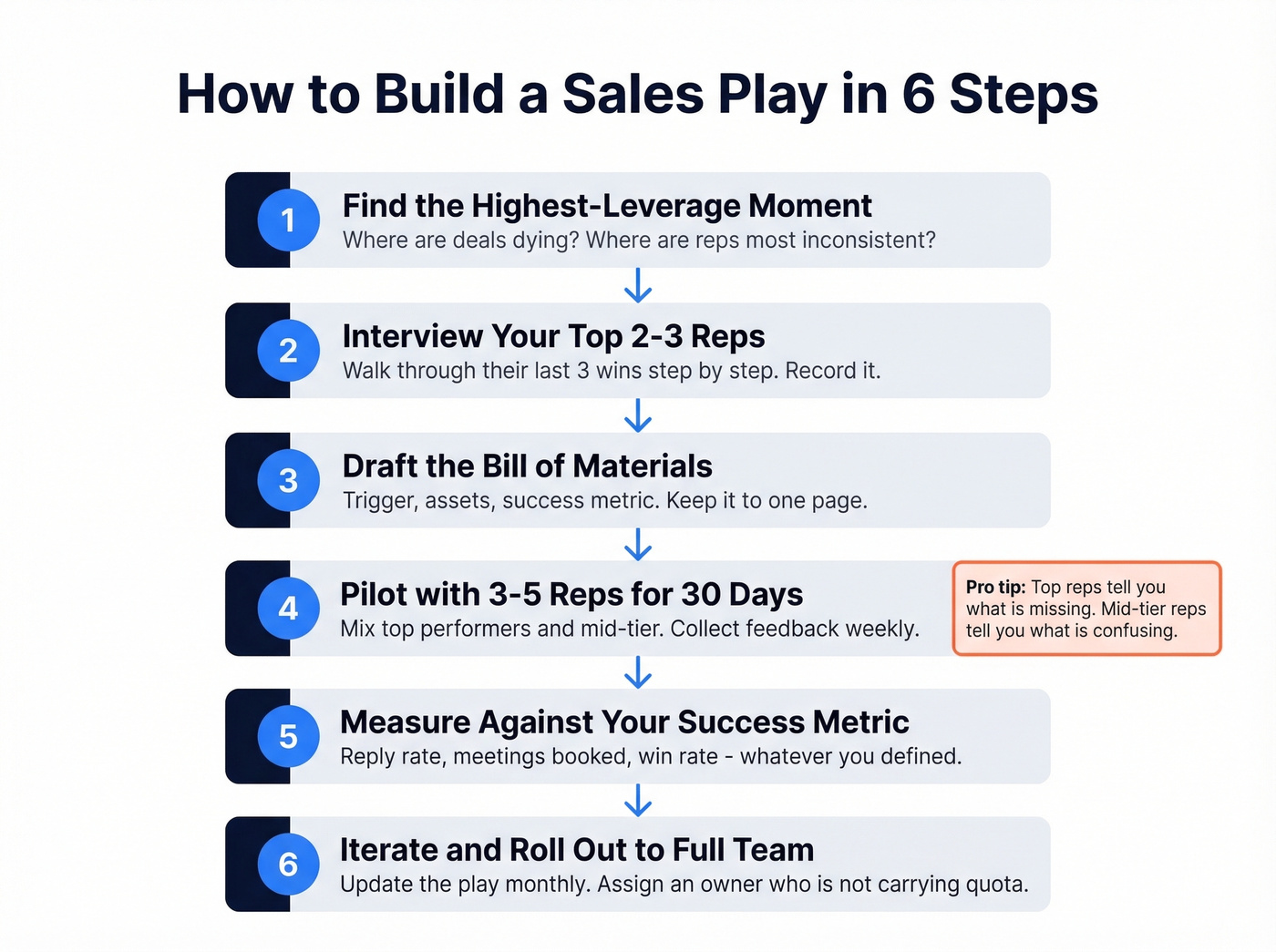
Identify the highest-leverage selling moment. Where are deals dying? Where are reps most inconsistent? That's your first play. For most teams, it's cold outbound or competitive displacement.
Interview your top 2-3 reps. Not a survey. A conversation. Ask them to walk you through their last three wins in that scenario, step by step. Record it. The patterns emerge fast.
Draft the bill of materials. Trigger, BOM, success metric. Keep it to one page. If it's longer, you're overcomplicating it.
Pilot with 3-5 reps for 30 days. Pick a mix of top performers and mid-tier reps. The top performers will tell you what's missing. The mid-tier reps will tell you what's confusing.
Measure against the success metric you defined. If reply rates didn't move, if win rates didn't budge, figure out why before rolling it out broadly.
Iterate based on field feedback. The first version of any play is wrong. That's fine. The point is to have a version to improve, not a perfect document that never ships.
Roll out with Equip-Train-Coach. Equip means giving reps the assets. Training means walking them through the play once. Coaching means reinforcing it in deal reviews and 1:1s for the next 60 days. 87% of sales training is forgotten within weeks without reinforcement. The coaching layer is what makes it stick. (For reinforcement tactics, borrow from sales training tips.)
Where to Store and Manage Plays
The enablement market is consolidating fast. Seismic and Highspot announced a merger in February 2026, Showpad merged with Bigtincan in late 2025, and Gong expanded into full revenue enablement earlier this year. Fewer platforms, more capability per platform.
A RevOps practitioner on Reddit asked the question every team eventually hits: "Where do you keep the playbook, and how do you keep it updated?" We've seen this play out across dozens of teams, and the answer is frustratingly simple: store plays where reps already spend their time.
| Tool | Best For | Price | Key Tradeoff |
|---|---|---|---|
| Google Docs | <5 reps, scrappy | Free | Gets messy fast |
| Notion / Coda | 5-20 reps | ~$8-$15/user/mo | No CRM embed |
| Guru / Tettra | 10-30 reps | ~$10-$20/user/mo | Knowledge mgmt only |
| Highspot / Seismic | 20+ reps | ~$20k-$100k+/yr | Enterprise setup |
| Gong | 20+ reps | ~$30k-$100k+/yr | Broader than plays |
Under 20 reps, Notion is the sweet spot. It's structured enough to organize plays by scenario, cheap enough that nobody questions the spend, and flexible enough to link call recordings, templates, and battle cards in one place. Over 20 reps, invest in an enablement platform that embeds plays directly in the CRM workflow. The play that lives inside your CRM gets used. The play that lives in a wiki gets forgotten. (If your CRM setup is messy, start with the basics of contact management software.)
How to Measure Play Effectiveness
The hardest part isn't building plays - it's knowing whether they work. A RevOps practitioner framed the core questions perfectly: Where do plays live? How do sellers know which play to use? How do you tie play usage to specific deals? And how do you measure which plays actually work?
Five KPIs worth tracking:
- Adoption rate - what percentage of reps actually used the play in the last 30 days? Below 60% signals a distribution or relevance problem, not a quality problem.
- Deal association rate - how many open opportunities have a play tagged to them? This requires CRM discipline, but it's the only way to connect play usage to outcomes.
- Win rate delta - compare win rates for deals where the play was used vs. deals where it wasn't. This is the single most important metric. No measurable delta after 30 days? Revise or kill the play.
- Cycle time delta - are deals moving faster when reps follow the play? Aberdeen's research points to 10% shorter cycles with well-documented processes.
- Content engagement - which assets in the BOM are reps actually sending? Which ones are prospects opening? Dead assets should be replaced, not left to rot.
Build a quarterly play review cadence. Pull the numbers, interview 3-5 reps, update the BOM, and kill plays that aren't performing. Teams using structured play management have reported deal velocity improvements of 20-25%.
Mistakes That Kill Plays
Not documenting learnings. Your top rep figured out that leading with the ROI calculator doubles meeting-to-opportunity conversion. If that insight stays in her head, it dies when she leaves. Capture field intel systematically - monthly "what's working" roundtables are the minimum.
Too many floating versions. Three reps are using three different versions of the competitive battle card. The prospect gets inconsistent messaging. The fix: a single source of truth with a clear owner and a last-updated date on every asset.
Not evolving the play. You built the cold outbound play when you were selling to SMBs. Now you're moving upmarket to enterprise. Same play, different buyer - that doesn't work. Plays need version control tied to market shifts, product changes, and segment expansion. (This gets sharper when you adopt data-driven selling.)
No peer collaboration. Plays built in a vacuum by enablement teams miss the nuance that field reps live every day. The best plays are co-authored - enablement provides the structure, reps provide the substance.
Bad data at the execution layer. This one's invisible until it's catastrophic. If 30-40% of your emails bounce, the play didn't fail - the data did. We've seen teams blame their messaging, their timing, their ICP definition, when the real problem was a contact list full of dead addresses. Verify your list before every campaign. (If bounces are a recurring issue, start with email bounce rate.)
Operationalizing Plays With AI in 2026
The enablement platforms are racing to make plays self-selecting. Instead of a rep digging through a wiki to find the right play, AI agents surface the right play at the right moment. Highspot's AI agent examples are illustrative - reps can ask things like "What sales play is best for pricing discussions this week?" and managers can query "Which reps skipped the competitive displacement play last quarter?"
That's a real shift. The play goes from a static document to a dynamic recommendation engine.
Early numbers are promising. Enterprise teams using AI-powered execution platforms report pipeline increases of 30%, win rate uplifts of 20-25%, and 6-10% of weekly seller time saved per rep. And 44% of lost deals stem from internal account shifts that sellers didn't detect in time - exactly the kind of signal AI can surface before it's too late.
Let's be honest: most teams aren't there yet. If you're under 50 reps, the AI-native enablement platforms are overkill. But the direction is clear - plays are becoming less about documents and more about contextual, real-time guidance delivered inside the tools reps already use. The teams that build strong, repeatable plays now will have the best raw material when AI takes over the distribution layer. Skip the AI layer for now if you haven't nailed the fundamentals; you'll just be automating chaos.
A play without accurate contact data is just a document. Teams using Prospeo book 26% more meetings than ZoomInfo users and 35% more than Apollo - because 98% verified emails and 125M+ direct dials mean your plays actually connect reps to real buyers, not dead inboxes.
Stop building plays on bad data. Start with contacts that connect.
FAQ
What's the difference between a sales play and a playbook?
A play is a repeatable set of steps for one specific selling situation - like competitive displacement or post-demo follow-up. A playbook is the full collection of your plays plus the processes tying them together. Build individual plays first; the playbook emerges naturally.
How many plays should a team start with?
Three to five, covering your highest-leverage moments: cold outbound, competitive displacement, and lost-deal reactivation. More than that before those are adopted just creates noise. Add new plays only after adoption on existing ones exceeds 60%.
How do you measure if a play is working?
Compare win rate and cycle time for deals where the play was used vs. not. No measurable delta after 30 days means you should revise or kill it. Teams tracking this consistently report 20-25% improvements in deal velocity.
Who should own and maintain plays?
Assign someone who isn't actively carrying a quota - typically a sales enablement manager or RevOps lead. They handle updates, version control, and quarterly reviews. Without a dedicated owner, plays go stale within 90 days.
Start with one play. Make it work. Then build the next one.