

Sales Presentation Strategy: The Data-Backed Playbook for 2026
The average B2B win rate sits at 21%. Four out of five deals end in a loss - and most sales teams don't have a real sales presentation strategy. They have a slide deck and a prayer.
Meanwhile, the average deal involves 5+ decision-makers, 80% of B2B interactions are digital, and sales cycles have stretched 32% longer since 2021. A confident closer with a pretty deck isn't enough anymore. You need a system built on stakeholder intelligence, modular content, virtual-first delivery, and real measurement.
The Quick Version
- Stop building one deck for every prospect. Use a modular system with interchangeable slides customized per stakeholder persona - champion, decision-maker, influencer, user.
- Design for virtual-first delivery. 80% of B2B interactions are digital now. Your pacing, interaction cadence, and follow-up must reflect that.
- Measure what matters. Track content adoption, win rate, and sales cycle length. If you can't tell which slides moved the deal forward, you're guessing.
Mistakes That Kill Presentations
Most presentation failures happen upstream of the slides. The approach matters far more than the polish on any individual slide.
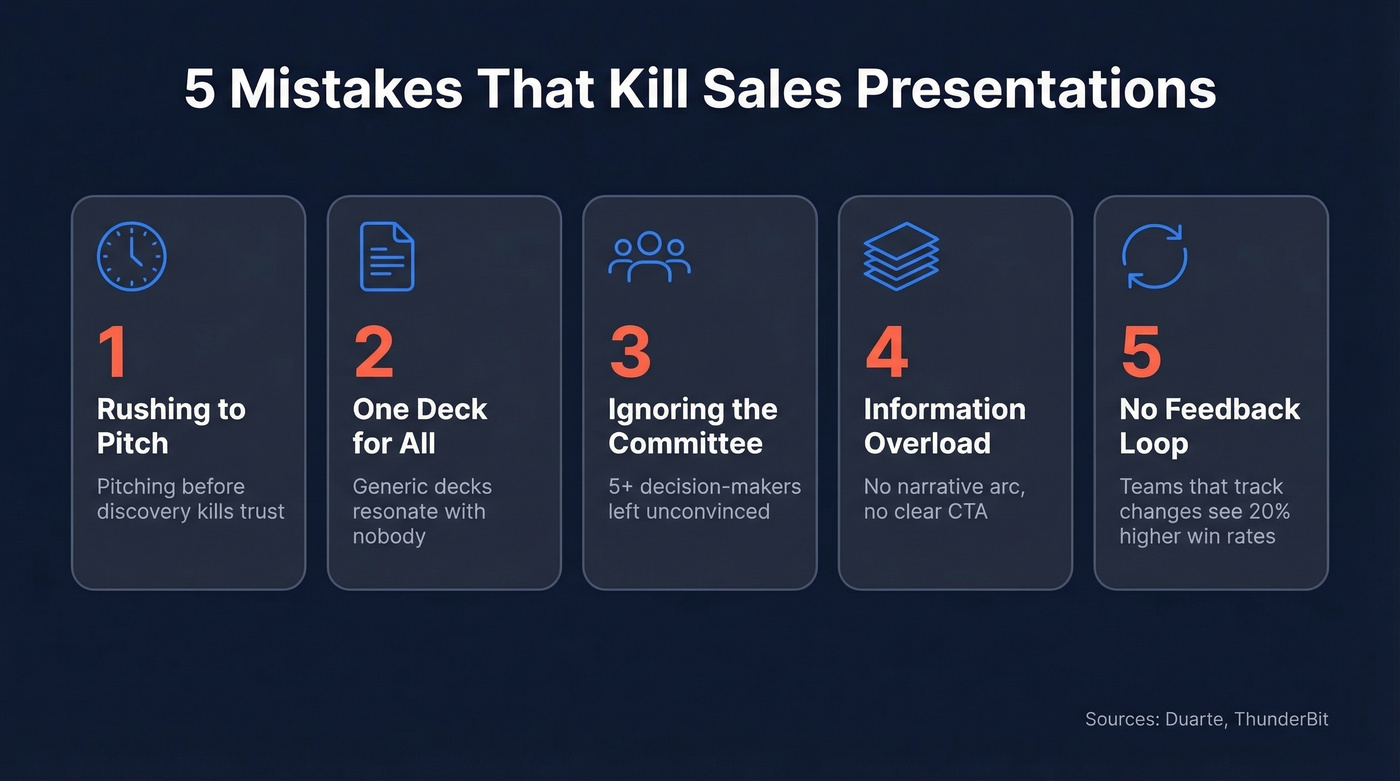
1. Rushing to pitch before discovery. Sending a deck two minutes into a call signals you don't care about the prospect's actual problem. The pitch should be the answer, not the opener. If you need a tighter pre-pitch process, start with a structured set of discovery prompts.
2. One deck for every prospect. Teams try to make a single deck do everything: founding story, full product suite, case studies for three industries. The result is a bloated 40-slide monster that resonates with nobody. Duarte's research confirms it - one size fits nobody.
3. Ignoring the buying committee. Deals stall because IT, finance, legal, or procurement raised objections nobody anticipated. If your presentation only speaks to one persona, you're leaving four decision-makers unconvinced. This is where team selling and clear role coverage matters.
4. Information overload. No clear ownership of the deck means repetitive slides, no narrative arc, no clear CTA. Too many cooks.
5. No feedback loop. One team reported a 20% win-rate increase over two quarters after replacing urgency-based CTAs with data-backed proposals and tailored value maps. They only discovered this because they tracked what changed.
Three Frameworks Worth Using
| Framework | Best For | Structure | When to Use |
|---|---|---|---|
| OPA | Technical buyers | Observations → Plan → Advantages | Complex technical solutions |
| SCR | Executive audiences | Situation → Complication → Resolution | Board-level strategic pitches |
| 6-Slide Arc | Most B2B deals | Problem → Solution → Proof → ROI → Next Steps | Default for mid-market sales |
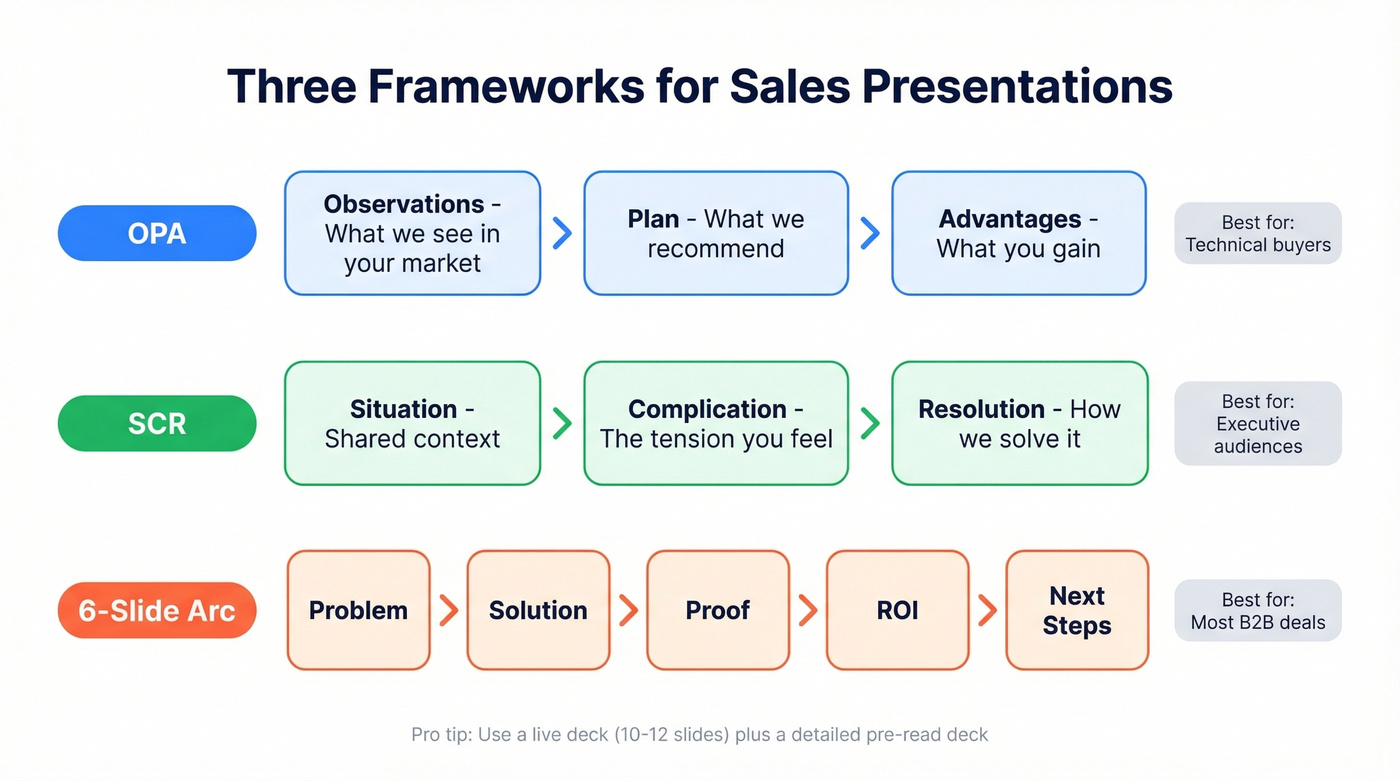
OPA (Observations → Plan → Advantages) works when your audience needs the logic chain. "Because X is happening in your market, we do Y, which produces Z." It's what technical stakeholders want - the mechanism, not just the outcome. (If you're mapping personas, the distinction between technical buyer vs economic buyer helps.)
SCR (Situation → Complication → Resolution) is storytelling for executives. You establish shared context, introduce the tension they're already feeling, then resolve it. Zuora's famous "old world vs. new world" opening slide is a textbook SCR complication - it reframes the entire conversation before the product ever appears. This framework pairs well with data storytelling principles where the complication is where your data does the heavy lifting.
The 6-Slide Arc is the workhorse. Problem, Solution, Proof, ROI, Next Steps. Think of how Steve Jobs launched the iPod: he didn't open with specs. He opened with "1,000 songs in your pocket" - problem and solution in one breath, then proof. That's the arc in action.
We've found a two-deck approach works best in practice. The live deck stays minimal - 10-12 slides max, heavy on visuals, designed for conversation. The pre-read deck is the detailed version with appendix slides, technical specs, and supporting data for stakeholders who weren't in the room. Marketing and sales should co-create this modular system together: sales knows what resonates in the room, marketing knows how to structure the narrative. Assign clear roles for live delivery - a narrative lead, a subject-matter specialist for deep questions, and a notetaker capturing objections.
Customize for Every Stakeholder
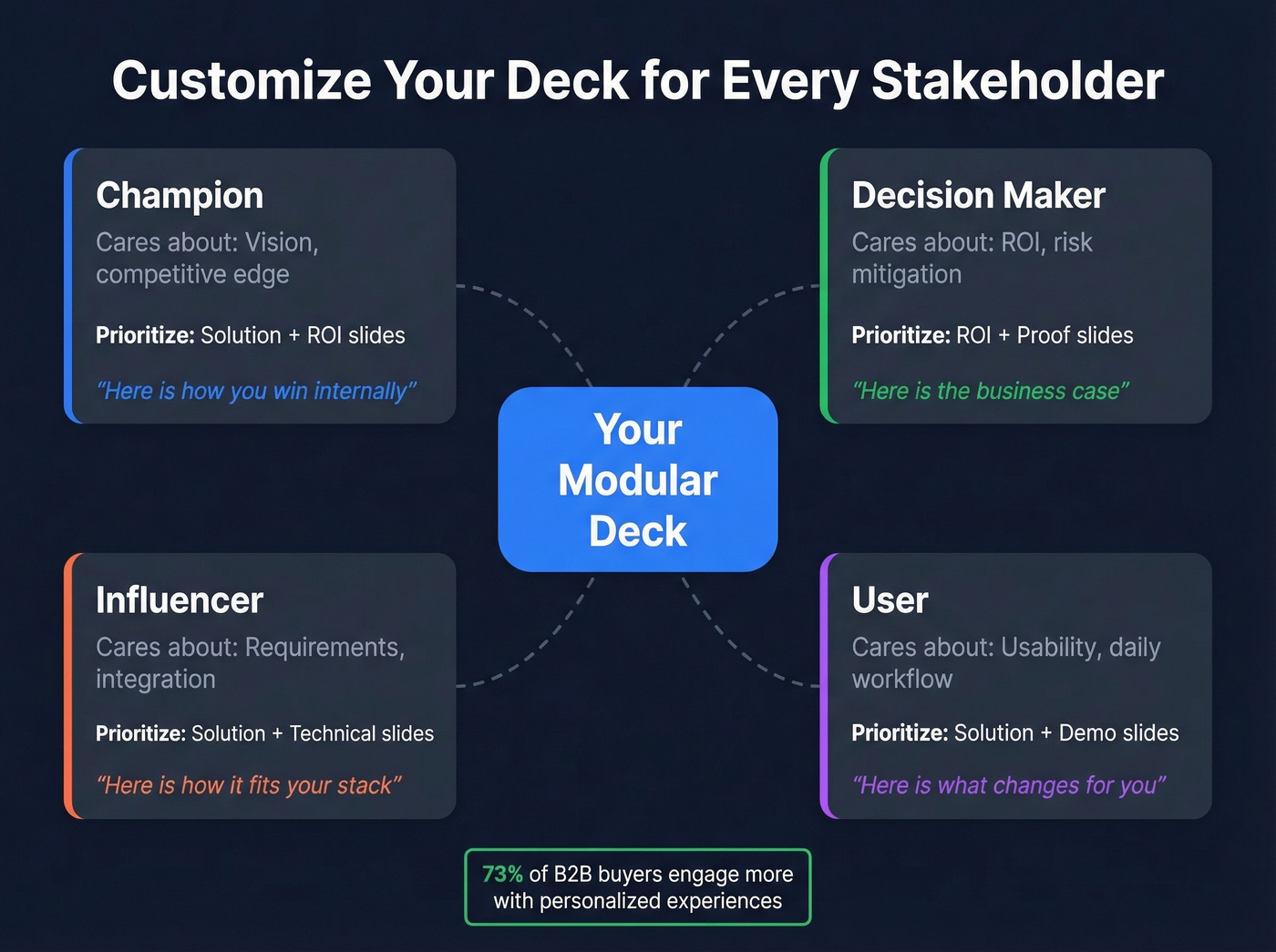
73% of B2B buyers are more likely to engage with vendors that demonstrate understanding through personalized experiences. Generic decks demonstrate laziness.
| Persona | What They Care About | Slides to Prioritize | Messaging Angle |
|---|---|---|---|
| Champion | Vision, competitive edge | Solution + ROI | "Here's how you win internally" |
| Decision Maker | ROI, risk mitigation | ROI + Proof | "Here's the business case" |
| Influencer | Requirements, integration | Solution + Technical | "Here's how it fits your stack" |
| User | Usability, daily workflow | Solution + Demo | "Here's what changes for you" |
The practical answer isn't four separate decks. It's a modular system - standardized building blocks assembled per deal. Your problem slide stays consistent. Your proof slides rotate based on industry. Your ROI slide gets customized with the prospect's actual numbers.

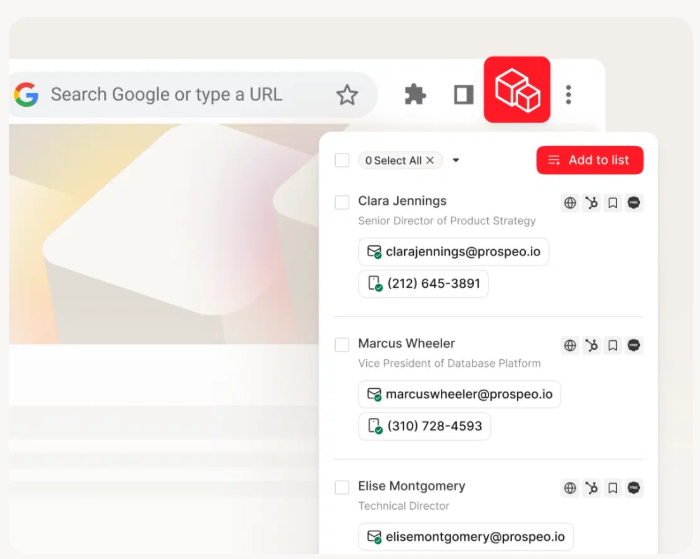
Here's the thing: personalization requires current data. If your CRM hasn't been enriched in months, you're guessing at job titles and priorities. Prospeo refreshes contact data every 7 days and includes intent data tracking 15,000 topics via Bombora - so when the VP of Engineering at your target account is surging on "API integration" topics, you know exactly what to put on the influencer slides. (If you're building this into your workflow, a lightweight lead enrichment step prevents bad personalization.)

Personalizing presentations requires knowing what each buyer cares about right now - not six weeks ago. Prospeo refreshes data every 7 days and tracks 15,000 intent topics via Bombora, so you can tailor every slide to what's actually on your stakeholders' minds.
Stop guessing what to put on the influencer slide.
Virtual Delivery Tactics
92% of B2B buyers prefer digital engagement, and 90% of decision-makers expect remote selling to remain long-term. Virtual isn't a compromise. It's the default.
But virtual presentations fail differently than in-person ones. Attention drops faster, technical glitches kill momentum, and you can't read the room when half the cameras are off. Here's what works:
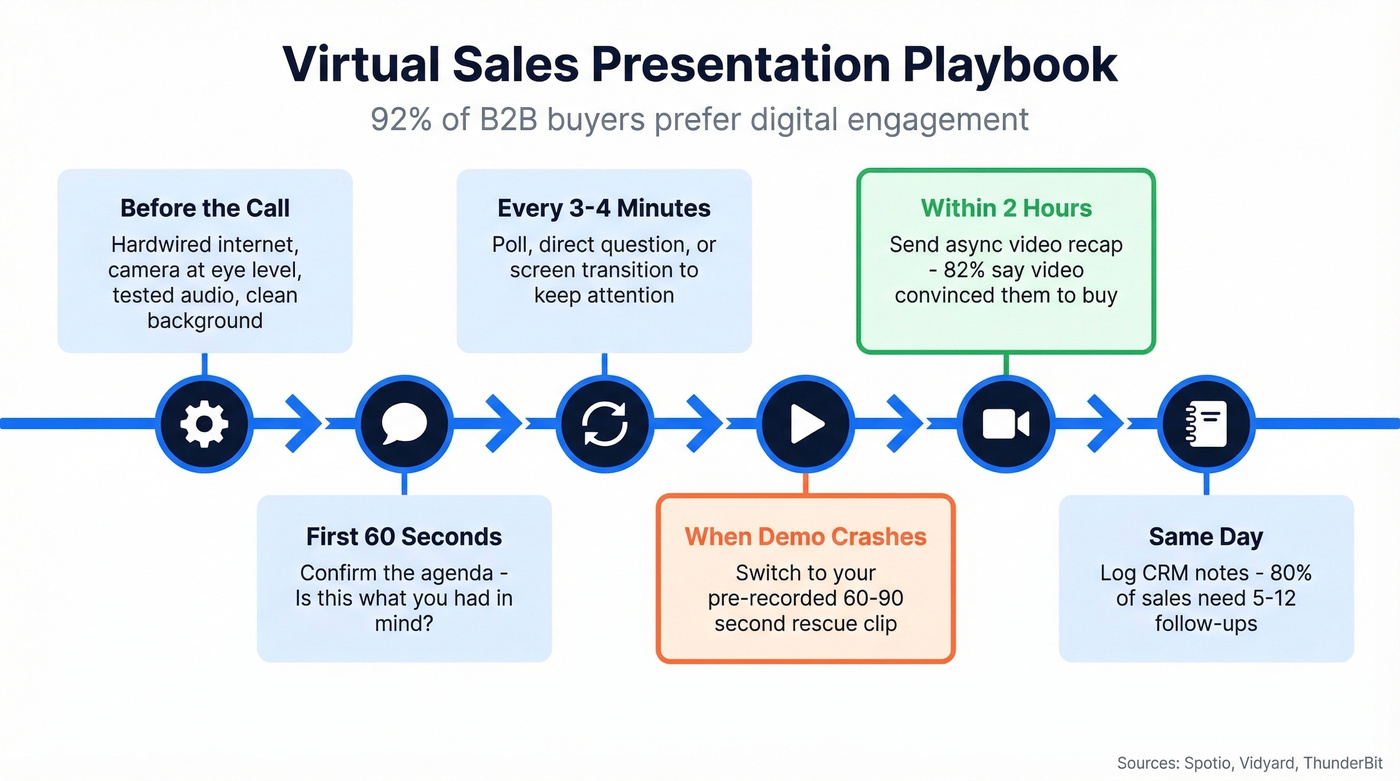
- Tech setup: Hardwired internet, camera at eye level, clean background, tested audio. Non-negotiable.
- Confirm the agenda in the first 60 seconds. "Is this what you had in mind?" gives the prospect ownership and prevents silent disconnect.
- Interaction every 3-4 minutes. A poll, a direct question, a screen transition. Virtual attention drops fast without these touchpoints.
- Have a rescue clip. Record a 60-90 second pre-recorded demo segment. When your live demo crashes - and it will eventually - you switch without missing a beat. (Use a simple product demo checklist so the backup is always ready.)
- Send an async video recap within 2 hours. 82% of customers say video has convinced them to buy. Async follow-up isn't optional. Summarize key points, restate priorities, include the next step.
- Log CRM notes the same day. 80% of sales require 5-12 follow-ups, yet 44% of reps give up after one. Speed and persistence win deals. If you need copy you can reuse, keep a set of sales follow-up templates on hand.
Slide Design and Delivery
Stop obsessing over slide design. Start obsessing over who's in the room.
Design is table stakes. Follow the 6x6 rule - six lines, six words per line - with 30+ point font and visuals over text. Aim for a 9-15 minute live presentation; anything longer and you're monologuing, not selling. In our experience, the best presenters spend 70% of their prep time on research and 30% on the deck itself.
The highest-leverage delivery tactic nobody uses enough: strategic silence. State your price, then pause. Ask "Is there anything I've missed?" and wait. Those moments invite the prospect to reveal objections they'd otherwise save for the internal debrief you'll never see. I started recording my own presentations and running weekly self-audits about a year ago - uncomfortable, yes, but it's the fastest path to improvement by a mile. (If you're standardizing this across reps, treat it like sales communication training, not a one-off tip.)
Tools for Building and Delivering
The right stack depends on where your bottleneck is.
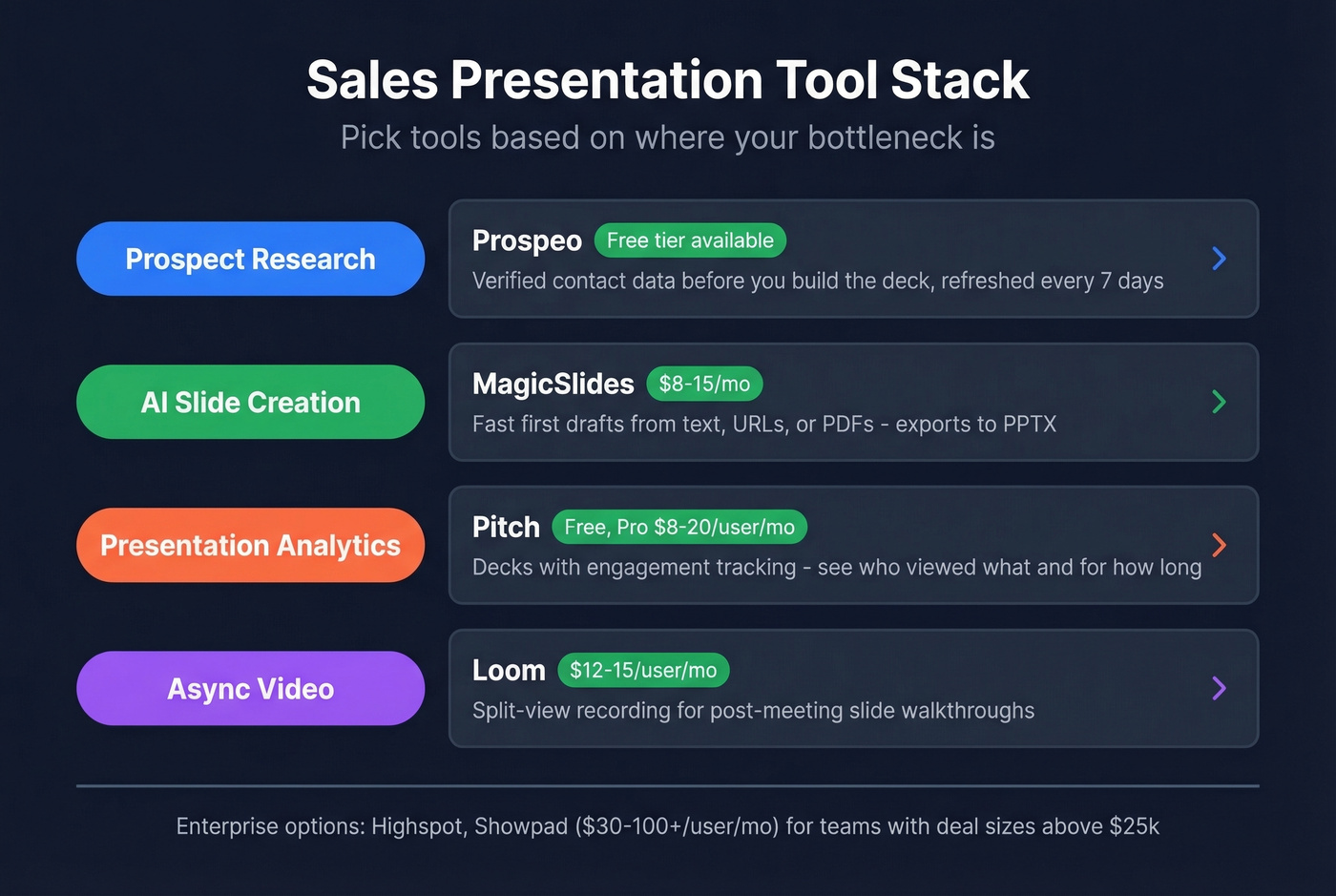
| Category | Tool | Starting Price | Best For |
|---|---|---|---|
| Prospect Research | Prospeo | Free tier available | Verified data before building |
| AI Slide Creation | MagicSlides | ~$8-15/mo | Fast first drafts, PPTX export |
| Presentation Analytics | Pitch | Free; Pro ~$8-20/user/mo | Decks with engagement analytics |
| Async Video | Loom | Free; Business ~$12-15/user/mo | Post-meeting video recaps |
MagicSlides takes text, URLs, PDFs, even YouTube videos and generates clean slides that export to PPTX without formatting headaches. The consensus on r/AIToolMadeEasy is that it strikes the right balance between automation and control. Best starting point for teams that need volume without sacrificing quality.
Pitch is the pick for sales teams that want engagement analytics baked in. "Pitch rooms" let you share presentations and track who viewed what, for how long. That makes it easier to see which stakeholders engaged and follow up with the right proof points. Reddit threads consistently call Pitch underrated for sales use cases. If you're building a more formal sharing workflow, a digital sales room can be the next step up.
Loom handles async follow-up. Split-view recording lets you walk through key slides after the meeting. At ~$12-15/user/month, it's cheap insurance against deals going cold. (If you want to operationalize this, see a dedicated Loom video cold email workflow.)
Plus AI (~$10-20/user/month) works well for teams living in Google Slides. Highspot and Showpad (typically $30-100+/user/month, often annual contracts) are the enterprise enablement platforms for content governance and analytics at scale. Skip these if your average deal size is under $25k - you'll spend more on the tool than it saves you. PandaDoc (~$19-60/user/month) handles the proposal layer when your presentation transitions into a formal document.
Measuring What Actually Works
If you can't measure it, you can't improve it. Here's what leading teams track, per the Sales Enablement Landscape Report:
| Metric | % of Teams Tracking | How to Measure |
|---|---|---|
| Content adoption | 50% | Deck usage rate across reps |
| Quota attainment | 43.1% | Revenue vs. target |
| Win rate | 42.2% | Closed-won / total opportunities |
| Revenue generated | 37.9% | Pipeline attributed to presentations |
| Sales cycle length | 33.6% | Days from first meeting to close |
Set goal behaviors with time windows: 25% of prospects visit your site within 48 hours of the presentation, 10% request a demo within 30 days. These leading indicators tell you whether the presentation created momentum or just filled a calendar slot. (To tighten your measurement model, align on a few core funnel metrics across sales + marketing.)
Outreach data shows deals closed within 50 days have a 47% win rate versus 20% for deals that drag beyond that. Track cycle length religiously.
Let's be honest about where most teams get this wrong: they over-invest in slide design tools and under-invest in knowing who's in the room. If your average deal size is under $25k, you probably don't need an enterprise enablement platform. You need accurate stakeholder data and a modular deck system. The sales presentation strategy that wins isn't the prettiest - it's the most informed. (If you're rebuilding the upstream engine, start with repeatable sales prospecting techniques.)
Your presentation strategy is only as good as your stakeholder intelligence. Prospeo gives you 50+ data points per contact, verified emails at 98% accuracy, and real-time buying signals - so every deck you build is backed by data, not assumptions.
Build presentations around real buyer data for $0.01 per contact.
FAQ
How long should a B2B sales presentation be?
Aim for 9-15 minutes on the live deck, capped at 15 slides. Anything longer becomes a monologue. Use a separate pre-read deck with appendix slides, technical specs, and supporting data for stakeholders who weren't in the room.
Which framework works best for executive buyers?
SCR (Situation → Complication → Resolution) consistently outperforms feature-led decks with C-suite audiences. Establish shared context, introduce the tension they already feel, then resolve it with your solution - Zuora's "old world vs. new world" slide is the textbook example.
How do I personalize for multiple stakeholders?
Build a modular deck with interchangeable slides per persona - champion, decision-maker, influencer, user. Verify each stakeholder's current role and intent signals before customizing. Tools like Prospeo's 30+ search filters and intent data let you confirm titles and buying signals so your slides speak to each person's actual priorities.
Should I use AI to create sales presentations?
For first drafts, absolutely - MagicSlides and Plus AI save hours on layout and structure. But always customize for your specific prospect and deal context. AI generates slides, not strategy.