

Sample Introductory Email: 15+ Templates That Get Replies in 2026
You've sent dozens of intro emails that disappeared into the void. No reply, no bounce notification - just silence. The average cold email reply rate sits at 3.43%, meaning roughly 97 out of 100 emails go nowhere. But the top 10% of campaigns hit reply rates above 10%. The gap between a bad introductory email and a great one isn't marginal. It's about 2.9x.
One founder on r/Entrepreneur documented a 62-day rebuild of their entire cold email approach - infrastructure, list quality, personalization, length - and doubled their reply rate from 3% to 6%. Their entire stack cost $420/month and generated 16 qualified leads. The biggest changes? Cutting email length from 141 words to under 56, verifying addresses, and sending Tuesday through Thursday between 8-11 AM in the recipient's timezone. None of that is complicated. Most people just don't do it.
What Actually Works in a First Introduction Email
If you're short on time, here's the cheat sheet:
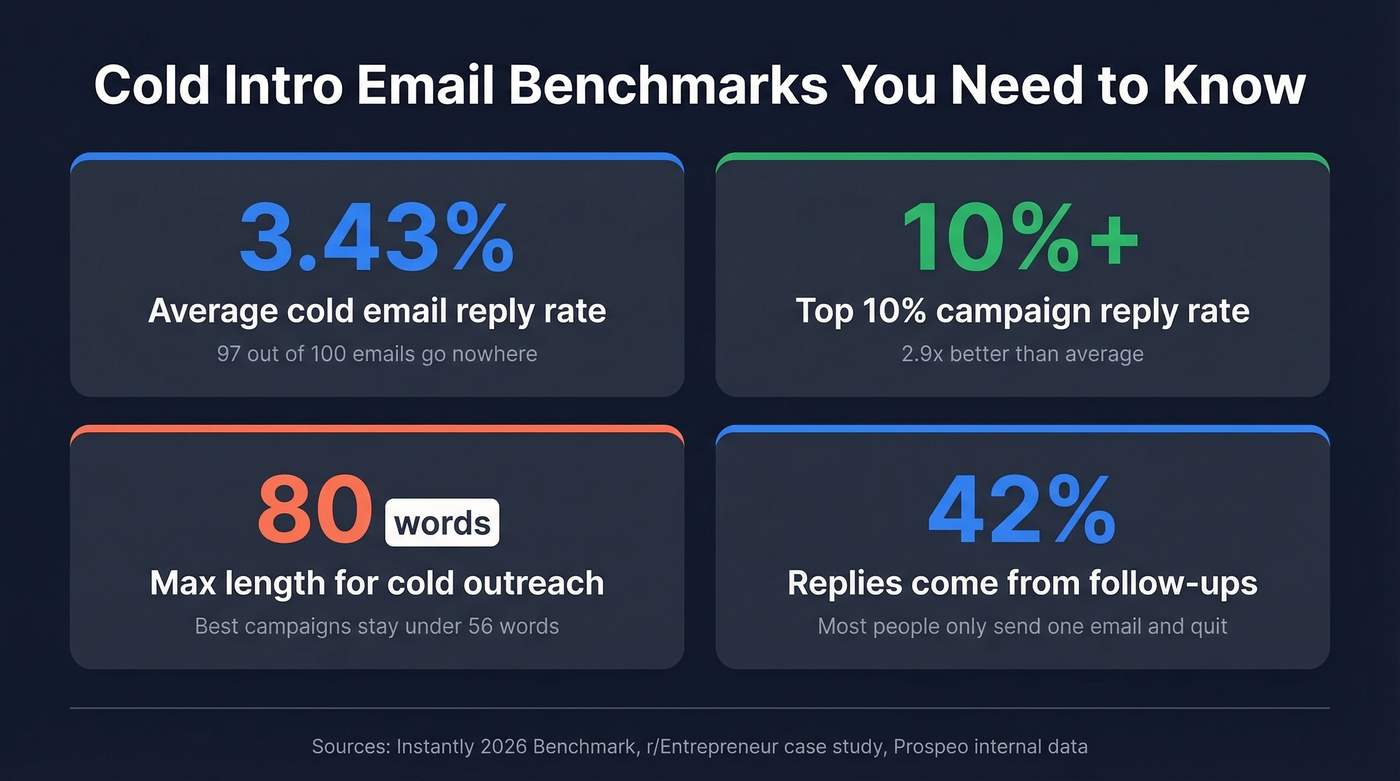
- Keep cold intro emails under 80 words. One clear ask, zero attachments. The best-performing campaigns in Instantly's 2026 benchmark stayed under this threshold.
- Use a curiosity-driven subject line. "Quick question" pulled 39% opens in one practitioner's A/B test. "Partnership opportunity" got under 19%. Never lead with a pitch. (If you want more options, see these subject line variants.)
- Verify every email address before sending. High bounce rates torch your sender reputation.
- Follow up. 58% of replies come from the first email, but that means 42% come from follow-ups. If you're sending one email and moving on, you're leaving nearly half your potential replies on the table. Use these follow-up templates as a starting point.
Jump to the templates or the data on timing and follow-ups for depth.
Anatomy of an Effective Intro Email
Every effective introductory email follows the same five-component structure, regardless of context.
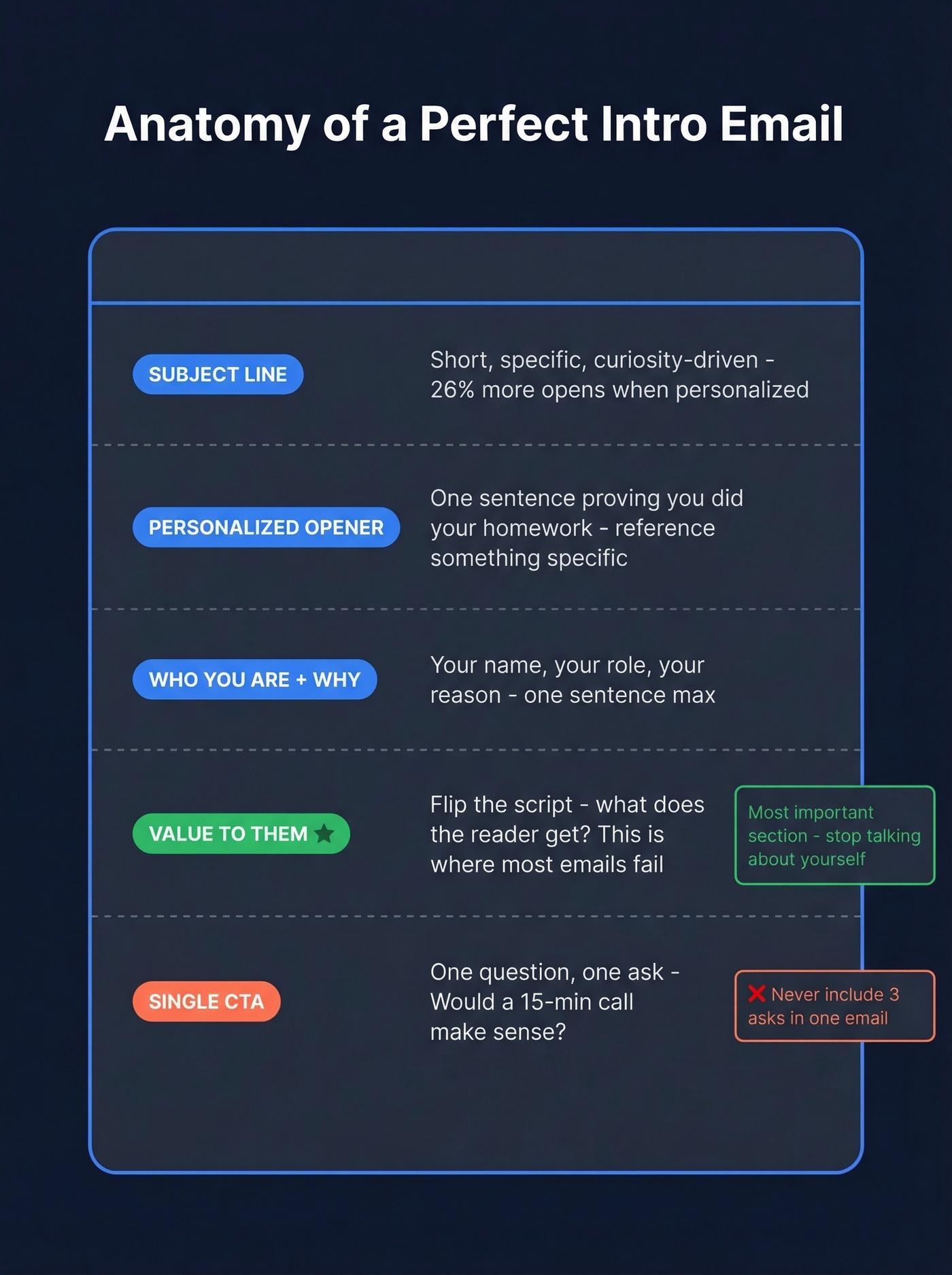
Subject line. Short, specific, curiosity-driven. Etiquette expert Jacqueline Whitmore puts it simply: keep subject lines "short, simple, and specific." Emails with personalized subject lines are 26% more likely to be opened. If you want a deeper framework, use this prospecting subject line guide.
Personalized opener. One sentence that proves you didn't mass-blast this. Reference something specific - a recent company announcement, a mutual connection, a piece of content they published. (More examples: personalized outreach.)
Who you are + why you're writing. One sentence. Your name, your role, and the reason for the email. Don't bury the purpose three paragraphs deep.
Value to them. This is where most intro emails fail. They talk about themselves instead of the recipient. Flip it. What does the reader get from engaging with you? (If you need a structure, borrow from these sample elevator pitches.)
Single CTA. One question. One ask. Not three. "Would a 15-minute call next week make sense?" works. "Check out our website, download our whitepaper, and let me know your thoughts" doesn't. For more patterns, see email call-to-action.
Whitmore also emphasizes: never skip the greeting and closing when corresponding for the first time. It signals respect and professionalism, even in casual industries.
Subject Lines That Actually Perform
Subject lines are the gatekeeper. If yours doesn't earn the open, nothing else matters.
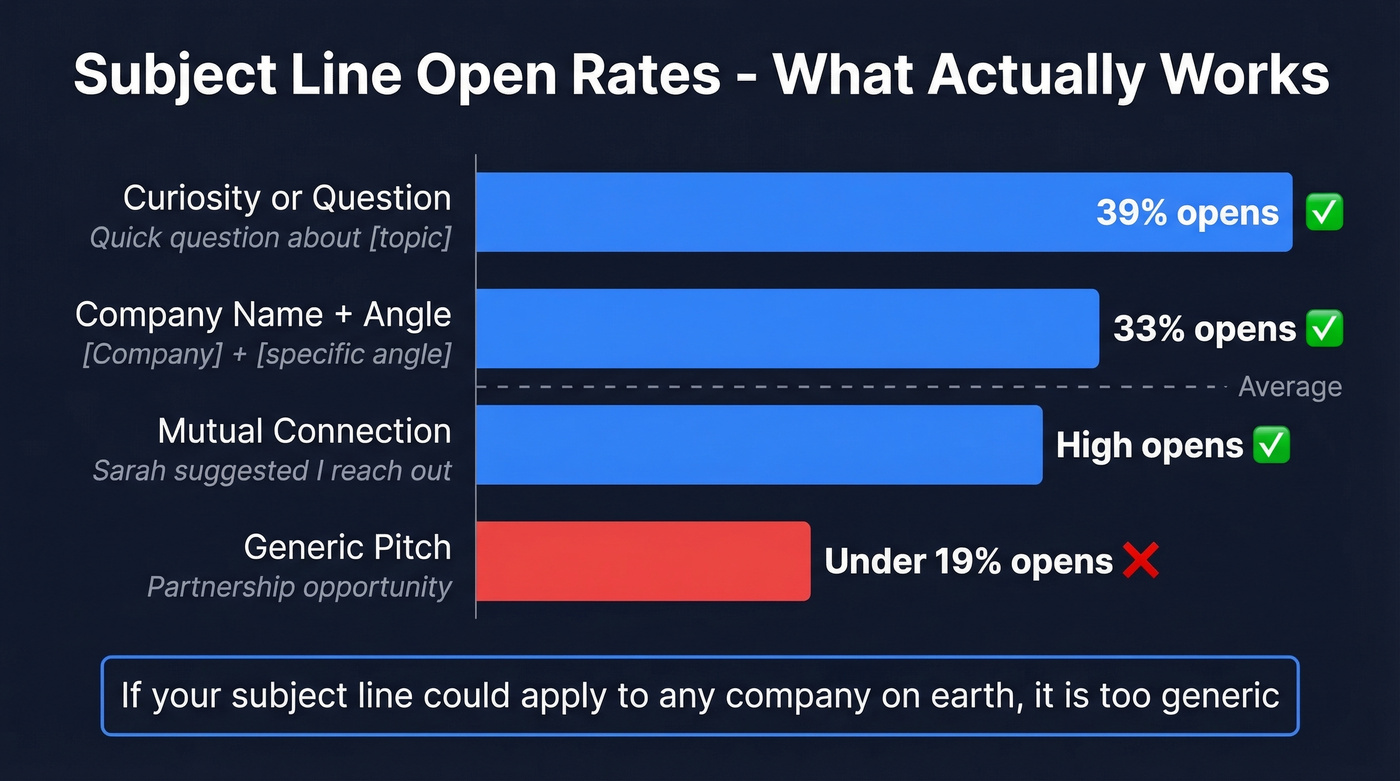
We've tested dozens of subject line variants across campaigns, and the pattern is consistent: questions and specificity win, pitches lose. Here's what the data shows across thousands of sends:
| Subject Line Type | Example | Open Rate | Verdict |
|---|---|---|---|
| Curiosity / question | "Quick question about [topic]" | ~39% | ✅ Best performer |
| Company name | "[Company] + [specific angle]" | ~33% | ✅ Strong |
| Mutual connection | "Sarah suggested I reach out" | High | ✅ High trust |
| Generic pitch | "Partnership opportunity" | <19% | ❌ Avoid |
Here's the thing: if your subject line could apply to any company on earth, it's too generic. Test three variants - a short question, a line referencing the recipient's company, and a mutual connection mention - then let the data tell you which one works for your audience.
15+ Sample Introductory Email Templates
Every template below stays under 80 words for cold outreach and under 150 for professional introductions. Adapt the structure, but respect the length.
Cold Sales Outreach
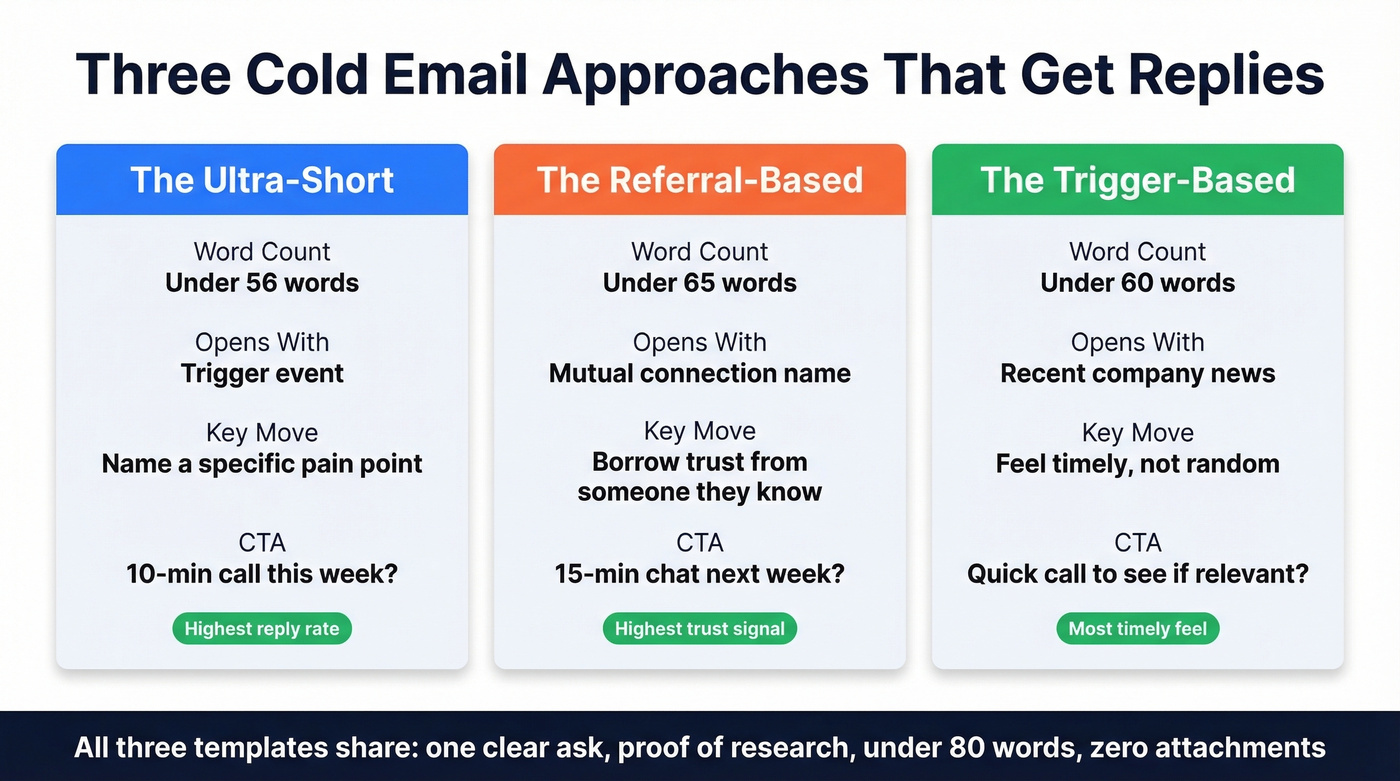
Template 1: The Ultra-Short (Under 56 Words)
Subject: Quick question about [specific challenge]
Hi [First Name],
Noticed [Company] just [specific trigger - e.g., opened a new office, posted 5 SDR roles]. When that happens, teams usually run into [specific problem].
We helped [similar company] solve that in [timeframe]. Worth a 10-minute call this week?
[Your Name]
Under 56 words. Opens with a trigger, names a pain, offers proof, closes with a single low-commitment ask. In our experience, this format consistently outperforms longer alternatives.
Template 2: The Referral-Based
Mutual connections create instant trust. That's why this template leads with the connection, not your pitch:
Subject: [Mutual Contact] suggested I reach out
Hi [First Name],
[Mutual Contact] mentioned you're working on [initiative]. We helped their team [specific result], and they thought we might be able to help with [your challenge].
Would it make sense to chat for 15 minutes next week?
[Your Name]
Template 3: The Trigger-Based
Subject: Congrats on the Series B
Hi [First Name],
Saw the funding news - congrats. Post-raise, most teams we work with hit a wall scaling [specific function] fast enough. We helped [similar company] go from [X] to [Y] in [timeframe].
Open to a quick call to see if that's relevant?
[Your Name]
Trigger-based emails feel timely, not random. Tools like Prospeo surface job changes, funding rounds, and hiring signals so your first line references something real - not a guess. (More on building this motion: sales prospecting techniques.)
Networking and Post-Event
Template 4: Post-Conference
Subject: Great meeting you at [Event]
Hi [First Name],
Really enjoyed our conversation about [topic] at [Event]. Your point about [specific thing they said] stuck with me.
I'd love to continue the conversation - coffee or a quick call next week?
[Your Name]
References a specific moment, proving you're not mass-emailing every attendee.
Template 5: Cold Networking via Mutual Connection
Subject: [Mutual Contact] thought we should connect
Hi [First Name],
[Mutual Contact] mentioned your work on [topic] and suggested we'd have a lot to talk about. I'm currently [brief context on what you do and why it's relevant].
Would you be open to a 20-minute call sometime this month?
[Your Name]
New Job - Introducing Yourself
The same person, the same new role - but the tone shifts everything. Here's how an introduction email changes based on company culture:
Formal (Large or Traditional Organization):
Subject: Introduction - [Your Name], [Your Role]
Dear [Team/Department],
I'm [Your Name], and I'll be joining as [Role] on [Date]. I'm coming from [Previous Company/Role] where I focused on [relevant experience].
I'm looking forward to meeting each of you and learning how I can contribute. Please don't hesitate to reach out.
Best regards, [Your Name]
Casual (Startup or Small Team):
Subject: The new [Role] 👋
Hey team!
I'm [First Name] - starting as [Role] on [Date]. Quick background: I spent the last [X years] at [Company] doing [one-liner]. Outside work, I'm into [hobby/interest].
Excited to meet everyone. Grab me for coffee anytime.
[First Name]
As Business Insider's etiquette guidance notes, match your tone to the culture you're entering. When in doubt, start formal and dial back.
Job Application and Informational Interview
Template 8: Expressing Interest in a Role
Subject: [Role Title] - [Your Name]
Hi [Hiring Manager's Name],
I'm writing to express interest in the [Role] position. My background in [relevant skill/experience] aligns closely with what you're looking for, particularly [specific requirement from the job posting].
I've attached my resume and would welcome the chance to discuss how I can contribute. What's the best way to set up a conversation?
[Your Name]
Template 9: Informational Interview Request
Subject: Quick question about your path to [Role/Field]
Hi [First Name],
I'm [Your Name], currently [your situation]. I've been following your work on [specific project or topic] and would love to learn more about your experience in [field].
Would you have 15 minutes for a quick call? I'd really appreciate your perspective.
[Your Name]
Flattering without being sycophantic. The specific reference shows genuine interest, and the ask is small enough that most people say yes.
Warm Introduction - Connecting Two People
Double opt-in is the gold standard for warm intros. Never connect two people without asking both sides first.
Template 10: Permission Request
Subject: Quick intro - [Person B] + [topic]
Hi [Person A],
I know someone who's working on [topic] and could really benefit from your expertise on [specific area]. Their name is [Person B], [one-line context].
Would you be open to a quick email introduction?
[Your Name]
Template 11: The Actual Introduction
Subject: Intro - [Person A] ↔ [Person B]
Hi [Person A] and [Person B],
Connecting you two because [one sentence on why this makes sense]. [Person A], [one-line context]. [Person B], [one-line context].
I'll let you take it from here. Moving to BCC.
[Your Name]
Partnership, Client, and Mentor Outreach
Template 12: Cross-Industry Partnership
Subject: [Your Company] + [Their Company] - potential fit?
Hi [First Name],
We work with [your audience], and I've noticed [their company] serves a complementary segment. There's a natural partnership around [specific idea - co-marketing, integration, referral].
Worth a 15-minute call to explore?
[Your Name]
Template 13: Client Onboarding Introduction
Subject: Welcome to [Your Company] - your team
Hi [Client Name],
I'm [Your Name], your [Role] at [Company]. I'll be your main point of contact going forward. Our kickoff is scheduled for [Date] - I'll send an agenda beforehand.
In the meantime, feel free to reach out with any questions.
[Your Name]
Template 14: Mentor/Advisor Cold Outreach
Subject: Your [talk/article/work] on [topic] - quick question
Hi [First Name],
I'm [Your Name], [brief context]. Your [specific piece of work] resonated with me because [specific reason]. I'm navigating [challenge] and would value your perspective.
Would you have 15 minutes for a call? I'd be grateful for any guidance.
[Your Name]

Trigger-based intro emails outperform generic blasts - but only if you have the signals. Prospeo surfaces job changes, funding rounds, and hiring spikes across 300M+ profiles so your opening line references something real. At $0.01 per verified email with 98% accuracy, your intro emails land in inboxes, not spam folders.
Stop writing great intro emails to bad addresses.
Personalization - The Sweet Spot
63% of people say they never respond to non-personalized emails. Personalized emails get 29% higher open rates and 41% higher click-through rates. That's the upside.
Here's the downside nobody talks about. A Gartner survey found that personalization generated a negative experience for 53% of customers, and those customers were 3.2x more likely to regret their purchase. Over-personalization makes people feel surveilled, not valued.
The sweet spot is narrow: personalize the first line and the value proposition. Reference something specific - a company announcement, a job posting, a recent hire. Don't personalize every field. Don't use data that feels invasive ("I noticed you were browsing our pricing page at 11:47 PM"). And avoid pronoun or gender assumptions - if you're unsure, use the recipient's first name.
Let's be honest: you don't need 15 templates. You need 3 good ones and the discipline to personalize the first line every time. A mediocre intro email with a killer first line beats a perfect template with a generic opener.
When to Send and How to Follow Up
Timing matters more than most people think. Instantly's benchmark data shows peak reply days are Tuesday-Wednesday, with Wednesday consistently highest. In one founder's campaign rebuild, their best send window was Tuesday through Thursday, 8-11 AM in the recipient's timezone. (More data: best time to send cold emails.)
The cadence matters too. Next-day follow-ups actually reduce replies by 11% - they feel desperate. Waiting three days yields a 31% increase. Here's the framework we've seen work best:
| Follow-Up | Days After Previous | Tone |
|---|---|---|
| Follow-up 1 | 2-3 days | Brief, feels like a reply |
| Follow-up 2 | 4 days | New angle or value add |
| Follow-up 3 | 7 days | Different format or ask |
| Follow-up 4 | 14 days | Breakup / last touch |
The sweet spot is 4-7 total touchpoints. Beyond 7, diminishing returns kick in hard.
Your step 2 email should feel like a reply, not an automated sequence. In Instantly's 2026 benchmark, "step 2" follow-ups that read like replies outperform formal follow-ups by roughly 30%. Drop the "Just following up on my previous email" opener. Instead, add a new insight, share a relevant resource, or ask a different question entirely. As one Redditor put it, "novel-length emails get ignored" - and the data backs that up for follow-ups too. (If you're building sequences, see B2B cold email sequence.)
Intro Emails Across Cultures
If you're emailing someone in a different country or cultural context, default to higher formality until they signal otherwise.
Use titles and honorifics - Dr., Professor, Mr./Ms. - until they sign off with their first name. Skip idioms and slang; "let's touch base" or "circle back" doesn't translate well. Be cautious with humor, sarcasm, and emojis because meanings vary across cultures. Watch date and time formats too: 03/04 means March 4th in the US and April 3rd in most of Europe, so spell it out.
The rule of thumb from cross-cultural email etiquette research is simple: err on the side of respect. You can always dial back formality. You can't undo a first impression that felt dismissive.
Mistakes That Kill Your Intro Email
These are the most common ways people sabotage their own introductory emails:
- Too long. If your cold intro email is over 80 words, it's too long. Period.
- "I hope this email finds you well." The fastest way to get deleted. It signals a mass email and wastes your precious opening line on nothing.
- Salesy subject lines. "Partnership opportunity" and "Exciting offer" are open-rate killers. Curiosity beats pitch every time.
- No clear CTA. If the reader finishes your email and doesn't know what you want them to do, you've failed.
- Too many links or attachments. Beyond being annoying, they're a deliverability risk. Email filters flag messages with multiple links.
- No follow-up. Sending one email and giving up means you're ignoring 42% of your potential replies.
- Guessing the email address. firstname.lastname@company.com might work. Or it bounces, damages your domain reputation, and lands you in spam. Verify first. (Related: email bounce rate.)
- Ignoring GDPR. In the EU, sending unsolicited emails without a legitimate interest basis can trigger complaints - another reason to verify your list and target carefully.
Skip the "spray and pray" approach entirely if you're working with a small, high-value prospect list. One bounced email to a dream account's domain can flag your sender reputation for weeks.
Your Email Has to Land First
The best sample introductory email in the world is worthless if it bounces. High bounce rates damage your sender reputation, and once that's damaged, even your emails to warm contacts start hitting spam folders. I've watched teams spend weeks perfecting their copy only to realize half their list was garbage data. If you need a full checklist, start with this email deliverability guide.
That founder on r/Entrepreneur? Their bounce rate was 11% before they rebuilt their process. After switching to manual verification, it dropped to under 2%. They also expanded from 3 sending domains to 7, each capped at 26 emails per day. That infrastructure change - combined with verifying addresses - was one of the biggest drivers of their reply rate doubling.
You should also have SPF, DKIM, and DMARC configured on your sending domain. These are table stakes for deliverability in 2026 - without them, even verified addresses won't save you. (If you're troubleshooting, see how to verify DKIM is working.)
High bounce rates destroy the sender reputation you need for intro emails to land. Prospeo's 5-step verification - with catch-all handling, spam-trap removal, and honeypot filtering - keeps bounce rates under 4%. Every address refreshes on a 7-day cycle, not the 6-week industry average.
Protect your domain and triple your reply rate with verified data.
FAQ
How long should an introductory email be?
For cold outreach, keep it under 80 words - the Instantly 2026 benchmark shows this is the sweet spot for reply rates. Professional and workplace introductions can run 50-150 words since the recipient already has context. Either way, shorter consistently outperforms longer.
What's the best subject line for an intro email?
Short, curiosity-driven subject lines outperform pitches by a wide margin. "Quick question" hit 39% opens in one practitioner's A/B test, while "Partnership opportunity" got under 19%. Use the recipient's company name or a mutual connection for the strongest results.
Should I follow up if I don't get a reply?
Yes - 42% of replies come from follow-ups, not the first email. Wait 2-3 days before your first follow-up, then use graduated spacing: 4, 7, and 14 days between subsequent touches. Aim for 4-7 total touchpoints before moving on.
How do I write a quick email introduction for networking?
State your name, role, and one sentence on why you're reaching out. Lead with value to the recipient, not your resume - something like "I'm [Name], [Role] at [Company] - reaching out because [reason that matters to them]." Keep it concise and end with a single, low-commitment ask like a 15-minute call.