

SDR Emails: Templates Are 20% of the Equation - Here's the Other 80%
A practitioner on r/coldemail sent 147,000 cold emails in a year and landed a 1.2% positive reply rate - roughly 1,764 conversations from six figures of sends. When the same person shifted to joining conversations already happening through warm outreach, reply rates jumped to 34%. That gap isn't about copy. It's structural.
Most SDR emails in 2026 fail because the data is stale, the infrastructure is fragile, and the personalization is skin-deep. Templates get all the attention. They shouldn't. Here's the full playbook - data layer, infrastructure, frameworks, and sequences - in the order that actually matters.
What You Need (Quick Version)
Clean data. If 25-30% of your list decays annually and you aren't verifying before every send, you're burning domain reputation on bounces. Fix this first. [Jump to data quality.](#the-step-everyone-skips - data-quality)
Proper infrastructure. Secondary domains, warmup schedules, SPF/DKIM/DMARC on every inbox. Skip this and your emails land in spam. Jump to infrastructure.
Trigger-based personalization. Not "Hey {{first_name}}, saw your company is doing great things." Real triggers - funding rounds, new hires, tech stack changes - that give your prospect a reason to care right now. Jump to the framework.
SDR Email Benchmarks for 2026
Here's what the data says across the largest datasets available:
| Source | Dataset Size | Avg Reply Rate | Top Performers |
|---|---|---|---|
| Instantly (2026) | Billions of emails | 3.43% | 10.7%+ (top 10%) |
| Prospeo compilation | 16.5M emails | 5.8% | Not segmented |
| RevNew ranges | Not disclosed | 4-9% (targeted) | 7-12% (trigger-based) |
Generic templates? Under 1.5%. That's the floor, and it's where most teams live without realizing it.
How to read your own numbers:
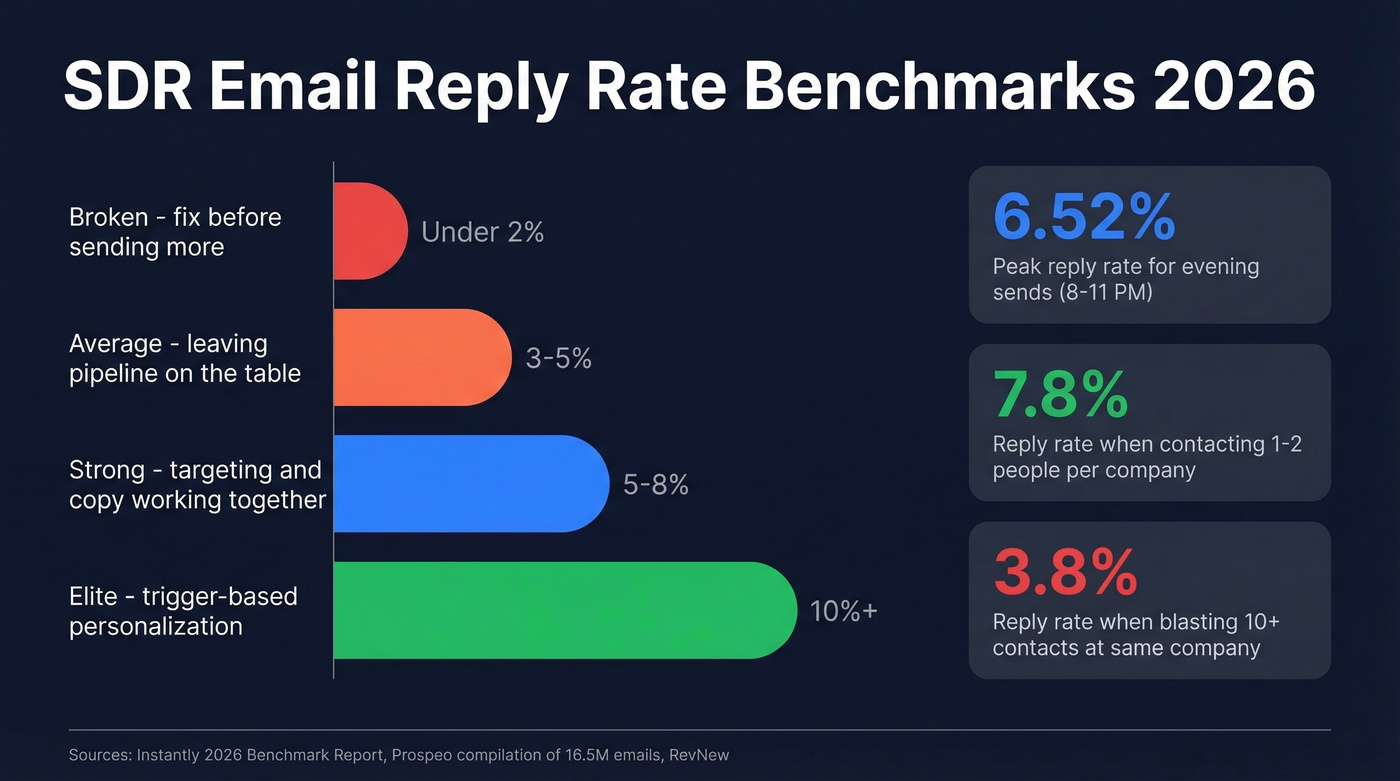
- Under 2%: Something's broken - data quality, deliverability, or targeting. Diagnose before sending more. (If you need a checklist, start with this email deliverability guide.)
- 3-5%: Average. You're in the game but leaving pipeline on the table.
- 5-8%: Strong. Targeting and copy are working together.
- 10%+: Elite. Trigger-based personalization and verified data, almost always.
Timing data varies by dataset, but the pattern is consistent: Tuesday-Wednesday tends to peak, and Thursday beats Monday. Evening sends between 8-11 PM peaked at 6.52%. And here's one that surprises people - contacting just 1-2 people per company yields a 7.8% reply rate, while blasting 10+ contacts at the same company drops you to 3.8%. Precision beats volume every time. (More on timing in our best time to send cold emails breakdown.)
The Step Everyone Skips - Data Quality
US email lists decay 25-30% per year. If you built a list six months ago and haven't refreshed it, roughly one in seven addresses is dead. Every bounce chips away at your sender reputation, and once that's damaged, even good emails land in spam.
The thresholds are unforgiving. Best-in-class bounce rates sit below 1.5%. Cross 3% and you're in serious warning territory. Spam complaint rates need to stay below 0.3% - ideally under 0.1% - if you want to stay out of the danger zone. (Benchmarks + fixes: email bounce rate.)
What does this look like in practice? Stack Optimize, an outbound agency using Prospeo's verified data, maintains 94%+ deliverability, under 3% bounce rates, and zero domain flags across all their clients. That's the standard.
We've seen teams go from sub-2% reply rates to 6%+ just by fixing their data layer before touching a single template. Before you write a subject line, run your list through a verification tool and clean it. This isn't optimization - it's a prerequisite. If you're comparing vendors, start with these data enrichment services and Bouncer alternatives.

Email Infrastructure Setup
Never send cold email from your primary domain. One spam complaint wave and your entire company's email - support tickets, investor updates, customer comms - goes to junk. Set up secondary domains that are close variants of your main domain.
The scaling math: run 2-3 email accounts per domain, send 10-15 emails per day per account. That gives you 30-45 sends per domain daily. Need 400 emails a day? You're looking at roughly 10-12 domains. Sounds like a lot, but it's the cost of doing outbound properly.
Use Google Workspace or Microsoft 365 - never free Gmail or Yahoo accounts. Configure SPF, DKIM, and DMARC for every single domain before sending anything. Since February 2024, Google and Yahoo require all three for bulk senders, and Gmail tightened enforcement again in late 2025 with temporary and permanent rejections for non-compliant senders. Test with MXToolbox to confirm everything passes. This takes an afternoon and saves months of headaches. (If you want a step-by-step, see how to verify DKIM is working and DMARC alignment.)
Make your accounts look human. Real names, profile photos, proper email signatures. ISPs look at these signals, and so do prospects.
Brief compliance note: Make sure your outbound follows the rules that apply to your region and audience - include a clear opt-out mechanism and appropriate business identification. If you're emailing EU prospects, GDPR obligations apply. (Related: Is It Illegal to Buy Email Lists?.)
Domain Warmup Schedule
Sending cold emails from a fresh inbox on day one is the fastest way to land in spam. Minimum warmup is 14 days; we recommend 21.
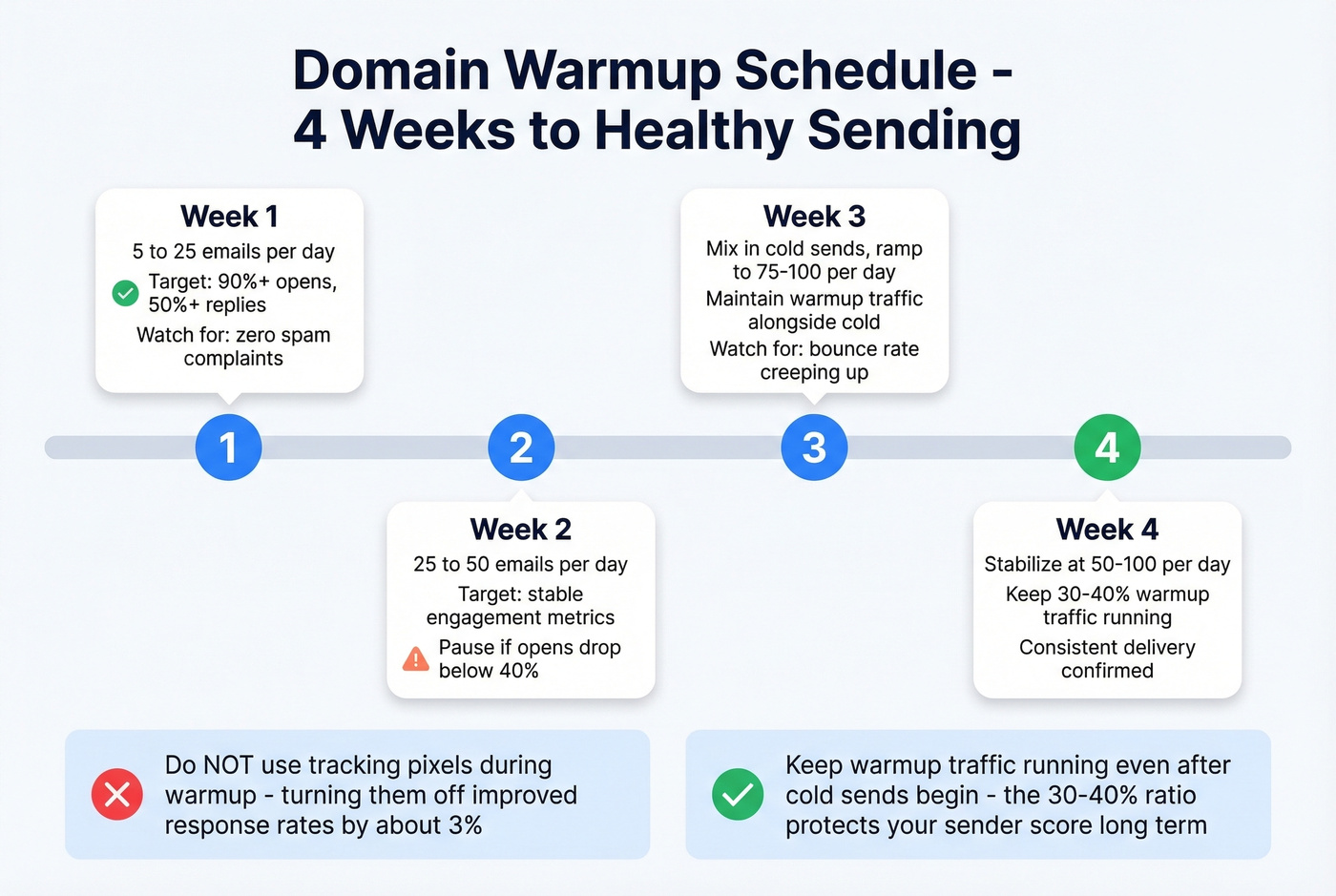
| Week | Daily Volume | Targets | Watch For |
|---|---|---|---|
| Week 1 | 5 to 25/day | 90%+ opens, 50%+ replies | 0 spam complaints |
| Week 2 | 25 to 50/day | Stable engagement | Pause if opens drop below 40% |
| Week 3 | Mix in cold; ramp to 75-100/day | Maintain warmup traffic | Bounce rate creeping up |
| Week 4 | Stabilize 50-100/day | Keep 30-40% warmup traffic | Consistent delivery |
Two details most guides skip: don't use tracking pixels during warmup. In our testing, turning off open-tracking pixels during warmup consistently improved response rates by roughly 3%. And keep warmup traffic running even after you start cold sends - that 30-40% warmup ratio keeps your sender score healthy long-term. (More on safe sending limits in email velocity.)

The article just told you: data quality is the step everyone skips. Prospeo's 5-step verification delivers 98% email accuracy and keeps bounce rates under 3% - exactly the threshold that separates healthy sender reputations from burned domains. Stack Optimize built a $1M agency on this data. At $0.01 per email, fixing your data layer costs less than a single wasted send day.
Stop writing better copy for dead inboxes. Verify first.
How to Write SDR Emails That Get Replies
The Trigger-to-CTA Framework
The highest-performing cold email structure on r/coldemail follows a 7-part flow: Trigger, Relevance, Pain, Urgency, Proof, Offer, CTA.
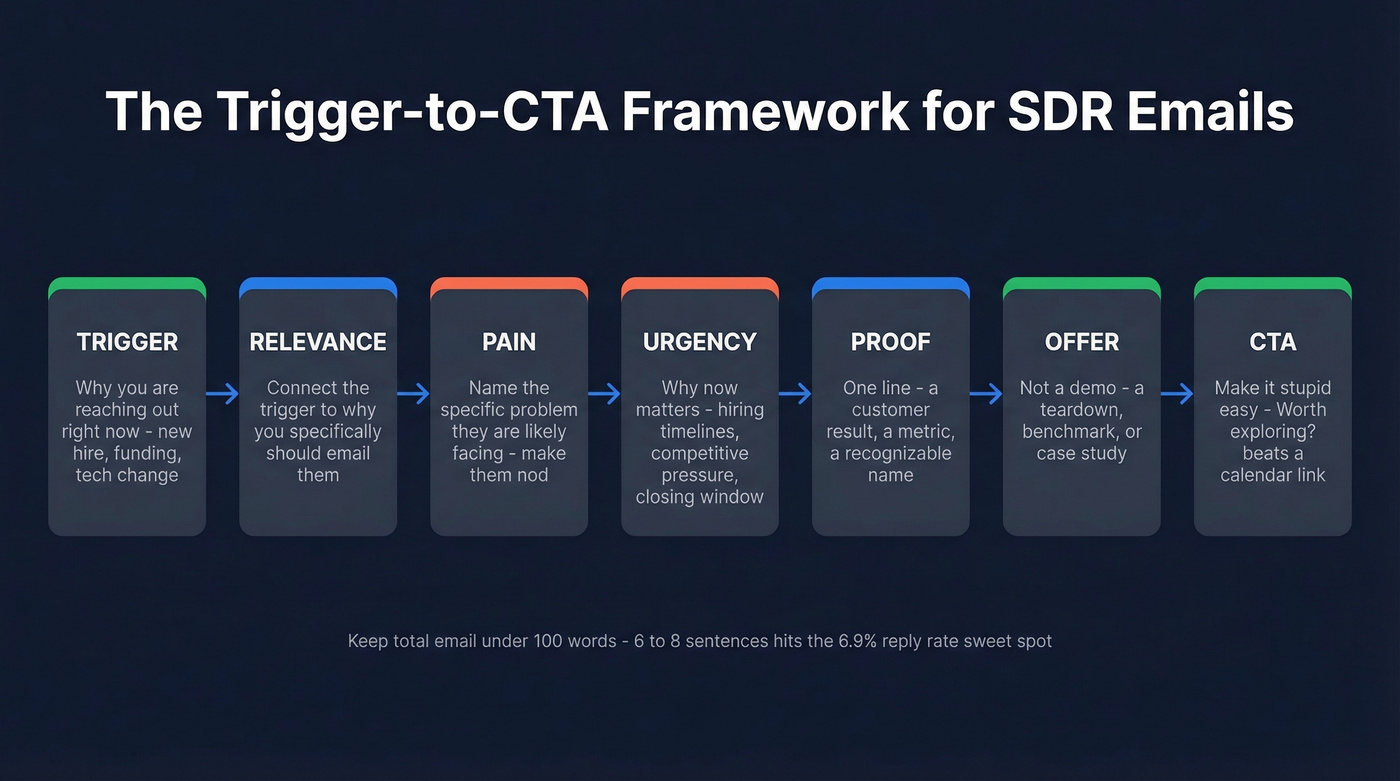
Trigger: The reason you're reaching out right now. They just posted an SDR role, closed a Series A, promoted a new Head of Sales, or switched CRM tools. Clay and similar tools surface these signals automatically. (If you need a system for this, use how to track sales triggers.)
Relevance: Connect the trigger to why you're the right person to email. One sentence. "Companies scaling outbound from 3 to 10 reps usually hit [specific problem] around month two."
Pain: Name the problem they're likely facing. Be specific enough that they nod. "Most teams scaling from 3 to 10 reps see bounce rates spike because nobody owns the data layer."
Urgency: Why now matters. Hiring timelines, competitive pressure, a window closing.
Proof: One line. A customer result, a metric, a recognizable logo.
Offer: Not a demo - something lower friction. A teardown, a benchmark comparison, a relevant case study.
CTA: Make it stupid easy. "Worth exploring?" beats "Can I get 15 minutes on your calendar next Tuesday?" every time. (More examples in email call to action.)
Copy Rules Checklist
- Subject lines: 1-3 words, lowercase, 25-45 characters. Avoid mobile truncation. (If you want a swipe file, see cold email subject line examples.)
- Body: 50-100 words. Hard cap at 150. The sweet spot is 6-8 sentences for a 6.9% reply rate.
- Paragraphs: 1-2 sentences each. White space is your friend.
- One question per email. Multiple questions create decision paralysis.
- More "you" than "I/we/our." Delete every sentence that starts with your company name.
- Personalize the first line - it's the preview text in every inbox.
- Write in the prospect's language. Emails sent in the recipient's native language see 7x higher open rates.
Cold Email Templates by Type
Five templates that follow the framework above. Each runs about 75 words.
Cold Outreach (Trigger-Based)
Subject: sdrs hiring?
Noticed you posted two SDR roles last week - scaling outbound is exciting until the data and infrastructure problems hit. We helped [similar company] go from 3 to 12 reps without their bounce rate crossing 2%. Happy to share what worked. Worth a look?
Specific trigger, named pain, proof point, soft CTA.
Follow-Up ("Feels Like a Reply")
Subject: re: sdrs hiring?
Forgot to mention - [similar company] also cut their ramp time in half by fixing their data layer before hiring. Thought that might be relevant given the timing.
Instantly's data shows follow-ups that feel like replies outperform formal follow-ups by ~30%.
Re-Engagement
Subject: still relevant?
We connected back in [month] about [topic]. Things may have changed - if outbound data quality is still on your radar, we just published benchmarks from 16.5M cold emails. Want me to send it over?
References prior context, offers value instead of asking for time.
Break-Up
Subject: closing the loop
I've reached out a few times and don't want to be that person who won't take a hint. If outbound data isn't a priority right now, no hard feelings. If it is - happy to pick this back up whenever timing works.
Respectful, creates small urgency through finality.
Referral Intro
Subject: [mutual connection] suggested I reach out
[Name] mentioned you're building out outbound at [company] and thought we should connect. We work with similar teams on [specific problem]. Worth a quick conversation?
Social proof from a real connection. The referral does the heavy lifting.
Sequence Design and Cadence
Let's be honest about follow-ups: 58% of replies come from Step 1. The remaining 42% trickle in across follow-ups, and each one needs to earn its place. (If you want more options, use these cold email follow-up templates.)
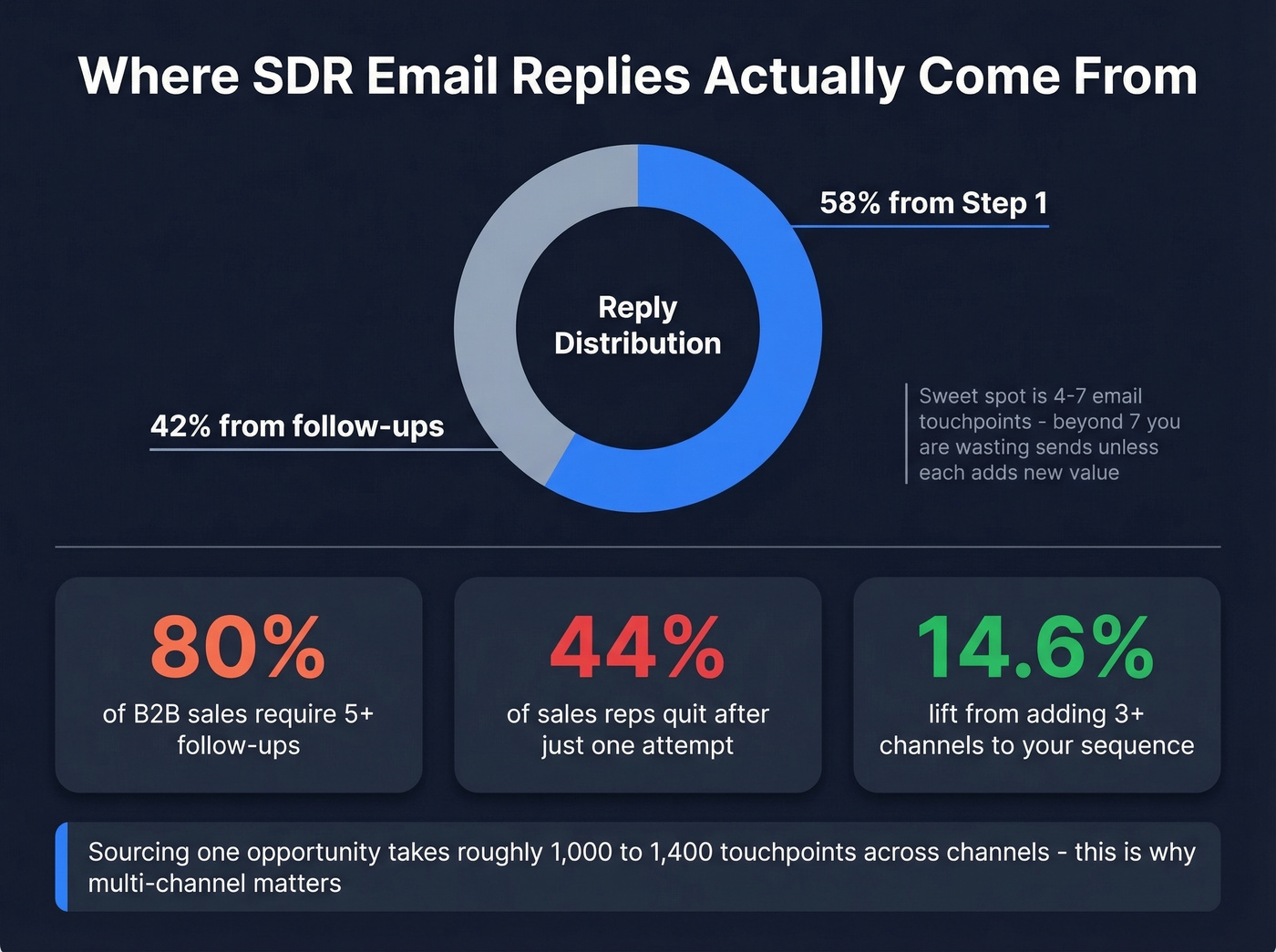
The sweet spot is 4-7 email touchpoints. Beyond 7, you're wasting sends unless each touch adds genuinely new value. And yet, 80% of B2B sales require 5+ follow-ups while 44% of reps quit after one attempt. That gap is where pipeline dies. (More on the mechanics in sequence management.)
For context on the effort involved, sourcing a single opportunity takes roughly 1,000-1,400 touchpoints across channels. That's why multi-channel matters - adding 3+ channels lifts results by 14.6%. Mix in calls, video messages, and social touches alongside email. Reaching executives requires more patience: Outreach's data shows exec-level prospects need roughly 9 touches versus about 4 for lower-level contacts. First follow-up timing: 3 days after the initial send, then space them out progressively.
One contrarian data point: 1-email sequences actually showed the highest reply rate at 8.4% in the benchmark compilation we reviewed. Adding a third email reduced reply rates by up to 20%. The takeaway isn't "only send one email" - it's that a lazy "just checking in" follow-up actively hurts your numbers. Every additional touch needs to justify its existence. (If you need alternatives, see how to say just checking in professionally.)
Here's my hot take: if your average deal size is under $10k, you probably don't need a 12-step sequence with custom video. A tight 3-touch email sequence with verified data and a real trigger will outperform a bloated cadence built on hope. Complexity isn't a strategy.
Subject Lines and A/B Testing
64% of recipients mark emails as spam without reading them due to poor subject lines. Personalized subject lines hit 46% open rates versus 35% without personalization. That's a meaningful gap, but open rates are increasingly unreliable thanks to Apple's Mail Privacy Protection. Track them directionally, but optimize for reply rate.
Keep subject lines between 25-45 characters. Lowercase, conversational, 1-3 words. "quick question" outperforms "Innovative Solution for Your Sales Team's Pipeline Challenges" every single time.
Subject Line Matrix
| Email Type | Example Subject | Goal |
|---|---|---|
| Cold outreach | sdrs hiring? | Trigger curiosity with relevance |
| Follow-up | re: sdrs hiring? | Mimic a reply thread |
| Re-engagement | still relevant? | Low-pressure re-open |
| Break-up | closing the loop | Create finality urgency |
| Referral | [name] suggested I reach out | Use social proof |
For A/B testing, isolate one variable per test. Use 250+ contacts per variant - push toward 500+ for statistical confidence. Measure positive reply rate, not opens. And avoid clickbait entirely. Deletions, unsubscribes, and spam complaints from misleading subjects are negative ISP signals that compound over time.
The Recommended SDR Email Stack
You don't need 12 tools. You need four, maybe five. The total cost is a fraction of what legacy platforms charge - cold email cost-per-lead runs $30-50 versus $300-500 for cold calling.
Data layer: Prospeo for verified contact data. 98% email accuracy, 7-day refresh cycle, and real-time email verification built on proprietary infrastructure. Native integrations with Salesforce, HubSpot, Smartlead, Instantly, Lemlist, Clay, Zapier, and Make. Starts free, paid plans from ~$39/mo.
Sending: Instantly ($47/mo, unlimited sending accounts) or Smartlead (~$39-79/mo). Both handle multi-inbox rotation, warmup, and sequence management. We lean toward Instantly for teams under 10 reps - the UI is cleaner and the analytics are more actionable. (More options in our SDR tools roundup.)
Signals: Clay (~$149-349/mo) for trigger detection - job changes, funding events, tech stack shifts. This is what turns generic outreach into trigger-based personalization.
System of record: HubSpot (free CRM tier works) or Salesforce ($25+/user/mo) to track pipeline and prevent duplicate outreach.
Total cost for a solo SDR or small team: roughly $250-500/mo. Compare that to a single ZoomInfo seat at $15-40k/year.
Skip the all-in-one platforms that try to do data, sending, and CRM in one product. In our experience, best-of-breed stacks outperform them because you can swap any layer without rebuilding your entire workflow.
Trigger-based personalization only works when you can find the right contacts fast. Prospeo's 30+ filters - buyer intent, job changes, tech stack, headcount growth - let you build lists around the exact signals this framework requires. Teams using Prospeo book 35% more meetings than Apollo users and 26% more than ZoomInfo, with data refreshed every 7 days instead of 6 weeks.
Turn triggers into pipeline with contacts that actually connect.
How many cold emails should an SDR send per day?
50-100 per inbox after a full warmup cycle. Scale by adding inboxes and domains, not by cranking volume on a single account. Most teams run 2-3 accounts per domain at 10-15 sends each.
What's a good reply rate for SDR emails?
3-5% is average across most B2B outbound programs. 5-8% means targeting and copy are dialed in. 10%+ is elite - typically trigger-based personalization with verified data and tight list criteria.
Should SDRs use AI to write cold emails?
For research, trigger identification, and first drafts - yes. For final copy, edit heavily. Prospects can spot AI-generated emails, and they read as templated. The best results come from AI-assisted research with human-written messaging.
How do you avoid landing in spam?
Secondary domains, SPF/DKIM/DMARC, proper warmup, verified email lists, and keeping bounce rates under 1.5%. A 98% accuracy data source and tools like MXToolbox for authentication checks cover the two biggest risk areas - bad data and misconfigured DNS.
What separates high-performing SDR emails from generic outreach?
Signal quality. Messages that reference a real trigger - a recent hire, a funding round, a tech stack change - outperform generic "just reaching out" emails by 3-5x on reply rate. Pair that with verified contact data and you eliminate the two biggest failure points before you even write a subject line.