

What Is Lead Generation in Sales? (And Why Most Guides Get It Wrong)
A RevOps lead we know spent three months optimizing landing pages, A/B testing CTAs, and building gated content - then realized his sales team had booked exactly zero meetings from those "leads." The problem wasn't the funnel. It was the definition. Most guides explaining what lead generation in sales actually means are written for marketers. Sales teams need something different.
As one practitioner on r/sales put it: "I'm not 'generating' any leads... They already exist. My job is to find them." That's the sales version - not building awareness campaigns, but identifying the right people, verifying their data, and getting them into a real conversation.
The short version: sales lead generation means finding the right people, verifying their contact data, qualifying them against your ICP, and starting a conversation. Not building landing pages. If you take one thing from this guide: stop chasing volume. Start with data quality, add a scoring model, and fix your MQL-to-SQL handoff.
Defining Lead Generation for Sales Teams
Lead generation is the process of identifying potential buyers and capturing enough information - email, phone, company, title - to start a sales conversation. Salesforce's definition adds "building interest," but for sales teams, the interest often already exists. Your job is to find it and act on it before a competitor does.
The distinction from marketing-led lead gen matters here. A common question teams ask is whether this is a sales or marketing function - the honest answer is both, but the activities look completely different. Marketing generates awareness and captures inbound interest. Sales-side prospecting is proactive: building account lists, enriching contact data, verifying deliverability, and qualifying fit before the first touch.
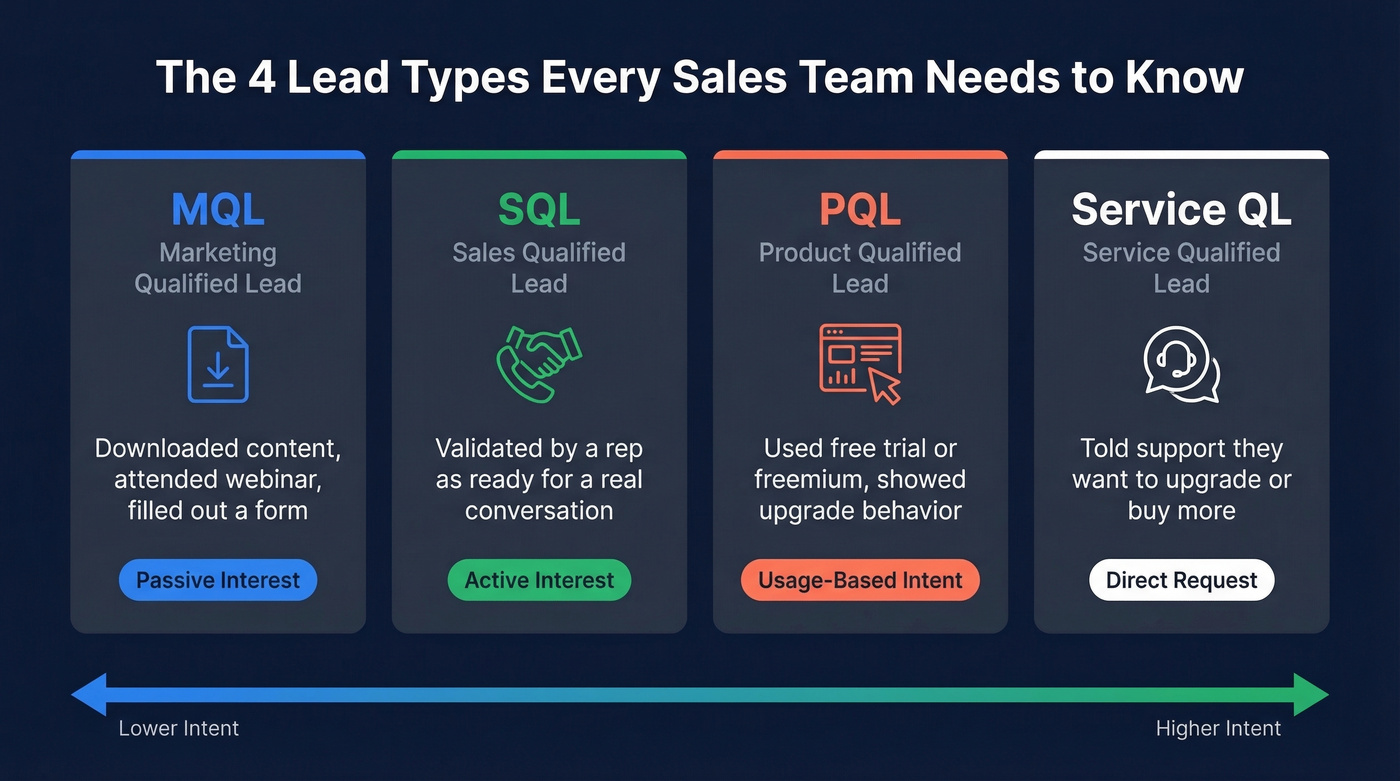
Four lead types get thrown around constantly:
- MQL (Marketing Qualified Lead): Engaged with content - downloaded a whitepaper, signed up for a webinar. Passive interest.
- SQL (Sales Qualified Lead): Validated by a rep as ready for a real conversation. Active interest.
- PQL (Product Qualified Lead): Used your product via free trial or freemium and showed upgrade behavior.
- Service Qualified Lead: Told your support team they want to upgrade or buy more. Pass directly to sales.
For scale, the lead generation industry is projected to hit $295B by 2027 at roughly 17% CAGR. This isn't a niche - it's the engine behind most B2B revenue.
Why It Matters More Than Ever
The buying process has shifted dramatically, and it's not shifting back. The average B2B buying cycle now runs 10.1 months. And here's the uncomfortable part: 92% of buyers start their evaluation with at least one vendor already in mind, and the winning vendor is on the Day One shortlist 95% of the time.
If you're not in the conversation early, you're probably not in the conversation at all.
Buyers complete roughly 70% of their journey before contacting sales, and 67% prefer self-service research over talking to a rep. By the time someone fills out your demo form, they've already compared you to two or three alternatives. Meanwhile, reps spend less than 36 hours per week actually selling - the rest goes to admin, data entry, and chasing bad contact info. Every hour spent calling a disconnected number or emailing a bounced address is an hour not spent with a real prospect. Generating quality leads isn't just about filling the top of the funnel; it's about making sure every contact in that funnel is real, reachable, and worth a rep's time.
The Sales Lead Generation Process
Forget the marketing funnel version with "awareness to interest to consideration to decision." Here's what the process actually looks like from a rep's desk.
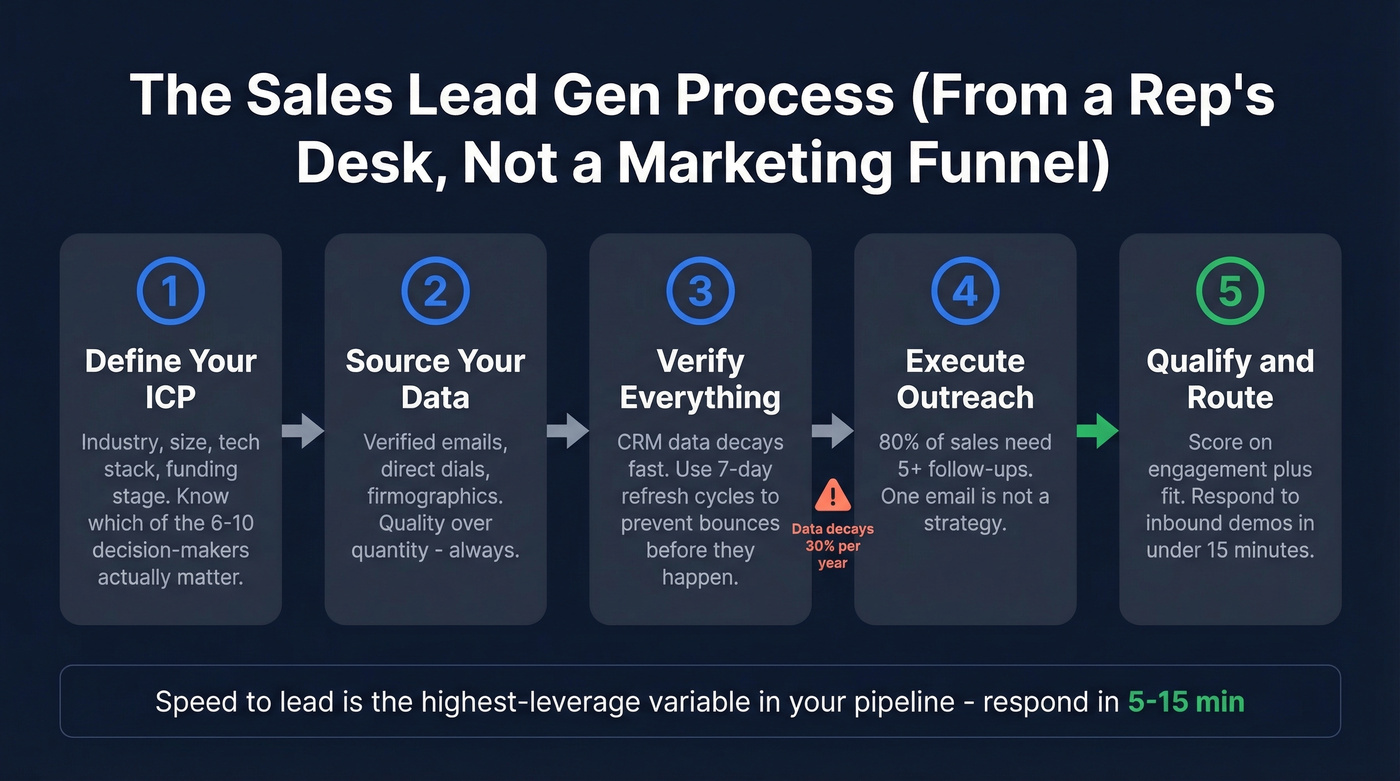
Step 1: Define your ICP. Get specific. Industry, company size, tech stack, funding stage, department headcount. Gartner puts the average B2B purchase at 6-10 decision-makers - you need to know which titles matter and which ones are noise. If you need a starting point, use an Ideal Customer Profile template.
Step 2: Source your data. This is where most teams either overspend or underinvest. You need accurate contact records - verified emails, direct dials, firmographic data - not a CSV of 50,000 names from a purchased list. We've tested dozens of data sources over the years, and the single biggest differentiator isn't database size. It's verification rigor. (If you're comparing vendors, start with data enrichment services and sales prospecting databases.)
Step 3: Verify everything. CRM data decays fast. Job changes, company merges, email domain switches - it all adds up. Verification tools with 7-day refresh cycles prevent your sequences from bouncing before they reach a single inbox. If you’re troubleshooting bounces, see email bounce rate benchmarks and fixes.
Step 4: Execute outreach. Cold email, cold calls, social touches - the channel matters less than the sequencing. 80% of sales require five or more follow-ups. One email and done isn't a strategy. If you want plug-and-play copy, use these sales follow-up templates.
Step 5: Qualify and route. Not every response is a real opportunity. Score leads based on engagement and fit, then hand qualified ones to the right rep at the right time. For inbound demo requests, respond within 5-15 minutes - speed-to-lead is one of the highest-leverage variables in your entire pipeline. To operationalize this, set up clear lead status rules.
Benchmarks That Ground Your Targets
Here's what conversion rates actually look like across industries, based on First Page Sage and Ruler Analytics data across 100M+ touchpoints:
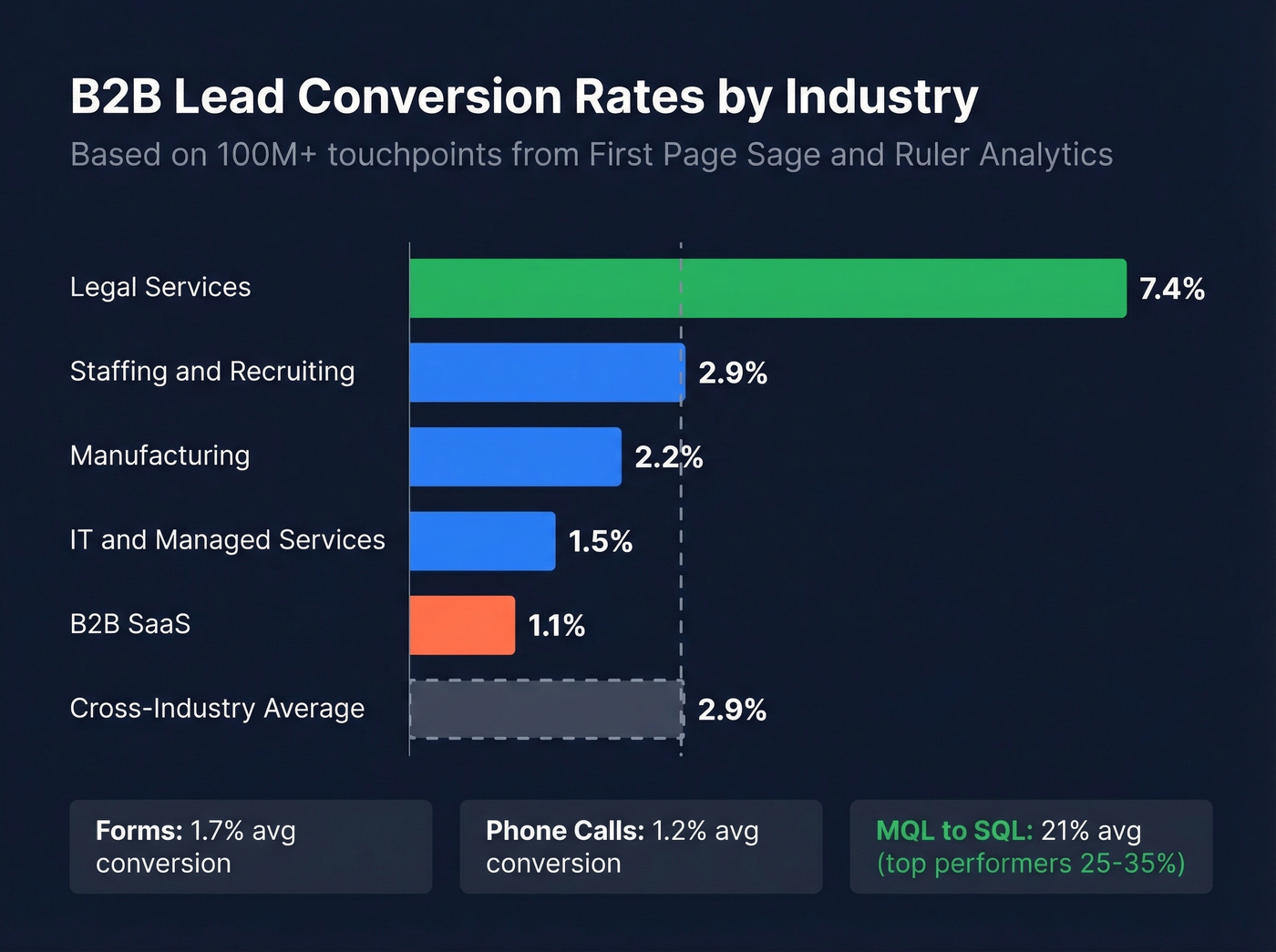
| Industry | Avg. Conversion |
|---|---|
| Legal Services | 7.4% |
| Staffing & Recruiting | 2.9% |
| Manufacturing | 2.2% |
| IT & Managed Services | 1.5% |
| B2B SaaS | 1.1% |
| Cross-industry avg. | 2.9% |
Forms convert at 1.7% on average; phone calls convert at 1.2%. The MQL-to-SQL conversion averages 21%, with top performers hitting 25-35%. (For more context, see average B2B lead conversion rate.)
And here's what you're paying per lead by channel:
| Channel | Avg. CPL |
|---|---|
| SEO | $31 |
| Email marketing | $53 |
| Webinars | $72 |
If your B2B SaaS site converts at 1.1% and you're paying $53 per email-sourced lead, you need these numbers before setting pipeline targets. In our experience, teams that track these benchmarks outperform those setting goals on gut feel by a wide margin.

You just read that CRM data decays fast and verification rigor is the biggest differentiator in lead gen. Prospeo refreshes 300M+ profiles every 7 days - not every 6 weeks like most providers. 98% email accuracy, 125M+ verified mobiles, 30+ ICP filters. At $0.01 per email, bad data stops being an excuse.
Build your first verified lead list in under 5 minutes.
How to Score and Qualify Leads
Lead scoring isn't a replacement for sales judgment - it's a precision layer that tells reps where to focus. The best models blend behavioral signals like page visits and demo requests with demographic fit, plus negative signals that flag bad leads early.
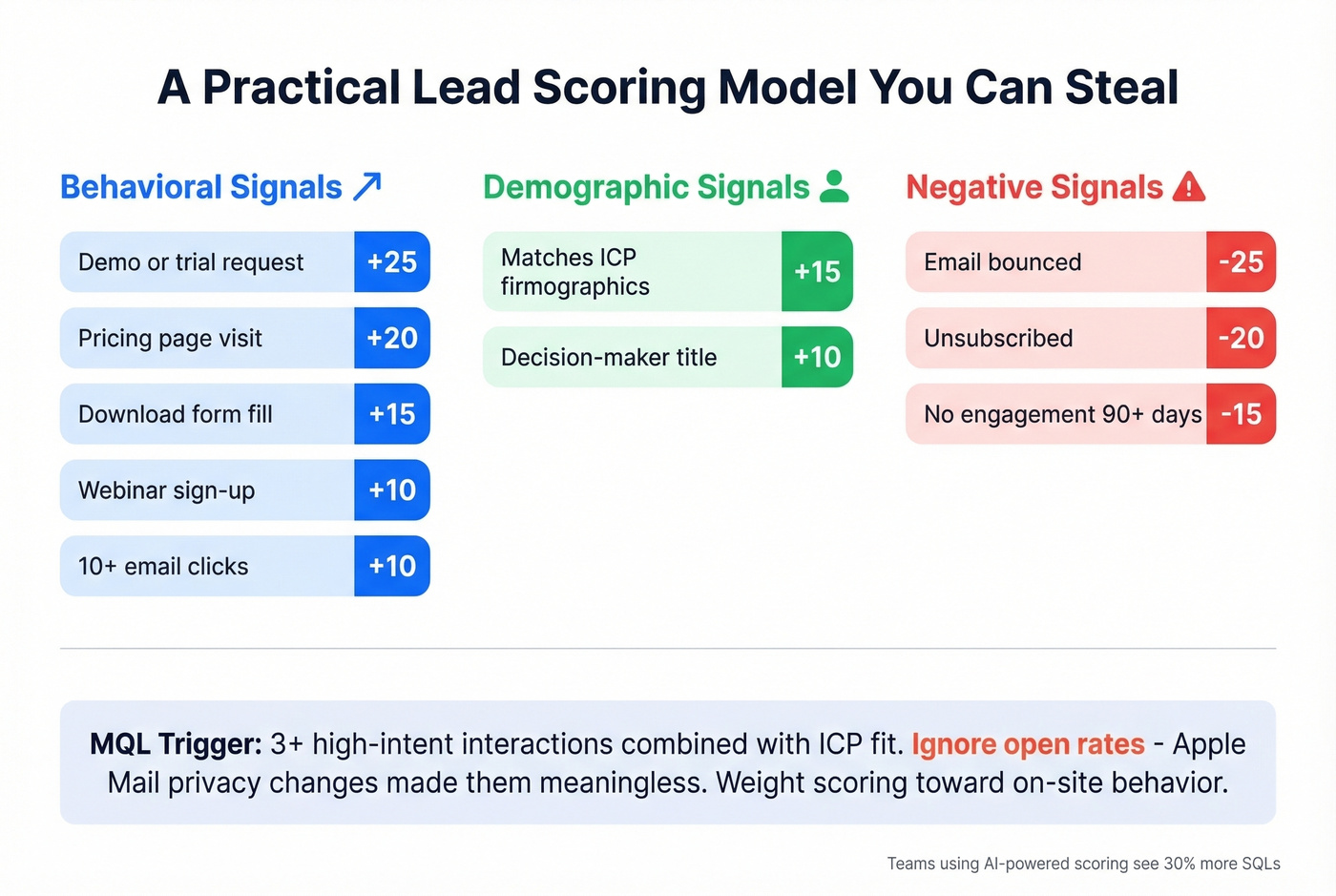
Here's a practical scoring model you can adapt:
| Signal | Points | Type |
|---|---|---|
| Pricing page visit | +20 | Behavioral |
| Demo/trial request | +25 | Behavioral |
| Download form fill | +15 | Behavioral |
| Webinar sign-up | +10 | Behavioral |
| 10+ email clicks | +10 | Behavioral |
| Matches ICP firmographics | +15 | Demographic |
| Decision-maker title | +10 | Demographic |
| Email bounced | -25 | Negative |
| Unsubscribed | -20 | Negative |
| No engagement 90+ days | -15 | Negative |
Apple Mail privacy changes have made open rates essentially meaningless. Weight your scoring toward on-site behavior - pricing page visits, form submissions, demo requests - not whether someone "opened" an email.
The BANT framework (Budget, Authority, Need, Timeline) still works as a qualification checklist for actual sales conversations. Use scoring to decide who gets the conversation; use BANT to decide what happens in it. If you want a deeper scoring framework, see lead scoring.
A useful threshold: 3+ high-intent interactions combined with ICP fit is a reasonable MQL trigger. HubSpot reported that teams using AI-powered lead scoring saw a 30% increase in SQLs - the automation catches signals humans miss.
The MQL-to-SQL Handoff
Look, this is where most lead generation programs die. Marketing says they delivered 500 MQLs. Sales says they're garbage. Both are right, because nobody agreed on what "qualified" means.
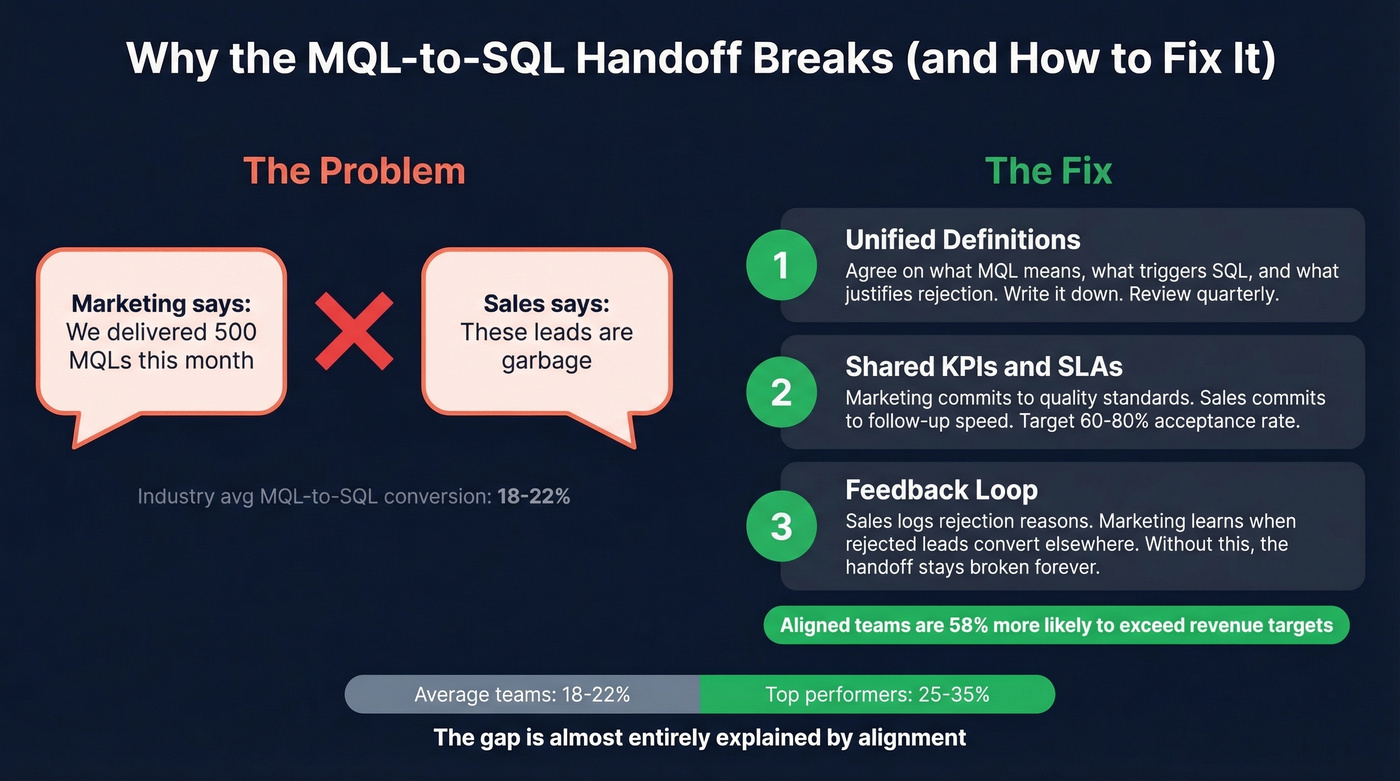
The fix requires three things.
Unified definitions. Marketing and sales must agree on what an MQL looks like, what triggers SQL status, and what criteria justify rejection. Write it down. Review it quarterly.
Shared KPIs and SLAs. Marketing commits to a volume and quality standard. Sales commits to follow-up speed and an acceptance rate target of 60-80%. When aligned teams operate under shared goals, they're 58% more likely to exceed revenue targets.
A feedback loop. When sales rejects an MQL, they log why. When a rejected lead later converts through a different path, marketing learns from it. Without this loop, the handoff stays broken forever.
The industry average MQL-to-SQL conversion sits at 18-22%. Top performers hit 25-35%. The gap is almost entirely explained by alignment - not better leads, not better reps, just better handoffs.
Essential Tools for Sales Lead Gen
Your lead gen stack doesn't need to be complicated. Four categories cover it.
Data & Verification is the foundation - and it's where we've spent the most time testing options. Prospeo covers 300M+ professional profiles with 98% email accuracy and a 7-day data refresh cycle. The free tier gives you 75 emails plus 100 Chrome extension credits per month, paid plans run about $0.01 per email with no contracts, and it integrates natively with Salesforce, HubSpot, Smartlead, Instantly, Lemlist, Clay, Zapier, and Make. ZoomInfo ($15-40K/year) offers the deepest US database but at enterprise pricing - teams on r/sales regularly flag the annual commitment as a dealbreaker for anyone under 10 reps. Apollo (~$49-99/mo per user) is a solid free-tier starting point for SMB teams, though email accuracy trails behind at around 79%.
If your team is under 10 reps, skip ZoomInfo entirely. The ROI math doesn't work at that scale.

CRM. Salesforce ($25-300/user/mo) for mid-market and enterprise. HubSpot's free CRM works for smaller teams, with Sales Hub at $20-150/user/mo for sequencing and pipeline management. If you’re evaluating options, start with these examples of a CRM.
Sequencing. Smartlead, Instantly, and Salesloft (typically $100+/user/mo) handle multi-step email and call sequences. Pick based on your channel mix and deliverability needs. If you’re building a system, see sequence management.
Intent Data. Bombora powers most intent signals in the market, tracking 15,000+ topics. Access it standalone (enterprise pricing, typically $30-100K+/year) or bundled through platforms that layer intent with contact data.
Your scoring model is only as good as the data feeding it. A bounced email costs you -25 points and a wasted touch. Prospeo's 5-step verification with catch-all handling and spam-trap removal means reps spend time on real conversations - not cleaning lists. Teams using Prospeo book 26% more meetings than ZoomInfo users.
Stop scoring leads that don't exist. Start with verified contacts.
Mistakes That Kill Your Pipeline
Buying lists and blasting them. Purchased contact lists destroy your sender reputation. We've seen sender reputations take months to recover from a single bad send to a honeypot-laden list. Before you blame your messaging, check your data - 98% email accuracy is the baseline you should expect from any provider. (If you’re unsure about compliance, read Is It Illegal to Buy Email Lists?.)
Treating every lead the same. Without scoring, your reps spend equal time on a webinar attendee who matches your ICP and a competitor's intern who downloaded a whitepaper. That's not a strategy. It's a lottery.
One touch and done. Most deals need five or more touches. If your sequences stop at two emails, you're leaving pipeline on the table.
Trusting outsourced "more leads" vendors blindly. There's a thread on r/sales where a rep reports getting roughly 75 cold emails in three weeks from lead gen vendors with vague "we'll get you more leads" pitches. If the vendor can't explain their ICP targeting and data sourcing, they're selling volume, not quality.
Ignoring data decay. Your CRM loses roughly a third of its accuracy every year. If you're not actively refreshing and verifying contact data, your outbound is degrading in real time - and you won't notice until bounce rates spike.
Lead Generation FAQ
Is Lead Generation Sales or Marketing?
It's both, but the work differs on each side. Marketing attracts inbound interest through content, ads, and SEO. Sales-side prospecting is outbound: reps identify, verify, and reach out to prospects who fit the ICP. The most effective teams treat it as a shared responsibility with clear handoff rules between the two functions.
Inbound vs. Outbound: Which Works Better?
Inbound attracts leads through content and SEO - they come to you. Outbound means reps proactively reach out via cold email, calls, or social selling. Most B2B teams use both, but outbound gives you more control over who enters your pipeline and when. For teams that need pipeline now rather than six months from now, outbound is the faster lever.
How Many Leads Should Convert?
The cross-industry average is 2.9%. B2B SaaS converts around 1.1% of website visitors to leads, while legal services hits 7.4%. For MQL-to-SQL, top performers convert 25-35% versus the 18-22% average.
What's the Best Free Tool for Verified Lead Data?
Prospeo's free tier includes 75 verified emails and 100 Chrome extension credits monthly - enough for small teams running real outbound campaigns. Apollo also offers a free plan, though its email accuracy sits around 79%. Hunter gives 25 searches per month but caps enrichment features.
How Does Data Quality Affect Lead Gen?
CRM data decays roughly 30% per year. Stale emails bounce, disconnected numbers waste call blocks, and bad data tanks your sender reputation. Platforms with 7-day data refresh cycles keep your outbound sequences hitting real inboxes instead of spam traps.