

The 7 Steps of the Sales Process (With Benchmarks, Exit Criteria, and What Actually Works)
84% of reps missed quota last year. Not because they couldn't sell - because they were running a process built for a buyer who no longer exists. 96% of prospects research your company before they'll even take a call, and buying committees now average around 6.3 stakeholders.
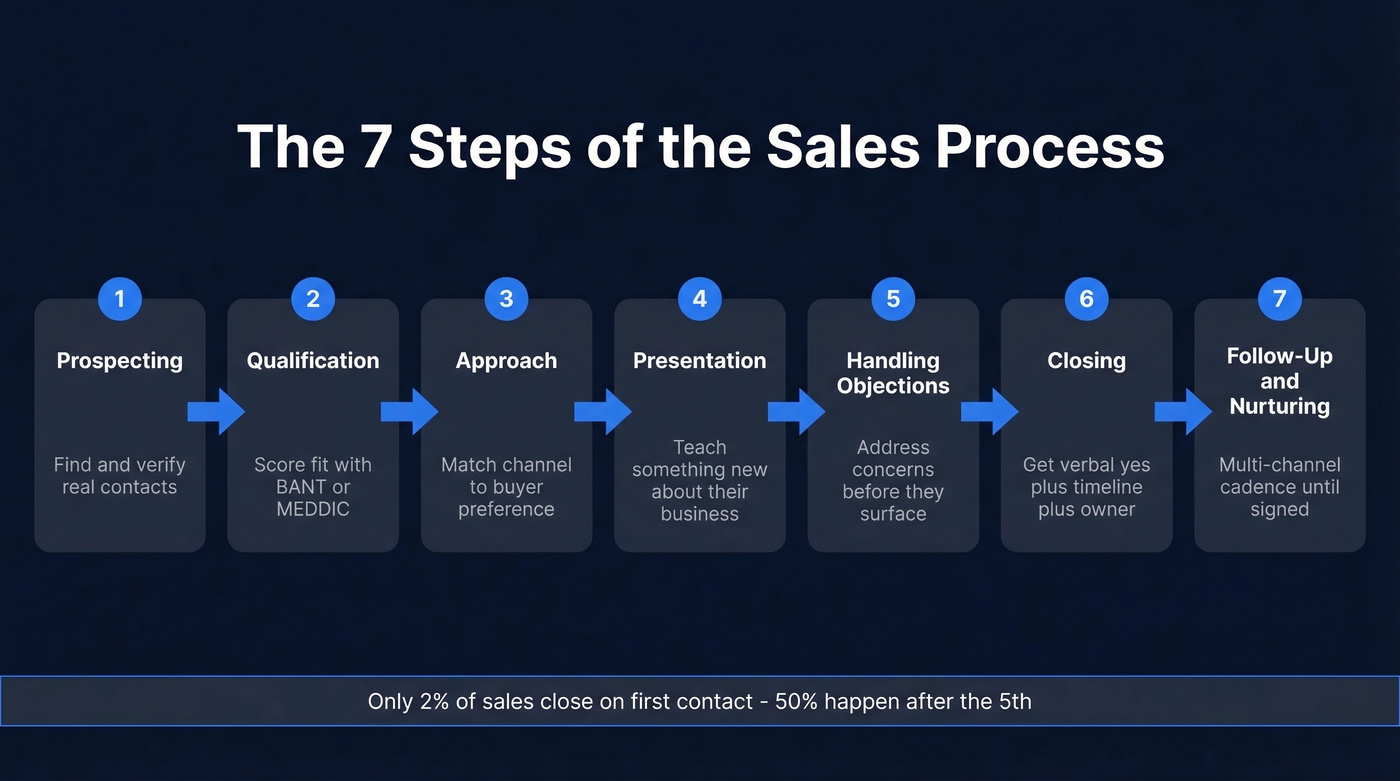
The classic 7 steps of the sales process still work - if you strip out the textbook fluff and replace them with stage-specific benchmarks, exit criteria your CRM can enforce, and qualification frameworks matched to your deal size. Here's the skeleton you can implement this week, with the muscle to make it hold up in production.
The Quick Version
If you're building or fixing a sales process, here's the priority order:
- Fix your prospecting data. Bad contacts poison every step downstream.
- Add stage exit criteria to your CRM so garbage deals stop clogging the pipeline.
- Pick a qualification framework that matches your deal size (BANT, MEDDIC, or SPIN - comparison below).
Process vs. Methodology
These get conflated constantly. Salesforce puts it simply: the sales process is the what - the repeatable steps your team follows from first touch to closed deal. The methodology is the how - the execution philosophy layered on top.
SPIN, Challenger, and MEDDIC are methodologies. They tell reps how to run discovery, how to teach, how to qualify. The seven sales process steps tell them when to do each of those things. You need both. Build the process first.
Complete Breakdown of Each Step
Step 1 - Prospecting
Up to 50% of sales go to the first vendor to respond. That alone tells you why prospecting isn't "finding names" - it's about reaching real people, fast, before your competitor does.
Here's the thing: 69% of cold emailers say performance declined year-over-year thanks to spam filtering and AI content fatigue, and 45% of teams are already running hybrid AI-SDR models to compensate. Your entire process depends on reaching real people at verified contact details. Prospeo covers 300M+ professional profiles with 98% email accuracy, plus 125M+ verified mobile numbers with a 30% pickup rate, all refreshed on a 7-day cycle. Snyk's 50-person AE team cut bounce rates from 35-40% to under 5% and generated 200+ new opportunities per month after switching.

Most teams treat prospecting as a volume game. It's not. Blasting 5,000 unverified emails doesn't build pipeline - it burns your domain reputation and poisons deliverability for months.
If you're rebuilding your outbound motion, start with sales prospecting techniques that fit today's deliverability reality.
Step 2 - Qualification
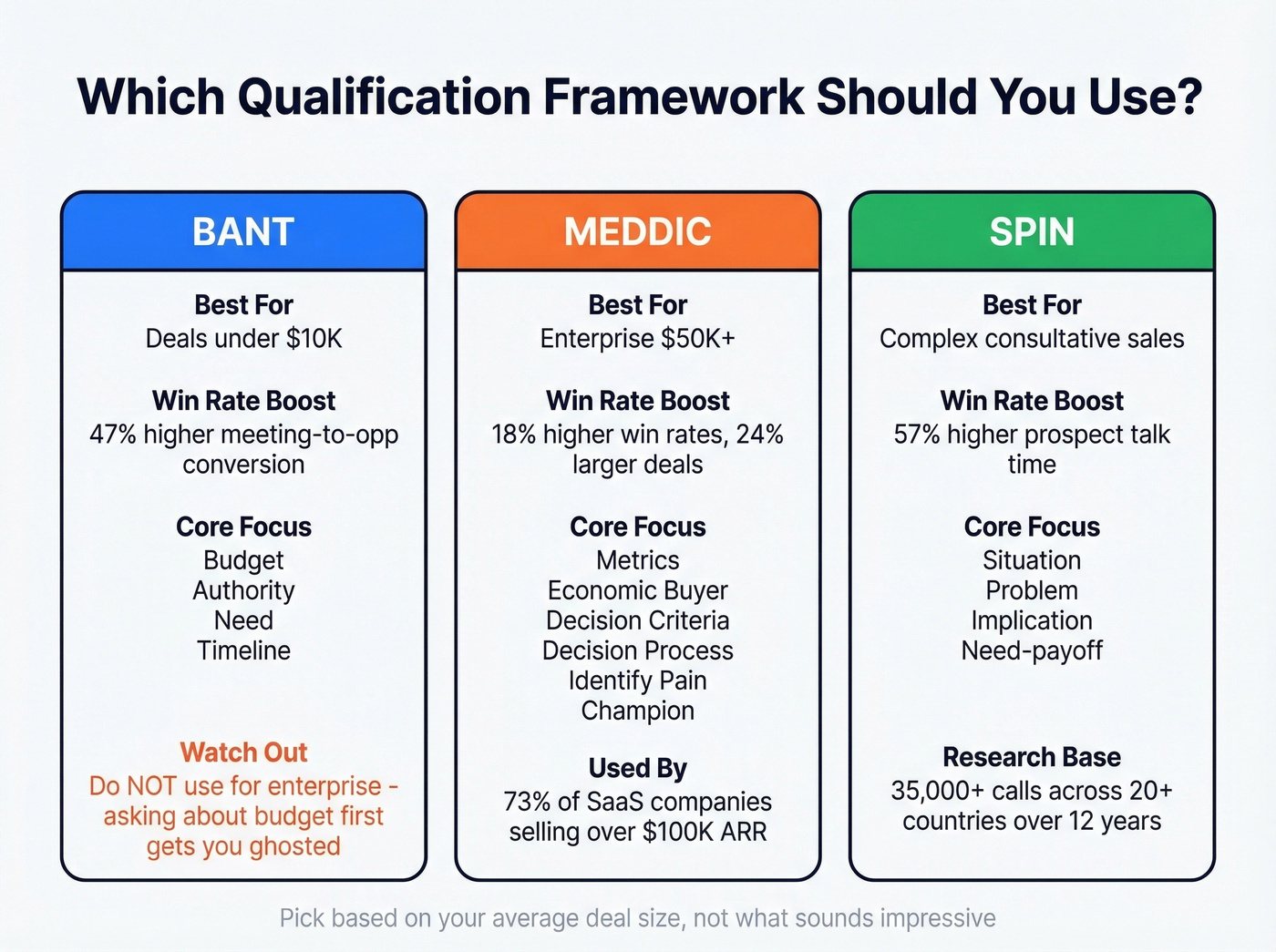
Not every prospect deserves a demo. The qualification step exists to separate real opportunities from polite time-wasters - and which framework you use matters more than most teams realize.
| Framework | Best For | Key Stat | Core Focus |
|---|---|---|---|
| BANT | Deals under $10K | 47% higher meeting-to-opp conversion (modernized) | Budget, Authority, Need, Timeline |
| MEDDIC/MEDDPICC | Enterprise $50K+ | 18% higher win rates, 24% larger deals | Metrics, Decision process, Champion |
| SPIN | Complex consultative | 57% higher prospect talk time during discovery | Situation, Problem, Implication, Need-payoff |
73% of SaaS companies selling >$100K ARR use some MEDDIC variant. That's not a trend - it's a consensus. For transactional deals, BANT still works if you modernize it by leading with need, not budget. For consultative sales where discovery depth drives the deal, SPIN's questioning framework is hard to beat.
This is also where multi-threading starts. With around 6.3 stakeholders in the average buying committee, map the org chart during qualification - not after. Identify the decision-maker, the champion, and the blocker early, then run parallel conversations from the start.
If you want a tighter system here, use an Ideal Customer Profile and a consistent lead scoring model so reps qualify the same way.
The trap: Using BANT for enterprise deals. Asking a VP "what's your budget?" in the first call is a fast way to get ghosted.
Step 3 - Approach
McKinsey's rule of thirds still holds: at any given stage, roughly a third of buyers prefer in-person, a third prefer remote, and a third want digital self-serve. And 71% of buyers prefer doing their own research over talking to a rep - so your approach must accommodate that preference, not fight it.
Buyers now use about 10 interaction channels on average, up from 5 in 2016. The reps who book meetings aren't the ones sending the most emails - they're the ones matching the channel to the buyer's preference. A CTO responds to a technical blog link on Slack. A VP of Sales picks up a cold call. A procurement lead wants a self-serve pricing calculator.
If you're standardizing this step, build it into your sales communication guidelines and your sequence management rules.
Quick channel-matching checklist:
- Technical buyers: async content like docs, case studies, Slack
- Executive buyers: phone or warm intro
- Procurement: self-serve pricing, ROI calculators
- Champions: whatever channel they respond on fastest
Step 4 - Presentation
The Challenger Sale research studied 6,000+ reps and found that "teaching" buyers something new about their own business outperformed relationship-building and problem-solving approaches. Xerox reported a 17% sales increase and $65M in contract value after implementing it.
SPIN's research base is even larger - 35,000+ sales calls across 20+ countries over 12 years. The core finding? Reps who ask better implication and need-payoff questions close more. In our experience, the best presentations are 70% questions and 30% talking. Most reps invert that ratio and wonder why deals stall.
If your demos keep stalling, tighten your discovery questions and use a repeatable product demo checklist.
Nobody buys software because it has "AI-powered analytics." They buy it because their forecast accuracy is garbage and the board is asking questions. Lead with the business problem, always.
Step 5 - Handling Objections
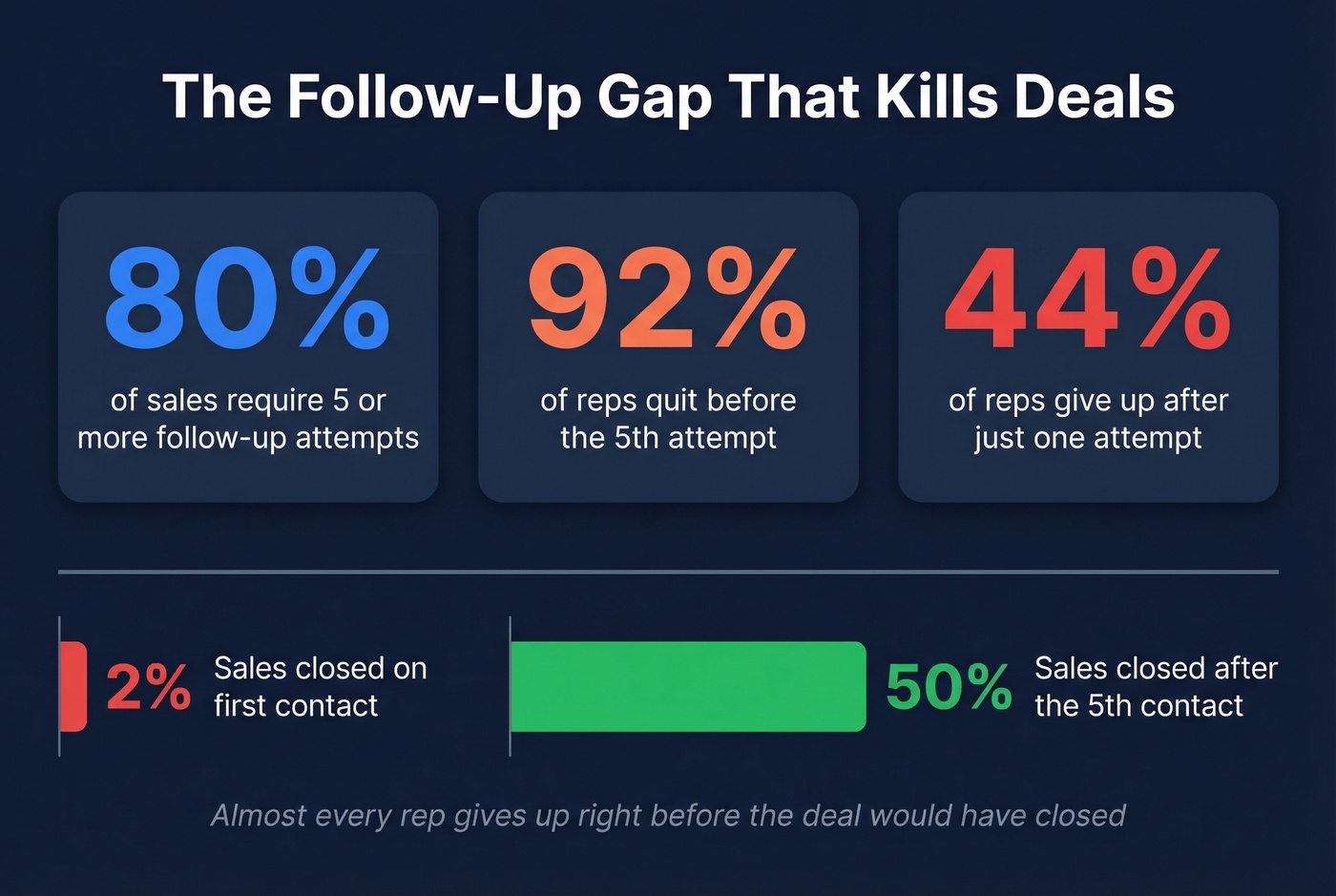
80% of sales require 5+ follow-up attempts. And 92% of reps quit before the fifth. Let that sink in - almost every rep gives up right before the deal would've closed.
Objections aren't rejection. They're buying signals wrapped in uncertainty. "It's too expensive" means they're evaluating ROI. "We need to think about it" means they can't sell it internally yet. "We're happy with our current vendor" means they haven't felt enough pain to switch.
If you want to reduce repeats, build a library of sales follow-up templates and a playbook for how to add value in sales at each touch.
Use this mindset: Every objection is a request for more information, delivered awkwardly.
Skip this mindset: Treating objections as personal rejection and moving on to the next prospect.
The best reps address the top 3 objections before the prospect raises them. If you're hearing the same objection on more than 30% of calls, bake the answer into your presentation deck.
Step 6 - Closing
Outreach's data tells a clear story: opportunities closed within 50 days show a 47% win rate. After 50 days, that drops to roughly 20%. Speed kills - in a good way. And 34% of revenue teams report cycles of 1-2 quarters; if yours is consistently longer, the closing step is where discipline breaks down.
If you're tightening late-stage execution, align your sales process optimization work with a clear pipeline health dashboard.
AI coaching tools are accelerating this. Outreach's Kaia closes deals 11 days faster on average, and for deals above $50K, win rates lift up to 10 percentage points. But the underlying principle is simpler than any tool: every meeting should end with a clear next step, a date, and an owner. If you can't get those three things, the deal isn't progressing. It's stalling.
Step 7 - Follow-Up and Nurturing
Only 2% of sales close on first contact. 50% happen after the 5th contact. Yet 44% of reps give up after one attempt. The math is brutal and obvious.
Multi-channel follow-up cadences produce 28% higher conversion rates than single-channel. A strong cadence structure looks like this:
- Days 1-3: Email + phone call on different days
- Days 4-7: Social touch + value-add email with a case study or relevant content
- Days 8-14: Phone + breakup email
- Days 15-30: Nurture sequence with monthly value touches, not sales pitches
The key is persistence without desperation. Every touch should add value or provide a new angle. "Just checking in" is the fastest way to get archived.
Stage Exit Criteria for Your CRM
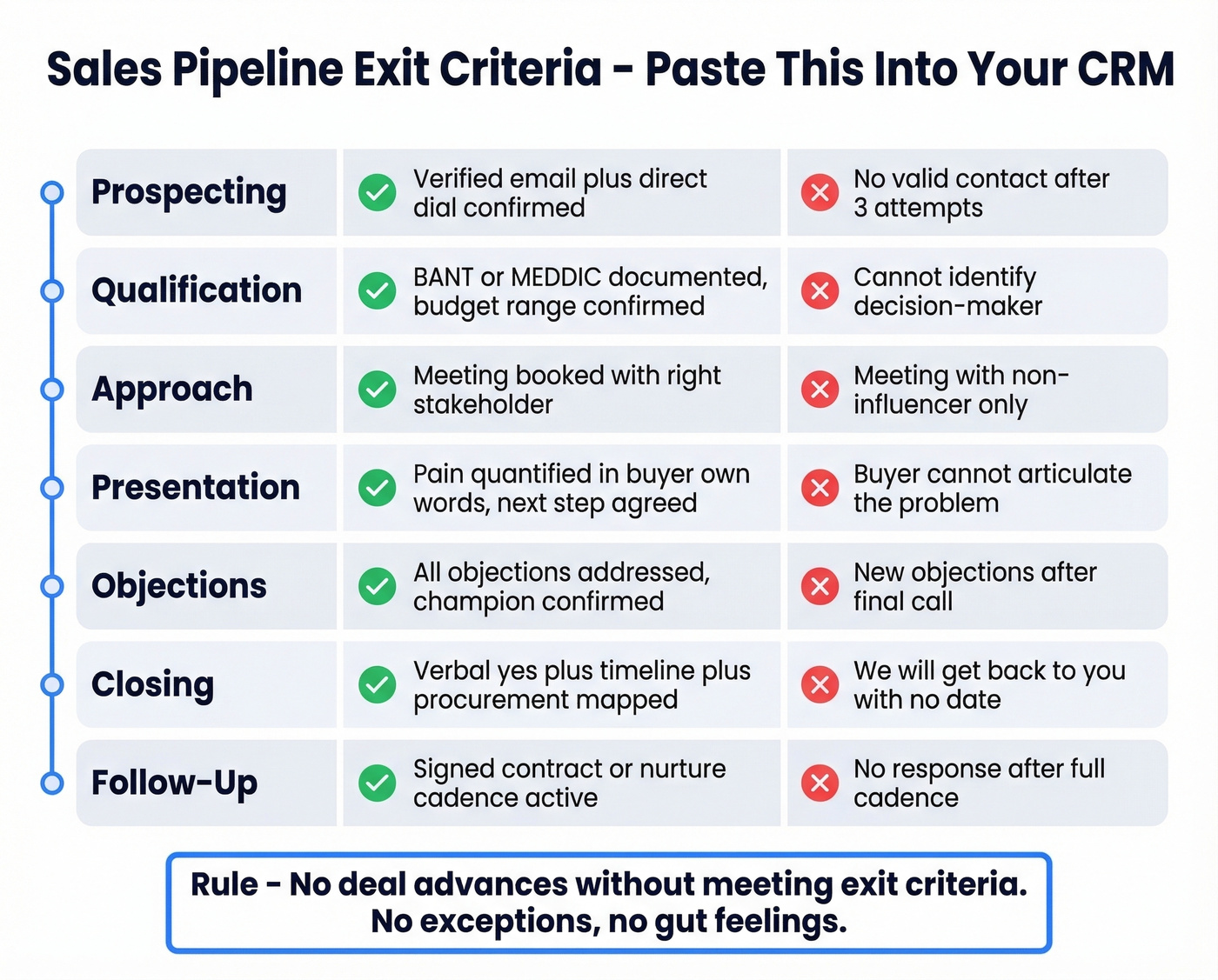
This is the table you paste into your CRM stage definitions. Each deal should meet these criteria before advancing - no exceptions, no "I have a good feeling about this one."
| Stage | Exit Criteria | Red Flag |
|---|---|---|
| Prospecting | Verified email + direct dial confirmed | No valid contact after 3 attempts |
| Qualification | BANT/MEDDIC documented; budget range confirmed | Can't identify decision-maker |
| Approach | Meeting booked with right stakeholder | Meeting with non-influencer |
| Presentation | Pain quantified in buyer's words; next step agreed | Buyer can't articulate the problem |
| Objections | All objections addressed; champion confirmed | New objections after "final" call |
| Closing | Verbal yes + timeline + procurement mapped | "We'll get back to you" with no date |
| Follow-Up | Signed contract or nurture cadence active | No response after full cadence |

84% of reps missed quota last year. Most of them failed at Step 1. Prospeo gives you 300M+ profiles with 98% email accuracy and 125M+ verified mobiles - all refreshed every 7 days, not 6 weeks. Snyk's 50 AEs dropped bounce rates from 35% to under 5% and added 200+ opportunities per month.
Stop poisoning your pipeline at the prospecting step.
You can't qualify, present, or close deals with prospects you never reached. Every step of your sales process depends on verified contact data. At $0.01 per email, Prospeo costs 90% less than ZoomInfo - and teams book 26% more meetings with it.
Nail all 7 steps by getting Step 1 right for a penny per lead.
Benchmarks That Actually Matter
Stop guessing whether your pipeline is healthy. Here's what the data says.
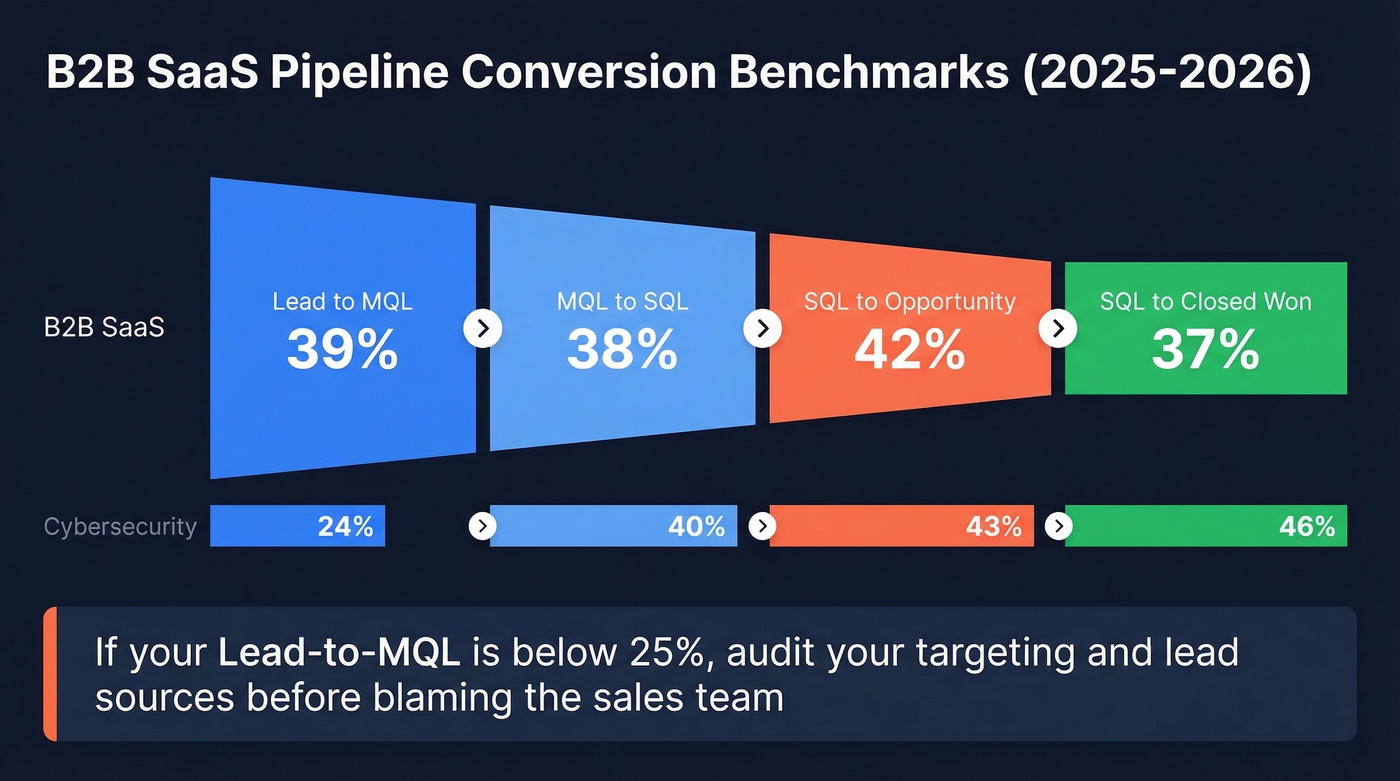
Conversion Rates by Stage (B2B)
| Industry | Lead-to-MQL | MQL-to-SQL | SQL-to-Opp | SQL-to-Closed |
|---|---|---|---|---|
| B2B SaaS | 39% | 38% | 42% | 37% |
| Cybersecurity | 24% | 40% | 43% | 46% |
We've found that Lead-to-MQL is almost always the weakest link. If yours is below 25%, audit your targeting and lead sources before blaming the sales team.
If you need a tighter model for these stages, map them to a B2B sales funnel template and track funnel metrics consistently.
Sales Cycle Length by Industry and ACV
| Segment | Avg Cycle (Days) |
|---|---|
| Software | 90 |
| Manufacturing | 130 |
| Healthcare | 125 |
| ACV under $1K | 25 |
| ACV $50K-$100K | 120 |
| ACV over $500K | 270 |
Sales Cycle by Company Size
| Company Size | Avg Cycle (Days) |
|---|---|
| 1-10 employees | 38 |
| 201-500 employees | 95 |
| 10,001+ employees | 185 |
Cycles are getting longer - 58% of B2B professionals report their sales cycles increased over the past year. But sales automation tools can shorten cycles by up to 15%, and Digital Sales Rooms cut them by up to 28%. If your cycle is significantly longer than your industry benchmark, audit your qualification step first. That's almost always where deals stall.
Why Linear Is a Lie
Here's our hot take: the seven selling steps are the best framework for building a repeatable motion - and also a terrible description of how deals actually close. TheSalesBlog makes this point well: real deals don't move neatly from step 1 to step 7. A prospect jumps from qualification straight to objection handling when a new stakeholder enters the conversation. You re-qualify after a budget cycle resets. The deal loops back on itself three times before it closes.
With around 6.3 stakeholders in the average buying committee, you're often qualifying one person while presenting to another while handling objections from a third. The framework gives you a shared language and a CRM structure. The best reps treat the steps as a checklist of things that need to happen, not a sequence that must happen in order.
Maintaining Your Selling Process
Building the process is step one. Keeping it alive is where most teams fail.
Run a quarterly audit: pull stage conversion rates, identify where deals stall, and check whether your CRM stage definitions still match reality. If reps are skipping a stage or gaming exit criteria, the process needs updating - not more enforcement. We've seen teams get paralyzed trying to force deals through a pipeline that no longer reflects how their buyers actually buy. Review your qualification framework fit, your exit criteria, and your cadence structure at least every quarter. The process should evolve with your market, not calcify around last year's assumptions.
Mistakes That Kill Deals
| Stage | Common Mistake | Fix |
|---|---|---|
| Discovery | Talking too much | Target 30/70 talk-to-listen ratio |
| Qualification | Qualifying too loosely | Document BANT/MEDDIC before advancing |
| Multi-threading | Wrong stakeholders | Map org chart; confirm decision-maker + champion |
| Presentation | Leading with price | Lead with business impact; quantify cost of inaction |
| Follow-up | Quitting after 1-2 attempts | Run full 5+ touch cadence across channels |
Look, none of these are surprising. But the gap between knowing them and enforcing them in your CRM is where deals die. The fix isn't awareness - it's exit criteria that prevent deals from advancing until the mistake has been avoided.
Putting It Together
The 7 steps of the sales process work when you enforce them with exit criteria and measure them with benchmarks. Start with clean data, qualify ruthlessly, and don't quit before the 5th follow-up. If your average contract value sits in the low four figures, you probably don't need MEDDIC-level rigor - but you absolutely need verified contacts and a multi-channel cadence. Build the skeleton this week. Add the muscle as you learn where your specific deals break down.
FAQ
What are the 7 steps of the sales process?
They are: (1) Prospecting, (2) Qualification, (3) Approach, (4) Presentation, (5) Handling Objections, (6) Closing, and (7) Follow-Up and Nurturing. Each step has specific exit criteria a deal should meet before advancing. The framework is universal, but execution - which qualification method you use, how you structure follow-up - should match your deal size and sales motion.
How long should a B2B sales cycle take?
Software averages 90 days. Deals under $1K ACV close in roughly 25 days; deals over $500K take about 270 days. Company size matters too - startups with 1-10 employees average 38-day cycles, while enterprises with 10,000+ employees average 185 days. If your cycle is significantly longer than your benchmark, audit your qualification step first.
Which qualification framework should I use?
BANT for transactional deals in the four-figure range. MEDDIC or MEDDPICC for enterprise deals above $50K - companies using it report 18% higher win rates and 24% larger deal sizes. SPIN for complex consultative sales where discovery depth drives the outcome. Match the framework to your average deal size, not to what sounds most sophisticated.
What's the best way to fix bad prospecting data?
Use a verified B2B data provider with a short refresh cycle. Prospeo refreshes records every 7 days versus the 6-week industry average and delivers 98% email accuracy across 300M+ profiles. Meritt tripled pipeline from $100K to $300K/week and cut bounce rates from 35% to under 4% after switching to verified data. Clean contacts are the foundation every other step depends on.
How does a sales process differ from a sales methodology?
The sales process defines the stages a deal moves through - from prospecting to follow-up. A methodology like SPIN, Challenger, or MEDDIC defines how reps execute within each stage. Think of the process as the structure and the methodology as the playbook. You need both: the process tells your team when to act, and the methodology tells them how.