

How to Build an ABM Campaign That Actually Generates Pipeline
Your CMO just came back from a conference and announced the team is "doing ABM now." There's a slide deck with a funnel diagram, a request for a "target account list by Friday," and zero clarity on what actually changes. You've seen this movie before - and you know how it ends without a real playbook.
Here's the uncomfortable truth about every ABM campaign that stalls: 71% of B2B practitioners already run some form of account-based marketing. The gap isn't adoption. It's execution. Most teams slap an ABM label on the same demand gen motions, wonder why pipeline doesn't move, and blame the strategy. The strategy isn't the problem. The implementation is.
What You Need (Quick Version)
- Account selection discipline, sales buy-in, and verified contact data. Tools come last.
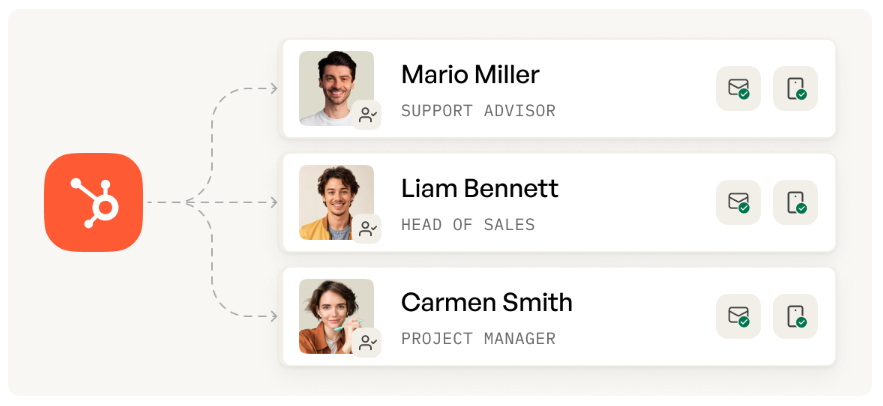
- Start with 10-25 accounts, not 500. Build a pod (AE + SDR + ABM manager). Measure account progression, not MQLs.
- You don't need a $50K platform. HubSpot or Salesforce + verified contacts + one personalized channel is enough to start.
What Is an ABM Campaign, Really?
A thread on r/DigitalMarketing put it bluntly: ABM sounds "revolutionary" until you realize it's basic B2B segmentation plus tailored content plus narrower targeting. The skepticism is fair - and mostly directed at how it gets implemented, not the framework itself.
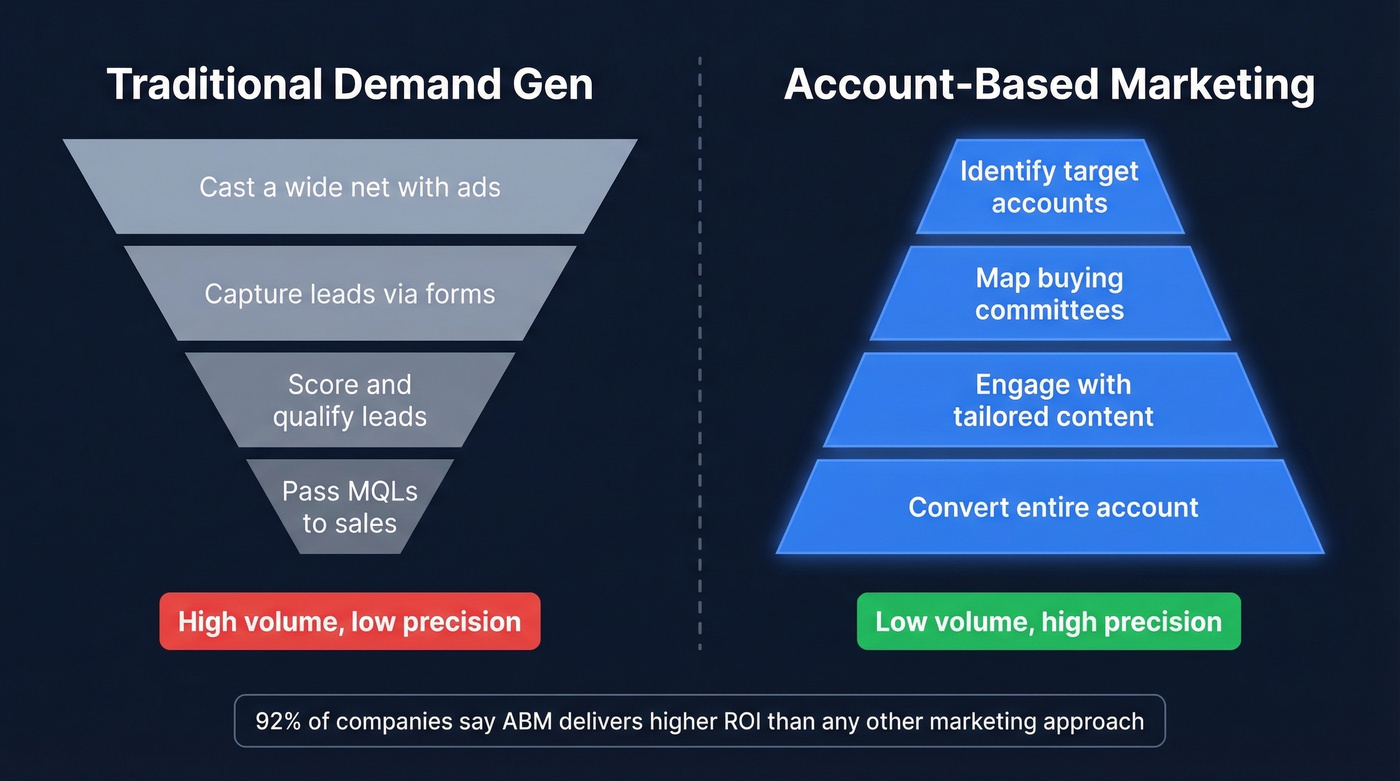
Traditional demand gen casts a wide net: run ads, capture leads, score them, pass to sales. An account-based marketing campaign flips the funnel. You start with named accounts your sales team actually wants to close, then build campaigns specifically for the buying committees inside those accounts. As one practitioner in Dreamdata's ABM discussion put it, "ABM is just good marketing." The difference is intentionality.
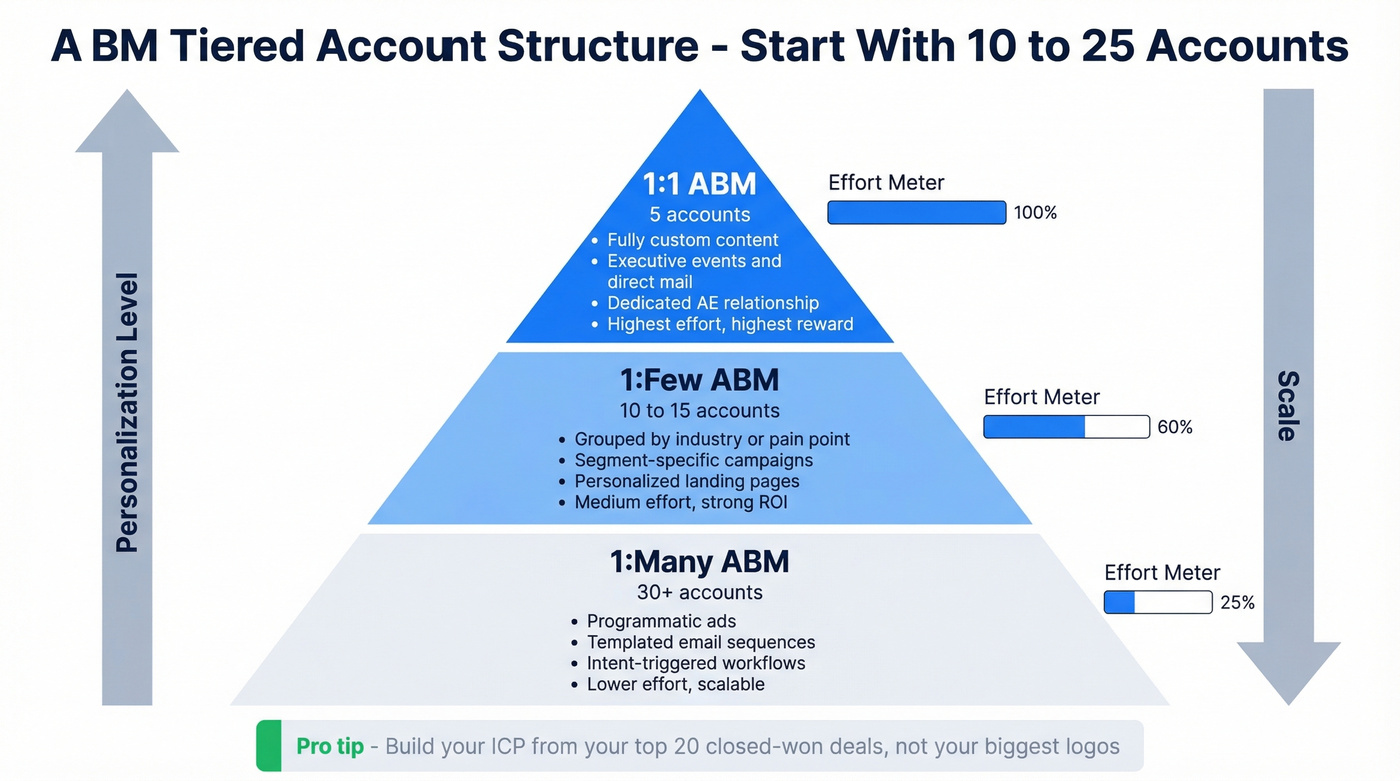
ABM operates across three tiers. 1:1 ABM targets 1-5 accounts with fully custom content, executive events, and direct mail - high effort, high reward. 1:Few ABM groups 10-30 accounts by shared characteristics like industry, pain point, or tech stack and delivers segment-specific campaigns. 1:Many ABM scales to 30+ accounts with lighter personalization: programmatic ads, templated email sequences, and intent-triggered workflows.
92% of companies say ABM delivers higher ROI than any other marketing approach. The directional truth holds: when you concentrate resources on accounts that actually fit your ICP, conversion rates go up and waste goes down. Contact-level targeting is pulling ahead too - up to 74% more booked meetings and 118% lift in pipeline conversion compared to account-level targeting alone.
Mistakes That Kill ABM Campaigns
The top challenges practitioners report: proving ROI (47%), aligning sales and marketing (43%), and scaling programs (40%). Most of those trace back to predictable anti-patterns.
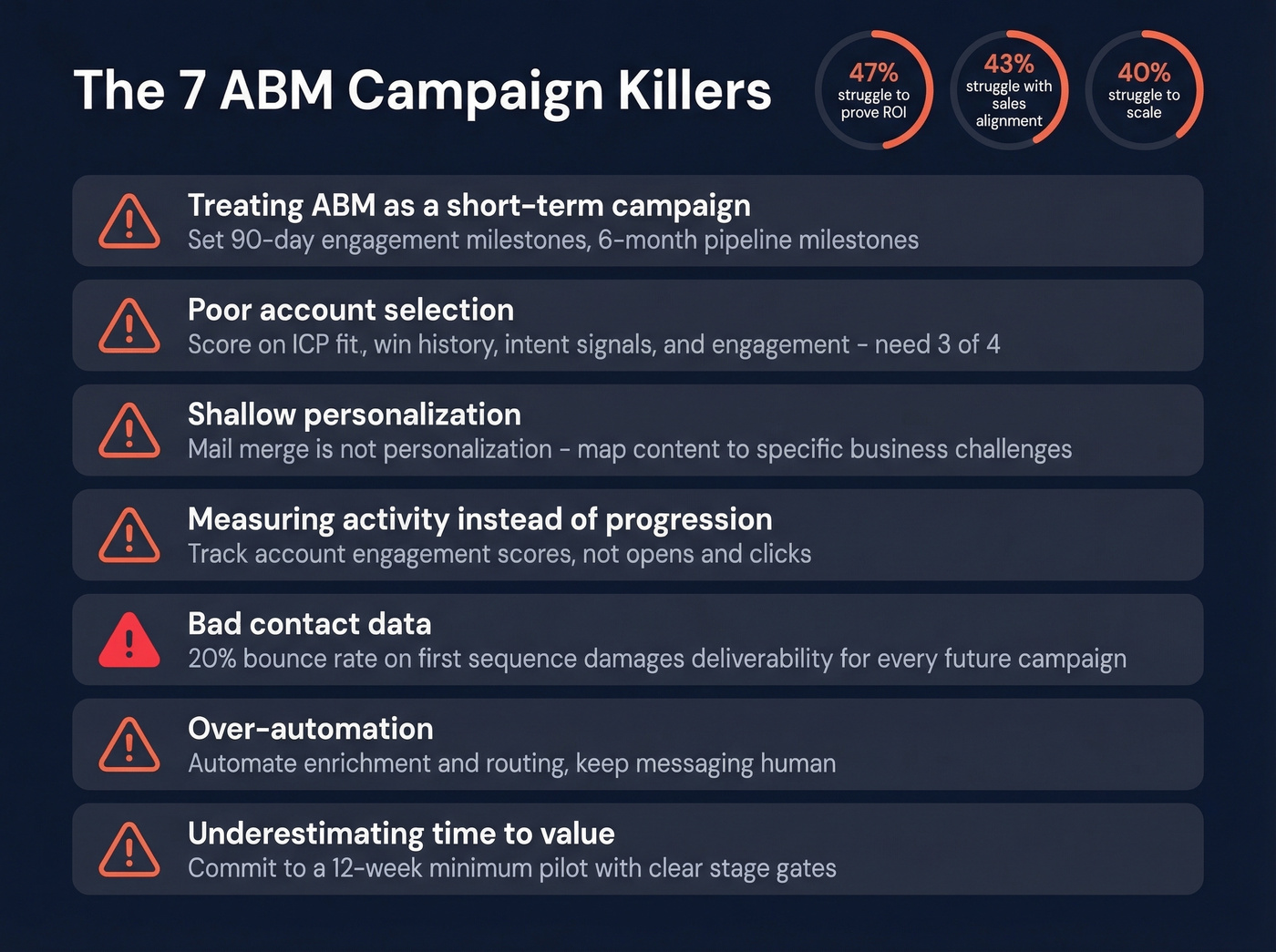
Treating ABM as a short-term campaign is the most common killer. Account-based marketing is a motion, not a sprint. If you're expecting pipeline in 30 days, you're running demand gen with an ABM label. Set 90-day milestones for engagement and 6-month milestones for pipeline.
Poor account selection is the second. Picking accounts based on firmographics alone - or letting sales cherry-pick their wish list without data validation - guarantees a bloated list with no signal. Combine ICP fit, historical win data, intent signals, and engagement trends. If an account doesn't score well on at least three of those four dimensions, cut it.
The remaining anti-patterns show up just as often:
- Shallow personalization. Swapping a company name into a template isn't personalization. It's mail merge. Map content to the specific business challenges each account segment faces.
- Measuring activity instead of progression. Opens and clicks don't tell you if an account is moving through the funnel. Track account engagement scores, opportunity creation, and deal velocity.
- Bad contact data. Bounced emails burn your domain reputation. Wrong phone numbers waste SDR time. If 20% of your list bounces on the first sequence, you've already damaged deliverability for every future campaign. Verify every contact before outreach.
- Over-automation. Automating personalization at scale sounds great until every touchpoint feels robotic. Automate the operational layer - enrichment, routing, alerts - and keep the messaging human.
- Underestimating time to value. Teams that kill programs after 60 days never see the payoff. Commit to a 12-week minimum pilot with clear stage gates.
The ABM Campaign Framework
Six steps, in order. Skip one and the whole thing wobbles.
Build Your Tiered Account List
Start from your best customers, not your biggest logos. Pull your top 20 closed-won deals from the last 18 months and look for patterns: industry, company size, tech stack, buying trigger, deal cycle length. That's your ICP - derived from data, not aspiration.
Layer in sales validation and trigger events like funding rounds, leadership changes, headcount growth, and new tech adoption. The ICP is the foundation; triggers tell you when to engage. If you need a repeatable way to build and maintain lists, see target account list workflows.
For your first program, target 10-25 accounts. Tier them: 5 accounts get 1:1 treatment, 10-15 get 1:few, and the rest sit in a 1:many nurture.
Enrich and Verify Contact Data
This is the step every other ABM guide skips, and it's the one that determines whether your campaign actually reaches anyone.
Each target account has a buying committee of 6-10 stakeholders - the economic buyer, the champion, the technical evaluator, the end user, and often a procurement gatekeeper. You need verified emails and direct dials for every one of them. We've seen teams build beautiful ABM programs that go nowhere because half their contact list bounces on the first sequence. (If you’re comparing vendors, start with data enrichment and lead enrichment basics.)

Prospeo's database covers 300M+ professional profiles, 143M+ verified emails, and 125M+ verified mobile numbers with 98% email accuracy. Upload your account list, filter by role and seniority using 30+ search filters, and export verified contacts in minutes. The data refreshes every 7 days - the industry average is 6 weeks, which means most databases are serving you stale contacts by the time your second email sequence fires.
The stakes are real. Snyk's 50-person AE team was running 35-40% email bounce rates before switching to verified data. After the switch, bounces dropped below 5%, AE-sourced pipeline jumped 180%, and the team generated 200+ new opportunities per month. Bounced emails don't just waste sends - they damage your sender reputation, which tanks deliverability for every future campaign across your entire domain. If you want to benchmark and fix this systematically, use an email bounce rate checklist and an email deliverability playbook.
Map Content to Funnel Stages
Email leads ABM channel usage at 92%, followed by in-person events at 72%. But channel selection matters less than channel-to-stage mapping. Early-stage accounts need awareness content: thought leadership, industry benchmarks, relevant case studies. Mid-stage accounts need proof - ROI calculators, customer stories from their vertical, technical deep dives. Late-stage accounts need air cover for the champion: executive summaries, competitive comparisons, implementation guides.
Only 13% of teams hyper-personalize their account-based marketing, and 31% say they lack the resources to personalize at scale. You don't need to personalize everything. Personalize the first touch and the highest-leverage assets - the case study, the landing page, the direct mail piece. Template the rest. For practical messaging patterns, borrow from personalized outreach and targeted email campaigns.
Don't overlook trigger-based plays either. A meeting booked should fire a different sequence than a no-show. A closed-lost account re-engaging with your content three months later deserves a re-activation play, not the same nurture drip.
Build Your ABM Pod
The pod structure from Dreamdata is the model that works: one AE, one SDR, and one ABM manager, "hunting in packs." The AE owns the relationship and the close. The SDR handles outbound sequencing and meeting booking. The ABM manager orchestrates content, ads, and campaign timing. If you’re building the outbound motion, keep a short list of sales prospecting techniques that match your tiers.
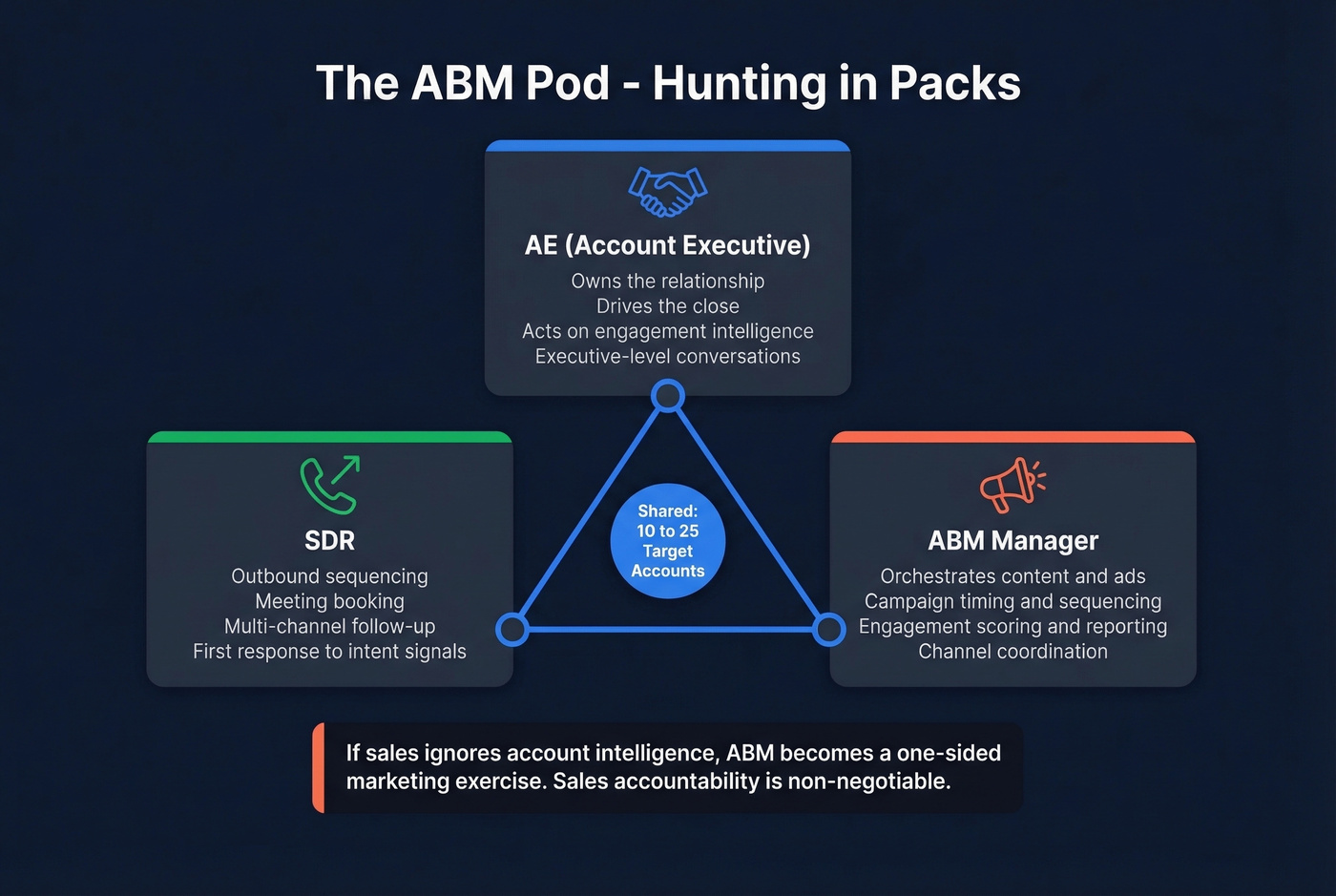
Sales accountability is non-negotiable. If sales ignores the account intelligence - engagement signals, content consumption data, ad interaction alerts - ABM becomes a one-sided marketing exercise. We've watched this happen more times than we can count, and it's the single fastest way to kill a program that's otherwise well-built.
Launch a Phased Rollout
| Phase | Weeks | Focus | Key Activities |
|---|---|---|---|
| Foundation | 1-4 | Baseline engagement | Finalize accounts, enrich contacts, launch first sequences + ads |
| Activation | 5-8 | Multi-channel layering | Add direct mail/video for top tiers, retarget mid-funnel, sync SDR outbound with marketing |
| Acceleration | 9-12 | Pipeline conversion | Executive engagement for 1:1 accounts, warm handoffs with full engagement history |
The critical discipline in Weeks 5-8: let Week 1-4 data guide your channel expansion. If email engagement is strong, add direct mail or personalized video for top-tier accounts. If ad engagement is high, retarget with mid-funnel content. Don't activate every channel at once - sequence them based on signal.
Measure Account Progression
Stop measuring ABM with MQL dashboards. MQLs are a demand gen metric. Account-based programs need account-level measurement. If you need a clean KPI set, align it to pipeline health and core funnel metrics.
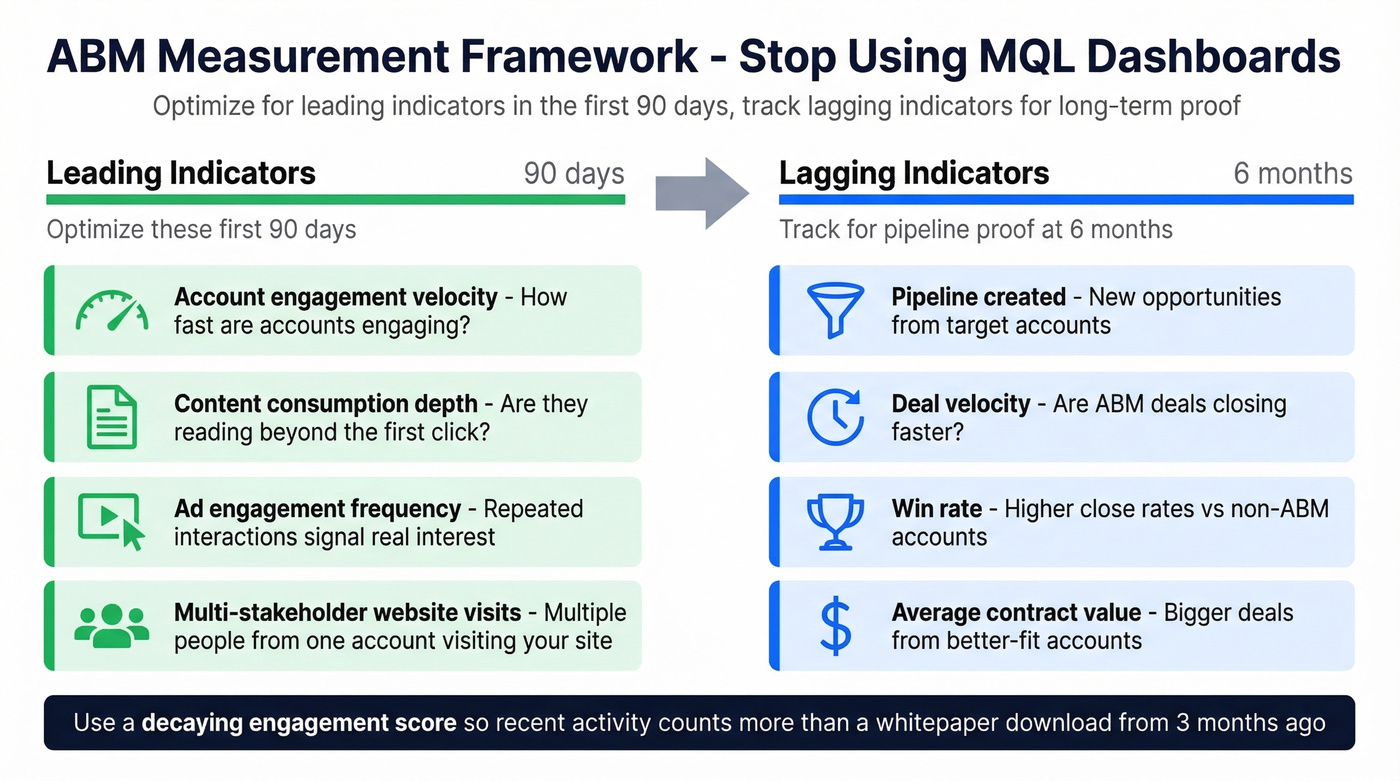
Dreamdata advocates a continually decaying engagement score - recent activity counts more than activity from 60 days ago. This prevents "zombie accounts" from sitting at the top of your list just because someone downloaded a whitepaper three months ago.
Leading indicators: account engagement velocity, content consumption depth, ad engagement frequency, website visits from multiple stakeholders at the same account. Lagging indicators: pipeline created, deal velocity, win rate, average contract value. Track both, but optimize for the leading indicators in the first 90 days.

ABM campaigns die when half your buying committee contacts bounce. Prospeo gives you 98% email accuracy and 125M+ verified mobile numbers across 300M+ profiles - refreshed every 7 days, not every 6 weeks. Upload your target account list, filter by role and seniority, and export verified contacts for every stakeholder in minutes.
Stop building ABM programs on stale data that tanks your domain reputation.
ABM Campaign Examples Worth Studying
| Company | ABM Type | Key Metric | Execution Detail |
|---|---|---|---|
| CipherHealth | Contact-level | $122.70 revenue per $1 | Slack + Salesloft automation |
| StarTree | Contact-level | 3.17x conversion lift | Account-to-contact targeting |
| AVEVA targeting GSK | 1:1 Enterprise | £7M pipeline | Personalized microsite |
| BlueBotics | 1:few | £4M+ opportunities | Marketing team of one |
| BioCatch | 1:many | 6x pipeline accounts | 553 global banks targeted |
| Quantexa | 1:few | 5.2x pipeline boost | 4.53x conversion rate |
What made CipherHealth the standout? Not the $122.70 return per dollar spent or the 83% pipeline lift - it was the operational detail. Real-time Slack notifications triggered by ad engagement fed directly into Salesloft sequences, so SDRs followed up within hours of a signal, not days. Speed of response turned intent into pipeline.
Show your CFO the BlueBotics case. A marketing team of one generated £4M+ in opportunities and £750K+ in revenue, landing Michelin, Toyota Forklift, and ABB. They built roughly 160 new relationships and converted 15 into active sales conversations. ABM doesn't require headcount - it requires focus.
AVEVA's campaign targeting GSK won Forrester's B2B Program of the Year for good reason: 2,000 visits to a personalized microsite, 46 new decision-maker relationships, and £7M in active pipeline.
ABM Benchmarks in 2026
The ZenABM benchmark dataset - covering 2025 performance data from 211 companies across 29 countries with $5.5M in ad spend and 161,000+ ads - gives us the most detailed view of ABM ad performance available.
Here's our hot take: if your average deal size is under $15K, you probably don't need ABM at all. The math doesn't work. ABM's compounding returns kick in when deal sizes justify the per-account investment. Below that threshold, you're better off with sharp demand gen and a good SDR team. Above it, ABM is the single highest-ROI motion you can run.
Two trends worth watching. First, 72% of buyers now encounter AI Overviews during research, and 90% click at least one cited source - your content needs to be citable and authoritative enough to surface in AI-generated summaries, not just traditional search. Second, 45% of practitioners see AI's promise for ABM personalization, but nearly 70% find current effectiveness limited. Don't bet your personalization strategy on AI tooling that isn't ready yet. Manual personalization on high-value accounts still wins.
40% of teams are integrating ABM with demand gen into a unified revenue motion. This is the right direction. Account-based marketing for your top-tier accounts, demand gen for everything else, and shared measurement across both.
| Metric | 1:1 ABM | 1:Few ABM | 1:Many ABM |
|---|---|---|---|
| Accounts targeted | 1-5 | 10-30 | 30+ |
| Personalization depth | Fully custom | Segment-specific | Light personalization |
| Typical channels | Direct mail, exec events | Email, ads, webinars | Programmatic ads, sequences |
| Time to pipeline | 6-12 months | 3-6 months | 1-3 months |
Running ABM on a Budget
A recurring sentiment on r/b2bmarketing deserves acknowledgment: most teams "doing ABM" are running generic ads to ~500 companies with minimal messaging changes and calling it account-based. That's not ABM. But the constraint is real - not everyone has $50K for Demandbase.
Starter ($0-$500/mo): HubSpot free or Starter for CRM and email. Prospeo's free tier gives you 75 verified emails + 100 Chrome extension credits per month - enough to build buying committees for 10-15 target accounts. Manual personalization on first touches. You don't need a $30K annual contract to start proving the motion works.
Growth ($500-$3,000/mo): HubSpot or Salesforce as your CRM backbone. Scale contact enrichment at ~$0.01 per email. Add one intent data source and one ad channel. This is where 1:few programs become sustainable.
Enterprise ($3,000-$10,000+/mo): Full ABM platform for orchestration and attribution. Enrichment at scale. Multi-channel activation across ads, email, direct mail, and events. This tier makes sense after you've proven pipeline impact at the Growth level. Skip this if you haven't run at least one successful 1:few program - you'll spend six figures configuring a platform you don't know how to use yet.
The ABM Tool Stack
Let's be honest: the tool stack is the least important part of ABM. Account selection discipline, sales buy-in, and contact data quality matter more than any software purchase. Start with data + CRM, add platforms after you've proven the motion.

Think about the stack across five capability layers: account identification, intent data, multi-channel activation, CRM integration, and attribution.
| Category | Tool | Starting Price | Best For |
|---|---|---|---|
| Contact Data | Prospeo | Free; ~$0.01/email | Verified buying committee data |
| Contact Data | Cognism | ~$1K-$3K/mo | European data + mobiles |
| Contact Data | ZoomInfo | ~$15K-$40K/yr | Large US database |
| ABM Platform | Demandbase | ~$30K-$100K+/yr | Enterprise orchestration |
| ABM Platform | 6sense | Free (50 credits); paid ~$30K+/yr | Intent-driven identification |
| ABM Platform | RollWorks | ~$975/mo | Mid-market ABM ads |
| Intent Data | Bombora | ~$20K-$50K/yr | Standalone intent signals |
| Web Personalization | Mutiny | ~$10K-$50K/yr | Website personalization |
| Contact-Level Ads | Influ2 | ~$2K-$5K+/mo | Person-level ad targeting |
87% of marketers confirm ABM delivers superior ROI, but most of that ROI comes from the strategy, not the stack. The teams getting 3x pipeline lifts aren't the ones with the most expensive tools - they're the ones with the tightest account lists and the most engaged sales partners. If you’re evaluating data sources, start with a shortlist of sales prospecting databases and B2B company data providers.
Snyk's 50 AEs cut bounce rates from 35% to under 5% and generated 200+ new opportunities per month with verified data. Your ABM buying committees have 6-10 stakeholders each - Prospeo's 30+ filters let you find and verify every one of them at $0.01 per email. No contracts, no sales calls.
Reach every decision-maker on your target account list - not just the ones with outdated emails.
ABM Campaign FAQ
What's the difference between ABM and demand gen?
Demand gen casts a wide net to generate leads from a broad audience, while an ABM campaign flips the funnel - you start with named target accounts and build personalized campaigns for specific buying committees. Most mature teams run both: account-based marketing for top-tier accounts, demand gen for everything else. They're complementary motions, not competing ones.
How long before an ABM campaign shows results?
Expect 3-6 months for 1:few programs and 6-12 months for 1:1 ABM to generate measurable pipeline. Anyone promising results in 30 days is selling software, not strategy. Track leading indicators like engagement velocity and multi-stakeholder visits while pipeline builds.
Can you run ABM without intent data?
Yes. Intent data accelerates account prioritization, but you can start with ICP fit plus trigger events - funding rounds, hiring surges, leadership changes. Even without a standalone intent platform, job change and headcount growth signals serve as lightweight proxies that work surprisingly well for early-stage programs.
What's the minimum budget for ABM?
You can launch for under $500/month with a free CRM, verified contacts from a self-serve data provider, and manual personalization on first touches. Enterprise platforms cost $30K-$100K+/year, but they aren't required to prove pipeline impact. Start lean, then invest in orchestration once you have the data to justify it.
How many accounts should I target first?
Start with 10-25 accounts for 1:few ABM. That's small enough to personalize meaningfully and large enough to generate useful data on engagement patterns and conversion rates. Scale after you've proven engagement and pipeline progression with the initial cohort.