

Every Account Based Marketing Resource You Actually Need
Most account based marketing resources are just vendor blogs linking to other vendor blogs. You end up with 47 tabs open and zero clarity on what to actually do Monday morning. That's a problem, because 84% of buying groups have already picked a preferred vendor before they ever talk to sales, according to 6sense's ABM benchmark research.
Here's the thing: if your average deal size is under $10k, you probably don't need a "full-stack ABM platform" yet. You need a tight target list, clean contact data, and a simple measurement model you'll actually stick with.
What You Need (Quick Version)
If you're starting from scratch, use the ZoomInfo ABM Playbook for the core framework, the RevvGrowth ABM Template to plan the work, and HubSpot Academy's ABM course to train the team. For contact data to populate your target account list, Prospeo gives you 300M+ profiles with 98% email accuracy and intent data across 15,000 Bombora topics. For measurement, use the stage model and formulas in the scoring section below. And if you want deeper strategic grounding, pick up Bev Burgess's original ITSMA-backed guide - it's still the most cited playbook in the space.
ABM Benchmarks Worth Knowing
These numbers keep your program grounded. The engagement lift and MQL-to-SAL improvement below come from Gartner Digital Markets' ABM insights - still one of the most referenced sources for enterprise benchmarks.
| Metric | Benchmark |
|---|---|
| Engagement lift | 28% increase |
| MQL-to-SAL conversion | 25% increase |
| Buying group size | ~10 members |
| Pre-selection rate | 84% choose before contact |
| Strong penetration rate | 20-30% of TAL |
| Starting TAL size | 50-200 accounts |
That 84% pre-selection stat should change how you run ABM. Your job isn't "get them to notice you." Your job is to be the vendor they already feel safe choosing when the internal debate starts. If you're not in the consideration set before the first sales call, you're already behind.

ABM Frameworks That Work
Most teams only need three motions:
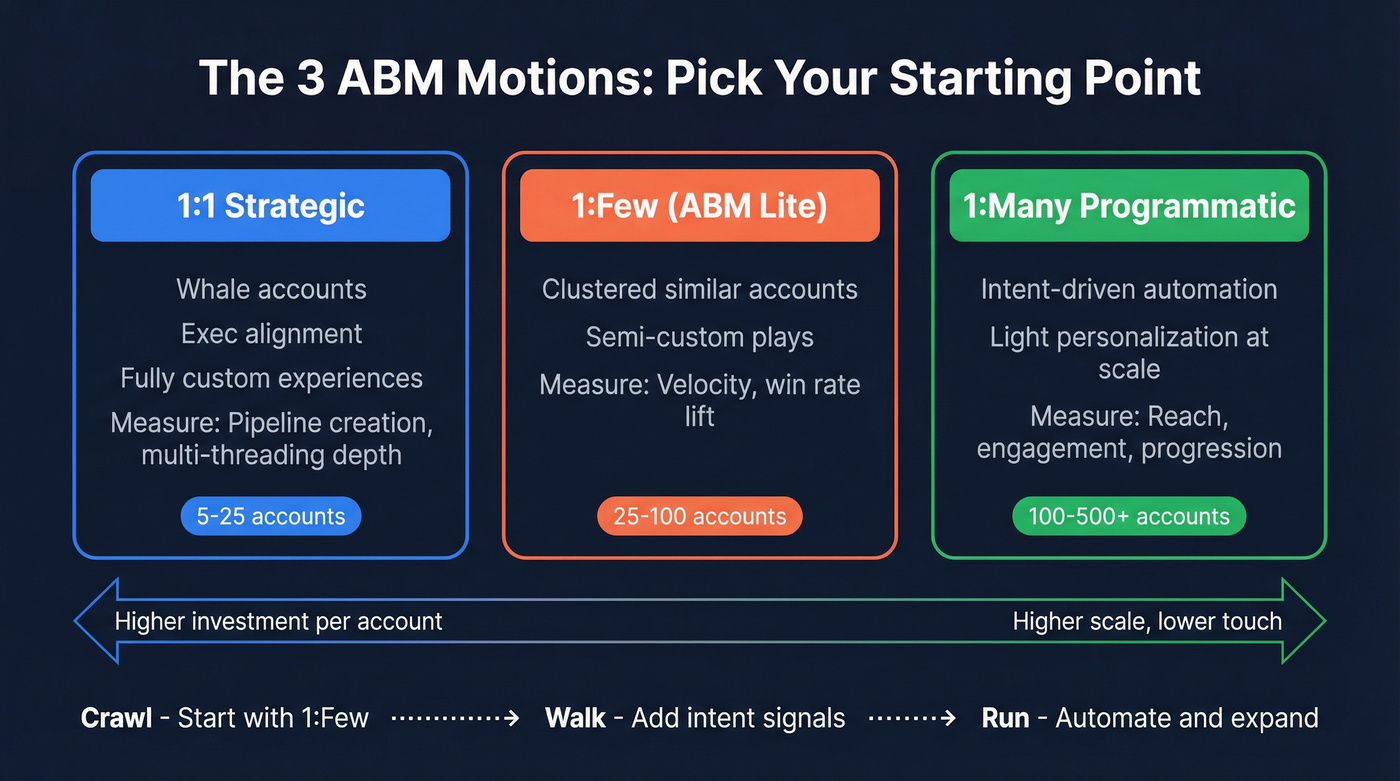
- 1:1 Strategic: a small set of whale accounts with real customization - exec alignment, tailored experiences, the works. Measure pipeline creation and multi-threading depth.
- 1:Few (ABM Lite): clusters of similar accounts with semi-custom plays. Measure velocity and win rate lift.
- 1:Many Programmatic: light personalization at scale using intent signals and automation. Measure reach, engagement, and account progression.
A simple maturity model helps you avoid overbuilding: crawl, walk, run. Crawl is 1:few with a tight list and clean reporting. Walk adds intent signals and better orchestration. Run is when you've earned the right to automate and expand - and "earned" means you can explain exactly what drove your last five meetings, not just that meetings happened. Much of this tiered thinking traces back to ITSMA's methodology, which originally codified the 1:1, 1:few, and 1:many framework that most vendors now reference.
Tiering matters too. A practical default: Tier 1 = bespoke, Tier 2 = standardized plays, Tier 3 = automated nurture. Tiering ranks by value; segmentation groups by shared attributes. Do both.
One truth we see over and over in our work: ABM doesn't fail because the strategy is wrong. It fails because the buying committee isn't reachable. Once you've tiered accounts, you need verified contacts across roles - economic buyer, champion, blockers, procurement. That's where your data layer stops being "nice to have" and becomes the foundation everything else sits on. (If you want a tighter definition of roles like economic vs technical stakeholders, see economic buyer and Technical Buyer vs Economic Buyer.)
Templates & Playbooks
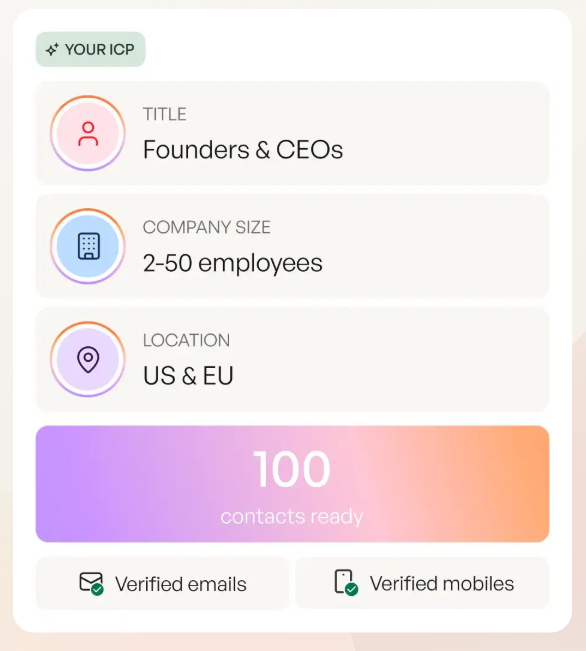
Start with the xGrowth ABM Playbook. It's the fastest way to get your ICP, prioritization rules, and launch steps out of your head and into a doc your team can execute against. If you need a quick starting point for your ICP, use an Ideal Customer Profile Template.
For something you can run like a weekly operating system, the RevvGrowth ABM Template is the most copy/paste-ready option we've found: roles and responsibilities, buying committee mapping, stage-based asset planning, and goal prompts that force you to pick numbers instead of vibes.
Then keep the ZoomInfo ABM Playbook open as your execution reference. It reads less like a worksheet and more like an operator's manual - cadence, account-level behavior tracking, and what to do when engagement spikes but pipeline doesn't.

Your ABM target account list is only as good as the contacts behind it. Prospeo gives you 300M+ profiles with 98% email accuracy, 125M+ verified mobiles, and intent data across 15,000 Bombora topics - so you can map entire buying committees across every tier. Data refreshes every 7 days, not 6 weeks.
Stop losing ABM pilots to bounced emails and missing stakeholders.
Account Scoring & Measurement
A good scoring model has three inputs: ICP fit, engagement, and intent. Fit tells you "worth it." Engagement tells you "they're paying attention." Intent tells you "timing is real." (If you’re formalizing scoring across the funnel, a Lead Scoring model can help you standardize weights.)
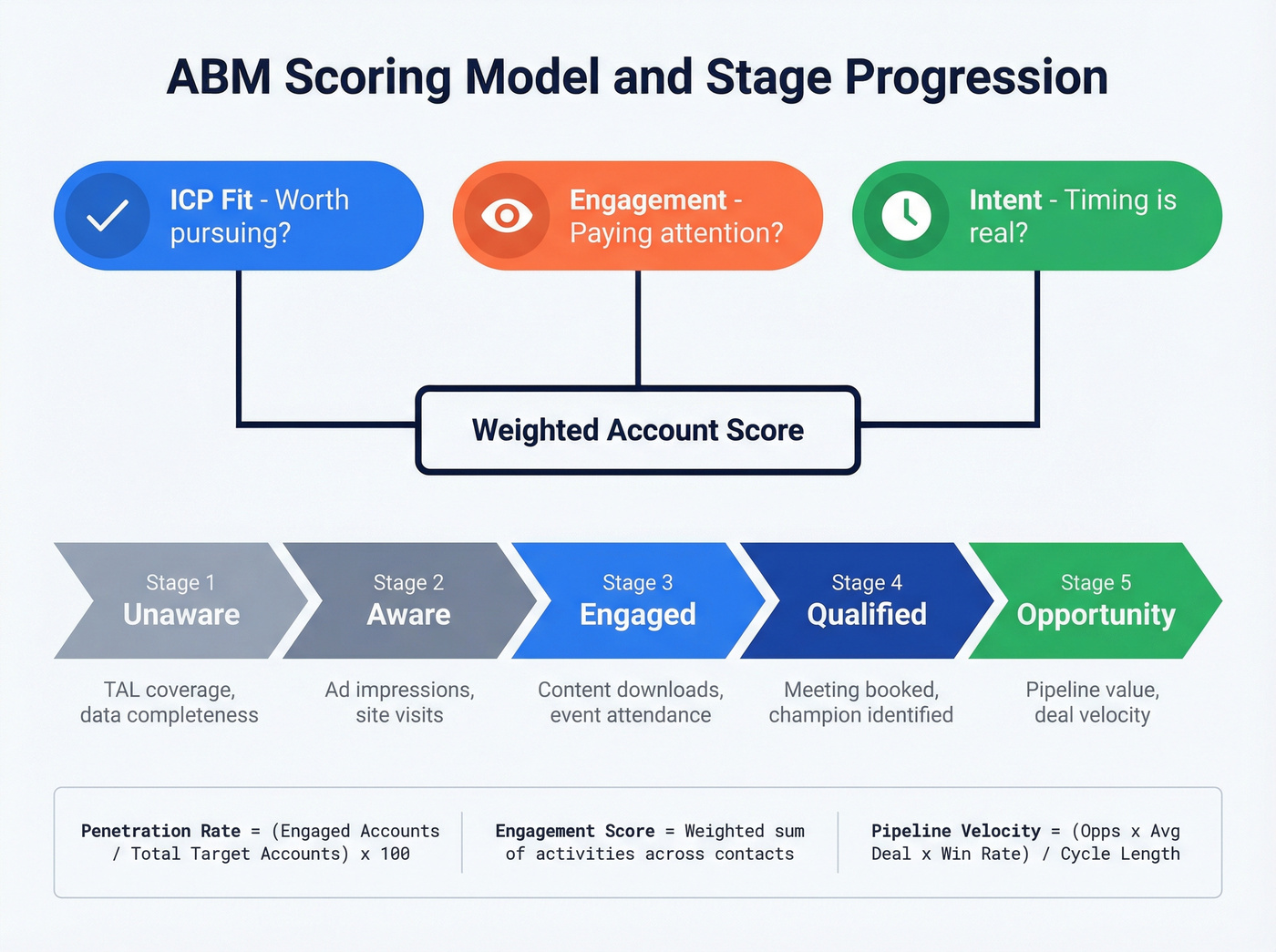
Most teams should start with a weighted formula model. Save predictive scoring for when you have at least a year of closed-won data - before that, you're training a model on noise. If you do want to go deeper on intent mechanics, Identifying Buying Signals is a useful companion.
Here are the formulas that matter:
- Account Penetration Rate = (Engaged Target Accounts / Total Target Accounts) x 100
- Account Engagement Score = weighted sum of activities across contacts in the account
- Pipeline Velocity = (Opportunities x Avg Deal Size x Win Rate) / Sales Cycle Length
For reporting, the clearest stage model we've used is Twelfth Agency's: Unaware - Aware - Engaged - Qualified - Opportunity. Keep 2-3 KPIs per stage and review the model quarterly so old intent doesn't keep accounts artificially "hot." If you want a broader view of what to track, use a Funnel Metrics checklist.
Common ABM Mistakes
Going wide too early. Start with 50-200 accounts. Earn expansion with results. (If you’re struggling to keep lists clean as you scale, How to Automate Target Account Lists in 2026 can help.)
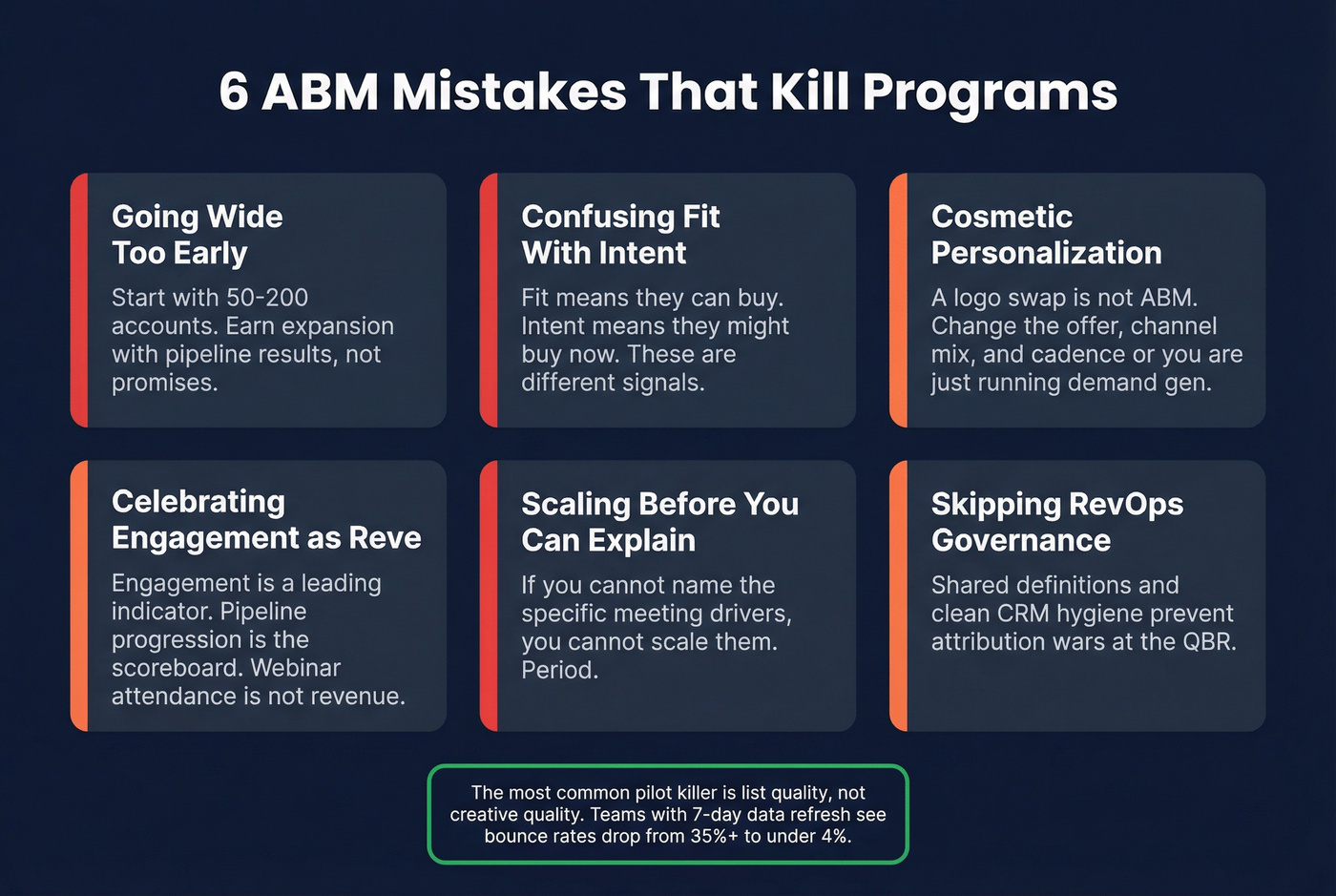
Confusing fit with intent. Fit is "can buy." Intent is "might buy now." They're not the same signal, and treating them as interchangeable is how you waste a quarter chasing accounts that look perfect on paper but aren't in-market.
Cosmetic personalization. A logo swap isn't ABM. Change the offer, the channel mix, and the cadence - or you're just running demand gen with extra steps. If you need a practical playbook for this, Personalized Outreach is a good starting point.
Celebrating engagement like it's revenue. Engagement is a leading indicator. Pipeline progression is the scoreboard. We've watched teams throw parties over webinar attendance while their pipeline stayed flat for three straight months. (To pressure-test whether your pipeline is actually moving, use a Pipeline Health review.)
Scaling before you can explain what worked. If you can't name the specific meeting drivers, you can't scale them. Period.
Skipping RevOps governance. Shared definitions and clean CRM hygiene prevent attribution wars. Directive Consulting's breakdown of ABM tactics that hurt growth is worth reading here. If you’re building the operating layer, a RevOps Manager guide can help clarify ownership and process.
Let's be honest about the most common pilot killer: it's not creative quality, it's list quality. Outreach bounces, nobody can find the right stakeholders, and the whole program gets axed in the QBR. Teams running data with a 7-day refresh cycle instead of the 6-week industry average see bounce rates drop from 35%+ to under 4%. That's the difference between a pilot that generates signal and one that dies quietly. (If bounces are a recurring issue, start with Email Bounce Rate.)
ABM Platforms at a Glance
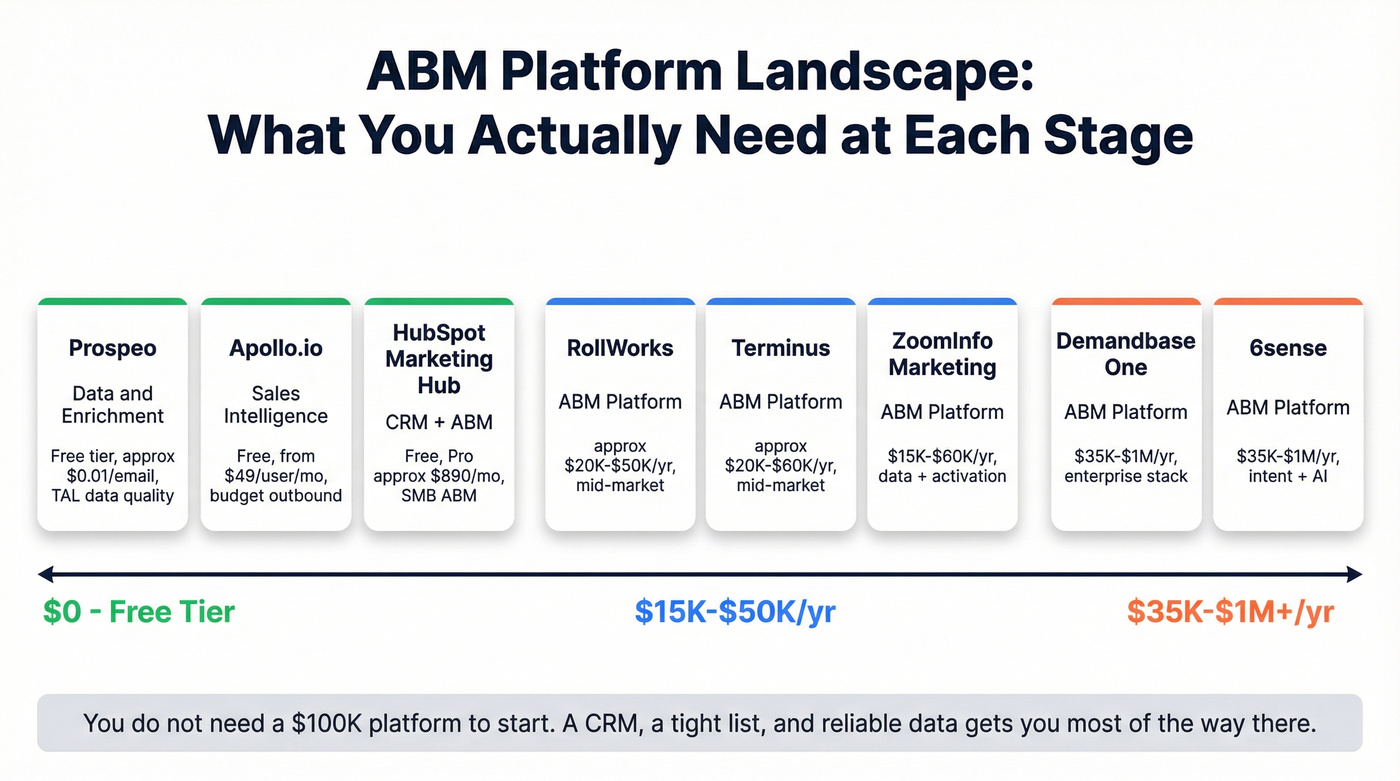
Gartner defines ABM platforms as tools that help you run account-based programs at scale across account selection, planning, engagement, reporting, and unifying first- and third-party data. Here's how the major players stack up:
| Platform | Category | Approx. Pricing | Best For |
|---|---|---|---|
| Prospeo | Data & Enrichment | Free tier; ~$0.01/email | TAL data quality & verification |
| Demandbase One | ABM Platform | $35K-$1M/yr | Enterprise stack |
| 6sense | ABM Platform | $35K-$1M/yr | Intent + AI |
| ZoomInfo Marketing | ABM Platform | Custom; typically $15K-$60K/yr | Data + activation |
| HubSpot Marketing Hub | CRM + ABM | Free; Pro ~$890/mo | SMB ABM |
| RollWorks | ABM Platform | ~$20K-$50K/yr | Mid-market ABM |
| Apollo.io | Sales Intelligence | Free; from $49/user/mo | Budget outbound |
| Terminus | ABM Platform | Custom; typically $20K-$60K/yr | Mid-market ABM |
You don't need a $100K platform to start. A CRM, a tight list, and reliable data gets you most of the way there. The ABM market is projected to reach $3.7B by 2030, and vendors will keep bundling features faster than most teams can adopt them. Skip the platform if you haven't nailed the fundamentals. If you’re evaluating data vendors specifically, compare options in Best B2B Company Data Providers in 2026.
Courses, Certifications & Communities
For training, start with HubSpot Academy's ABM course. It's free, self-paced, and actually usable for onboarding new team members who need to stop thinking in leads and start thinking in accounts.
For credentials and measurement depth, Demandbase's certifications are short, practical, and force you to think in account stages instead of lead stages. They're worth the time even if you don't use Demandbase as your platform.
MarketingProfs' ABM Hub is a solid library when you want ideas without doomscrolling. For long-form learning, a dedicated ABM book - Peter Isaacson and Sangram Vajre's work, or Burgess's ITSMA guide - gives you strategic depth that blog posts rarely cover.
For live learning, attending an ABM conference like the ABM Innovation Summit or Demandbase's annual event is one of the fastest ways to pressure-test your strategy against what other teams are actually running. Nothing exposes blind spots like hearing someone describe a program that's two years ahead of yours.
For community, Reddit is the most honest place to sanity-check your plan. r/b2bmarketing regularly debates TAL size, whether ABM tools are worth the spend, and what "good" engagement actually looks like. The consistent advice there is refreshingly boring: start smaller, measure pipeline, don't buy software to compensate for messy fundamentals.
ABM programs don't fail because the strategy is wrong - they fail because teams can't reach the buying committee. Prospeo's 30+ search filters let you target by intent signals, technographics, job changes, and department headcount to find every decision-maker in your tiered accounts. At $0.01 per email, you spend budget on plays, not data.
Reach every member of the buying group before your competitor does.
FAQ
How much does an ABM program cost to launch?
A pilot can be close to $0 using a CRM and free training like HubSpot Academy. Full ABM platforms typically start around $30K-$35K/year and scale into six figures. Budget for data quality and content before you budget for orchestration software - that order matters more than most vendors will tell you.
How many target accounts should I start with?
50-200 accounts. That's enough volume to learn patterns without diluting personalization. Tier them into three groups and match effort to value: bespoke for Tier 1, standardized plays for Tier 2, automated nurture for Tier 3.
What's the difference between ABM and demand gen?
Demand gen starts broad and captures leads; ABM starts with named accounts and works the buying committee. Demand gen optimizes for volume, ABM optimizes for pipeline and revenue per account. Mature teams run both motions in parallel - they're not competing strategies.
How do I measure ABM without a dedicated platform?
Track stage progression per account in your CRM: Unaware, Aware, Engaged, Qualified, Opportunity. Use penetration rate, engagement score, and pipeline velocity as core KPIs. If you can't keep it updated in a spreadsheet, you won't keep it updated in software either.
What are the best account based marketing resources for beginners?
Use one framework, one template, and one course: ZoomInfo's ABM Playbook, RevvGrowth's ABM Template, and HubSpot Academy's free ABM course. Pair them with a free data tier to build your first target account list, then run a 6-8 week pilot with weekly reporting. Don't buy anything else until you've finished that pilot.