

How to Find B2B Clients: The Data-Backed Playbook for 2026
You've sent 500 cold emails this month and your reply rate is under 1%. You're not alone - 84% of sales reps missed quota last year, and 67% don't expect to hit it this year either. One founder on r/sales shared that it took roughly 1,500 cold emails to land a single customer in logistics. That's not a failure story. That's the baseline reality nobody talks about.
The difference between teams that land B2B clients consistently and teams that quit isn't motivation. It's having the right data, the right channels, and realistic expectations about what each one costs in time and money. We've spent years watching outbound campaigns succeed and fail, and the patterns are clear: the teams that win aren't doing anything exotic - they're just disciplined about the fundamentals.
Here's the short version before we get into the details:
- Need results in 90 days? Lean on your network and cold email with verified data. Nothing else produces on a compressed timeline.
- Building for 6+ months? Invest in SEO, content marketing, and ABM. The compounding returns are real, but they take time.
- Your tool stack needs three things: a verified data provider, an outreach platform (Instantly or Lemlist), and a CRM (HubSpot's free tier works fine to start).
What Is a B2B Client?
A B2B client is any business that buys products or services from another business. Don't overthink the distinction between "clients" and "customers" - we use them interchangeably here.
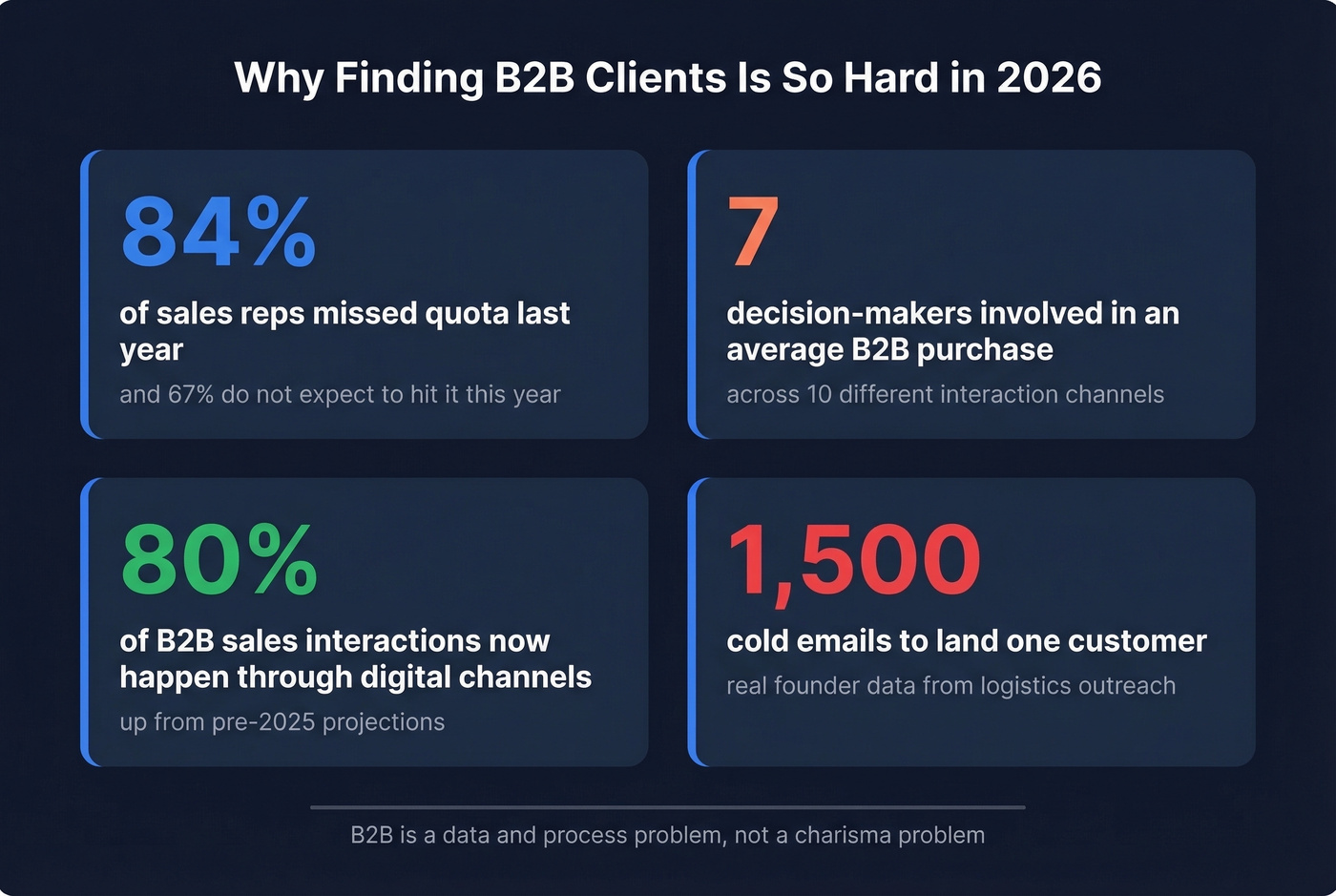
What makes B2B different from B2C isn't the definition. It's the complexity. Gartner projected that 80% of B2B sales interactions would occur through digital channels by 2025, and the shift has only accelerated into 2026. The average purchase involves 7 decision-makers in mid-sized companies, using roughly 10 different interaction channels before signing anything. You're not convincing one person to buy - you're navigating a committee. That's why finding and winning these accounts is a data and process problem, not a charisma problem.
Channels That Actually Work
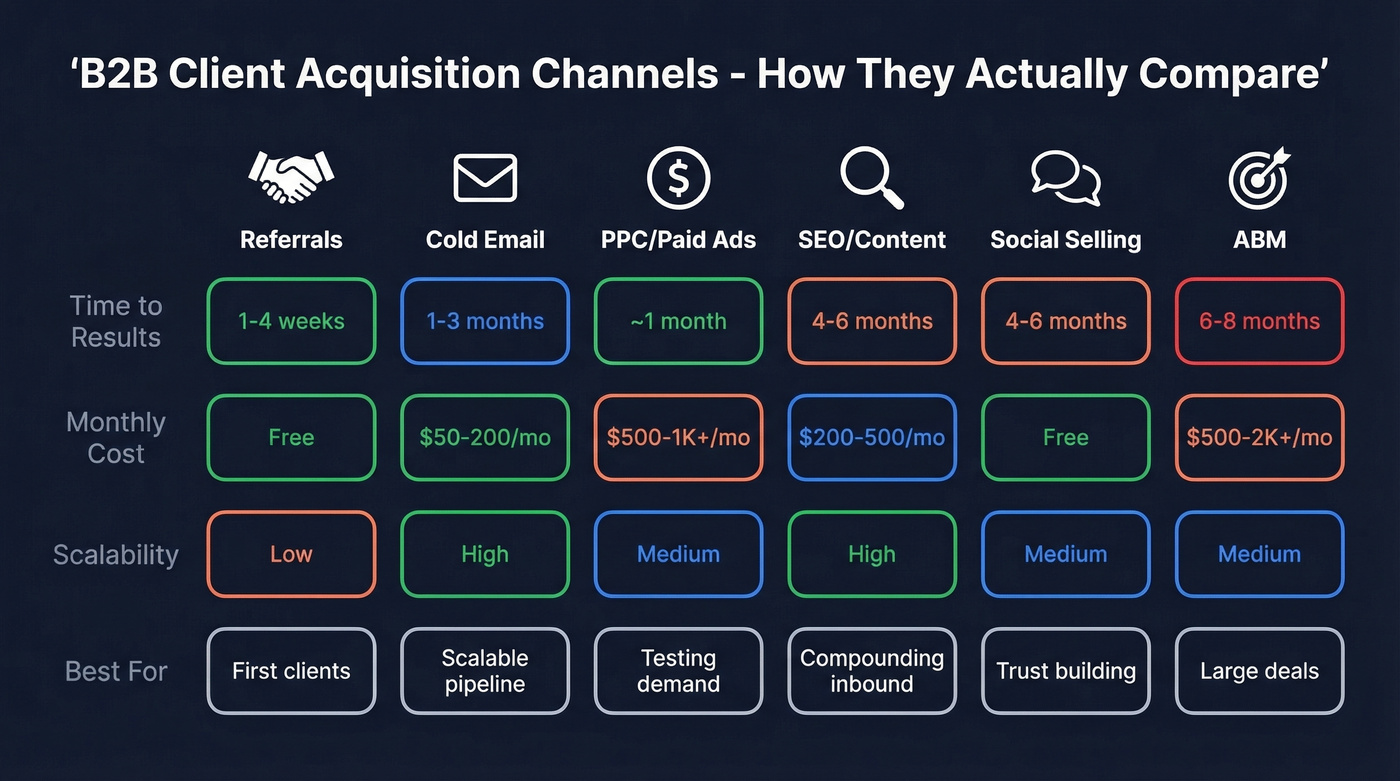
Pick two channels. Master them. Then add a third. Here's what each one actually looks like in practice, especially in 2026, where tighter budgets, cautious buyers, and AI-driven search are reshaping which channels deliver ROI.
Cold Email
Cold email still works, but the bar is higher than it was three years ago. Short emails consistently outperform long pitches. If it doesn't fit on a single mobile screen, expect it to get ignored.
If you're building a repeatable outbound motion, start with a documented B2B cold email sequence instead of one-off blasts.
The format getting responses right now is absurdly simple - 40-60 words, a context trigger, a specific outcome, quick proof, and a soft CTA:
Hi [Name], noticed [company] is [trigger - hiring, expanding, raised funding]. We help [specific ICP] [specific outcome] - [proof point, e.g., "helped 3 Series B SaaS teams cut bounce rates from 35% to under 4%"]. Worth a conversation?
No "I hope this finds you well." No three-paragraph company history. The offer quality matters more than shallow personalization - "I read your blog post" isn't enough if what you're offering is weak.
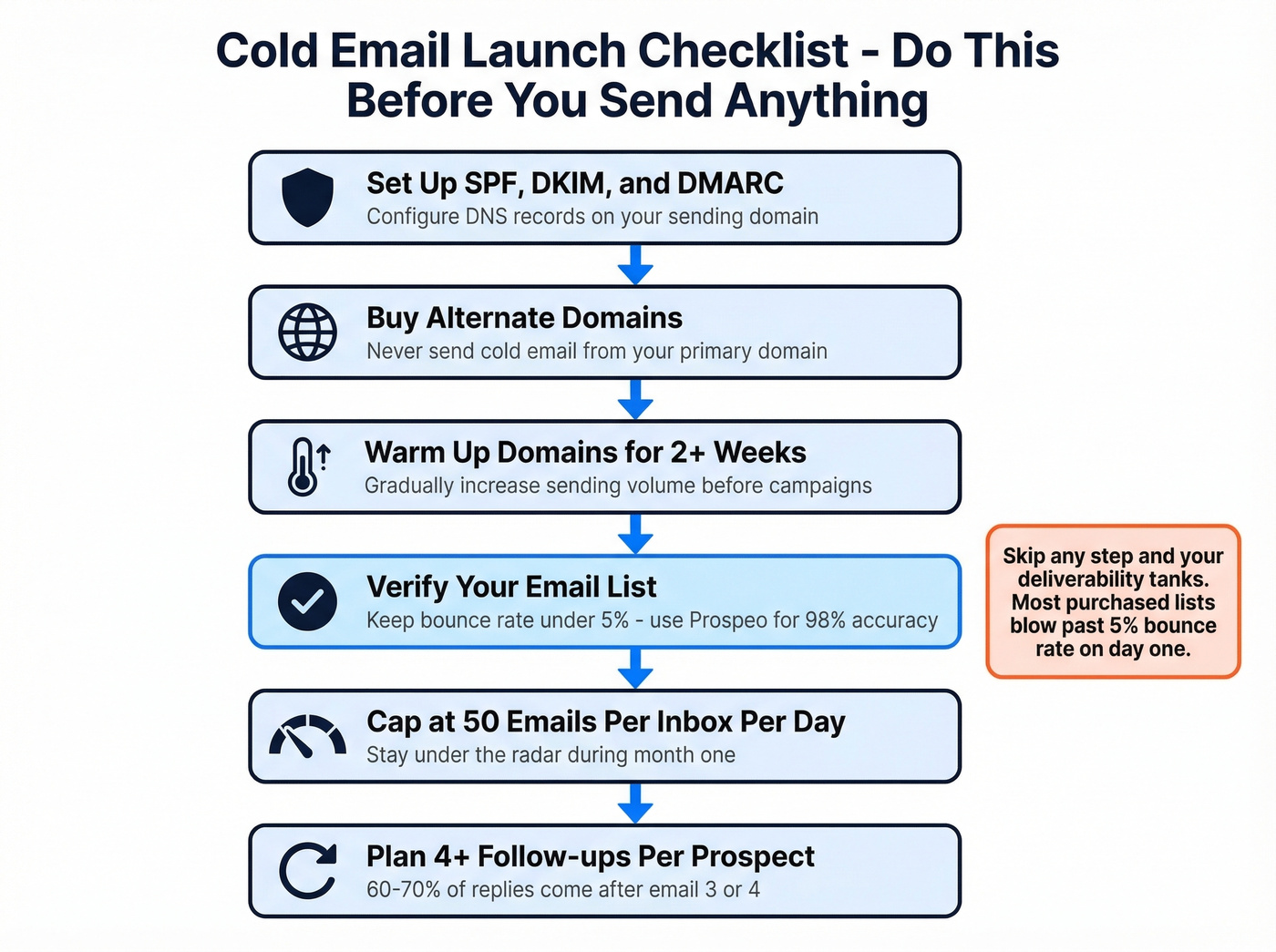
The infrastructure checklist before you send anything:
- SPF, DKIM, and DMARC records configured on your sending domain
- Alternate domains set up (never send cold email from your primary domain)
- Warm up those domains for at least 2 weeks before launching campaigns
- Keep daily send volume under 50 per inbox during the first month
If you want to go deeper on the technical side, use a full email deliverability guide to avoid avoidable inboxing issues.
Follow-up persistence is where most teams fail. 60-70% of replies come after email #3 or #4. If you're sending one email and moving on, you're leaving the majority of your pipeline on the table. (If you need copy, steal from these cold email follow-up templates.)
And before you send a single message, verify your list. A 5% bounce rate is the maximum before deliverability tanks, and most purchased lists blow past that number on day one. We use Prospeo internally - 98% email accuracy with a 7-day data refresh cycle, so you're not emailing addresses that went stale three months ago. Bad data is the silent killer of outbound, and it's the easiest problem to fix.

Content Marketing & SEO
87% of marketers say content marketing generates demand, and 74% say it nurtures leads effectively. But 54% still struggle with lead quality, which is why gating every blog post behind a form and calling it "lead gen" doesn't cut it anymore.
The catch with content is time. Expect 4-6 months before SEO-driven content produces meaningful pipeline. If you're building this channel seriously, it helps to align on what B2B content marketing actually includes (and what it doesn't).
One founder on Reddit shared that their content on BI and analytics "barely got any clicks" because the keyword difficulty was too high. The fix is niching down - target long-tail queries where you can actually rank. A blog post that ranks #1 for a 200-search-volume keyword with buyer intent beats a post sitting on page 3 for a 10,000-volume term every single time.
AI search platforms like ChatGPT and Perplexity are also changing discovery patterns. Some buyers now get their answers without ever clicking through to your site, which makes bottom-of-funnel, high-specificity content more valuable than ever. Generic "what is X" posts are the first to lose traffic. And don't sleep on webinars: 73% of marketers say they drive high-quality leads, making them one of the most efficient content formats for B2B.
Social Selling & Communities
Professional networks, niche communities, and Reddit threads are trust-building channels that compound over time. The play here isn't pitching - it's demonstrating expertise consistently until inbound conversations start happening.
This is a long game. The teams that do this well post 2-3 times per month with genuinely useful insights, not thinly veiled product pitches. One effective pattern: find a subreddit or Slack community where your ICP asks questions, then answer 5-10 of those questions thoroughly over a month. Don't link to your product. Just be the most helpful person in the room. The DMs will come.
Paid Acquisition
Google Ads is the fastest way to test demand. Start with $500-1K/month and target high-intent keywords in your niche. B2B CPCs typically run $2-15 depending on the vertical, with some competitive categories like cybersecurity and fintech pushing $25+.
Time-to-results is roughly one month if your landing page is solid. The median landing page conversion rate is 6.6% across industries, but SaaS specifically averages just 3.8%. If you're below that, fix the page before you increase spend.
Referrals
Referrals are the fastest path to your first accounts. Lenny Rachitsky's framework calls this "concentric circles" - start with former colleagues, then friends-of-friends, then warm introductions from investors or advisors.
Here's the reality check from Reddit: networking events and conferences produce testers, but not always paying customers. One founder reported that events generated interest but "zero customers" because the problem wasn't urgent enough for their network. Referrals work best when there's genuine urgency - someone has a problem right now and a trusted contact says you can fix it.
ABM & Intent-Based Outreach
Account-based marketing isn't just for enterprise teams anymore. Intent data has made it accessible to companies of nearly any size, and the numbers back it up: 58% of B2B marketers report larger deal sizes with ABM, and 56% see better sales and marketing alignment.
The approach is straightforward. Identify accounts showing buying signals - hiring for relevant roles, researching your category, expanding into new markets. Then coordinate outreach across email, ads, and direct mail to the buying committee. Time-to-results is 6-8 months, but the deal sizes justify the patience. For teams figuring out how to acquire B2B clients at scale, ABM consistently delivers the highest average contract values.
If you're building this motion, follow account-based selling best practices and formalize how you're identifying buying signals so targeting doesn't turn into guesswork.
How Long Each Channel Takes
| Channel | Time to First Results | Best For |
|---|---|---|
| Referrals | 1-4 weeks | First clients |
| Cold email | 1-3 months | Scalable pipeline |
| PPC / Paid ads | ~1 month | Testing demand |
| SEO / Content | 4-6 months | Compounding inbound |
| Networking | 4-6 months | Relationship-driven |
| ABM | 6-8 months | Large deal sizes |
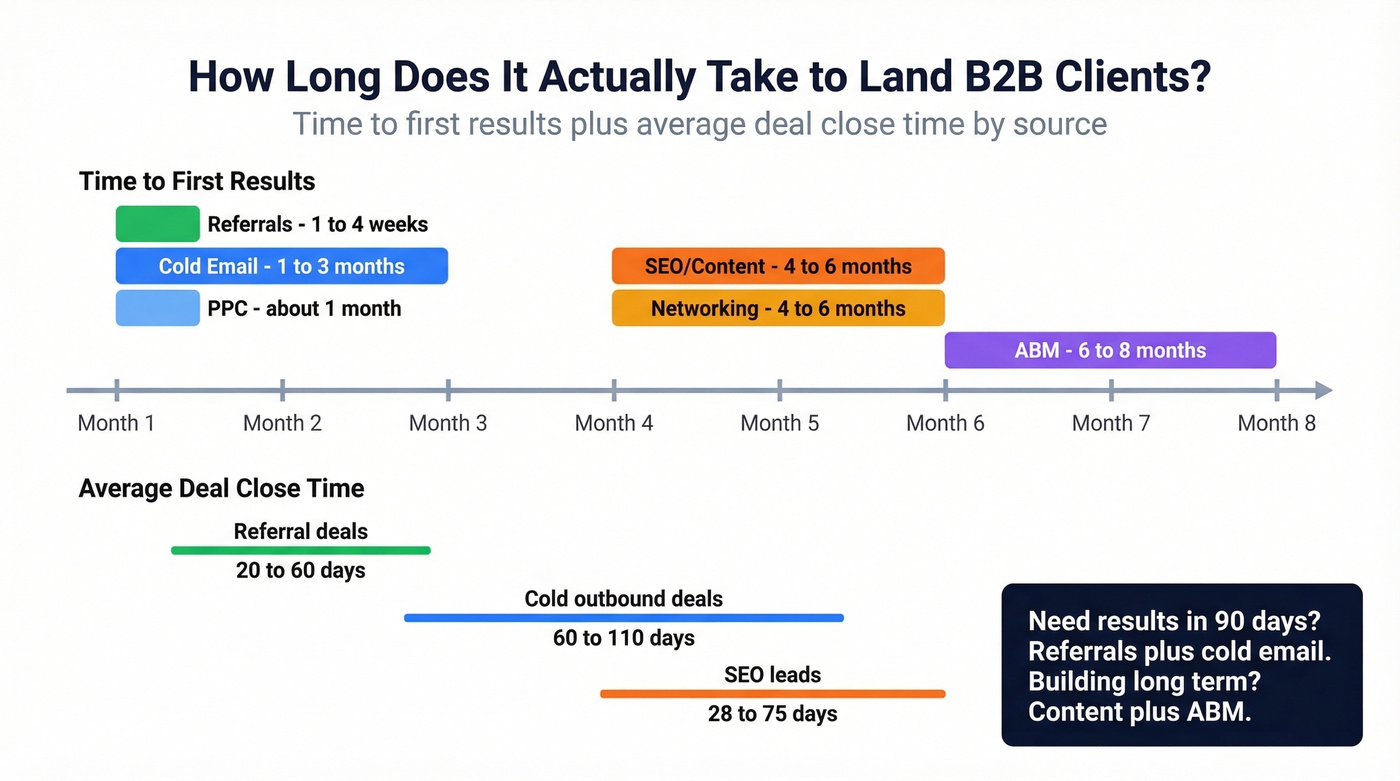
The channel you choose also affects how long deals take to close. Data from Focus Digital shows referral-sourced deals close in roughly 20-60 days depending on complexity, while cold outbound deals average 60-110 days and SEO-sourced leads run 28-75 days.
Here's the thing: the biggest mistake we see is teams spreading themselves across all six channels simultaneously, doing none of them well. If you need results in 90 days, that's referrals plus cold email. Period. If you're building for the long term, it's content plus ABM. Add a third channel only after the first two are producing consistently.
If you need a system to keep execution tight, build a simple 30-60-90 day plan for sales reps around your two chosen channels.

The article says it: bad data is the silent killer of outbound. With a 7-day refresh cycle and 98% email accuracy, Prospeo ensures every cold email you send actually reaches a real person. Teams using Prospeo cut bounce rates from 35% to under 4% - and tripled their pipeline.
Stop emailing dead addresses. Start landing B2B clients.
The Real Benchmarks
You've probably read five articles about finding B2B clients that told you to "use your network" without a single number attached. Let's fix that.
Acquisition Cost by Industry
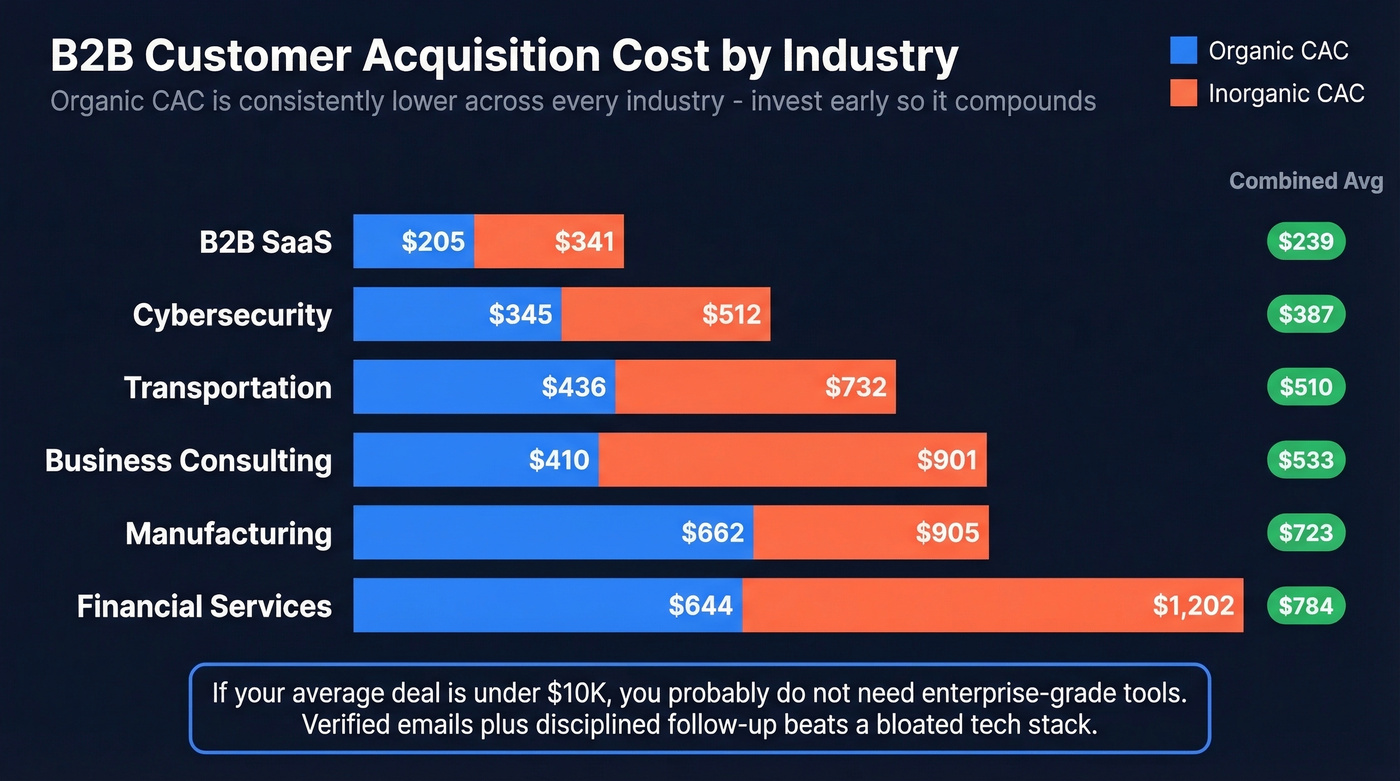
Customer acquisition cost varies wildly by vertical. Here are the combined averages from FirstPageSage's dataset spanning January 2022 through August 2025:
| Industry | Organic CAC | Inorganic CAC | Combined Avg |
|---|---|---|---|
| B2B SaaS | $205 | $341 | $239 |
| Cybersecurity | $345 | $512 | $387 |
| Transportation | $436 | $732 | $510 |
| Business Consulting | $410 | $901 | $533 |
| Manufacturing | $662 | $905 | $723 |
| Financial Services | $644 | $1,202 | $784 |
The organic vs. inorganic split tells the real story. Organic CAC is consistently lower across every industry in that dataset. That doesn't mean you should skip paid - it means you should invest in organic early so it compounds while paid carries the short-term load.
If you want the underlying math and definitions, map this back to cost to acquire customer.
For SaaS specifically, CAC scales dramatically with customer size. Fintech CAC ranges from $1,461 for small business customers to $14,774 for enterprise. Adtech runs $576 to $8,582. If you're selling upmarket, your acquisition costs will reflect it.
Our honest take: if your average deal is under $10K, you probably don't need enterprise-grade ABM or a $50K/year data platform. A verified email finder, a good outreach tool, and disciplined follow-up will outperform a bloated tech stack every time. Complexity is the enemy of early-stage sales.
Sales Cycle Length
Sales cycle length is one of the most underestimated variables in B2B planning. Here's what the data from Focus Digital shows:
| Industry | Avg Sales Cycle |
|---|---|
| Retail | 70 days |
| Software | 90 days |
| Manufacturing | 130 days |
| Energy | 155 days |
| Non-profit | 162 days |
Deal size matters even more than industry:
| Deal Size | Avg Cycle |
|---|---|
| Under $1K | 25 days |
| $10K-$50K | 75 days |
| $50K-$100K | 120 days |
| Over $500K | 270 days |
Company size matters too. Selling to a 10-person startup averages 38 days. Selling to a 10,000+ employee enterprise? 185 days. Plan your cash flow accordingly.
Conversion & Win Rates
Two major datasets give us a clear picture. Unbounce analyzed 41,000 landing pages across 464 million pageviews and found a median conversion rate of 6.6%. SaaS-specific pages convert at 3.8%, while professional services hit 6.2%. Ruler Analytics' dataset of 100M+ data points paints a more conservative picture at 2.9% average, with forms at 1.7% and calls at 1.2%.
The gap between these datasets comes down to how "conversion" is defined - Unbounce measures landing page actions, while Ruler measures qualified leads.
Beyond conversion, the numbers that matter most are close rate and win rate. The average B2B close rate sits around 29%, and the average win rate hovers near 21%. That means roughly 4 out of 5 qualified opportunities still don't close. Only 28% of companies are satisfied with their conversion rates. If yours feel low, you're in the majority. The fix is almost always reducing friction - shorter forms, clearer value propositions, faster page loads.
To benchmark your funnel end-to-end, compare against a current sales conversion rate baseline.
Mistakes That Kill Your Pipeline
These seven mistakes account for the vast majority of failed acquisition efforts. Every one of them is fixable.
No defined ICP. 60% of prospects are lost due to poor targeting. If you can't describe your ideal customer in two sentences - industry, company size, job title, pain point - you're spraying and praying. Build your ICP document before you build your list.
Generic messaging. 44% of prospects disengage when messaging feels irrelevant. "We help companies grow" tells nobody anything. Build tiered templates by vertical and persona, and use triggers like funding rounds, job changes, or tech stack signals to make each message specific.
Single-channel outreach. Email alone produces a fraction of what multi-channel sequences deliver. Email plus professional network outreach plus one polite call produces roughly 3X better reply rates.
Inconsistent follow-up. Most teams send 1-2 emails and give up. The data says 60-70% of replies come after email #3 or #4. Standardize a 5-touch cadence and add value with each message - don't just "bump" the thread.
Bad data hygiene. Sending to stale or unverified lists tanks your domain reputation and wastes every dollar you spend on outreach tooling. Most data providers refresh on roughly a 6-week cycle, so lists go stale faster than you'd expect. Verify every list before sending and re-verify monthly.
No lead qualification. Not every reply is a qualified opportunity. Without a framework like BANT or MEDDIC, reps waste hours on prospects who'll never close. Define qualification criteria before you start outreach, not after. (If you're using MEDDIC, keep a tight set of MEDDIC discovery questions.)
Overpromising in outreach. Aggressive claims in cold emails create expectations you can't meet, leading to short sales cycles that end in "no." Lead with specific, provable outcomes from similar customers instead.
B2B Client Acquisition Tools
You don't need 15 tools. You need four categories covered, and you need them to talk to each other.
| Category | Tool | Starting Price |
|---|---|---|
| Prospecting & Data | Prospeo | Free tier; ~$39/mo |
| Outreach | Instantly | ~$30/mo |
| Outreach | Lemlist | ~$59/mo |
| CRM | HubSpot | Free tier |
| CRM | Salesforce | ~$25/user/mo |
| Workflow | Clay + Zapier | ~$150/mo+ |
If you're evaluating stacks, start with a shortlist of SDR tools so you don't overbuy early.
Prospecting & Data
Prospeo covers 300M+ professional profiles, 143M+ verified emails, and 125M+ verified mobile numbers. The 98% email accuracy comes from a 5-step verification process - catch-all handling, spam-trap removal, and honeypot filtering included. Data refreshes every 7 days, compared to the 6-week industry average.

The 30+ search filters include buyer intent powered by Bombora across 15,000 topics, technographics, job changes, headcount growth, funding, and revenue. You can go from "I need VP-level contacts at Series B fintech companies using Stripe" to a verified list in minutes. Native integrations with HubSpot, Salesforce, Smartlead, Instantly, Lemlist, Clay, Zapier, and Make mean your data flows directly into whatever outreach stack you're running. Pricing starts free with 75 verified emails/month plus 100 Chrome extension credits/month, scales at roughly $0.01 per email, and requires no contracts.
Outreach Platforms
Skip Instantly if you need multi-channel. It's purpose-built for high-volume cold email - unlimited email accounts, built-in warmup, and campaign analytics for ~$30/month. It does that one thing extremely well, and for pure email outbound, nothing beats the price-to-performance ratio.
Pick Lemlist if you're running coordinated sequences across email, calls, and social touches. At ~$59/month it's pricier, but the multi-channel workflow builder justifies the cost for teams that have moved past email-only outreach. In our experience, teams get better results pairing multi-channel sequencing with verified data than using any all-in-one platform.
CRM
Most teams overthink this decision. HubSpot's free CRM handles pipeline management, contact tracking, and basic reporting without spending a dollar. You'll outgrow it when you pass 10 reps or need custom objects, but until then, it's the right starting point.
If you're comparing options, use these examples of a CRM to sanity-check features vs. price.
Salesforce at ~$25/user/month is the move if you're already in that ecosystem or need advanced reporting and custom workflows. Just budget for implementation time - nobody sets up Salesforce in a weekend.
Analytics & Workflow
Clay handles enrichment workflows and data orchestration - think of it as the glue between your data sources and your outreach tools. Pair it with Zapier or Make for automations that keep your stack connected without manual CSV exports.
If you're doing this at any scale, follow a repeatable lead generation workflow so enrichment and routing don't break.
Finding B2B clients is a data problem, not a hustle problem. Prospeo gives you 300M+ profiles with 30+ filters - buyer intent, technographics, funding, headcount growth - so you reach the right accounts before your competitors do. At $0.01 per email, enterprise-grade targeting doesn't require enterprise budgets.
Build your ideal client list in minutes, not weeks.
Landing Your First Account
If you're pre-revenue or early-stage, the playbook is different. Lenny Rachitsky's framework for winning your first 10 B2B customers lays out a clear sequence:
- Start with your personal network - former colleagues, friends-of-friends
- Run strategic cold outbound to your exact ICP
- Tap your investors' networks for warm introductions
- Engage in communities where your buyers already spend time
- Build a content following that attracts inbound interest
- Pursue press and visibility
- Just launch - put it out there and iterate
The key insight: "None of these seven strategies scale. That's why they work." Early traction is hand-to-hand combat - onboarding people yourself, doing high-touch support, and manually earning trust until you have proof the product sticks.
The Reddit threads on this topic are brutally honest. One founder reported zero paying customers from networking events. Another shared that 150 cold calls produced 3 meaningful conversations and no sales. The grind is real, and anyone who tells you otherwise is selling something.
But once you have 10 paying B2B clients, you have proof. You have case studies. You have referral sources. Then you scale - verified cold email for pipeline, content for compounding inbound, and ABM for the big deals. The question shifts from how to land your first account to how to build a repeatable engine that fills your pipeline every month.
FAQ
What's the fastest way to get B2B clients?
Referrals and warm introductions close fastest - often in under 30 days. Cold email with verified data is the fastest scalable channel, typically producing results within 1-3 months. Pair both for the quickest path to revenue.
How much does it cost to acquire a B2B client?
B2B SaaS averages $239 per customer, while financial services averages $784. Organic CAC is consistently lower than paid CAC, so invest in content early while paid channels carry the short-term load.
How many cold emails does it take to land a client?
Expect 1,000-2,000 emails per closed deal. The key variables are data quality, messaging relevance, and follow-up persistence - 60-70% of replies come after the third or fourth email.
What tools do I need for B2B client acquisition?
At minimum: a verified data provider like Prospeo for accurate contact information, an outreach platform like Instantly or Lemlist, and a CRM like HubSpot's free tier. Add enrichment tools like Clay as you scale past your first 50 accounts.
How long is the average B2B sales cycle?
Software deals average 90 days. Deals under $1K close in about 25 days, while enterprise deals over $500K take up to 270 days. Selling to a 10-person startup averages 38 days versus 185 days for 10,000+ employee companies.