

B2B Leads in 2026: What's Actually Working (and What's Not)
A sales team we worked with last year burned through 5,000 B2B leads in a single quarter. Eight hundred bounced. Their domain reputation tanked, and the SDRs spent more time managing inbox warmup infrastructure than actually selling. That's not a lead generation problem - it's a data quality problem dressed up as a pipeline problem. And 42% of B2B companies cite lead quality as their top marketing challenge, so this isn't an edge case. It's the norm.
What You Need (Quick Version)
- Volume is dead. Signals win. The teams generating pipeline in 2026 aren't sending more emails - they're targeting accounts showing buying intent and engaging with context.
- Know your funnel math. Visitor-to-lead conversion above 5% is great. MQL-to-SQL above 60% means your handoff works. Below those thresholds, you've got a leak to fix before you buy more leads.
- Start with clean data. Bad data is the silent killer of every other tactic on this list. Verify before you send.
What Are B2B Leads?
A B2B lead is a person at a company who fits your ideal customer profile and has shown some signal - a form fill, a content download, a pricing page visit, a job posting that matches your use case - that they might buy what you sell.
The taxonomy matters though. An MQL (marketing-qualified lead) fits the profile and has engaged with your content. An SQL (sales-qualified lead) has a confirmed need, timeline, and budget. And an SAL - sales-accepted lead - is the accountability checkpoint most teams skip entirely. It's the moment sales formally agrees to work a lead, creating a clear handoff SLA. Without it, 53% of deals break down in the middle of the funnel, and only 29% of lead handoffs are considered "very effective."
Types Worth Distinguishing
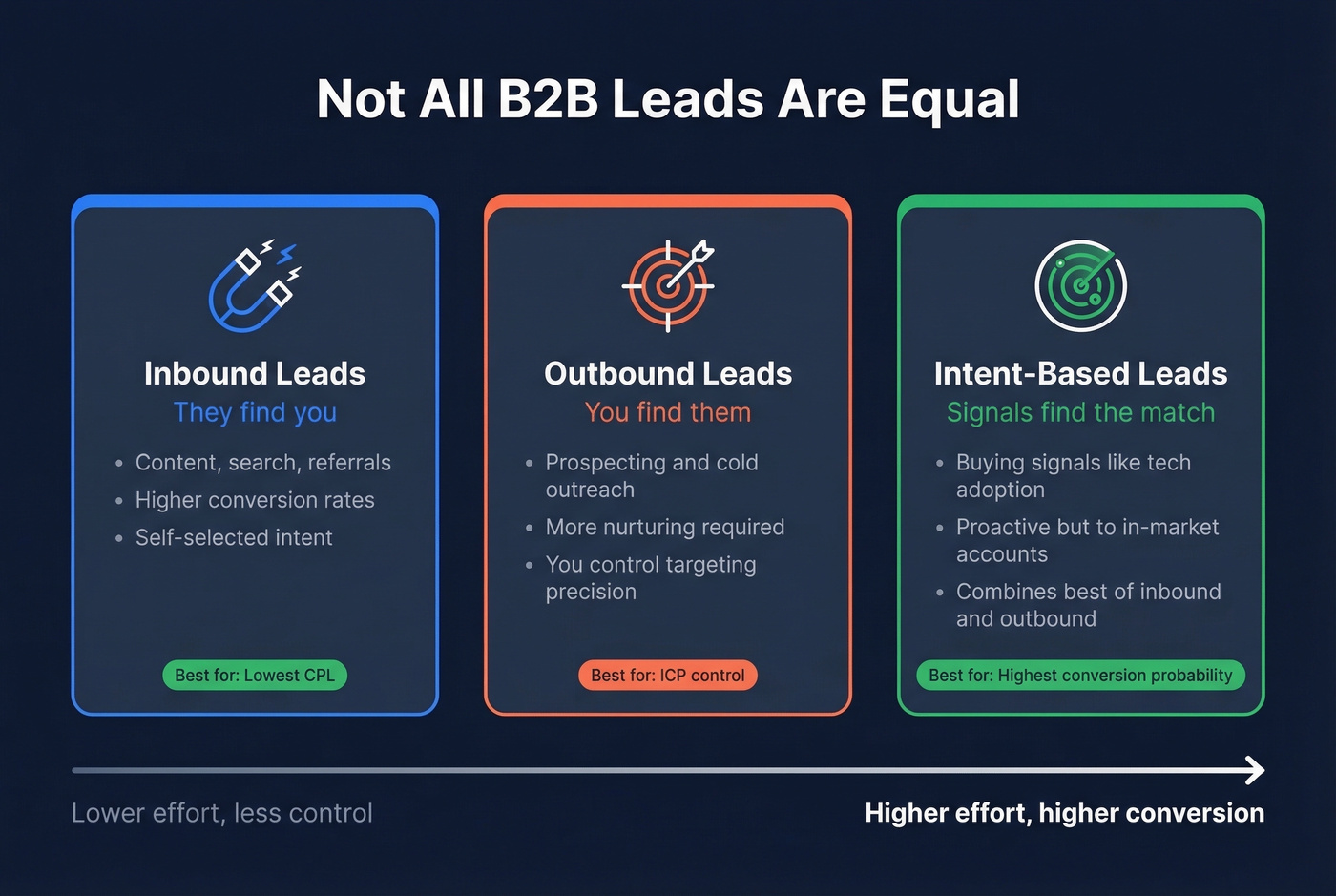
Not every prospect carries the same weight. Inbound leads - those who find you through content, search, or referrals - tend to convert at higher rates because they've self-selected. Outbound leads, sourced through prospecting and cold outreach, require more nurturing but let you control targeting precision. Then there are intent-based leads, identified through buying signals like technology adoption or competitive research. These combine the best of both: you're reaching out proactively, but to accounts already in-market.
What Changed in 2026
Three shifts are reshaping how teams source and convert prospects. If you're still running the 2023 playbook, you're feeling all of them.
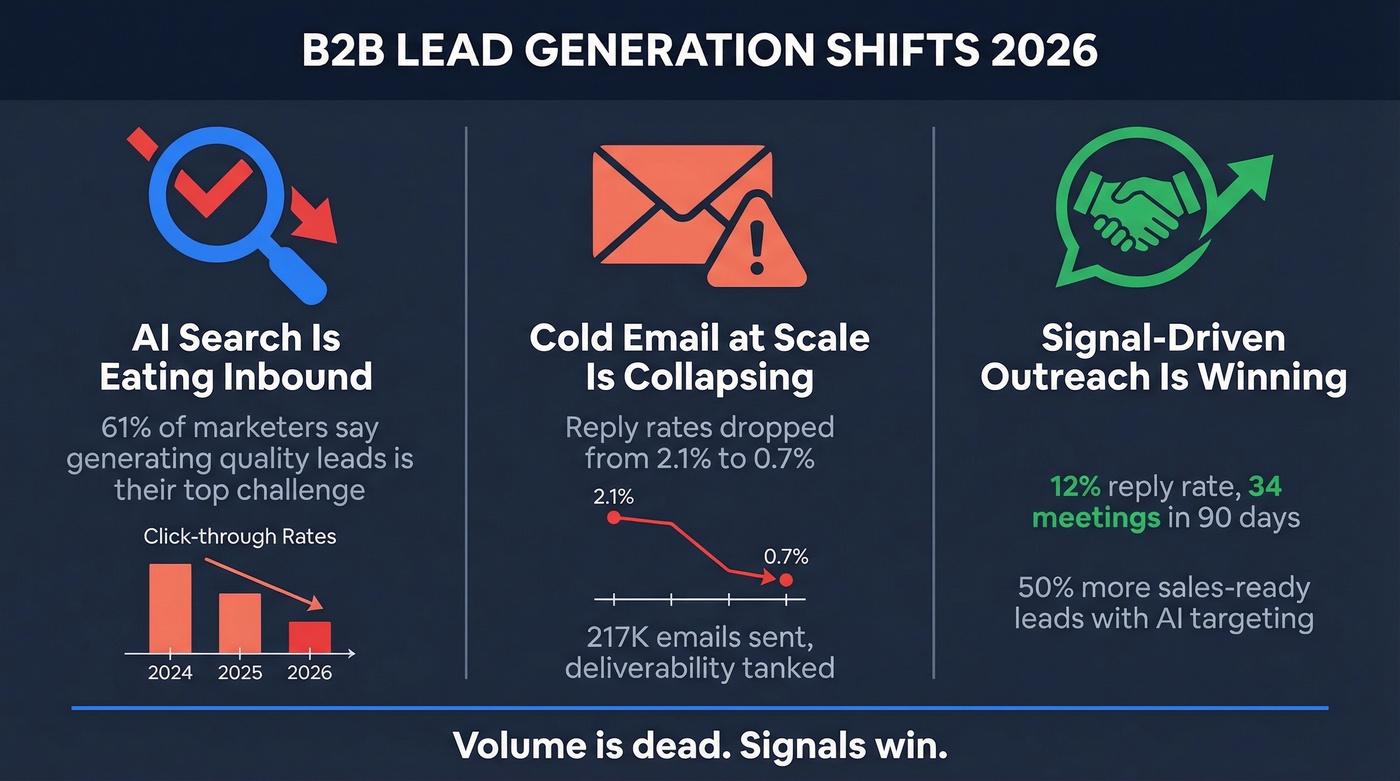
AI Search is eating inbound. Google's AI Overviews and ChatGPT-style search are answering queries before prospects ever click through to your blog. ZoomInfo's own team puts it bluntly: AI Search is reducing the effectiveness of inbound marketing. Meanwhile, 61% of marketers say generating quality leads is their top challenge, and AI Search is making it harder. The content-to-MQL pipeline that worked for a decade is compressing. Content isn't dead - but content alone isn't enough.
Cold email at scale is collapsing. One practitioner on r/b2bmarketing documented sending 217,000 cold emails and watching reply rates crater from 2.1% to 0.7% as deliverability fatigue set in. The infrastructure overhead - SPF records, inbox rotation, warmup sequences - became a full-time job. This isn't one person's bad luck. It's the trajectory of every high-volume cold email program without signal-based targeting. (If you're troubleshooting bounces and throttling, start with email deliverability and email velocity.)
Warm outreach is outperforming when it's signal-driven. That same practitioner switched to social listening - engaging with prospects' posts about pain points and competitor frustrations before reaching out - and hit a 12% reply rate with 34 meetings booked in 90 days. Infrastructure cost? Basically zero. 89% of B2B marketers already use LinkedIn for lead generation, but the ones winning use it for signal capture, not spray-and-pray InMails. Teams using AI for lead generation report 50% more sales-ready leads and up to 60% lower customer acquisition costs.
The macro trend underneath all of this: Gartner predicts 75% of B2B organizations will complete their highest-revenue deals via digital channels by 2028. Buyers are self-educating longer, engaging sellers later, and expecting relevance when they do engage. Volume-based lead gen doesn't survive that shift.
How to Generate B2B Leads That Convert
You don't need 10 strategies. You need two or three, executed relentlessly with clean data underneath them. Here are six worth evaluating - pick the ones that match your stage, budget, and ICP.
Intent-Based Outbound
This is the 2026 differentiator. Instead of blasting a static list, you monitor trigger events - funding rounds, hiring surges, leadership changes, tech stack changes, competitive research - and reach out when accounts are actively in-market. Layer buying signals on top of job role and company growth filters to build lists of accounts that are actually looking for what you sell right now. Every prospect sourced through intent data carries a fundamentally higher conversion probability than a cold list pull. (If you want a scoring model for these triggers, see identifying buying signals.)
Social Selling and Warm Outreach
LinkedIn drives 80% of B2B social media leads. But the teams getting results aren't sending connection requests with pitch decks attached. They're commenting on prospects' posts, engaging with their content, and building familiarity before the first DM.
The practitioner who booked 34 meetings in 90 days used a simple stack: Sales Navigator for signal capture, Clay for enrichment, a verification tool for data accuracy, and low-volume personalized outreach. Time spent on relationship-building replaced time spent on email infrastructure. That's the trade-off worth making. (For a repeatable system, use a sales prospecting cadence and tighten your personalized outreach.)
SEO and Content Marketing
Content still produces leads at one of the lowest CPLs of any scalable channel - roughly $31 in some benchmarks - though broader channel averages put SEO leads around $206. The AI Search caveat is real: if your content strategy depends entirely on ranking for informational queries, expect diminishing returns.
The teams still winning with content are building brand presence in LLM training data, creating gated assets that capture intent, and using content as a lead nurturing mechanism rather than a top-of-funnel-only play. Quick optimization: 3-field forms convert 27% better than 5-field forms. If your gated content asks for phone number, company size, and job title upfront, you're losing prospects before they start. (If you're rebuilding the motion, map it to a B2B sales funnel template and track funnel metrics.)
Cold Email (With Caveats)
Cold email isn't dead. Cold email at scale without signals is dead.
Low-volume, highly targeted cold email - 50-100 sends per inbox per day with verified data and genuine personalization - still works. The moment you cross into thousands of daily sends with generic copy, you're fighting deliverability math. Keep bounce rates under 2%, spam complaints under 0.01%, and only email people who match a tight ICP with a relevant trigger. (If you need structure, build a B2B cold email sequence and monitor email bounce rate.)
Webinars and Virtual Events
Webinars convert at 11.2% on average. CPL varies a lot by format: some webinar programs land in the $60-80 range, while broader benchmarks put webinar/event leads closer to $267. Treat webinars as pipeline acceleration, not top-of-funnel lead capture. A webinar attendee who asked a question during Q&A is a fundamentally different prospect than someone who registered and never showed up. Score accordingly.
ABM and Multi-Threading
For enterprise deals with six-figure ACVs, multi-threading - reaching multiple stakeholders within a target account simultaneously - shortens deal cycles and reduces single-thread risk. The CPL is higher at around $188 for multi-channel prospecting, but the deal sizes justify it. (If you're operationalizing this, follow account-based selling best practices.)

Bad data killed that team's pipeline - 800 bounces from 5,000 leads. Prospeo's 5-step verification and 7-day data refresh keep bounce rates under 2%, exactly where cold email needs to be. Layer intent data across 15,000 topics to only reach accounts that are actually in-market.
Stop guessing. Start sending to verified buyers showing intent signals.
B2B Lead Generation Benchmarks
Benchmarks without context are useless. Here's what the numbers actually look like, so you can calibrate your own performance.
CPL by Channel
| Channel | Avg CPL |
|---|---|
| Referrals | $25 |
| SEO | $206 |
| Webinars | $267 |
| Multi-channel | $188 |
| Cold emails | $225 |
| Cold calling | $300 |
| Paid LinkedIn | $408 |
| PPC (Google) | $463 |
| Trade shows | $840 |
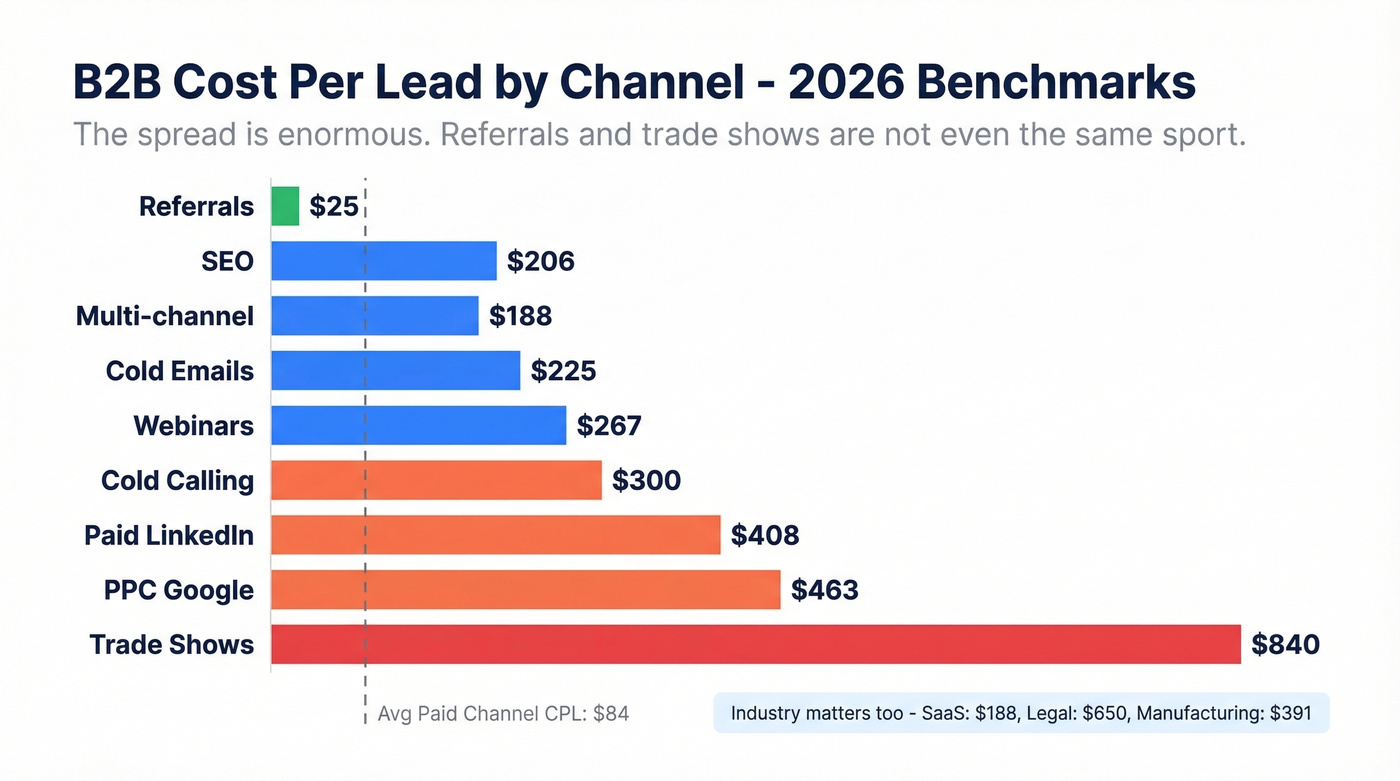
The spread is enormous. Referrals at $25 and trade shows at $840 aren't even the same sport. Industry matters too: SaaS averages $188 per lead, legal hits $650, and manufacturing lands around $391. The average B2B CPL across paid channels is $84, but that number hides massive variance.
Funnel-Stage Thresholds
| Stage | Great | Average | Needs Work |
|---|---|---|---|
| Visitor to Lead | >5% | 2-5% | <2% |
| MQL to SQL | >60% | 40-60% | <40% |
| Lead to Customer | >20% | 10-20% | <10% |
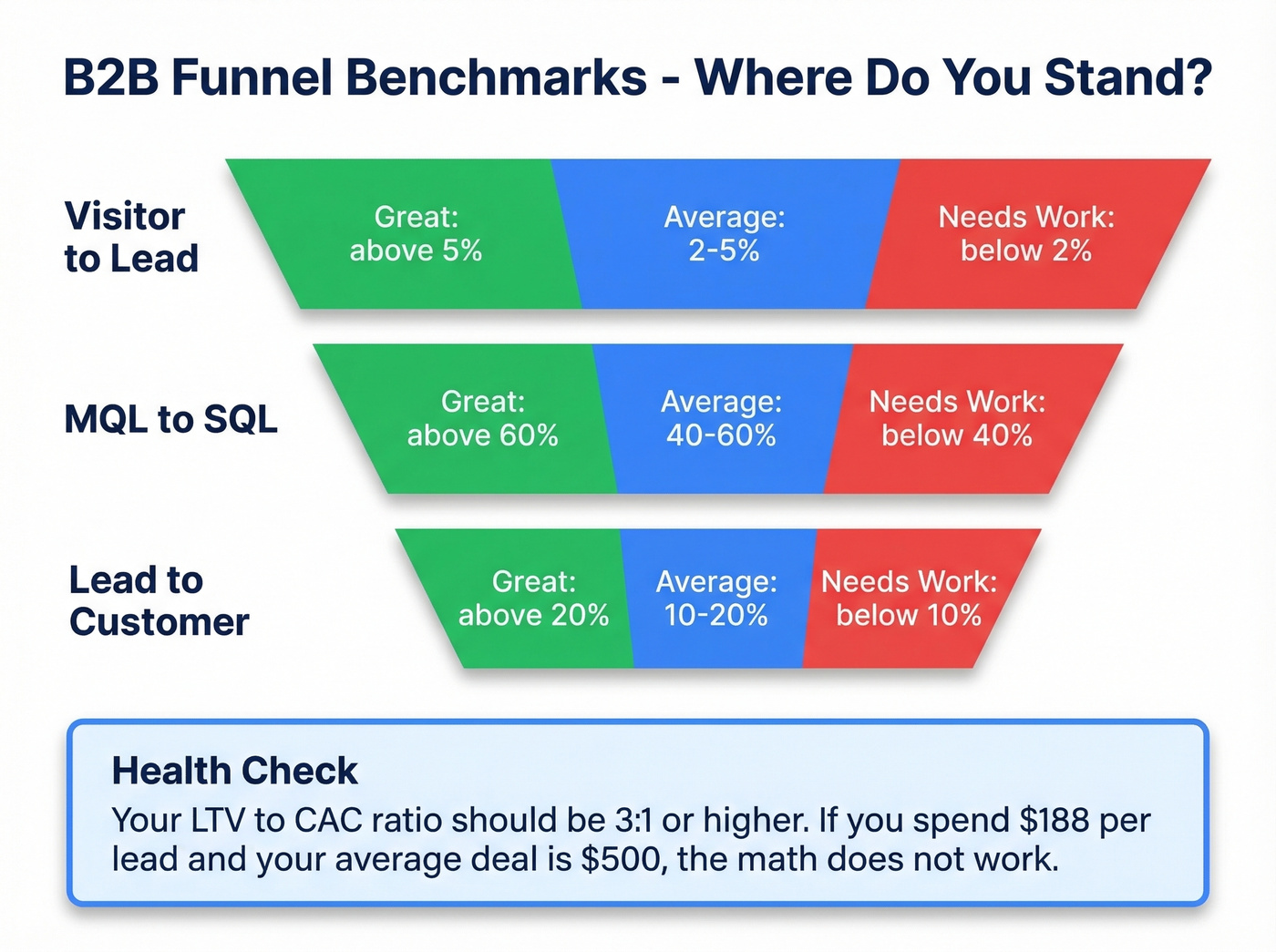
The health benchmark that ties it all together: your LTV:CAC ratio should be at or above 3:1. If you're spending $188 per SaaS lead and your average deal is $500, the math doesn't work regardless of how good your funnel conversion rates are.
Here's the thing: if your average deal size sits below $10K, you probably don't need ZoomInfo-level data infrastructure. A $39/month tool with 98% email accuracy will outperform a $25K/year platform your team only uses for basic contact lookups.
Why Your Leads Don't Convert
Let's be honest about a scenario we've seen play out dozens of times. Marketing generated 2,000 MQLs last quarter. Sales followed up on 600. Forty-seven became opportunities. Eight closed. Everyone's frustrated, and the finger-pointing starts.
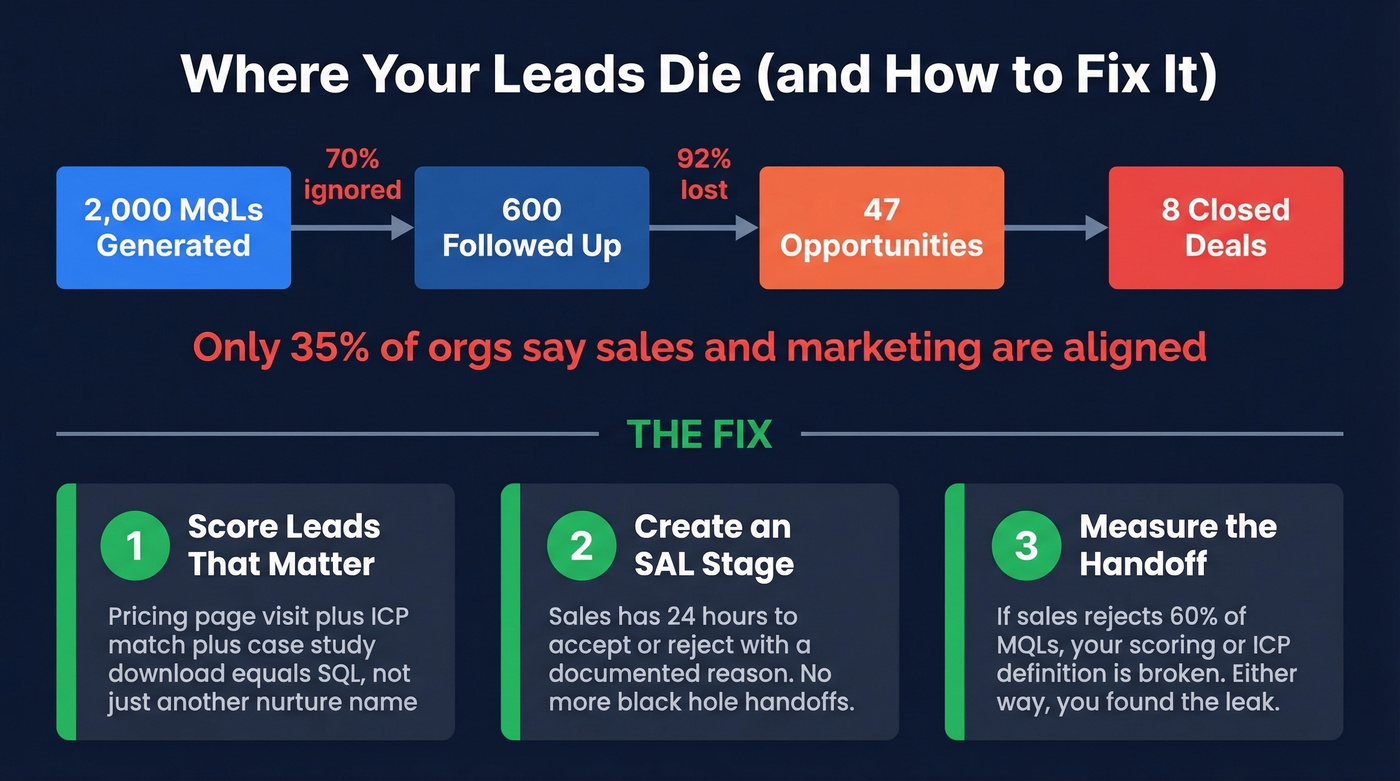
The problem is almost always in the middle of the funnel. That 53% stat isn't abstract - it's the gap between "marketing sent a lead" and "sales worked a lead." Only 35% of organizations say marketing and sales are fully aligned. The rest are running two separate operations that happen to share a CRM. Companies that excel at lead nurturing generate 50% more sales-ready leads at 33% lower cost, yet most teams treat nurture as a drip campaign afterthought.
The fix isn't complicated, but it requires discipline. First, implement lead scoring that actually means something: if a prospect visited your pricing page, matches your ICP firmographics, and downloaded a case study, that's an SQL - not just another name in the nurture sequence. Second, create an SAL stage with a handoff SLA. Sales has 24 hours to accept or reject a lead with a documented reason.
Third, measure the handoff. If sales is rejecting 60% of MQLs, either your scoring is wrong or your ICP definition is wrong. Either way, you've found the leak.
Best Tools for B2B Leads in 2026
| Tool | Database | Email Accuracy | Pricing | Best For |
|---|---|---|---|---|
| ZoomInfo | 100M+ contacts | ~87% | $15K-$36K/yr | Enterprise platform |
| Apollo | 275M+ contacts | ~79% | Free-$119/mo/user | Startups, all-in-one |
| Cognism | 400M+ contacts | Not published | ~$1K-$3K/mo | EMEA / GDPR |
| Instantly | 160M+ contacts | Not published | From $30/mo | Outreach + leads |

Prospeo
Best overall for teams that care about data quality over feature bloat. The database covers 300M+ professional profiles with 143M+ verified emails and 125M+ verified mobile numbers - all refreshed every 7 days, compared to the 6-week industry average.
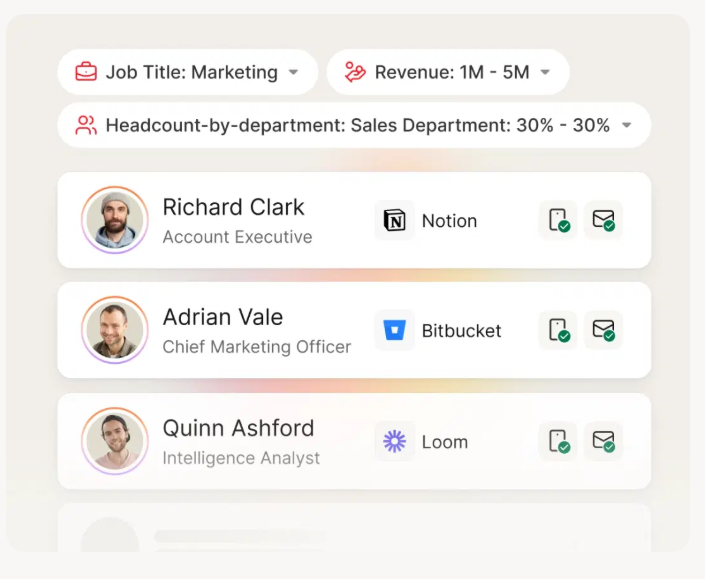
The proof is in production: Snyk's 50 AEs saw bounce rates drop from 35-40% to under 5% after switching, with AE-sourced pipeline up 180%. The 30+ search filters - including department-level headcount growth and live job posting signals via Wappalyzer - let you build lists based on real hiring activity, not just firmographic checkboxes. The Chrome extension (40,000+ users) verifies contacts from any website in one click, and the API delivers a 92% match rate. Pricing starts free with 75 verified emails per month and scales at roughly $0.01 per email with no annual contracts.
ZoomInfo
The enterprise default. ZoomInfo's 100M+ contact database is deep in the US, and the platform bundles intent data, chat, workflow automation, and org charts into one ecosystem. The problem is cost: list pricing runs $14,995 to $35,995 per year depending on tier, with a minimum of 2-3 seats and additional licenses at $2,500/year. Discounts of 30-65% are common if you negotiate hard.
The #1 complaint on r/sales? Paying for modules you don't use. If you're a 200+ person sales org that'll actually use the full platform, ZoomInfo earns its price. For everyone else, you're subsidizing features your team will never open.
Apollo.io
Apollo is the obvious starting point for startups that want prospecting, sequencing, and a database in one tool. The 275M+ contact database is massive, and the free plan gets you in the door with 50 AI credits and basic sequences.
But Apollo's pricing gets unpredictable fast. The hybrid credit model means a tool advertised at $49/month can balloon to $3,452 in year one once you factor in per-user fees, credit overages, and annual requirements. Credits don't roll over. We've talked to teams who were genuinely surprised by the jump from free to paid - read the fine print.
Cognism
Cognism's 400M+ contact database is the strongest option for teams selling into European markets. GDPR compliance is baked in, and their Diamond Data mobile verification is useful for reaching prospects in the UK and DACH regions. Custom pricing typically lands in the $1,000-$3,000/month range on annual contracts. Where ZoomInfo wins: US database depth and workflow breadth. Where Cognism wins: EMEA compliance and mobile verification quality.
Instantly
Use this if you need outreach infrastructure and a lead database in one platform. Skip this if you need deep data accuracy or enterprise-grade enrichment. Instantly starts at $30/month with 160M+ contacts and focuses on deliverability - inbox rotation, warmup, and send optimization. It's the budget play for teams running cold email campaigns who don't want to stitch together five different tools.
Quick Mentions
Lusha covers 45M+ contacts at $29-99/month - solid for quick lookups, thin for building large lists. Hunter.io indexes 200M+ emails and runs $0-499/month; it's an email finder, not a full database. Lead411 starts at $49/month with a 7-day free trial and focuses on trigger-event alerts - worth testing if intent-based outbound is your primary motion. Clay is the enrichment workflow engine that ties everything together; pair it with any database tool via API for automated prospecting sequences.
Our recommendations, stated plainly:
- Self-serve / SMBs / agencies: Prospeo, then Apollo, then Lusha
- Enterprise with budget: ZoomInfo (negotiate hard), then Cognism
- Outreach + leads in one: Instantly
- Enrichment workflows: Clay + Prospeo API
Mistakes That Kill B2B Lead Gen
Five mistakes we see repeatedly, each with a concrete consequence.
Running on unverified data. B2B data decays roughly 3% per month. A list you bought six months ago has lost about 18% of its accuracy. Anything below 95% email accuracy is a liability - your bounce rate climbs above 2%, ESPs start throttling you, and your domain reputation degrades. We've watched teams spend months rebuilding sender reputation that took one bad list to destroy.
Ignoring compliance. GDPR penalties run up to EUR 20M or 4% of global annual revenue. Keep your spam complaint rate under 0.01%. If you're emailing EU prospects without a legitimate interest basis, you're playing a game with asymmetric downside.
Single-channel dependency. The practitioner who sent 217,000 cold emails learned this the hard way: cold email alone at scale produces diminishing returns. Layer in social selling, content, and intent-based outreach. Diversification isn't a nice-to-have - it's insurance against channel fatigue.
No ICP definition. Emails to large untargeted lists get 67% fewer replies than smaller, targeted groups. If you can't describe your ideal customer in two sentences - industry, company size, job title, pain point - you're not ready to generate leads. You're ready to waste money.
Skipping intent signals. Trigger events - funding rounds, hiring surges, tech stack changes, competitive research - are the 2026 differentiator between teams that book meetings and teams that burn lists. If you're not filtering for intent, you're guessing.
Signal-based outbound only works when the data underneath it is clean. Prospeo gives you 30+ filters - buyer intent, hiring surges, tech stack, funding - across 300M+ profiles with 98% email accuracy at $0.01 per lead. No contracts, no sales calls.
Replace your bloated lead lists with precision-targeted, verified prospects.
FAQ
What's the average cost per B2B lead?
The average CPL across paid channels is $84, but that number is nearly meaningless without context. Referrals cost ~$25, trade shows run ~$840, SaaS averages $188, and legal services hit $650. Always benchmark against your specific channel mix and industry vertical.
What's the difference between MQL, SQL, and SAL?
An MQL fits your target profile and has engaged with marketing - downloaded content, attended a webinar, visited key pages. An SQL has a confirmed need, budget, and timeline. An SAL is when sales formally accepts the lead and commits to working it within a defined SLA. Most funnel leaks happen because teams skip the SAL stage entirely.
Is cold email dead for generating B2B leads?
No, but high-volume cold email without intent signals is. Low-volume, signal-based outreach with verified data and genuine personalization still books meetings. Keep sends to 50-100 per inbox per day, bounce rates under 2%, and targeting tight to your ICP.
How do I improve lead quality?
Define a tight ICP, use intent data to prioritize in-market accounts, verify all contact data before outreach, and implement lead scoring with clear MQL-to-SQL thresholds. A pricing page visit plus ICP match plus content download should trigger a different workflow than a blog visit alone.
What's the best free tool for finding B2B leads?
Prospeo offers 75 verified emails per month on its free tier - no credit card or sales call required. Apollo also has a limited free plan with 50 AI credits and basic sequencing. Starting with both and comparing data quality against your actual ICP is the fastest way to decide.