

B2B SaaS Sales Process: Benchmarks & Stages (2026)
Most B2B SaaS sales process guides list seven stages, slap "qualify your leads" on step two, and call it a day. Meanwhile, sales cycles have lengthened 22% since 2022, buying committees average 6.8 stakeholders according to Gartner, and your reps are still winging discovery calls.
Here's the process with actual numbers attached - stage by stage, segmented by deal size.
Your Sales Motion Is Dictated by ACV
The median B2B SaaS sales cycle is 84 days, but that number is useless without segmentation. SMB deals close in 14-30 days. Enterprise runs 90-180+. In our experience, the two biggest leaks are usually qualification and prospecting - fix those two, and the rest of the funnel tightens on its own.
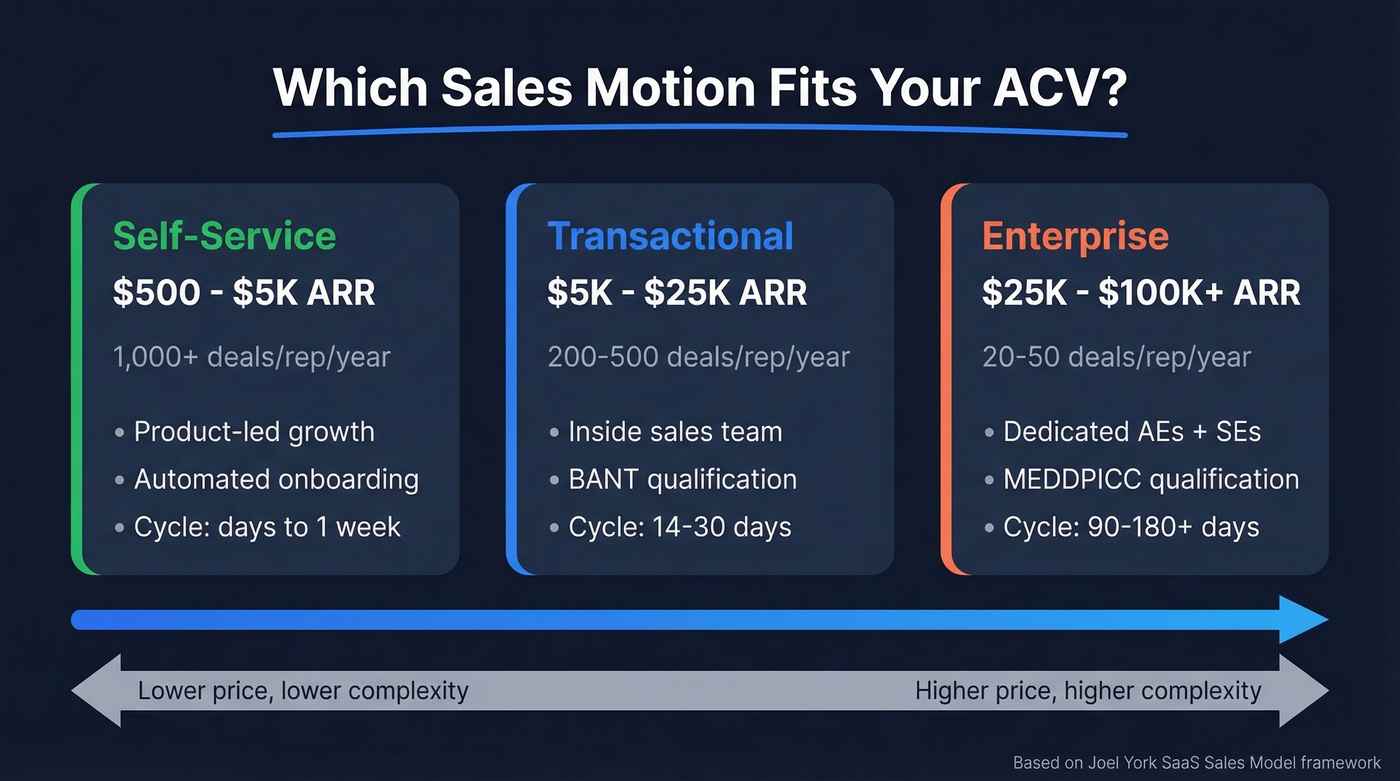
Before you build stages, know which game you're playing. Joel York's framework still holds: price and complexity push you toward self-service, transactional, or enterprise. At $500 ARR, a rep needs roughly 1,000 deals a year to justify their seat - that's self-service territory. At $50K ARR, you can afford dedicated AEs and a 90-day cycle. And $10M in revenue looks completely different depending on whether you're closing 10,000 customers at $1K or 1,000 at $10K.
Here's the thing: most teams pick the wrong motion and then blame their reps. A transactional team running enterprise playbooks will burn cash. An enterprise team trying to self-serve will lose every deal to a competitor who shows up with a champion strategy.
7 Stages From Prospect to Close
Prospecting
42% of salespeople say prospecting is the hardest part of their job. Your process breaks at step one if contact data is stale - bounced sequences, burned domains, reps chasing contacts who already left. Prospeo's 300M+ profiles with 98% email accuracy on a 7-day refresh cycle address this directly: Snyk's 50 AEs cut bounce rates from 35-40% to under 5% and added 200+ new opportunities per month after switching their data provider. If you're troubleshooting deliverability, start with email bounce rates and email deliverability before you scale volume. 57% of C-suite buyers prefer phone outreach, so verified mobile numbers matter just as much as emails.

Qualification
Use the right framework for the deal size. BANT works for deals under $15K ACV - it's a lightweight screening tool. For mid-market contracts in the $15K-$100K range, switch to MEDDIC. Above $100K, MEDDPICC adds Paper Process and Competition tracking for navigating 6-10+ stakeholders and legal review. If you want to operationalize it, use a consistent lead status model in your CRM.
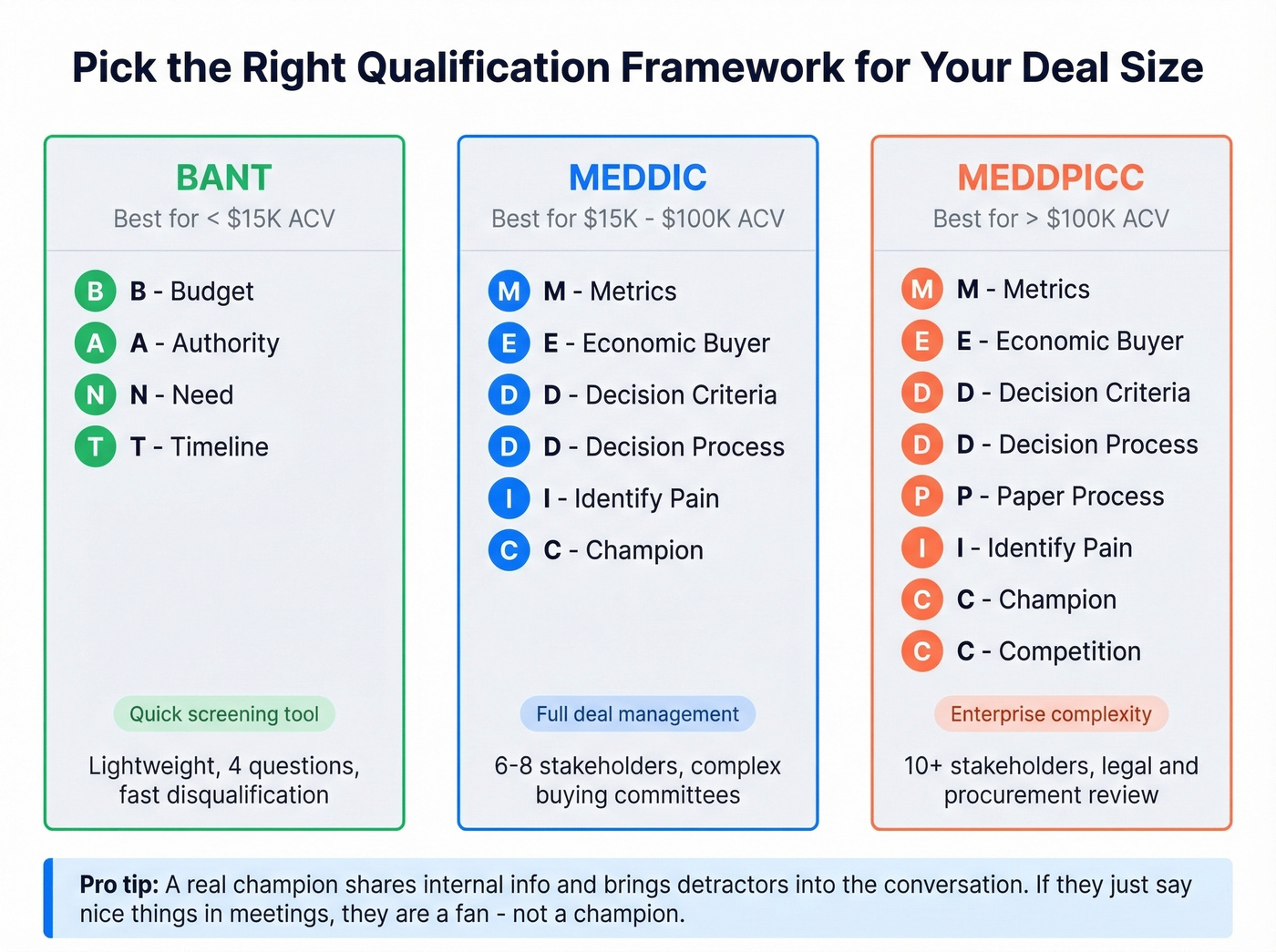
Most teams confuse a fan with a champion. A real champion shares internal information, maps the org chart, and brings detractors into the conversation voluntarily. If your contact just says nice things in meetings, they're a fan. Fans don't close deals.
Discovery
Timebox discovery calls to LTV. Under $1,500 lifetime value? Keep it to 15 minutes. Higher LTV justifies 60+ minutes. A popular framework from r/sales is the "rules of engagement" opener: align on the objective, set the agenda, and agree on the next decision - all in the first 90 seconds. For a tighter structure, keep a bank of discovery questions and a standardized discovery call script.
The best discovery questions force prioritization. Ask "What are your top 2-3 priorities? Stack rank them." Then dig into #1 with impact questions like "What happens if this doesn't get solved in the next six months?" You'll learn more in two minutes of prioritization than in twenty minutes of open-ended conversation.
Demo, Proposal, Negotiation, and Close
Proposals sent within 24 hours of a demo close 35% faster - yet most teams take 3-5 days. Deals with 3+ contacts engaged close 2.4x faster than single-threaded ones.
For enterprise, negotiation-to-close eats 35-40% of total cycle time. Legal and procurement are the bottleneck, not your buyer. The modern closing tool isn't a hard ask - it's a mutual action plan with 3-5 concrete steps and owners on both sides. Track stage timestamps in your CRM so you can diagnose exactly where deals stall. If you’re tightening late-stage execution, borrow a few steps to close a sale patterns.
Onboarding and Expansion
Land-and-expand is the growth engine for most SaaS companies, and churn prevention starts at onboarding. A clean CSM handoff with context - pain points, stakeholders, success criteria - is the difference between expansion revenue and early churn. Skip this step and you'll spend six months winning a customer only to lose them in sixty days. Expansion planning is easier when you track churn analysis alongside renewals.
Stage-by-Stage Benchmarks
| Stage | SMB (<$15K) | Mid-Market ($15-50K) | Enterprise (>$100K) |
|---|---|---|---|
| Discovery to Demo | 3-5 days | 5-10 days | 10-20 days |
| Demo to Proposal | 1-3 days | 5-15 days | 15-30 days |
| Proposal to Negotiation | 3-7 days | 10-20 days | 20-40 days |
| Negotiation to Close | 2-5 days | 10-20 days | 30-60 days |
| Total | 14-30 days | 30-60 days | 90-180+ days |
| Avg touches to close | 8-15 | 15-30 | 30-60+ |
| Procurement time adder | - | +2-4 weeks | +4-8+ weeks |
Inbound leads from SEO and content typically close faster than cold outbound. An SMB deal sourced from inbound might close in roughly 14 days versus 30+ from a cold call. Plan your pipeline mix accordingly.

You need 433 leads to close 10 deals. At 80% data accuracy, 87 of those are dead on arrival - and the waste compounds through every stage. Prospeo delivers 98% email accuracy on a 7-day refresh cycle, so your pipeline math actually works. Snyk's 50 AEs dropped bounce rates from 35-40% to under 5% and added 200+ opportunities per month.
Stop leaking pipeline at the top of your funnel.
Pipeline Math That Actually Works
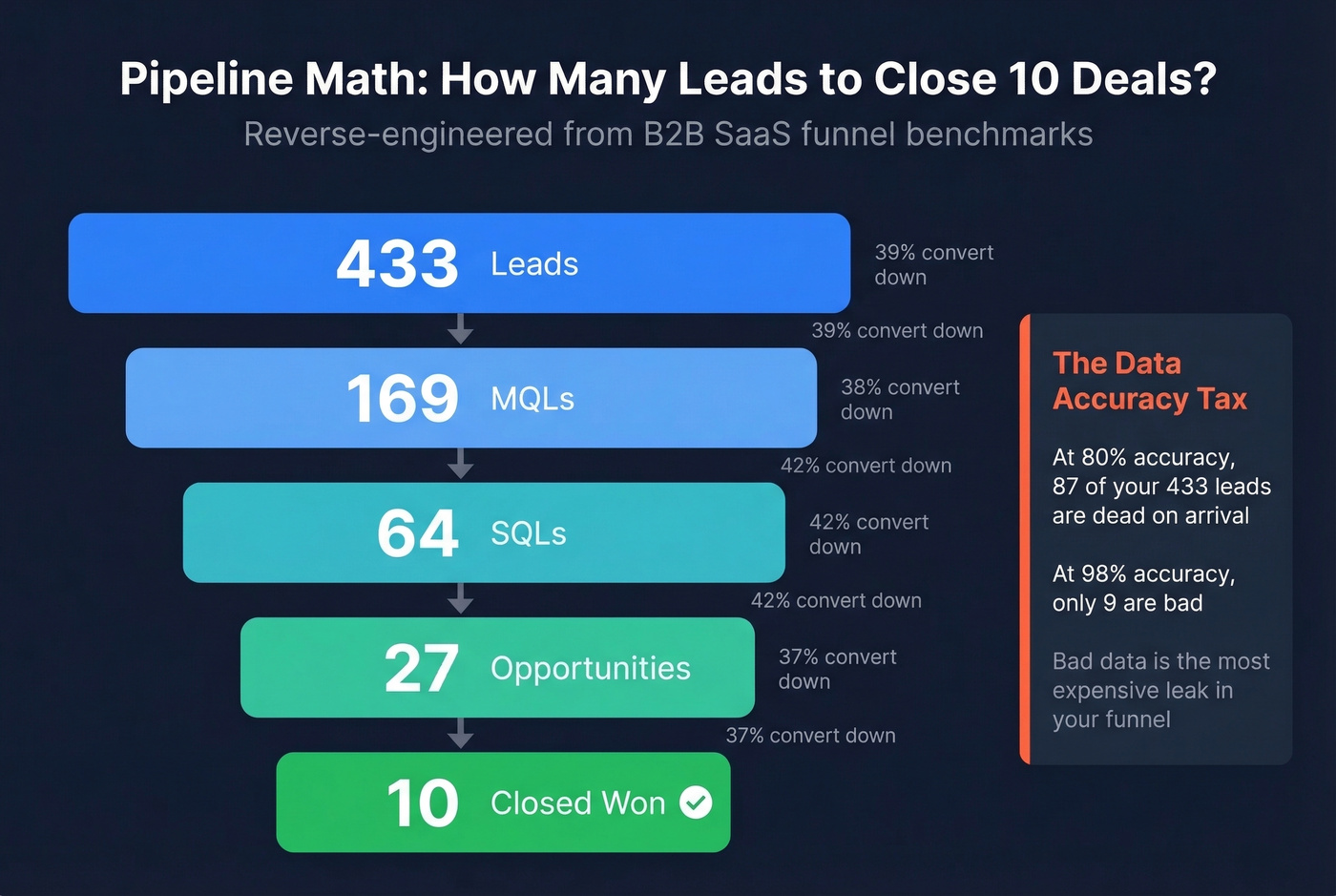
Let's reverse-engineer benchmarks into required volume. To close 10 deals per month, using B2B SaaS funnel benchmarks:
| Stage | Conversion Rate | Volume Needed |
|---|---|---|
| Closed Won | - | 10 |
| Opp to Closed | 37% | ~27 Opps |
| SQL to Opp | 42% | ~64 SQLs |
| MQL to SQL | 38% | ~169 MQLs |
| Lead to MQL | 39% | ~433 Leads |
You need 433 leads at the top to close 10 deals. If your prospecting data is 80% accurate instead of 98%, you're starting with roughly 87 dead contacts every month - and the compounding waste hits every stage below. We've run this math with dozens of teams, and bad data is always the most expensive leak in the funnel. This is also why teams track pipeline health metrics, not just top-line revenue.
Mistakes That Kill Deals
Fake urgency destroys trust. HubSpot's research confirms what every experienced buyer already knows - manufactured scarcity in B2B SaaS pushes deals to "no decision" faster than it creates urgency. Bryan Vasquez at LinkBuilder.io replaced urgency-based CTAs with data-backed proposals and saw a 20% win rate increase over two quarters.
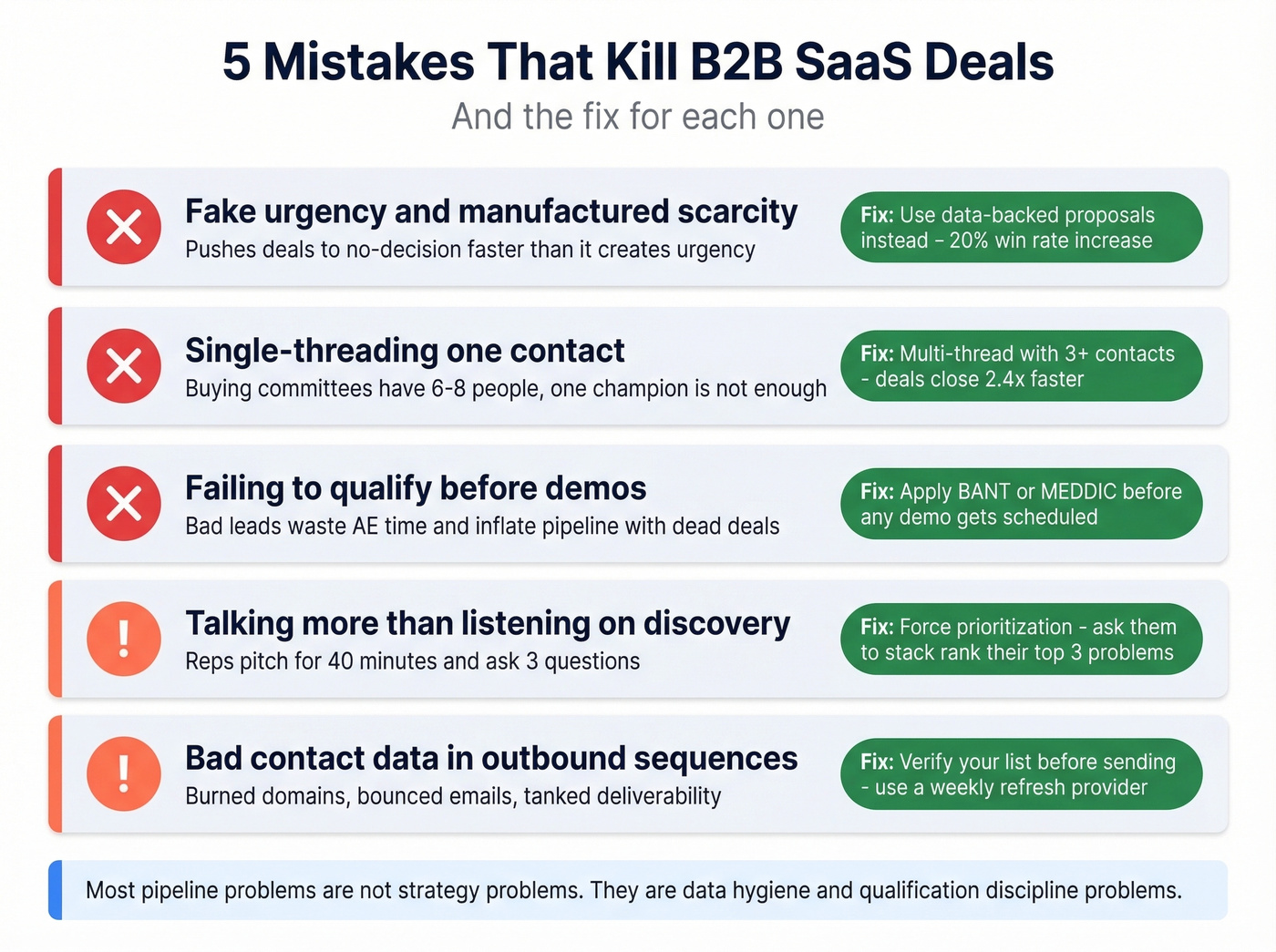
The other deal-killers we see repeatedly:
- Failing to qualify - bad leads get demos, waste AE time, and inflate pipeline with deals that never close
- Single-threading - talking to one contact when the buying committee has 6-8 people
- Talking more than listening - discovery calls where the rep pitches for 40 minutes and asks three questions
- Skipping stakeholder mapping - your champion gets overruled by someone you never met
- Bad contact data - verify your list before you send, or you'll burn your domain and tank deliverability
Most pipeline problems aren't strategy problems. They're data hygiene and qualification discipline problems. Fix those two and you'll see conversion rates shift within a quarter. One r/SaaS founder put it well: systematize your stages and instrument your CRM early, because you can't fix what you can't measure. If you’re building a more repeatable system, start with sales process optimization and then standardize funnel metrics.
A well-instrumented B2B SaaS sales process gives you the visibility to diagnose bottlenecks before they compound. The stages above aren't theoretical - they're the same structure top-performing SaaS teams use to hit quota consistently.
Enterprise deals need 30-60+ touches across 6-8 stakeholders. That means verified emails and direct dials for every contact on the buying committee - not just your champion. Prospeo gives you 300M+ profiles, 125M+ verified mobiles with a 30% pickup rate, and 30+ filters to target by intent, technographics, and headcount growth.
Multi-thread every deal with contact data that connects.
FAQ
How long is the average B2B SaaS sales cycle?
The median is 84 days, but segment by deal size: SMB closes in 14-30 days, mid-market in 30-60 days, and enterprise runs 90-180+. Cycle length correlates directly with ACV and stakeholder count.
What's the difference between BANT and MEDDIC?
BANT is a quick four-question screening tool best suited for deals under $15K ACV. MEDDIC is a full deal-management framework designed for enterprise complexity - it maps metrics, economic buyers, decision criteria, and champions across 6+ stakeholders.
How do I fix high email bounce rates in outbound?
Switch to a data provider with real-time verification and a short refresh cycle. Look for providers that refresh records weekly rather than monthly - the industry average is six weeks, and a lot of contact data goes stale in that window. Snyk cut bounce rates from 35-40% to under 5% after switching to a weekly-refresh provider.
What conversion rates should I expect across the SaaS funnel?
For a healthy B2B SaaS pipeline, target roughly 39% Lead-to-MQL, 38% MQL-to-SQL, 42% SQL-to-Opp, and 37% Opp-to-Close. That means roughly 433 top-of-funnel leads to close 10 deals per month. Track these by source - inbound typically converts 1.5-2x better than cold outbound.