

B2B Sales: What It Actually Takes to Win in 2026
Four months in. Five hundred cold emails sent. Pipeline: empty. That's not a hypothetical - it's a real post on r/b2bmarketing from a seller with no training, no mentor, and no idea what to prioritize. B2B sales has changed fundamentally, and most guides haven't caught up. They recycle the same funnel diagrams and "always be closing" platitudes from 2018. This one uses 2026 data from Gartner, 6sense, Bain, and RepVue - because the way buyers buy has shifted, and the playbook needs to match.
The Short Version
Business-to-business sales in 2026 comes down to three things:
- Reaching the right people - data quality is the foundation. If your emails bounce at 35%, nothing else matters. (If you're troubleshooting deliverability, start with bounce-rate benchmarks.)
- Reaching them early - 95% of winning vendors are already on the buyer's Day One shortlist. Brand and content get you there.
- Reaching them relevantly - 73% of buyers actively avoid suppliers who send irrelevant outreach. Personalization and methodology aren't optional.
The numbers that define the market: 61% of buyers prefer no rep involvement, only 28% of reps hit quota, and the average sales cycle compressed from 11.3 to 10.1 months between 2024 and 2025. If you're exploring a career, scroll to the compensation table - enterprise AEs clear $265K OTE at the median. If you're optimizing a team, jump to strategies and benchmarks. If your outbound is broken, it's probably a data problem.
What Is B2B Sales?
It's the process of selling products or services from one business to another. That's the textbook answer. The practical answer is messier: you're navigating a buying committee of 6-17 people, across a cycle that can stretch from weeks to over a year, where the person you're talking to rarely has final authority.
Think of any commercial transaction where both buyer and seller are organizations - not individual consumers. That covers everything from a manufacturer purchasing raw steel to a startup subscribing to a CRM platform. The global B2B eCommerce market alone is estimated at $32.11 trillion in 2025, and total transaction volume runs into the tens of trillions. This isn't a niche. It's the backbone of the global economy.
B2B vs. B2C
| Dimension | B2B | B2C |
|---|---|---|
| Cycle length | 1-12+ months | Minutes to days |
| Decision-makers | 6-17 people | 1-2 people |
| Avg deal size | $5K-$500K+ | $10-$500 |
| Relationship | Long-term, trust-based | Transactional |
| Buying motive | ROI, efficiency, risk | Emotion, convenience |
The market breaks into a few distinct motions. Supply and wholesale covers raw materials, components, and distribution. SaaS and services means recurring revenue and subscription models - the world most of us live in. Enterprise involves seven-figure deals with procurement teams and legal reviews. And B2G (business-to-government) plays by its own rules entirely.
The distinction between inside sales and outside sales used to matter a lot. Inside reps sold remotely; outside reps traveled to close deals in person. That line has almost completely blurred. Post-pandemic, even enterprise deals that once required steak dinners now close over Zoom. What matters is whether you can navigate a complex buying committee, not whether you do it from a conference room or a home office.
How Buyers Actually Buy in 2026
Buyers don't follow your sales process. They follow their own.
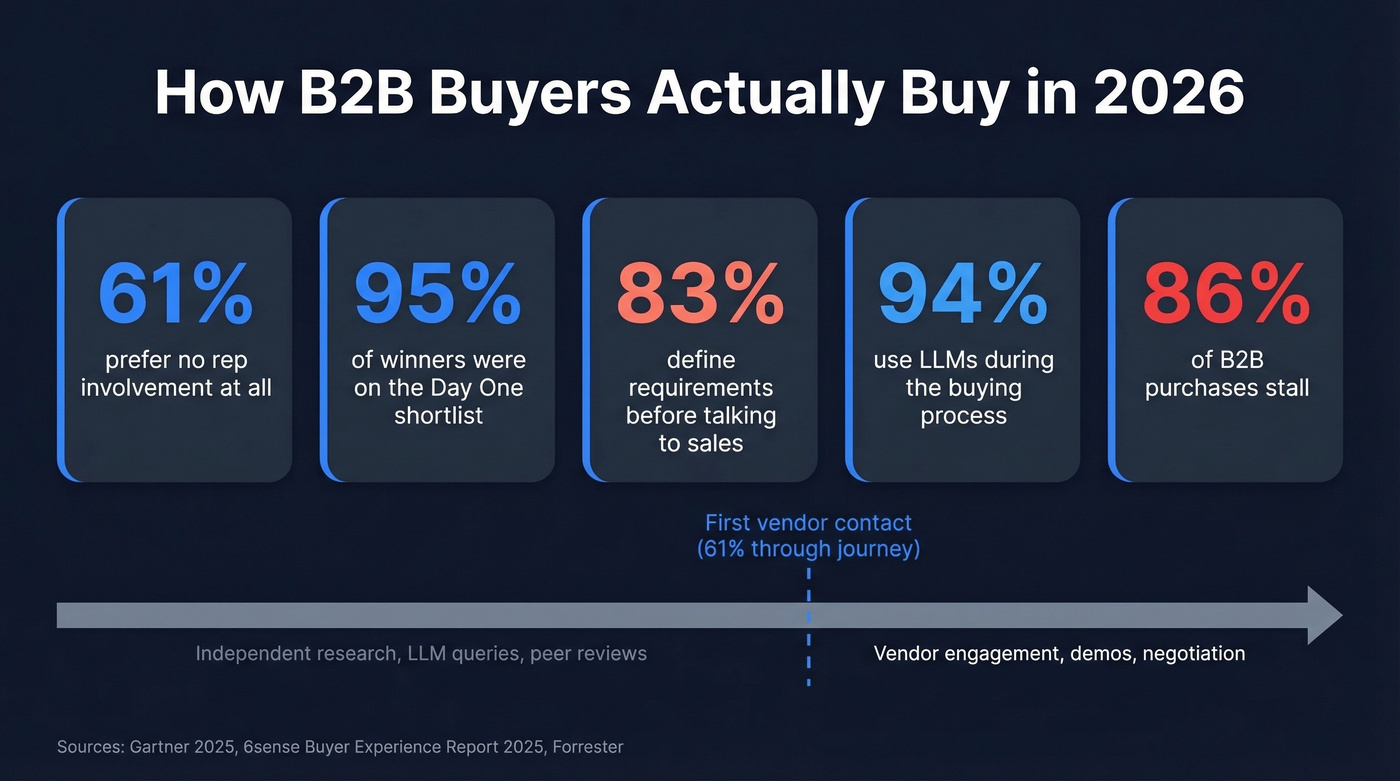
61% of B2B buyers now prefer a completely rep-free buying experience - based on a Gartner survey of 632 buyers. Not "prefer digital-first." Prefer no rep at all. Meanwhile, 83% of buyers mostly or fully define their purchase requirements before they ever talk to sales.
The timeline is shifting too. The 6sense 2025 Buyer Experience Report - nearly 4,000 buyer responses across North America, APAC, and EMEA - found that the point of first contact moved from 69% to 61% of the buyer journey, roughly 6-7 weeks earlier than the prior year. Economic pressure is forcing buyers to engage sooner, but they're arriving with more research already done.
The shortlist dynamic is the most important data point in all of this: 95% of the time, the winning vendor is already on the buyer's Day One shortlist. The pre-contact favorite wins roughly 80% of deals. If you're not on that shortlist before the buyer picks up the phone, you're fighting for scraps.
Buyers are using new tools to build those shortlists. 94% now use LLMs during the buying process - asking ChatGPT and Perplexity to compare vendors before they ever visit your website. And 89% ultimately purchase solutions that include AI features. Yet despite all this research, 86% of B2B purchases stall according to Forrester, and 81% of buyers ended up dissatisfied with the provider they chose. Adding to the dysfunction, 69% of buyers report inconsistencies between what they find on a vendor's website and what sellers actually tell them.
The buying process is broken on both sides.
On r/b2b_sales, sellers describe 2025-2026 as a trust deficit era - organic reach is dead, AI-generated outreach has created content fatigue, and buyers demand proof over promises. That frustration tracks with the data. When buyers have already made up their minds before you get a meeting, the only lever that matters is your data: who you're reaching, when you're reaching them, and whether the information you're sending matches their actual situation.
The B2B Sales Process
The seven steps haven't changed in decades. What's changed is how little time you get to execute them.
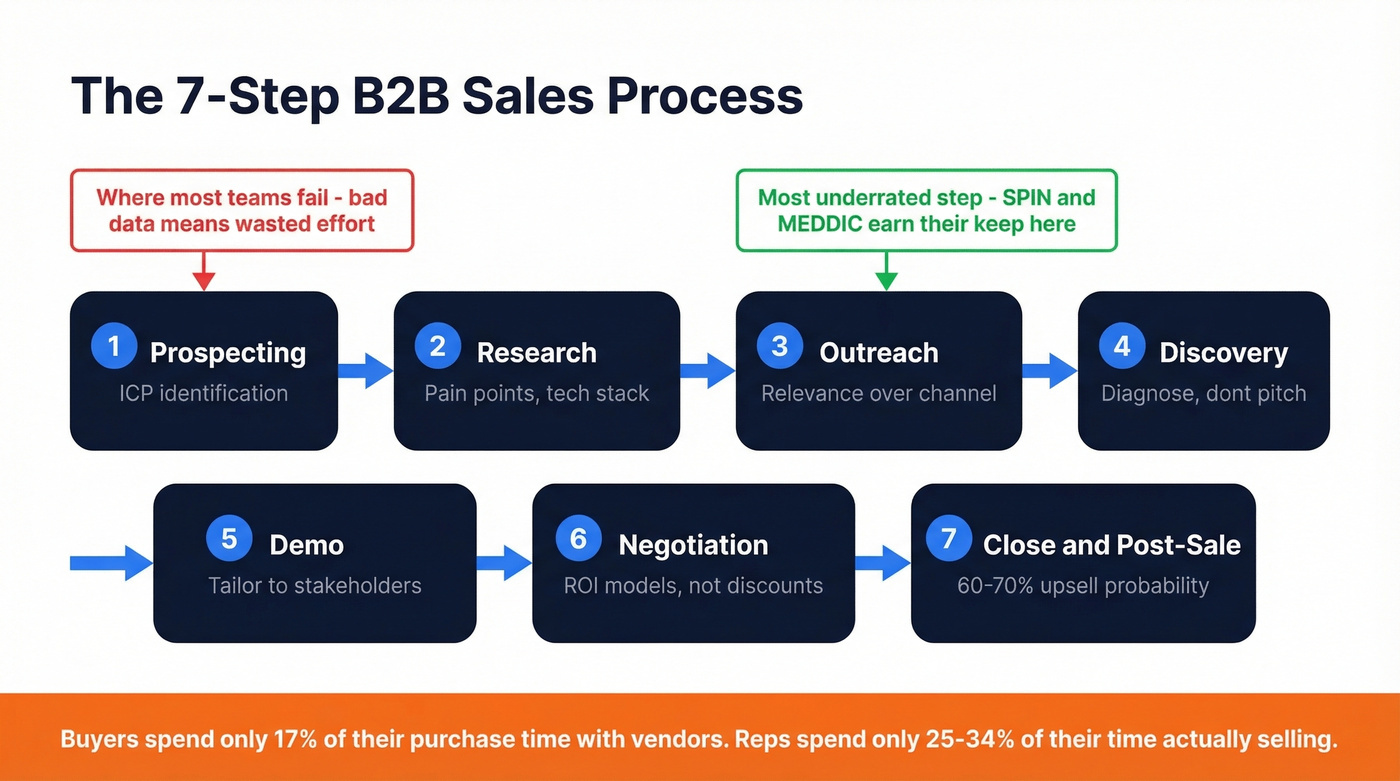
- Prospecting - Identify accounts and contacts that match your ICP. This is where most teams fail. Bad data means wasted effort on people who'll never buy. (If you need a refresher, use these sales prospecting techniques.)
- Research & Preparation - Understand the account's pain points, tech stack, recent news, and org structure before you reach out. Buyers can tell when you haven't done this.
- Outreach & Approach - First touch. Cold email, cold call, warm intro, social. The channel matters less than the relevance. Two out of three buyers prefer engaging reps only in later stages - up 17 percentage points year over year. (For sequencing, see a B2B cold email sequence.)
- Discovery & Qualification - The most underrated step. This is where methodologies like SPIN and MEDDIC earn their keep. You're not pitching - you're diagnosing. (Use a tighter discovery questions framework.)
- Presentation & Demo - Tailor to the specific stakeholders in the room. A demo that doesn't address the CFO's concerns is a demo that delays the deal. (Keep a product demo checklist handy.)
- Negotiation & Objection Handling - Procurement is involved earlier and more aggressively than five years ago. Come prepared with ROI models, not discounts.
- Close & Post-Sale - The close is a milestone, not the finish line. The probability of selling to an existing customer is 60-70% versus 5-20% for a new prospect.
Buyers spend only 17% of their total purchase time engaging with vendors. Reps spend just 25-34% of their time actually selling. The steps aren't the hard part. Reaching the right person at the right time is.
B2B Sales Benchmarks for 2026
Numbers don't lie, but they do require context.
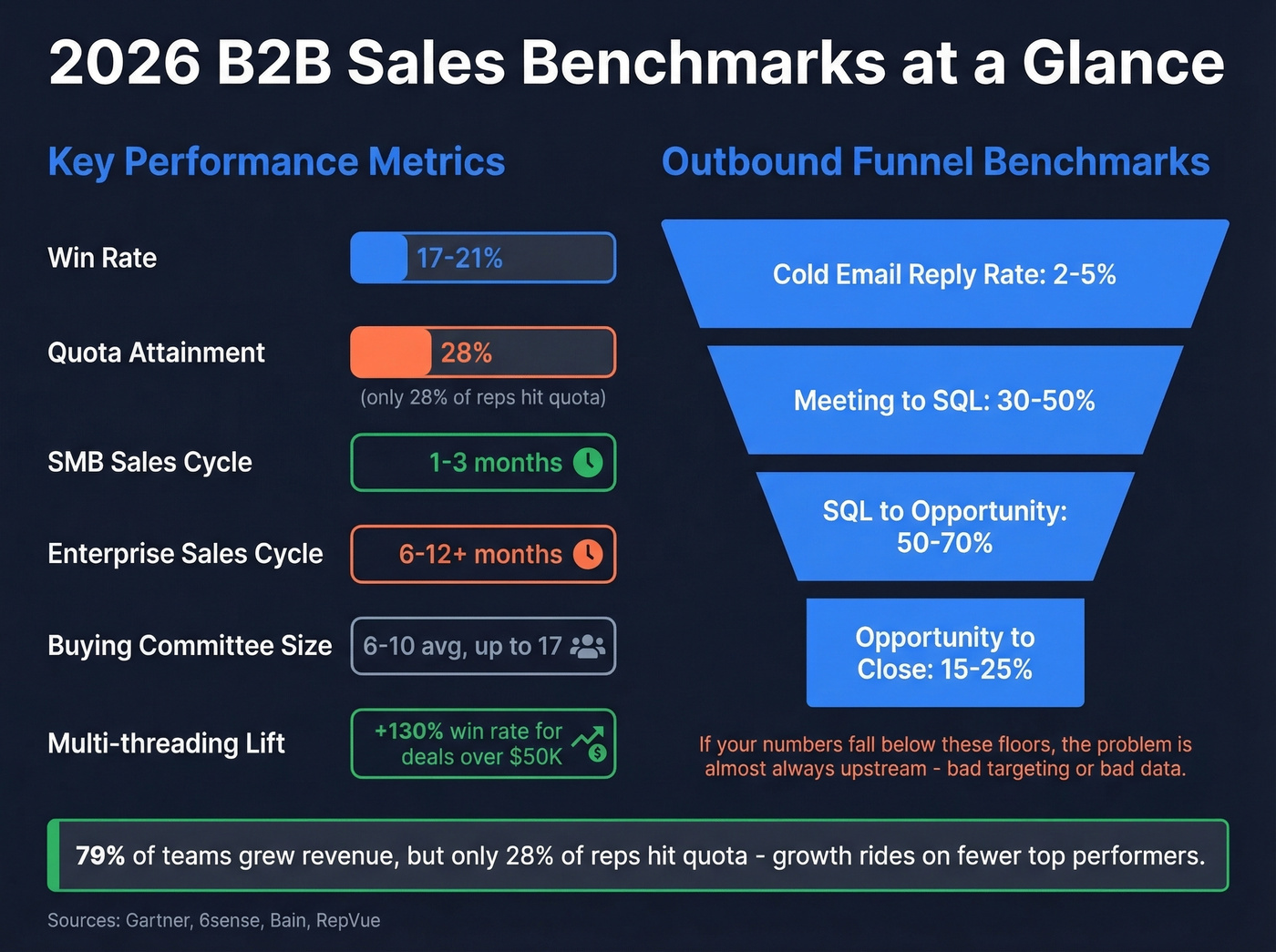
| Metric | Benchmark | Context |
|---|---|---|
| Win rate | 17-21% | Varies by segment |
| Quota attainment | 28% hit; ~43% avg | Rep-level, not team |
| Sales cycle | 1-3 mo (SMB); 6-12+ mo (>$100K) | Enterprise stretches further |
| Buying committee | 6-10 avg; 15-17 enterprise | More stakeholders = longer cycles |
| Time spent selling | 25-34% | Rest is admin, CRM, meetings |
| Multi-threading lift | 2x contacts in won deals | 130% win-rate boost for >$50K |
| Referral conversion | ~26% | Highest of any channel |
The performance paradox: 79% of sales teams grew revenue last year, while only 28% of individual reps hit quota. Companies are growing on the backs of a shrinking number of top performers.
The gap between the best reps and everyone else is widening, and the tools and data those top performers use is a big part of why. The multi-threading stat deserves special attention - an analysis of 1.8 million opportunities found that closed-won deals have roughly 2x as many buyer contacts as lost deals. For deals over $50K, multi-threading boosts win rates by 130%. Single-threading - talking to one champion and hoping they sell internally - is the fastest way to lose a deal you should've won.
Directional outbound funnel benchmarks for teams calibrating expectations:
| Stage | Typical Conversion |
|---|---|
| Cold email reply rate | 2-5% |
| Meeting-to-SQL | 30-50% |
| SQL-to-opportunity | 50-70% |
| Opportunity-to-close | 15-25% |
These ranges shift based on ACV, ICP fit, and data quality. But if your numbers fall significantly below these floors, the problem is almost always upstream - bad targeting or bad data. (To pressure-test your targets, use an ideal customer profile template.)

The article says it plainly: if your emails bounce at 35%, nothing else matters. Prospeo's 5-step verification delivers 98% email accuracy - and teams using it book 26% more meetings than ZoomInfo users. At $0.01 per email, bad data is no longer an excuse.
Stop bleeding pipeline to bounced emails. Start with data that connects.
B2B Sales Methodologies
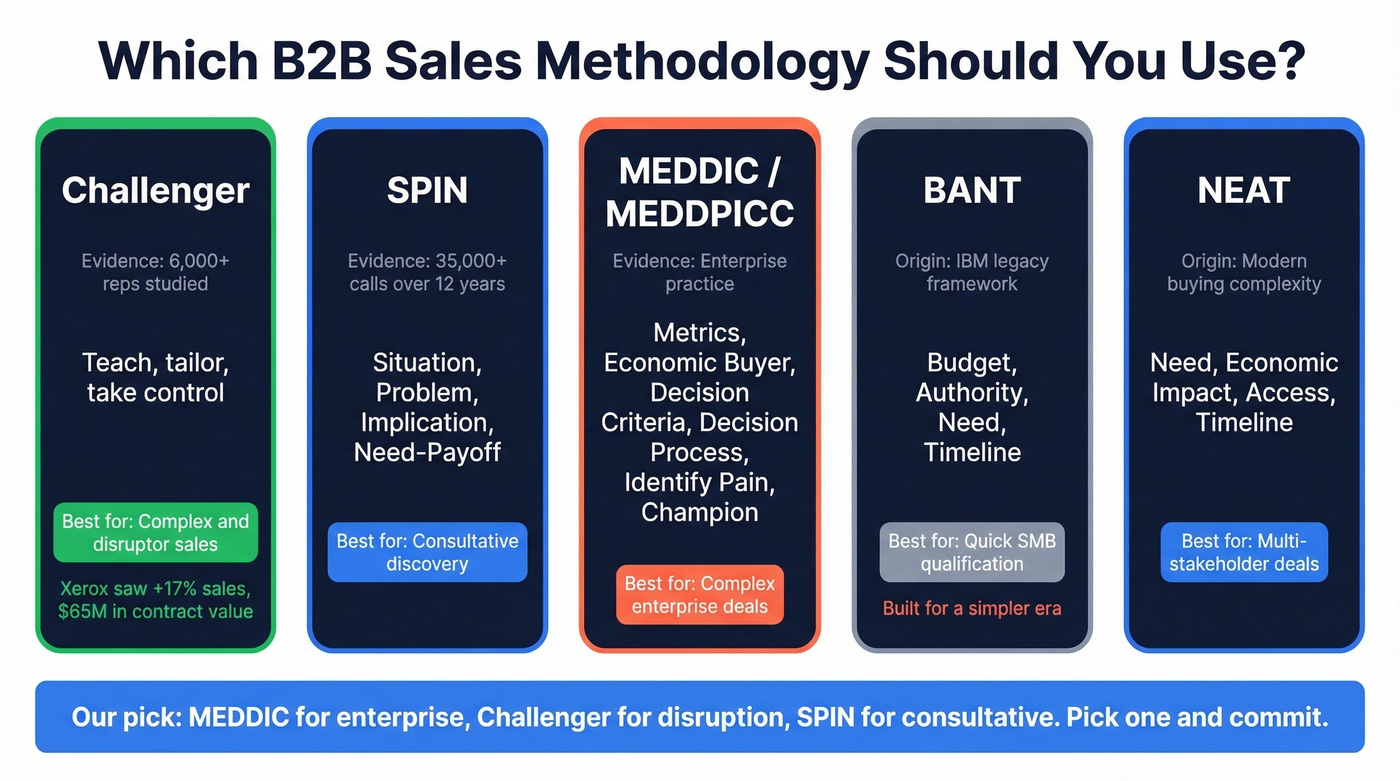
Pick a methodology and commit. The worst approach is no approach.
| Methodology | Research Basis | Best For | Core Idea |
|---|---|---|---|
| Challenger | 6,000+ reps (CEB) | Complex / disruptor sales | Teach, tailor, take control |
| SPIN | 35,000+ calls, 12 years | Consultative discovery | SPIN question sequence |
| MEDDIC/MEDDPICC | Enterprise practice | Complex enterprise deals | Qualification rigor |
| BANT | Legacy (IBM) | Quick SMB qualification | Budget/Authority/Need/Timeline |
| NEAT | Modern buying complexity | Multi-stakeholder deals | Need/Impact/Access/Timeline |
Challenger has the strongest evidence base for complex sales - Xerox reported a 17% increase in sales and $65M in contract value after implementing it. SPIN is the gold standard for consultative selling; Neil Rackham's research across 35,000+ calls and 20+ countries still holds up. MEDDIC is non-negotiable for enterprise deals where qualification rigor separates pipeline from pipe dreams. (If you're implementing it, start with MEDDIC sales qualification.)
BANT still works for quick SMB qualification, but it was built for an era when buyers had less information and fewer stakeholders. NEAT addresses modern buying complexity better, focusing on economic impact rather than just budget.
Our recommendation: MEDDIC for enterprise, Challenger for disruption, SPIN for consultative. Pick one and commit. Blending three frameworks gives you zero frameworks.
Strategies That Work in 2026
Multi-Threading
This is the single highest-leverage tactic in business-to-business selling, and most teams still don't do it well. Closed-won deals have 2x the buyer contacts of lost deals. For deals over $50K, multi-threading boosts win rates by 130%.
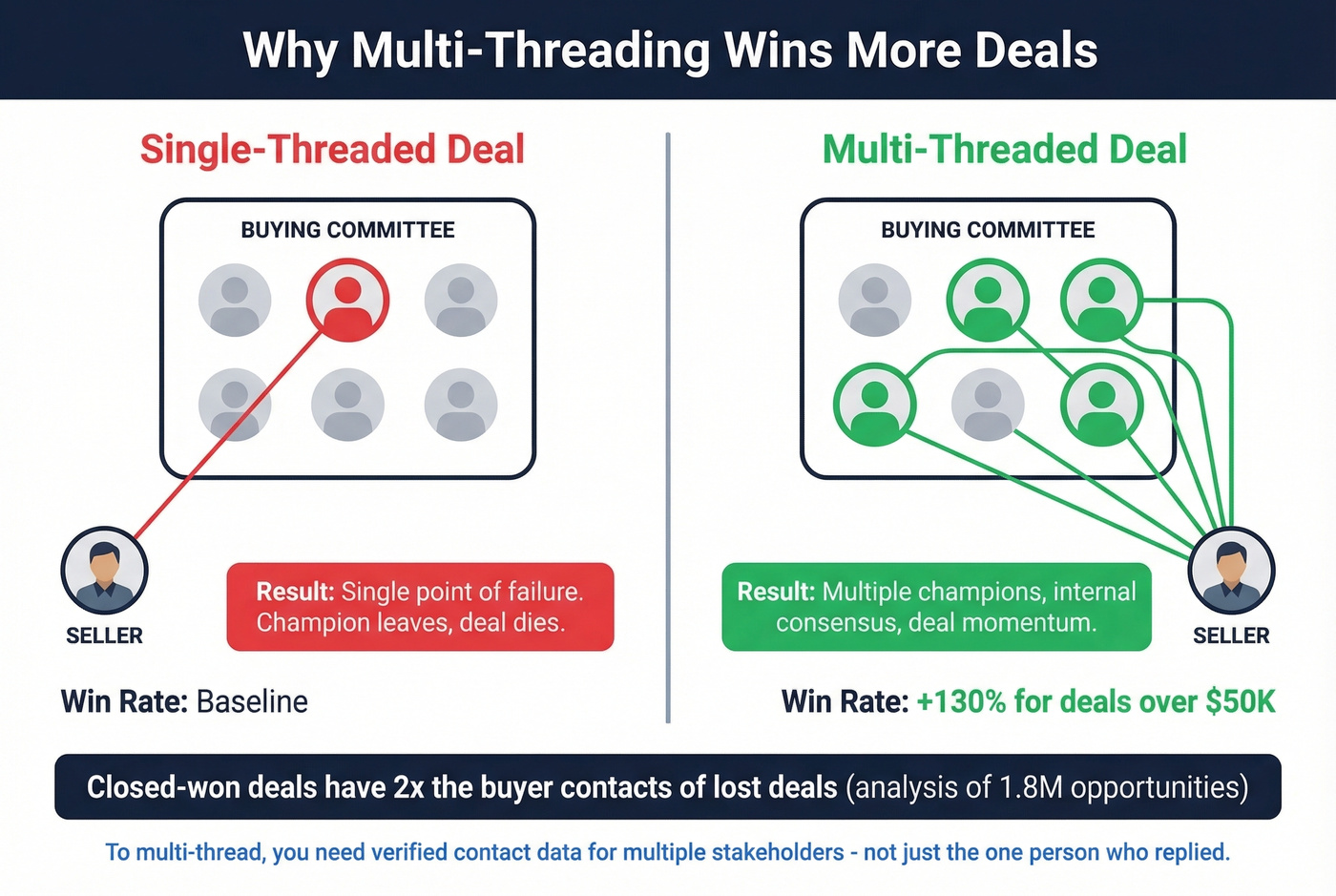
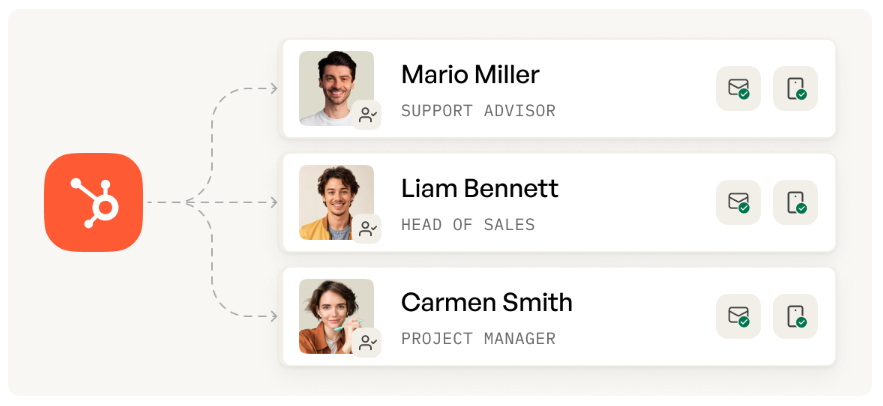
Here's the thing: to multi-thread effectively, you need verified contact data for multiple stakeholders - not just the one person who replied to your cold email. That means a data platform with broad coverage and high accuracy across the entire buying committee, not just the VP who showed up on a webinar list.
Social Selling
Social media delivers 42% response rates, nearly double what email gets. But social selling isn't "posting on LinkedIn and hoping." It's engaging with prospects' content, sharing relevant insights, and building familiarity before the first outreach. Two out of three buyers prefer engaging reps only in later stages - up 17 percentage points year over year. Social selling bridges the gap by building trust before a formal sales conversation starts.
Data-Driven Prospecting
73% of buyers avoid suppliers who send irrelevant outreach. Bad data doesn't just mean bounced emails - it means destroyed domain reputation, which makes every subsequent email less likely to land. (If you're cleaning lists, compare data enrichment services before you buy.)
We've seen teams burn through three email domains in six months because they were sending to unverified lists from a data provider that refreshes quarterly. When Snyk switched to a provider with a 7-day refresh cycle and 98% email accuracy, their bounce rate dropped from 35-40% to under 5%, and AE-sourced pipeline jumped 180%. Data freshness isn't a feature - it's the difference between a working outbound motion and an expensive one.
Account-Based Selling & Alignment
If 95% of winners are on the Day One shortlist, the question isn't "how do I sell better?" It's "how do I get on the shortlist?" That's a brand and content problem as much as a sales problem. 40% of teams expanded self-serve tools like pricing pages and customer stories last year. (If you're building this motion, start with account-based selling best practices.)
This is where sales-marketing alignment becomes non-negotiable. When marketing drives the content and brand awareness that gets you on the Day One shortlist, and sales executes the multi-threaded outbound that converts shortlist presence into pipeline, the two functions are running the same play. Teams where sales and marketing operate as separate kingdoms - different ICPs, different messaging, different definitions of "qualified" - are structurally disadvantaged. The data is clear: influence is increasingly indirect, and the traditional handoff model doesn't work when 83% of buyers have already defined their requirements before talking to a rep.
AI in B2B Sales - What's Real
Let's separate signal from noise.
Bain found that sellers spend roughly 25% of their time actually selling. Early AI implementations show 30%+ improvement in win rates - but only when companies redesign end-to-end processes, not just automate existing workflows. Slapping an AI layer on a broken process gives you a faster broken process.
The top AI use cases in sales right now: AI SDRs (44% adoption), outreach personalization (43%), and account/contact research (42%). 92% of organizations are increasing AI spend. 88% of power users are willing to pay a premium for AI capabilities. (If you're evaluating tools, start with generative AI sales tools.)
The blockers are predictable: fragmented seller workflows, unclear objectives, poor data quality, and change management. That last one is underrated - over the past decade, change initiatives at organizations increased 67%, while employee willingness to support those initiatives dropped from 74% to 44%. Your reps might not want the AI tools you're buying them.
If your average deal size is under $10K, you probably don't need an AI SDR platform charging $2K/month. You need clean data, a good sequence, and a rep who actually listens on discovery calls. AI won't replace sellers. Bad sellers who ignore AI will be replaced by good sellers who use it. The competitive advantage isn't having AI - it's having clean data to feed it and redesigned processes to act on it.
The B2B Sales Tech Stack
CRM
Your CRM is the system of record. Salesforce typically runs $25-$300/user/month depending on edition. HubSpot has a free tier and paid plans that scale into the hundreds per month as you add seats and enterprise features. Pipedrive is a lightweight option at roughly $14-$99/user/month. Pick based on your team size and integration needs - switching CRMs later is painful. (If you're comparing options, see examples of a CRM.)
Data & Prospecting
Your outbound is only as good as your data. This is the category where most teams either overspend or underinvest - rarely getting it right. (If you're shopping, start with sales prospecting databases.)
Prospeo covers 300M+ professional profiles with 98% email accuracy and 125M+ verified mobile numbers that deliver a 30% pickup rate. The 7-day data refresh cycle matters more than most teams realize - the industry average is 6 weeks, which means competitors are serving you stale data by default. With 30+ search filters including buyer intent (15,000 topics via Bombora), technographics, job changes, and headcount growth, you can build hyper-targeted lists without stitching together three different tools. Real results: Meritt tripled their pipeline from $100K to $300K per week after switching, and Snyk's 50 AEs went from 35-40% bounce rates to under 5% with AE-sourced pipeline up 180%.

Most data providers lock you into $15K+ annual contracts. ZoomInfo runs $15-40K/year depending on seats and modules. Apollo offers a free tier with paid plans from ~$49-99/mo per user. Cognism typically runs $1K-3K/mo for small teams. Prospeo starts free - 75 emails + 100 Chrome extension credits/month - and scales at roughly $0.01 per verified email with no contracts.
Skip the big-ticket platforms if you're a team under 10 reps. You don't need a $30K annual contract to prospect effectively.
Reaching 6-17 decision-makers per deal requires verified direct dials, not switchboard numbers. Prospeo gives you 125M+ verified mobiles with a 30% pickup rate and 300M+ profiles filtered by buyer intent, tech stack, and headcount growth - so you land on the Day One shortlist.
Reach every stakeholder in the buying committee before your competitors do.
Sales Engagement
Outreach and Salesloft typically run $100-200/user/month for sequencing and cadence management. For teams with tighter budgets, Instantly, Lemlist, and Smartlead ($30-97/user/mo) handle cold email at scale with better deliverability tooling. The engagement platform matters less than the data feeding it - a perfect sequence sent to bad emails is just expensive noise. (If you're tightening follow-ups, use these sales follow-up templates.)
Conversation Intelligence & Intent
Gong and Chorus land around $100-200/user/month for call recording, transcription, and coaching workflows. They're expensive but genuinely useful for coaching and deal inspection. For intent data, Bombora, 6sense, and Demandbase ($20K-100K+/year) help you identify accounts actively researching your category. These are enterprise investments - don't buy intent data until you've nailed your ICP and outbound fundamentals.
Mistakes That Kill Deals
The probability of selling to an existing customer is 60-70% versus 5-20% for a new prospect. Yet most teams pour the majority of their resources into new logos. That's mistake number one.
- Ignoring existing customers. Expansion and renewal revenue is cheaper to win and faster to close. Proven ROI and high-quality support are the top renewal drivers at 33% each. If your CS team and sales team don't talk, you're leaving money on the table.
- Talking too much, not listening. Discovery calls where the rep talks 70% of the time aren't discovery calls - they're pitches.
- Failing to qualify. BANT and MEDDIC exist for a reason. Reps who skip qualification fill the pipeline with deals that were never going to close, then wonder why their win rate is 12%.
- Single-threading. We've beaten this drum already. 2x contacts in won deals, 130% win-rate boost for deals over $50K. Map the buying committee early.
- Using bad contact data. Bounced emails destroy your domain reputation. Every bad email makes the next good email less likely to land. Audit your bounce rate monthly - if it's above 5%, your data provider is the problem. (If you're fixing inboxing, start with an email deliverability guide.)
- Relying on one channel. Cold email alone won't cut it. Cold calling alone won't cut it. The best teams use 3-4 channels in coordinated sequences.
- Rushing prospects. Buyers have their own timeline. Pushing for a close before they've built internal consensus doesn't accelerate the deal - it kills it.
B2B Sales Compensation in 2026
"What's the catch?" is one of the top-performing threads on r/sales - and one of the first things people look for when researching what careers in this space actually pay. Here's the honest answer.
| Role | Median Base | Median OTE | Top Performer OTE | % Hitting Quota |
|---|---|---|---|---|
| SDR/BDR | $60K | $85K | $128K | 57.3% |
| SMB AE | $70K | $130K | $269K | 44.8% |
| Mid-Market AE | $90K | $175K | $391K | 43.9% |
| Enterprise AE | $135K | $265K | $628K | 40.9% |
| Sales Manager | $150K | $280K | $508K | 51.3% |
Data from RepVue's 2026 salary guide, based on thousands of self-reported comp packages.
The ceiling is extraordinary. Enterprise AE top performers clear $628K. Sales managers can hit $508K. But look at the quota attainment column: fewer than half of reps at any level hit their number. At the enterprise level, it's 40.9%. (If you want the math behind comp packages, see OTE in sales.)
The catch isn't the work - it's choosing the wrong company. Directional ranges from Sybill's analysis support these numbers: SDR OTE runs $70K-$100K (up to $120K in hot SaaS hubs), mid-market AE OTE lands at $140K-$200K, and enterprise AE OTE stretches $220K-$320K.
Check RepVue before accepting any offer. A company where 55%+ of reps hit quota is a fundamentally different experience from one where 30% do. The role matters less than the company, the territory, and the product-market fit.
FAQ
What does B2B mean in sales?
B2B stands for business-to-business - any sale where both buyer and seller are companies rather than individual consumers. In practice, it means longer cycles, larger deal sizes, 6-17 decision-makers, and a buying process driven by ROI rather than impulse.
Is B2B sales a good career in 2026?
Yes - enterprise AEs earn $265K+ OTE at the median, and top performers clear $600K+. But only 28-43% of reps hit quota, so company selection matters more than role selection. Check quota attainment data on RepVue before accepting any offer.
How long is a typical B2B sales cycle?
One to three months for SMB deals, six to twelve-plus months for enterprise deals over $100K. The average across all segments dropped from 11.3 to 10.1 months between 2024 and 2025 as economic pressure pushed buyers to engage earlier.
What's the difference between B2B and B2C sales?
B2B involves multiple decision-makers (6-17 people), longer cycles, higher deal values, and relationship-driven buying. B2C is typically single-buyer, shorter cycle, lower value, and more emotion-driven. In a business-to-business sale, the buyer must justify the purchase to stakeholders - which fundamentally changes how you sell.
What tools do B2B sales teams actually need?
At minimum: a CRM (HubSpot or Salesforce), a data platform with verified contacts and 98%+ email accuracy, and a sales engagement tool for sequencing outreach. Add conversation intelligence and intent data as you scale past 10 reps.
That seller from the opening - 500 cold emails, empty pipeline? Their problem wasn't effort. It was data, timing, and methodology. Fix those three in your own B2B sales motion, and the pipeline fills itself.