

The B2B Sales Cycle: Benchmarks, Stages, and How to Shorten It in 2026
Most content about the B2B sales cycle starts with "Step 1: Prospecting" and ends with a vague suggestion to "align with the buyer's journey." None of it answers what you actually came for: how long should your deals take, and what's dragging them out? The average cycle length is a meaningless number without context - deal size, industry, and buying committee complexity change everything.
This piece gives you the benchmarks that matter, broken down by ACV tier and industry, plus the specific tactics we've seen compress timelines by 20-30% across dozens of sales orgs.
Quick Reference
- Benchmarks: A $5K ACV deal closes in ~30 days. A $100K deal takes 90-180 days. Enterprise ($500K+) runs 6-18 months. Jump to benchmarks.
- The formula that matters: Sales Velocity = (Opportunities x Win Rate x Avg Deal Size) / Sales Cycle Length. Jump to measurement.
- Three highest-leverage tactics: Clean prospect data from Day 1, multi-thread every deal, and engage procurement before they engage you. Jump to acceleration.
What Is a B2B Sales Cycle?
The sales cycle is the time one deal takes from first meaningful contact to signed contract - a stopwatch on a single opportunity. Don't confuse it with the sales process, which is the repeatable methodology your team follows across all deals: stages, playbooks, qualification criteria.
B2B deals involve more stakeholders, higher price points, longer evaluation periods, and usually a procurement team that wasn't part of the conversation five years ago. A consumer buys shoes in minutes. A VP of Engineering buys a security platform in months.
How Long Is a B2B Sales Cycle?
"Average" is doing a lot of heavy lifting here. A SaaS startup selling $3K subscriptions and an industrial manufacturer selling $2M production lines don't share a meaningful average. You need benchmarks segmented by what actually drives cycle length.
Benchmarks by Industry
| Industry | Avg. Cycle (Days) |
|---|---|
| Retail | ~70 |
| Software/Tech | 90-110 |
| Healthcare | ~125 |
| Manufacturing | ~130 |
| Pharmaceuticals | ~153 |
A useful median breakdown is 84 days from lead to opportunity and 18 days from opportunity to close - 102 days total. But those medians mask enormous variance.
Benchmarks by Deal Size (ACV)
| ACV Tier | Expected Cycle |
|---|---|
| < $2K | ~14 days |
| < $5K | ~30 days |
| < $25K | ~90 days |
| < $100K | 90-180 days |
| $100K-$500K | 3-9 months |
| $500K+ | 6-18+ months |
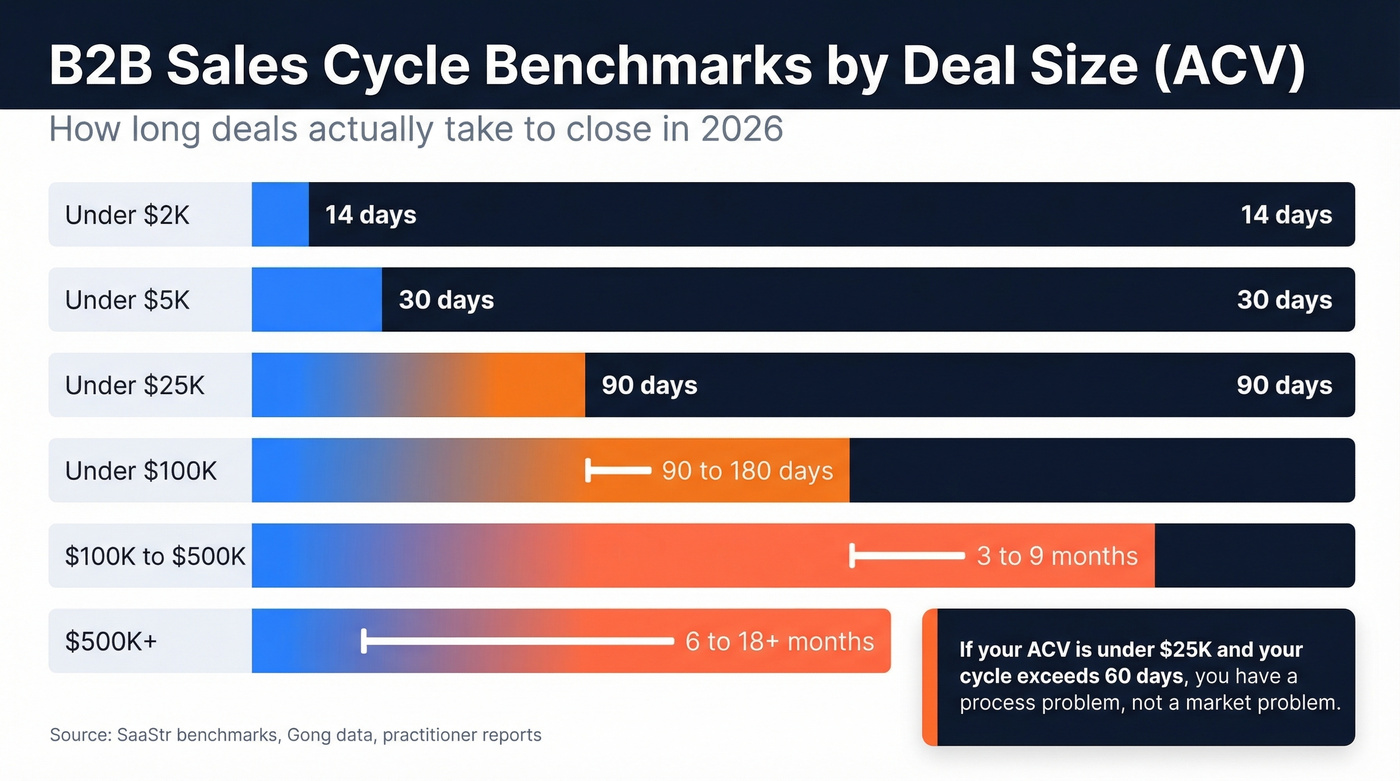
These tiers come from SaaStr's benchmarks, and they hold up well against what we see in practice. Gong's data shows a $97K average deal closing in 69 days - faster than the $100K tier suggests, likely because their customer base includes many mature SaaS teams with optimized processes.
Real practitioners confirm the spread. On r/b2bmarketing, an advertising agency owner reported ~4 months from qualified lead to first invoice. A capital equipment seller in FMCG and pharma reported 9-12 months due to sign-offs and bespoke project planning. Both are legitimate. Neither is useful as an average.
6sense data shows the average cycle dropped from 11.3 months in 2024 to 10.1 months in 2025. Buyers are also pulling first contact forward - from 69% to 61% through the buying journey, roughly 6 weeks sooner. That's encouraging, but it doesn't mean your cycle is getting shorter, especially if your buying committees are growing.
Here's the thing: if your ACV sits below $25K and your cycle exceeds 60 days, you don't have a market problem. You have a process problem. Fix qualification and data quality before blaming the buyer.
One critical caveat: teams define "cycle start" differently. First touch? Qualified lead? Opportunity creation? If your team hasn't agreed on a consistent start point, your cycle metrics are noise.
The 7 Stages of a B2B Sales Cycle
Every B2B deal moves through roughly the same stages, even if your CRM labels them differently. Modern buying journeys aren't linear - buyers re-enter earlier stages after new stakeholders join or requirements shift - but the stages themselves stay consistent.
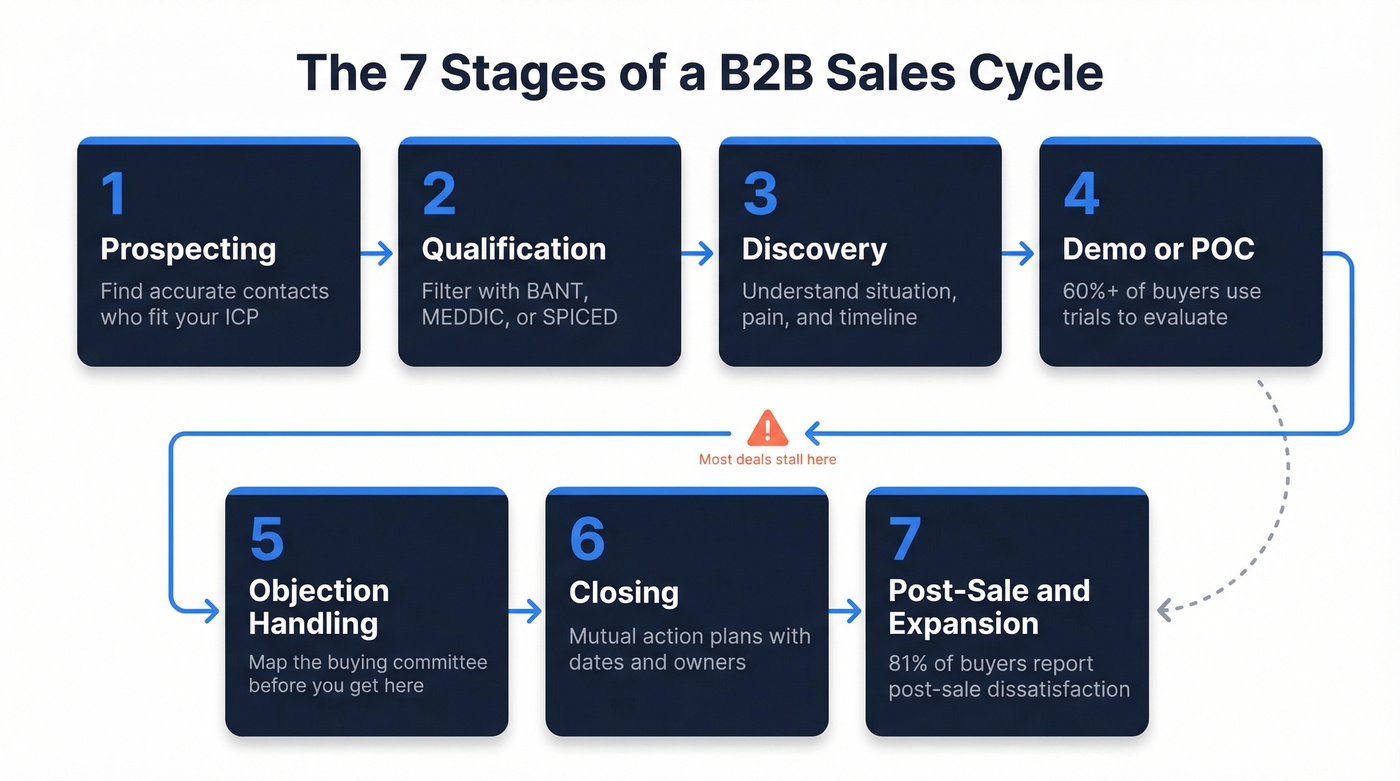
1. Prospecting. Identify potential buyers who fit your ICP. The biggest time sink isn't finding names; it's finding accurate contact data. Bad emails and dead phone numbers add weeks of dead time before a single conversation happens. Use a verified B2B data platform to build prospect lists so your first touchpoint reaches a real person, not a dead inbox. (If you need a starting point, see these sales prospecting techniques.)
2. Qualification. Not every prospect deserves a discovery call. Apply a framework - BANT, MEDDIC, or SPICED - to filter out deals that'll waste your pipeline. Qualify on decision process, not just budget. A prospect with budget but no internal champion is a dead deal walking.
3. Discovery. Your first real conversation. The goal isn't to pitch - it's to understand the prospect's situation, pain, and timeline. Buyers define purchase requirements 83% of the time before speaking with sales, so you're catching up, not leading. Ask about their evaluation process and who else is involved. (Use a tighter set of discovery questions to surface timelines early.)
4. Demo / POC. Show the product early. Over 60% of business buyers use a trial or POC to evaluate solutions - for $10M+ purchases, that number hits 78%. If you're gatekeeping demos behind three discovery calls, you're adding weeks to your cycle for no good reason. A simple product demo checklist helps keep this stage from ballooning.
5. Objection Handling. The most common stall here is "I need to check with [stakeholder you haven't met]." That's a multi-threading failure from Stage 3, not an objection problem. Map the buying committee before you get here.
6. Closing. Negotiation, legal review, procurement sign-off. This stage has gotten slower as procurement teams embed themselves earlier in the process. Build mutual action plans with specific dates, owners, and deliverables - don't leave the close timeline to the buyer's imagination. If negotiation drags, revisit your anchor in negotiation before discounting.
7. Post-Sale / Expansion. The cycle doesn't end at signature. 81% of buyers report dissatisfaction with their chosen provider, which means your post-sale experience directly affects renewal and expansion cycles. Hand off with a shared document that captures every commitment made during sales.

Bad emails and dead phone numbers are the silent killers of your sales cycle. Every bounce adds days of dead time before a single conversation happens. Prospeo gives your reps 98% accurate emails and 125M+ verified mobiles - refreshed every 7 days, not every 6 weeks.
Stop losing weeks to stale data. Start closing deals faster.
Why Deals Stall (and What It Costs)
Picture your Q3 pipeline review. Half the deals in stages 4-6 haven't moved in three weeks. The reps say "the prospect went dark" or "they're waiting on internal approval." What actually happened? Procurement wasn't engaged, the champion lost internal momentum, and the account map was built on stale data.
The numbers are brutal. 86% of B2B purchases stall during the buying process. In 2024, 34% of deals slipped past their expected close date, and 75% of sales reps missed quota. When a deal runs 30 days past your typical cycle length, close rates drop by 60%.
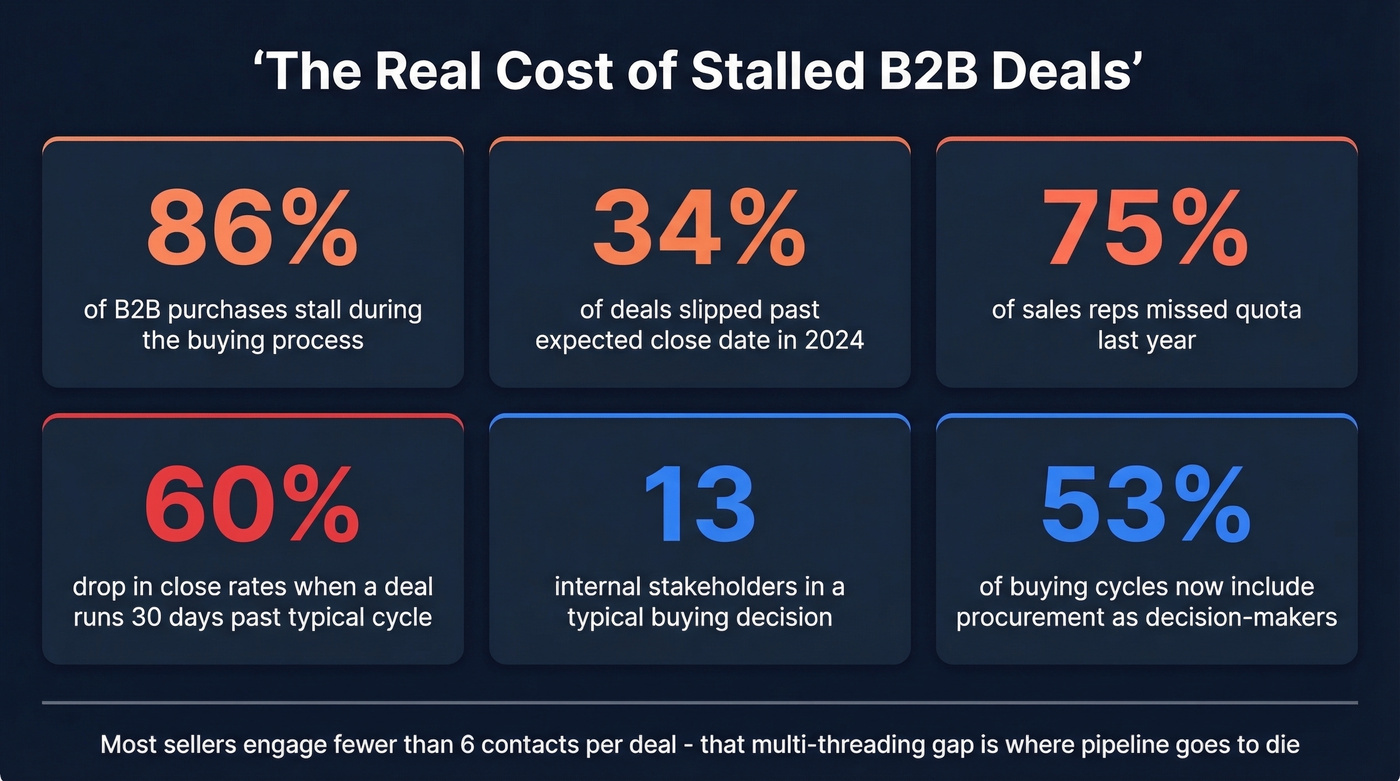
The root cause is complexity. A typical buying decision now involves 13 internal stakeholders and 9 external influencers. Procurement are decision-makers in 53% of buying cycles and engage from the start. Most sellers still engage fewer than six contacts per deal. That multi-threading gap kills pipeline.
And the cost isn't just lost deals - it's opportunity cost. Every week a deal sits in stage 5 is a week your rep isn't working a new opportunity. Sales cycles stretched 20% longer year-over-year in 2024, and that trend compounds into lower quota attainment, worse forecasting accuracy, and higher CAC. (If your numbers feel off, audit your pipeline health before changing comp plans.)
Choosing a Qualification Framework
The right framework depends on your deal complexity, not personal preference.
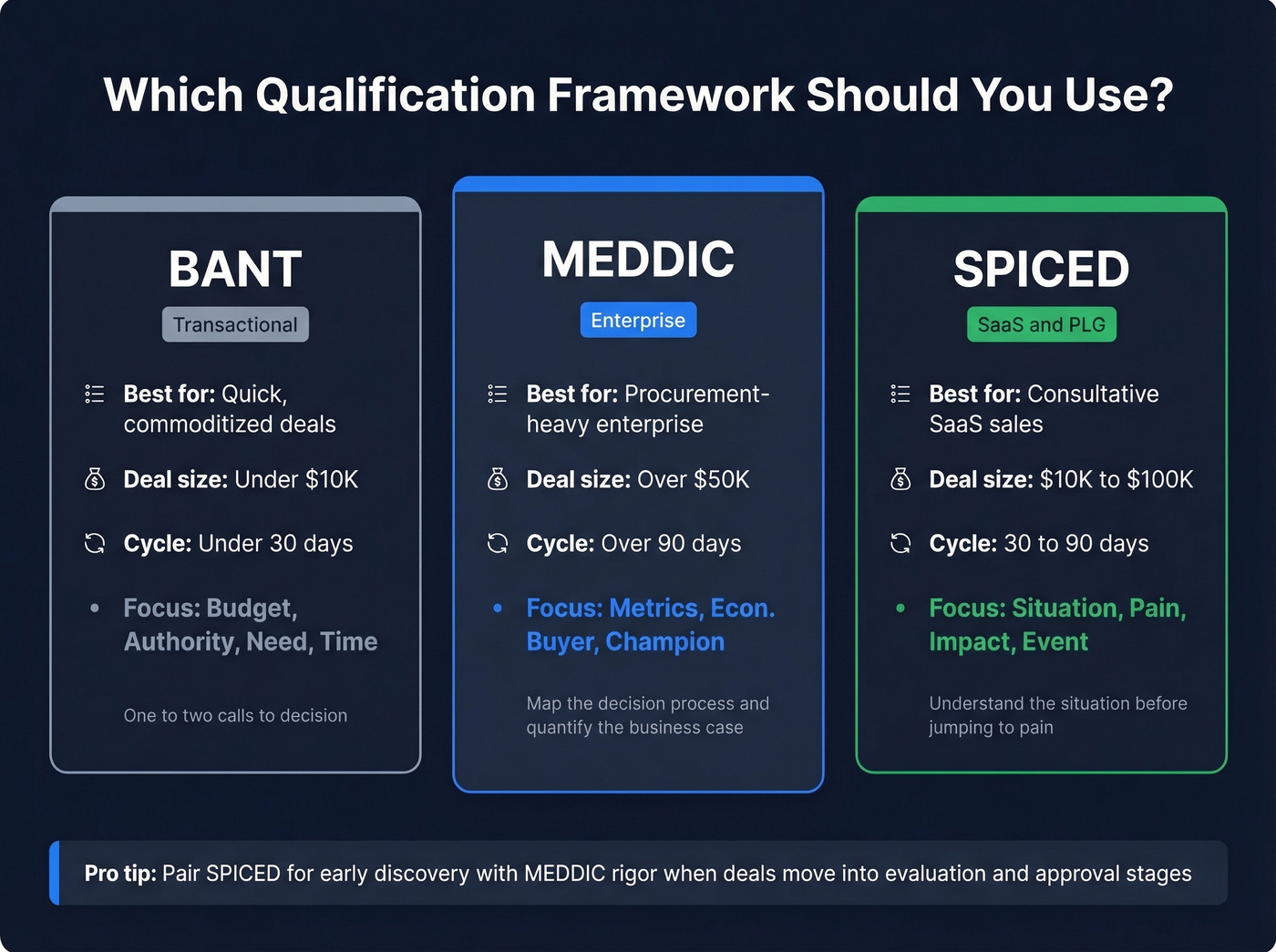
| Framework | Best For | Deal Size | Cycle | Focus |
|---|---|---|---|---|
| BANT | Transactional | < $10K | < 30 days | Budget, Authority, Need, Time |
| MEDDIC | Enterprise | > $50K | > 90 days | Metrics, Econ. buyer, Champion |
| SPICED | SaaS / PLG | $10K-$100K | 30-90 days | Situation, Pain, Impact, Event |
BANT works when deals are commoditized and price-sensitive - sub-five-figure transactions where one or two calls should get you to a decision. MEDDIC is built for procurement-heavy enterprise deals where you need to map the decision process, identify a champion, and quantify the business case with hard metrics.
SPICED sits in the middle and works well for consultative SaaS sales. It forces reps to understand the prospect's situation before jumping to pain, which prevents the "solution looking for a problem" trap.
The smartest teams we've worked with pair frameworks: SPICED for early discovery, then MEDDIC's rigor when the deal moves into evaluation and approval stages. Your CRM should have fields that map to whichever framework you choose - sales enablement teams that enforce this see measurably shorter cycles because unqualified deals stop clogging the pipeline.
How to Measure Your Sales Cycle
Sum the total days from opportunity creation to close for all won deals, divide by the number of deals. Simple formula, tricky execution.
The measurement ambiguity problem - when does the cycle actually start? - trips up more teams than any formula. Pick one definition and enforce it across the org. Most RevOps teams use opportunity creation date as the start, since it's the cleanest CRM timestamp.
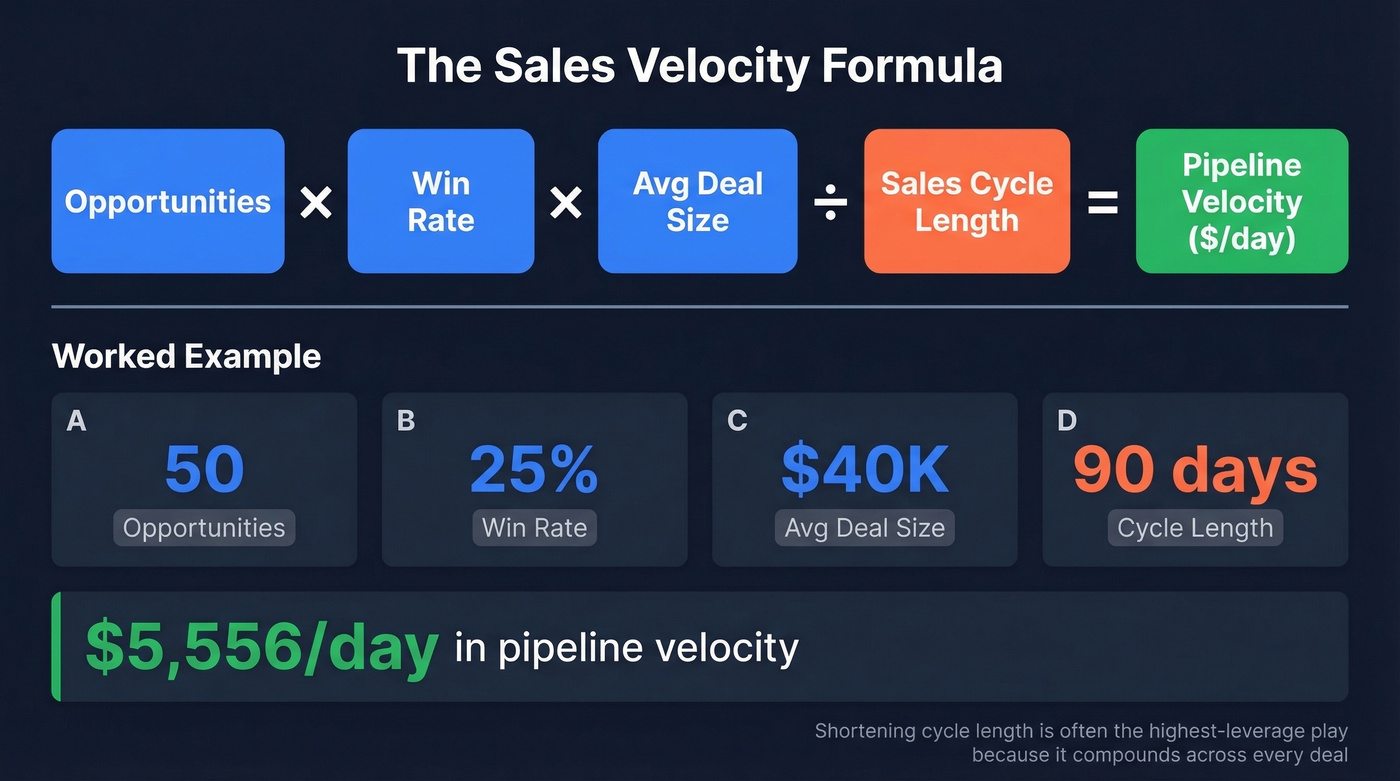
The metric that actually matters for cycle optimization is sales velocity:
Sales Velocity = (Opportunities x Win Rate x Avg Deal Size) / Sales Cycle Length
A worked example: 50 opportunities x 25% win rate x $40K average deal / 90-day cycle = $5,556/day in pipeline velocity. Improving any of those four levers moves the number, but shortening cycle length is often the highest-leverage play because it compounds across every deal.
Track these KPIs alongside cycle length for the full picture: win rate for B2B teams typically runs 20-30%, with top performers hitting 30%+. Close rate across most B2B funnels lands at 15-25%. Keep deal slippage under 20%, and target 3-4x quota coverage in your pipeline. (For more context, compare against sales pipeline benchmarks.)
How to Shorten Your B2B Sales Cycle
Seven tactics, ordered by impact. Each one targets a specific stage where deals lose momentum.
1. Start with clean prospect data. When 40% of emails bounce, your cycle doesn't start at prospecting - it starts at list-rebuilding. Prospeo fixes this with 300M+ professional profiles, 98% email accuracy, and 125M+ verified mobile numbers on a 7-day refresh cycle. Snyk's 50-person AE team saw bounce rates drop from 35-40% to under 5%, and AE-sourced pipeline jumped 180%. (If bounces are a recurring issue, start with email bounce rate benchmarks and fixes.)

2. Multi-thread from Day 1. Engage 6+ contacts per account, including procurement. Most sellers still work fewer than six contacts per deal, and that gap is where pipeline goes to die. If your champion leaves or goes dark, you need other threads alive. This is easiest to operationalize with account-based selling habits.
3. Enforce a qualification framework. Pick BANT, MEDDIC, or SPICED based on your deal complexity and enforce it in your CRM. Unqualified deals clog your pipeline and inflate cycle metrics. Skip this if you're selling a self-serve product under $2K - at that price point, the framework overhead costs more than the deal.
4-5. Mutual action plans + early product access. These two work together. A shared document with milestones, owners, and dates creates accountability on both sides and surfaces procurement timelines early. Pair it with early trials or POCs - over 60% of buyers expect them, and gating product access behind weeks of discovery calls adds friction that competitors aren't adding. Show the product in the first or second meeting, then use the mutual action plan to drive next steps.
6. Use signal-based outreach. Reaching prospects who are actively researching your category changes the math entirely. Signal-personalized outreach drives 15-25% reply rates versus 3-5% for generic cold email. Intent data, job changes, and funding signals all shorten deal timelines by connecting reps with buyers who already have urgency. (If you want a system for this, see identifying buying signals.)
7. Engage procurement from the start. Treating procurement as a late-stage formality is the single most common reason enterprise deals slip by 30+ days. They're decision-makers in 53% of buying cycles. Bring them in early, give them the security docs and pricing structure they need, and watch the close stage compress.
Deals stall when reps can't reach the full buying committee. With 300M+ profiles, 30+ filters including department headcount and job changes, and 83% enrichment match rates, Prospeo lets you multi-thread every deal from Day 1 - at $0.01 per email.
Map the entire buying committee before your deal goes dark.
How AI Is Changing Deal Timelines
81% of sales teams are experimenting with or have implemented AI, and 92% plan to increase AI investment in 2026. The headline stat: AI-enabled teams report cycles that are 25% shorter on average.
The most measurable impact comes from signal-based selling. Teams using signal-qualified leads see 47% better conversion rates and 43% larger deal sizes. That's not AI replacing reps - it's AI telling reps which accounts to call and when. On the buyer side, 94% of buyers use LLMs during their buying process, which means your prospects are better-informed and more opinionated before they ever talk to a rep.
Despite the hype around agentic AI, only 24% of B2B suppliers have actually deployed it in sales workflows per Deloitte Digital's February 2026 report. Most teams are still experimenting. There's also a quality gap worth knowing: AI SDRs convert meetings to opportunities at about 15%, compared to 25% for human SDRs. The volume is higher, but the conversion delta is real.
Let's be honest: AI won't fix a broken sales process. It makes a good process faster. If your qualification is weak, your data is stale, and your reps aren't multi-threading, AI just accelerates the dysfunction.
FAQ
What is the average B2B sales cycle length?
Most B2B companies close deals in 3-6 months, but this varies dramatically by deal size. A $5K SaaS deal closes in ~30 days; a $500K enterprise contract takes 6-18 months. Benchmark against your ACV tier, not a generic industry average.
How is sales cycle length calculated?
Add up the total days from opportunity creation to close for all won deals, then divide by the number of deals. The key is agreeing on a consistent start point - opportunity creation date is the most common and cleanest CRM timestamp.
Why is my sales cycle getting longer?
Growing buying committees (13 internal + 9 external stakeholders on average), earlier procurement involvement, and mandatory trials or POCs are the top drivers. Stale prospect data also adds weeks of dead time at the top of the funnel - a platform with a weekly data refresh cycle eliminates that lag.
What's the fastest way to shorten a B2B sales cycle?
Focus on three areas: clean prospect data that eliminates dead time at the top of the funnel, multi-threading across 6+ contacts per account to prevent single-point-of-failure stalls, and engaging procurement early. Teams that address all three consistently compress timelines by 20-30%.
What's the difference between a sales cycle and a sales process?
The sales cycle measures the time one deal takes from first contact to close - it's a metric. The sales process is the repeatable methodology your team follows across all deals, including stages, playbooks, and qualification criteria. One is a stopwatch; the other is a blueprint.