

B2B Sales Leads: A Data-First Playbook for 2026
You built a 10,000-contact list from a database you trusted, loaded it into your sequencer, and hit send. Three days later, your bounce rate is 23%, your domain reputation is tanking, and deliverability across all campaigns is cratering. That's the reality of generating B2B sales leads with bad data - and it's happening to more teams in 2026 than ever before.
Bulk-sender filtering has tightened hard. Authentication and list hygiene aren't optional anymore - they're the foundation. SPF and DKIM are the minimum, DMARC is now standard for serious outbound, and B2B contact data decays at roughly 3% per month. That means about 30% of your database goes stale every year. The old playbook of blasting 10,000 cold emails from a purchased list doesn't just underperform now. It actively destroys your infrastructure.
What You Actually Need
You don't need 32 tactics. You need five that work, executed with verified data.
Clean data. If your emails bounce above 5%, nothing else matters. Your domain gets flagged, open rates collapse, and every subsequent campaign suffers. (If you want the exact thresholds and fixes, see bounce rate.)
A tight channel mix. Pick 3-5 channels you can execute well. Outbound email, content-driven inbound, and intent-based ABM cover most B2B use cases. Spreading across 15 channels means doing none of them well.
Deliverability infrastructure. Authentication, domain warm-up, list verification, bounce monitoring. This is the plumbing that makes everything else work. Use a real email deliverability guide as your baseline.
The recommended starter stack: Prospeo for verified contact data, a sequencing tool like Instantly or Smartlead for outreach, HubSpot CRM (free tier) for pipeline management, and Zapier or Make to glue them together with automated lead routing. Total cost: around $0-$200/mo depending on volume. That's not a typo - you can run a real outbound operation for less than a nice dinner.
What Are B2B Sales Leads?
A B2B sales lead is a person at a company who fits your ideal customer profile and could buy your product. That's it. The complexity isn't in the definition - it's in the qualification layers that sit on top.
MQL (Marketing Qualified Lead): Someone who's engaged with your content or hit a scoring threshold - downloaded a whitepaper, attended a webinar, visited your pricing page three times. Marketing says they're worth talking to. (If you need a practical scoring model, use lead scoring.)
SQL (Sales Qualified Lead): A rep has had a conversation and confirmed budget, authority, need, and timeline. This is where pipeline actually starts.
SAL (Sales Accepted Lead): The handoff stage. Marketing passed the lead, sales accepted it into their workflow. The gap between MQL and SAL is where most lead gen programs leak revenue - and it's the gap nobody wants to talk about in pipeline reviews.
The B2B vs B2C distinction matters because it shapes every tactical decision:
| Dimension | B2B | B2C |
|---|---|---|
| Sales cycle | 3-18 months | Minutes to days |
| Decision makers | 6-10 stakeholders | 1-2 people |
| Content consumed | 13+ pieces | 1-3 pieces |
| Average deal size | $5K-$500K+ | $10-$500 |
| Relationship | Ongoing, consultative | Transactional |
When buyers involve six to ten stakeholders and consume 13+ pieces of content before talking to sales, your lead generation can't be a single touchpoint. It's a system.
The 2026 Buying Reality
Your prospects aren't waiting for you to find them. They're already shopping.
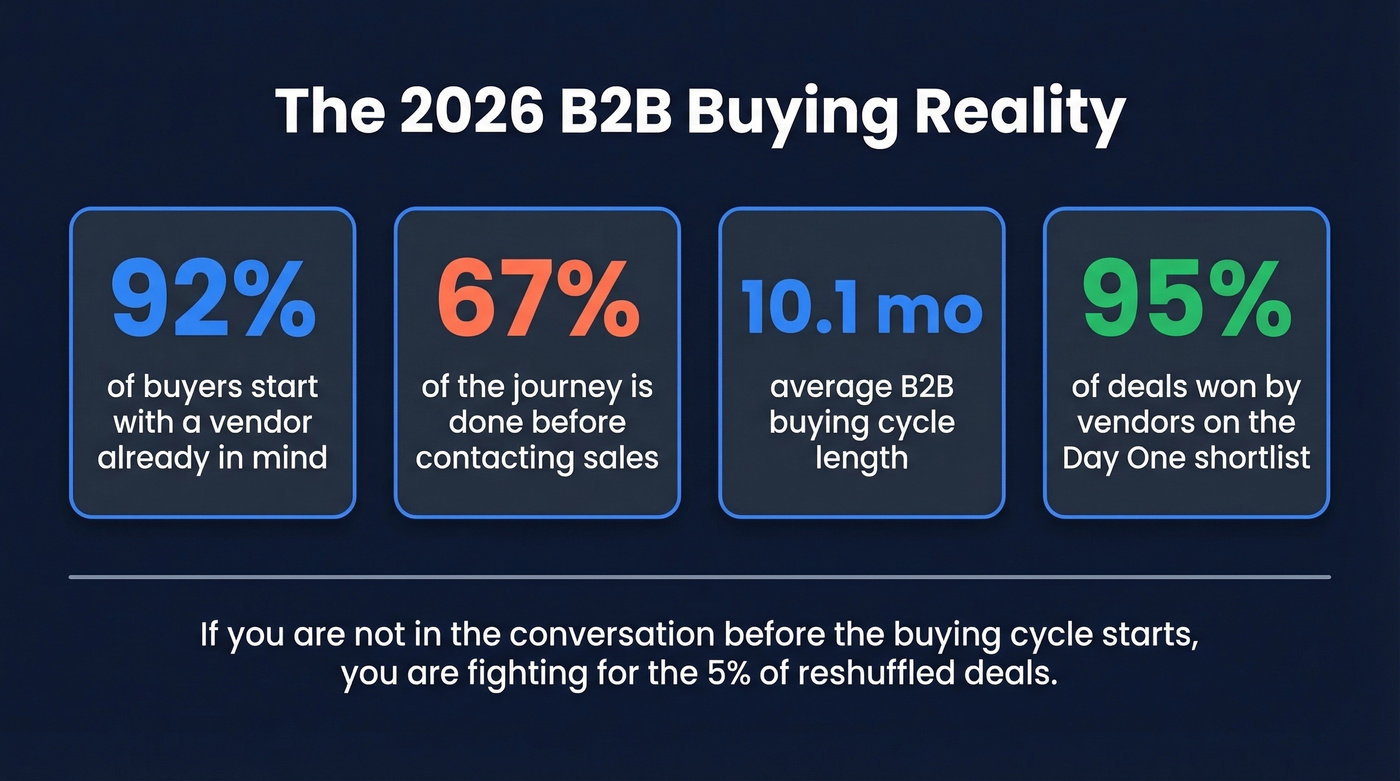
92% of B2B buyers start their evaluation with at least one vendor already in mind. 41% have a preferred vendor before formal evaluation even begins. The winning vendor appears on the Day One shortlist 95% of the time.
If you're not in the conversation before the buying cycle kicks off, you're fighting for the 5% of deals where the shortlist gets reshuffled. The average B2B buying cycle runs 10.1 months, and buyers complete roughly 67% of that journey before they ever contact sales. Let's be honest: by the time someone fills out your demo form, the decision is mostly made.
The implication is straightforward. Generating quality B2B sales leads in 2026 isn't just about capturing demand - it's about creating preference before the buying window opens. That requires showing up consistently in the channels your ICP actually uses, not just running ads when you need pipeline.
Here's the thing: if your average contract value is below $15k, you probably don't need a $40k/year data platform. A $150/month stack with verified data and disciplined execution will outperform an enterprise suite that's half-configured and over-licensed. The teams winning right now aren't the ones with the biggest budgets. They're the ones with the cleanest data.
How to Generate B2B Sales Leads
Define Your ICP
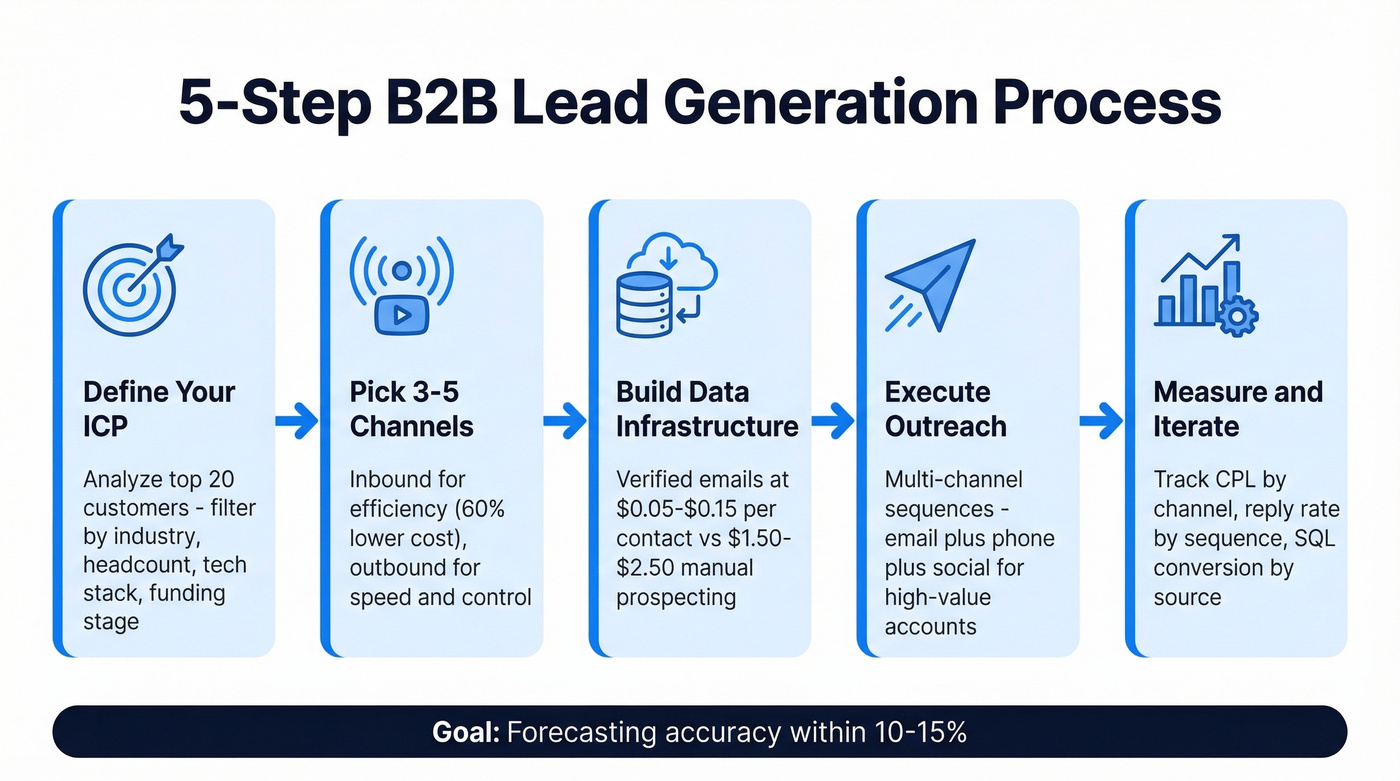
Start with your best 20 customers. What do they have in common? Industry, headcount range, tech stack, funding stage, growth rate. Your ICP isn't a persona document that lives in a Google Doc nobody reads. It's a set of filters you can actually apply in a database to pull a list. (If you need a plug-and-play framework, use an ideal customer profile template.)
Pick 3-5 Channels
Inbound leads cost roughly 60% less than outbound and close at 7-8x higher rates (14.6% vs 1.7%). But inbound takes 3-6 months to generate consistent volume. Outbound generates leads in days.
Most teams need both - inbound for efficiency, outbound for speed and control. For most B2B companies selling to mid-market, that's some combination of cold email, content/SEO, and targeted ABM. If you want a broader menu of options, start with free lead generation tools.
Build Your Data Infrastructure
This is where most teams cut corners and pay for it later. A $60k/year SDR costs about $29/hour before overhead. Manual prospecting - finding emails, verifying them, researching accounts - often takes 3-5 minutes per contact, which puts the labor cost around $1.50-$2.50 per contact before you factor in tools and management. A good database brings that down to $0.05-$0.15 per contact. The math isn't close. (For enrichment options, compare data enrichment services.)
Execute Outreach
Sequences, not one-offs. Personalization at the account level, not the "Hi {first_name}" level. Multi-channel (email + phone + social) for high-value accounts. Single-channel email for volume plays. If you need a proven structure, build a B2B cold email sequence.
Measure and Iterate
Track CPL by channel, reply rate by sequence, and SQL conversion rate by source. If you can't attribute a lead to a channel and a cost, you can't optimize. A systematic lead generation process creates forecasting accuracy within 10-15%. That's the goal. (To tighten the model, track lead generation metrics.)

The article says it: if your bounce rate tops 5%, nothing else matters. Prospeo's 5-step email verification delivers 98% accuracy with a 7-day data refresh cycle - so the B2B sales leads you pull today are still valid next week. At $0.01 per email, your entire outbound data infrastructure costs less than one hour of SDR prospecting time.
Stop destroying your domain reputation with stale data.
Tactics That Work in 2026
Cold Email, Calling, and Social Selling
Cold email isn't dead - it's just harder to do badly. Average B2B cold email open rates sit at 27.7%, with a 5.1% response rate. A 2-email sequence with one follow-up drives the highest response rate at 6.9%. We've tested this extensively - the 2-email sequence outperforms longer drips every time. More emails don't help. They just annoy. (For more plays beyond email, use these sales prospecting techniques.)
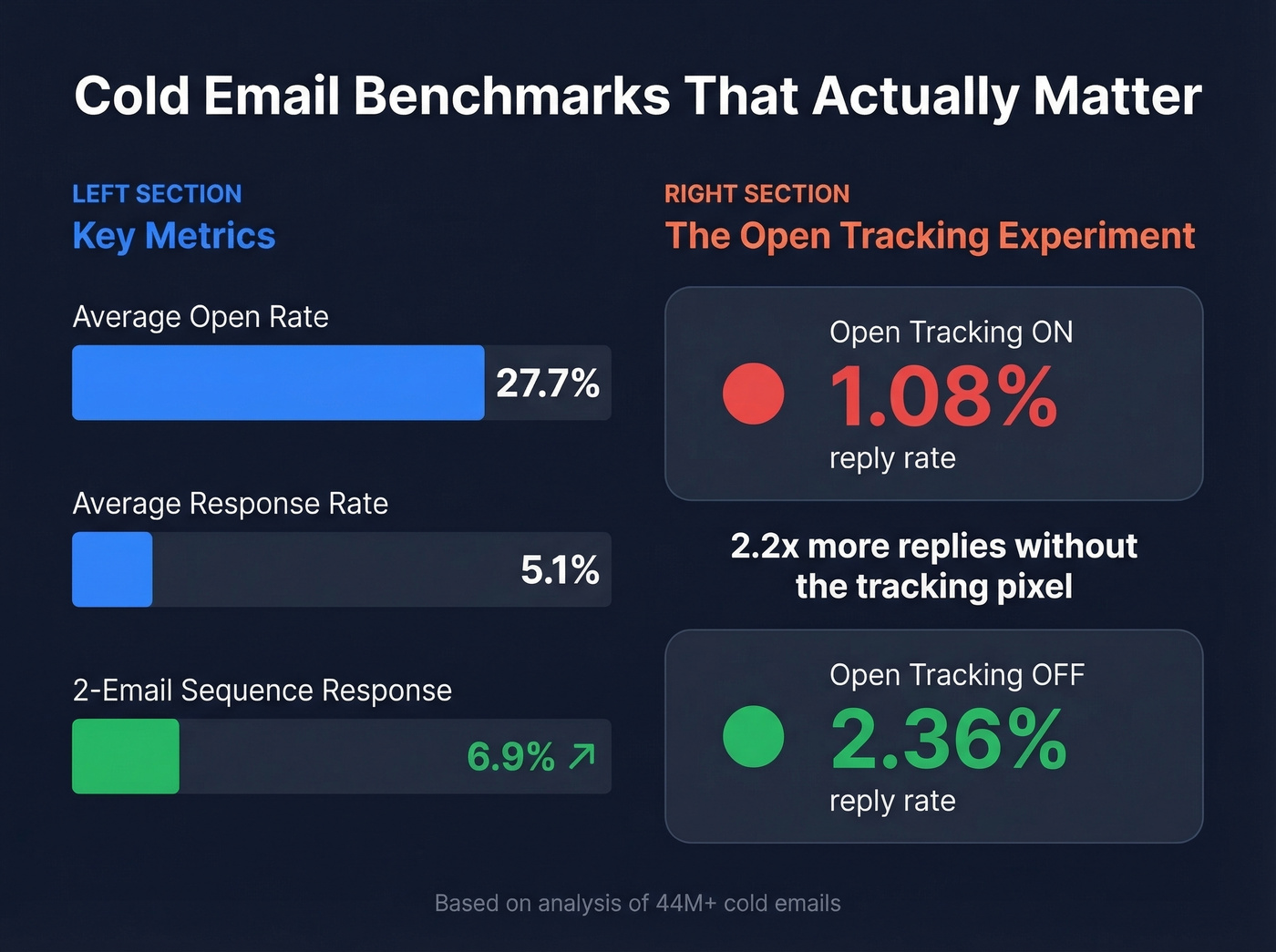
One counterintuitive finding from an analysis of 44M+ emails: turning open tracking off more than doubled reply rates (2.36% vs 1.08%). If you're optimizing for replies, not vanity metrics, kill the pixel. (If you want the technical why, see email tracking pixels.)
Cold calling still works for high-ACV deals. Social selling on professional networks works for warming accounts before the cold touch. The best outbound teams run all three in coordinated sequences - and the consensus on r/sales is that the phone call after the second email is the highest-converting touchpoint in the whole sequence.
Inbound: SEO, Content, Webinars
Inbound is a long game with compounding returns. Website conversion rates vary wildly by industry - SaaS converts at 1.1%, IT at 1.5%, manufacturing at 2.2%, and legal services at 7.4%. Know your industry benchmark before you panic about conversion rates.
The play: create content that answers the questions your buyers ask during that 67% of the journey they complete before talking to sales. Bottom-of-funnel comparison content converts better than top-of-funnel thought leadership, but you need both to fill the pipeline. Inbound content is one of the most sustainable ways to generate B2B sales leads over time, even if the ramp-up period tests your patience. (If you want a dedicated system, see SEO sales leads.)
ABM and Intent-Based Prospecting
Account-based marketing works when you can identify which accounts are actively researching your category. Intent data - tracking which companies are consuming content around specific topics - turns ABM from "spray and pray at a target account list" into "reach out when they're actually looking."
But intent data is noisy. Layer it with firmographic filters (right size, right industry, right tech stack) to cut through the noise. The combination of intent signals with verified contact data is what separates ABM programs that generate pipeline from ones that generate reports. (If you need the mechanics, start with firmographic filters.)
AI-Powered Prospecting Workflows
More than 80% of B2B sales teams using AI report measurable revenue growth, and reps reclaim 4-7 hours per week on prospecting tasks. The shift in 2026 isn't just automation - it's agentic AI that identifies accounts, enriches contacts, personalizes messaging, and triggers outreach based on buying signals.
Real talk: most teams don't need a fully autonomous AI SDR. They need AI to handle the research and enrichment grunt work so human reps can focus on conversations. Start with AI-assisted list building and personalization before you try to automate the whole funnel.
Your B2B Lead Database Stack
| Tool | Database Size | Starting Price | Contract | Best For |
|---|---|---|---|---|
| Prospeo | 300M+ profiles | Free; ~$0.01/email | No contract | Email accuracy + mobiles |
| Apollo | 275M+ contacts | Free; $49/mo | Monthly | All-in-one outbound |
| ZoomInfo | 100M+ contacts | ~$15k/yr | Annual | Enterprise teams |
| Lusha | 45M+ contacts | Free; $22.45/mo | Monthly | Quick lookups |
| Cognism | 400M+ contacts | ~$15k + $1.5k/user/yr | Annual | European mobiles |
| Lead411 | Not disclosed | $49/mo | Monthly | SMB intent data |
| SalesIntel | 30M+ verified | Quote-based | Annual | Research-on-demand |
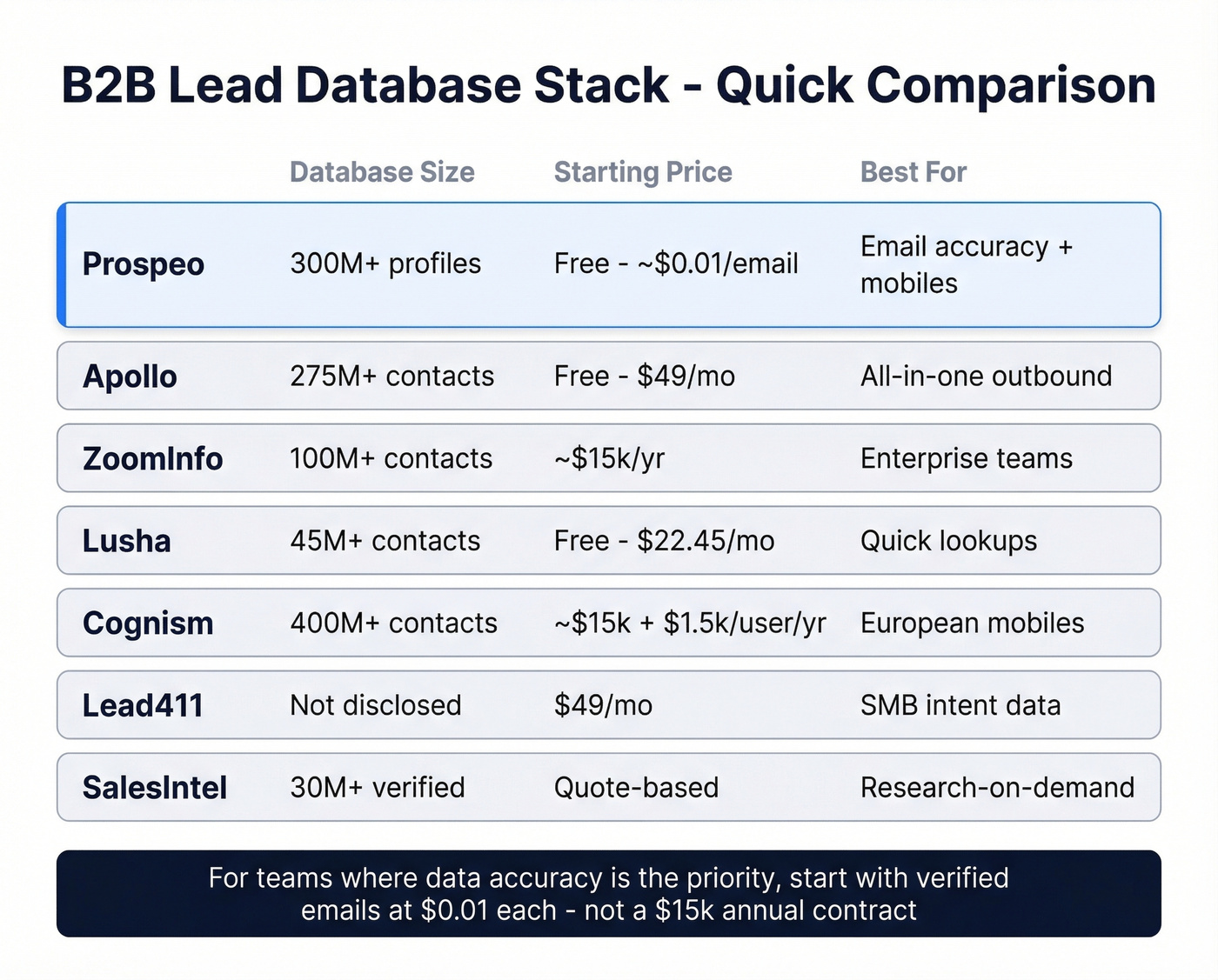
Prospeo is the starting point if data accuracy is your priority. The database covers 300M+ professional profiles with 143M+ verified emails at 98% accuracy and 125M+ verified mobile numbers. A 7-day data refresh cycle keeps lists clean when the industry average sits around six weeks. Pricing starts free at 75 verified emails/month plus 100 Chrome extension credits/month, scaling at roughly $0.01 per email with no contracts. The 30+ search filters include buyer intent across 15,000 topics, technographics, job changes, headcount growth, and funding signals. Native integrations with Smartlead, Instantly, Lemlist, HubSpot, Salesforce, Clay, Zapier, and Make mean you go from search to sequence without exporting CSVs. We've seen teams pair this with a $30/mo sequencer and HubSpot's free CRM and run a full outbound operation for under $150/month.
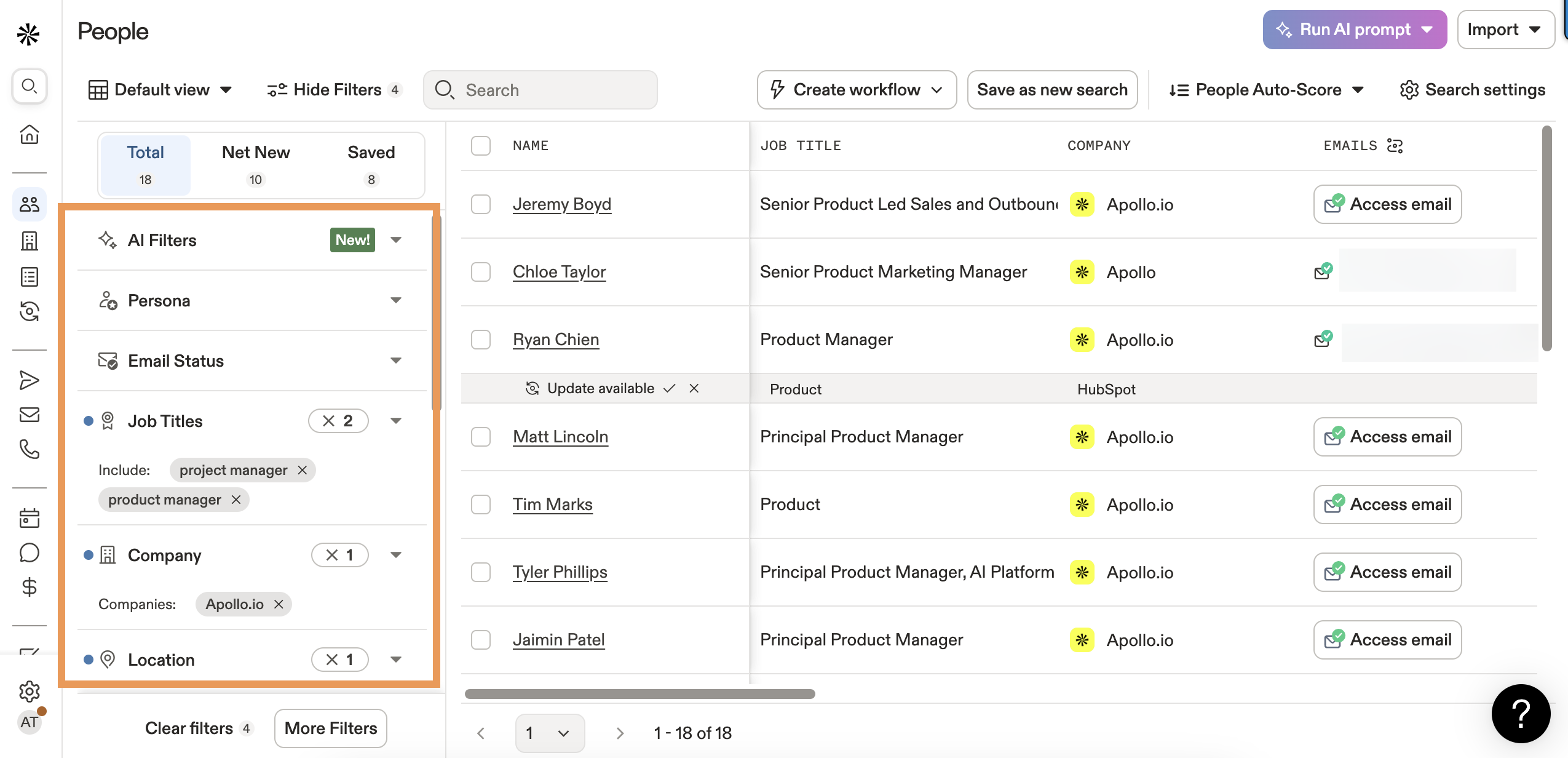
Apollo is the best all-in-one option for teams that want database + sequencing in a single tool. With 275M+ contacts, built-in email sequences, and a generous free tier, it's the default for startups. Paid plans start at $49/mo per user. The tradeoff: email accuracy runs lower than dedicated data platforms, so you'll want to verify before sending.
ZoomInfo remains the enterprise standard. The database is deep for US contacts, and the platform includes intent data, website visitor tracking, and workflow automation. But with multiple seats and add-ons, contracts commonly land in the $30k-$60k/year range. Skip this if you're a team under 10 reps - you'll pay for modules you never activate.
Lusha works well for quick lookups and browser-based prospecting. Pro plans start at $22.45/mo per user on annual billing. The database is smaller at 45M+ contacts, so it's better as a supplement than a primary source.
Cognism is the pick for European mobile numbers and GDPR-first compliance. The database covers 400M+ contacts, though coverage skews heavily toward EMEA. Expect ~$15k platform fee plus $1,500/user/year.
Data Quality and Deliverability
Bad data doesn't just waste money - it compounds. Every bounced email damages your sender reputation, which lowers deliverability on future sends, which means even your good contacts stop seeing your emails. It's a death spiral. We've watched teams burn through three domains before they finally fixed their verification process. (If you're actively repairing a damaged domain, start with how to improve sender reputation.)
The numbers tell the story: average cold email bounce rate is 7.5%. Good deliverability means staying above 95%. Email verification reduces bounce rates from 15-30% down to 2-5%. That gap is the difference between a functioning outbound program and a burned domain.
Beyond verification, list hygiene is non-negotiable. Deduplicate your lists before every send. Suppress existing customers and active opportunities - nothing kills credibility faster than cold-emailing someone who's already paying you. Remove role-based addresses (info@, sales@) that inflate bounce rates without generating conversations.
Your deliverability checklist:
- SPF and DKIM configured on all sending domains (DMARC strongly recommended)
- Dedicated sending domains - don't send cold email from your primary domain
- List verification before every campaign, not just at import
- Duplicate removal and existing-customer suppression before every send
- Bounce monitoring with automatic suppression
- Gradual domain warm-up: start at 20-30 emails/day, scale over 2-4 weeks
- Spam complaint rate under 0.1%
- Remove unengaged contacts after 3-4 sequences with no response
Benchmarks You Should Know
| Metric | Benchmark | Source |
|---|---|---|
| Average CPL (all channels) | $391.80 | Snov.io, 2026 |
| Cold email open rate | 27.7% | Snov.io, 2026 |
| Cold email response rate | 5.1% | Snov.io, 2026 (single email) |
| 2-email sequence response | 6.9% | Snov.io, 2026 (one follow-up) |
| Cold email bounce rate | 7.5% | Snov.io, 2026 |
| B2B buying cycle | 10.1 months | 6sense via Directive |
| SaaS website conversion | 1.1% | First Page Sage |
| Manufacturing conversion | 2.2% | First Page Sage |
| Legal services conversion | 7.4% | First Page Sage |
That $391.80 CPL is an average across all channels. Your actual CPL will vary dramatically. Inbound content leads might cost $50-$150 each but take months to build. Outbound leads might cost $200-$400 each but arrive in days. Neither number is "right" - the right CPL is the one that produces SQLs at a cost your unit economics can support.
Five Mistakes That Kill Lead Programs
1. No shared MQL definition between marketing and sales. Marketing celebrates 500 MQLs. Sales says 480 of them are garbage. This isn't a lead quality problem - it's an alignment problem. Define MQL criteria together, in writing, with scoring thresholds both teams agree on.
2. Prioritizing volume over quality. Cheap lead sources - low-quality content syndication, purchased lists, untargeted ads - inflate your dashboard but collapse downstream. A 500-lead list with 15% SQL conversion beats a 5,000-lead list at 1% every single time, and it's not even close when you factor in the rep hours wasted qualifying junk leads that were never going to convert.
3. Fragmented data and broken attribution. When your CRM, marketing automation, intent platform, and enrichment tool don't talk to each other, you can't tell which channels actually produce revenue. Fix the plumbing before you scale the spend.
4. Slow lead activation. Responding to an inbound lead within one hour makes you 7x more likely to qualify that lead. Most teams take 24-48 hours. Speed-to-lead is a revenue KPI, not an operational afterthought.
5. Generic nurture sequences with no intent signals. Sending the same 6-email drip to every lead regardless of their behavior or buying stage is lazy and it shows. Layer intent data and engagement signals into your nurture logic. A lead researching your competitor's pricing page needs a different message than one who downloaded a top-of-funnel ebook.
You read the math: manual prospecting costs $1.50-$2.50 per contact. Prospeo brings that to roughly $0.05 with 300M+ profiles, 30+ ICP filters - buyer intent, technographics, headcount growth, funding - and native integrations with Instantly, Smartlead, and HubSpot. That's the exact starter stack this playbook recommends, ready in minutes.
Generate verified B2B sales leads for less than a penny each.
FAQ
How do you find B2B sales leads that convert?
Define your ICP from your best existing customers, then use a verified database with intent and firmographic filters to build targeted lists. Layer multiple signals - job title, company size, tech stack, and active buying intent - so every contact has a realistic path to becoming a customer. The more filters you stack, the smaller your list gets, but the higher your conversion rate climbs.
What's the difference between a lead and a prospect?
A lead is anyone who matches your ICP or has shown initial interest - they're in your database but unqualified. A prospect is a lead you've vetted and are actively working through your sales process. All prospects started as leads, but most leads never become prospects.
How much does a B2B lead cost on average?
The average cost per lead across all channels is $391.80. Inbound leads typically cost ~60% less than outbound but take 3-6 months to generate at consistent volume. Your target CPL should be driven by your average deal size and close rate, not industry averages.
Is cold email still effective in 2026?
Yes. B2B cold email averages a 27.7% open rate and 5.1% response rate. A 2-email sequence with one follow-up drives the highest response rate at 6.9%. The key requirements are verified contact data, proper authentication (SPF, DKIM, DMARC), and personalization beyond "Hi {first_name}."
What's the best free B2B lead database for small teams?
Prospeo's free tier gives you 75 verified emails and 100 Chrome extension credits monthly - enough to run real campaigns without an annual contract. Apollo is another strong option starting at $49/month with built-in sequencing, useful if you want database and outreach in one tool.