

Benefits of Account-Based Marketing: What the Data Shows in 2026
Your CMO just greenlit an ABM pilot. The budget's modest, the sales team is skeptical, and someone in leadership wants to know "what's the ROI on this?" before you've even picked your first target account.
You're not alone - 71% of B2B practitioners now run an ABM strategy, and the global ABM market hit $1.2B in 2024 with a 12.4% CAGR projected through 2030. The benefits of account-based marketing are well-documented at this point. But "mainstream" doesn't mean "easy," and those advantages only show up if you get the execution right.
What Is Account-Based Marketing?
Traditional marketing starts broad and narrows down - awareness, interest, consideration, close. ABM flips that funnel. You identify the accounts most likely to buy, then build personalized campaigns to engage the buying committee inside those companies. Instead of marketing to thousands and hoping the right ones respond, you choose the companies first.
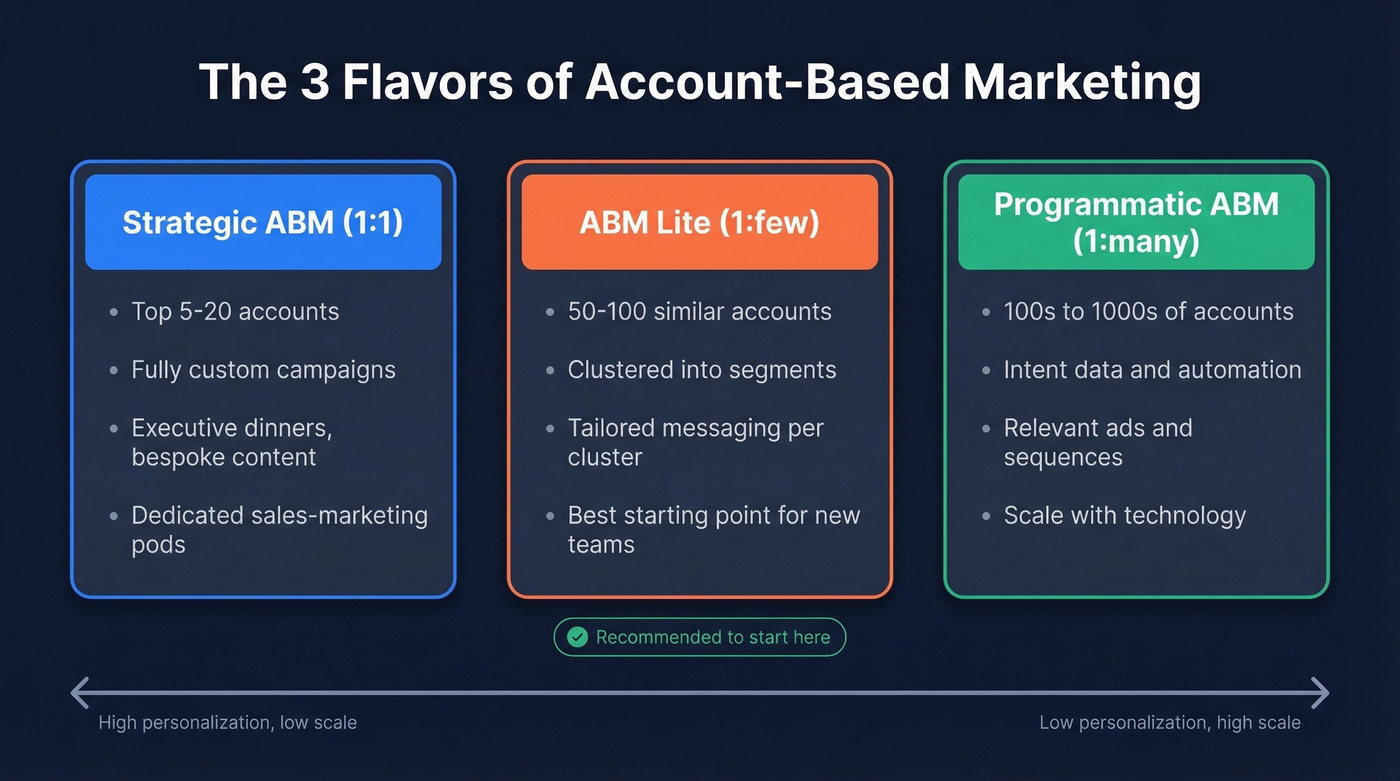
ABM has roots in the 1990s key-account selling model, and the modern version took off in the 2010s as B2B platforms matured. Today there are three flavors, and most mature programs run all three simultaneously:
Strategic ABM (1:1) means fully custom campaigns for your top 5-20 accounts - bespoke content, executive dinners, dedicated pods. ABM Lite (1:few) clusters 50-100 similar accounts into segments with tailored messaging. Programmatic ABM (1:many) uses intent data and automation to target hundreds or thousands of accounts with relevant ads and sequences.
Start with 1:few if you're new. It balances personalization with scale, and it's where we've seen teams get the fastest proof-of-concept wins.
The Quick Version
If you're scanning, here's what the data says:
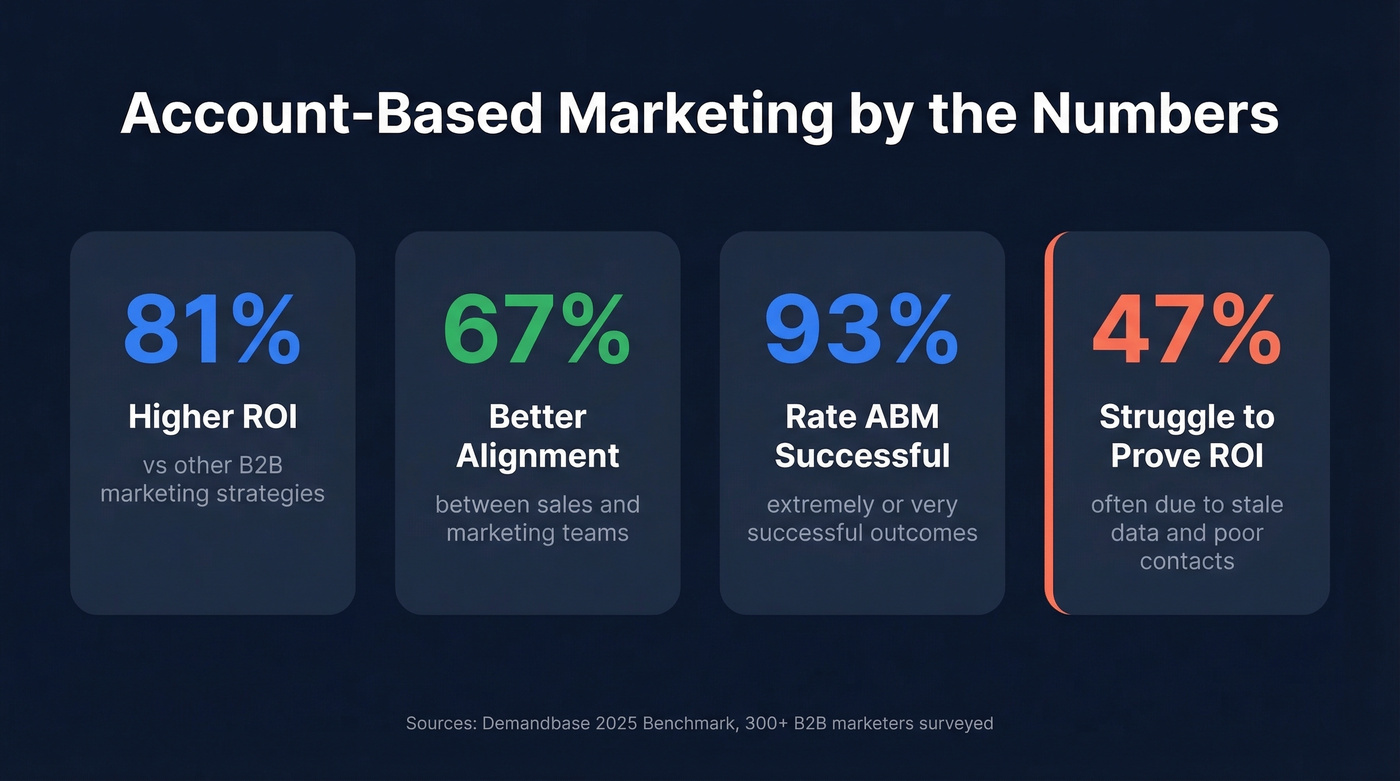
- 81% higher ROI than other B2B marketing strategies (Demandbase, 300+ marketers surveyed)
- 67% better sales-marketing alignment among ABM adopters
- 93% of marketers rate their ABM efforts extremely or very successful
The biggest risk? 47% of teams struggle to prove ROI. The silent killer behind that number is almost always data quality - stale contacts, bounced emails, and sales reps who stop trusting the target account list by week two.
7 Proven ABM Benefits
1. Sales and Marketing Finally Working the Same List
67% of ABM adopters report improved alignment between sales and marketing. That's not a soft metric - it's the difference between marketing generating leads that sales ignores and both teams coordinating outreach against the same accounts.
ABM eliminates the MQL handoff war because there's no handoff. Marketing and sales agree on the accounts upfront, then work them together. Reps spend their time on accounts that marketing is actively warming, rather than chasing cold leads solo. In our experience, this single shift - shared accountability over a shared list - changes team behavior faster than any process document or Slack channel ever could.
2. Higher ROI With Less Waste
Most teams think ABM costs more. It doesn't.
ABM delivers 81% higher ROI than other B2B strategies, according to Demandbase's benchmark of 300+ global marketers. Separately, 47% of B2B marketers say ABM makes campaigns more effective at the same budget. You're not spending more - you're directing resources toward accounts that actually match your ICP instead of spraying budget across thousands of companies that'll never close. If you're still tightening your ICP, use an Ideal Customer Profile scoring rubric before you lock the list.
3. Bigger Deals
91% of B2B companies with ABM programs report larger deal sizes.
The mechanism is straightforward: B2B purchases often involve around seven decision-makers, and ABM forces you to multi-thread into those accounts. When you're engaging the VP of Engineering, the CFO, and the procurement lead simultaneously, you're not just closing a deal - you're closing a bigger one because you've built consensus across the buying committee. That multi-threading approach is how teams capture larger contract values without adding headcount. (If you want the sales-side playbook, see account-based selling.)
4. Shorter Sales Cycles
Teams running ABM report 24% faster revenue growth and 38% higher win rates. Personalized outreach to pre-qualified accounts removes the discovery friction that drags out traditional sales cycles. When a prospect receives content that addresses their specific tech stack, their specific pain points, and their specific competitive landscape, the "why should we care?" phase shrinks dramatically. This is also where lead scoring helps you prioritize which accounts get the highest-touch plays.
5. Personalization That Actually Converts
Here's where ABM separates from every other B2B tactic.
93% of marketers rate their ABM efforts extremely or very successful. The key distinction: ABM personalizes at the account level, not just the lead level. You're not swapping a first name in a template. You're building campaigns around a company's funding round, their recent leadership changes, or the specific technology gaps in their stack. That depth of relevance is what drives reply rates north of 15-20% when most outbound sits below 5%. If you need a system for this, start with personalized outreach and then operationalize it with personalized drip campaigns.
6. Smarter Resource Allocation
Industry benchmarks show top performers allocate more budget to ABM - 18% versus 14% on average. That gap matters because ABM forces prioritization. You stop spending on accounts that will never close and redirect those resources toward the 50-200 accounts where you have a realistic shot. It's the difference between a marketing team that's busy and one that's effective. If your pipeline still feels noisy, map the bottlenecks using these sales pipeline challenges.
7. Clearer Measurement and Revenue Attribution
When you pre-agree on a target account list, attribution becomes straightforward. You know exactly which accounts to measure, which touchpoints influenced engagement, and which deals closed. Revenue attribution replaces vanity MQL counts.
ABM also drives retention and expansion within existing accounts. The "land and expand" motion - turning a single department win into a company-wide deal - is one of the most underrated advantages of a focused account strategy, and it's where compounding ROI really kicks in. (For SaaS teams, this ties closely to upsell vs cross-sell mechanics.)

47% of ABM teams can't prove ROI because stale data kills campaigns before they start. Prospeo refreshes 300M+ profiles every 7 days - not every 6 weeks - so your target account list stays accurate. With 98% email accuracy and 30+ filters including buyer intent and technographics, you reach the right people inside every account.
Stop letting bad data sabotage your ABM program.
ABM Results: Real Numbers
DocuSign ran an ABM program that produced a 60% increase in engagement, a 300% rise in page views from target accounts, and 22% growth in sales pipeline. That wasn't a pilot - it was a program-level transformation that reshaped how their marketing team operates.
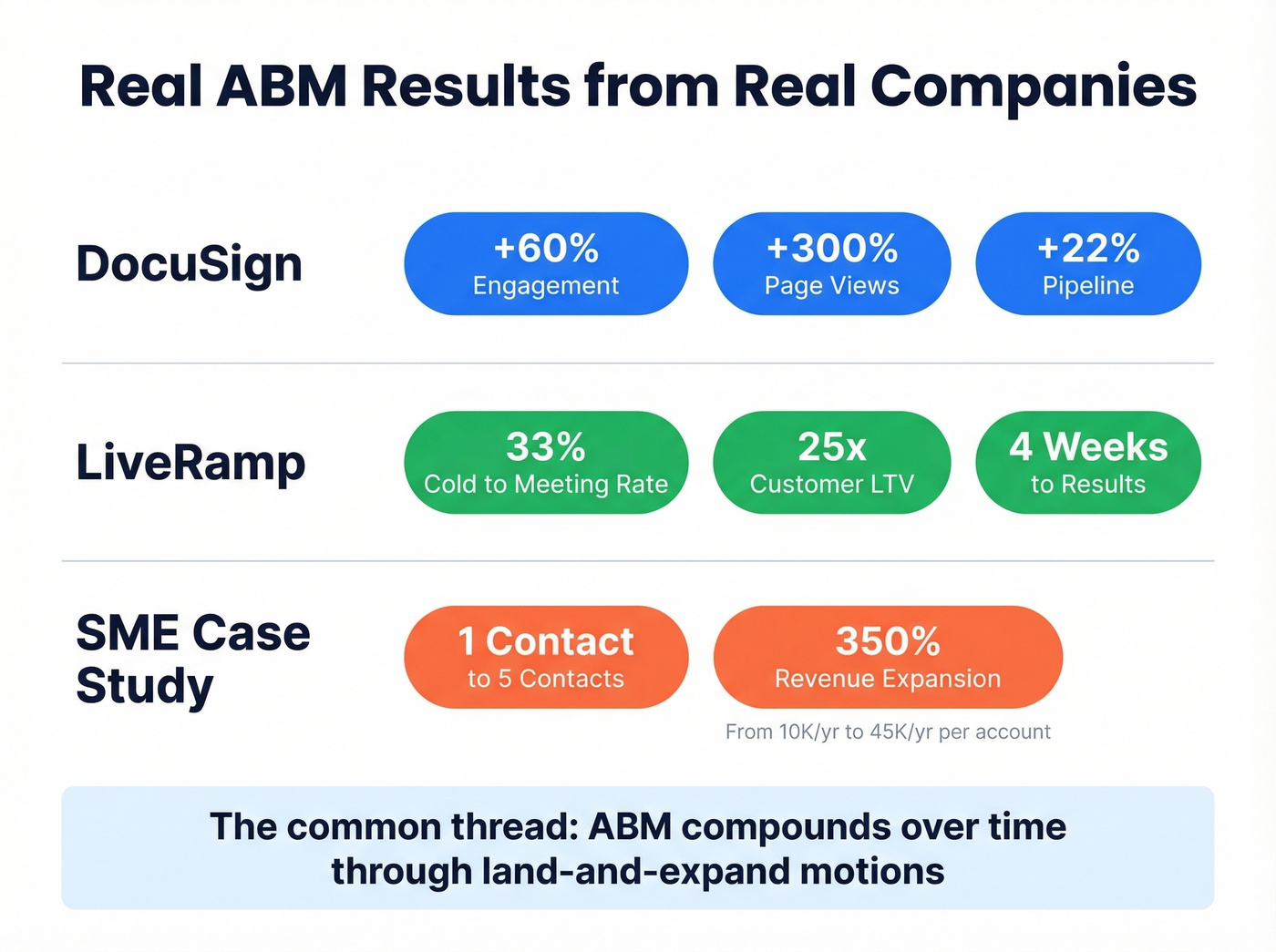
LiveRamp converted cold leads to meetings at a 33% rate within four weeks of launching ABM. Over two years, customer lifetime value increased 25x. The compounding effect of landing and expanding within high-value accounts is where ABM's real power lives.
And it's not just enterprise. One SME turned a single contact spending £10,000/year into five contacts spending £45,000/year - a 350% revenue expansion from one account play. If your average deal size is under $10K, you probably don't need a six-figure ABM platform. But you absolutely need the ABM mindset: pick your best-fit accounts, personalize the outreach, and multi-thread into the buying committee.
The Honest Part: ABM Challenges
Let's be real about what goes wrong. The 2026 Demand Gen benchmark lays it out:
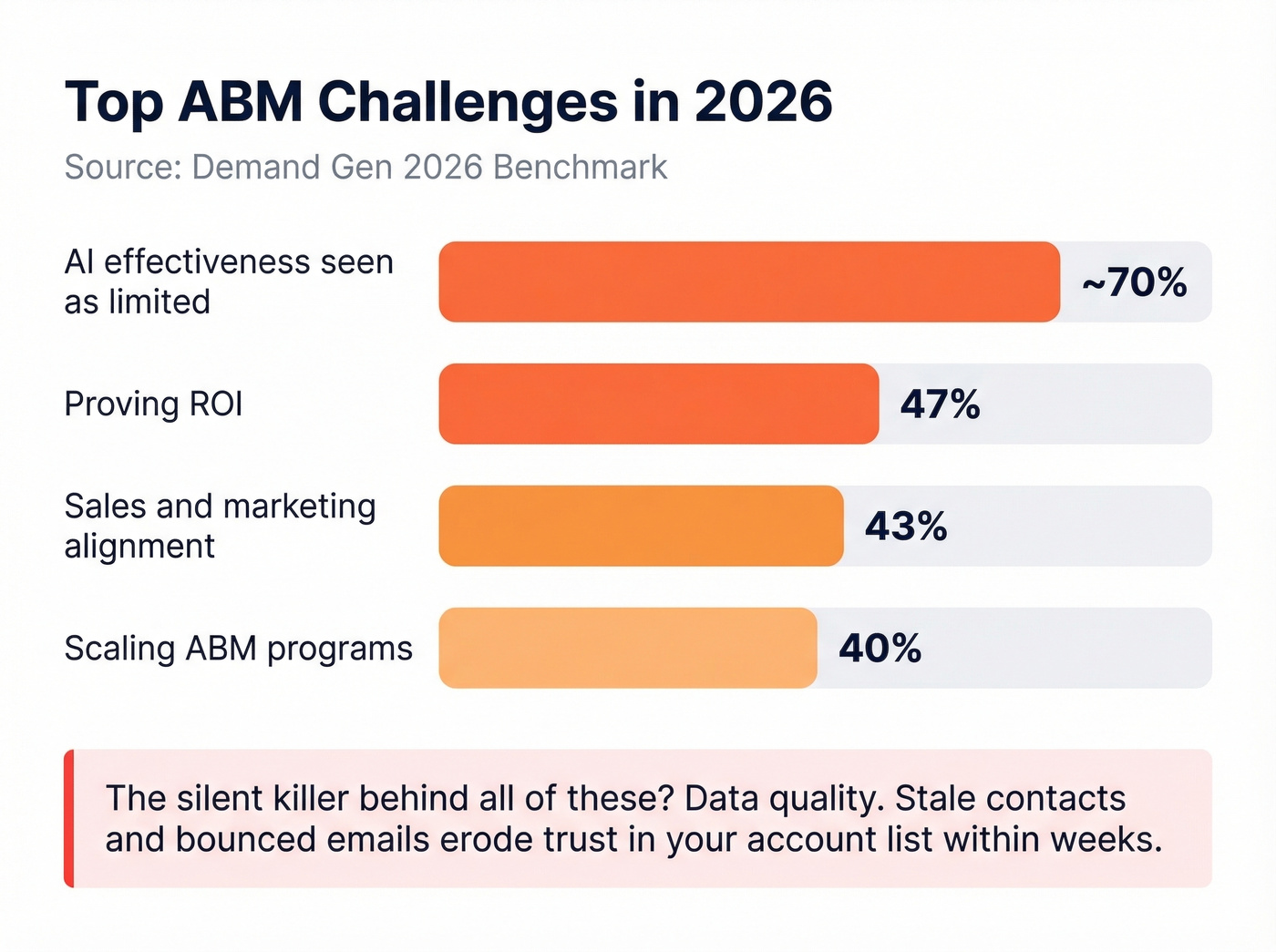
- 47% of teams struggle to prove ROI
- 43% can't align sales and marketing
- 40% hit walls when trying to scale
The AI hype hasn't helped either - while 45% see promise in AI for personalization, nearly 70% find its current effectiveness limited.
But the challenge nobody talks about enough is data quality. We've seen this pattern play out dozens of times: a team builds a beautiful target account list, loads it into their sequencer, and bounce rates spike past 30%. SDRs stop trusting the list by week two. The ABM program doesn't fail because of strategy - it fails because the contact data was stale before the first email went out. If you're seeing this, start by diagnosing your email bounce rate and then fix the root causes with an email deliverability guide.

This is where data infrastructure matters more than any ABM platform. Prospeo refreshes contact data every 7 days versus the 6-week industry average and delivers 98% email accuracy. Snyk's team saw this firsthand: bounce rates dropped from 35-40% to under 5%, and they went from struggling with data trust to generating 200+ new AE-sourced opportunities per month. When your sales team trusts the data, they actually work the accounts.
How ABM Works in Practice
The operating model that works best for high-touch ABM is the pod structure: one AE, one SDR, and one ABM manager hunting in packs against a shared account list. Shared accountability changes behavior faster than any process document - we've watched teams go from finger-pointing to genuine collaboration within weeks of adopting pods.
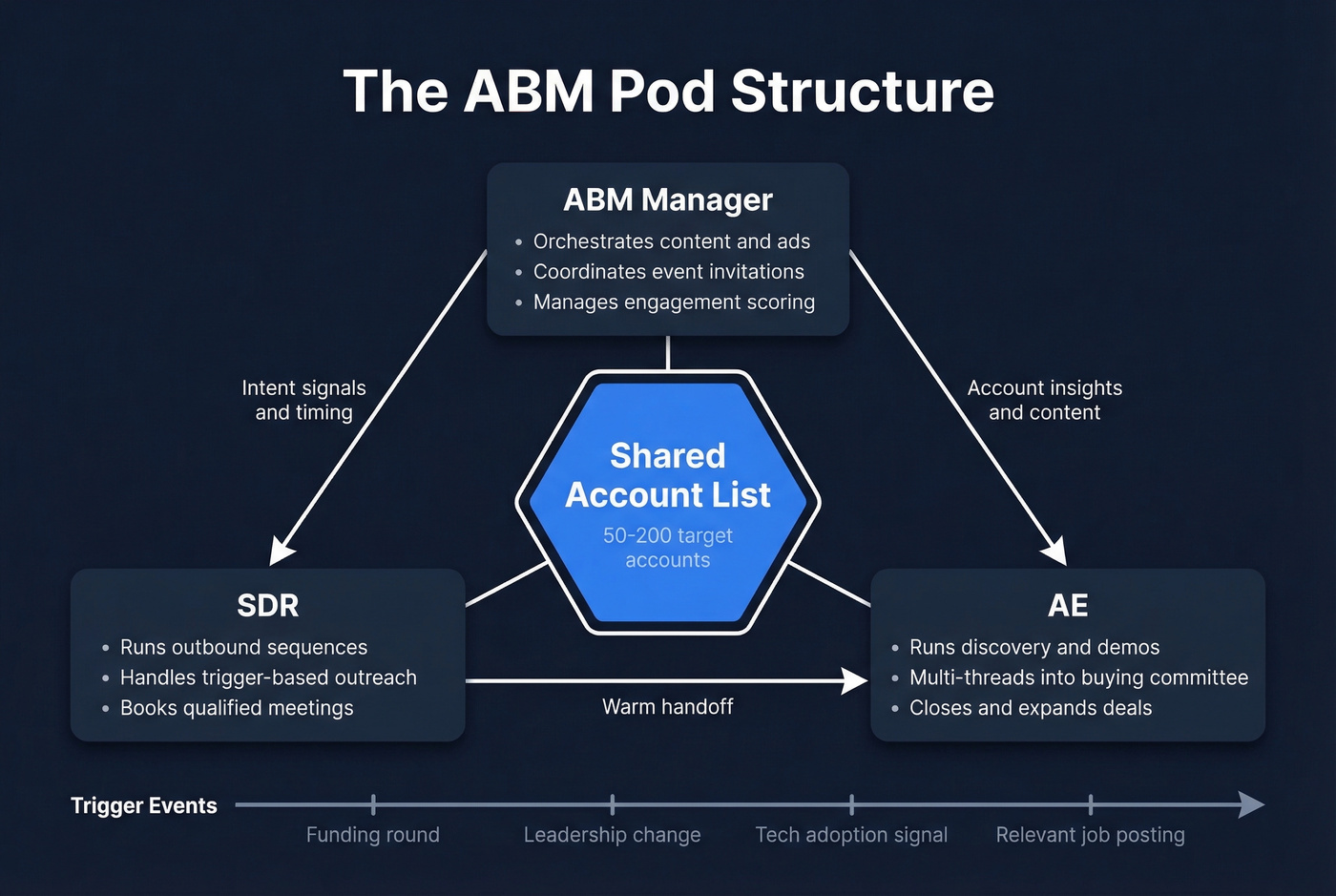
The SDR handles outbound sequences, the AE runs discovery and demos, and the ABM manager orchestrates content, ads, and event invitations around the same accounts.
Timing matters as much as targeting. The best ABM teams use trigger events - funding rounds, leadership changes, technology adoption signals, job postings in relevant departments - to determine when to engage an account. A decaying engagement score model helps prioritize: accounts that showed intent last week rank higher than accounts that downloaded a whitepaper three months ago. Some teams decay scores by 10-15% weekly to prevent stale accounts from clogging the pipeline, which forces constant reprioritization toward the hottest opportunities. To operationalize this, build a process for identifying buying signals and how to track sales triggers.
The shift from MQLs to MQAs (Marketing Qualified Accounts) is the measurement backbone of ABM. You're qualifying companies, not individual leads. That single change in how you count success rewires the entire sales-marketing relationship.
| Dimension | ABM | Demand Gen |
|---|---|---|
| Approach | Targeted push | Broad pull |
| Qualification | MQA (account) | MQL (lead) |
| Funnel direction | Flipped - accounts first | Traditional - awareness first |
| Best for | High-ACV, complex sales | Volume pipeline, SMB/mid |
| Top channels | Email (92%), events (72%) | Content, paid, SEO |
40% of practitioners now integrate ABM directly with demand gen. They're not competing strategies - demand gen fills the top of funnel while ABM concentrates resources on the accounts that matter most. Forrester's B2B marketing research and ITSMA's ABM benchmarking studies both confirm that hybrid approaches outperform either tactic in isolation.
Building Your ABM Tech Stack
Here's the thing: the fastest way to kill an ABM pilot is to spend three months evaluating platforms before you've validated a single account list. The biggest mistake teams make is over-investing in orchestration before they've confirmed their ICP and account list actually hold up.
Start with three things - a CRM, a data enrichment tool, and one orchestration platform. Everything else can wait. If you're comparing vendors, this breakdown of data enrichment services can help you shortlist quickly.
| Category | Tool | Approx. Annual Cost |
|---|---|---|
| ABM Platform | Demandbase | $36K-$100K+ |
| ABM Platform | 6sense | $30K-$120K+ |
| ABM Platform | Terminus | $20K-$60K |
| ABM Platform | RollWorks | $10K-$25K |
| CRM (ABM features) | HubSpot Marketing Pro | ~$9,600/yr |
| CRM (ABM features) | Salesforce Marketing | ~$15K+/yr |
| Data & Enrichment | Prospeo | Free tier; ~$0.01/email |
| Data & Enrichment | ZoomInfo Marketing | $15K-$40K+ |
Demandbase and 6sense are the heavyweights for account identification, intent scoring, and multi-channel orchestration. They're worth the investment if you're running programmatic ABM across hundreds of accounts with a dedicated team. For everyone else, the combination of a solid CRM and clean contact data gets you 80% of the way there at a fraction of the cost. The ABM Leadership Alliance has useful benchmarking resources if you want to compare your stack against peers.
Skip the enterprise platforms entirely if your team is under five people or your target list is under 100 accounts. You'll spend more time configuring dashboards than running campaigns.
Multi-threading into buying committees means you need verified emails and direct dials for every stakeholder - the VP, the CFO, and procurement. Prospeo gives you 143M+ verified emails and 125M+ mobile numbers at $0.01 per email, so you can engage all seven decision-makers without blowing your ABM budget.
Reach the entire buying committee, not just one gatekeeper.
FAQ
What are the main benefits of account-based marketing?
The core benefits are higher ROI (81% above other B2B strategies), larger deal sizes (91% of practitioners report bigger deals), shorter sales cycles, and dramatically better sales-marketing alignment. The compounding benefit most teams underestimate is clearer attribution - when you pre-select target accounts, you always know what's working.
Is ABM only for enterprise companies?
No. The SME example of growing one account from £10K to £45K/year proves ABM works at any scale. Start with 10-20 target accounts and a clean contact list - free-tier data tools give smaller teams enterprise-grade accuracy without enterprise pricing.
Does ABM replace demand generation?
ABM and demand gen are complementary, not competing. 40% of practitioners integrate both strategies. ABM targets known high-value accounts with personalized outreach; demand gen fills the top of funnel with broader awareness campaigns.
How long until ABM shows results?
Most teams see early engagement signals - ad clicks, content downloads, reply rates - within 30-60 days. Pipeline impact typically takes 3-6 months. Measure account-level progression (cold to engaged to pipeline) rather than individual lead counts.
What's the biggest reason ABM programs fail?
Data quality. If 30% of your target account emails bounce, sales loses trust immediately and stops working the list. A 7-day data refresh cycle and 98%+ email accuracy prevent the stale-data problem that kills ABM programs before they gain traction.