

C-Suite Sales: The Data-Backed Playbook for 2026
C-suite sales is a different game. You've got 50 words to convince someone who gets 300 emails a day, manages a $200M P&L, and has already defined their purchase requirements before you even knew the deal existed. 98% of cold emails to executives go unanswered. The other 2% share a playbook - and it's not what most sales trainers teach.
Most reps freeze up when selling to the c-suite because they see the title, not the person. As one rep put it on r/sales, the intimidation is a limiting belief. A CFO is just someone further along in their career who happens to own a specific problem. Your job isn't to impress them - it's to show you understand that problem better than anyone else who emailed them today. That mindset shift is the foundation everything else builds on.
What You Need (Quick Version)
Three things separate reps who get executive meetings from reps who get ignored:
- Verified contact data. Your outreach can't work if it bounces. A single bad campaign tanks your domain reputation for weeks. (If you need a deeper stack view, start with an email deliverability guide.)
- A point of view, not a pitch. Executives buy outcomes. If your first email describes your product, you've already lost. (This is the core of data-driven selling.)
- Financial literacy. If you can't read a 10-K or talk about P&L impact, you're not ready for this conversation.
Why Executive Selling Changed in 2026
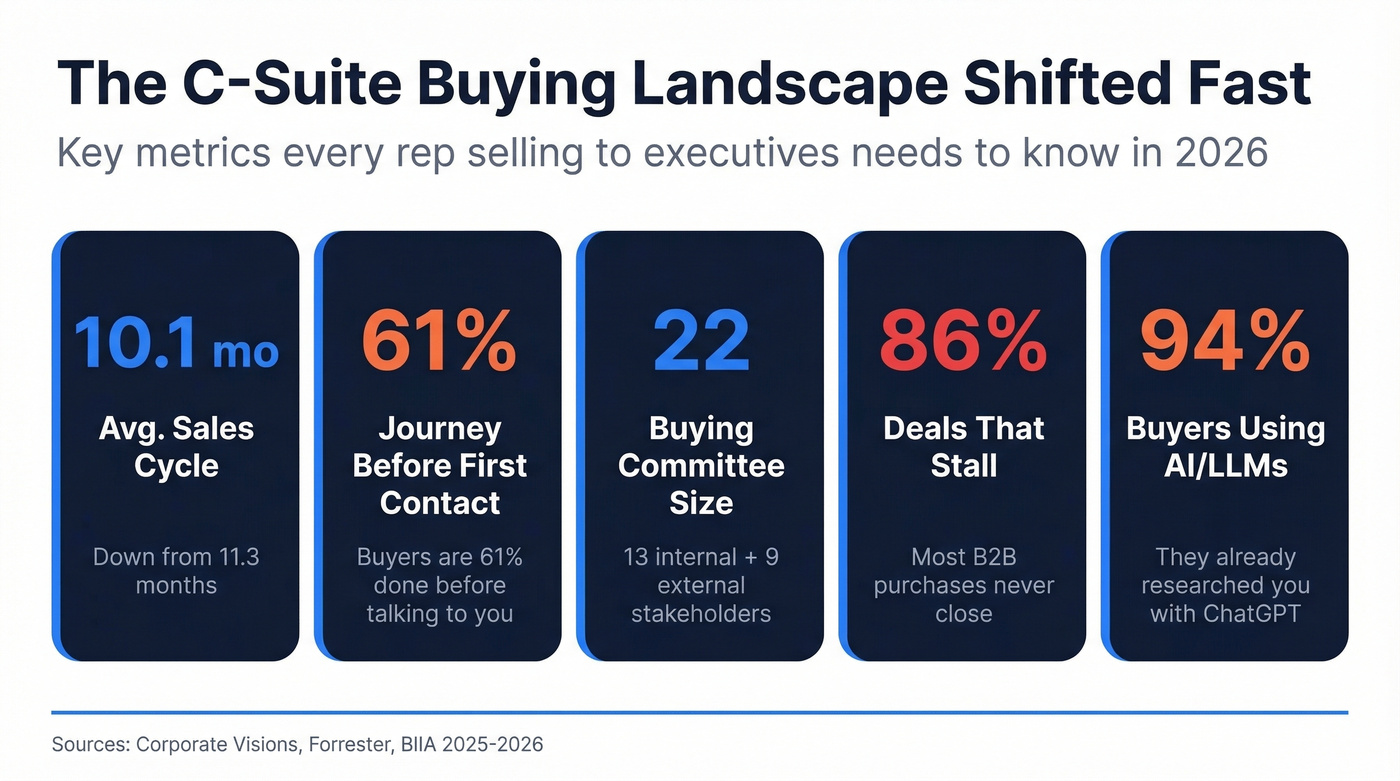
The way companies sell to the c-suite changed faster than most reps adapted. Here are the numbers.
| Metric | 2024 | Latest |
|---|---|---|
| Avg. sales cycle | 11.3 months | 10.1 months |
| First seller contact | 69% of journey | 61% of journey |
| Buying committee | 11-13 stakeholders | 13 internal + 9 external |
| Deals that stall | - | 86% |
| Buyers using AI/LLMs | - | 94% |
Sales cycles compressed from 11.3 to 10.1 months as economic pressure forced faster decisions. But buyers now make first contact at 61% of their journey, meaning they've already compared vendors and, in 83% of cases, defined their requirements before talking to a single rep.
94% of buyers use LLMs during their research process. By the time they talk to you, they've already had ChatGPT summarize your competitor's pricing page and draft a comparison matrix. And even when deals close, 81% of buyers end up dissatisfied with their chosen provider. That means the bar for a great buying experience is shockingly low. That's your opening.
Meanwhile, 86% of B2B purchases stall, and buying committees have ballooned to 13 internal stakeholders and 9 external participants. Feature-first pitching is dead at the executive level. By the time you get the meeting, they already know what your product does. What they need is a reason to prioritize it - and any viable strategy for c-suite sales in 2026 must account for this reality.
What Executives Actually Care About
68% of respondents identify C-suite leaders as the decision-makers in B2B purchases. But executives don't need you to educate them on their problem. They need you to expand their thinking about solutions they haven't considered.
You don't need to be a C-suite peer to earn a C-suite conversation. You need business acumen and a point of view worth their time. Before you reach out, use the Imagine, Investigate, Confirm method: hypothesize what the executive likely cares about, research their public filings and earnings calls to validate, then confirm your hypothesis in the conversation itself. (If you want a tighter targeting system, build an ideal customer profile first.)
One thing most playbooks miss: executives process information differently. Some want the data first, others want the big vision before any numbers. Pay attention in the first 30 seconds of any meeting - how they respond to your opening tells you which type you're dealing with.
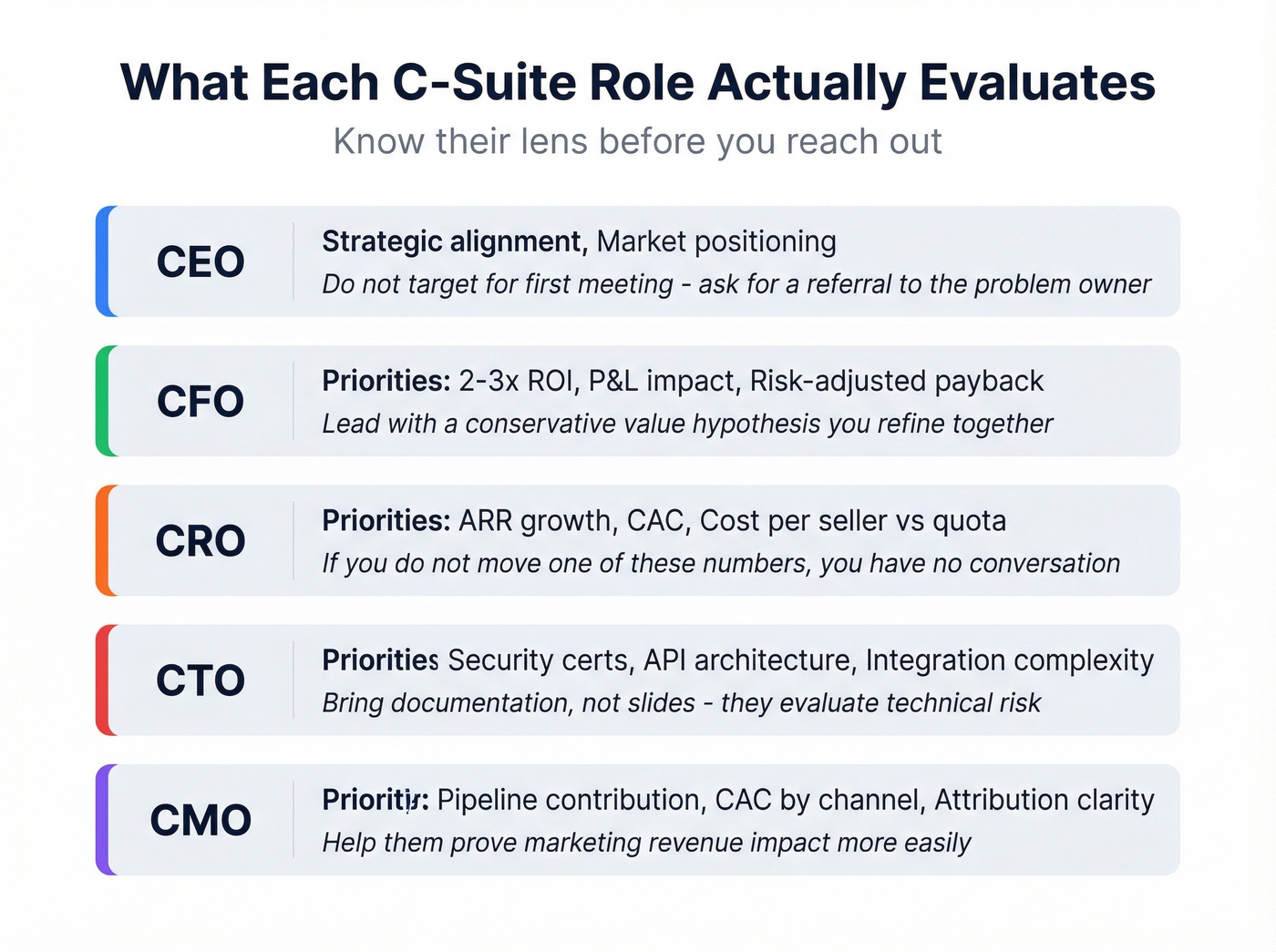
Here's how each role evaluates your solution:
CEO - Don't target the CEO for a first meeting. ZoomInfo CEO Henry Schuck put it bluntly: "You actually don't want a meeting with me right away... You want me to connect you with someone in the business who's going to take that meeting." The CEO is a referral conduit. Your ask: "Can you connect me with the person who owns this problem?"
CFO - Three numbers matter: 2-3x ROI, P&L impact, and risk-adjusted payback period. Lead with a conservative value hypothesis you refine collaboratively with their team. Inflated projections destroy credibility instantly. (If you need the language for this, use sales battle cards to standardize ROI + risk proof.)
CRO - ARR growth, customer acquisition cost, cost per seller against quota delivered. If your solution doesn't move one of those numbers, you don't have a conversation. (Tie it back to cost to acquire customer to keep the math clean.)
CTO - Security certifications, API architecture, integration complexity. Come with documentation, not slides. CTOs aren't evaluating your value proposition - they're evaluating your technical risk.
CMO - Pipeline contribution, CAC by channel, attribution clarity. If you can show how your solution makes marketing's revenue impact easier to prove, you're speaking their language.

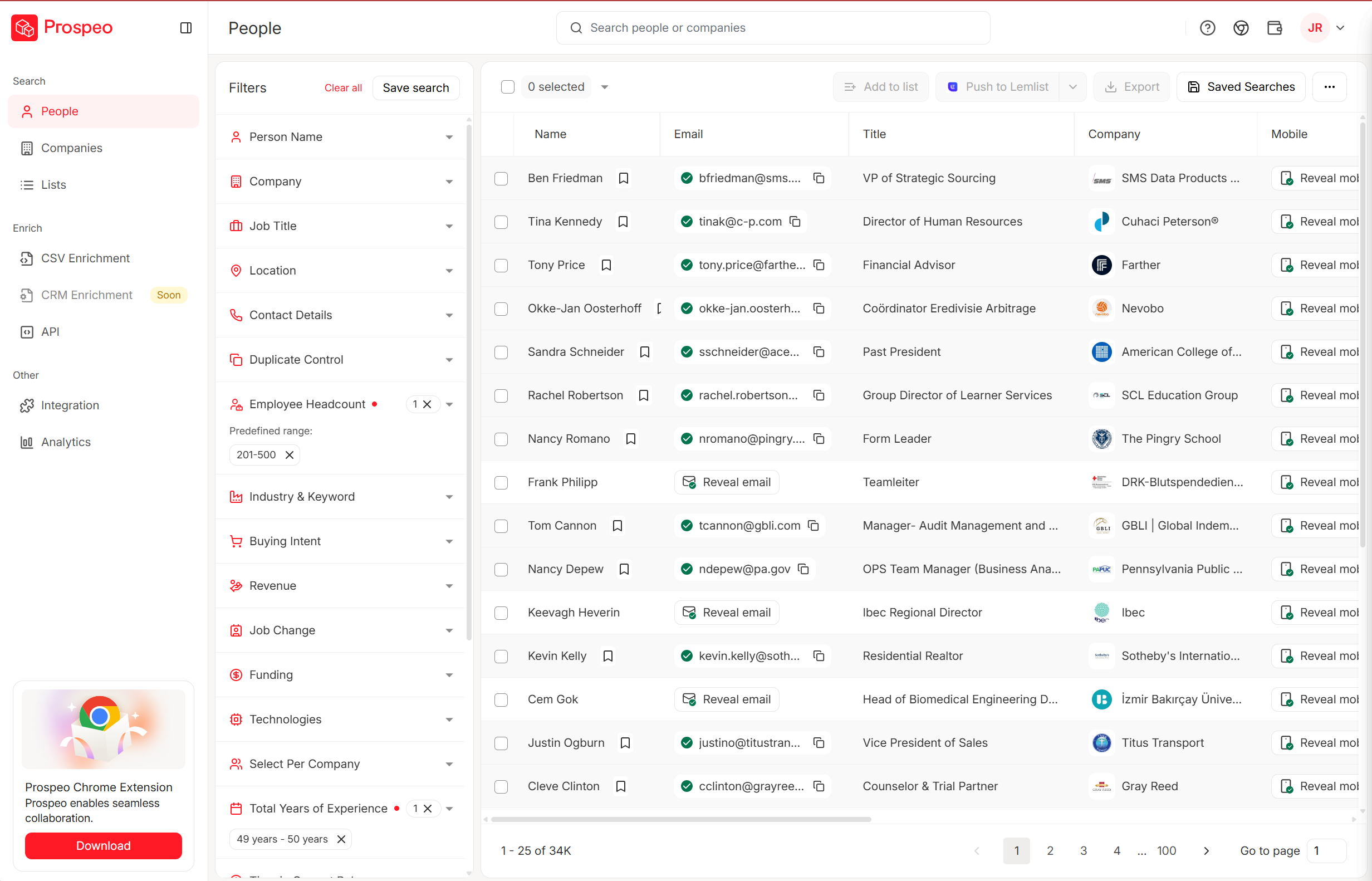
You just mapped what every C-suite role cares about. Now you need verified contact data to reach them. Prospeo gives you 143M+ verified emails at 98% accuracy with 30+ filters - including title, seniority, and buyer intent - so you land in the right executive inbox, not the spam folder.
Build your C-suite prospect list in minutes, not days.
Cold Outreach for C-Suite Selling
The Data Quality Problem
Before you write the perfect 50-word email, make sure it actually lands. CEOs receive 200-300+ emails per day. If your bounce rate is above 5%, your domain reputation degrades with every campaign, and once your domain is flagged, even emails to warm prospects start hitting spam. (Benchmarks + fixes: email bounce rate.)
We've seen teams burn through three sending domains in a quarter because they were working off stale data. Prospeo's database covers 143M+ verified emails with 98% accuracy on a 7-day refresh cycle, so you're not emailing someone who changed jobs six weeks ago. Catch-all verification and spam-trap removal handle the edge cases that wreck deliverability for most teams. (If you’re troubleshooting, start with spam trap removal.)
Email Structure
The 6-part framework for executive outreach:
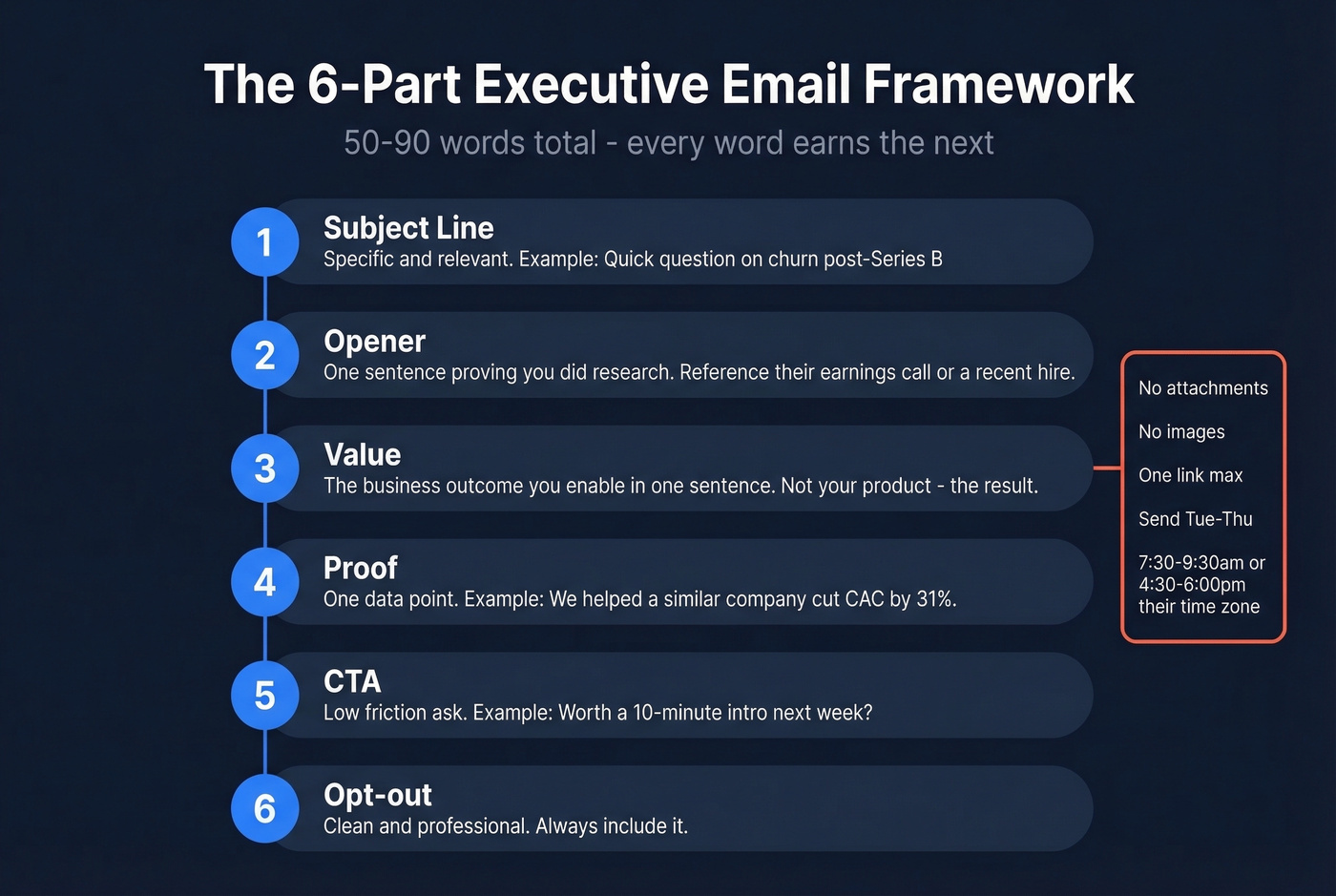
- Subject line: Specific and relevant. "Quick question on churn post-Series B" beats "Intro from [Company]." (More options: cold email subject line examples.)
- Opener: One sentence proving you've done research. Reference their earnings call, a recent hire, or a strategic initiative.
- Value: The business outcome you enable, in one sentence. Not your product - the result.
- Proof: One data point. "We helped [similar company] cut CAC by 31%."
- CTA: Low friction. "Worth a 10-minute intro next week?" (Rules + examples: email call to action.)
- Opt-out: Clean and professional.
Keep the whole thing between 50 and 90 words. No attachments, no images, one link maximum. Send Tuesday through Thursday, 7:30-9:30am or 4:30-6:00pm in the recipient's time zone. These tips apply whether you're targeting a Series B startup or a Fortune 500.
Executive-Grade Template
Subject: [Specific trend] hitting [their vertical]
Hi [Name],
[Company]'s expansion into [market/segment] caught my eye - teams scaling that fast typically see [specific problem] spike by 30-40%.
We helped [similar company] solve that and cut [metric] by [number]. Takes about 10 minutes to show how.
Worth a quick call this week?
Follow-Up Cadence
Most meetings are booked after the fifth touchpoint. Space follow-ups 3-5 business days apart, adding new value each time - a relevant case study, an industry stat, a direct question. Don't just bump the thread. (If you want plug-and-play copy, use these cold email follow-up templates.)
The breakup email works surprisingly well. On your final touch, acknowledge you're closing the loop: "Looks like the timing isn't right - I'll check back in Q3." In our experience, breakup emails generate more replies than the initial outreach in roughly one out of five campaigns.
Before any of this: dedicated sending domain, SPF/DKIM/DMARC configured, inbox warmup for 2-4 weeks, cap volume at 30-50 emails per day per inbox. Skip this setup and nothing else in this article matters. (For safe limits, see email velocity.)
One bounced email to a CFO doesn't just waste a touch - it degrades your domain reputation for every campaign after it. Prospeo refreshes all contact data every 7 days with 5-step verification, catch-all handling, and spam-trap removal. Teams using Prospeo keep bounce rates under 4% while sending 4x the volume.
Protect your domain and triple your executive pipeline at $0.01 per email.
How to Run the Executive Meeting
The first two minutes decide everything. Executives don't want to sit through 20 slides to find out what you're asking for.
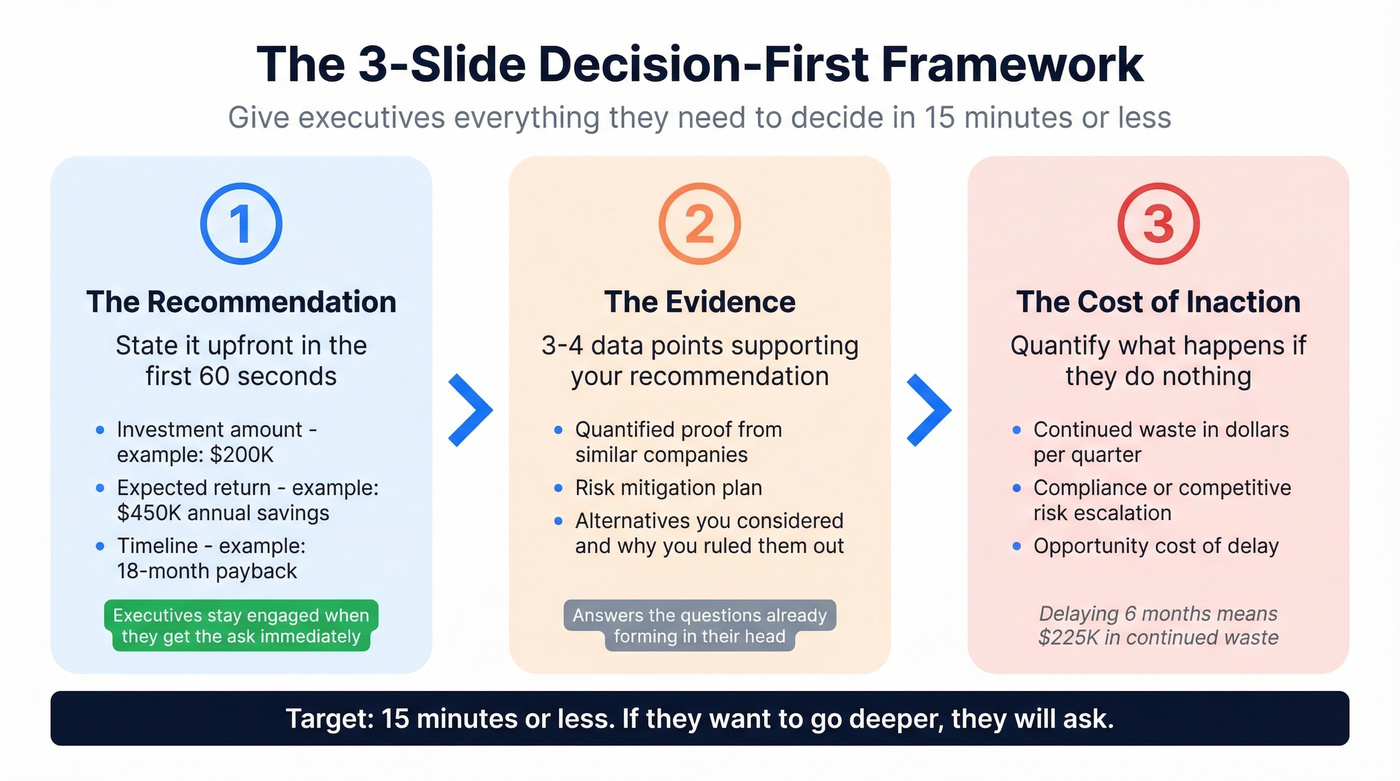
Use the 3-slide decision-first framework:
Slide 1: The Recommendation. State it upfront. "Approve a $200K investment. Return: $450K in annual savings, 18-month payback." Investment, return, timeline - all in the first 60 seconds. In our experience, executives who get the recommendation immediately stay engaged for the full meeting. Bury it on slide 15 and you'll see them checking their phone by slide 3.
Slide 2: The Evidence. Three to four data points supporting your recommendation. Include risk mitigation and alternatives you considered. This slide answers the questions the executive is already forming while you're still talking.
Slide 3: The Cost of Inaction. Quantify what happens if they do nothing. "Delaying 6 months means $225K in continued waste plus 3x compliance cost increases in Q3." This creates urgency without pressure tactics - it's just math.
Fifteen minutes or less. If the executive wants to go deeper, they'll ask. But you've given them everything they need to make a decision - or to champion it internally. This framework works especially well in SaaS deals, where technical complexity tempts reps into over-explaining features instead of leading with outcomes. (If your deck needs tightening, use sales deck storytelling.)
Champions and Multi-Threading
With 13 internal stakeholders and 9 external participants involved in the average B2B purchase, single-threading is a deal killer. If your entire deal depends on one champion who goes on vacation or loses political capital, you're dead. (This is why account-based selling best practices matter more than ever.)
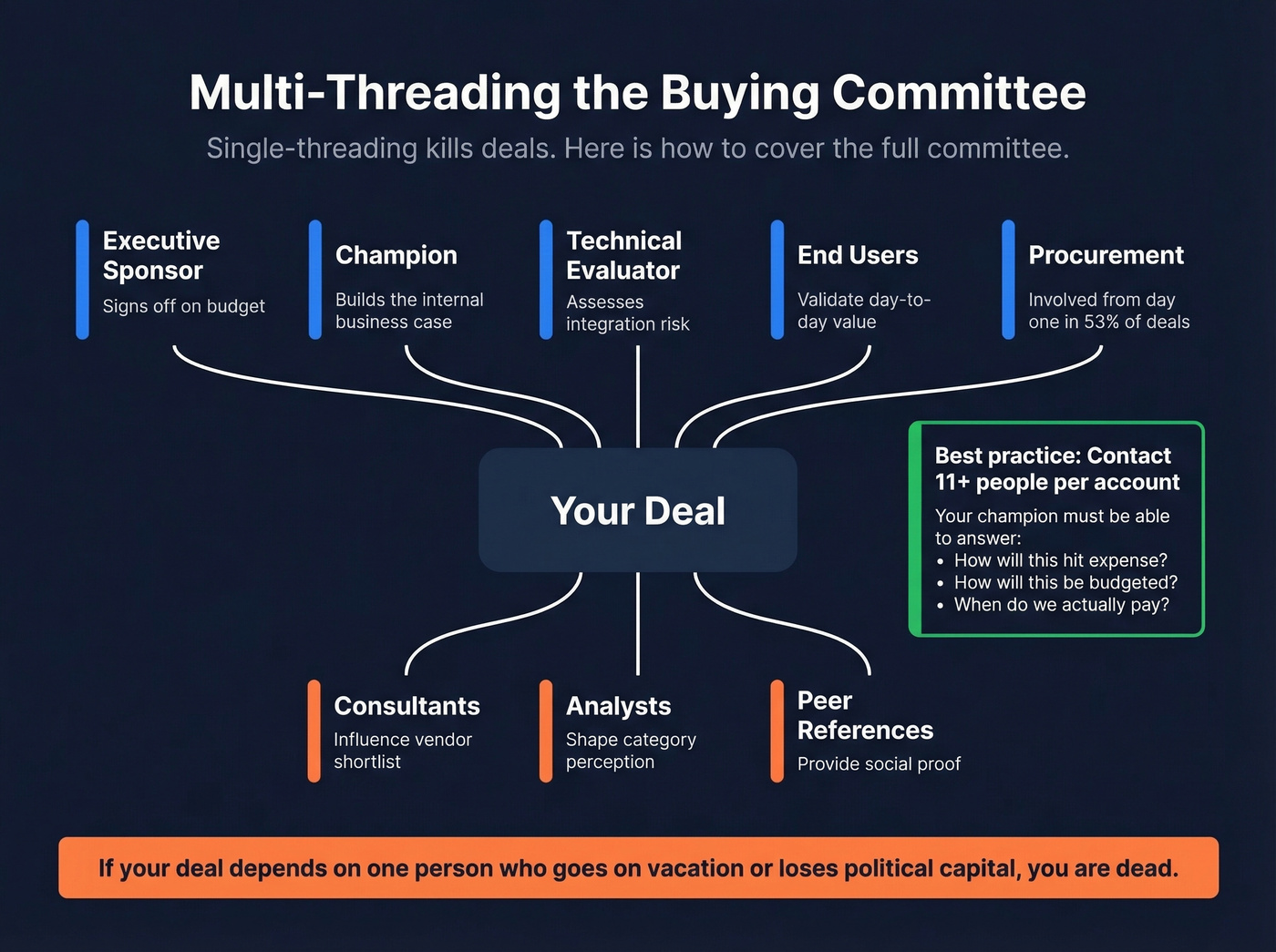
Successful account-based campaigns targeting mid-market companies contact 11+ people per account. That's not spam - it's strategic multi-threading across the buying committee. And 53% of the time, procurement is involved from the earliest stages. Ignore them at your peril.
Your champion's real job isn't to sell internally - it's to craft the business case for the CFO and procurement. Help them answer the questions that will come up: "How will this hit expense? How will this be budgeted? When are they going to actually pay?" If your champion can't answer those, the deal stalls. We've found that giving champions a pre-built one-pager with those answers cuts internal approval time nearly in half.
Here's the thing: 35% of buyers who complete a trial end up converting with a different provider. The deal isn't won until the contract is signed. That's why 57% of C-level buyers prefer phone over email - once you've earned the right to a conversation, pick up the phone. Consultative selling over a call builds trust faster than any email thread, and knowing how to sell to executives on the phone is a skill worth developing separately from your email game.
Mistakes That Kill Executive Deals
Leading with features. Executives care about outcomes. If your first slide describes functionality, you've lost the room.
Asking "What keeps you up at night?" This signals you haven't done your homework. Executives expect you to already know their challenges from public filings and earnings calls.
Ignoring procurement. 53% of procurement teams are involved from day one. Treating them as a late-stage checkbox gets deals killed.
Single-threading. One contact per account is a gamble, not a strategy. Thread across the buying committee or accept that 86% stall rate.
Talking more than listening. The ratio is 30/70 - you talk 30%, they talk 70%. Reps who dominate the conversation never get a second meeting.
Leading with price over value. If the first thing an executive hears is your cost, they'll anchor on it. Lead with the return, then contextualize the investment.
Using one message for every role. A CFO and a CTO evaluate risk completely differently. Tailor your message to each role or it won't resonate with any of them. If you're not sure how to adjust, go back to the role breakdown above and write a separate opening line for each stakeholder.
FAQ
How do you get a meeting with a C-suite executive?
Lead with a business insight tied to their strategic priorities, not a product pitch. Use verified contact data to ensure deliverability, and ask for a referral to the right internal owner rather than requesting a direct meeting. The best executive selling strategies focus on earning the referral first.
What's the best way to cold email a CEO?
Keep it under 90 words with one business outcome tied to their strategic priorities and a single low-friction CTA. Send Tuesday through Thursday, 7:30-9:30am or 4:30-6:00pm in their time zone. No attachments, no images, one link max.
How many stakeholders are in a B2B buying committee?
Forrester research found an average of 13 internal stakeholders and 9 external participants per B2B purchase. Multi-threading across the committee - contacting 11+ people per account - is essential to prevent deals from stalling when a single champion loses influence.
What do CFOs care about in a sales pitch?
ROI of 2-3x minimum, cost efficiency, risk mitigation, and P&L impact. Start with a conservative value hypothesis and refine collaboratively - inflated projections destroy credibility instantly. Lead with the payback period, not the feature set.
How do you build a verified executive contact list?
Use a platform with real-time verification, catch-all handling, and frequent data refresh cycles. Prospeo's database covers 143M+ verified emails with 98% accuracy on a 7-day refresh, and you can filter by title, company size, and industry. The free tier includes 75 verified emails per month - enough to test before scaling.