

Closed Won Meaning: What It Is and What Most Teams Get Wrong
84% of reps missed quota last year. 89% of B2B buyers report at least one stalled deal in the past twelve months. Those two stats are connected - and the connection runs straight through how teams define, track, and act on their won deals.
The closed won meaning is straightforward but frequently misapplied. Below: the full definition, 2026 benchmarks to compare yourself against, CRM setup steps, and edge cases nobody else covers.
The Full Definition
Closed won is the final stage in a sales pipeline where the prospect has signed a contract or purchase order and revenue can be recognized. Not a handshake. Not a verbal "yes." The moment the deal is legally and financially complete.
What makes this stage different from every other pipeline stage is that it's a cross-functional trigger. When a deal hits closed won, Finance starts revenue recognition, customer success begins onboarding, ops provisions the account, and marketing logs the win for attribution. If any of those teams are surprised by a won deal, your process has a gap.
The simplest test: if someone in finance can't book the revenue based on what's in the CRM, it isn't closed won yet.
Closed Won vs Closed Lost
Both are "closed" stages - the deal is no longer active in your pipeline. The difference is the outcome.
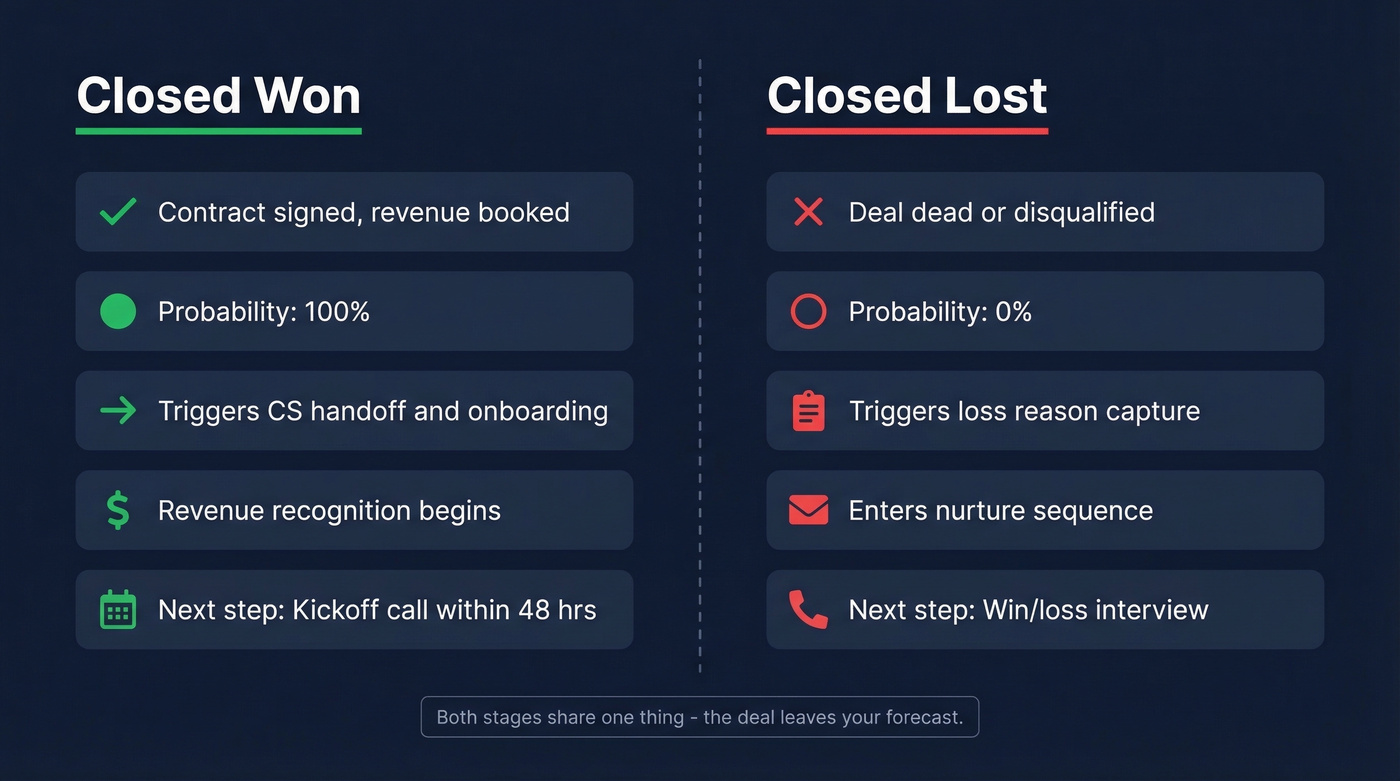
| Closed Won | Closed Lost | |
|---|---|---|
| Definition | Contract signed, revenue booked | Deal dead or disqualified |
| CRM Type | Closed/Won | Closed/Lost |
| Probability | 100% | 0% |
| What It Triggers | CS handoff, onboarding, rev rec | Loss reason capture, nurture |
| Next Action | Kickoff call within 48 hrs | Win/loss interview |
Here's what both stages share: the deal leaves your forecast. A deal sitting at "Negotiation" for six months does more damage to your pipeline accuracy than a clean closed-lost ever will.
How It Fits Into Your Pipeline
Every CRM uses stages to model deal progression. Here's a common Salesforce stage progression, which most teams customize:
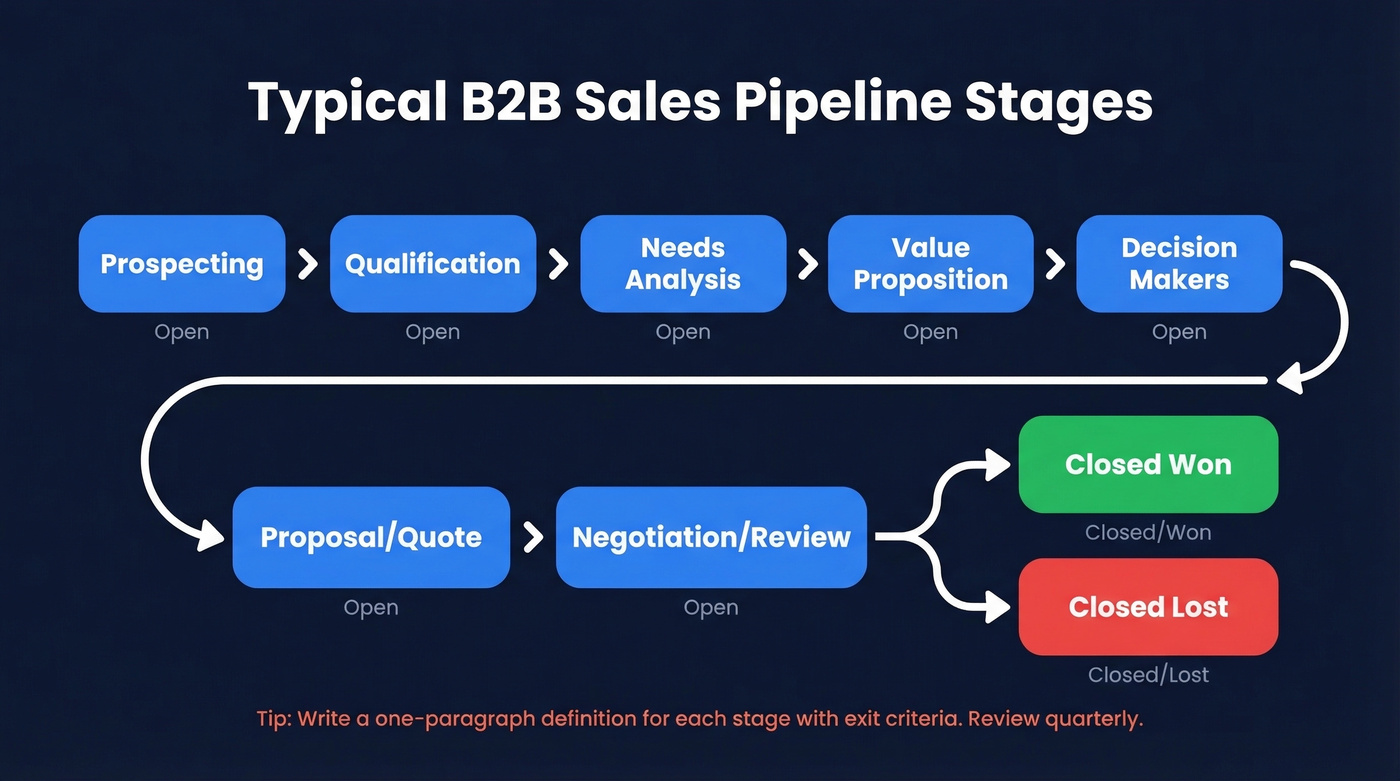
| Stage | Type |
|---|---|
| Prospecting | Open |
| Qualification | Open |
| Needs Analysis | Open |
| Value Proposition | Open |
| Decision Makers | Open |
| Proposal/Price Quote | Open |
| Negotiation/Review | Open |
| Closed Won | Closed/Won |
| Closed Lost | Closed/Lost |
In practice, stages break the moment reps interpret them differently. One rep marks "Proposal Sent" when they email a PDF. Another waits for the prospect to acknowledge it. That inconsistency compounds across a team of 20 reps and makes your weighted pipeline meaningless.
The fix isn't complicated: write a one-paragraph definition for each stage, include an exit criterion, and review it quarterly. Most teams skip this and wonder why their forecasts are off. If you want a tighter system end-to-end, start with sales process optimization and then audit your pipeline health monthly.
When to Mark a Deal Closed Won
Four common thresholds exist. Pick one and enforce it across every rep:
- Contract signature - the most common default, and the one we'd recommend for most teams. The deal is legally binding.
- Payment received - more conservative. Reduces revenue recognition risk but delays CS handoff.
- Legal + finance approval - common in enterprise. Both departments sign off before the CRM updates.
- Implementation kickoff - used in services and custom implementations where scope can still change post-signature.
Contract signature is the right default for most B2B companies. It's clean, verifiable, and doesn't create a lag between the win and the handoff.
Look - a verbal agreement isn't a won deal. Period. End of quarter, VP asks for the forecast, and half the deals were marked before contracts were signed? That's not optimism. It's fiction. And it trains the entire org to distrust the CRM. If your team struggles here, standardize your sales activities and use consistent sales follow-up templates so reps don’t “go dark” after sending the contract.
Edge Cases That Trip Teams Up
Verbal Commits
A prospect says "we're in, send the contract." Great news. Also not a won opportunity. Mark it as Negotiation/Review with high probability and follow up daily until ink is on paper. We've seen deals die between "yes" and signature more times than we can count.
"On Hold" Deals
The prospect's timeline shifted. Budget got frozen. New VP started. Don't mark these closed lost - that contaminates your win-rate math. Create a distinct "On Hold" or "Deferred" stage with a 0-10% probability instead. It keeps the deal out of your forecast without inflating your loss count.
If you reopen a deal that was previously closed lost, you often end up double-counting it in your pipeline metrics. Better to create a new opportunity linked to the original.
Contracts Unsigned for Weeks
If a contract has been sitting unsigned for more than two weeks, stop calling it "in progress." Every day it sits there reduces the chances of closing. After two weeks, treat it as a red flag - escalate, bring in an exec, or move it to closed lost and save your forecast.
Refunds and Chargebacks
A customer signs, you mark the deal won, and three weeks later they request a refund. Don't reopen the original opportunity - that retroactively corrupts your historical win-rate math. Create a new opportunity with a negative value linked to the original deal instead. This keeps your reporting clean while giving finance a clear paper trail for the revenue reversal.

Deals stall when reps chase wrong contacts. Prospeo's 300M+ verified profiles and 125M+ mobile numbers connect your team to actual decision-makers - the people who sign contracts and move deals to closed won.
Teams using Prospeo book 35% more meetings than Apollo users.
Win-Rate Benchmarks for 2026
Your SDR team generated 200 opportunities last quarter. Win rate came in at 22%. Is that good?
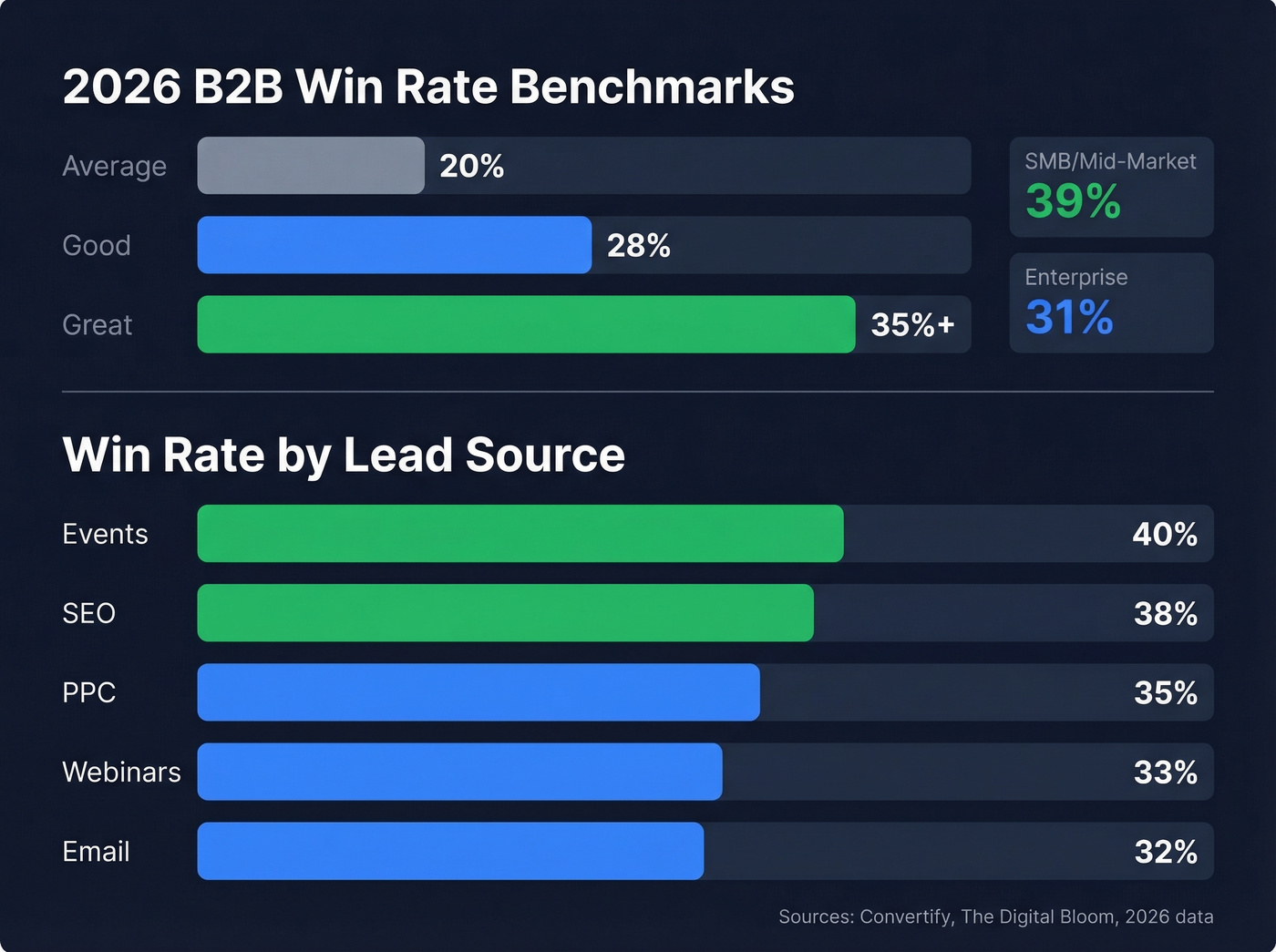
Convertify's analysis of 500+ B2B companies breaks win rates into tiers:
| Tier | Win Rate |
|---|---|
| Average | 20% |
| Good | 28% |
| Great | 35%+ |
Company size matters. SMB and mid-market teams close at about 39%, while enterprise deals convert at roughly 31%. More stakeholders, longer cycles, more places for deals to stall. If you’re pressure-testing your numbers, compare against broader sales pipeline benchmarks and your own sales conversion rate by segment.
Lead source matters too, based on 2026 B2B SaaS benchmarks:
| Source | Opp-to-Close Rate |
|---|---|
| Events | 40% |
| SEO | 38% |
| PPC | 35% |
| Webinars | 33% |
| 32% |
For B2B SaaS specifically, demo-to-close runs 20-30%. Professional services firms see proposal-to-close rates of 40-60%. Your benchmark depends on your segment and sales motion - don't compare your enterprise SaaS win rate to an agency's close rate and panic.
CRM Setup for Closed Won
Salesforce Setup
In Salesforce, opportunity stages are configured with three properties: Stage Name, Probability, and Type (Open, Closed Won, or Closed Lost). The path: Setup > Object Manager > Opportunity > Fields & Relationships > Stage. You'll need admin permissions. If you’re evaluating tools or migrating, it helps to review a few examples of a CRM and the best sales forecasting solutions for your reporting needs.
Each stage needs a probability that reflects your actual conversion data, not Salesforce's defaults. If your Negotiation stage converts at 70%, set it to 70% and audit these quarterly against real outcomes. One common trap flagged on r/salesforce: teams that auto-update opportunities based on quote status create reporting gaps where deals appear won before anyone actually confirmed the sale. Always require a manual stage change or a validated automation trigger.
HubSpot Workflows
HubSpot's real power at this stage is automation. A solid sales-to-ops handoff workflow triggers on Deal Stage = "Closed Won" and then:
- Creates an ops task with production specs
- Creates a service ticket titled "New Order: [Deal Name]"
- Assigns by territory or product line
- Notifies the CS rep
For post-sale revenue, add a 90-day delay after the deal closes, then create a rep task to check reorder potential. Simple, but most teams don't bother setting it up. If you want to systematize the handoff itself, keep a ready-to-send handoff email template in your enablement library.
One gotcha: HubSpot workflows can't natively create a Product object record. If you need that, you're looking at a custom-coded workflow action via the API. Not hard, but it trips up teams that assume everything is drag-and-drop.
Why Deals Die at the Finish Line
Three failure modes kill deals at the closing stage, and they're all preventable.
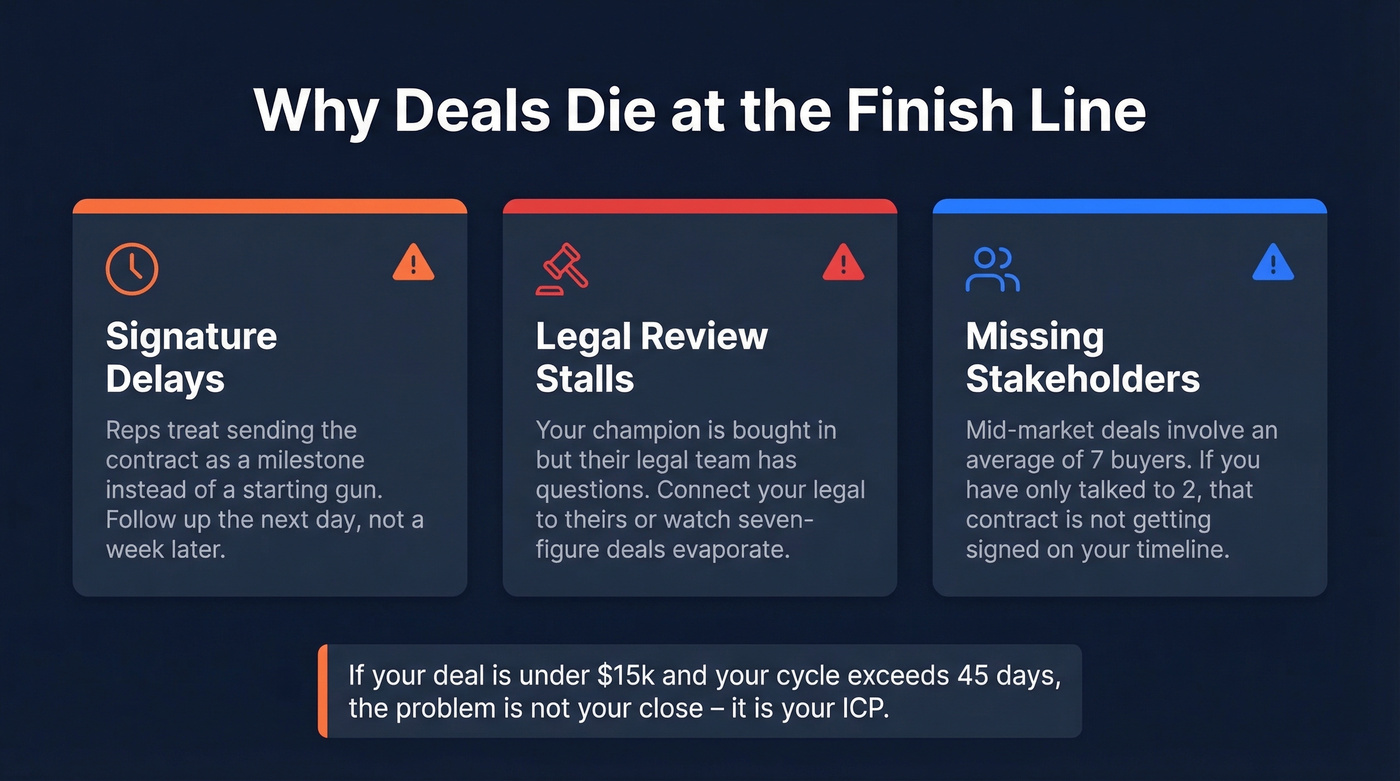
Signature delays happen when reps treat "sent the contract" as a milestone instead of a starting gun. The contract isn't the finish line - the signature is. Follow up the day after sending, not a week later. (If your team needs a repeatable cadence, build it into your AI sales follow-up workflow.)
Legal review stalls are the silent killer. Your champion is bought in, but their legal team has questions about indemnification clauses. If you don't have a process for connecting your legal team to theirs, deals sit in limbo until someone loses interest. We've watched seven-figure deals evaporate this way.
Missing stakeholders surface late because reps didn't multi-thread early enough. Mid-market buying decisions involve an average of 7 people. If you've only talked to two of them, that contract isn't getting signed on your timeline. This is where account-based selling best practices and clear team selling roles stop deals from stalling.
Let's be honest: if your deal size is under $15k and your average sales cycle exceeds 45 days, the problem isn't your closing technique. It's that you're selling to the wrong accounts. Fix your ICP before you fix your close.
Learning from Your Wins and Losses
This is where most teams fall apart. 91% of CRM data is incomplete. 70% of it becomes inaccurate within a year. And 60% of sellers are partially or completely wrong about why they lost a deal.
So when you pull a report on win reasons and see "better product fit" as the top answer, what are you actually learning? Nothing. You're reading what a rep typed into a dropdown three weeks after the deal closed.
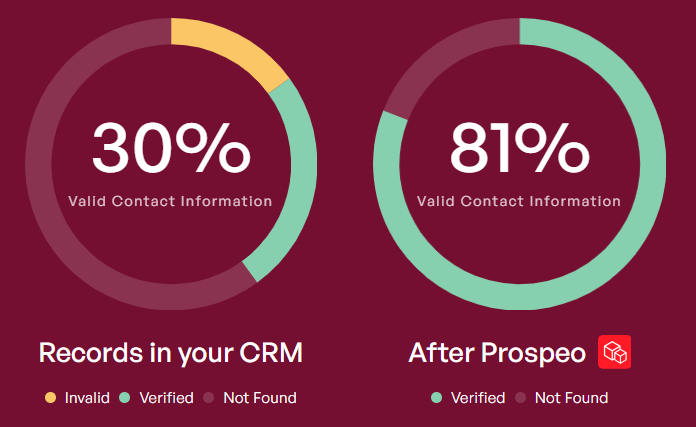
The fix starts with buyer interviews - actually talking to the people who bought or didn't. But interviews are only useful if the underlying contact data is accurate enough to identify the right people to interview. If contacts decay every few weeks, your pipeline reports reflect last quarter's org chart, not reality. Prospeo's 7-day data refresh cycle and 98% email accuracy across 300M+ profiles keep your CRM current, so when you run that win/loss analysis, you're working with contacts who still hold the titles and roles your reports say they do. If you’re comparing vendors, start with the landscape of data enrichment services.
Beyond interviews, use your won-deal data to refine your ICP. Look for patterns across your wins: which industries, company sizes, tech stacks, and buying triggers show up repeatedly? That pattern is your product-market fit signal. Teams that systematically analyze closed won deals build sharper targeting and shorter cycles over time. A practical next step is to formalize an ideal customer profile and keep it updated as your win data changes.
How to Increase Your Win Rate
Start by disqualifying faster. MEDDIC and BANT exist for a reason - they force reps to identify bad-fit deals before investing weeks of effort. A higher win rate often comes from fewer, better-qualified opportunities, not from closing harder. If you’re rolling MEDDIC out, use a structured set of MEDDIC discovery questions to keep qualification consistent.
Reach the right decision-makers early. You can't close a deal if you're emailing the wrong person. Prospeo's enrichment returns 50+ data points per contact with a 92% API match rate, so reps talk to people who can actually sign.
Nail the post-close handoff. The best handoff documents include why the customer bought, their success metrics, key stakeholders and champions, objections that came up, and alternatives they evaluated. Schedule the kickoff call before the deal closes - not after. Onboarding engagement within 48 hours of signature is closely tied to retention.
Skip the "closing technique" courses if your pipeline is full of bad-fit accounts. No amount of objection handling fixes a fundamentally misaligned ICP.
And track your win rate by lead source. If events close at 40% and webinars close at 33%, that's a resource allocation signal your marketing team needs yesterday.
A 22% win rate means 78% of your pipeline dies. Bad contact data is the silent killer - 35% bounce rates, wrong numbers, stale emails. Prospeo refreshes every 7 days and delivers 98% email accuracy at $0.01 per lead.
Stop losing winnable deals to outdated data.
FAQ
Can you reopen a closed-won deal?
Most CRMs allow it, but reopening a won deal counts it twice in pipeline reports and corrupts your win-rate math. Create a new opportunity linked to the original instead - your historical metrics stay clean and the new deal gets its own timeline and stage tracking.
Does a verbal agreement count as closed won?
No. Mark a deal won only when the contract is signed or payment is received. Verbal commits inflate forecasts and erode CRM trust. Keep verbal agreements at Negotiation/Review with high probability and follow up daily until the signature lands.
What's a good closed-won rate?
Average is 20%, good is 28%, great is 35%+. Enterprise deals typically close at ~31% while SMB teams hit ~39% due to fewer stakeholders. Compare against your segment and lead source - not industry-wide averages - for a meaningful benchmark.
What triggers should fire when a deal hits closed won?
At minimum: a CS handoff notification with deal context, an onboarding task creation, a revenue recognition update for finance, and a congratulations message to the rep. Most teams also trigger account provisioning and a 90-day check-in task for expansion opportunities.
How do you keep CRM data accurate for win/loss reporting?
Use enrichment tools that refresh contact data automatically rather than relying on reps to update records manually. A 7-day refresh cycle and verified email accuracy ensure your pipeline reflects current reality - not stale job titles from six months ago.