

Cold Email Conversion Rate in 2026: Real Benchmarks, Real Data
Eighteen months ago, a mid-market SDR team we know was pulling an 8% reply rate on cold email. Solid numbers, consistent pipeline, predictable revenue. By early 2026, that same team - same ICP, same copy framework, same tools - was sitting at 3%. Nobody changed anything. The channel just got harder underneath them.
That story isn't unique. If you're tracking your cold email conversion rate, you're probably living some version of it right now.
Cold email isn't the only outbound channel, but it's the one with the most measurable funnel - and the one where data quality has the highest impact on results.
Fix Priority
The average cold email reply rate in 2026 is 3.43%. Top quartile teams hit 5.5%+. Elite campaigns crack 10.7%+. But "conversion rate" means different things at different funnel stages, and most benchmarks conflate all of them into a single useless number.
Here's the order that matters:
- Verify your data. Bad emails bounce, bounces tank your domain reputation, and a burned domain means every future campaign lands in spam. (If you want a deeper breakdown, start with email bounce benchmarks and fixes.)
- Fix authentication. SPF, DKIM, DMARC - skip these and you're invisible to half your list. (Use an email deliverability checklist and confirm DKIM is working.)
- Then optimize copy. Subject lines, personalization, length - all of it matters, but only after steps 1 and 2 are locked down. (See cold email subject line examples and email copywriting.)
Your conversion problem is almost certainly a data quality problem, not a copywriting problem. Let's prove it.
What "Conversion" Actually Means in Cold Email
When someone says "our conversion rate is 5%," that could mean reply rate, positive reply rate, meeting booking rate, or deal close rate. Wildly different numbers. Most benchmarks are useless because they mash all four into one figure. (This is the same issue you see in broader funnel metrics reporting.)
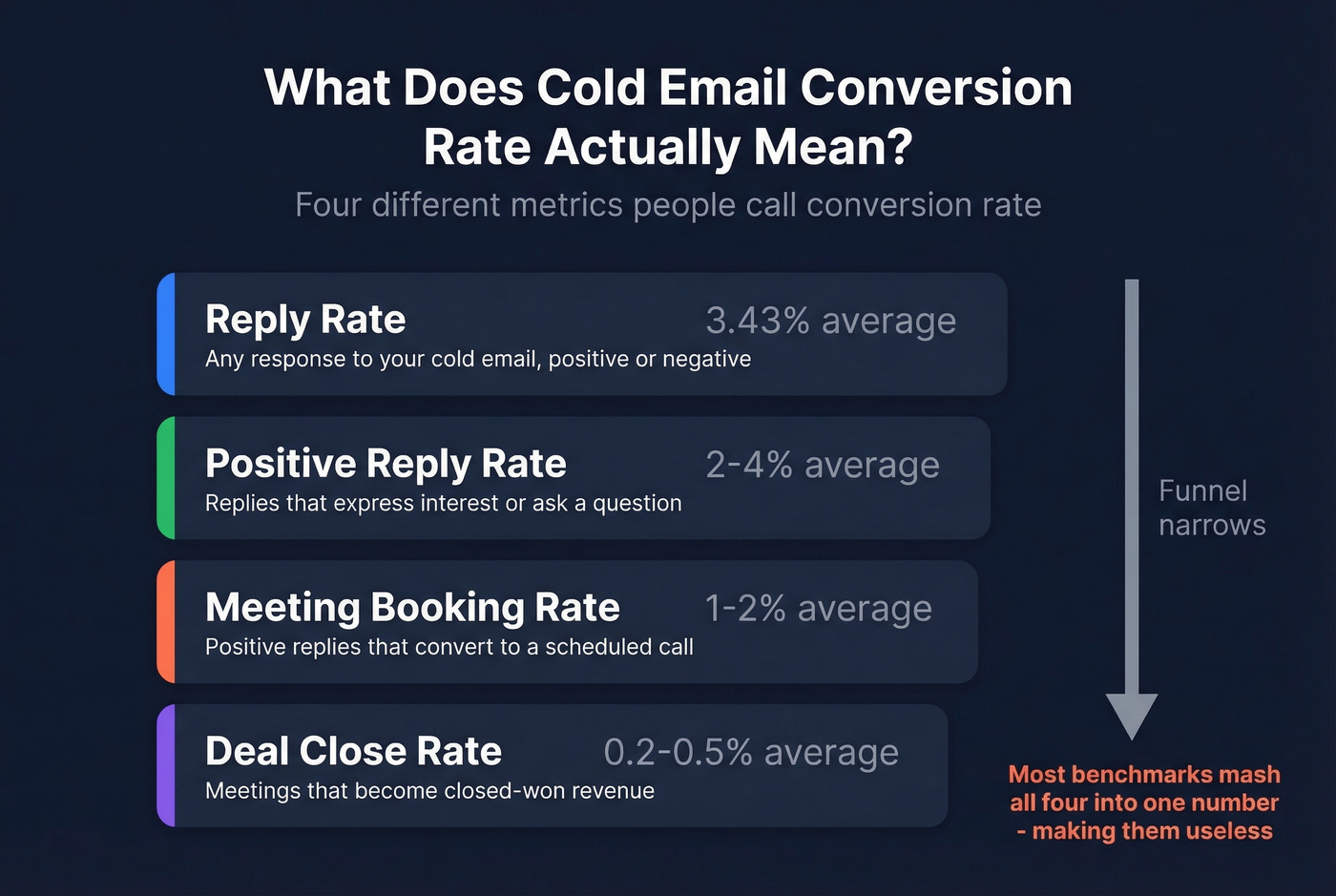
Martal's metrics hierarchy breaks cold email measurement into three tiers:
- Tier 1 - Revenue outcomes: qualified opportunities, pipeline value, closed-won revenue, cost per deal.
- Tier 2 - Conversion health: reply rate, positive reply rate, meeting booking rate, show rate.
- Tier 3 - Activity metrics: opens, clicks, bounce, unsubscribe.
Tier 3 is mostly noise in 2026. Throughout this article, we specify which stage we mean when we say "conversion rate." A 3.43% reply rate and a 0.2% deal conversion rate are both technically "conversion rates," but they describe completely different realities.
Benchmarks by Funnel Stage
Here's a practical funnel model stitched together from Instantly's 2026 benchmark report, Belkins' 16.5M-email study, Martal's opportunity benchmarks, and practitioner data from r/coldemail. No single dataset covers every step.
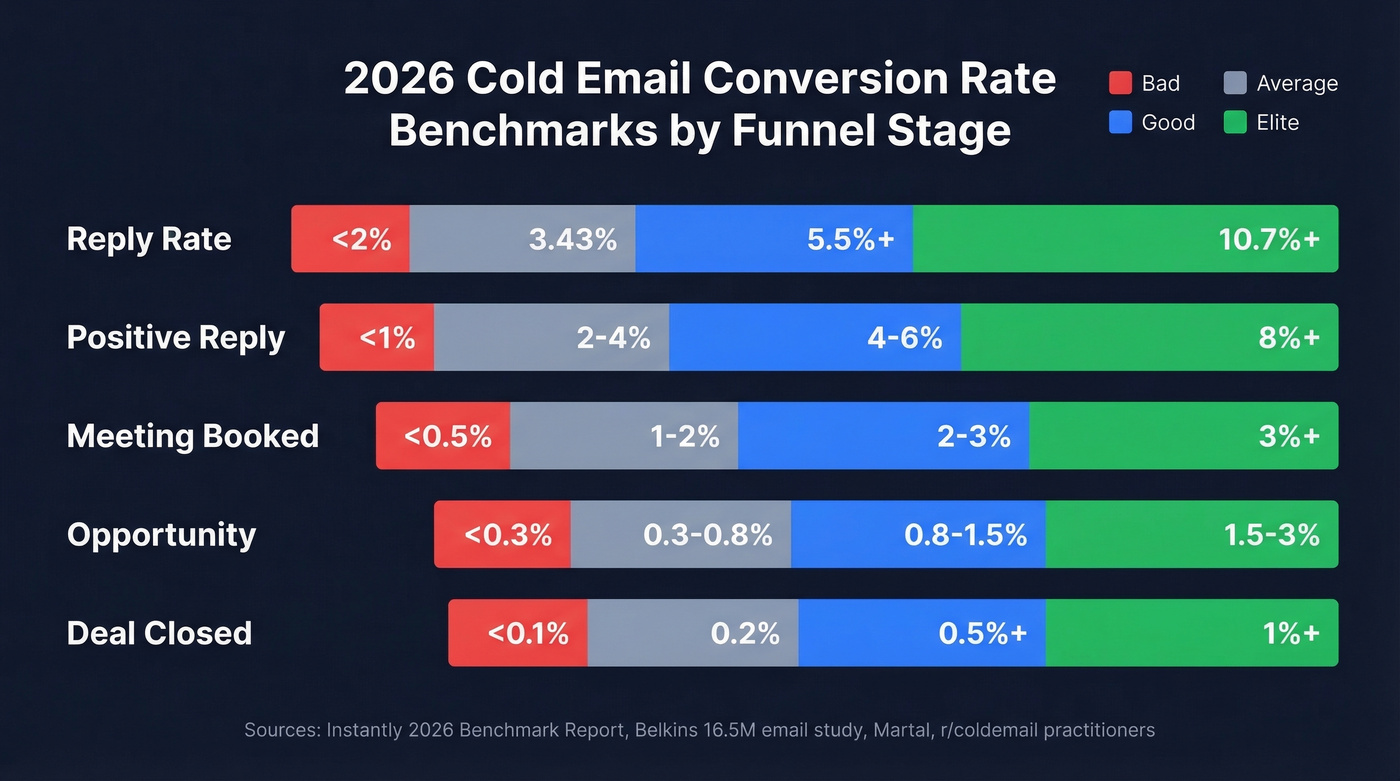
| Funnel Stage | Bad | Average | Good | Elite | Source |
|---|---|---|---|---|---|
| Sent | 100% | 100% | 100% | 100% | Baseline |
| Opened | - | 31-46% (unreliable) | - | - | Belkins (2024 swings) |
| Replied | <2% | 3.43% | 5.5%+ | 10.7%+ | Instantly 2026 |
| Positive Reply | <1% | 2-4% | 4-6% | 8%+ | r/coldemail practitioners |
| Meeting Booked | <0.5% | 1-2% | 2-3% | 3%+ | r/coldemail practitioners |
| Opportunity | <0.3% | 0.3-0.8% | 0.8-1.5% | 1.5-3% | Martal |
SoPro's compilation of outreach statistics puts the average response rate at 5.1%, with anything above 2% considered solid for meaningful cold email conversions. Industry variance exists too - SaaS and professional services cluster at the higher end of these ranges, while manufacturing and construction run lower. But the funnel-stage distinction matters more than vertical.
Here's the thing: an average ~0.2% deal conversion rate (around 1 deal per ~500 emails) includes every campaign with garbage data, no authentication, and spray-and-pray targeting. It's a floor created by bad operators, not a ceiling. Teams running verified lists with proper infrastructure routinely hit 0.5%+ deal conversion - a 3-5x improvement that compounds across thousands of sends.
Open rates are included for completeness, but treat them as decorative. Apple Mail Privacy Protection inflates them, Belkins stopped tracking opens mid-2024, and they don't correlate with revenue. Belkins found that disabling open-tracking pixels improved response rates by 3% - the tracking itself was hurting deliverability. Reply rate is the only reliable engagement metric. (If you still need to use opens, understand email tracking pixels first.)

The benchmarks are clear: bad data is the #1 cold email conversion killer. Prospeo's 5-step verification delivers 98% email accuracy with a 7-day refresh cycle - so your list never goes stale between build and send. Stack Optimize built a $1M agency on it with bounce rates under 3%.
Stop optimizing subject lines on a list that's 11% invalid.
Why Outreach Conversion Rates Keep Declining
The 2023-to-2026 decline isn't about your copy getting worse. It's structural.
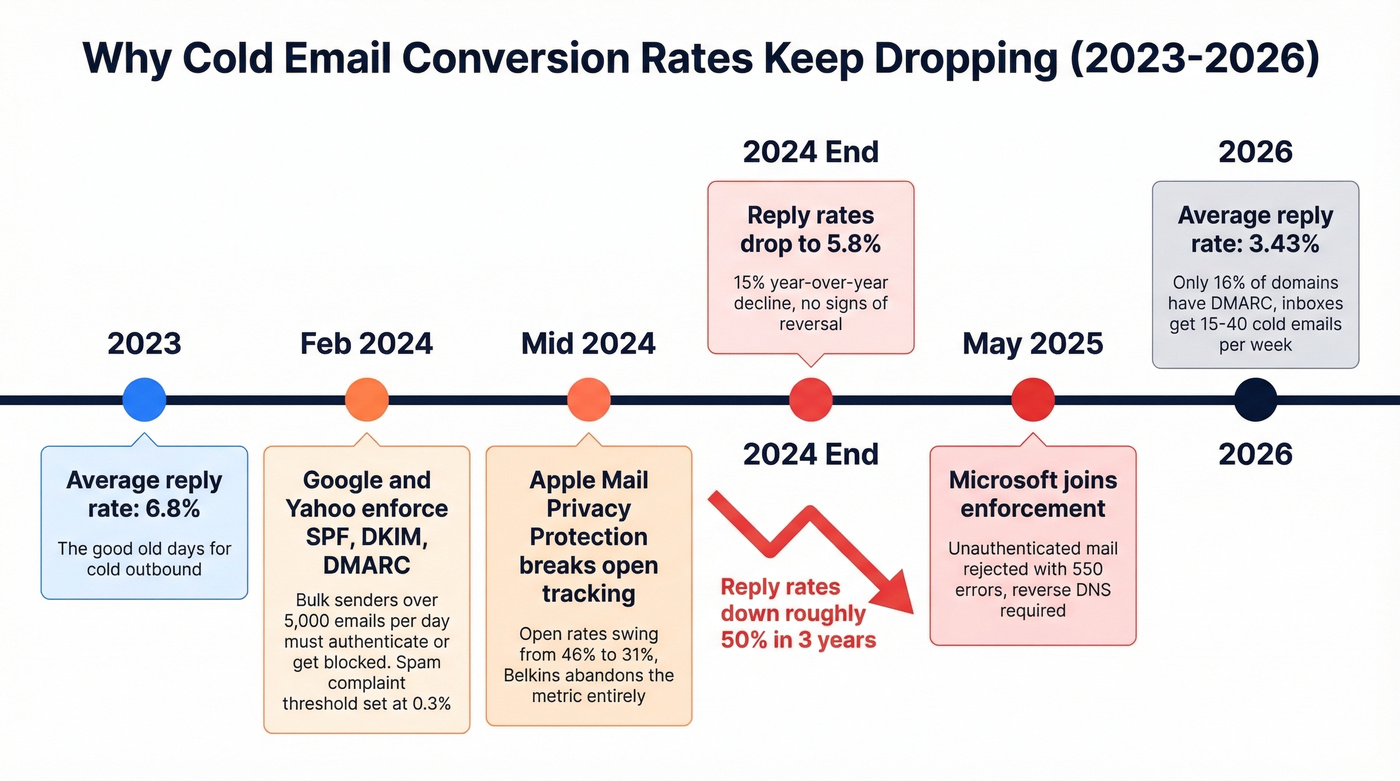
Inbox providers got aggressive. In February 2024, Google and Yahoo rolled out bulk sender requirements - SPF, DKIM, and DMARC became mandatory for anyone sending over 5,000 emails per day, with a hard spam complaint threshold of 0.3%. In May 2025, Microsoft followed with its own enforcement, rejecting unauthenticated mail with a 550 5.7.515 error and pushing senders to have proper reverse DNS records. Miss one of these, and you risk throttling, junk placement, or outright rejection. (If you're troubleshooting, start with sender reputation and email reputation tools.)
Open tracking broke. Apple's Mail Privacy Protection prefetches tracking pixels, making open rates unreliable for most B2B audiences. Belkins' 16.5M-email study showed open rates swinging from 46% to 31-32% within 2024, before they abandoned the metric entirely.
Inboxes are crowded. Decision-makers receive 15-40 cold emails per week. Only 16% of domains have implemented DMARC, leaving 84% without it. Year-over-year data shows average reply rates dropped from 6.8% in 2023 to 5.8% in 2024 - a 15% decline that hasn't reversed.
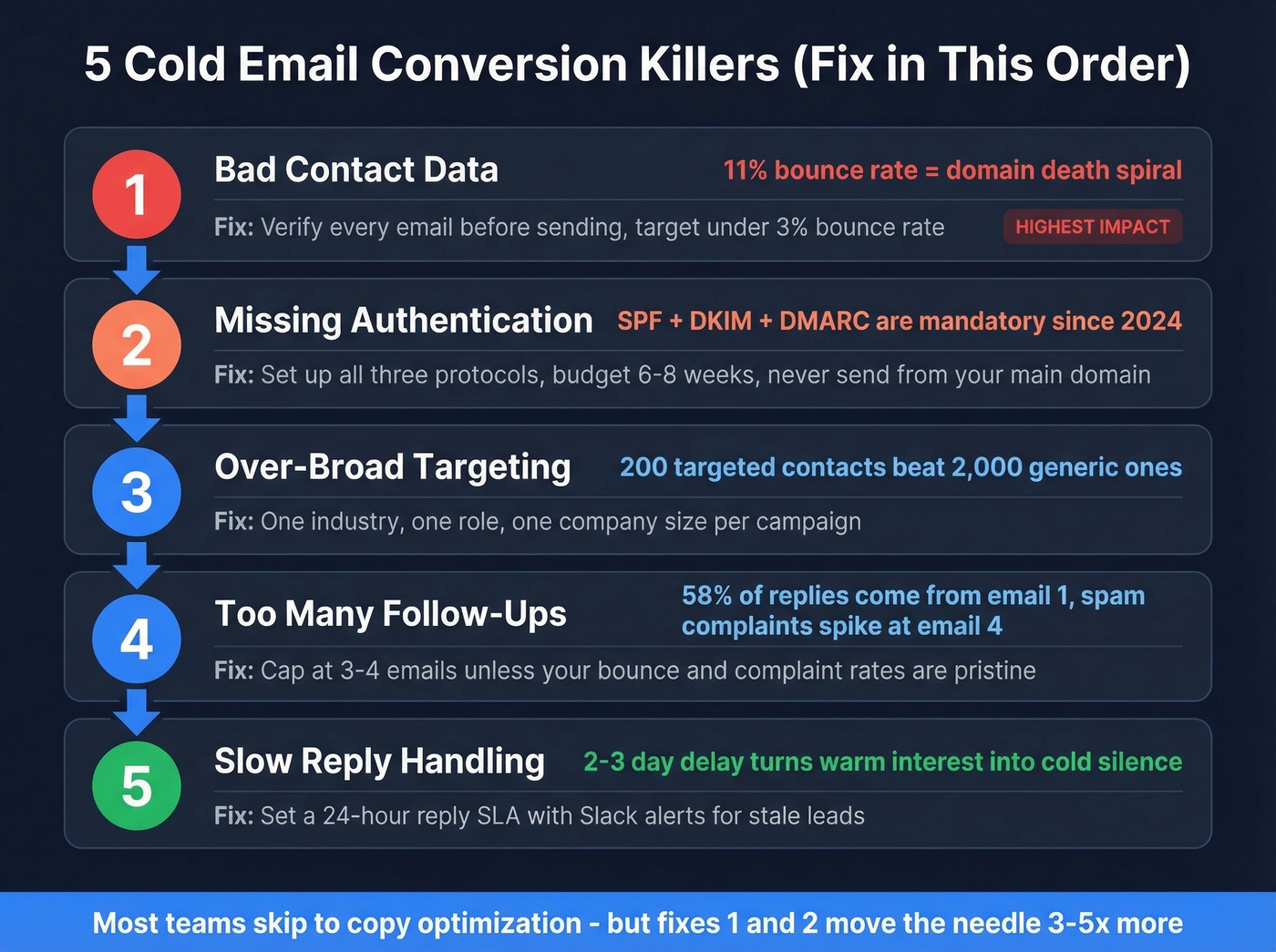
Five Conversion Killers to Fix
1. Bad Contact Data
You send 1,000 emails. 110 bounce. Your bounce rate hits 11%, and your sending domain's reputation enters a death spiral. Future emails - even to valid addresses - land in spam. In audits we've run, some campaigns show effective deliverability as low as 40%, meaning 60% of emails never reach a human inbox.
This is the single fastest way to destroy a cold email program.
The fix is straightforward: verify every email before it enters a sequence. Prospeo's 5-step verification with catch-all handling, spam-trap removal, and honeypot filtering delivers 98% email accuracy, and the 7-day data refresh cycle means contacts don't go stale between list build and send. Stack Optimize, an outbound agency that scaled to $1M ARR, runs this verification on every client list - 94%+ deliverability, bounce rates under 3%, zero domain flags. (If you're cleaning lists at scale, see spam trap removal.)
2. Missing Authentication
Without SPF, DKIM, and DMARC properly configured, your emails either bounce or land in spam. Post-2024 enforcement, this is table stakes. Implement all three protocols and budget 6-8 weeks for setup and monitoring. Start with SPF and DKIM, then layer DMARC with a monitoring-only policy before moving to enforcement. (If you get stuck, DMARC alignment and an SPF record example help.)
Never send from your main business domain. Use dedicated outbound domains with clean reputations.
3. Over-Broad Targeting
Look - if your list spans five industries, three company sizes, and twelve job titles, every email you write is generic enough to fit all of them, which means it resonates with none of them. The consensus on r/coldemail is clear: spray-and-pray targeting is the most common reason campaigns underperform.
Narrow your ICP to one industry-role-company size combination per campaign. A 200-person list of VP-level ops leaders at Series B SaaS companies will outperform a 2,000-person list of "decision-makers" every time. Smaller lists also let you personalize at a level that actually moves reply rates - and that's where the gap between average and elite teams really shows up. (Use an ideal customer profile template if you need a scoring rubric.)
4. Too Many Follow-Ups
Before: 7-email sequence, aggressive cadence. Spam complaints escalate from 0.5% on the first email to 1.6% by the fourth. Unsubscribes hit 2% by round four. Replies drop 55% compared to earlier emails. You're actively damaging your domain reputation with every send.
After: 3-4 emails total, spaced intelligently. Instantly's data shows 58% of replies come from the first email and 42% from follow-ups, with 4-7 touchpoints cited as optimal. But spam complaint data shows real damage starts showing up hard by email 4. Our recommendation: cap at 3-4 unless your bounce and complaint rates are pristine enough to justify a fifth. (For sequences, see cold email follow-up templates.)
5. Slow Reply Handling
A prospect replies with interest on Tuesday. Your team doesn't see it until Thursday because it's buried in a shared inbox. By then, the moment's gone.
We've seen this pattern kill meeting conversion rates more than any copy issue. Set a 24-hour reply SLA. Flag any lead response that hasn't gotten a human reply within that window - Slack alerts, daily "stale replies" sweeps, whatever works. A 2-3 day response delay turns warm interest into cold silence. (If you need messaging, borrow from sales follow-up templates.)
Teams using verified data book 26% more meetings than ZoomInfo users and 35% more than Apollo. At $0.01 per email, fixing your conversion rate costs less than one bounced campaign costs your domain reputation.
Move from average 3.43% reply rates to top-quartile - start with the data.
Cost Per Deal: The Real Math
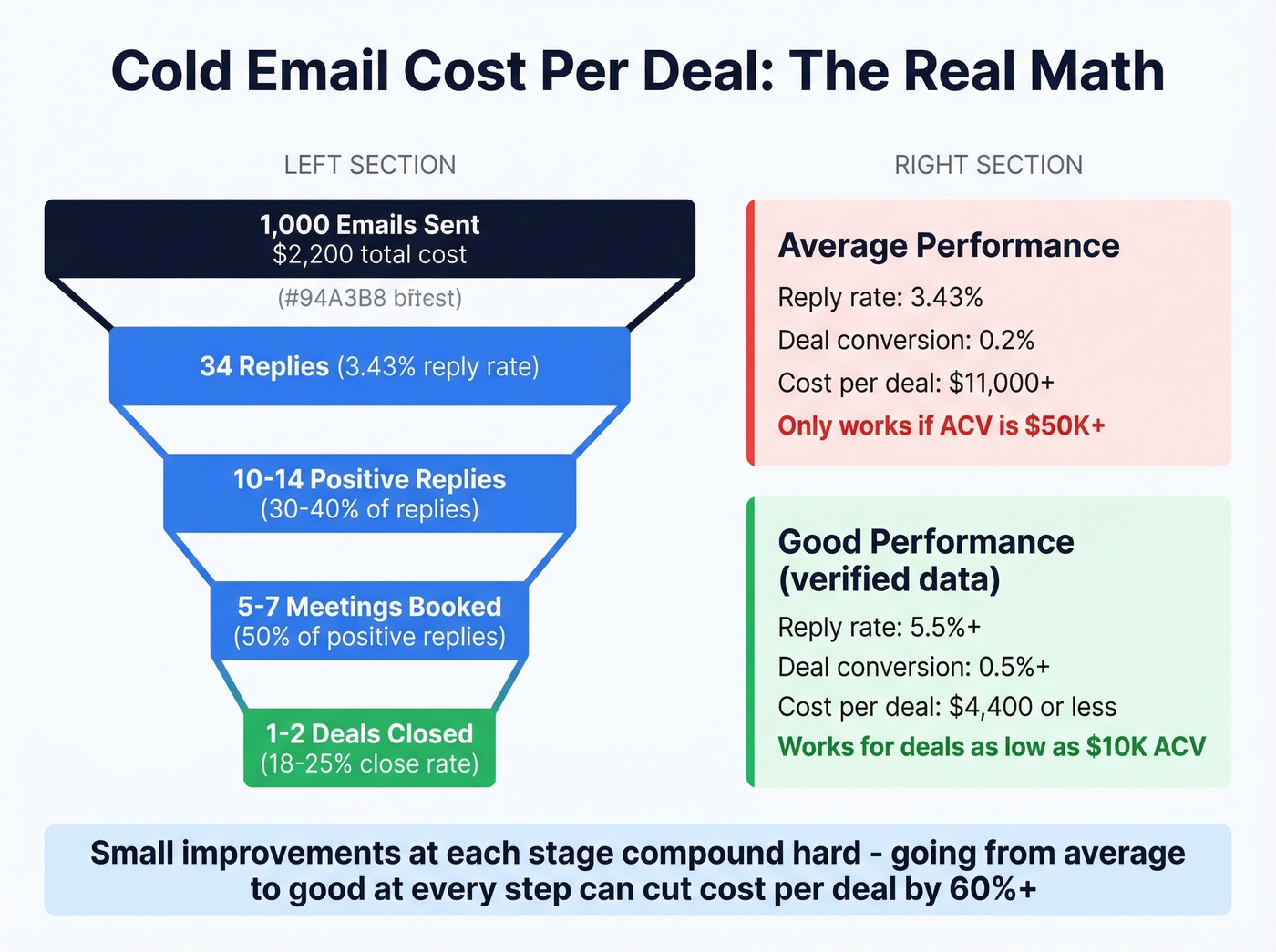
MarketOwl estimates an in-house cold email campaign targeting 1,000 contacts costs roughly $2,200 total.
| Cost Line | Per 1,000 Contacts |
|---|---|
| Contact search + verification | $530-$2,000 |
| Personalization / message prep | $800-$1,000 |
| Sending infrastructure | ~$480 |
| Follow-ups labor + reply handling | ~$400 |
| Total (in-house) | ~$2,200 |
A clean way to model expected output:
Expected deals = emails sent x reply rate x (positive replies / replies) x (meetings / positive replies) x (closed-won / meetings).
Martal's benchmark close rate on email-sourced opportunities is 18-25%, which is why small improvements at each funnel stage compound so hard. (If you want broader context, compare against the average B2B lead conversion rate.)
Hot take: If your average deal size is under $10K, you probably can't afford average cold outreach performance. You need to be in the "good" tier minimum, which means verified data and proper infrastructure aren't optional - they're the only way the unit economics work. Skip this if you're selling $50K+ ACV deals where even a 0.2% conversion rate pencils out.
Case Study: 3% to 6% Reply Rate
A practitioner on r/Entrepreneur documented a turnaround that mirrors the SDR team from our intro. Here's what changed.
They scaled from 3 domains to 7, capping each at 26 emails per day to stay under provider radar. They stopped buying third-party lists and switched to manual email verification - bounce rate dropped from 11% to under 2%. Email length got cut from 141 words to under 56. Sending windows narrowed to Tuesday through Thursday, 8-11am in the recipient's timezone. (If you're tuning volume, use email velocity as your guardrails.)
Total stack cost: $420/month. Output: 16 qualified leads per month at ~$26 per lead. Reply rate: 6% - double where they started. The copy changes helped, but clean data and proper sending setup did the heavy lifting. That's the pattern we see over and over again.
FAQ
What's a good cold email conversion rate?
Average reply rate in 2026 is 3.43%; top quartile hits 5.5%+, and elite campaigns exceed 10.7%. For deal conversion, average teams close around 0.2% of emails sent while optimized programs reach 0.5%+. Always specify which funnel stage you mean - replies, meetings, and closed deals are very different numbers.
How many emails does it take to close one deal?
At average performance, expect roughly 464-500 emails per closed deal. Elite teams with verified data and tight targeting close in 150-200. The gap is almost entirely data quality and targeting precision, not send volume.
Are open rates still worth tracking?
No. Apple Mail Privacy Protection inflates them, and Belkins stopped tracking opens mid-2024 after seeing wild swings. Reply rate is the only reliable engagement metric. Disabling open tracking actually improved response rates by 3% in their experiments.
How does email verification improve conversions?
Bad emails bounce, bounces tank domain reputation, and a damaged domain means future emails land in spam - even to valid addresses. Keeping bounce rates under 3% protects the deliverability that every other optimization depends on. Fix data first, optimize copy second.
The teams pulling 6%+ reply rates in 2026 aren't running better subject lines. They're running cleaner data, proper authentication, and tighter targeting - in that order. Your cold email conversion rate is a lagging indicator of infrastructure decisions you made weeks ago.