

Cold Email Frameworks That Get Replies (and Why Most Don't)
Every "proven cold email template" has a shelf life. Once it spreads across Reddit and sales blogs, prospects recognize the pattern and ignore it. The opener that worked in 2022 is spam-folder wallpaper now.
The frameworks that still get replies in 2026 aren't clever copy tricks. They're structural principles paired with operational discipline - the kind of stuff that doesn't make for a sexy headline but actually moves reply rates. AI can scale personalization, but it still needs a structural backbone. Here's what separates the approaches that work from the ones filling spam folders.
What You Need (Quick Version)
- Your default framework: QVC (Question, Value Prop, CTA). Three to five sentences. Works for 80% of cold outreach.
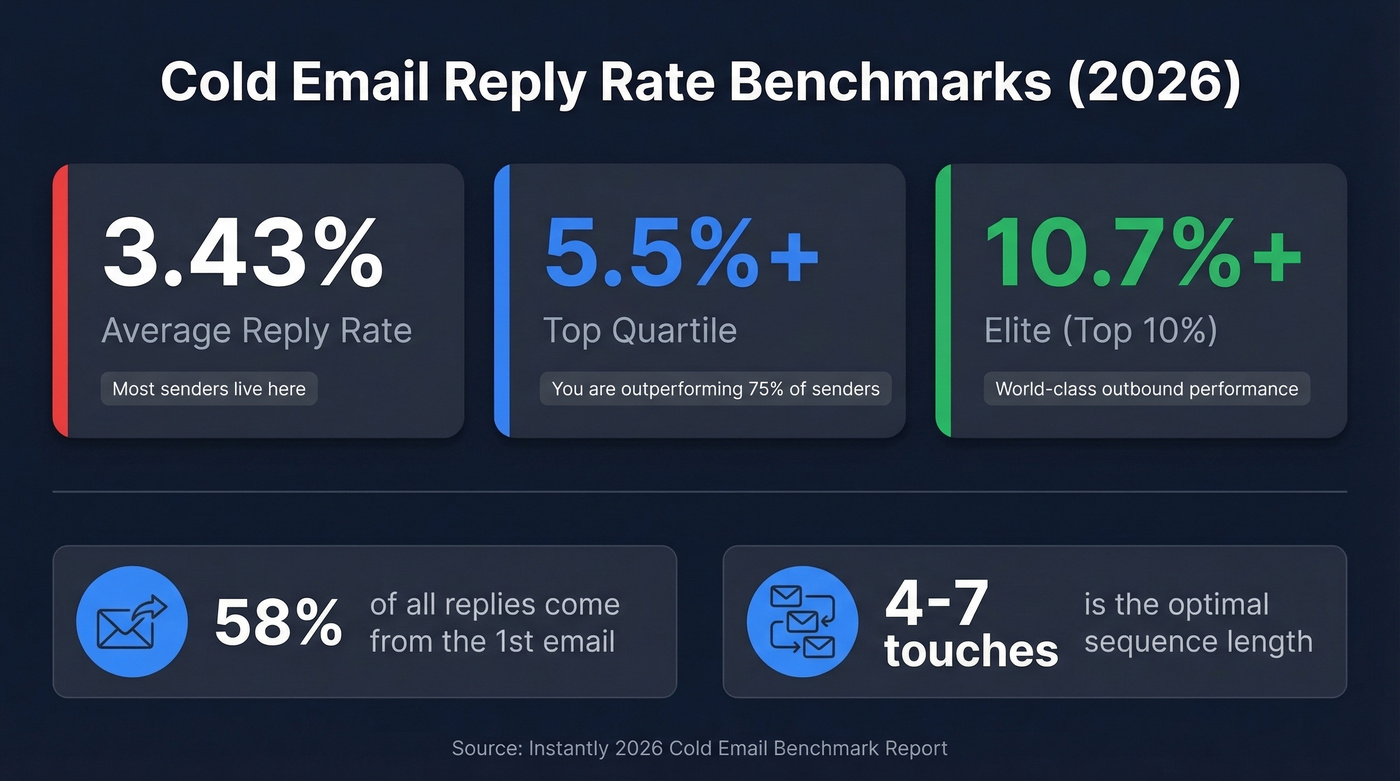
- Your benchmark: Average reply rate is 3.43%. Above 5.5%, you're top quartile. Above 10.7%, you're elite.
- The thing nobody tells you: Frameworks don't matter if your emails land in spam. Verify your list, warm your domains, send around 26-30 emails per day per domain.
Benchmarks - What "Working" Means
Instantly's benchmark report analyzed billions of cold email interactions:
| Metric | Number |
|---|---|
| Average reply rate | 3.43% |
| Top quartile | 5.5%+ |
| Elite (top 10%) | 10.7%+ |
| Replies from 1st email | 58% |
| Optimal sequence length | 4-7 touches |
Department matters too. Lavender's analysis of 231,818 cold emails found Engineering and Product teams reply at 5.2%, while HR sits at 3.4%. When sellers wrote A-grade emails to HR, reply rates jumped 27%.
Only 5% of senders personalize every email. Those who do see 2-3x better results. The bar is embarrassingly low. Clear it.

Frameworks only work when emails reach real inboxes. Prospeo's 5-step verification delivers 98% email accuracy - teams using it cut bounce rates from 35% to under 4% and tripled pipeline. Stop A/B testing copy that lands in spam.
Verify your list before you send another cold email.
Six Frameworks That Actually Work
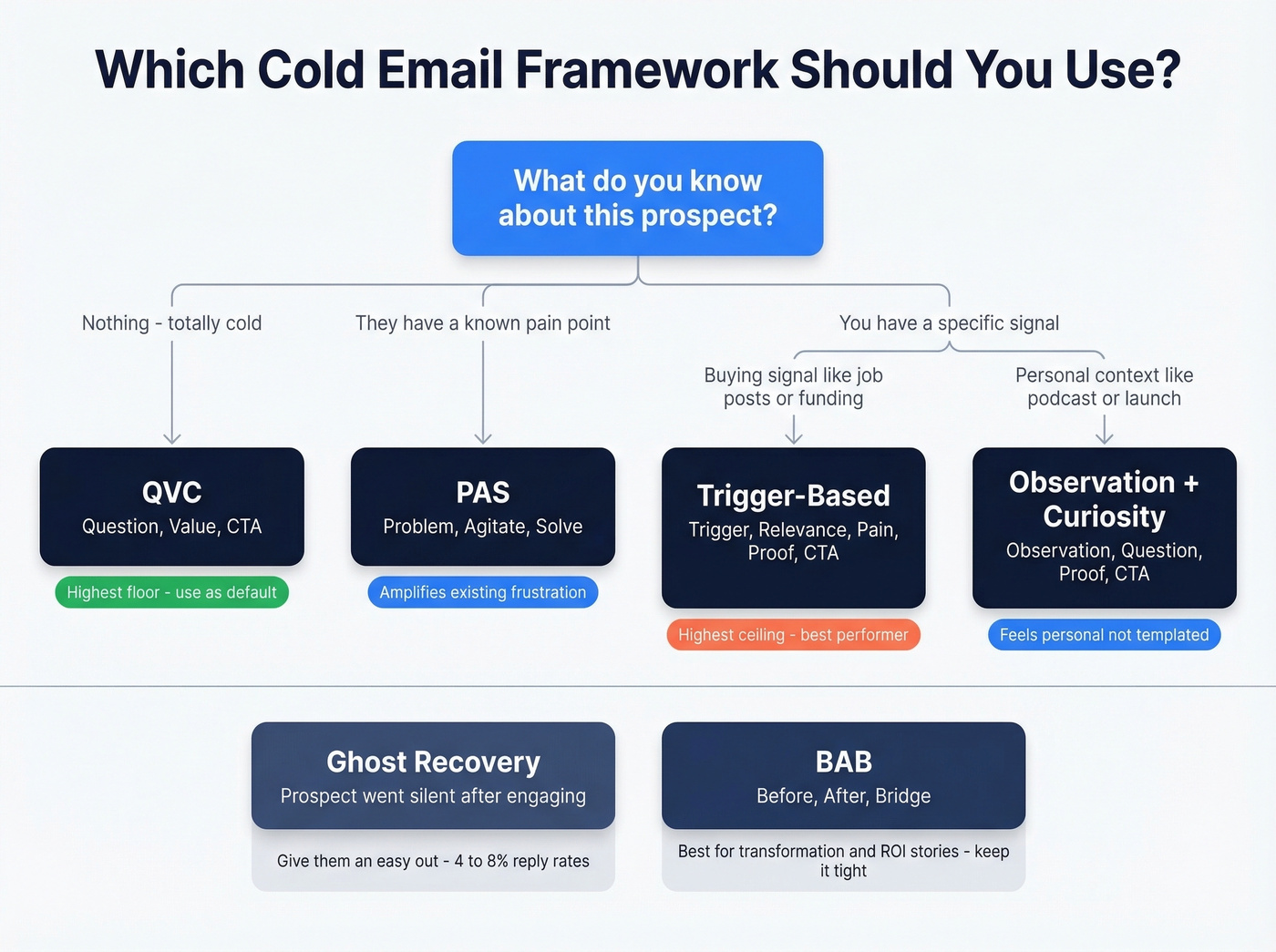
You'll find lists of 16+ frameworks elsewhere. Most are variations of these six. Master them and you won't need the rest - pick based on the situation, not personal preference.
| Prospect Situation | Framework | Why |
|---|---|---|
| Cold, no prior signal | QVC | Simplest; highest floor |
| Aware of their pain | PAS | Amplifies existing frustration |
| Showing buying signals | Trigger-Based | Relevance beats copywriting |
| Specific observation available | Observation + Curiosity | Feels personal, not templated |
| Went silent after engagement | Ghost Recovery | Low-pressure re-engagement |
| Transformation/ROI story | BAB | Paints the before/after contrast |
QVC (Question, Value, CTA)
Your workhorse. Open with a question tied to a real problem, deliver one value prop, close with a single CTA. No "My name is..." opener - ever. We've tested QVC against PAS for completely cold prospects across dozens of campaigns, and QVC wins about 3:1.
"Are your reps spending more time finding contacts than actually selling? We help teams like [similar company] cut list-building from 6 hours to 45 minutes. Worth a 15-minute look?"
Use QVC when you have no signal and need a reliable starting point.
PAS (Problem, Agitate, Solve)
Best for prospects who already know they have a problem. Name the pain, twist the knife gently, present your solution as the obvious fix.
"Most outbound teams bounce 8-12% of their lists. That's not just wasted sends - it's domain reputation damage compounding every week. We fix that in one upload."
Don't manufacture urgency that isn't there. PAS works when the pain is real and widely felt. If you're stretching to articulate the problem, QVC is probably the better call.
Trigger-Based Flow
This is the framework we get most excited about, because it consistently outperforms generic outreach when you have the right signal. The structure: Trigger, Relevance, Pain, Urgency, Proof, Offer, CTA.
High-signal triggers to watch: 3+ SDR roles posted on a careers page, Series A announced, Head of Sales promoted, CRM switch detected. The trigger line does the heavy lifting - "Saw you're scaling the sales org - 4 new AE openings went live last week." Relevance beats copywriting every time. Invest in signal detection, not wordsmithing. Tools with intent data tracking let you layer buying signals with job role and company growth filters so your trigger emails hit prospects already in-market.
If you want a deeper system for finding and scoring those signals, see buying signals and the operational playbook on track sales triggers.
Observation + Curiosity
Open with something specific - a podcast appearance, a product launch, a hiring pattern. Follow with a curiosity question, brief proof, and a casual CTA.
"Saw your team just launched [feature]. Curious - are you handling the inbound spike with the same SDR count?"
This one's best for warm-adjacent prospects where you have genuine context. Skip it if you're faking the observation. Prospects can tell.
Ghost Recovery
For prospects who engaged then went silent. Keep it short:
"Hey [Name] - circling back. Totally fine if timing's off. Worth revisiting, or should I check back next quarter?"
No guilt trips. No "just bumping this up." Give them an easy out and you'll get more honest replies. We've seen ghost recovery sequences pull 4-8% reply rates when the original thread had genuine engagement.
If you need more follow-up patterns, borrow from these sales follow-up templates and cold email follow-up templates.
BAB (Before, After, Bridge)
Paint the current state, show the transformed state, bridge with your solution.
"Before: 3-hour list builds, 11% bounce rates. After: verified lists in minutes, bounce under 2%. The bridge: [your product]."
Keep it tight. BAB gets bloated fast, and the moment it reads like a case study instead of an email, you've lost them.
Subject Lines - What 85M Emails Reveal
An analysis of 85M+ cold emails surfaced clear patterns:
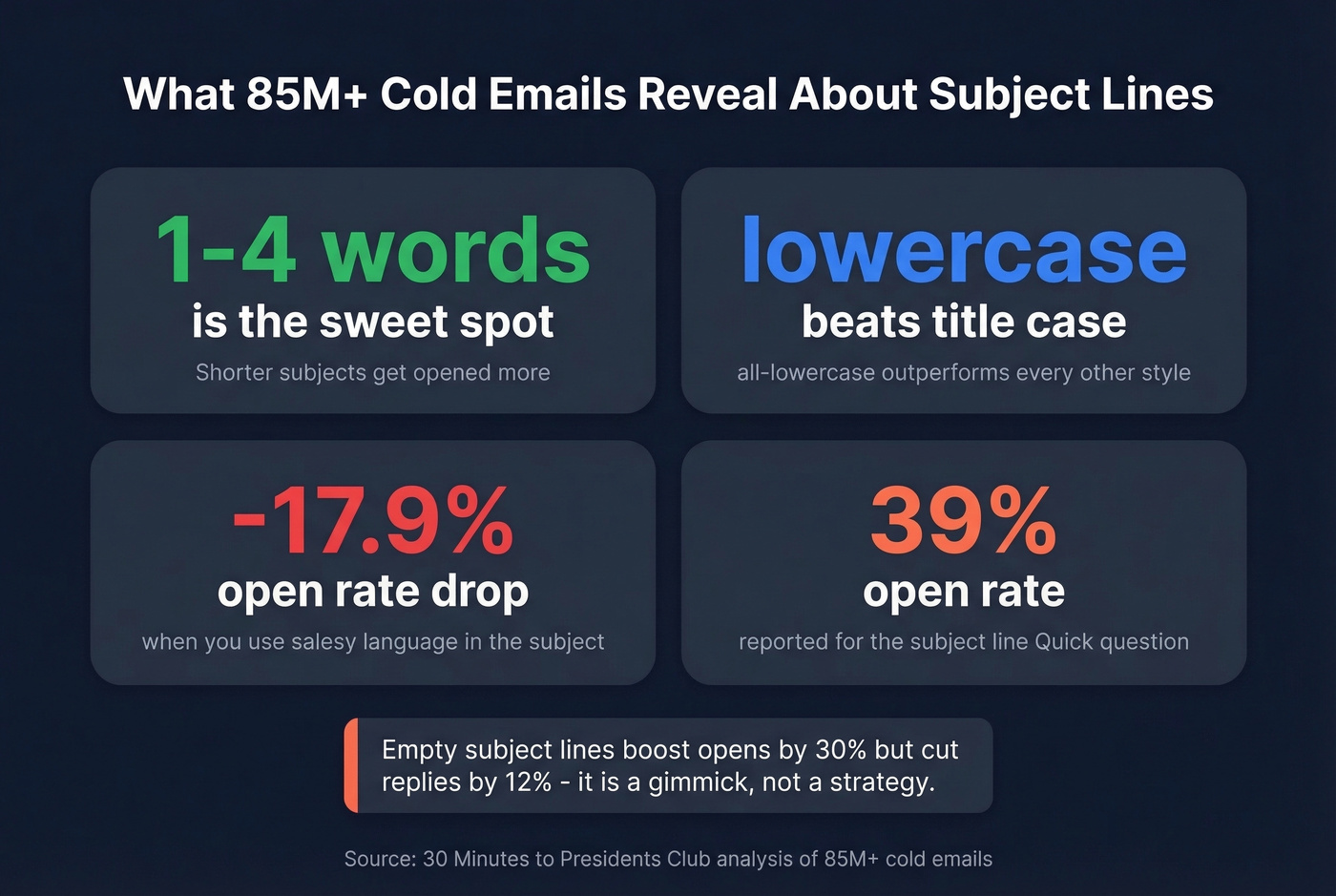
1-4 words is the sweet spot. Shorter subjects get opened more. All-lowercase outperforms title case and sentence case. Empty subject lines boost opens by 30% but cut replies by 12% - it's a gimmick, not a strategy. Salesy language drops open rates by up to 17.9%.
If you want tested options to swipe, use these cold email subject line examples or the broader library of email subject line examples.
One practitioner reported "Quick question" hitting 39% opens. Simple wins.
The Operational Layer - Why Frameworks Fail
Here's the thing most sales content won't tell you: if your deal sizes sit below five figures, the framework matters less than your deliverability setup. The best copy in the world bounces off a spam folder. Nearly half of cold emailers don't even track bounce rates.
That's genuinely frustrating. People spend hours A/B testing subject lines while their domain reputation quietly tanks from a 12% bounce rate.
Authentication first. SPF, DKIM (2048-bit keys), and DMARC on every sending domain. Start DMARC at p=none with rua reports, then tighten to quarantine. Use a custom tracking domain. Google and Yahoo now require one-click unsubscribe headers and keep spam complaints under 0.3% for bulk senders - monitor compliance with Gmail Postmaster Tools and Microsoft SNDS.
If you need the full checklist, start with an email deliverability guide, then validate your setup with SPF record examples and how to verify DKIM is working. For the tracking piece, use this tracking domain explainer.
Warm up properly. Week 1: 30-50 emails/day per mailbox. Week 2: 50-80. Week 3: 80-120. Week 4: 120-150, but only if bounce stays under 3% and spam complaints under 0.1%. Plain text, one link max, no images during warmup.
For safe scaling, follow email velocity limits and use unlimited email warmup tools if you're ramping multiple domains.
Verify every list before you send. One practitioner on r/Entrepreneur documented their reply rate jumping from 3% to 6% after overhauling their ops. They moved from 3 domains to 7, capped each at 26 emails/day, cut email length from 141 words to under 56, and sent only Tuesday through Thursday, 8-11 AM recipient time. Their bounce rate dropped from 11% to under 2% - and that's where the reply rate gains came from. Not a new framework. Not a better subject line. Cleaner data.
If you're diagnosing list issues, start with email bounce rate and remediation like spam trap removal.
The 30/30/50 Rule
A useful mental model for allocating effort: roughly 30% of your results come from your offer, 30% from your copy and messaging structure, and 50% from your targeting and list quality. The math intentionally exceeds 100% because these factors compound - great copy sent to a garbage list still fails, and a perfect list with a weak offer underperforms.
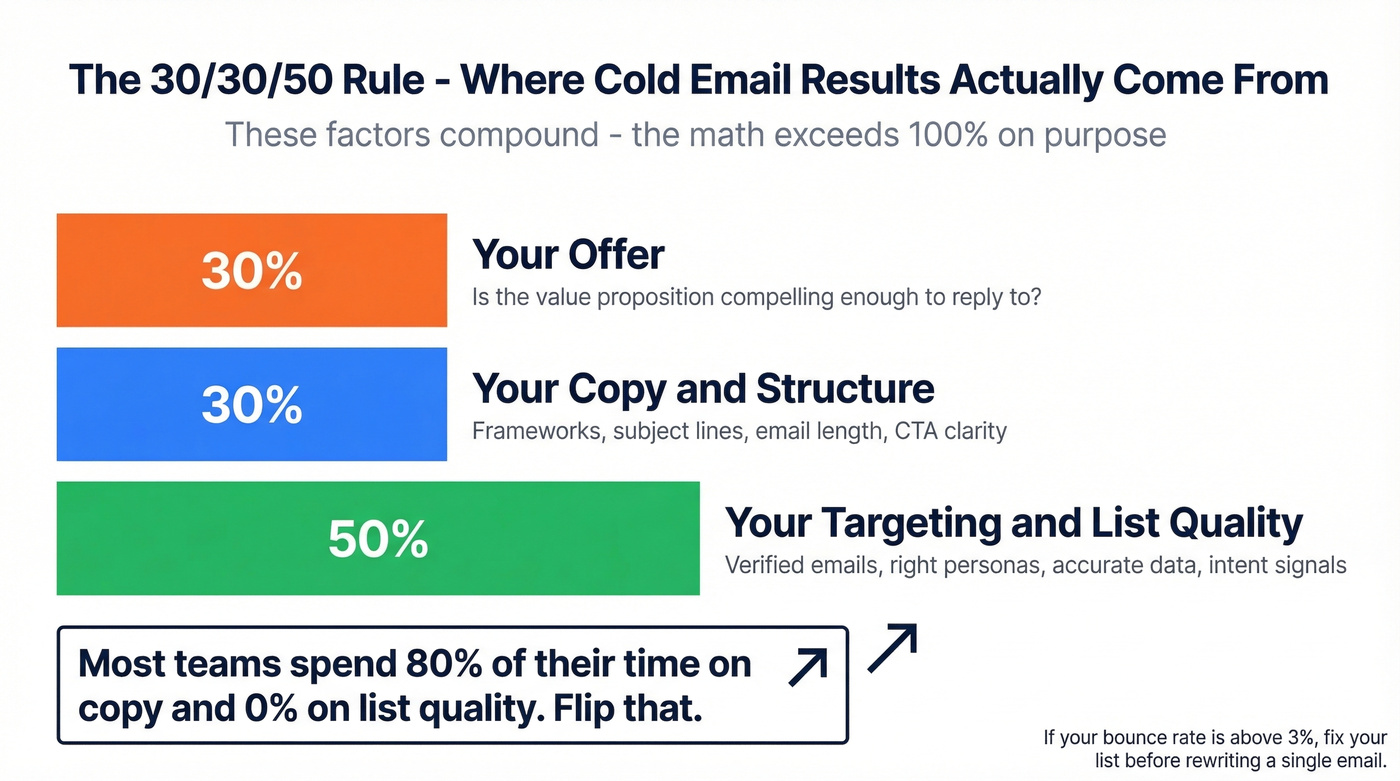
The takeaway is clear: if you're spending all your optimization time on email structure and none on list hygiene or offer positioning, you're ignoring the majority of the equation. Prospeo's 5-step verification - catch-all handling, spam-trap removal, honeypot filtering - delivers 98% email accuracy with data refreshing every 7 days versus the 6-week industry average. Pre-send hygiene prevents the domain reputation damage that kills campaigns before any framework gets a chance.
If you're building full sequences (not just single emails), use this B2B cold email sequence guide.
Trigger-based emails crush generic outreach, but only if you have the signals. Prospeo tracks 15,000 intent topics, detects job changes, and layers buyer signals with 30+ filters - so your trigger line writes itself.
Find in-market prospects before your competitors do.
FAQ
How many frameworks do I need?
Two to three covers 90% of scenarios. QVC as your default, PAS for pain-aware prospects, trigger-based when you have buying signals. Let's be honest - collecting 16 frameworks is procrastination disguised as preparation.
What's a good cold email reply rate?
Average is 3.43% according to Instantly's 2026 benchmark data. Top quartile hits 5.5%+, and elite campaigns exceed 10.7%. Consistently under 3%? Fix infrastructure and list quality before rewriting copy.
How do I stop cold emails landing in spam?
Set up SPF, DKIM, and DMARC on every sending domain. Warm each domain about 4 weeks before scaling. Verify every email address before sending with a tool offering 98%+ accuracy and spam-trap detection. Use a custom tracking domain and cap sends at around 26-30 per domain per day.
What's the 30/30/50 rule?
It breaks down cold email success into three weighted factors: 30% offer strength, 30% copywriting quality, and 50% targeting and data accuracy. It's a reminder that even well-structured outreach can't compensate for poor list quality or a weak value proposition. Start by nailing your targeting, then optimize your messaging.