

Cold Follow-Up Email Templates That Get Replies (2026)
You sent 200 cold emails last week. Three replies - all from the first touch. The other 197? Silence.
Here's the thing: 42% of all cold email replies come from follow-ups, not the initial send. If you're writing one email and moving on, you're leaving almost half your pipeline on the table. The average reply rate sits at 3.43%, and elite senders push past 10% - but they're not writing better first emails. They're running better follow-up sequences. Every cold follow up email template below is built to close that gap.
The Short Version
Send 4-7 total touches, spaced 3-4 days apart. Under four quits too early. Beyond seven shows diminishing returns unless each touch adds something genuinely new.
Every follow-up adds new value. "Just checking in" isn't a strategy. New angle, new proof point, new resource - every time. And verify your list before you send. Bad data kills sequences before copy ever gets a chance.
The Cadence That Works
Timing separates a 2% reply rate from a 5% one. Tuesday through Wednesday consistently produces the highest reply rates, with Wednesday taking the top spot across major benchmark studies and the best time to send cold emails.
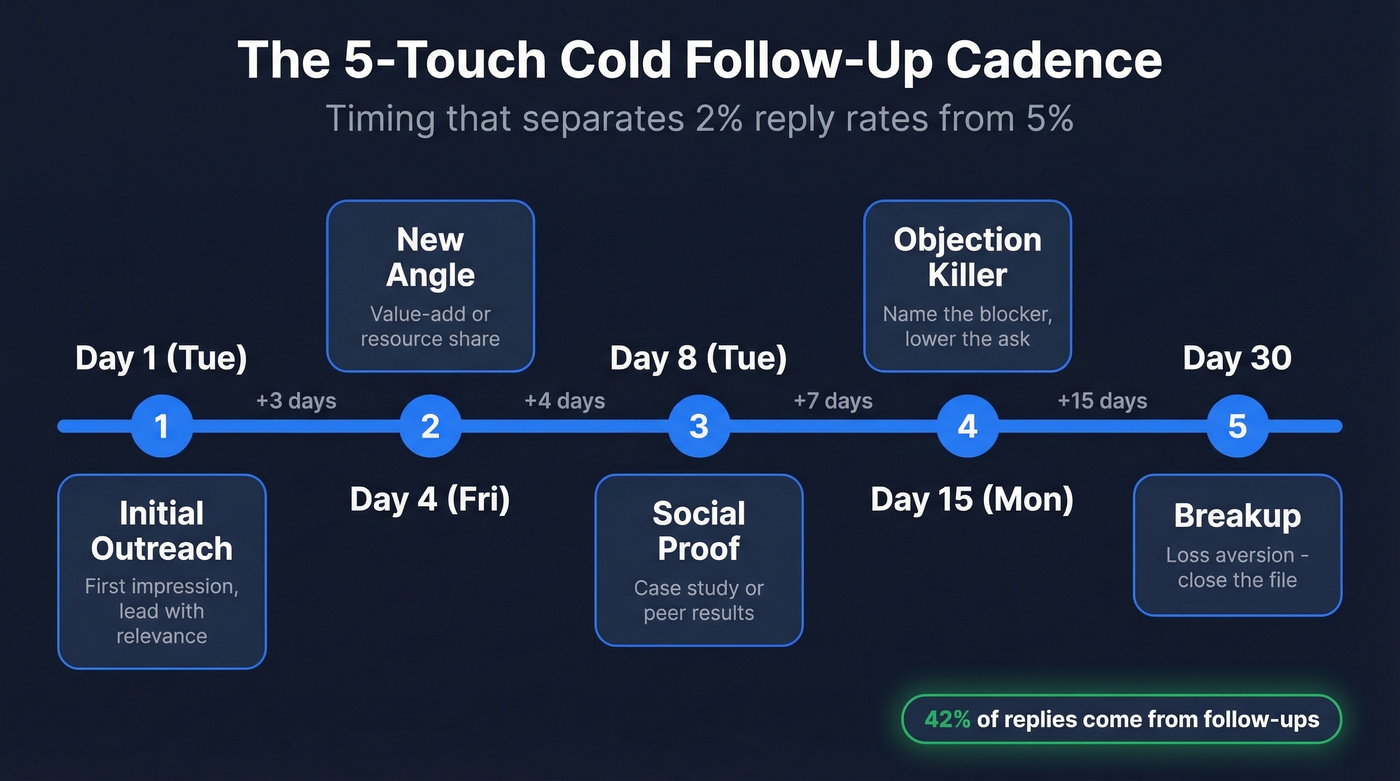
| Touch | Day | Purpose |
|---|---|---|
| Email 1 | Day 1 (Tue) | Initial outreach |
| Follow-up 1 | Day 4 (Fri) | New angle |
| Follow-up 2 | Day 8 (Tue) | Social proof |
| Follow-up 3 | Day 15 (Mon) | Objection killer |
| Follow-up 4 | Day 30 | Breakup or re-engage |
Reply rates vary by industry, so calibrate expectations:
| Industry | Average Reply | Good | Elite |
|---|---|---|---|
| SaaS/Tech | 1.5-3% | 3-5% | 5%+ |
| Agencies | 2.5-4.5% | 4.5-6% | 7%+ |
| Prof. Services | 2-3.5% | 3.5-5% | 5%+ |
Data from Mailshake's cold email benchmarks by industry.
6 Follow-Up Templates for Cold Outreach
Knowing how to write a follow-up is half the battle. The other half is having proven frameworks to start from. Each template below targets a different psychological lever so you can rotate angles across your sequence and build a B2B cold email sequence.
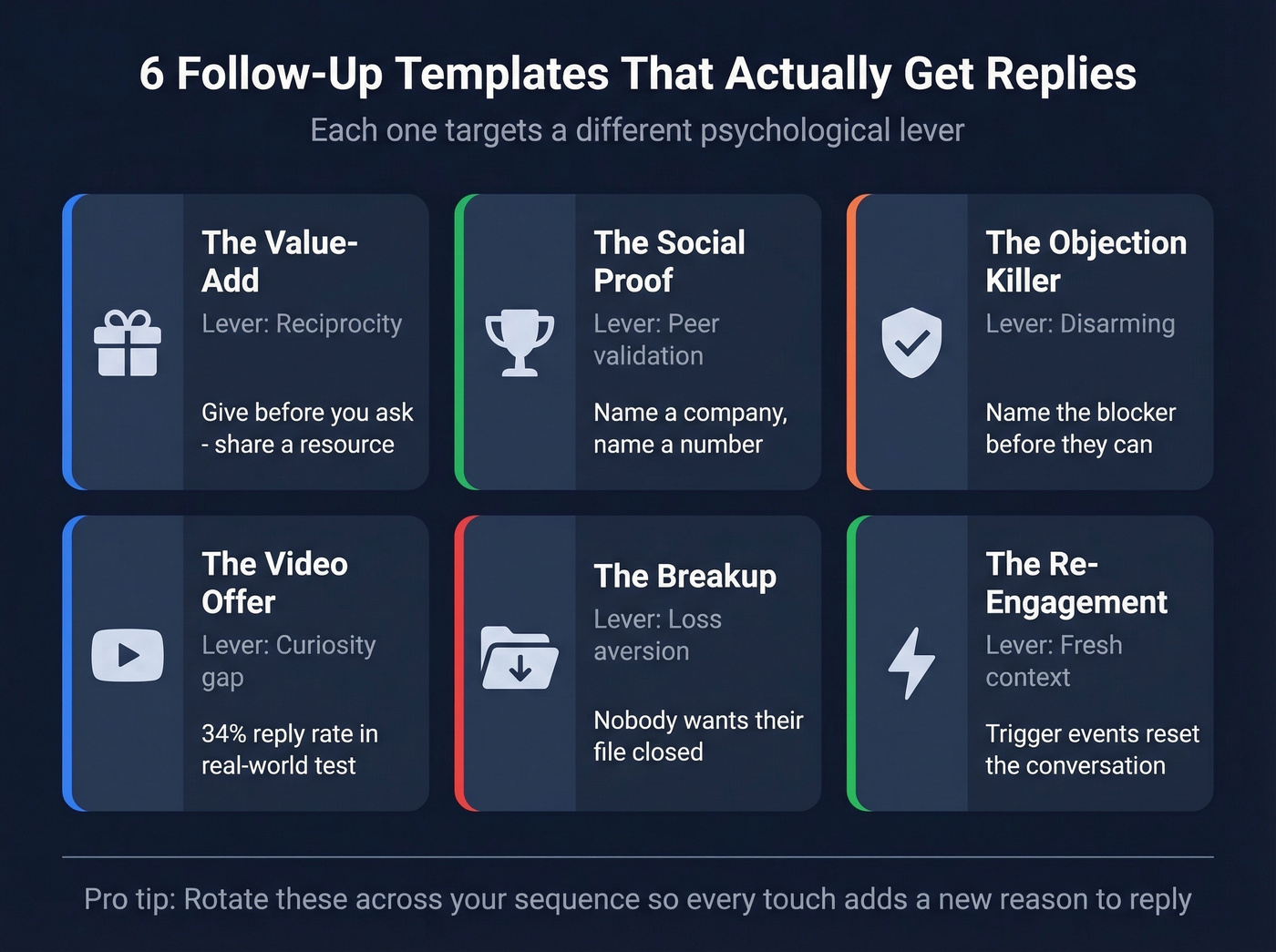
The Value-Add
Subject: Re: [original subject]
Hey [First Name], I pulled together [specific resource] that's relevant to what [Company] is doing with [initiative]. Figured it'd be useful regardless of whether we chat. [Link]
Reciprocity does the heavy lifting here. You give before you ask, so the follow-up feels like a favor, not a nudge. We've found this works best as the first follow-up in a sequence because it sets a generous tone for everything that comes after.
The Social Proof
Subject: How [Similar Company] handled this
[First Name], [Similar Company] dealt with the same [problem] last quarter. They [specific result - "cut bounce rates from 35% to under 4%"]. Happy to share what they did differently.
Specificity beats vague claims. Name a company, name a number. This is consistently one of the best cold email follow-up examples we've seen because it shifts the conversation from your pitch to a peer's results. If you don't have a named case study, even an anonymized one with real numbers outperforms "we help companies like yours."
The Objection Killer
Subject: Probably not the right time
[First Name], I know [Q4/hiring freeze/migration] makes this tough to prioritize. Most teams we work with felt the same - until they saw [specific outcome]. Worth a 15-min look when things settle?
You're naming the objection before they can use it, then lowering the commitment ask. Disarming. This works especially well on touches three and four, when silence usually means a hidden objection rather than disinterest. (If you want a system for handling these, see discovery questions and how to reduce sales objection rate.)
The Video Offer
A Reddit practitioner tested this approach on 150 e-commerce brands and pulled a 34% reply rate - 51 replies, 8 paying clients, roughly EUR12K in revenue. The curiosity gap does the heavy lifting:
Subject: I recorded a video for you
[First Name], I put together a quick strategy breakdown for [Company] - covers [2-3 specific wins you spotted]. No pitch, just ideas. Want me to send it over?
When they say yes, send a 3-5 minute Loom with real analysis and a soft CTA. We've tested this across outbound campaigns and it consistently beats generic text-only "bump" follow-ups. The key is that the video has to be genuinely personalized - a screen recording walking through their actual website, their actual funnel, their actual tech stack. If it looks templated, the magic disappears. (More ideas: Loom video cold email.)
The Breakup
Subject: Should I close your file?
[First Name], I've reached out a few times and haven't heard back - totally fine. I'll close this out. If anything changes, reply here and we'll pick up where we left off.
Loss aversion. Nobody wants a file "closed" on them. This pulls replies from prospects who ignored everything else. Skip this if your sequence is only two or three touches - it doesn't land unless the prospect has actually seen multiple messages from you first.
The Cold Lead Re-Engagement
Subject: Saw [trigger event] - had to reach out
[First Name], noticed [Company] just [raised a round / hired 3 SDRs / launched a new product]. That usually means [relevant pain point] is top of mind. Worth revisiting [your solution]?
A trigger event resets the conversation entirely. You're not "following up" - you're reaching out with fresh context. A cold lead follow-up email tied to a real event outperforms generic re-engagement every time. If you want to operationalize this, use a process for identifying buying signals and how to track sales triggers.
Let's be honest about sequence length, though: if your average deal size is under $10K, you probably don't need a seven-touch sequence. A two-email sequence with one strong follow-up generates 6.9% reply rates on its own. Save the full cadence for deals worth the effort.

Every template above assumes one thing: your emails actually land. Bad data turns a 5-touch sequence into 5 bounces that torch your domain reputation. Prospeo's 98% email accuracy and 7-day data refresh mean your follow-ups reach real inboxes - not dead addresses.
Stop perfecting copy that bounces. Fix the data first.
Mistakes That Kill Replies
Your SDR sends "just wanted to circle back" for the third time. The prospect doesn't reply. Shocking.
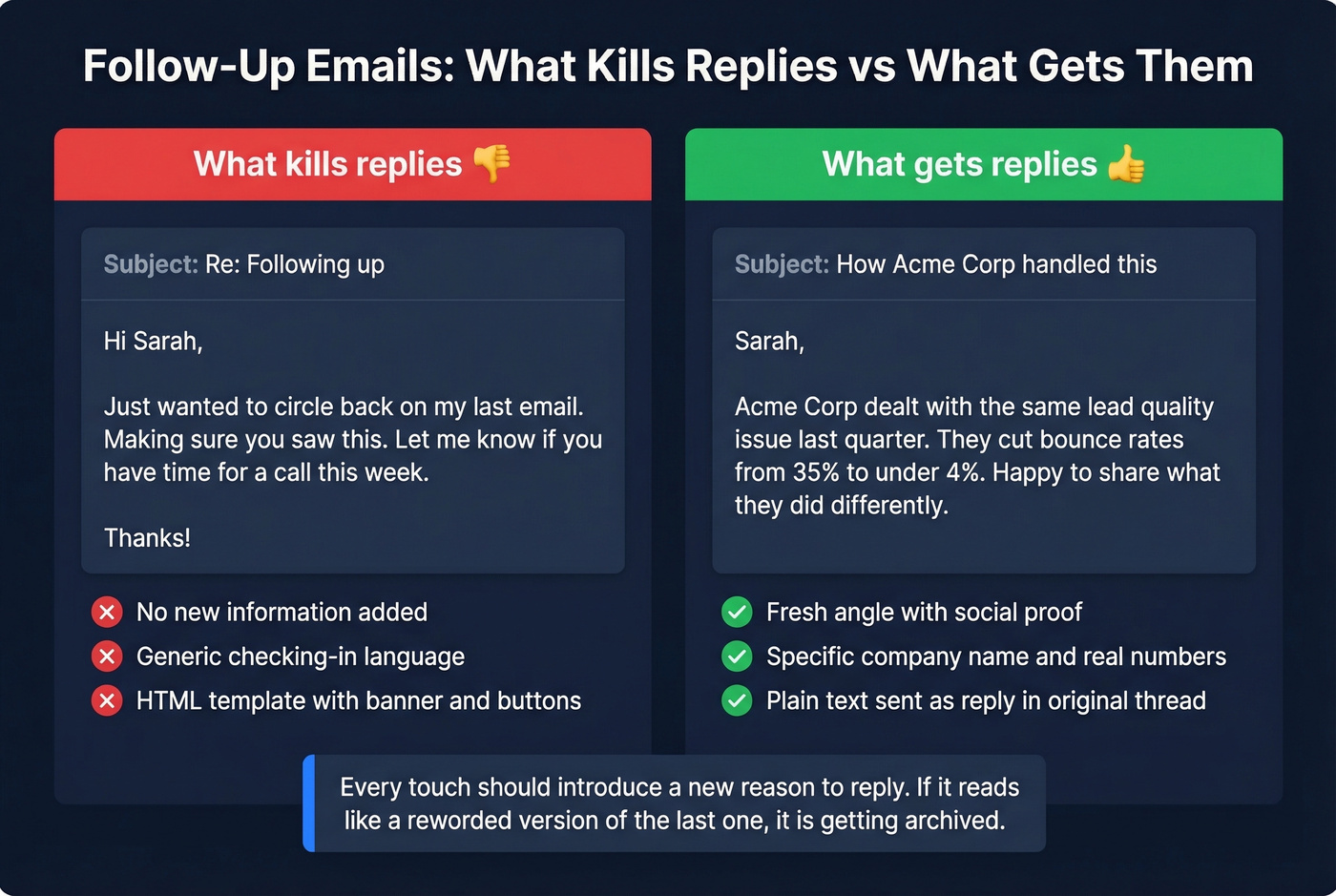
The biggest follow-up mistakes are predictable, and we see the same ones over and over. Bumping with no new information - "making sure you saw this" isn't a reason to email someone. Ignoring objections - prospects ghost for five reasons (no need, unclear value, no urgency, don't want it, don't trust you), and your follow-ups should address each one systematically across your sequence. Over-formatting - HTML templates with banners and buttons scream "mass email," while plain text sent as a reply in the original thread feels like a real person wrote it.
Looking at cold email follow-up examples from top-performing teams, the pattern is clear: every touch introduces a new reason to reply. If your follow-up reads like a slightly reworded version of the previous one, it's getting archived. (For more options, compare these sales follow-up templates.)
Pro Tips Most Reps Miss
Turn off open tracking. A Snov.io analysis of 44M emails found disabling open tracking more than doubled reply rates - 2.36% vs 1.08%. The tracking pixel triggers spam filters, and the marginal data you get from open rates isn't worth the deliverability hit. If you want the technical breakdown, see email tracking pixels.
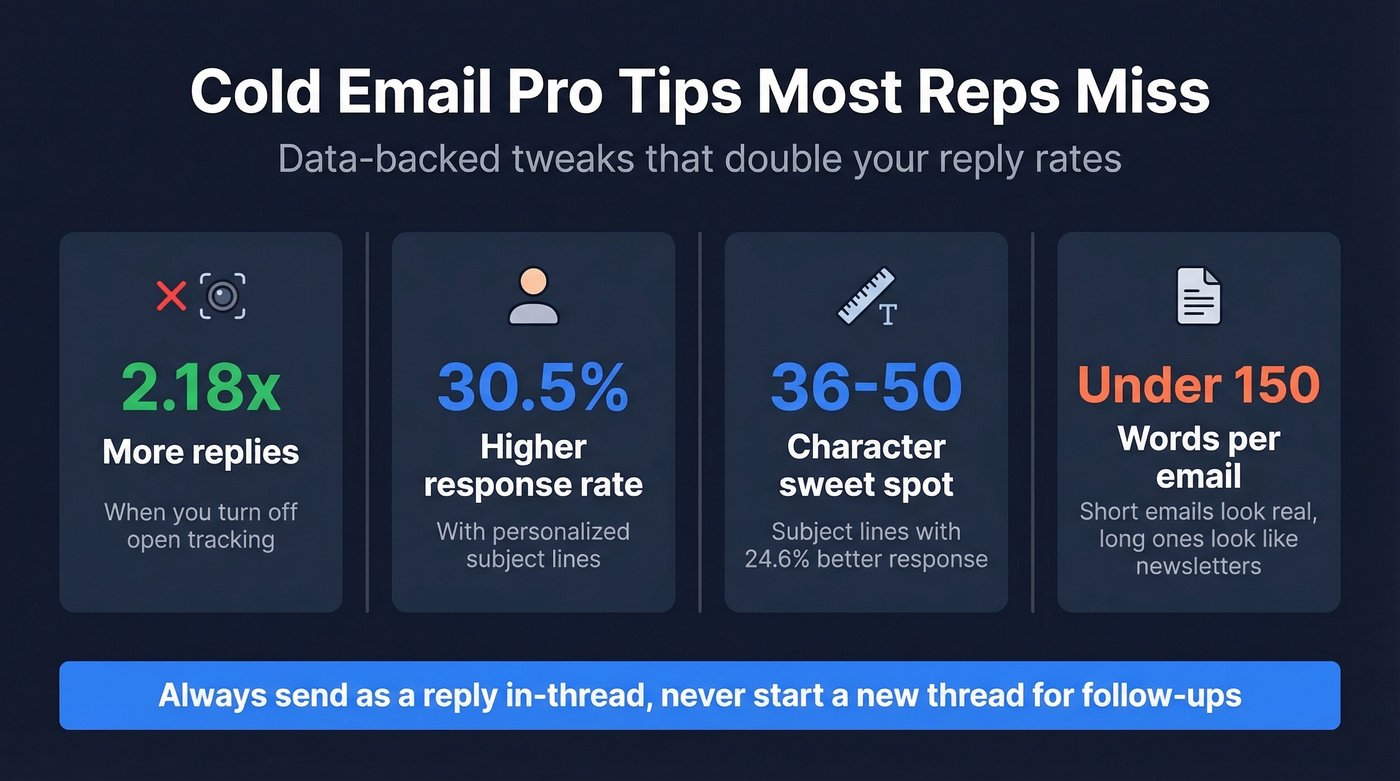
Personalize your subject line and keep it short. Personalized subject lines lift response rates by 30.5%, and 36-50 characters hit the sweet spot with 24.6% higher response rates. Even "[First Name] - quick question" outperforms generic lines. If you need more options, use these email subject line examples.
Keep it under 150 words. Shorter emails look like real messages. Longer ones look like newsletters. (More on structure: email copywriting.)
Send as a reply in-thread. Don't start a new thread for each follow-up. Replying keeps context intact and signals a 1:1 conversation. In our experience, reps who switch to in-thread replies see an immediate lift in engagement - it's one of the easiest wins in cold outreach.
Try a one-stroke CTA. Instead of "Want to hop on a call?", try "Interested? Reply 1 for a call, 2 for a case study." Reducing friction increases replies. (More patterns: email call to action.)
Before You Hit Send
Configure SPF, DKIM, and DMARC on your sending domain. Use a secondary domain for outreach - never your primary. Age new domains 30-90 days before scaling. Start at 10-20 emails per day per mailbox, then ramp gradually. Include an unsubscribe link in every follow-up - CAN-SPAM penalties can reach $50,120 per violation, and GDPR fines can hit EUR20M or 4% of global revenue. For a deeper deliverability checklist, see the email deliverability guide.
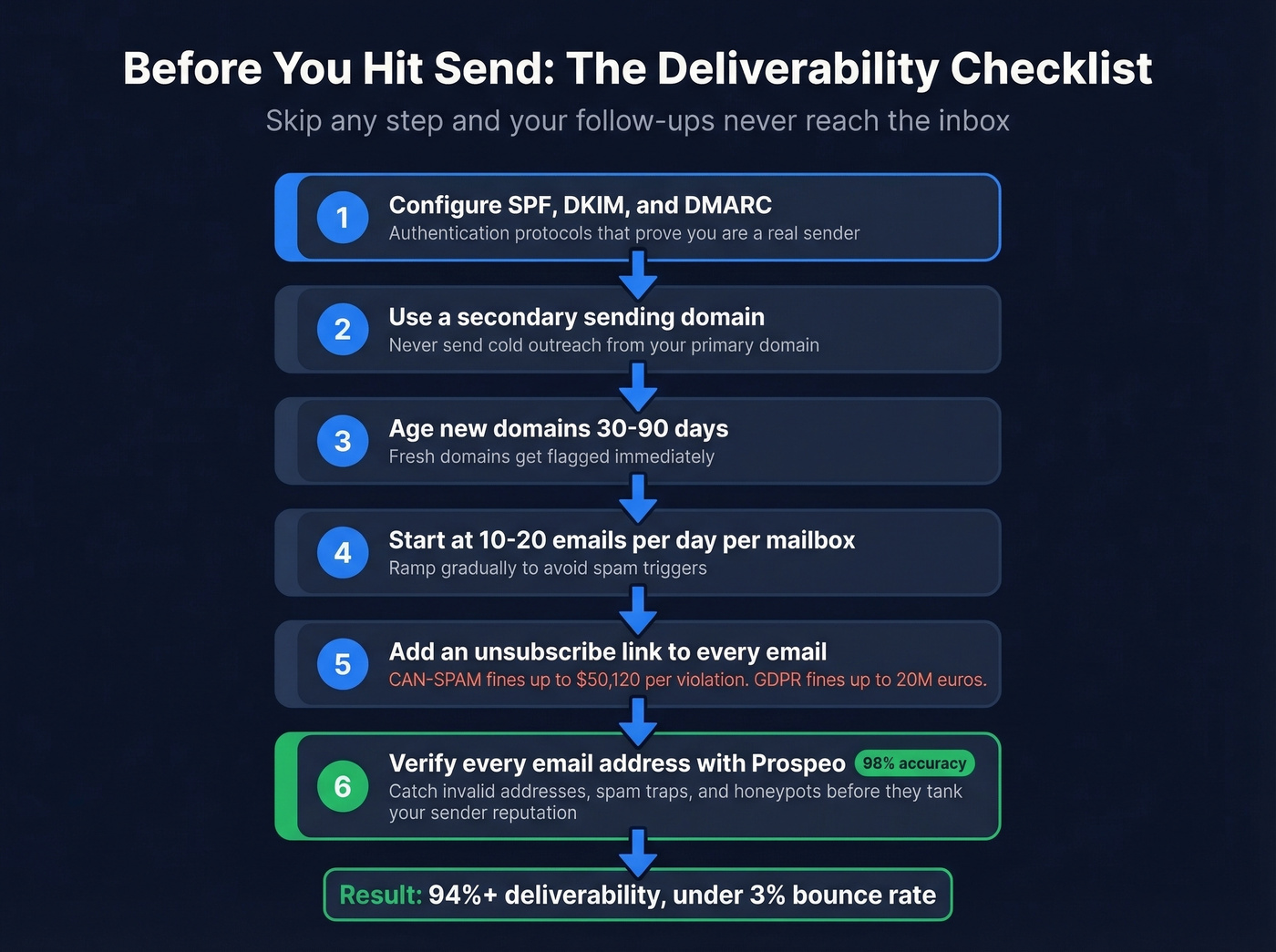
Then verify your list. Run every address through Prospeo before launching any sequence - one bulk upload catches invalid addresses, spam traps, and honeypots before they tank your sender reputation. Stack Optimize built to $1M ARR using Prospeo data with 94%+ deliverability and under 3% bounce across all clients. That kind of list hygiene is what separates sequences that scale from sequences that get your domain blacklisted.

Trigger-based re-engagement emails only work when you know who just raised a round, hired SDRs, or switched tools. Prospeo tracks 15,000 intent topics and buyer signals across 300M+ profiles - so your cold lead follow-ups arrive with perfect timing.
Find the trigger events that make prospects reply. Starting at $0.01 per lead.
FAQ
How many follow-up emails should I send?
Plan for 4-7 total touches. Fewer than four quits too early - 42% of replies come from follow-ups. Beyond seven shows diminishing returns unless each touch adds genuine new value like a case study or trigger event.
What's the best day to send a follow-up?
Tuesday through Wednesday between 7-11 a.m. in the prospect's local time zone produces the highest reply rates. Avoid Monday mornings (inbox overload) and Friday afternoons (mentally checked out).
How do I stop follow-ups from landing in spam?
Configure SPF, DKIM, and DMARC, use a secondary sending domain, start at 10-20 emails per day per mailbox, and verify every address before sending. Bad addresses trigger spam traps that tank deliverability across your entire domain.
What makes a good cold follow up email template?
A strong template adds new value on every touch - a fresh angle, a relevant case study, or a trigger event. It avoids generic "checking in" language, stays under 150 words, and includes a low-friction CTA that makes replying easy.