

Best Contact Database Software for 2026: Data Platforms + CRMs Compared
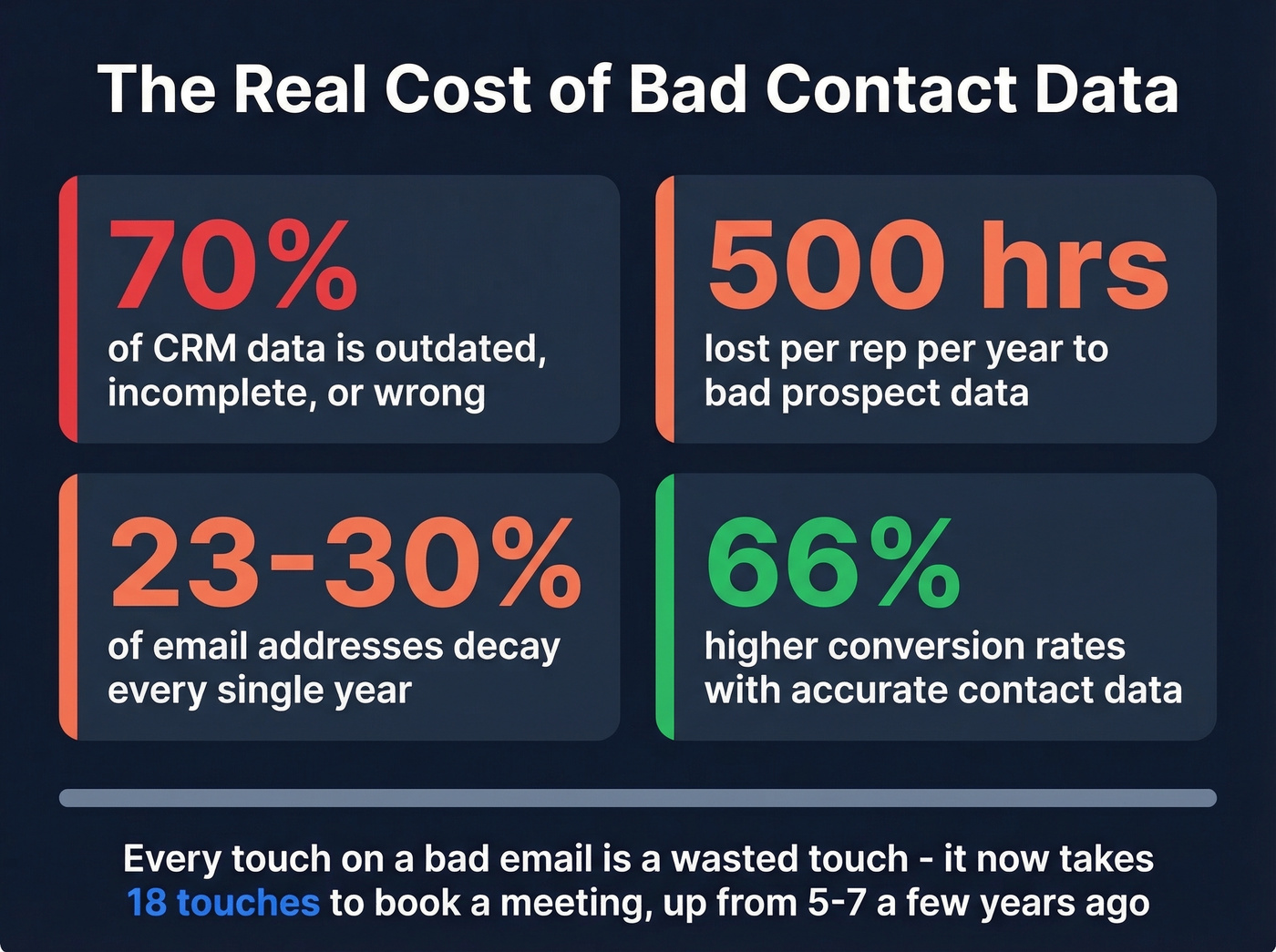
70% of CRM data is outdated, incomplete, or flat-out wrong. That's the reality most sales teams live with every Monday morning when they open their pipeline and start dialing numbers that don't connect. Choosing the right contact database software matters more than most buying decisions you'll make this year - and 23-30% of email addresses go stale annually, which means the list you built in January is already rotting by summer.
Here's the thing most articles get wrong: they lump two completely different tool categories together. A CRM organizes contacts you already have. A data platform helps you find new ones. We've tested dozens of tools across both categories, and the pattern is always the same - buying the wrong one first is how you end up with a $15k/year tool that nobody uses.
We evaluated each tool below on data accuracy, pricing transparency, free tier availability, integration depth, and real user sentiment from G2 and Reddit.
Top Picks at a Glance
| Tool | Best For | Starting Price |
|---|---|---|
| Prospeo | Verified B2B emails + mobiles | Free (75 emails/mo) |
| HubSpot CRM | Free CRM for organizing contacts | Free (up to 1M contacts) |
| Apollo | Budget all-in-one (data + outreach) | Free / $49/user/mo |
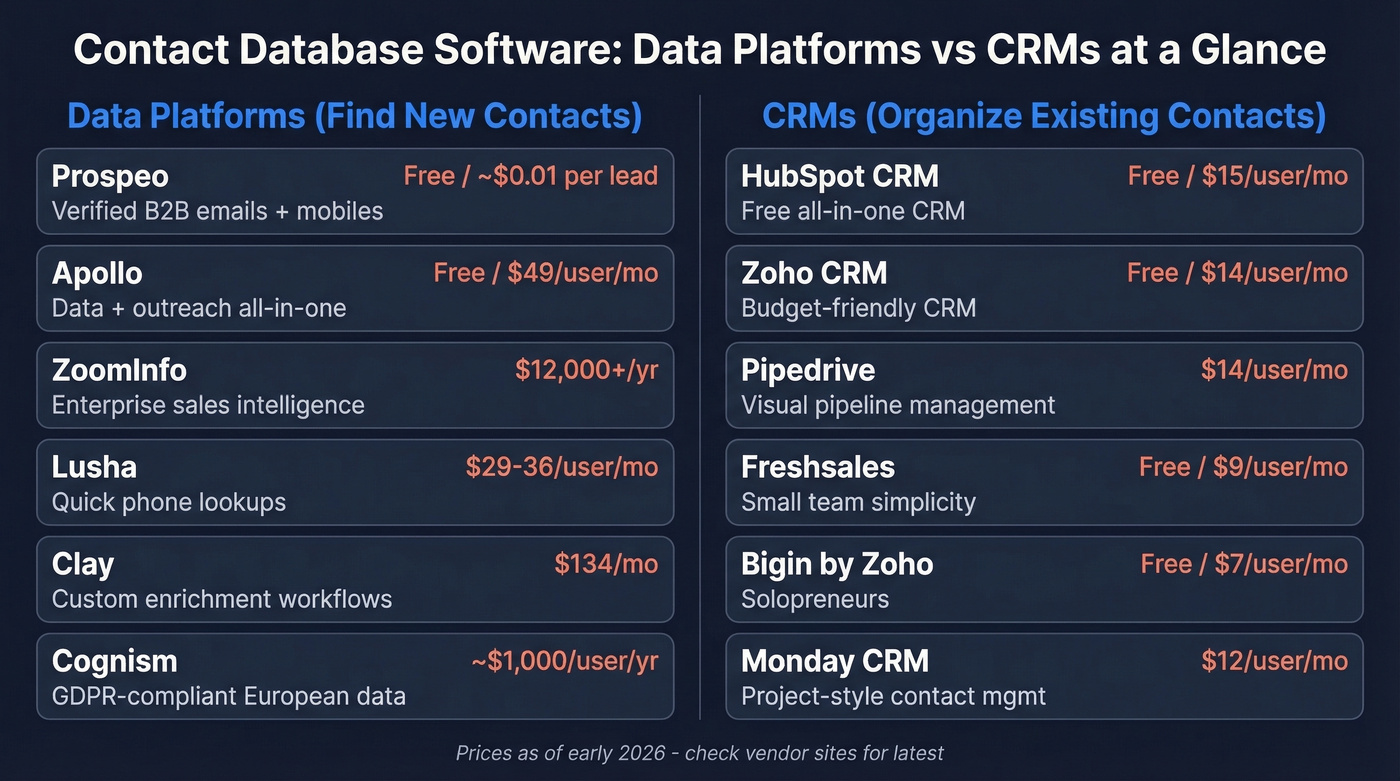
Here's the full pricing breakdown across all 12 tools:
| Tool | Category | Starting Price | Free Tier | Best For |
|---|---|---|---|---|
| Prospeo | Data Platform | ~$0.01/email | Yes (75 emails/mo) | Verified B2B emails + mobiles |
| Apollo | Data Platform | $49/user/mo | Yes (limited) | Data + outreach all-in-one |
| ZoomInfo | Data Platform | $12,000+/yr | No | Enterprise sales intelligence |
| Lusha | Data Platform | $29-$36/user/mo | Yes (limited) | Quick phone lookups |
| Clay | Data Platform | $134/mo | No | Custom enrichment workflows |
| Cognism | Data Platform | ~$1,000/user/yr | No | GDPR-compliant European data |
| HubSpot CRM | CRM | $15/user/mo | Yes | Free all-in-one CRM |
| Zoho CRM | CRM | $14/user/mo | Yes | Budget-friendly CRM |
| Pipedrive | CRM | $14/user/mo | No | Visual pipeline management |
| Freshsales | CRM | $9/user/mo | Yes (3 users) | Small team simplicity |
| Bigin by Zoho | CRM | $7/user/mo | Yes (1 user) | Solopreneurs |
| Monday CRM | CRM | $12/user/mo | No | Project-style contact mgmt |
Best B2B Data Platforms
These are the tools that actually find contacts - verified emails, direct dials, company data. If your problem is "I don't have enough people to call," start here. (If you want a deeper ranking, see our guide to the best B2B databases.)
Prospeo
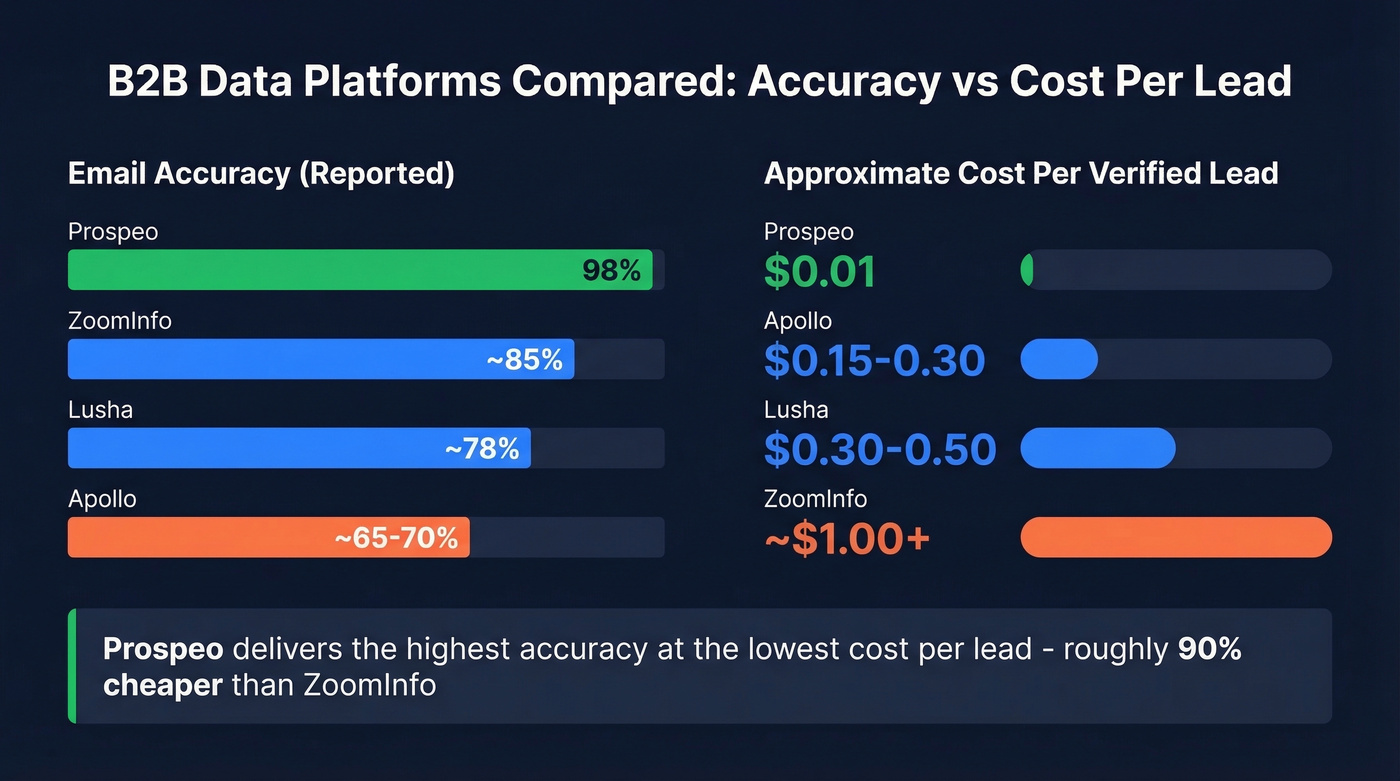
Prospeo is the tool we'd hand to any team that's been burned by bad data. The database covers 300M+ professional profiles with 143M+ verified emails, 98% email accuracy, and 125M+ verified mobile numbers. Records refresh on a 7-day cycle, compared to a roughly 6-week industry average. That difference matters when you're running outbound at scale.
The numbers aren't theoretical. One customer, Snyk, had 50 AEs prospecting 4-6 hours per week. Bounce rate dropped from 35-40% to under 5%, and AE-sourced pipeline jumped 180%.

Pricing is where Prospeo really separates from the pack. At roughly $0.01 per lead, it's about 90% cheaper than ZoomInfo's ~$1/lead. The free tier gives you 75 verified emails and 100 Chrome extension credits per month - enough to test data quality before you commit anything. Paid plans scale from there with no annual contracts required. For teams running outbound sequences through Smartlead, Instantly, or Lemlist, Prospeo plugs in natively and keeps your sender reputation clean. (If you're comparing providers specifically on verification, start with verified contact databases.)
Apollo
Apollo is the obvious starting point for teams that want data and outreach in one platform without a five-figure contract. The database covers 275M+ contacts, the free tier is genuinely useful for getting started, and paid plans begin at $49/user/mo.
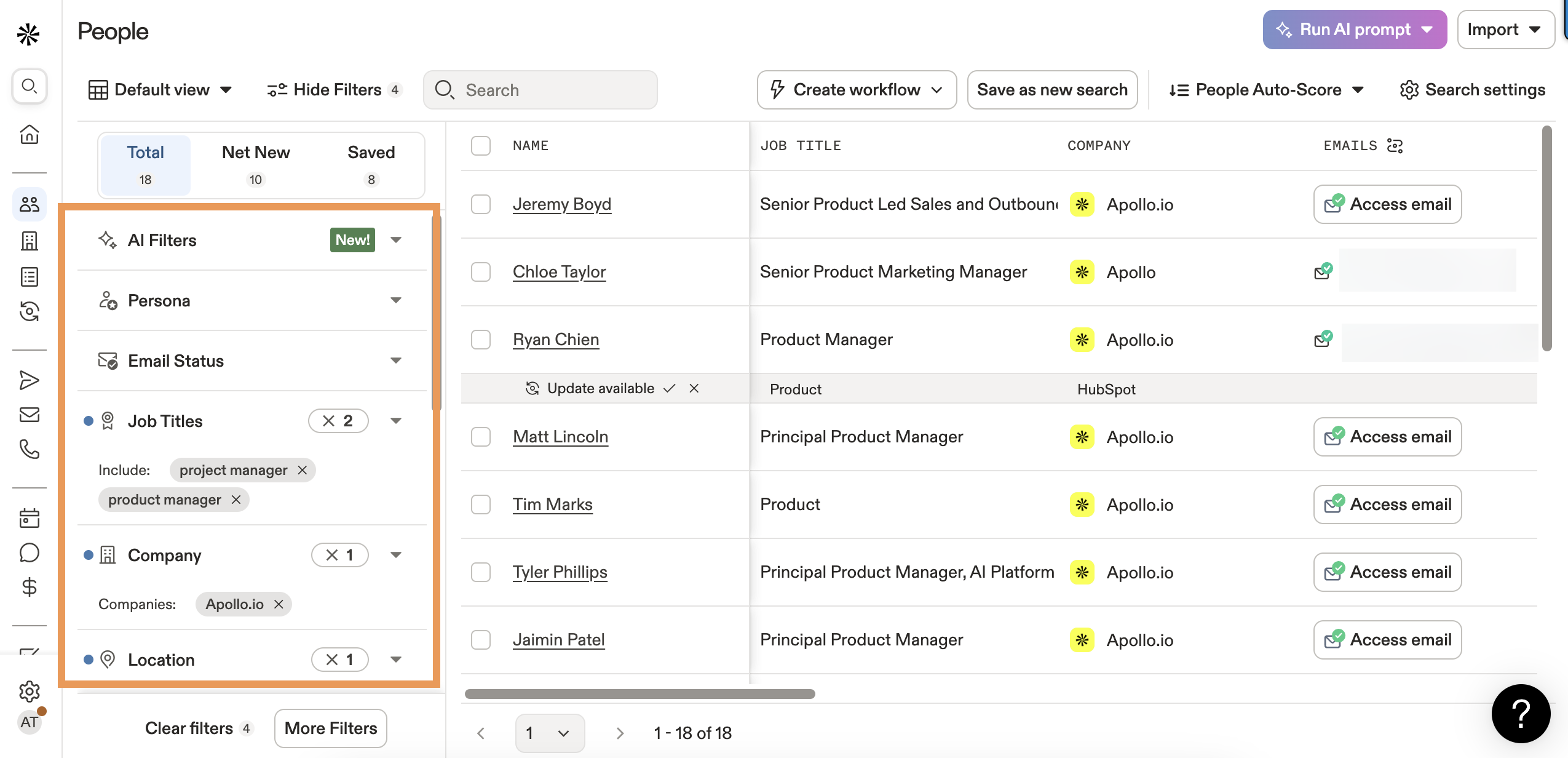
The catch is accuracy. Community-reported email accuracy hovers around 65-70%, which means roughly one in three emails will bounce or land in a catch-all void. Reddit practitioners consistently call Apollo the easiest default for data plus basic outreach, and they're right. But you'll want to run those exports through a verification tool before loading them into your sequencer. (For a full breakdown of options, see our email verifier guide.) The free tier is generous, though limits hit fast once you're past the initial honeymoon.
ZoomInfo
ZoomInfo is the enterprise default. For 500-person sales orgs running outbound, ABM, and intent from one platform, it earns its price tag. For everyone else? The #1 complaint on Reddit is pricing - $15k+ annually for small teams, and that's before you add modules for intent data or mobile numbers. There's no public pricing page, which tells you everything about the sales process.
If your average deal size is under $15k or you have fewer than 50 reps, you almost certainly don't need ZoomInfo-level tooling. You're paying for a platform built to serve enterprise GTM motions, and most of those features will sit untouched. (If you're building a broader stack, our database providers guide breaks down the main categories.)
Lusha
Use Lusha if you need quick phone number lookups from a Chrome extension and your prospects are primarily in North America or Western Europe. It starts at $29-$36/user/mo and the extension is fast - two clicks to pull a direct dial. If your team is dialing heavily, pair this with stronger phone sales skills training to maximize connect rates.
Skip it if you're prospecting outside major markets. Reddit users consistently flag Lusha as hit or miss depending on region, and the credit expiration model is genuinely frustrating. You pay for credits monthly, and unused ones vanish. If your prospecting cadence is uneven, you're burning money.
Clay
Clay is the power user's dream and everyone else's headache. Think of it as LEGO pieces for data - you chain together enrichment steps from dozens of providers to build hyper-specific lists that no single database can produce. Starting at $134/mo, it's not cheap, and it absolutely needs someone on the team who enjoys building workflows.
But if you're targeting "Series B fintech companies using Stripe that just hired a VP of Sales," Clay is the only tool that can chain those signals together reliably. (If you're going down this route, our best data enrichment tools roundup is a good companion read.)
Cognism
GDPR-first data platform built for European markets. At ~$1,000/user/year, Cognism is the go-to if your ICP is heavily EMEA and compliance isn't optional. US coverage exists but doesn't match ZoomInfo or Apollo's depth. If you're selling into the UK, DACH, or Nordics, it's worth a trial. For a compliance checklist, see our GDPR compliant database guide.

You just read that 23-30% of email addresses decay every year. Prospeo refreshes its entire 300M+ contact database every 7 days - not every 6 weeks like the industry average. With 98% email accuracy and 125M+ verified mobile numbers, your outbound stays clean all year.
Stop prospecting from a database that's already rotting.
Best CRMs for Managing Contacts
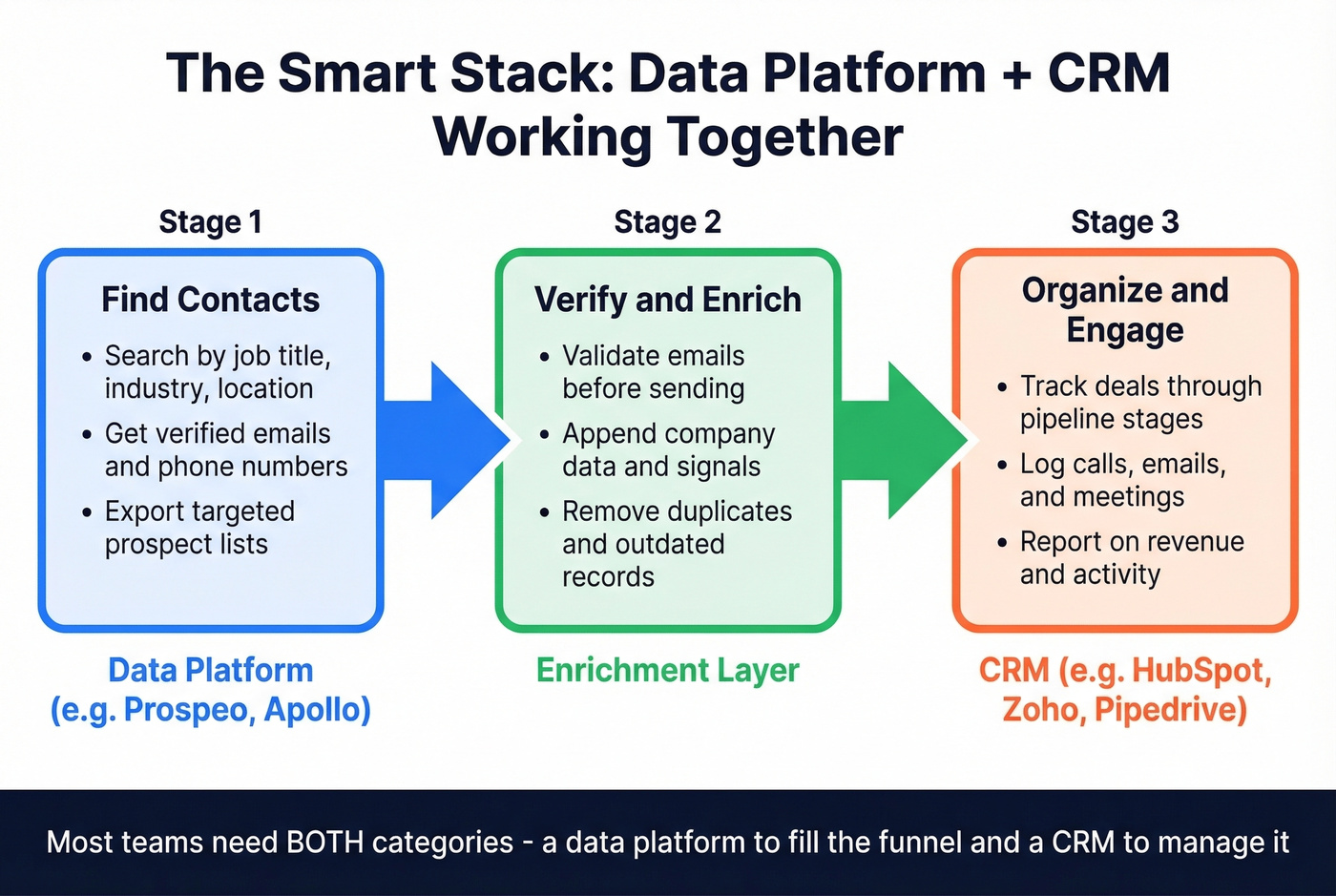
These tools don't find new contacts - they organize the ones you already have. If your problem is "I have leads everywhere and no system," this is your category. A well-maintained client contact database is the foundation every sales workflow depends on. (If you're evaluating CRMs more broadly, use our CRM management system guide.)
HubSpot CRM
HubSpot's free CRM is widely used for good reason: unlimited users, up to 1 million contacts, plus core tools like email marketing, landing pages, live chat, and basic reporting. With a 4.4/5 on G2 across 13,564 reviews, it's the most battle-tested free option available.
The limitation is that HubSpot won't help you find new contacts. It organizes what you feed it - functioning as customer contact database software rather than a prospecting engine. The Breeze Intelligence add-on bolts on enrichment, but it's a paid extra. The smart play is pairing HubSpot with a dedicated data platform: push verified contacts in and let each tool do what it's best at. (If you're choosing between CRM approaches, see how to choose a CRM.)
Zoho CRM
Zoho costs half of what most teams expect to pay for this feature set. Free plan available, paid tiers from $14/user/mo, and at the Enterprise level you get Zia - Zoho's AI assistant for lead scoring and insights. The UI isn't as polished as HubSpot's, but for cost-conscious teams that want a full-featured CRM without the eventual upsell pressure, Zoho delivers. The ecosystem is massive too: Zoho has an app for basically everything, and they all talk to each other natively.
Pipedrive
Pipedrive is built for salespeople who think visually. The kanban-style pipeline view makes deal tracking intuitive in a way that spreadsheet-style CRMs can't match. Starting at $14/user/mo with no free plan, it's a deliberate choice - you're paying for a tool that does pipeline management exceptionally well rather than trying to be everything.
4.3/5 on G2 with 2,951 reviews. Skip it if you need marketing automation or a help desk. Pick it if your reps need to see their pipeline at a glance and move deals forward without clicking through five menus. (For pipeline systems and KPIs, see B2B sales pipeline management.)
Freshsales
Free for up to 3 users, paid from $9/user/mo. Freshsales is the lightweight CRM that gets out of your way - fast setup, clean interface, built-in phone and email. Ideal for small teams that need a business contact manager up and running today, not next quarter.
Bigin by Zoho
Zoho's micro-CRM for solopreneurs and tiny teams. Free for one user, $7/user/mo after that. It strips away everything a solo operator doesn't need and keeps contact management dead simple.
Monday CRM
Starting at $12/user/mo with no free plan, Monday CRM brings a project-management mindset to contact management. If your team already lives in Monday.com for task tracking, adding CRM functionality keeps everything in one place. It's a visual workspace that happens to manage contacts - either perfect or completely wrong for your workflow, depending on how your team operates.
Honorable Mentions
Streak is the best option for teams that live in Gmail and want CRM functionality without leaving their inbox. Nimble excels at social selling by pulling contact context from social profiles automatically. Bitrix24 offers unlimited free contacts with a built-in project management suite - rough around the edges, but hard to beat on value.
Why Bad Data Costs More Than Good Tools
Let's be honest about what bad data actually costs. Sales reps lose roughly 500 hours per year to bad prospect data - dialing disconnected numbers, emailing bounced addresses, researching contacts who left the company six months ago. That's not a productivity problem. That's a revenue problem.

It's getting worse, too: it now takes an average of 18 touches to book a meeting, up from 5-7 a few years ago. Every touch on a bad email is a wasted touch. Companies with accurate contact data see 66% higher conversion rates compared to those running on stale records, and the average CRM returns $8.71 for every $1 invested - but 37% of CRM users report revenue loss from poor data quality. 91% of companies with 11+ employees now use a CRM. The tool isn't the problem. The data inside it is. (If you're scaling outbound, this ties directly to outbound email spam prevention.)
Enrichment bridges the gap. It fills in verified job titles, company size, tech stack data, and buying signals on records that would otherwise be just a name and email. In our experience, teams that enrich and verify before sending consistently outperform teams running on raw, unverified lists - regardless of which CRM they use. The B2B data market is projected to grow from $863M to $3.2B by 2030, and the tools that win will be the ones solving the freshness problem, not just the volume problem.
How to Choose the Right Tool
Five questions that'll save you from a bad purchase:
Do you need to find contacts or organize them? If you don't have enough leads, a CRM won't help - start with a data platform. If you have leads scattered across spreadsheets and inboxes, you need contact management software to centralize everything first. (For list-building systems, see cold email lead list building.)
What's your accuracy tolerance? Running cold email at scale, even a 5% bounce rate compounds into deliverability damage. A 30% bounce rate will tank your domain reputation within weeks. (If you're troubleshooting deliverability, start with inbox placement.)
What integrations are non-negotiable? The best tool in the world is useless if it doesn't connect to your sequencer, CRM, or enrichment workflow. Check native integrations before you trial.
What's your real budget, including hidden costs? A $49/mo tool with 70% accuracy costs more in wasted rep time than a $99/mo tool with 98% accuracy. Always calculate cost per valid contact, not cost per credit.
Will your team actually use it? The consensus on r/CRM is blunt: "CRMs fail because no one wants to use them." Trial with your actual reps, not just the ops team. For Gmail-heavy teams, something like Streak might get more adoption than a full-featured CRM that feels like extra work.
FAQ
CRM vs. Contact Database: What's the Difference?
A CRM organizes contacts you already have - tracking deals, logging emails, managing pipeline. A contact database finds new contacts with verified emails and phone numbers. HubSpot and Zoho are CRMs. Apollo and Prospeo are data platforms. Most B2B teams need one of each.
Is There Free Contact Database Software?
Yes. HubSpot CRM offers a free plan with unlimited users and up to 1 million contacts. Prospeo provides 75 free verified emails plus 100 Chrome extension credits monthly. Apollo also has a free tier with limited search credits - enough to test data quality before committing.
How Accurate Are B2B Contact Databases?
Accuracy varies dramatically by provider. Community reports put Apollo around 65-70%, while platforms with multi-step verification deliver 98% email accuracy. Always test a sample of 100-200 contacts before committing budget at scale.
How Fast Does Contact Data Go Stale?
23-30% of email addresses become outdated every year. People change jobs, companies rebrand, domains expire. Weekly refresh cycles are the gold standard - monthly is acceptable, but anything longer means you're building on a decaying foundation.
Do Contact Databases Need GDPR Compliance?
Yes, if you're storing or using EU contact data. Check that your provider offers a Data Processing Agreement, enforces opt-outs globally, and is transparent about data sourcing. Ignoring this isn't just a legal risk - it's a trust risk with your prospects.