

Cross Selling Benefits: What the Data Actually Shows (and What Most Guides Leave Out)
Cross selling and upselling drive roughly a fifth of total company revenue - and selling to existing customers costs a fraction of what new customer acquisition does. But here's the number most guides conveniently skip: one in five cross-buyers is actually unprofitable, and that group accounts for 70% of a firm's total customer loss. The real cross selling benefits aren't about "more revenue." They're about more revenue from the right customers.
What Is Cross Selling?
Cross selling means recommending a complementary product or service alongside what a customer is already buying. Amazon's "frequently bought together" section is the textbook example - you're buying a camera, and the page suggests a memory card and a carrying case. The goal is to deepen the transaction by adding relevant value, not just padding the cart.
Cross selling broadens the relationship; upselling deepens it on a single product line. Different motions, different outcomes. If you want the data-backed breakdown, see Cross Selling vs Upselling.
| Cross Selling | Upselling | |
|---|---|---|
| What changes | Additional product | Better version |
| Example | Phone + case | 64GB to 128GB phone |
| Relationship effect | Broadens | Deepens |
The Short Version
Cross selling and upselling contribute about 21% of company revenue on average, and selling to existing customers costs 5-7x less than acquiring new ones. But 1 in 5 cross-buyers is unprofitable, and that group drives 70% of a firm's total customer loss. The benefit isn't volume - it's precision.
The Economic Case for Cross Selling
The math is straightforward. Acquiring a new customer costs 5-7x more than retaining an existing one. Reducing customer defections by just 5% can improve profits by 25-85%, per Reichheld and Sasser's foundational retention research. Cross selling is how you monetize that retention advantage - 87% of salespeople already cross-sell, and 91% upsell, with those motions accounting for roughly 21% of company revenue.
If you want to model the economics more precisely, start with your cost to acquire customer and then map expansion impact to renewal rate.

RAIN Group's research puts the performance gap in sharper terms. Top-performing account teams are:
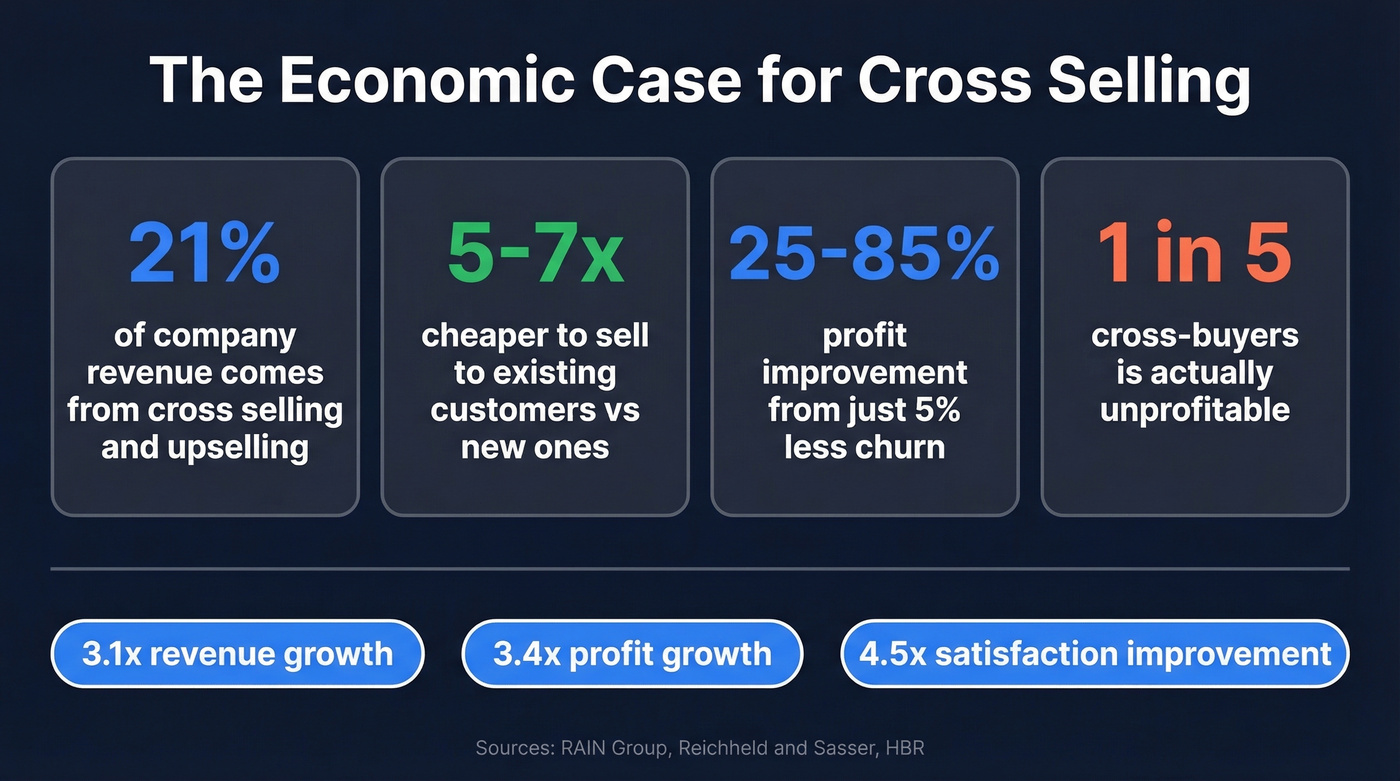
- 3.1x more likely to grow revenue by 20%+ in strategic accounts
- 3.4x more likely to grow profit by 20%+
- 4.5x more likely to see year-over-year improvement in client satisfaction
Cross selling isn't just a revenue play. It's a satisfaction play. Customers who buy more tend to stay longer and rate the relationship higher, which is something we've seen consistently across the B2B teams we work with.
Seven Advantages of Cross Selling
Increases Revenue Per Customer
Cross selling and upselling can lift sales by 20% and profits by 30%. That's the aggregate result of recommending relevant add-ons at the right moment - and even modest conversion rates on cross-sell offers compound quickly across a customer base. A 2% attach rate across 50,000 customers adds up fast.
Raises Customer Lifetime Value
Every additional product a customer buys extends the economic relationship. Bain & Company found that in apparel, a customer's fifth purchase is 40% larger than their first, and their tenth is nearly 80% larger. CLV isn't just about deal size; it's about duration, and cross selling directly extends both.
Improves Customer Experience
This one surprises people. Cross selling, done well, is a service - not a pitch. CustomerThink's research across dozens of companies found a 39% average improvement in company revenues through CX-driven cross-sell improvements. When you recommend something a customer genuinely needs, you're solving a problem they hadn't articulated yet.
Builds Loyalty and Reduces Churn
A 5% reduction in customer defections can improve profits by 25-85%.
- Reichheld & Sasser
Cross selling creates product stickiness. The more integrated a customer is with your ecosystem, the higher the switching cost - and the lower the churn risk. In our experience working with B2B teams, the accounts that buy three or more products churn at roughly one-third the rate of single-product accounts.
If you’re quantifying this, run a proper churn analysis and align on what is churn definitions first.
Lowers Effective Acquisition Costs
Every dollar of revenue from an existing customer is cheaper than a dollar from a new one. You've already paid the acquisition cost, built the relationship, and earned the trust. When you factor in the 5-7x cost gap between retention and acquisition, a cross-sell that converts at even 3% can outperform a new-customer campaign converting at 15% on a cost-per-revenue-dollar basis.
Reveals Product and Market Intelligence
Cross-sell patterns are demand signals in disguise. When customers consistently pair Product A with Product C but ignore Product B, that tells you something about adjacency, bundling potential, and product-market fit. We've seen teams use cross-sell data to reshape their entire product roadmap - killing features nobody bundles with and doubling down on the pairings customers create organically.
Strengthens Competitive Moats
A customer using your CRM, your email tool, and your analytics platform isn't switching to a competitor for one of those. Totango's benchmarks show that multi-product customers have 59% higher net retention rates than single-product users. Cross selling isn't about this quarter's revenue - it's about making your position defensible over time.
If you’re building this into your operating cadence, tie it to pipeline health and sales operations metrics, not just top-line.

Cross selling lifts revenue 20% - but only when you reach the right buyers in each account. Prospeo's 300M+ profiles with 30+ filters (buyer intent, department headcount, technographics) let you map every stakeholder worth a cross-sell offer. 98% email accuracy means your expansion plays actually land.
Stop cross selling blind. Start with verified contacts across every department.
Cross Selling in Action
Let's look at real numbers, not theory.
Tushy added post-purchase cross-sell offers on their thank-you page using ReConvert. The result: a 2% conversion rate on those offers, generating $191,786 in monthly incremental sales - a 174,022% ROI. Post-purchase is an underused touchpoint, and Tushy proved why.
Vanessa Megan, an Australian skincare brand, used AI-powered email recommendations to cross-sell complementary products and subscription bundles. The program delivered a 25.5x ROI.
A temporary staffing agency studied by CustomerThink found that accounts receiving a targeted cross-sell experience generated roughly 150% higher Year 2 revenues compared to accounts that didn't - a 400%+ ROI on the effort. An IT services firm in the same research saw 55% higher revenues from accounts with great support experiences, with an NPS gap of 80 vs. -20 between cross-sold and non-cross-sold accounts. That's a 100-point NPS difference - the kind of gap that separates category leaders from churn machines.
When Cross Selling Destroys Profit
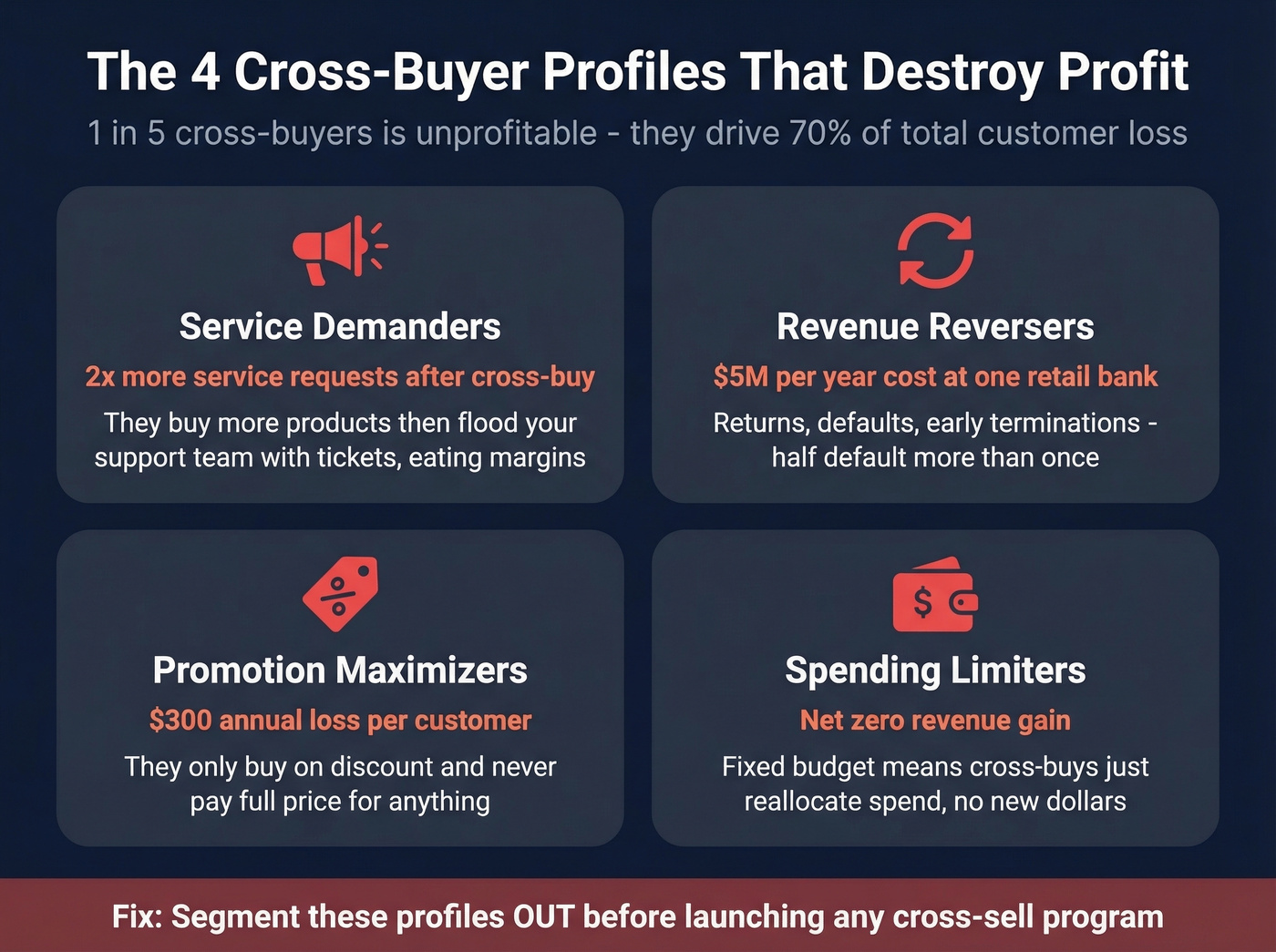
Here's the thing: most cross-selling guides won't touch this. An HBR study analyzing customer datasets from five Fortune 1,000 companies over 4-7 years found that one in five cross-buying customers is unprofitable. That 20% accounts for 70% of a firm's total customer loss.
If that sounds abstract, think Wells Fargo. Employees opened millions of unauthorized accounts to hit cross-sell quotas. The bank was fined more than $185 million and refunded more than $2.8 million to customers, and later reviews found over 3.5 million fraudulent accounts.
The HBR study identified four unprofitable cross-selling customer profiles:
| Profile | Behavior | Real-World Impact |
|---|---|---|
| Service demanders | Service usage spikes after cross-buy | Bank service requests 2x+ after cross-buying |
| Revenue reversers | Returns, defaults, early terminations | ~$5M/year cost at one retail bank |
| Promotion maximizers | Only buy on discount | ~$300 annual loss per customer |
| Spending limiters | Fixed budget; cross-buy just reallocates | Net zero revenue, added marketing cost |
At one retail bank, revenue reversers alone cost $5M per year, with about half defaulting more than once. Promotion maximizers at catalog and fashion retailers generated $300 in annual losses each. Understanding these disadvantages of cross selling is just as important as understanding the upside - ignoring them is how teams turn a growth lever into a margin drain.
The takeaway isn't "don't cross-sell." It's "don't cross-sell blindly." Segment first. Exclude the profiles that'll eat your margin.
Placement Benchmarks by Touchpoint
Not all touchpoints convert equally.
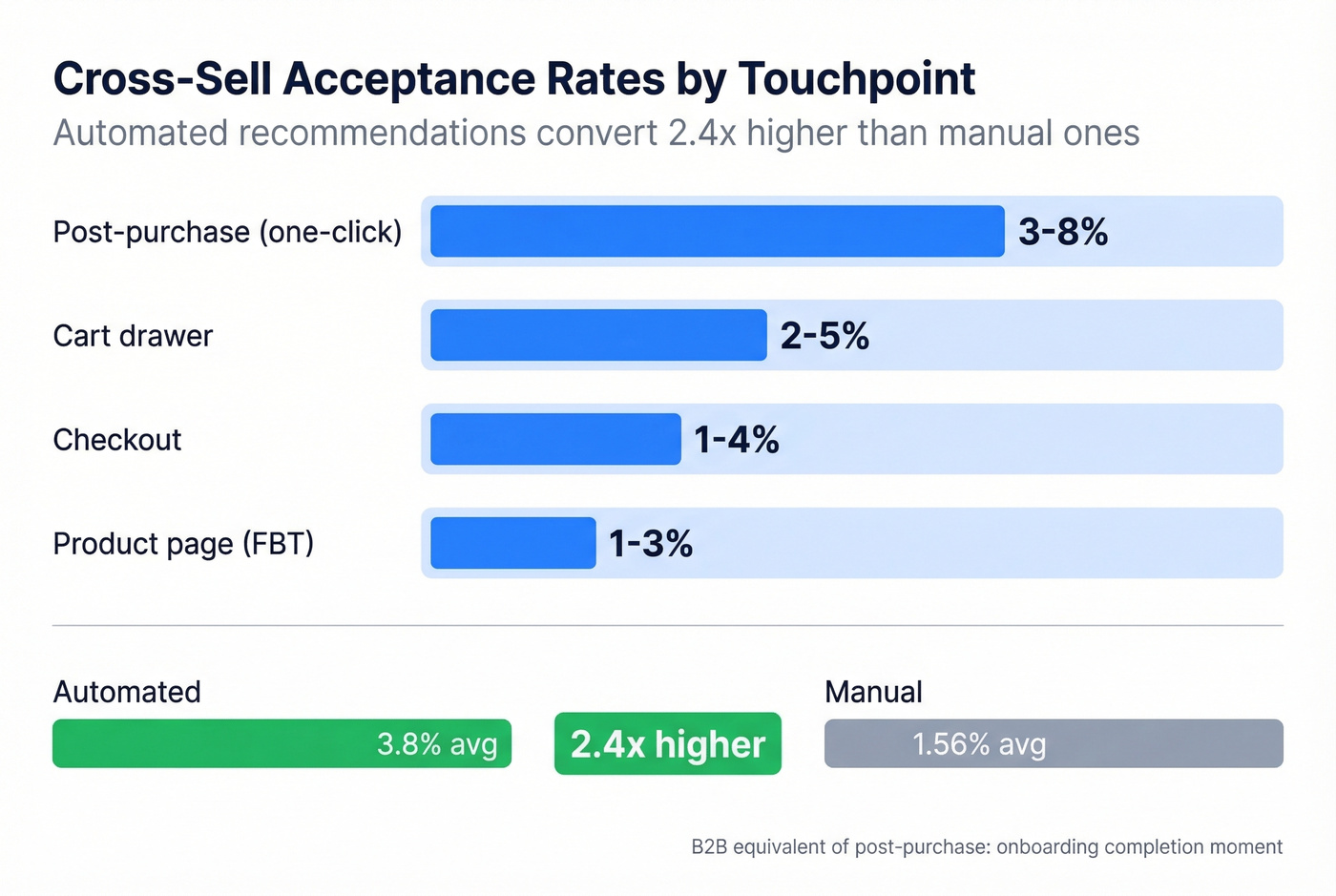
| Touchpoint | Acceptance Rate |
|---|---|
| Post-purchase (one-click) | 3-8% |
| Cart drawer | 2-5% |
| Checkout | 1-4% |
| Product page (FBT) | 1-3% |
Automated recommendations average 3.8% acceptance versus 1.56% for manual - 2.4x higher. Automation wins decisively. If you're still manually curating cross-sell offers, you're leaving money on the table and burning team hours doing it.
For B2B, the equivalent of "post-purchase" is the onboarding completion moment - the customer has realized value and is most receptive to adjacent offers. In ecommerce, the thank-you page remains the highest-converting placement by a wide margin.
How to Cross Sell Effectively
Segment First
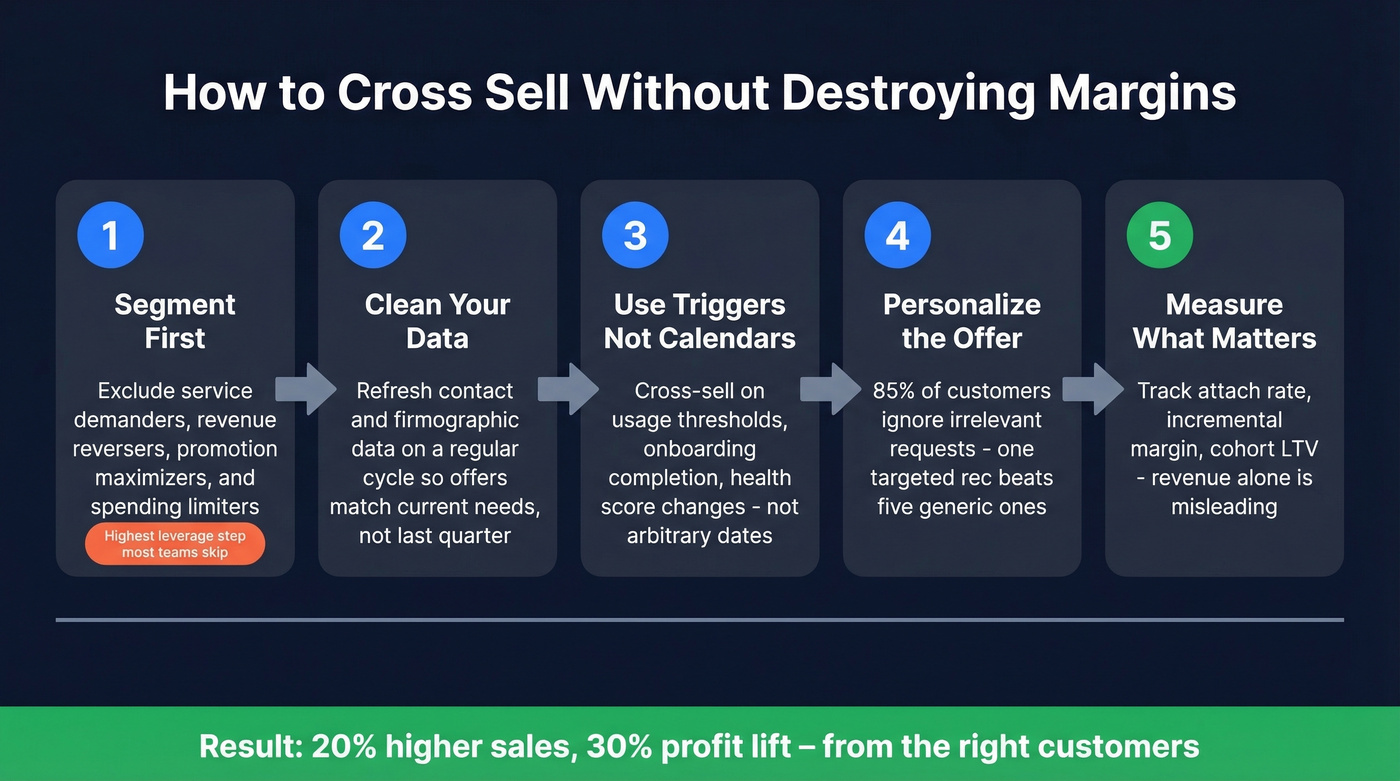
Before you cross-sell anyone, exclude the four unprofitable profiles from the HBR study. Service demanders, revenue reversers, promotion maximizers, and spending limiters will erode your margins faster than the cross-sell revenue can build them. In our experience, this segmentation step alone eliminates the majority of cross-sell waste - and it's the single highest-leverage step most teams skip.
If you need a practical framework for segmentation, start with an Ideal Customer Profile and then layer intent based segmentation on top.
Skip this if you're running a low-ACV product with minimal support costs. The math on unprofitable cross-buyers matters most when service and return costs are real.
Start with Accurate Data
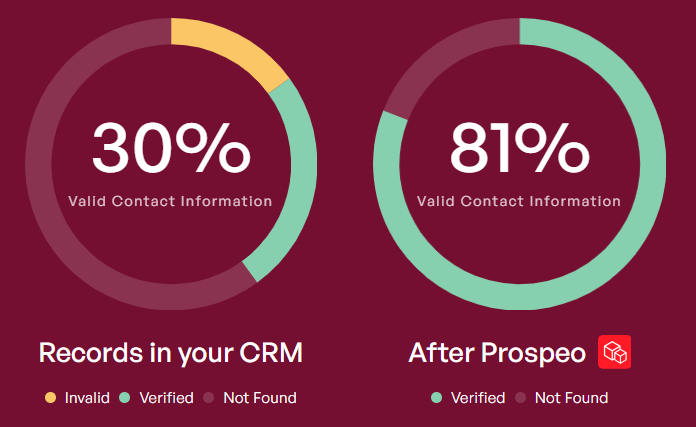
Cross-sell targeting is only as good as your customer data. Stale CRM records lead to irrelevant offers - which is exactly the failure mode this entire article warns about. Tools like Prospeo can help here by refreshing contact and firmographic data on a 7-day cycle, so your segmentation reflects what customers need now rather than what your CRM captured last quarter.
If you’re evaluating vendors, compare data enrichment services and get clear on what “enrichment” actually includes with lead enrichment.
Use Triggers, Not Calendars
Don't cross-sell on a schedule. Cross-sell on signals. Usage thresholds, onboarding completion, support ticket patterns, health score changes - these are the moments when a customer is primed for a relevant offer. Combine product usage data with CRM signals to time outreach to natural expansion moments.
To operationalize this, build a system for identifying buying signals and standardize how to track sales triggers.
Personalize the Offer
85% of customers won't respond to irrelevant cross-sell requests. One well-targeted recommendation outperforms five generic ones every time. Choice overload is real - too many add-ons at checkout creates decision paralysis, not revenue.
Measure What Matters
Track attach rate, incremental margin, cohort LTV, and cross-sell conversion rate. Revenue alone is misleading - if your cross-sell program is attracting promotion maximizers, top-line growth masks bottom-line erosion.
Cross Selling in B2B and SaaS
B2B cross selling runs on different signals than ecommerce. You're not recommending a phone case - you're identifying when an account is ready for an adjacent product based on how they're using your current one.
The triggers that matter: feature adoption thresholds where a team maxes out their current plan's capabilities, onboarding completion where they've realized value and are ready for more, support ticket patterns with repeated questions about functionality you offer in another product, and health score changes where engagement trending up signals expansion readiness.
Here's a hot take: if your average deal size is under $10k, you probably don't need a dedicated cross-sell motion at all. Automate product recommendations inside the app and let usage data drive expansion. Reserve the human-led cross-sell playbook for accounts where the expansion potential justifies the effort.
Sales teams consistently debate whether cross selling should be CS-led or sales-led. The answer depends on product adjacency - if the cross-sell is a natural extension of the current product, CS owns it. If it's a genuinely different product line, sales needs to run the conversation. The consensus on r/sales leans the same way: CS for expansion, AEs for new product lines.
Account planning is where this gets operationalized. Integrate your product analytics with your CRM to build predictive models for cross-sell readiness, using enrichment tools that return 50+ data points per contact so your account plans reflect real buying signals rather than stale job titles.
Multi-product accounts churn at one-third the rate - but reaching new decision-makers inside existing accounts requires fresh, accurate data. Prospeo refreshes every 7 days and returns 50+ data points per contact, so your cross-sell outreach hits real buyers, not dead inboxes.
Expand accounts with data that's never more than a week old.
FAQ
Is cross selling ethical?
Yes - when the recommendation is relevant and genuinely helpful. Suggesting a complementary product a customer actually needs is service. Pushing unrelated products to hit a quota is the Wells Fargo playbook. Segment first, personalize always, and measure margin impact, not just attach rate.
What's the difference between cross selling and upselling?
Cross selling offers a complementary product alongside the original purchase - a phone case with a phone. Upselling offers a higher-tier version of the same product - upgrading from 64GB to 128GB storage. Both increase order value, but cross selling broadens the relationship across product lines while upselling deepens it within one.
How do you identify the right customers to cross sell?
Start with purchase history, usage patterns, and intent signals. Exclude the four unprofitable profiles from the HBR study - service demanders, revenue reversers, promotion maximizers, and spending limiters. Then layer in firmographic enrichment and intent data to pinpoint accounts actively researching adjacent solutions.
What are the biggest cross selling benefits for B2B teams?
Higher net retention, lower effective acquisition costs, and stronger competitive moats. Totango data shows multi-product customers retain at 59% higher rates. For B2B specifically, each additional product deepens switching costs and turns single-threaded accounts into platform-dependent relationships that churn at roughly one-third the rate.