

Customer Targeting in 2026: A Practical, Data-Backed Guide
A retail brand cleaned up its customer data - removed duplicates, fixed broken event tracking, simplified its stack - and saw email revenue jump 28% in two months. Not from a new channel. Not from a new message. Just from making sure the right message actually reached the right person. That's what customer targeting comes down to: precision, not volume.
What You Need Fast
Customer targeting is the practice of identifying specific groups of potential or existing customers and directing personalized marketing, sales, or product actions toward them. It sits downstream of segmentation - you divide your market first, then target the segments worth pursuing.
The loop: Data → Segment → Activate → Measure → Refresh.
Here's what matters right now:
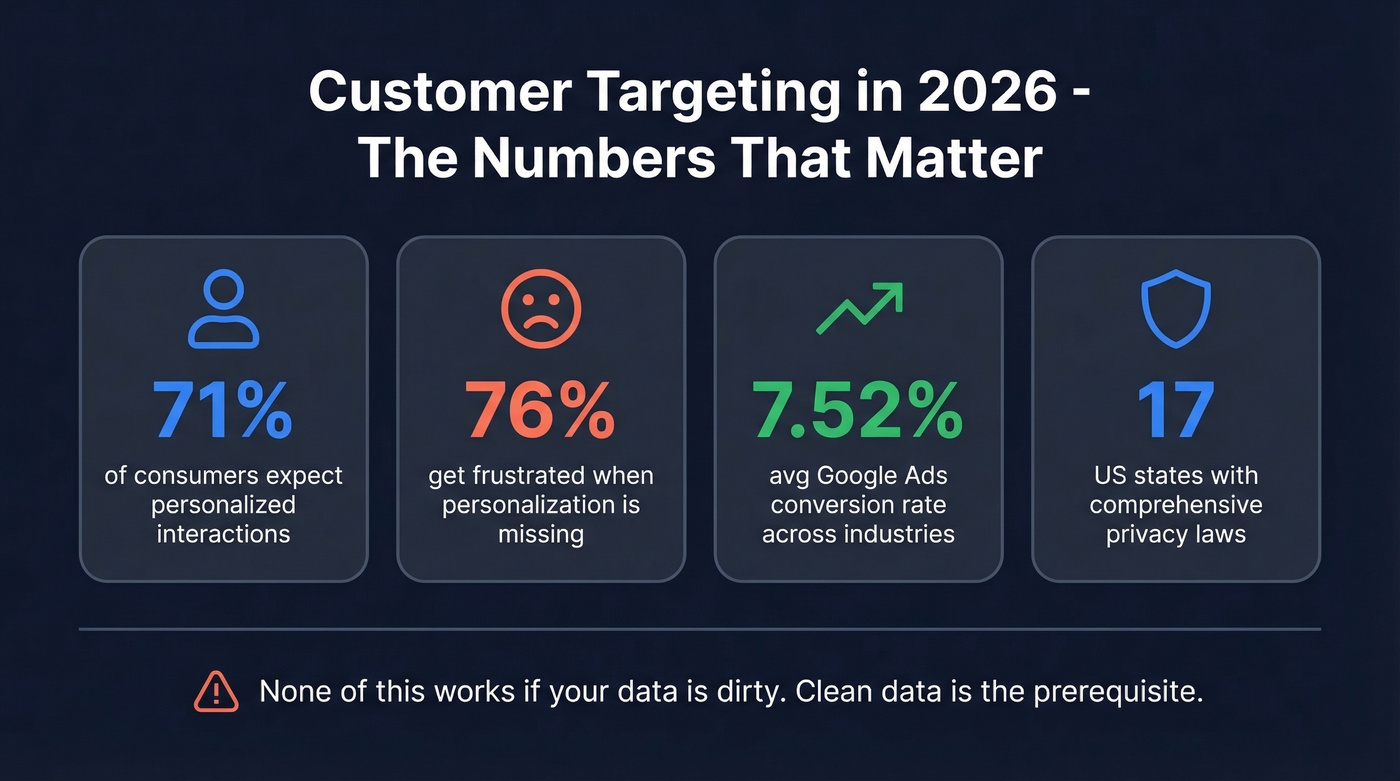
- 71% of consumers expect personalized interactions. 76% get frustrated when it doesn't happen. And 65% cite targeted promotions as a top reason to purchase.
- A useful Google Ads baseline: 7.52% average conversion rate across industries, $70.11 average CPL. If you're far below that, your targeting or your offer needs work.
- Privacy isn't optional. 17 US states now have comprehensive privacy laws in effect or taking effect. GDPR fines run up to EUR 20M or 4% of global turnover. Your strategy needs a compliance layer baked in.
- None of this works if your data is dirty. Clean data is the prerequisite. Duplicates, bounced emails, and broken event tracking silently destroy targeting ROI.
Five steps, in order: audit your data quality, define segments based on actual behavior, activate through the right channel, measure against real benchmarks, and refresh quarterly.
What Is Customer Targeting?
Customer targeting is the process of focusing marketing and sales resources on the people most likely to buy, stay, and expand. The concept isn't new. What's new is the infrastructure around it - and the cost of getting it wrong.
The marketing automation market grew from roughly $6.65B in 2024 and is projected to exceed $20B by 2030. That growth reflects a shift from "pick a demographic and blast an email" to "identify a behavioral signal, match it to a segment, trigger a personalized action across channels, and measure the result within hours."
Why does this matter more in 2026 than it did five years ago? Three forces are converging. First, signal loss - third-party cookies are functionally dead, and interest-based targeting on Meta and Google isn't performing the way it used to. Practitioners on r/DigitalMarketing are openly asking whether broad campaigns now outperform detailed targeting. Second, privacy regulation has exploded in scope: GDPR, CCPA/CPRA, and 15+ additional state laws mean you can't just target whoever you want however you want. Third, AI maturity - machine learning models that predict churn, purchase propensity, and next-best-action aren't experimental anymore. They're in production at mid-market companies.
The companies winning aren't the ones with the biggest databases. They're the ones with the cleanest data, the tightest segments, and the fastest feedback loops.
Targeting vs. Segmentation
These terms get used interchangeably, and it causes real confusion.
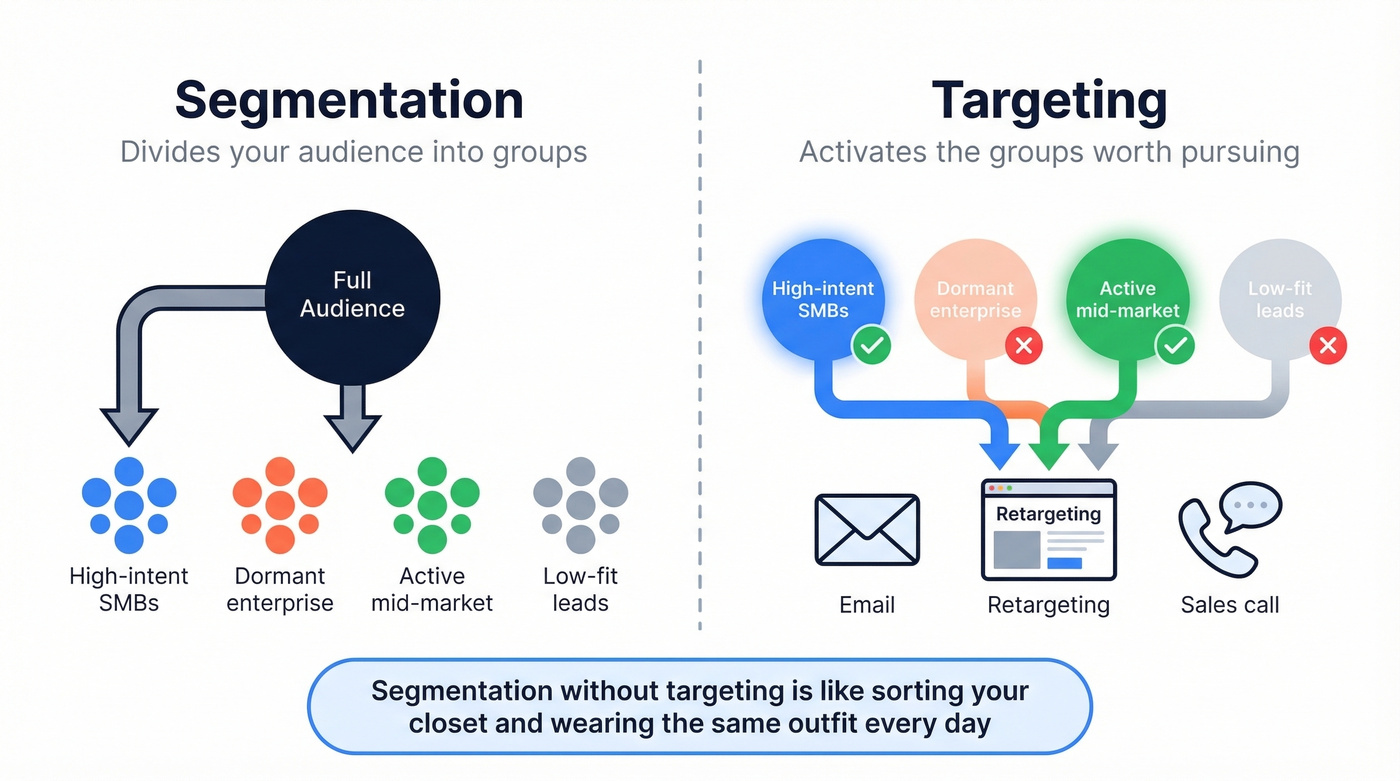
Segmentation divides. Targeting activates.
Segmentation is the analytical work of grouping your market into clusters based on shared characteristics. Targeting is the strategic decision about which of those segments to pursue and how to reach them.
| Segmentation | Targeting | |
|---|---|---|
| What it does | Divides audience into groups | Selects groups to pursue |
| When it happens | Before campaigns | During campaign planning |
| Output | Segment definitions | Channel + message decisions |
| Example | "SMBs in fintech, 50-200 employees" | "Run email nurture to this segment via Outreach" |
A few examples. You segment your email list by engagement level - opened in last 30 days vs. dormant - then target the dormant segment with a re-engagement sequence using different subject lines and a different offer. You segment website visitors by pages viewed, then target the "pricing page + case study" cluster with retargeting ads featuring a demo CTA. You segment your user base by feature adoption, then target low-adoption accounts with in-app nudges toward the features that correlate with retention.
The mistake we see most often: teams spend weeks building beautiful segments and then blast the same message to all of them. That's segmentation without targeting. It's like sorting your closet and then wearing the same outfit every day.
Fix Your Data First
Every targeting strategy assumes your data is accurate. Most data isn't.
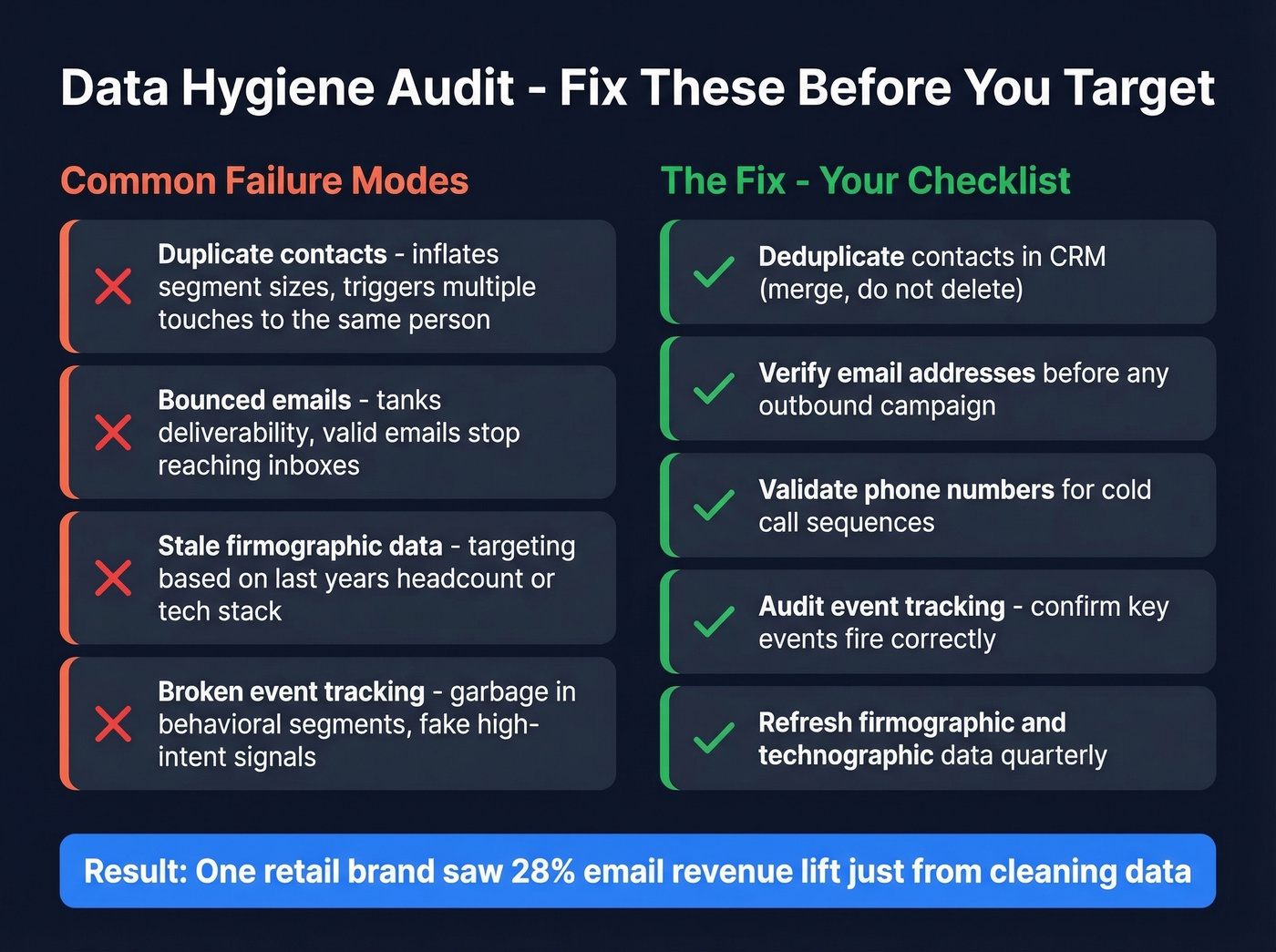
We've seen teams launch sophisticated multi-channel campaigns - intent-triggered sequences, personalized landing pages, the works - only to discover that 15% of their email list bounces, their CRM has thousands of duplicates, and their event tracking is firing on the wrong pages. The targeting logic was fine. The data underneath it was broken.
The failure modes are predictable:
- Duplicate contacts inflate segment sizes and trigger multiple touches to the same person
- Bounced emails tank deliverability scores, which means even your valid emails stop reaching inboxes
- Stale firmographic data means you're targeting companies based on last year's headcount or tech stack
- Broken event tracking feeds garbage into behavioral segments - your "high-intent" segment is actually just people who triggered a misconfigured pixel
That retail brand from the opening? The 28% email revenue lift came from fixing exactly these problems. No new creative. No new channels. Just clean data flowing into existing segments.
Use this approach if: you haven't audited your contact database in the last 6 months, your bounce rate exceeds 3%, or you're running enrichment from a provider that refreshes data monthly or less.
Skip this if: you already have a verified, deduplicated database with sub-2% bounce rates and real-time event tracking. Most teams don't.
Data hygiene checklist:
- Deduplicate contacts in your CRM (merge, don't delete - preserve activity history)
- Verify email addresses before any outbound campaign (see email bounce rate benchmarks and fixes)
- Validate phone numbers if you're running cold call sequences
- Audit event tracking: confirm that key behavioral events fire correctly
- Refresh firmographic and technographic data quarterly at minimum (use data enrichment services if your CRM is stale)
For the verification piece, Prospeo runs every email through a 5-step verification process with catch-all handling, spam-trap removal, and honeypot filtering at 98% accuracy. The 7-day data refresh cycle means contacts you pulled last week are still current. For teams running outbound, that's the difference between a 2% bounce rate and a 15% bounce rate - and that gap compounds across every campaign you send.
Segmentation Types That Drive Results
Not all segmentation is created equal. Some types drive real targeting decisions. Others just make your dashboards look busy.
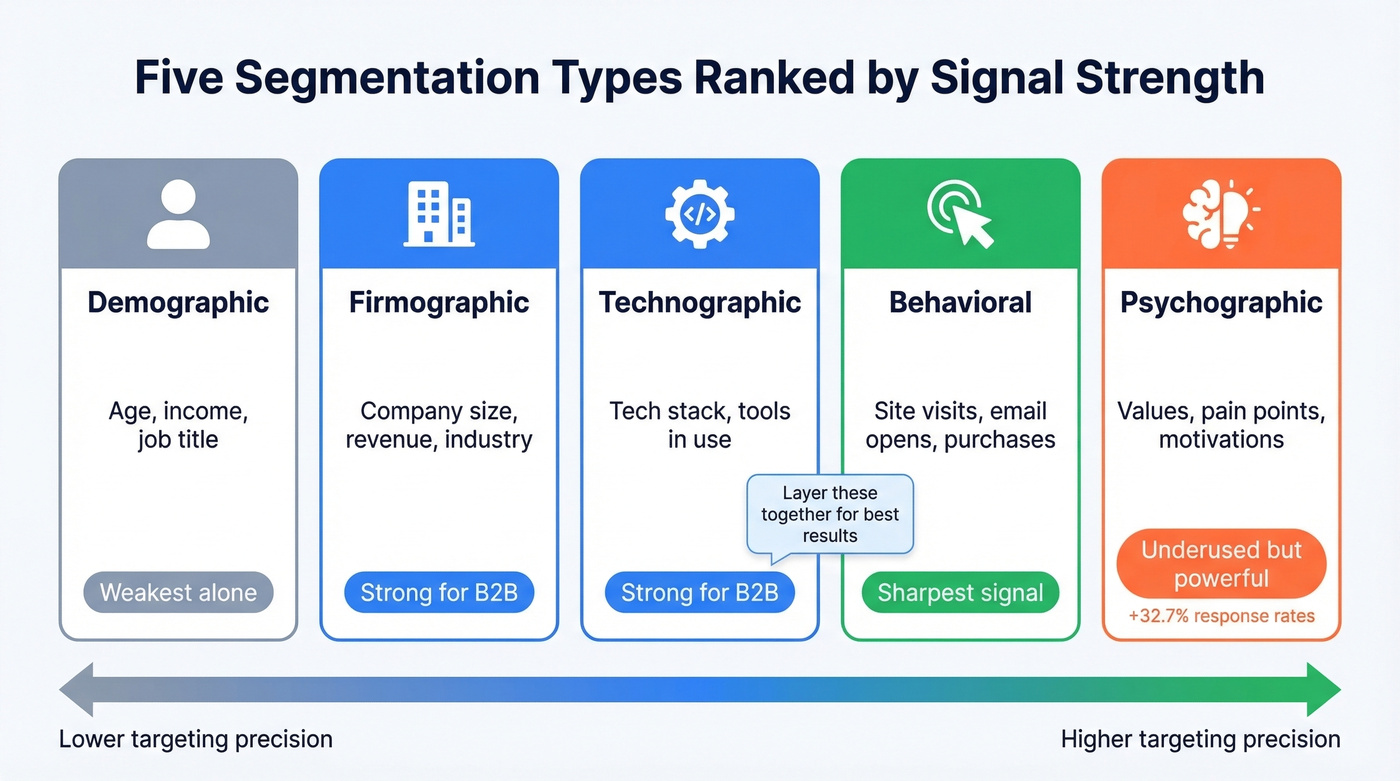
Here are the five types that actually move the needle:
| Type | What It Captures | Activation Example |
|---|---|---|
| Demographic | Age, income, education, job title | Tailor ad copy by seniority level |
| Behavioral | Purchase history, site activity, email engagement | Trigger abandoned-cart sequence after 2 hours |
| Psychographic | Values, pain points, motivations | Position product as "efficiency" vs. "growth" based on survey responses |
| Firmographic | Company size, revenue, industry, growth rate | Route enterprise leads to AE team, SMB to self-serve |
| Technographic | Tech stack, tools in use, infrastructure | Target companies using a competitor's product with migration messaging |
Demographic segmentation is where most teams start, and it's the weakest signal on its own. Knowing someone is a VP of Marketing at a 200-person company tells you something, but it doesn't tell you if they're in-market, frustrated with their current tools, or even the right decision-maker.
Behavioral data is where targeting gets sharp. A prospect who visited your pricing page three times, downloaded a comparison guide, and opened your last two emails is a completely different target than someone who signed up for a webinar six months ago and went silent. Same job title. Completely different intent. Netflix understood this early - their recommendation engine doesn't care about your age or zip code; it watches what you actually do, then serves personalized artwork and suggestions based on viewing behavior. The same principle applies to B2B.
Firmographic and technographic data matter most in B2B. If you're selling a Salesforce integration, targeting companies that use Salesforce is obvious - but layering in headcount growth, recent funding, and tech stack changes turns a broad segment into a high-probability target list (see firmographic and technographic data).
Psychographic segmentation is underused and powerful. Customizing outreach based on psychographic attributes - pain points, values, decision-making style - can increase response rates by 32.7%. The challenge is collecting this data at scale, which typically requires a mix of surveys, conversation intelligence, and CRM notes.
B2B vs. B2C Differences
The mechanics diverge in ways that matter for your strategy, channels, and measurement.
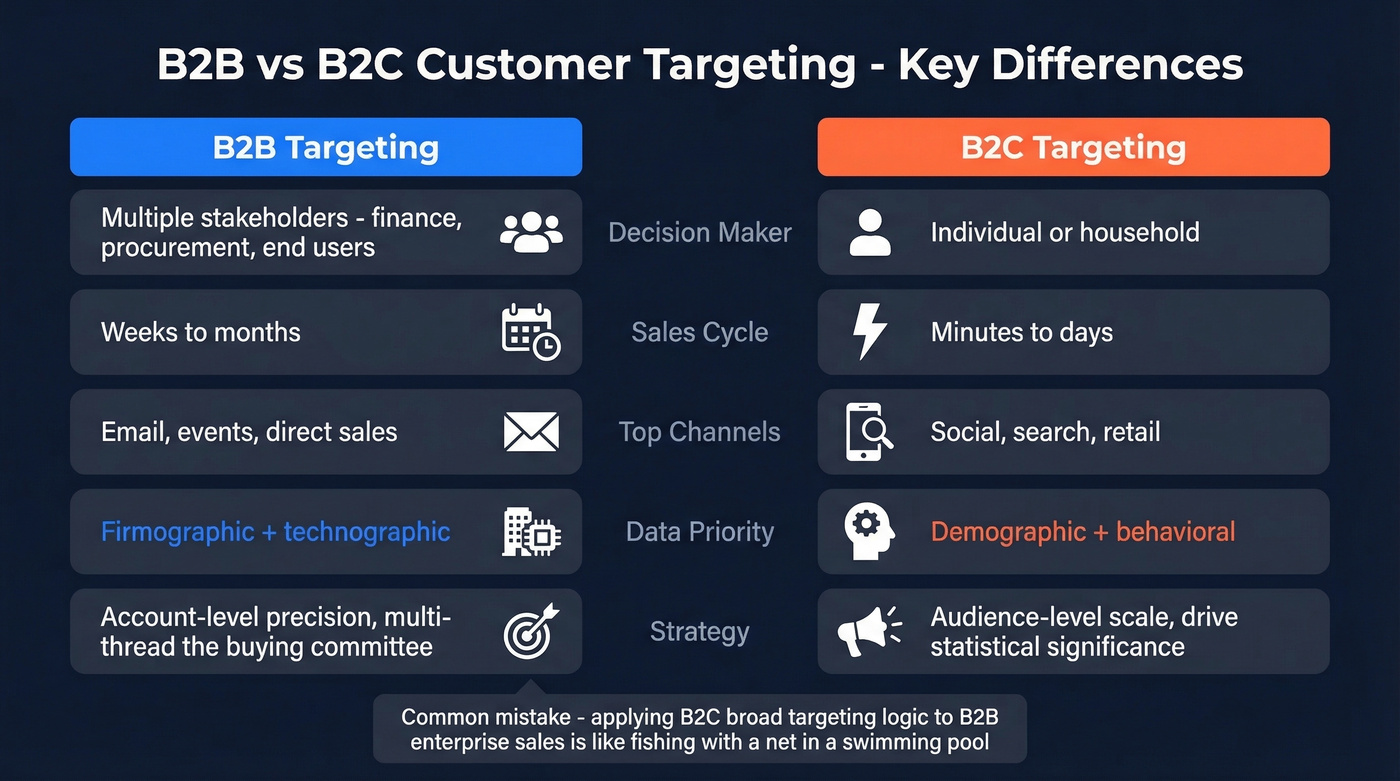
| Dimension | B2B | B2C |
|---|---|---|
| Decision-maker | Multiple stakeholders | Individual or household |
| Sales cycle | Weeks to months | Minutes to days |
| Primary channel | Email, events, direct sales | Social, search, retail |
| Data priority | Firmographic + technographic | Demographic + behavioral |
| CLV dynamic | Higher LTV, longer relationships | Lower LTV, loyalty-driven |
The US Chamber of Commerce frames the B2B buying process as a multi-step consensus exercise: identify need, research solutions, define requirements, select supplier - with finance, procurement, and end-users all weighing in. Your targeting can't just reach the right company. It needs to reach the right people within that company, at the right stage of their buying process.
B2C targeting leans harder on emotional triggers and broad reach. You're optimizing for impulse, urgency, and storytelling. The data signals are different - purchase frequency, cart behavior, social engagement - and the channels skew toward visually engaging platforms.
One pattern that trips up B2B teams: applying B2C logic to enterprise sales. Running broad Facebook ads to "marketing directors" and expecting pipeline is like fishing with a net in a swimming pool. B2B requires account-level precision - identifying the right companies first, then multi-threading into the buying committee. B2C requires audience-level scale - reaching enough of the right people to drive statistical significance in your campaigns.
B2B ICP Framework
If you're in B2B, everything starts with your Ideal Customer Profile. An ICP defines the type of company most likely to buy, succeed with, and expand your product. It's not a persona - personas describe people; ICPs describe organizations.
How to build an ICP that actually works:
Step 1: Start with your top 10 customers. Not your biggest logos - your best customers. The ones with the highest NRR, fastest onboarding, lowest support burden, and strongest expansion. Pull their firmographic data: industry, headcount, revenue, growth rate, tech stack, funding stage.
Step 2: Find the patterns. What do these companies have in common? Maybe they're all Series B-C SaaS companies with 100-500 employees using Salesforce and HubSpot. Maybe they're all in financial services with a recent CTO hire.
Step 3: Build an influence map. For each ICP account, identify the typical buying committee. Who initiates the search? Who evaluates? Who signs? Who blocks?
Step 4: Validate with negative examples. Look at your churned customers and lost deals. What firmographic patterns do they share? These become your exclusion criteria. An ICP isn't just who to target - it's who to avoid.
Step 5: Operationalize. Turn your ICP into a searchable filter set in your data platform. Prospeo's 30+ search filters let you translate an ICP definition directly into a verified prospect list - filter by the criteria that define your best customers, and you've got a targeted account list in minutes rather than days. (If you want a scoring rubric, use an Ideal Customer Profile template.)
Step 6: Refresh quarterly. Markets shift. Your product evolves. The ICP that worked six months ago might be slightly off today. Review against recent wins and losses every quarter.

The article says it clearly: clean data is the prerequisite for customer targeting. Prospeo's 5-step verification delivers 98% email accuracy with catch-all handling, spam-trap removal, and honeypot filtering - refreshed every 7 days, not every 6 weeks.
Stop targeting the right segments with the wrong contact data.
Strategies That Work in 2026
These are the approaches producing results right now - not theoretical frameworks, but plays that teams are actually running.
Re-engagement triggers. Most teams have a "dormant" segment they ignore. That's a mistake. Set up behavioral triggers that fire when a dormant contact re-engages: visits your site, opens an email after 90 days of silence, or shows intent signals on third-party sites. The re-engagement window is short - hit them within 24 hours with relevant content, not a generic "we miss you" email.
Lifecycle orchestration. Map your targeting to the customer lifecycle, not just the funnel. Post-purchase targeting - onboarding sequences, adoption nudges, expansion triggers, renewal campaigns - is where the compounding value sits. A well-timed cross-sell message to a customer who just hit a usage milestone often converts at 3-5x the rate of a cold outbound touch (see cross selling vs upselling).
Intent-based targeting. Instead of targeting companies that match your ICP and hoping they're in-market, layer intent data to identify companies actively researching your category. This narrows your list dramatically - from "all companies that fit" to "companies that fit and are buying now" (more on intent based segmentation).
Cross-sell and upsell plays. Segment your existing customer base by product usage, contract value, and expansion potential. Target the "high usage, low contract" segment with upgrade messaging. These campaigns have lower CAC and higher close rates than net-new acquisition.
Micro-segment activation. Here's the thing: the 80/20 rule applies hard. 20% of your segments drive 80% of your revenue. A hyper-targeted campaign to 500 perfect-fit accounts will outperform a broad campaign to 50,000 loosely-fit contacts every time. Learning how to target customers at this level of precision is what separates high-performing teams from everyone else.
Predictive churn intervention. Build a model (or use your platform's built-in scoring) that identifies accounts likely to churn in the next 30-60 days. Target them with retention plays - executive outreach, success reviews, feature adoption campaigns. See the AI section below for implementation details and real-world results (and a deeper churn analysis framework).
Channel-specific personalization. Don't just personalize the message - personalize the channel. Some segments respond to email. Others engage through in-app messaging. Others need a phone call. Vendor-reported examples show results like 45% increases in lead capture and 67% reductions in CPA when cross-channel orchestration is done well - directional, not guaranteed, but the pattern is consistent.
Paid Ads Reality Check
If you're running paid acquisition, your targeting playbook needs an update. The rules changed, and a lot of teams haven't caught up.
The core problem: interest-based targeting on Meta and Google isn't performing the way it used to. Practitioners on Reddit are openly questioning whether detailed targeting still works, and the consensus is shifting toward a different approach.
First-party seed audiences. Upload your customer list (or high-intent segment) as a seed for lookalike/similar audiences. The quality of your seed determines the quality of your output. A clean, verified list of 2,000 actual buyers produces better lookalikes than a messy list of 20,000 contacts with 15% bounce rates.
Broad campaigns with strong creative. Counterintuitive, but broad targeting paired with AI-optimized creative is outperforming hyper-targeted campaigns in many cases. The platforms' algorithms are better at finding your audience than your manual targeting settings - if you give them good creative to test.
AI creative testing at scale. Run 10-20 creative variants per campaign and let the platform's ML optimize delivery. The targeting happens through creative resonance, not audience settings.
Server-side tracking (CAPI). With browser-side tracking degrading due to privacy controls, server-side event tracking via Conversions API or enhanced conversions is essential. Without it, your optimization signals are incomplete and your targeting degrades over time. (If you're auditing your setup, start with email tracking pixels and measurement hygiene.)
Stop doing these things:
- Stacking 15 interest categories and calling it "targeting"
- Relying on third-party data segments from your DSP without validating match rates
- Ignoring the Global Privacy Control signal (regulators are enforcing this)
- Running retargeting without consent management - this is a legal risk in 17+ states
Here's my hot take: the paid ads teams getting the best results in 2026 are spending less time in audience settings and more time on creative strategy, first-party data infrastructure, and measurement. If your average deal size is under five figures, you probably don't need hyper-granular audience targeting at all - broad campaigns with great creative and strong landing pages will outperform the micro-targeted approach that worked in 2020.
AI-Powered Targeting in Practice
AI-driven targeting isn't a buzzword anymore - it's a production capability. But the gap between "we use AI" and "AI is actually improving our results" is enormous.
McKinsey's research on "next best experience" models quantifies the opportunity: companies implementing AI-powered targeting see customer satisfaction increase 15-20%, revenue increase 5-8%, and cost-to-serve decrease 20-30%.
Three layers define what this looks like in practice.
Layer 1: Predictive scoring. ML models that score accounts or contacts based on likelihood to convert, churn, expand, or respond. This replaces manual lead scoring with dynamic, continuously-updated predictions. The inputs are behavioral data, firmographic data, and intent signals. The output is a prioritized list that updates daily. (If you're building this in B2B, see lead scoring.)
Layer 2: Dynamic segmentation. Instead of static segments that you define and refresh quarterly, AI clusters your audience based on emerging patterns. A cluster might form around "companies that recently hired a VP of Sales and are researching CRM migration" - a segment you'd never think to create manually but that converts at 3x your average.
Layer 3: Intervention selection. Given a scored account in a dynamic segment, what's the best action? Email? Phone call? In-app message? Discount offer? AI models that optimize the action - not just the audience - are where results compound. One global payments processor built an ML model predicting merchant attrition within 7 days and recommended specific interventions for each merchant, estimating up to 20% attrition reduction per year. A North American retailer using propensity models saw roughly a 3% boost in annualized margins - modest-sounding until you apply it to nine-figure revenue.
The prerequisite for all three layers is the same: clean, frequently-refreshed data. AI models trained on dirty data produce confidently wrong predictions. We've watched teams invest six figures in ML infrastructure and get worse results than a simple rule-based system because their underlying data was full of duplicates and stale records.
The practical starting point for most teams isn't building custom ML models. It's using the AI capabilities already embedded in your existing tools - HubSpot's predictive lead scoring, Salesforce Einstein, intent data platforms - and making sure the data feeding those systems is accurate.
Benchmarks to Diagnose Targeting
Benchmarks are diagnostic tools, not targets. If your numbers are wildly off from industry averages, something is wrong with your targeting, your offer, or your funnel.
Paid acquisition benchmarks (via WordStream, updated late 2025):
| Channel | Avg CVR | Avg CPL |
|---|---|---|
| Google Ads (all industries) | 7.52% | $70.11 |
| Facebook lead ads | 7.72% | $27.66 |
Industry variation is massive. Auto repair converts at 14.67% on Google Ads with a $28.50 CPL. Attorneys convert at 5.09% with a $131.63 CPL. Finance and insurance sits at 2.55%. If you're benchmarking against "average," you're benchmarking against nothing. Compare within your vertical.
Funnel-stage heuristics for diagnosing targeting vs. offer problems:
| Campaign Type | Expected CVR Range |
|---|---|
| Branded search | 15-25% |
| Competitor comparison | 8-12% |
| Broad discovery | 2-4% |
The diagnostic rule: if your high-intent campaigns (branded, competitor) aren't converting at 2-3x your discovery campaigns, you likely have a targeting or offer problem, not a funnel problem. If branded search converts at 18% but competitor campaigns convert at 4%, your competitive positioning needs work - not your landing page.
Email benchmarks to watch:
- Bounce rate above 3%: data quality problem
- Open rate below 15%: deliverability or subject line problem
- Click-through rate below 1.5%: relevance or targeting problem
- Unsubscribe rate above 0.5% per send: frequency or segmentation problem
One thing benchmarks won't tell you: whether you're targeting the right people in the first place. A 10% conversion rate on a poorly-targeted audience is worse than a 3% conversion rate on a perfectly-targeted one - if the latter produces higher-value customers with better retention. Always pair conversion benchmarks with downstream metrics like customer quality, LTV, and payback period.
Mistakes That Kill Results
The Kellogg School of Management identifies three classic targeting errors that are still rampant in 2026.
The "Everyone" target. Your target definition is so broad it's meaningless. "Marketing professionals at mid-size companies" isn't a target - it's a census category. SpotHero fixed this by narrowing from "people who park" to "business parkers" - a specific segment with specific needs and specific willingness to pay.
The "Popular Kid" target. You pick the biggest, most obvious segment because it looks attractive. So does every competitor. Look for underserved segments instead. The segment that's 1/10th the size but has 1/100th the competition is almost always more profitable.
The "Egocentric" target. You evaluate your targeting and creative through your own lens instead of the customer's. Old Spice's famous repositioning worked because they stopped thinking about what they wanted to say and started thinking about what their actual target wanted to feel. This mistake is especially common in B2B, where marketers write copy that impresses other marketers instead of resonating with buyers.
Beyond those three, here are the operational mistakes we see constantly.
Segmenting without activating. You build beautiful segments in your CDP and then... nothing. No automated journeys, no personalized content, no differentiated outreach. Segmentation without activation is just expensive data organization.
Never refreshing segments. Markets change. Customers change. Dialog Insight recommends reviewing segments every 6-12 months. We'd push for quarterly reviews on your top-performing segments.
Over-segmentation. The opposite of the "Everyone" target. You create 47 micro-segments, each with its own messaging, creative, and journey. Your team can't maintain them. Three well-executed segments beat twenty neglected ones.
Ignoring the human behind the data. Quantitative segmentation tells you what people do. It doesn't tell you why. Combine behavioral data with qualitative inputs - customer interviews, support tickets, sales call recordings - to build segments that reflect actual motivations, not just click patterns.
Privacy and Compliance in 2026
Let's be honest: the legal landscape has changed more in the last three years than in the previous decade. Ignoring compliance isn't just risky - it's expensive.
GDPR (EU/EEA): Applies to any company processing EU residents' data, regardless of where you're based. Marketers typically need explicit consent as the legal basis for targeting. Penalties run up to EUR 20M or 4% of global annual turnover - whichever is higher.
CCPA/CPRA (California): Operates on an opt-out model rather than opt-in. You must provide a "Do Not Sell or Share My Personal Information" link. Penalties hit $7,500 per intentional violation and $2,500 per unintentional violation. Those per-violation fines add up fast when you're processing thousands of records.
| GDPR | CCPA/CPRA | |
|---|---|---|
| Model | Opt-in (consent) | Opt-out |
| Scope | EU/EEA residents | CA residents |
| Max penalty | EUR 20M / 4% turnover | $7,500/violation |
| Key requirement | Explicit consent | "Do Not Sell" link |
The US patchwork: 17 states now have privacy laws in effect or taking effect - California, Virginia, Colorado, Connecticut, Utah, Oregon, Montana, and more. Each has slightly different definitions of "targeted advertising," but they all cover the practices most marketers rely on: retargeting, lookalike audiences, and cross-site behavioral targeting.
If you're running paid ads to US audiences, you're likely subject to multiple state laws simultaneously.
Recent changes worth tracking: regulators in California, Colorado, and Connecticut are actively enforcing compliance with Global Privacy Control signals. California AB 566 requires major browsers to include built-in opt-out preference signals by 2027, which will dramatically increase opt-out signal volume. And tracking pixels and session replay tools are generating lawsuits under video privacy and wiretapping statutes - audit every pixel on your site.
Your 2026 compliance checklist:
- Implement GPC/universal opt-out signal handling across all properties
- Audit consent flows for every state where you have customers
- Review all tracking pixels and session replay tools for legal exposure
- Ensure your "Do Not Sell or Share" link is prominent and functional
- Document your legal basis for each targeting activity
- Run a DSAR response drill - can you fulfill a data deletion request within 30 days?
The practical approach: build to the strictest standard (GDPR) and layer in state-specific requirements where they diverge.
Tools to Execute Targeting
Strategy without execution is a whiteboard exercise. Here are the tools that turn targeting plans into pipeline.
Prospeo
The data quality foundation your targeting stack needs. 300M+ professional profiles, 143M+ verified emails, 125M+ verified mobile numbers - all refreshed on a 7-day cycle while the industry average sits at six weeks. 98% email accuracy means your segments actually reach real people instead of bouncing into the void.

For B2B targeting, 30+ search filters let you operationalize your ICP directly: firmographics, technographics, headcount growth, funding, department size, and buyer intent across 15,000 topics powered by Bombora. Build a targeted list, verify every contact, and push it to HubSpot, Salesforce, Lemlist, Instantly, or Clay through native integrations. Pricing starts free (75 verified emails/month), with paid plans from ~$39/mo. No contracts, no sales calls required.
HubSpot
HubSpot dominates the mid-market for a reason: it combines CRM, segmentation, automation, and reporting in one platform. The free CRM tier is genuinely useful for early-stage teams. Marketing Hub (from ~$800+/mo for Professional) adds smart lists, behavioral triggers, lead scoring, and multi-channel workflows. Where HubSpot shines is the feedback loop - targeting data, campaign execution, and performance measurement all live in one system. Where it falls short: data quality. HubSpot is a great activation layer, but it relies on whatever data you put into it. (If you're evaluating options, start with examples of a CRM.)
Segment (Twilio)
Segment is the plumbing that makes targeting work across your entire stack. It collects behavioral events from your website, app, and product, unifies them into customer profiles, and pushes audiences to your activation tools. If your data lives in five different tools, Segment creates a single source of truth. Free tier handles basic event collection. Team plans start around $120/mo. Business plans with advanced audiences run $1,000+/mo depending on volume.
GA4, Mailchimp, and Salesforce
GA4 is free and essential for understanding how targeting translates to on-site behavior. Build audiences based on behavioral signals and push them to Google Ads for retargeting. GA4's predictive audiences add an AI layer without additional cost. GA 360 runs ~$50k/year for enterprise features.
Mailchimp remains the accessible starting point for email-centric targeting. Standard plans from ~$20/mo include segmentation by purchase behavior and engagement. It won't replace a full CDP, but for teams where email is the primary channel, it's cost-effective and fast. (If you're troubleshooting inboxing, use an email deliverability guide.)
Salesforce is the enterprise standard. Sales Cloud from $25/user/mo, Marketing Cloud from ~$1,250/mo with journey orchestration and Einstein AI for predictive scoring. The power is enormous; the complexity is equally enormous. Right for organizations with dedicated ops teams. For everyone else, the implementation cost makes it a heavy lift.
Quick Mentions
Sprout Social (from $199/seat/mo) - social audience analytics and listening for B2C teams. Creatio CRM (from $25/user/mo) - low-code CRM with built-in process automation for teams that want custom workflows without developers. Kissmetrics (from $299/mo billed annually) - behavioral analytics for product-led companies. Optimizely (~$50k+/year) - experimentation and personalization where targeting and creative optimization intersect.
Pricing Comparison
| Tool | Category | Best For | Starting Price |
|---|---|---|---|
| Prospeo | B2B data + verification | Verified contact lists | Free / ~$39/mo |
| HubSpot | CRM + automation | Mid-market all-in-one | Free / ~$800+/mo Pro |
| Segment | CDP | Multi-tool data unification | Free / ~$120/mo |
| GA4 / 360 | Analytics | Behavioral audiences | Free / ~$50k/yr |
| Mailchimp | Email marketing | Email segmentation | ~$20/mo Standard |
| Salesforce | Enterprise CRM | Large org orchestration | $25/user/mo+ |
| Sprout Social | Social analytics | Social audience insights | $199/seat/mo |
| Creatio CRM | Low-code CRM | Custom workflows | $25/user/mo |
| Kissmetrics | Behavioral analytics | Product-led conversion | $299/mo |
| Optimizely | Experimentation | A/B + personalization | ~$50k+/yr |
Precision targeting demands more than demographics. Prospeo gives you 30+ filters - buyer intent across 15,000 topics, technographics, job changes, headcount growth, and funding signals - so you activate against segments that actually convert.
Build segments from real signals, not stale firmographics.
Start Here
Don't overthink this. The path is concrete.
This week: Export your CRM contacts, run a dedup, and verify emails. If your bounce rate is above 3%, nothing else in this guide matters until you fix that.
Next week: Define your top two segments based on actual behavior and intent - not demographics alone. Use the ICP framework above if you're in B2B.
Week three: Launch one targeted campaign to your strongest segment with clear measurement criteria. Compare results against the benchmarks in this guide.
Ongoing: Refresh quarterly. Review segments against recent wins and losses. Kill the segments that aren't performing and double down on the ones that are.
The teams that win at customer targeting aren't the ones with the most tools or the most data. They're the ones with the discipline to keep their data clean, their segments tight, and their feedback loops fast. Start with the bounce rate. Everything else follows.