

The B2B Customer Targeting Playbook That Replaces Spray and Pray
You sent thousands of emails last quarter. Some bounced. The rest? Silence. Maybe a couple replies, all some version of "not interested" or "please remove me." Your SDR team isn't bad - they're just targeting badly.
That's the core problem with customer targeting for B2B: teams cast wide nets and wonder why the fish aren't biting. 86% of B2B purchases stall before they reach a decision - not because the product is wrong, but because the wrong people got the wrong message at the wrong time. Precision targeting isn't a nice-to-have. It's the difference between pipeline and noise.
What You Need (Quick Version)
This playbook runs on seven steps, each building on the last:
- Confirm product-market fit - targeting without PMF is burning cash
- Define your ICP on one slide - firmographics, technographics, trigger events, psychographics
- Score and tier accounts - 100-point rubric, three tiers, quarterly validation
- Map the buying committee - 3-5 contacts per account, role-specific content
- Layer intent and signal data - first-party, second-party, third-party signals stacked
- Build the targeting workflow - from ICP filters to verified list to personalized outreach
- Avoid the five mistakes that burn budget and destroy sender reputation
The PMF Check
Before you spend a dollar on targeting, answer one question: are your existing customers referring new ones? If roughly 30% or more of your customers came through referrals, you've got product-market fit within that segment. That's your green light to invest in scaling outbound.
Below that threshold, targeting won't save you. You'll just reach more people faster with a product they don't want. Fix PMF first, then come back.
Define Your ICP on One Slide
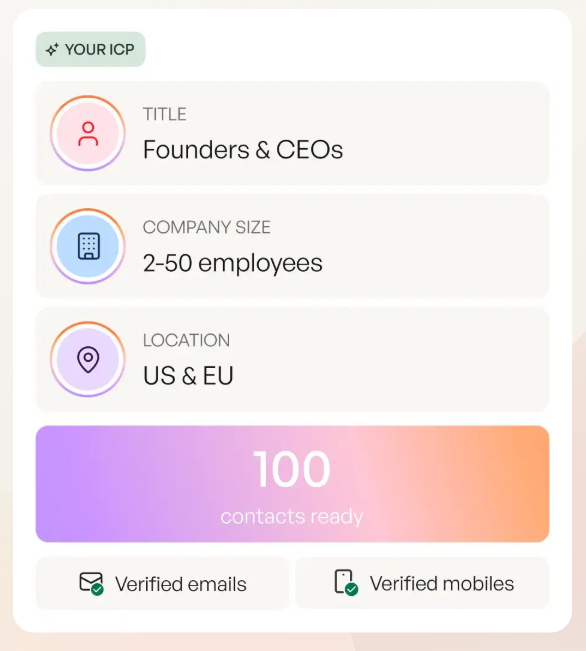
Pull your last 50-100 closed-won deals from the past 12 months. Look for patterns. In our experience, 70-80% of wins share three to five traits. Those traits are your ICP.
Here's the constraint that matters: your ICP should fit on a single slide. If it takes a 20-page document to describe your ideal customer, you don't have an ICP - you have a wish list.
| Dimension | What to Capture | Example |
|---|---|---|
| Firmographics | Industry, size, revenue, geo | B2B SaaS, 50-500 employees, NA |
| Technographics | Tech stack signals | Uses Salesforce + Outreach |
| Trigger Events | Timing signals | Recent funding, new VP hire |
| Psychographics | Buying motivations | Values speed over features |
Build from closed-won data, not assumptions. The deals you've actually won tell you more than any persona workshop ever will.
Score and Tier Your Accounts
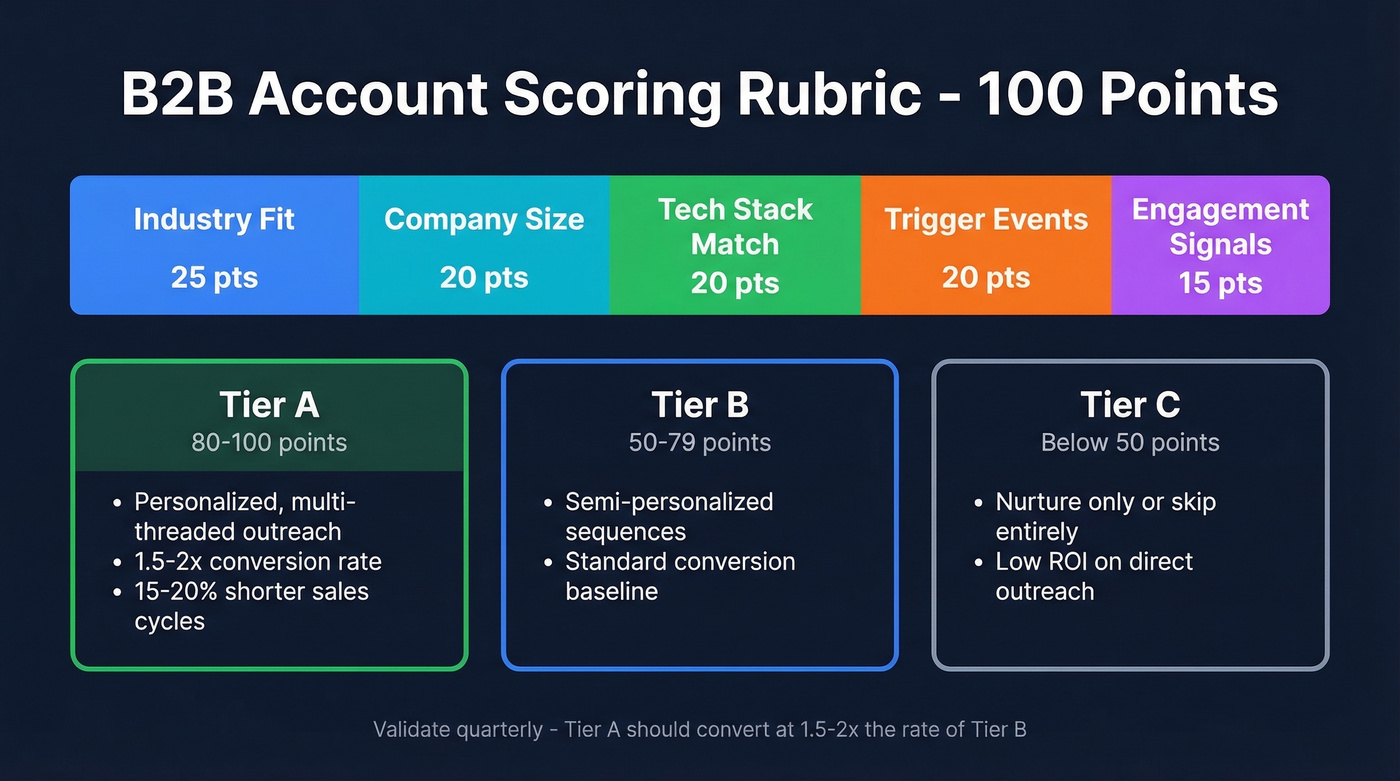
Once you've defined the ICP, you need a scoring system that separates accounts worth pursuing from the ones that'll waste your reps' time. A 100-point rubric works well.
If you want a more structured starting point, use an Ideal Customer Profile Template to keep scoring consistent across teams.
| Category | Weight | Example Criteria |
|---|---|---|
| Industry fit | 25 pts | Target vertical: 25, adjacent: 15 |
| Company size | 20 pts | 50-500 emp: 20, 501-2K: 10 |
| Tech stack match | 20 pts | Uses your integration partners |
| Trigger events | 20 pts | Funding, hiring, expansion |
| Engagement signals | 15 pts | Site visits, content downloads |
Tier A (80-100 points): your best-fit accounts - personalized, multi-threaded outreach. Tier B (50-79): solid fit, semi-personalized sequences. Tier C (below 50): nurture only, or skip entirely.
The validation benchmark is straightforward: Tier A accounts should convert at 1.5-2x the rate of Tier B, with 15-20% shorter sales cycles. If they don't, your scoring model needs recalibration. Check quarterly. We've seen teams run the same broken scoring model for a full year before someone finally pulls the data - don't be that team.
Marketbridge's segmentation framework maps typical B2B tiers as Key Accounts (10-100), National (50-500), Core (100-1,000), and SMB (millions). Keep your segments between three and five. Fewer lacks discrimination, more creates administrative chaos.
If you’re formalizing this in RevOps, it helps to align tiers with lead status definitions and a simple lead scoring model.

You just built a 100-point scoring model and tiered your accounts. Now you need verified contact data that matches. Prospeo's 30+ search filters - buyer intent, technographics, funding, headcount growth - let you pull Tier A accounts directly from 300M+ profiles with 98% email accuracy. No broken scoring models fed by broken data.
Turn your ICP scoring model into a verified pipeline in minutes.
Map the Buying Committee
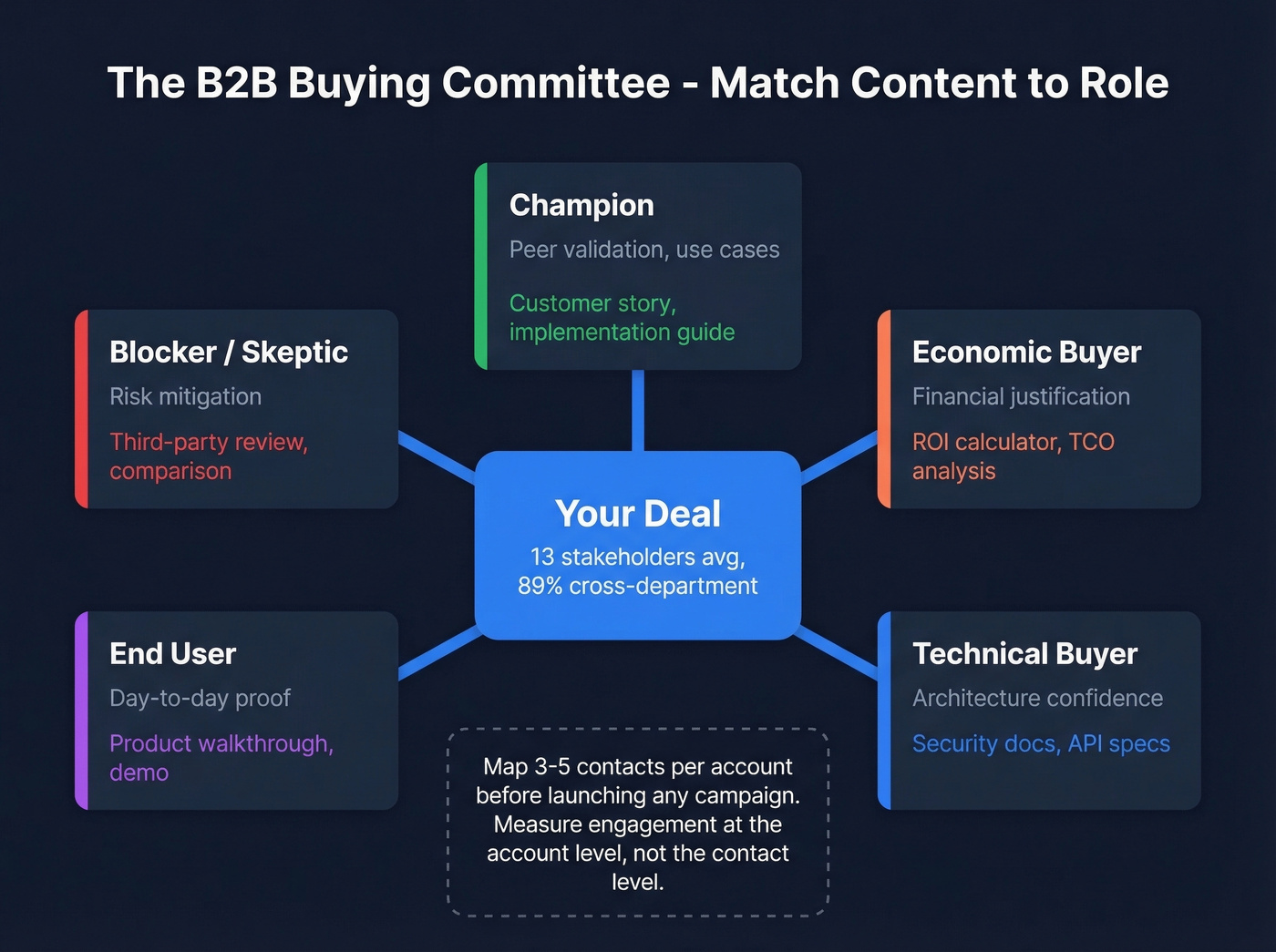
The average B2B purchase now involves 13 stakeholders, with 89% of decisions crossing multiple departments. Your champion could love you and still lose the internal battle. Buyers spend just 17% of their purchasing time meeting with vendors - split across every vendor in the evaluation. And 41% already have a preferred vendor before formal evaluation begins.
Let's be honest: single-threading into one contact is how you hit that 86% stall rate head-on. Manager and director tenure averages around 2.5 years. That champion you spent six months nurturing might be gone before the deal closes.
The 5-Role Content Matrix
Each role in the buying committee needs different proof to say yes.
| Role | What They Need | Example Asset |
|---|---|---|
| Champion | Peer validation, use cases | Customer story, impl. guide |
| Economic Buyer | Financial justification | ROI calculator, TCO analysis |
| Technical Buyer | Architecture confidence | Security docs, API specs |
| End User | Day-to-day proof | Product walkthrough, demo |
| Blocker/Skeptic | Risk mitigation | Third-party review, comparison |
Sending your ROI calculator to the technical buyer is a waste. Sending your architecture diagram to the CFO is worse. Match the content to the role.
Map 3-5 contacts per account before you launch any campaign - at minimum, your champion, economic buyer, and technical buyer. Stagger outreach over two to three weeks so it doesn't feel like a coordinated assault, and measure engagement at the account level, not the contact level.
If you want a tighter process for multi-threading, borrow a few account-based selling best practices and treat it like team selling, not “one rep, one inbox.”
Layer Intent and Signal Data
The intent data market hit $4.49B in 2026 and is projected to reach $20.89B by 2035 at 16.6% CAGR. 91% of B2B marketers now use intent data. The catch? Only 24% report exceptional ROI. Most teams buy intent data and don't know what to do with it.
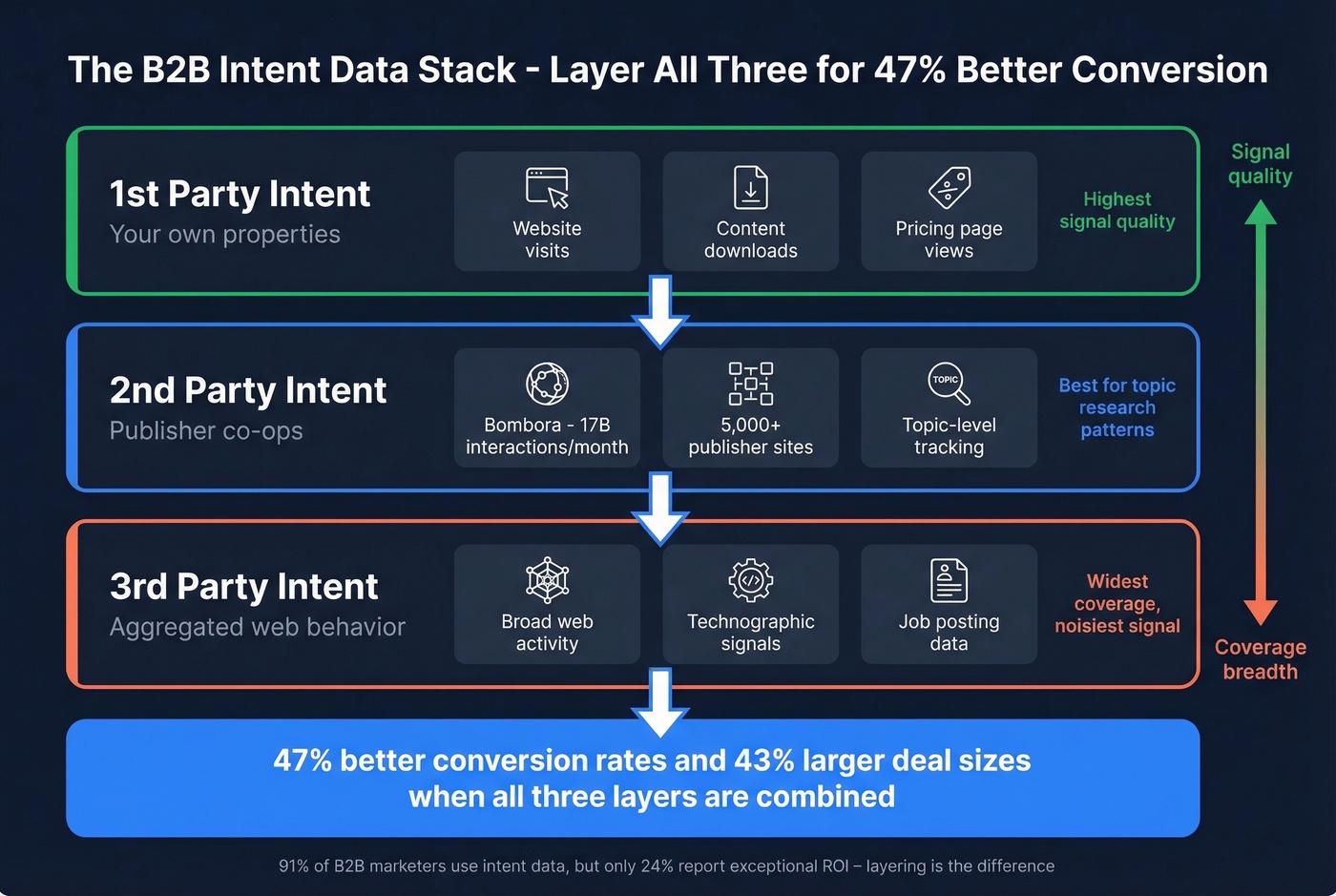
First-party intent comes from your own properties - website visits, content downloads, pricing page views. Second-party intent comes from publisher co-ops like Bombora, which tracks 17B interactions monthly across 5,000+ sites. Third-party intent is aggregated from broader web behavior. Teams that layer all three see 47% better conversion rates and 43% larger deal sizes.
One angle most teams miss: mapping topic research patterns across the buying timeline. Closed-won accounts tend to research specific topics in a predictable sequence - broad category terms early, integration and pricing terms late. Tracking that progression tells you where an account sits in the buying journey, not just whether they're "in-market."
The problem is cost.
| Provider | Annual Cost | Data Type | Notes |
|---|---|---|---|
| Prospeo | Free tier + paid plans | Bombora-powered, 15K topics | Bundled in platform |
| Bombora | $12K-$40K/yr | Third-party co-op | Pure-play data |
| 6sense | $35K-$300K+/yr | Blended + orchestration | 3-6 month implementation |
Here's the thing: most teams under 50 employees don't need a standalone intent data platform. The signal-to-noise ratio only pays off when you have enough reps to actually act on the data in real time. If you can't follow up on a surge alert within 48 hours, you're paying for information you'll never use.
To operationalize signals, it helps to standardize identifying buying signals and build a repeatable system for how to track sales triggers.
Build Your B2B Targeting Workflow
This is where the framework becomes operational. The best targeting strategies follow a repeatable sequence that connects ICP definition to actual outreach - no gaps, no guesswork.
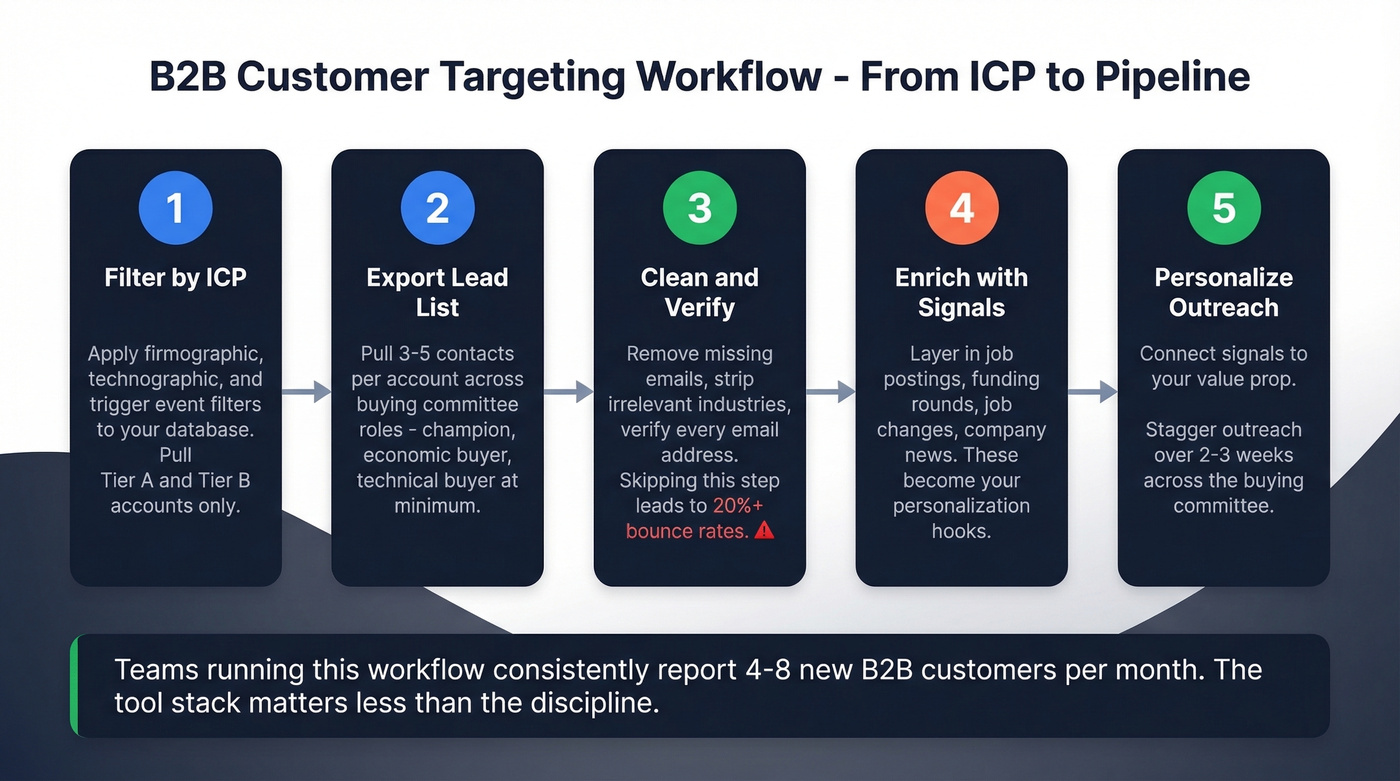
2. Export your initial lead list. Pull contacts matching your Tier A and Tier B criteria. Aim for 3-5 contacts per account across the buying committee roles you mapped earlier.
3. Clean and verify. Remove records with missing emails or websites, strip out irrelevant industries that slipped through, and verify every email address. Skipping verification is how teams hit 20%+ bounce rates on their first sequence - enough to tank sender reputation for months. We've watched it happen repeatedly.
If you’re seeing bounces, start with email bounce rate basics and a concrete plan to improve sender reputation.
4. Enrich with real-time signals. Layer in job postings, funding rounds, job changes, and company news. These become your personalization hooks.
5. Personalize with signal context. Don't just mention the signal - connect it to your value prop. "Saw you're hiring three SDRs" is weak. "You're scaling outbound - here's how teams at your stage avoid burning through domains" is a conversation starter.
If you need a system for this, use a personalized outreach framework and keep your messaging consistent with strong email copywriting.

A practitioner workflow shared on r/b2bmarketing backs this up: teams running signal-based outbound talk about landing 4-8 new B2B customers per month when they consistently clean lists, verify emails, enrich with signals, and personalize outreach. The tool stack matters less than the discipline.
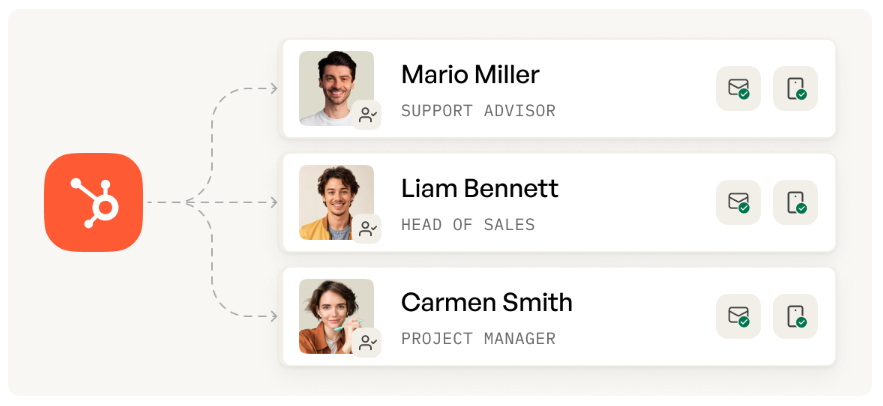
Mapping 3-5 contacts per buying committee means nothing if half the emails bounce. Prospeo delivers 98% email accuracy and 125M+ verified mobile numbers across every role - champion, economic buyer, technical buyer. Multi-thread into real contacts at $0.01 per email, with intent data from 15,000 Bombora topics already bundled in.
Reach every stakeholder in the buying committee with data that actually connects.
Five Targeting Mistakes That Burn Budget
1. Trusting lookalike audiences for niche B2B. Lookalike algorithms need large seed datasets. If your TAM is a few thousand companies, the algorithm doesn't have enough signal. Manual list building outperforms algorithmic matching for niche audiences almost every time.
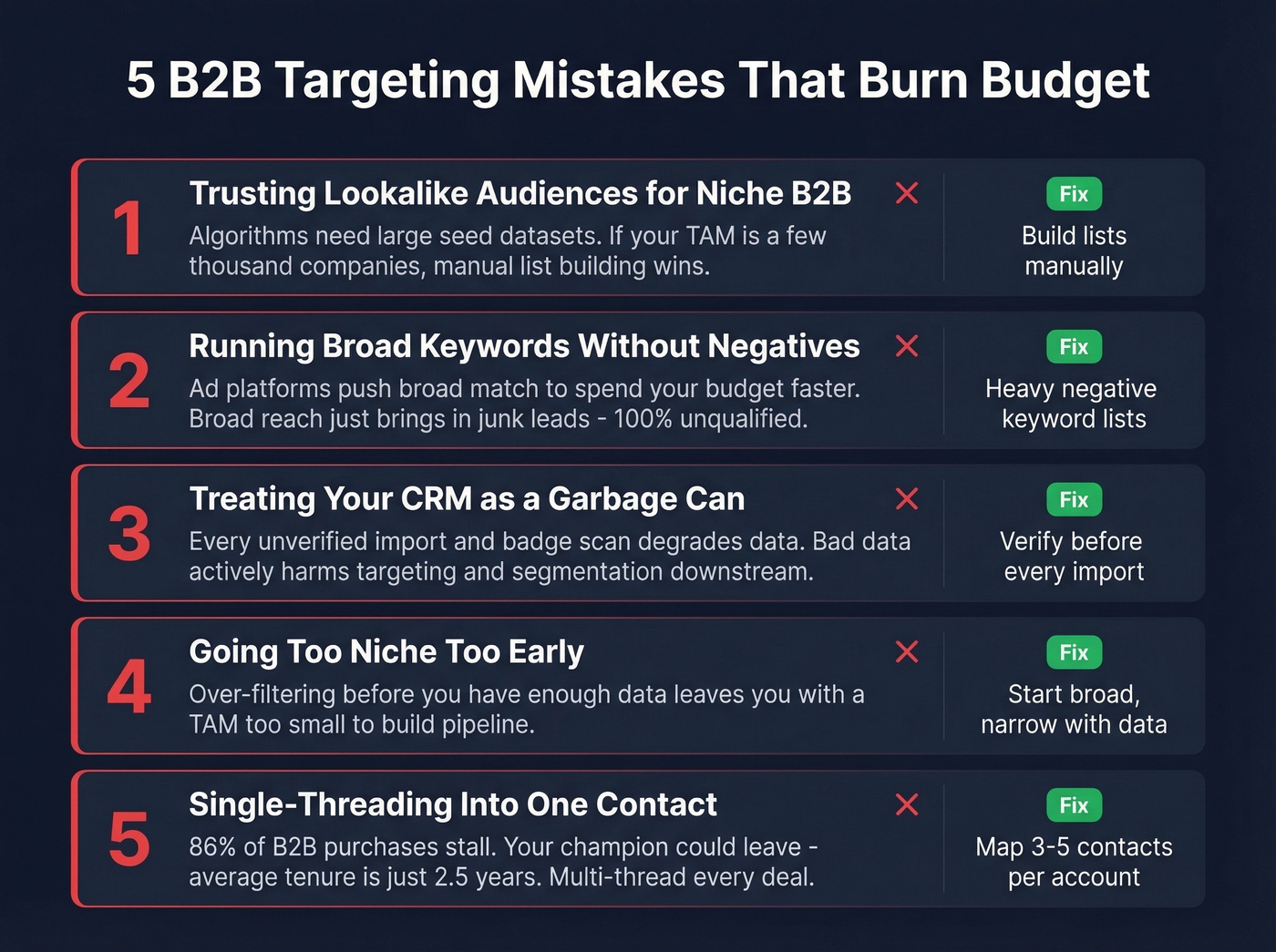
2. Running broad keywords without negative keyword lists. Ad platforms push you toward broad match because it spends your budget faster. For B2B, be heavy-handed with negative keywords. A "project management software" campaign without negatives will attract students, freelancers, and people looking for free tools. As one r/PPC commenter put it: "Broad reach just brings in junk leads - 100% unqualified."
3. Treating your CRM as a garbage can. Every unverified import, every trade show badge scan, every "just add them" request degrades your data. Bad CRM data doesn't just sit there - it actively harms targeting, segmentation, and everything downstream.
4. Going too niche within a persona. If your target is "VP of Engineering at Series B fintech companies in the Northeast using Kubernetes and hiring Rust developers," you've got maybe 12 people in your TAM. That's not a segment - that's a dinner party.
5. Skipping email verification. A 20%+ bounce rate doesn't just waste sends - it destroys your sender reputation. Recovery takes months. Verification costs pennies per contact. Reputation recovery costs pipeline.
Benchmarks: What Good Looks Like
Low conversion rates are normal in long-cycle B2B. Don't panic if your numbers look small - panic if they're trending the wrong direction.
| Industry | Conversion Rate |
|---|---|
| B2B SaaS | 1.1% |
| IT & Managed Services | 1.5% |
| Manufacturing | 2.2% |
| Staffing & Recruiting | 2.9% |
| Legal Services | 7.4% |
These benchmarks come from FirstPageSage's analysis of client data spanning January 2022 through August 2025. The pattern is clear: the more specialized the service, the higher the conversion rate - which is exactly why targeting precision matters more than traffic volume.
Channel selection is itself a targeting decision. Where you show up determines who you reach.
| Channel | ROI | Notes |
|---|---|---|
| SEO | 748% | Longest payback, highest ceiling |
| 261% | 2.4% avg conversion rate | |
| LinkedIn Paid | 229% | 2.74% visitor-to-lead rate |
| Webinars | 213% | Peaks at 430% for B2B SaaS |
| PPC | 36% | Break-even in ~4 months |
ABM deserves its own line item. Over 70% of B2B marketers now focus on account-specific engagement, and companies running ABM programs report up to 150% revenue boosts. If your growth targets are aggressive, dedicate 30-50% of marketing resources to ABM and expect it to influence at least 50% of total revenue. One emerging channel worth watching: GEO (Generative Engine Optimization) - optimizing content for AI-driven discovery surfaces like ChatGPT and Perplexity, where B2B buyers increasingly start their research.
FAQ
What's the difference between ICP scoring and lead scoring?
ICP scoring evaluates account-level firmographic and technographic fit, while lead scoring measures individual contact engagement like email opens and page visits. Use both together: ICP scoring decides which companies to target, lead scoring decides which contacts to prioritize within those accounts.
How often should I update my ICP?
Validate your scoring tiers quarterly by comparing win rates and cycle times across Tier A, B, and C accounts. If Tier A isn't converting at 1.5-2x Tier B, recalibrate your weights. Reevaluate your full segmentation model every two to three years or after major market shifts.
Is intent data worth the cost for small teams?
Standalone intent platforms run $12K-$300K+ per year - hard to justify for a five-person sales team. For smaller teams that want in-market buyer signals without a separate enterprise contract, bundled options like Prospeo's Bombora-powered intent tracking on 15,000 topics are a more practical entry point.
How many contacts should I target per account?
Map three to five contacts minimum - champion, economic buyer, and technical buyer at the very least. Single-threading into one contact exposes you to the 86% purchase stall rate and the reality that manager/director tenure averages just 2.5 years.
What's a realistic conversion rate for B2B targeting campaigns?
B2B website conversion rates range from 1.1% for SaaS to 7.4% for legal services. Even best-in-class companies convert under 5% of traffic. A 1.5% rate on precisely targeted traffic beats 3% on unqualified visitors - focus on pipeline quality and deal velocity rather than raw volume.