

Deal Pipelines: The Complete Guide to Building, Managing, and Fixing Yours
It's Thursday afternoon. Your VP of Sales asks for the forecast. You open the CRM, stare at 147 "open" deals, and realize you have no idea which ones are real. You're not alone - fewer than 20% of sales leaders rate their pipeline forecast accuracy as "predictable." The problem isn't your CRM. It's how deal pipelines get built, what's allowed into them, and how often anyone actually cleans them.
The Short Version
- Keep 5-7 stages with strict exit criteria. Companies with a defined pipeline process grow revenue up to 18% faster.
- Track pipeline velocity, not just deal count. The formula's below - it's the single most useful metric most teams ignore.
- Your pipeline is only as good as the data in it. Verify contacts before they enter the CRM. Bounced emails create ghost deals that wreck your forecast.
What Is a Deal Pipeline?
A deal pipeline is a visual representation of where every active opportunity sits in your sales process. Think of it as a kanban board for revenue - each column is a stage, each card is a deal, and the goal is to move cards right until they close.
People confuse pipelines with funnels constantly. They're related but distinct:
| Pipeline | Funnel | |
|---|---|---|
| Perspective | Seller's actions | Buyer's journey |
| Tracks | Deal stages & next steps | Awareness to purchase |
| Used by | Sales reps & managers | Marketing & leadership |
| Primary metric | Velocity & win rate | Conversion rate |
The pipeline answers "what does my rep need to do next?" The funnel answers "how are buyers progressing toward a purchase?" You need both, but this guide focuses on the pipeline - the tool that drives daily sales execution.
Why Pipelines Matter for Revenue
The numbers aren't subtle. Companies with a defined pipeline process grow revenue up to 18% faster than those winging it. Gartner links structured pipeline and deal management to forecast accuracy improvements of up to 20%. And according to G2, fixing just three common pipeline mistakes drives 28% revenue growth.
Here's the context that makes this urgent: sales cycles have lengthened 32% since 2021. Deals take longer, involve more stakeholders, and stall more often. A pipeline that was "good enough" three years ago is leaking revenue today.
For a $5M ARR company, 18% faster growth is nearly $1M in additional revenue. The pipeline isn't just a reporting tool - it's the operating system for how your team closes deals. Without it, reps guess, managers react, and forecasts are fiction.
The 7 Stages of a Pipeline
Most B2B teams perform best with 5-7 stages. More than that creates friction and slows deal movement. Here's the standard framework with probability benchmarks and exit criteria:
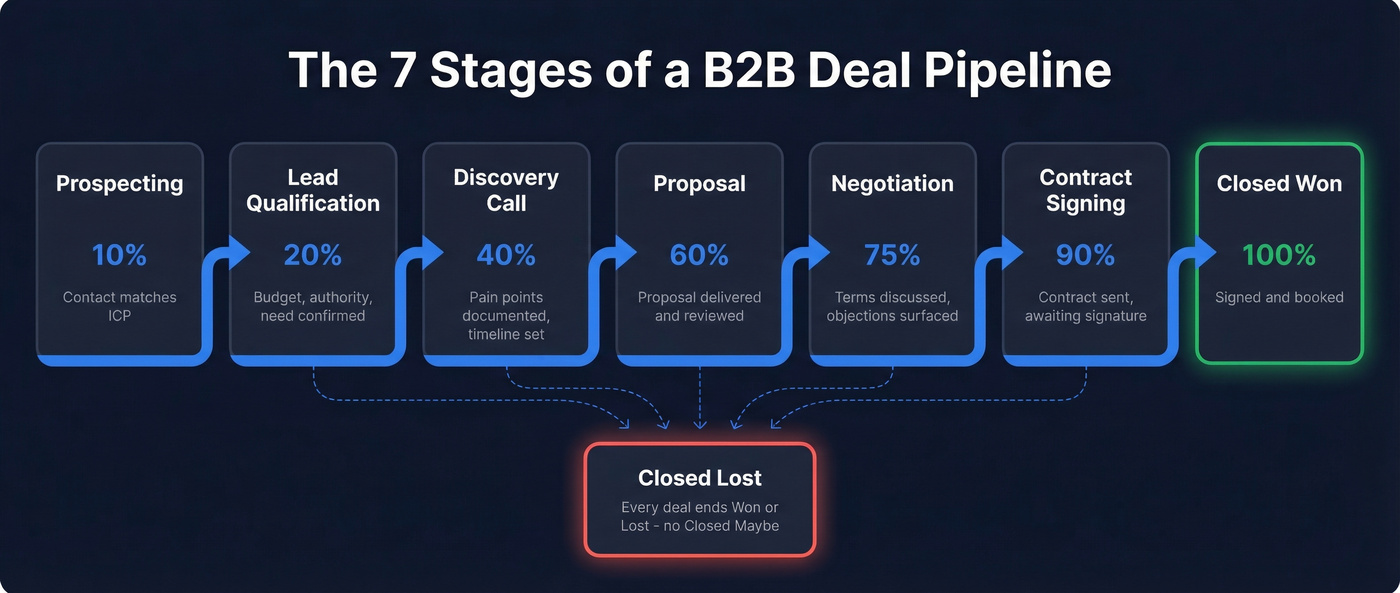
| Stage | Probability | Exit Criteria |
|---|---|---|
| Prospecting | 10% | Identified contact matches ICP |
| Lead Qualification | 20% | Confirmed budget, authority, need |
| Discovery Call | 40% | Pain points documented, timeline set |
| Proposal | 60% | Proposal delivered and reviewed |
| Negotiation | 75% | Terms discussed, objections surfaced |
| Contract Signing | 90% | Contract sent, awaiting signature |
| Closed Won | 100% | Signed and booked |
These probabilities are starting points - your actual conversion data should replace them within a quarter. The exit criteria matter more than the probabilities. If you can't explain what happens at a stage in one sentence, merge it with the next one.
Closed Lost is the mirror stage. Every deal ends in Won or Lost. There's no "Closed Maybe." (If you want a clean definition and win-back playbook, see Closed Lost.)
Seven is the upper bound. We've seen teams with 10+ stages where reps spend more time updating deal records than actually selling. If "Discovery Call" and "Needs Analysis" are functionally the same meeting for your sales motion, collapse them. The pipeline should mirror how opportunities actually move, not how your process document imagines they should.
How to Build Your Pipeline
1. Define your ICP. Every deal that enters the pipeline should match your ideal customer profile. Letting unqualified leads in because "maybe they'll convert" pollutes the forecast from day one.
2. Map stages to the buyer journey. Your stages should reflect real friction points in the buying process - moments where the deal either advances or stalls. Don't copy someone else's stages. Build them from your last 50 closed-won deals. (If you need a practical framework, use B2B buyer journey mapping.)
3. Set exit criteria and probabilities. Each stage needs a clear definition of "done." Discovery isn't complete until pain points are documented and a timeline is established. No exceptions, no stage-skipping. (For benchmarked definitions, see sales stages.)
4. Establish governance rules. The biggest governance decision: when does a deal get created? There are two schools of thought, and the choice matters more than most teams realize.
Some teams create an opportunity at any meeting, then qualify in or out - this gives visibility but creates a messy pipeline full of early close-lost deals. Others delay opportunity creation until qualification is confirmed, keeping the pipeline clean but hiding early-stage activity. We recommend the qualification gate. A clean pipeline is a trustworthy pipeline.
5. Choose your tools and verify your data. Pick a CRM that fits your team size and budget. Before deals enter the pipeline, verify the contact data - bounced emails and disconnected numbers create ghost deals that inflate your forecast from the start. (If you’re standardizing your stack, compare deal management software options.)

Your pipeline is only as trustworthy as the contacts inside it. Prospeo verifies emails at 98% accuracy and refreshes data every 7 days - so every deal in your CRM is attached to a real, reachable buyer. No ghost deals, no inflated forecasts.
Stop forecasting on bad data. Verify contacts before they enter the pipeline.
Pipeline Benchmarks and KPIs
Most pipeline guides tell you to "track metrics" without giving you actual numbers. Let's fix that. (If you want a broader KPI set beyond pipeline, use these sales operations KPIs.)
The Velocity Formula
Pipeline velocity measures how fast revenue moves through your pipeline:
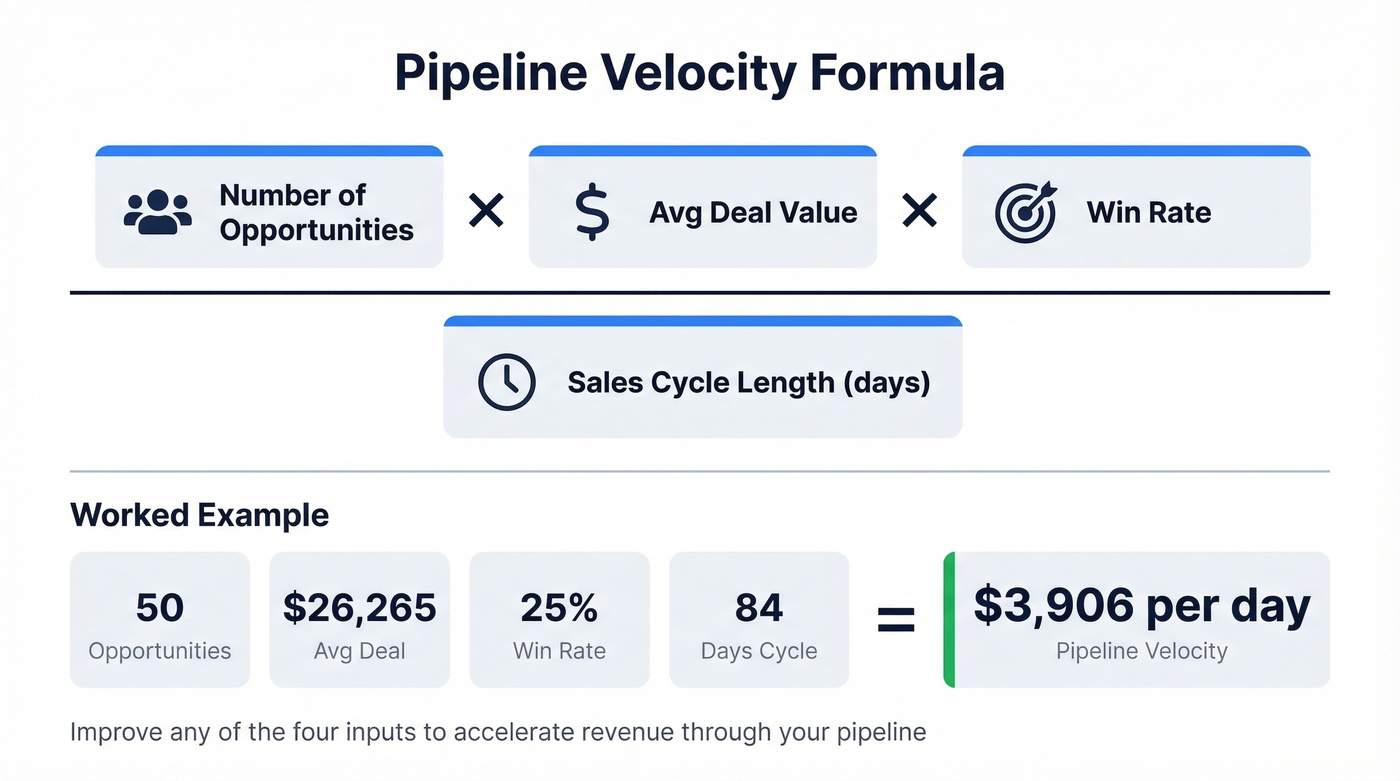
(Number of Opportunities x Average Deal Value x Win Rate) / Sales Cycle Length
Worked example: 50 opportunities x $26,265 average deal x 25% win rate / 84 days = $3,906/day. (To go deeper on levers, see deal velocity.)
Key Benchmarks
Based on recent SaaS benchmark data compiled from 40+ studies:
- Median sales cycle: 84 days (optimal range: 46-75 days) - see sales cycle length
- Typical win rate: 20-30% - see sales win rate
- Median deal size (private SaaS): $26,265
- Pipeline velocity: $743-$2,456/day depending on industry
- Lead-to-customer conversion: 2-5%
- Rep book size: 100-300 active accounts for high-velocity teams; refresh every 30-60 days
Stage-by-Stage Conversion
| Stage | SMB/Mid-Market | Enterprise |
|---|---|---|
| Visitor to Lead | 1.4% | 0.7% |
| Lead to MQL | 41% | 39% |
| MQL to SQL | 39% | 31% |
| SQL to Opportunity | 42% | 36% |
| Opportunity to Close | 39% | 31% |
Enterprise conversion drops at every stage - that's expected. Longer cycles, more stakeholders, higher scrutiny. The important thing is knowing your numbers so you can diagnose where deals are dying.
Pipeline Coverage
A common heuristic: maintain 3x-4x quota coverage for mature inbound pipelines, and 4x-5x for outbound or enterprise motions. If your team needs to close $500K this quarter and you've got $1.2M in pipeline, you're short. The math doesn't lie. (For why the rule breaks, read pipeline coverage ratio.)
Management Best Practices
Quality Over Quantity
Here's the thing: most teams don't have a pipeline problem. They have a too much pipeline problem. Bigger pipelines don't mean more revenue. Sales management expert Jason Jordan found that top sellers had smaller pipelines because they disqualified early. Those smaller pipelines enabled 20% more prospecting calls, 25% more meetings, and 50% more deals closed.
The data backs this up at the account level too. One study found that trimming rep books from 1,000+ accounts down to 300-400 increased win rates from 13% to over 20% in under a year. Fewer accounts, deeper engagement, more closed deals.
A pipeline with 100 deals and no exit criteria is a to-do list, not a forecast. Ruthless disqualification isn't pessimism - it's focus.
Diagnose Your Pipeline Shape
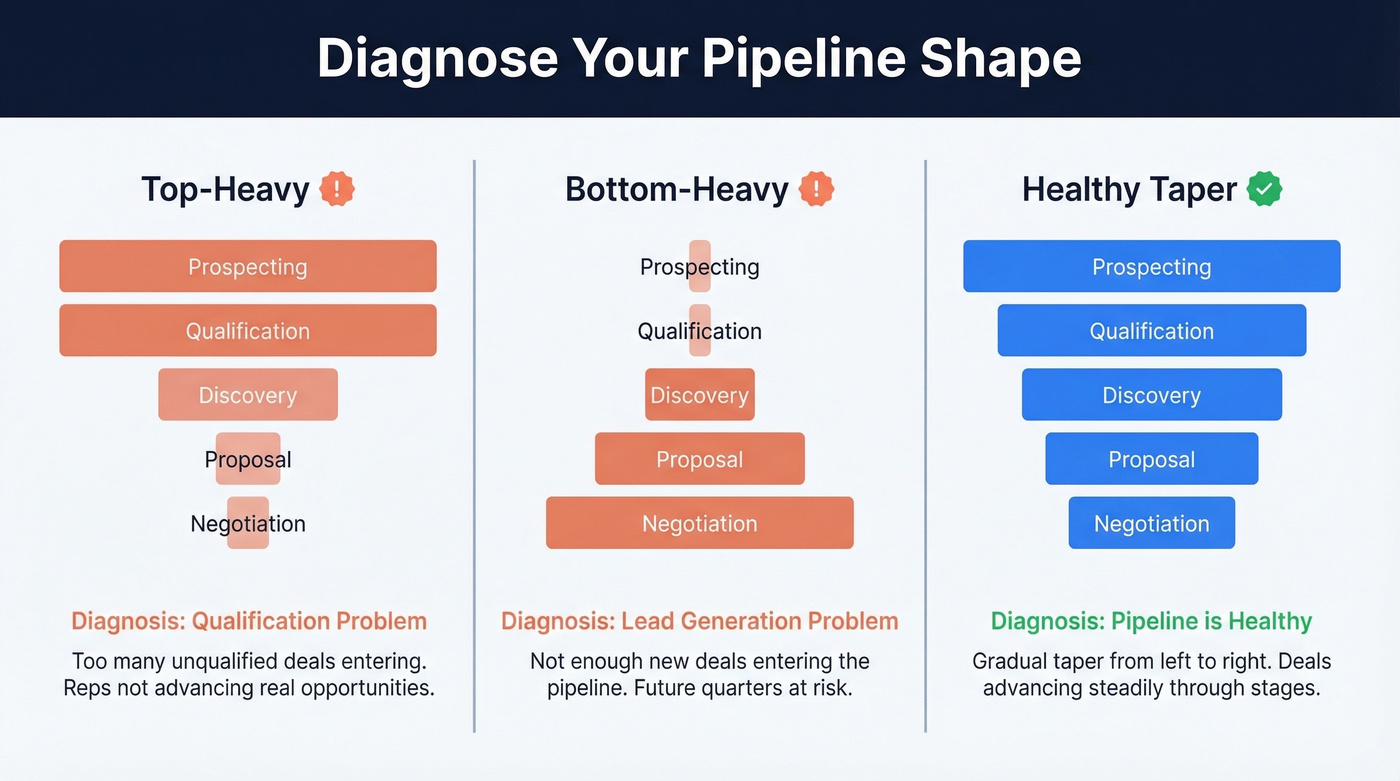
Pull up your pipeline right now and look at the distribution across stages. Top-heavy - lots of early-stage deals, few in negotiation or contract - means you have a qualification problem. Reps are letting too many unqualified deals in and not advancing the real ones. Bottom-heavy with few new deals entering? That's a lead generation problem. A healthy pipeline looks like a gradual taper from left to right, not a cliff or a bottleneck. (If you’re seeing consistent drop-offs, start with sales bottlenecks.)
Weekly Reviews and Stale Deal SLAs
Run pipeline reviews weekly. Not monthly, not "when we have time." Weekly.
Every deal gets a status check: what's the next step, when is it happening, and is this deal still real? Set a stale deal rule: if there's been no activity in 2x the average stage duration, force a decision. Either the rep re-engages the prospect this week or the deal moves to closed-lost. We've seen enterprise AEs sitting on 40+ active deals, feeling overwhelmed and reactive rather than proactive. Stale deal SLAs prevent that spiral.
Governance Rules
Two models exist for when to create deals, and the debate is real:
- Use the "any meeting" model when you need full-funnel visibility and your team can handle the noise of early close-lost deals in reporting.
- Use the qualification gate when forecast accuracy matters more than activity tracking, or when your pipeline is already bloated with stale deals.
Stage definitions can't be skipped. If a rep jumps from "Prospecting" to "Proposal" without a discovery call, either the stages don't match your actual sales motion or the rep is cutting corners. Both need fixing.
Common Pipeline Mistakes
Companies that fix just three common mistakes see 28% revenue growth. Here are the ones worth fixing first:
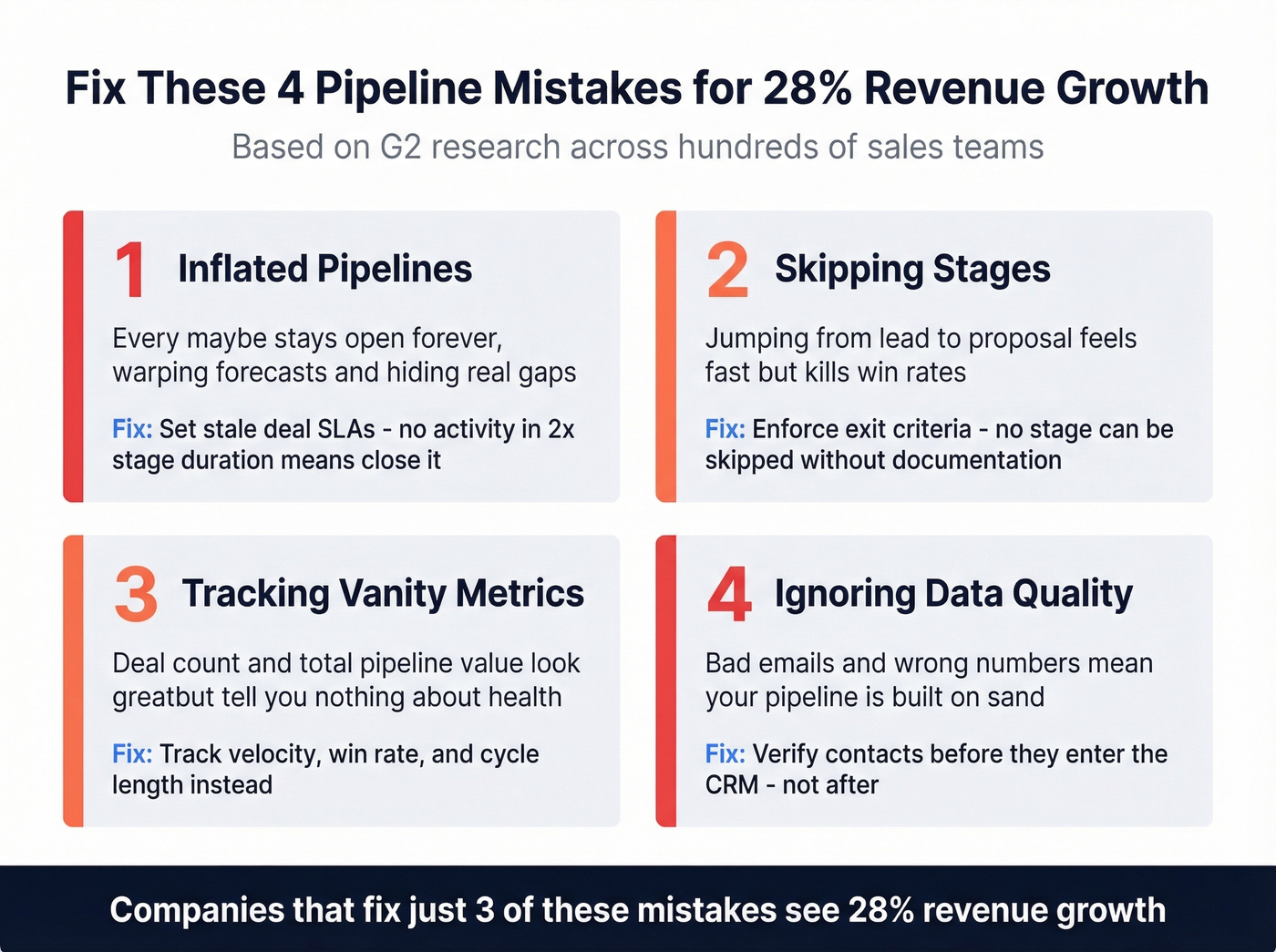
- Inflated pipelines. No disqualification process means every "maybe" stays open forever, warping the forecast and hiding real pipeline gaps.
- Skipping stages. Jumping from lead to proposal feels fast but kills win rates. Each stage exists to reduce risk.
- Tracking vanity metrics. Deal count and total pipeline value look impressive in dashboards but tell you nothing about health. Track velocity, win rate, and cycle length instead.
- Ignoring data quality. If half your contacts have bad emails or wrong phone numbers, your pipeline is built on sand. (If you’re auditing deliverability, start with email bounce rate.)
Data Quality - The Pipeline Killer
Picture this: an SDR adds 50 new deals to the pipeline on Monday. By Wednesday, 18 of those emails have bounced, 7 phone numbers are disconnected, and 3 contacts left the company six months ago. Those 28 "deals" are ghosts - they inflate the pipeline, distort the forecast, and waste rep time.
Bad contact data is the fastest way to build a pipeline that looks healthy but performs terribly. The chain reaction is predictable: bad data leads to an inflated pipeline, which leads to a wrong forecast, which leads to a missed quarter. When leadership runs deal rollups at the end of the month, those ghost deals skew the aggregated numbers and make it impossible to trust what the CRM is telling you. (If this sounds familiar, see missed sales forecast.)
Prospeo prevents this pipeline pollution before it starts. Its 5-step verification process checks every email - including catch-all handling, spam-trap removal, and honeypot filtering - on a 7-day data refresh cycle versus the 6-week industry average. That 98% email accuracy means contacts entering your CRM are real people at real companies. The free tier gives you 75 verified emails plus 100 Chrome extension credits per month to test it, and native integrations with HubSpot and Salesforce push verified data straight into your pipeline. One customer, Meritt, saw their bounce rate drop from 35% to under 4% and their pipeline jump from $100K to $300K per week.
Maintaining 3x-5x pipeline coverage means nothing if half your deals are built on bounced emails and disconnected numbers. Prospeo gives you 143M+ verified emails and 125M+ verified mobiles at $0.01/lead - so every opportunity in your pipeline can actually convert.
Real pipeline coverage starts with contacts that actually pick up the phone.
CRM Tools for Deal Pipelines
Your CRM is the container for your pipeline. Here are the main options in 2026:
| Tool | Starting Price | Best For |
|---|---|---|
| HubSpot Sales Hub | Free (Pro: $90/seat/mo + $1,500 onboarding) | Free tier; scales expensive |
| Salesforce | $25/user/mo (Enterprise: $80/user/mo) | Enterprise teams |
| Pipedrive | $14/user/mo | Small teams, best value |
| Close | $35-$99/user/mo | Mid-market, built-in calling |
| Zoho CRM | $14-$40/user/mo | Budget-friendly |
| Monday CRM | $12-$28/seat/mo (3-seat min) | Teams already on Monday |
| Pipeline CRM | $25-$49/user/mo | Pipeline-focused simplicity |
| Copper | $9-$59/user/mo | Google Workspace teams |
| Nutshell | $13-$59/user/mo | Simple and affordable |
Best value for small teams: Pipedrive at $14/user. Best free tier: HubSpot, though watch for that $1,500 onboarding fee when you upgrade. Best for enterprise: Salesforce. Skip this section if you're running fewer than 30 deals - a spreadsheet works fine until you outgrow it. (If you want a ranked shortlist, see best sales pipeline software.)
Spreadsheets are fine for your first pipeline. Track deal stage, expected close date, deal size, probability, weighted forecast, owner, and next steps. That's seven columns. You don't need a $90/seat CRM to manage 30 deals. But whichever tool you pick, the data feeding it matters more than the tool itself.
AI and Pipeline Management
Sales reps spend just 2 hours per day actually selling. Tools like Clari, Gong, and Salesforce Einstein handle predictive analytics, pipeline risk detection, and automated data capture. Gartner predicts that by 2028, AI will close 70% of sales cycles by automating prospecting, qualification, and parts of negotiation. That's not a distant future - it's already underway. The pipeline isn't going away, but the manual work of maintaining it is disappearing fast.
FAQ
What's the difference between a deal pipeline and a sales funnel?
A pipeline tracks where deals are from the seller's perspective - it's about rep actions and next steps. A funnel tracks the buyer's journey from awareness to purchase. Pipeline is your internal forecasting tool; funnel is a marketing framework for conversion optimization. Most teams need both, but they serve different audiences.
How many stages should a pipeline have?
Most B2B teams perform best with 5-7 stages. More stages create friction and slow deal movement. The test: if you can't explain what happens at a stage in one sentence, merge it with the next one. Seven is the ceiling, not the target.
What is pipeline velocity?
Pipeline velocity measures how fast revenue moves through your stages. The formula: (Number of Opportunities x Average Deal Value x Win Rate) / Sales Cycle Length. Median B2B SaaS velocity runs $743-$2,456/day. If yours is below that range, diagnose which variable is dragging.
How do you keep pipeline data accurate?
Set stale deal SLAs - no activity in 2x the average stage duration means you force a decision. Run weekly reviews. Verify contact data before it enters the CRM. Reducing bounce rates to under 4% prevents ghost deals from inflating your numbers.
What are deal rollups and why do they matter?
Deal rollups aggregate the value and status of individual opportunities into summary views - by rep, team, region, or time period. They give managers a high-level snapshot of pipeline health without digging into every deal. Accurate rollups depend entirely on clean underlying data; stale stages or bad contact info cascade upward and break the forecast.