

How to Use Email Marketing to Generate Leads (Without Burning Your Domain)
The email marketing industry grew from $7.5B in 2020 to a projected $17.9B by 2027 - a 13.3% annual clip. Yet practitioners on r/b2bmarketing report cold email reply rates hovering around 2%, and 80% of new leads never convert into revenue. Using email marketing to generate leads still works - 73% of B2B decision-makers prefer sellers to contact them via email - but the lazy version, blast a bought list and cross your fingers, is dead.
You don't need 23 strategies. You need five things done well, in the right order.
The Short Version
- Authenticate your domain - SPF, DKIM, and DMARC. Non-negotiable for bulk senders in 2026.
- Build your list with a lead magnet that converts 5-15% of visitors.
- Verify every email before you send a single campaign.
- Set up an automated welcome + nurture sequence - in Klaviyo's 2026 benchmarks, flows outperform one-off campaigns by 3.3x on click rate.
- Segment and personalize - never blast your full list with the same message.
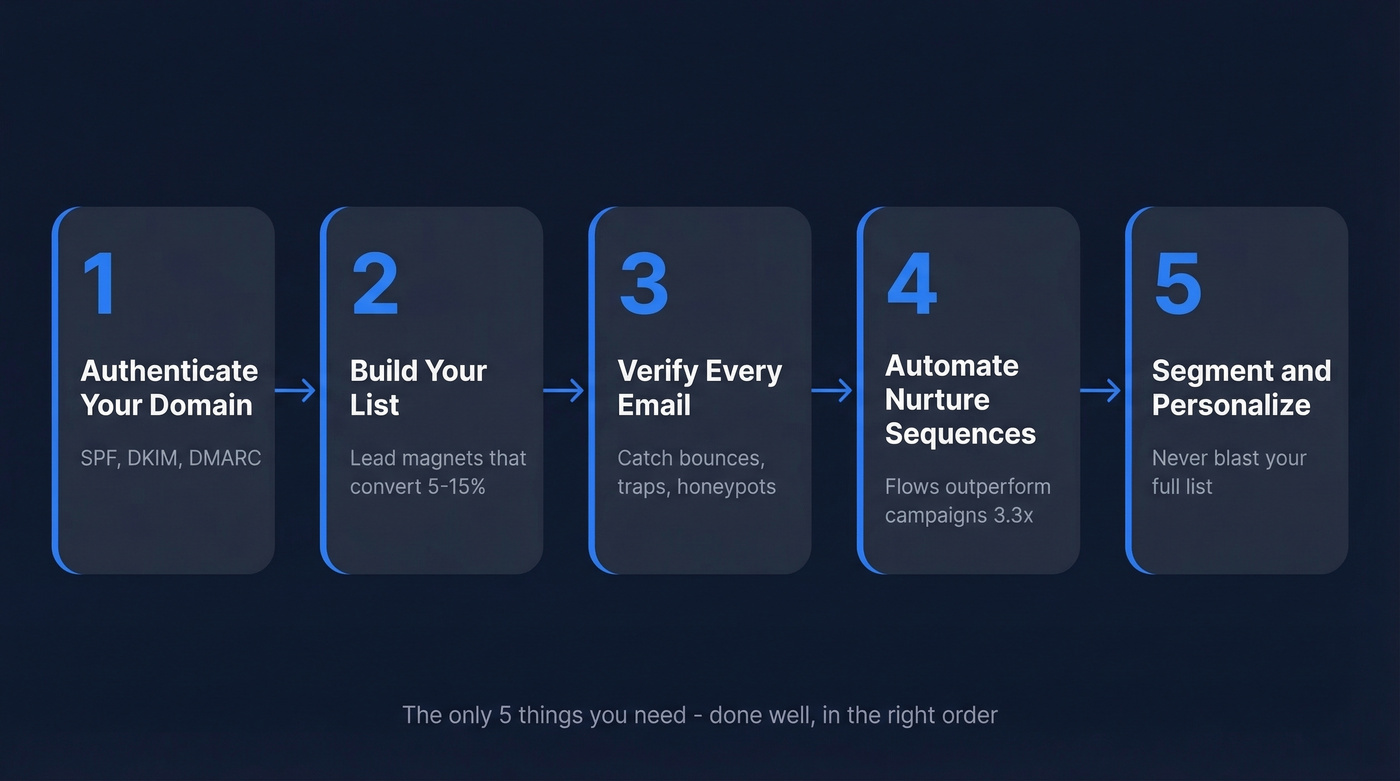
That's the framework. Let's break down each piece.
How Email Lead Generation Works
Email lead generation is the process of turning strangers into contacts who've given you permission - or at least a reason - to keep talking. It splits into two lanes.
Inbound means opt-in: someone downloads your checklist, signs up for your newsletter, or takes your quiz. They raise their hand. Outbound means you find them first: cold email, prospecting sequences, targeted campaigns to enriched lists. Both work. Both require different infrastructure.
Here's the thing: 96% of website visitors aren't ready to buy on their first visit. Email - with its 312% average ROI - is how you stay in front of them until they are. And unlike your social following, nobody can take your email list away from you. We've watched companies lose entire social accounts overnight to algorithm changes or policy shifts; your email list is the one marketing asset you actually own.
The Deliverability Foundation
If you're not authenticating your domain in 2026, nothing else in this guide matters. Gmail and Yahoo changed the rules in 2024, and they're enforcing them hard.
Your non-negotiable checklist:
- SPF, DKIM, and DMARC - all three, configured at the DNS level. If you're sending 5,000+ messages per day, Gmail and Yahoo require them.
- Spam complaint rate below 0.3% - Gmail recommends staying under 0.10%. One bad send can tank your sender reputation for weeks.
- One-click unsubscribe via List-Unsubscribe header (RFC 8058), with opt-out requests processed within 2 days.
- Domain warm-up - new domains or IPs need a gradual ramp. Don't send 10,000 emails on day one.
- 6-month sunset rule - if a subscriber hasn't opened or clicked in six months, suppress them. Dead weight drags your entire domain down.
Before you send your first campaign, run your list through a verification tool. Prospeo's 5-step verification catches invalid addresses, spam traps, and honeypots - including catch-all domain verification. One customer, Meritt, saw their bounce rate drop from 35% to under 4% after switching their verification workflow.
If you want a deeper technical breakdown, start with an email deliverability audit, then validate your SPF record and confirm DKIM is actually passing.

Most email guides still don't mention SPF, DKIM, or DMARC - after Gmail literally changed the rules. That tells you how much of this content is recycled from 2019.
Lead Magnets That Convert Visitors
A lead magnet is the thing someone gets in exchange for their email address. The good ones convert 5-15% of visitors. The bad ones sit on your landing page collecting dust.
Start with the highest-conversion, lowest-production-cost formats.
Checklists and templates are fast to create and immediately useful. Maze, the product research platform, gates a UX research template library that drives a significant chunk of their inbound signups. A "Cold Email Deliverability Checklist" converts better than a 40-page ebook because people can use it today.
Calculators and quizzes are the 2026 trend. They feel personalized, and they give you segmentation data for free. HubSpot's Website Grader has generated millions of leads with this exact approach. Mini-courses of 3-5 emails pull double duty as both lead magnet and nurture sequence. Industry benchmarks or original data work when you have proprietary numbers - people trade emails for data they can't get elsewhere.
Keep your form fields minimal. Name and email is enough for top-of-funnel. Every additional field drops conversion rate. We've seen teams cut form fields from seven to two and double their opt-in rate overnight.
2026 Email Benchmarks Worth Knowing
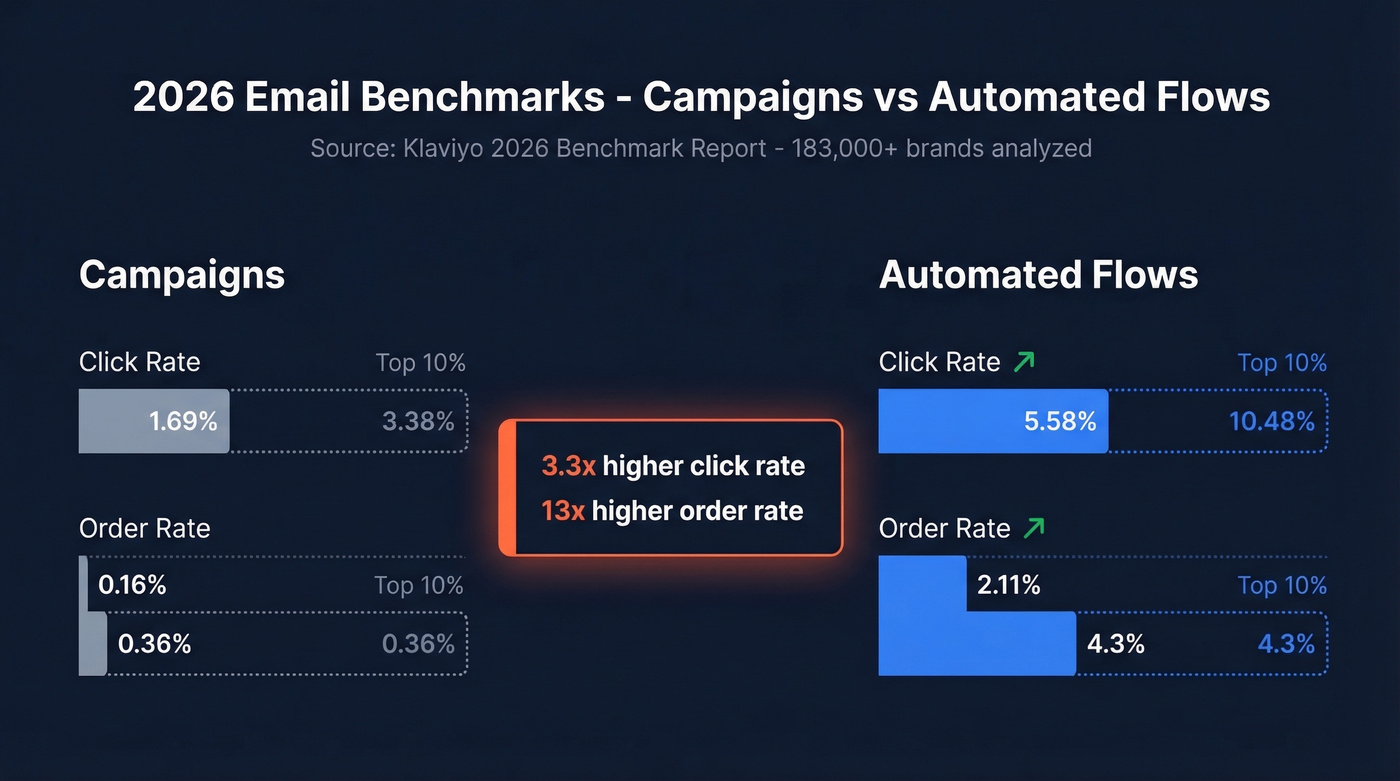
Klaviyo's 2026 benchmark report analyzed 183,000+ brands. The gap between campaigns and automated flows is staggering:
| Metric | Campaign Avg | Campaign Top 10% | Flow Avg | Flow Top 10% |
|---|---|---|---|---|
| Open Rate | 31% | 45.1% | Not reported separately | - |
| Click Rate | 1.69% | 3.38% | 5.58% | 10.48% |
| Order Rate | 0.16% | 0.36% | 2.11% | 4.3% |
Automated flows generate a 5.58% click rate versus 1.69% for campaigns - 3.3x higher. If you're only sending one-off blasts and ignoring automation, you're leaving the majority of your engagement on the table.
A caveat on open rates: Apple Mail Privacy Protection inflates them by pre-loading tracking pixels. Treat open rate as directional, not gospel. Click rate and conversion rate are the numbers that actually matter.
On subject lines: keep them under 9 words for higher CTR. If you need ideas, pull from these email subject line examples. Including the recipient's first name lifted open rates from 10% to 39% in Klenty's testing. Short, personalized, specific beats clever every time.

You just read that bounce rates kill sender reputation. Meritt cut theirs from 35% to under 4% with Prospeo's 5-step verification - catching spam traps, honeypots, and catch-all domains before a single email leaves your server. At $0.01 per email, cleaning your entire list costs less than one bounced campaign.
Stop nurturing invalid addresses. Verify first, send second.
Nurture Sequences That Convert
80% of new leads never convert into sales. Not because the leads are bad - because nobody followed up properly. Mature nurture programs generate 50% more sales-ready leads at 33% lower cost.
If your follow-up is inconsistent, start with a few proven sales follow-up templates and then automate what works.
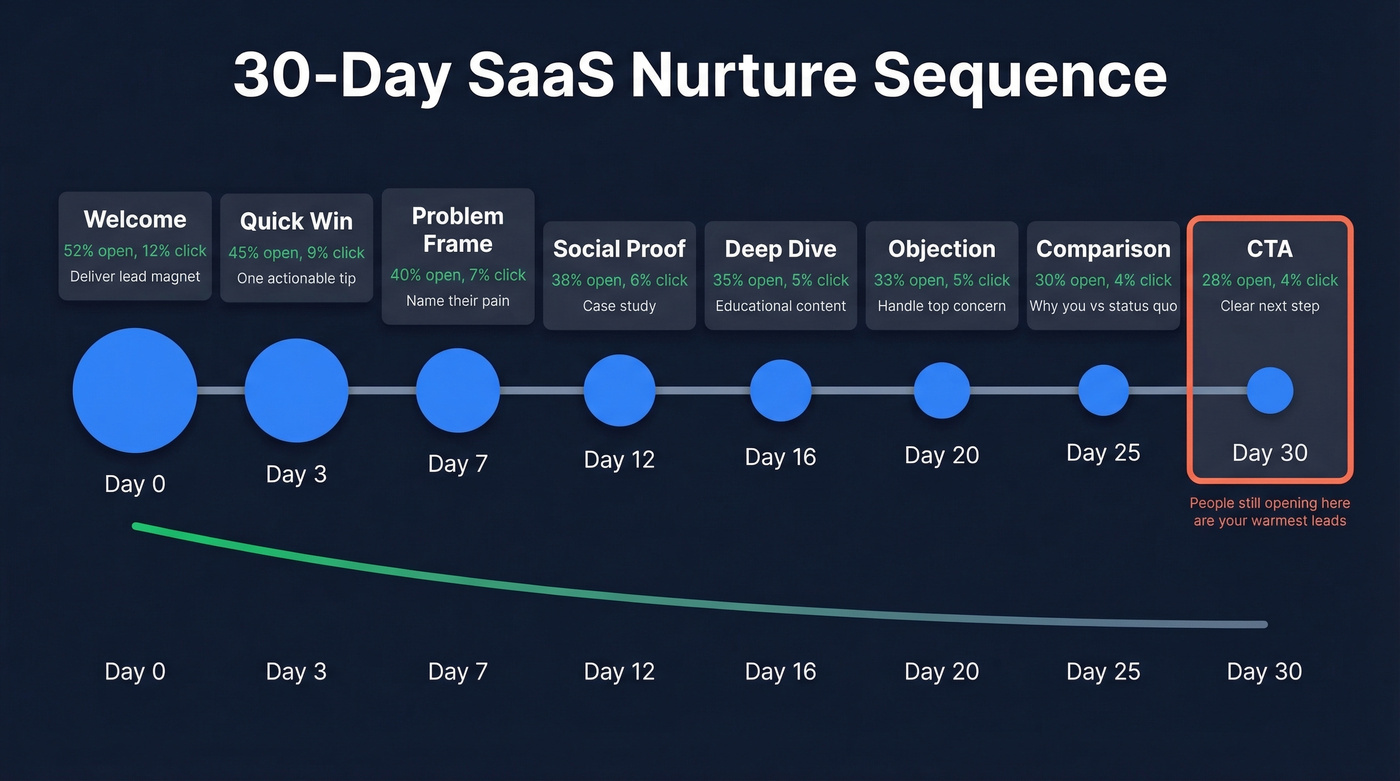
Here's a concrete SaaS nurture sequence you can adapt - eight emails over 30 days, with realistic performance decay:
| Day | Focus | Est. Open Rate | Est. CTR | |
|---|---|---|---|---|
| Welcome | 0 | Deliver lead magnet | 52% | 12% |
| Quick Win | 3 | One actionable tip | 45% | 9% |
| Problem Frame | 7 | Name their pain | 40% | 7% |
| Social Proof | 12 | Case study | 38% | 6% |
| Deep Dive | 16 | Educational content | 35% | 5% |
| Objection | 20 | Handle #1 concern | 33% | 5% |
| Comparison | 25 | Why you vs status quo | 30% | 4% |
| CTA | 30 | Clear next step | 28% | 4% |
Here's what the Welcome email actually looks like in practice:
Subject: Your [Lead Magnet Name] is ready
Hey [First Name],
Here's the [checklist/template/guide] you requested: [Link]
One quick tip while you have it open - most teams skip step 3, and it's the one that makes the biggest difference. Give it 5 minutes today and you'll see why.
Over the next few weeks, I'll send you a handful of emails with the tactics we've seen work best for [specific outcome]. Nothing fluffy, all actionable.
Talk soon, [Your name]
Notice the decay pattern in the table - open rates drop from 52% to 28% across the sequence. That's normal. The people still opening email #8 are your warmest leads. They're the ones worth a sales call.
Build the sequence once, let it run, and optimize based on where people drop off.
A word of caution: If your deal size is under $10K, you probably don't need a 15-email nurture. The 8-email sequence above is overkill for most SMB sales cycles. Start with 4 emails, measure, and add complexity only when the data justifies it.
Segmentation and Lead Scoring
Personalized CTAs convert 202% better than generic ones. That stat alone should end the "blast the whole list" approach forever.
If you want a more complete framework, use a dedicated lead scoring model and pair it with intent based segmentation so sales only reaches out when the signals are real.
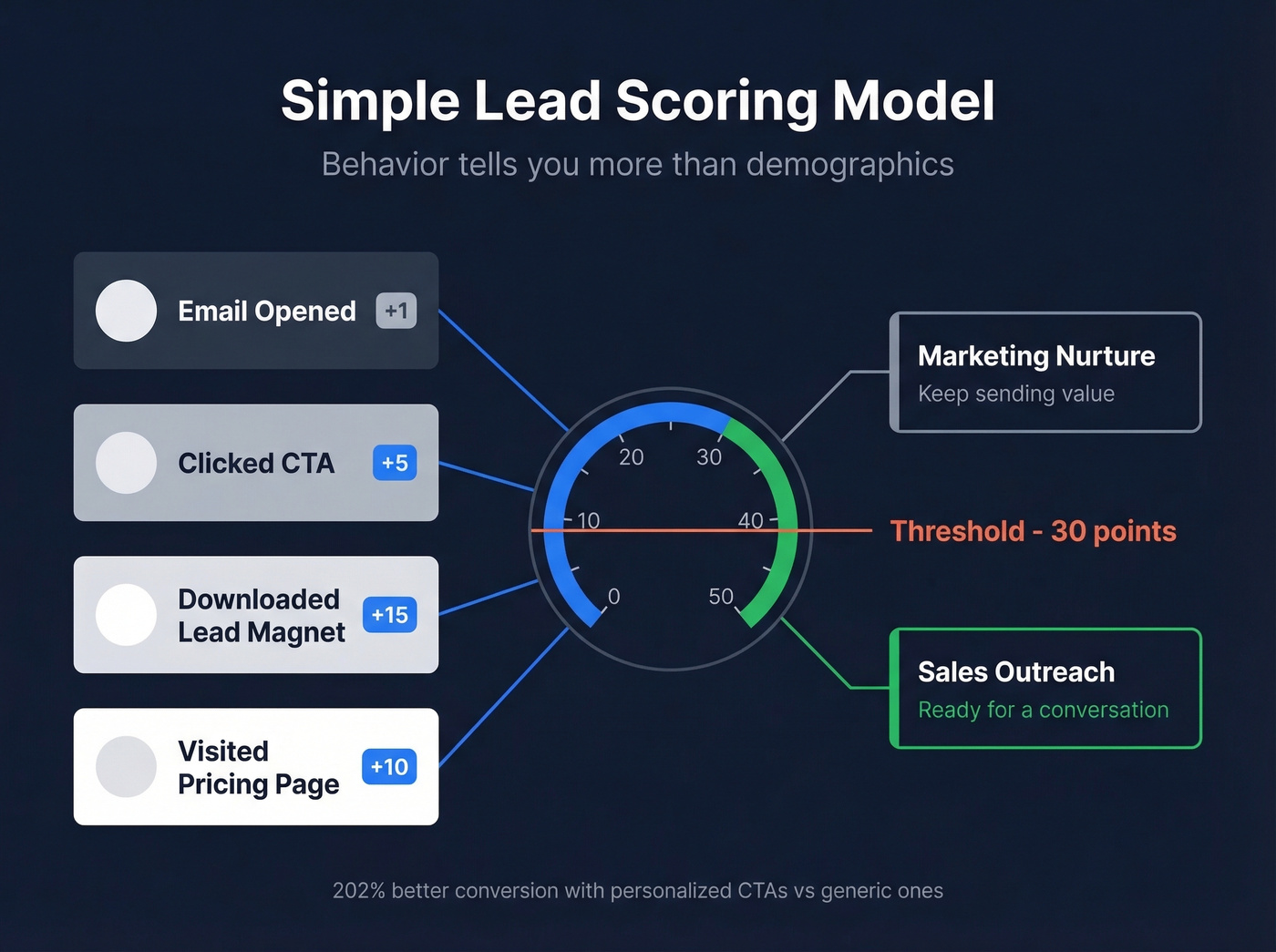
Effective segmentation isn't complicated. Start with behavior, not demographics. What did they download? That tells you their problem. Which emails did they click? That tells you their interest level. Did they visit your pricing page? That tells you they're evaluating.
Layer in a simple lead scoring model to prioritize follow-up:
| Action | Points |
|---|---|
| Email opened | +1 |
| Clicked CTA | +5 |
| Visited pricing page | +10 |
| Downloaded lead magnet | +15 |
When someone crosses your threshold - say, 30 points - they move from marketing nurture to sales outreach. This isn't rocket science. It's just discipline most teams skip.
The Tools You Actually Need
You don't need a 15-tool stack. Four categories, covered.
Email platform: Mailchimp has a free plan, with paid tiers starting around $13/month. Beehiiv is strong for newsletter-first approaches, with a free plan and paid plans from ~$39/month. Either works. Pick one and commit.
CRM: HubSpot's free CRM handles most early-stage needs. Marketing Hub paid plans start around $20/month. Pipedrive starts around $15/user/month. For teams that are just getting started, the free tier of either is more than enough - skip this if you're a solo founder with fewer than 50 leads. (If you're still comparing options, here are a few examples of a CRM to sanity-check fit.)
Enrichment and automation: Clay keeps coming up in r/sales threads as the go-to for enrichment workflows, with pricing starting around $149/month. Trigify shows up in the same "what tools are you using" conversations for trigger-based prospecting. Both plug into the modern outbound stack. If you're evaluating vendors, start with these data enrichment services.
Email verification and B2B contact data: Prospeo covers this with 300M+ professional profiles, 143M+ verified emails, and 98% email accuracy - all refreshed on a 7-day cycle versus the 6-week industry average. It integrates natively with HubSpot, Salesforce, Clay, Instantly, Lemlist, and most outbound tools, so it slots into whatever stack you're already running.
Automated flows beat campaigns by 3.3x on click rate - but only if your emails actually land in the inbox. Prospeo refreshes every record on a 7-day cycle, so the contacts fueling your sequences stay accurate weeks after you build them. That's 6x faster than the industry average.
Build lead gen sequences on data that doesn't decay between sends.
Compliance: GDPR, CAN-SPAM, and CASL
Cumulative GDPR fines have hit ~EUR 5.88B across 2,245 enforcement actions. Penalties can reach EUR 20M or 4% of global annual turnover. This isn't theoretical risk.
| Regulation | Region | Model | Max Penalty |
|---|---|---|---|
| CAN-SPAM | US | Opt-out | Up to $51K per violation |
| GDPR | EU/EEA | Opt-in | EUR 20M or 4% revenue |
| CASL | Canada | Opt-in | Up to $10M CAD |
| PECR | UK | Opt-in | Up to GBP 500K |
| Spam Act | Australia | Opt-in | Up to $2.1M AUD/day |
The US is the outlier - CAN-SPAM allows opt-out, meaning you can email someone who hasn't explicitly opted in as long as you include an unsubscribe link. Everywhere else requires explicit consent. Pre-checked boxes don't count.
Spam accounts for roughly 47% of global email traffic. Beyond the legal risk, getting flagged as spam destroys your sender reputation - and recovering takes months.
Mistakes That Kill Your Lead Gen
These are the patterns we see repeatedly in teams that can't figure out why their campaigns fall flat:
"Personalization" that isn't personal. Merging a first name into a template that clearly wasn't written for them is worse than no personalization at all. If your automation doesn't match the recipient's actual behavior, it feels robotic. If you need a better baseline, start with personalized outreach principles before you add more variables.
Ignoring mobile. Tiny text, broken layouts, untappable CTAs. At least half your audience reads email on their phone. I tested a campaign last quarter that looked perfect on desktop and was completely unreadable on an iPhone 15 - the CTA button was literally off-screen. Test every send on mobile before it goes out.
Blasting the full list. Same message to everyone, every time. This is the fastest way to spike your spam complaint rate and tank deliverability.
Sending too often. Excessive frequency causes fatigue, unsubscribes, and spam marks. If your unsubscribe rate spikes after a send, you're mailing too much. Pull back to biweekly and see if engagement recovers.
Skipping verification. Sending to unverified lists means bounces, spam traps, and domain damage. This connects directly back to the deliverability foundation - verify before every campaign, not just once. (If you’re troubleshooting, start with email bounce rate benchmarks and root causes.)
FAQ
How many emails should a nurture sequence have?
Most effective B2B sequences run 6-10 emails over 30-60 days. Automated flows outperform one-off campaigns by 3.3x on click rate according to Klaviyo's 2026 data, so invest the time to build the sequence rather than relying on one-off blasts.
Do I need SPF, DKIM, and DMARC for bulk sends?
Yes - Gmail and Yahoo require all three for anyone sending 5,000+ messages per day. Without authentication, your emails land in spam, not promotions. Configure them at the DNS level before your first campaign.
What's the best approach to email lead generation?
Automated nurture sequences paired with a strong lead magnet. Flows convert at a 2.11% order rate versus 0.16% for one-off campaigns - 13x higher. Nail authentication, list hygiene, and segmentation first, then let automation do the heavy lifting.
How do I keep my email list clean?
Run every list through a verification tool before sending. Suppress anyone who hasn't engaged in six months, and re-verify quarterly to maintain low bounce rates. The difference between a 35% bounce rate and a sub-4% bounce rate is often just one verification step.