

The 9 Best Email Sales Automation Tools in 2026
Sales reps spend 29% of their time actually selling. The rest disappears into admin, data entry, and manually chasing prospects who went quiet three weeks ago. Email sales automation claws back that time - the best tools save reps 4.5 hours per week on average.
Here's the thing: most "best tools" guides lump Mailchimp and Klaviyo in with Instantly and Outreach. Those are different universes. Marketing automation platforms send newsletters to people who opted in. Sales email automation sends personalized outbound sequences to prospects who've never heard of you. Different tools, different compliance rules, different deliverability strategies entirely.
We've tested and evaluated nine tools that actually belong in the sales automation category. Real pricing, honest trade-offs, and the data quality layer that determines whether any of this works.
Our Picks at a Glance
| Use Case | Tool | Starting Price | Why |
|---|---|---|---|
| Best for data accuracy | Prospeo | Free (75 emails/mo) | 98% email accuracy, 7-day refresh |
| Best for SMB outbound | Instantly | $30/mo (yearly) | Unlimited email accounts, solid warmup |
| Best for multichannel | Lemlist | $87/mo/user (yearly) | Email + calling + LinkedIn in one |
| Best for enterprise | Outreach | ~$100-200/user/mo (quote-based) | Deep sequencing + analytics |
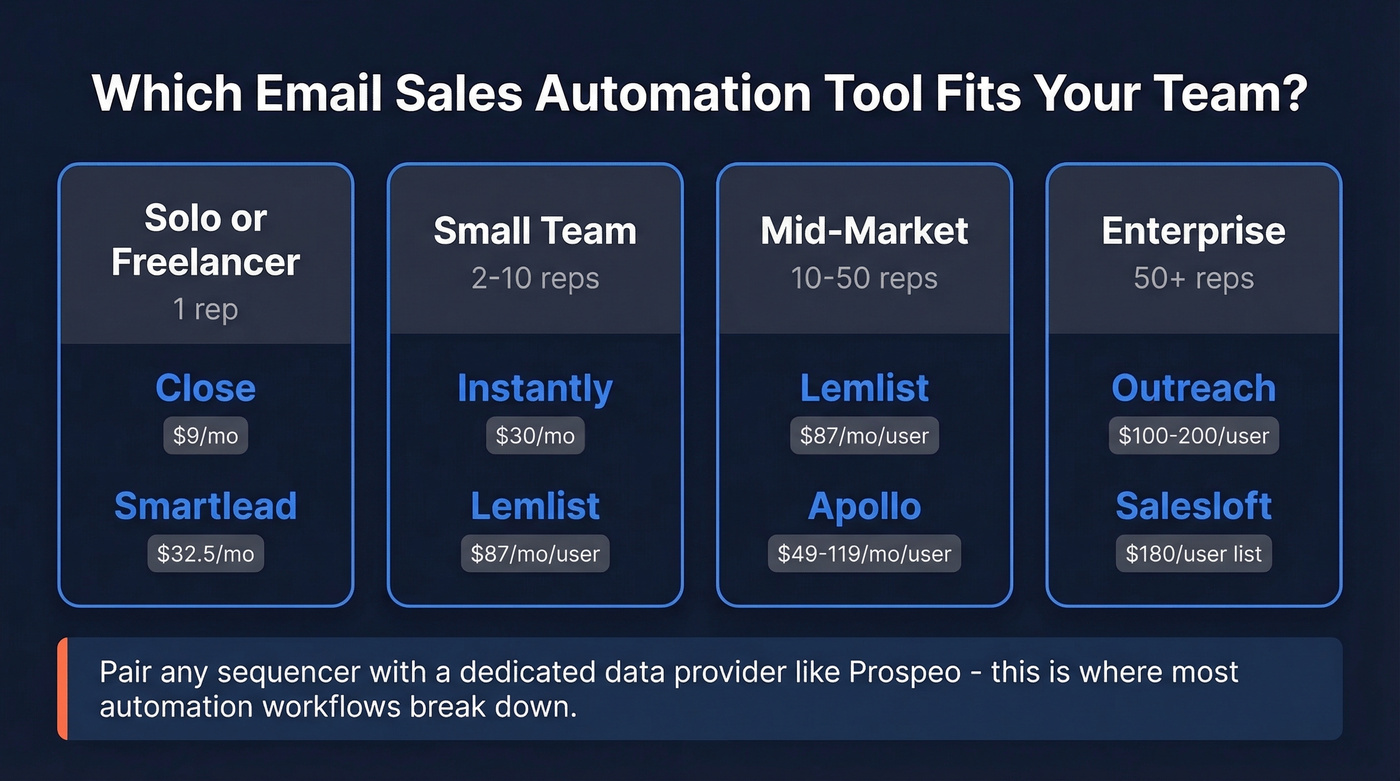
Solo or freelancer? Close or Smartlead. Team of 2-10 reps? Instantly or Lemlist. Mid-market (10-50)? Lemlist or Apollo. Enterprise (50+)? Outreach or Salesloft. Regardless of which sequencer you pick, pair it with a dedicated data provider - that's where most automation workflows fall apart.
What Good Looks Like
Before evaluating tools, you need to know what healthy outbound metrics actually look like. Cold emails can hit open rates as high as 60% with strong subject lines and warm domains. Reply rates typically land between 1-5%, and a 2-4% reply rate is genuinely good at any real volume. If someone tells you they're getting 15% reply rates, they're either sending 30 emails a day or lying.
If you want to tighten the inputs that drive those numbers, start with your cold email subject lines and your email copywriting fundamentals.
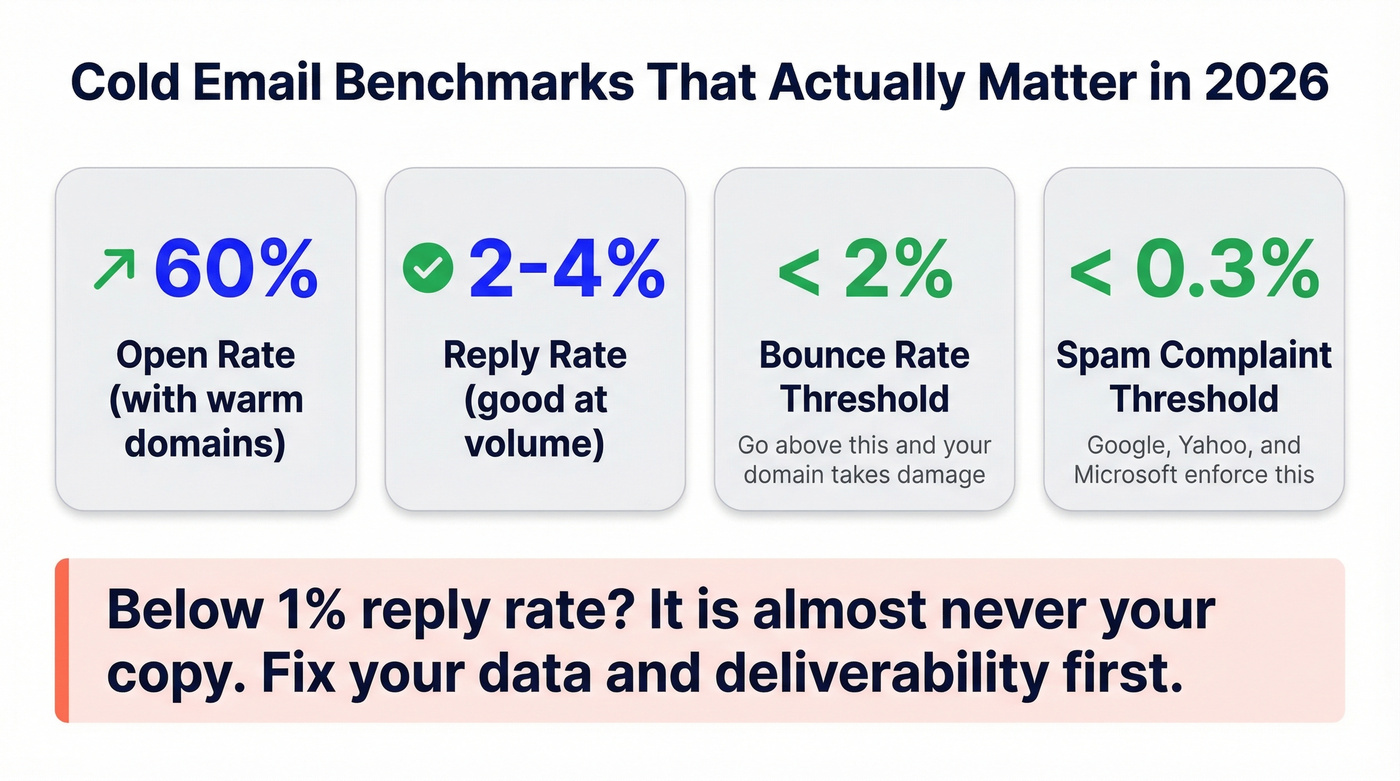
The numbers that actually matter for long-term health are bounces and spam complaints. Keep bounces under 2% and spam complaints under 0.3% - those are the thresholds Google, Yahoo, and Microsoft enforce for bulk senders. Drop below either line and your domain reputation takes damage that can take weeks to recover from.
If you're below 1% reply rate, it's almost never your copy. It's your data or your deliverability. Fix those first. (If you need a deeper playbook, use this email deliverability guide and track email bounce rate properly.)

The 9 Best Tools for Automated Outbound
Prospeo - The Data Layer
Every sequencer on this list sends emails. None of them guarantee those emails reach real inboxes. That's the gap Prospeo fills.
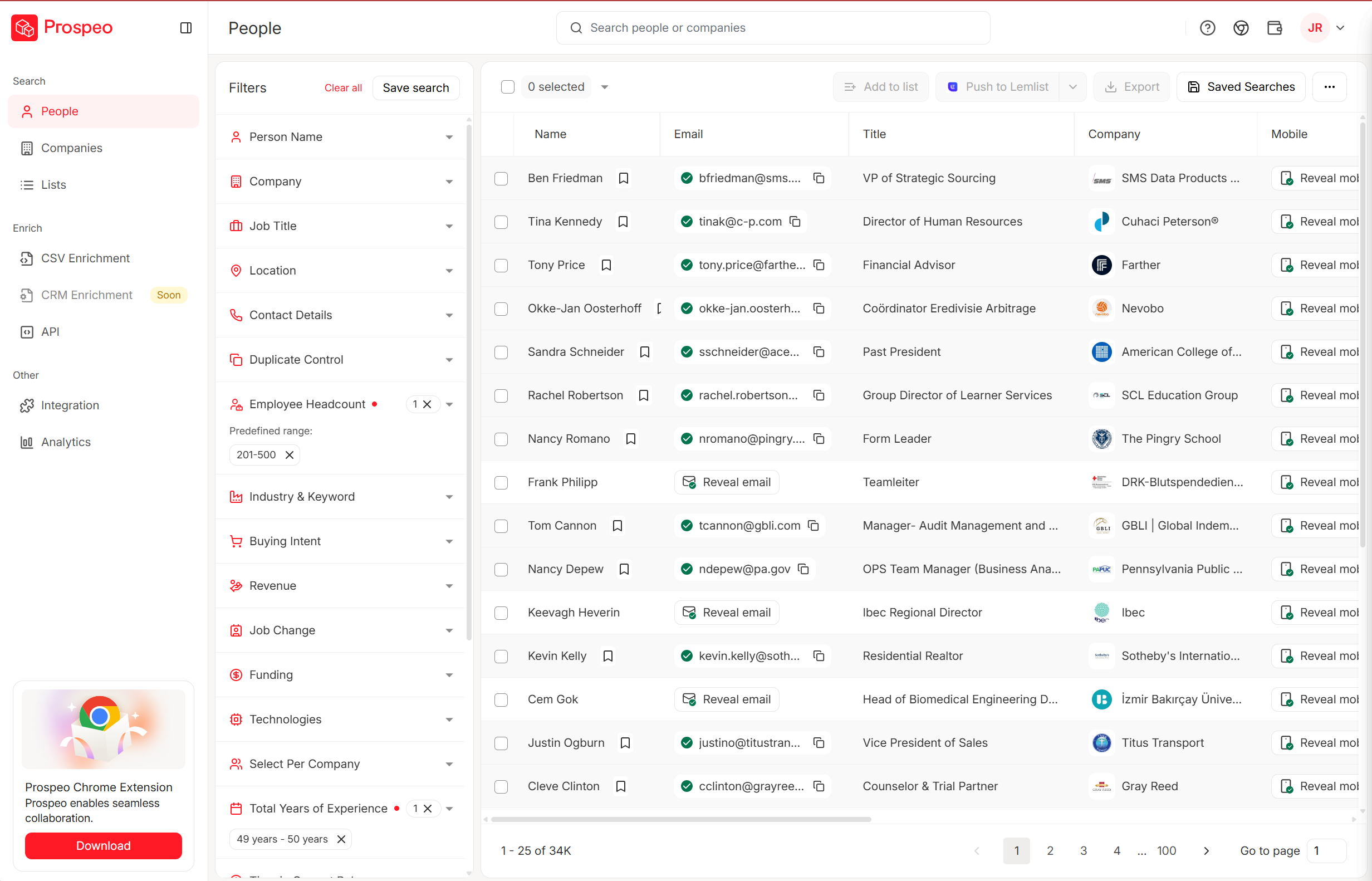
Prospeo's database covers 300M+ professional profiles with 143M+ verified emails at 98% accuracy and 125M+ verified mobile numbers that hit a 30% pickup rate. The data refreshes every 7 days - the industry average is 6 weeks, which means most providers are serving you stale contacts by the time your automated sequence fires. A proprietary 5-step verification process handles catch-all domains, removes spam traps, and filters honeypots before a contact ever reaches your sequencer. The Chrome extension (40,000+ users) lets you verify contacts directly from any website, and 30+ search filters - including buyer intent powered by Bombora - help you target accounts showing purchase signals. Native integrations with Instantly, Lemlist, Smartlead, Salesloft, Outreach, HubSpot, and Salesforce mean it slots into whatever stack you already run.
If you're comparing providers, it helps to understand the broader landscape of data enrichment services and how lead enrichment impacts deliverability.
The Snyk case tells the story well: 50 AEs were prospecting 4-6 hours per week with bounce rates running 35-40%. After switching to Prospeo, bounces dropped under 5% and AE-sourced pipeline jumped 180%.
Use this if: You want verified data feeding your sequences - not guessing whether contacts are valid. Free tier gives you 75 emails/month at roughly $0.01/email on paid plans.
Instantly
Instantly is the default choice for SMB outbound teams, and for good reason. Unlimited email accounts, built-in warmup, and a unified inbox (Unibox) that makes managing replies across dozens of sending addresses actually manageable.
If you're building a full outbound stack, it also helps to understand sequence management so you don't scale chaos.
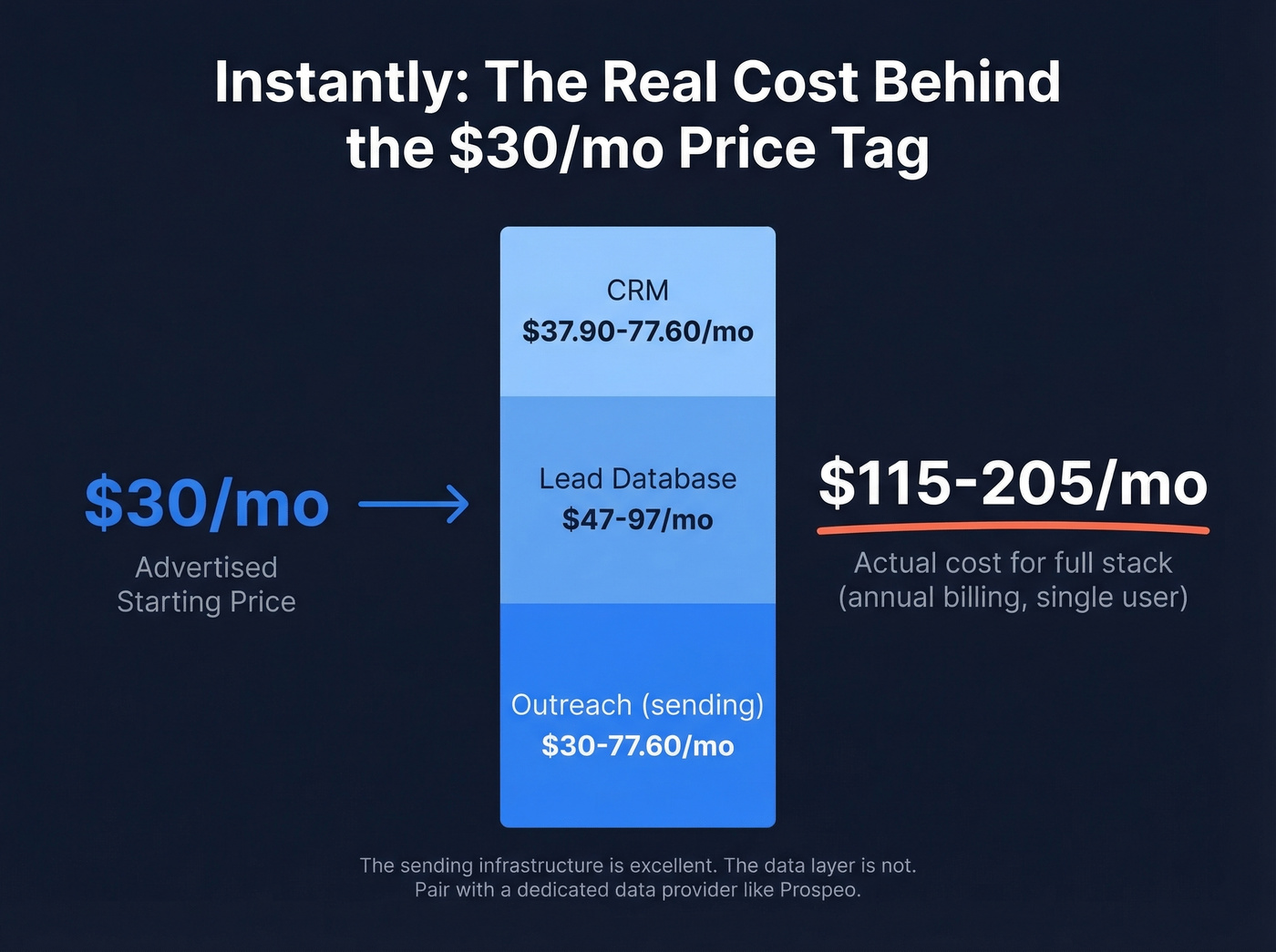
The pricing gets complicated fast, though. Instantly splits into three separate products. Outreach starts at $30/mo yearly ($37 monthly) - Growth caps you at 5,000 emails/month, while Hypergrowth at $77.60/mo yearly bumps that to 100,000. Want their lead database? Another $47-97/mo. Their CRM? Another $37.90-$77.60/mo on annual billing. The full stack runs about $115-205/mo on annual billing for a single user. That's not a $30/mo tool anymore.
The other issue is data. Instantly markets a database of 450M+ B2B leads, but volume without verification creates bounce problems. The sending infrastructure is excellent. The data layer is not.
Use this if: You're running high-volume outbound and need unlimited email accounts with solid deliverability. Pair it with a dedicated data provider for contacts.
Skip this if: You expect the $30/mo price to cover everything. It won't.
Lemlist
Lemlist is the strongest option for teams that want email, calling, and LinkedIn outreach in a single workflow. The Multichannel Expert plan ($87/mo/user yearly) includes all three channels, 5 email senders per user, 400 enrichment credits, and a built-in dialer with VoIP integrations.
The real cost is higher once you add what most teams actually need. Extra email senders run $9/mo each, deliverability protection is $20/mo/user, calling numbers cost $15/mo each, and WhatsApp automation adds $20/mo/user. A realistic monthly cost for a rep running multichannel is closer to $131/user/mo with the common add-ons, or $151/user/mo if you also add WhatsApp. For a team of 5, that's $655-755/mo - not the $435 you'd calculate from the base price.
Multichannel sequences that blend email touches with social steps and calls in a single timeline convert better than email-only, and Lemlist makes that workflow native rather than duct-taped together. If you only need automated email sequences, you're paying for channels you won't use - look at Instantly or Smartlead instead.
If you want to improve conversion without adding channels, use proven sales follow-up templates to tighten your sequence steps.
Apollo
Apollo tries to be your database, sequencer, and CRM in one platform. It does all three at a B- level. For small teams that can't afford three separate tools, that's a legitimate value proposition. The free tier gives you 100 credits/month, and paid plans commonly land in the $49-119/mo per user range.
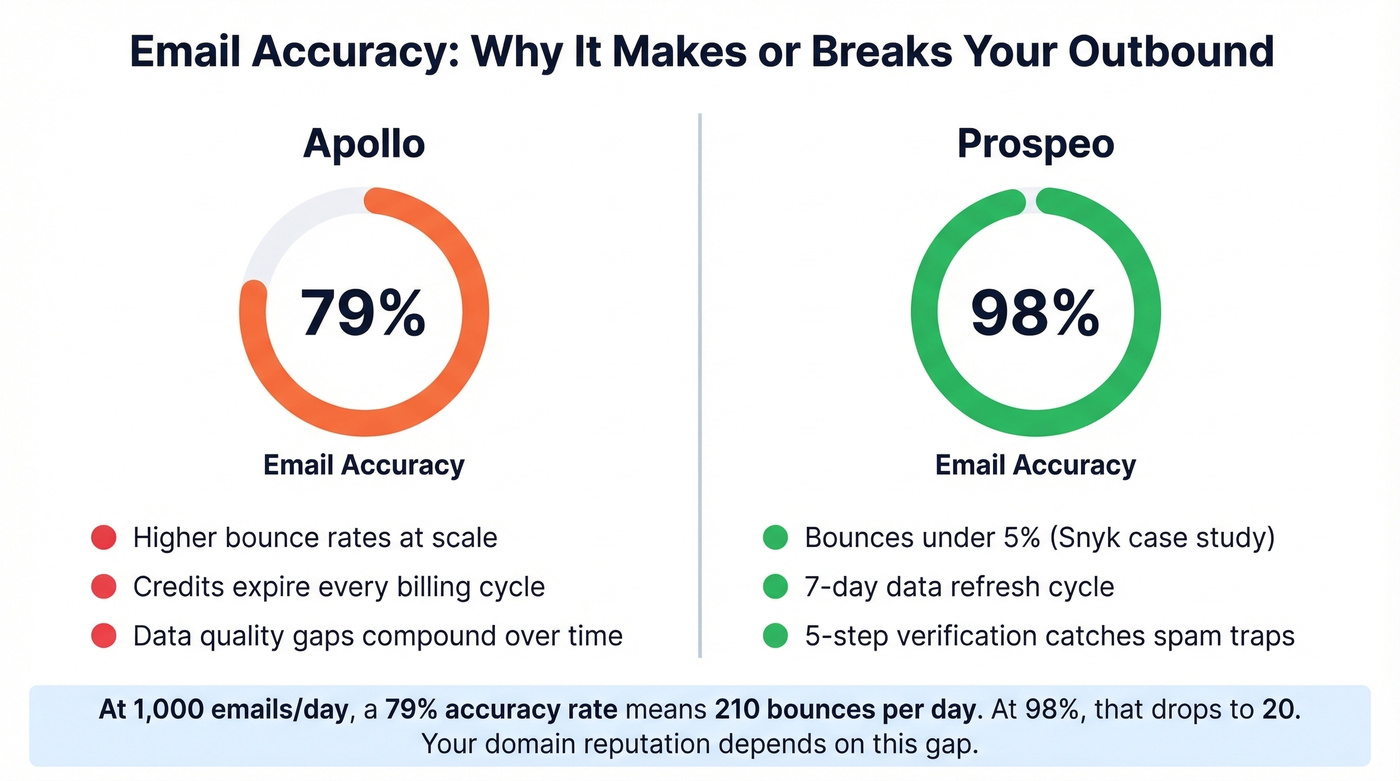
The credit model is the gotcha. Credits don't roll over - they expire every billing cycle. If you're on the Professional plan and don't use your monthly allotment, those credits vanish. Overages can trigger additional charges, and it's common to see different limits for accounts on the same tier depending on when they migrated to Apollo's newer credit system.
Apollo's email accuracy sits around 79% - compared to 98% from a dedicated verification provider. For small teams doing moderate volume, Apollo works fine. For teams scaling past 50 emails/day, the data quality gap starts costing you in bounces and domain reputation. The consensus on r/sales is that Apollo is great for getting started but becomes a liability at scale.
Bottom line: Best all-in-one for teams under 10 reps who want simplicity over best-in-class accuracy. Once you're scaling outbound volume, the credit expiration and accuracy gaps compound fast.
Smartlead
Smartlead is the budget pick for agencies and teams that prioritize deliverability mechanics. Starting at $32.5/mo on annual billing, it offers strong warmup, inbox rotation, and analytics at a price point that undercuts Instantly.
The trade-off is a steeper learning curve. Setting up API integrations, webhooks, and ChatGPT-powered personalization requires more technical comfort than Instantly's plug-and-play approach. If you're an agency managing multiple client campaigns or a technical team comfortable with configuration, Smartlead punches above its weight. If you want a polished UI and zero setup friction, look elsewhere.
HubSpot Sales Hub
If your team already lives in HubSpot CRM, Sales Hub sequences are the path of least resistance. Sales Hub starts around $90/month billed annually, and HubSpot offers a 14-day free trial.
Let's be honest: HubSpot sequences aren't purpose-built for cold outbound at scale. They're designed for warm follow-ups and deal progression within an existing CRM workflow. Don't buy Sales Hub for cold email. Buy it because your CRM is already HubSpot and you want automated sequences that don't require a separate tool.
If you're still deciding what belongs in your stack, compare examples of a CRM and what you actually need from contact management software.
Outreach
Outreach is the enterprise standard for sales engagement - deep sequencing logic, granular analytics, A/B testing, and workflow automation that handles complex multi-step cadences across large teams. Tiers include Engage, Call, and Meet, and expect around $100-200/user/month depending on seats and modules.
The platform earns its price for teams with 20+ reps who need manager-level visibility into sequence performance. If your team is under 20 reps, you're almost certainly overpaying for capabilities you won't use. The analytics and coaching features justify the premium only at scale. Outreach's own research backs this up - their ROI case studies almost exclusively feature teams north of 25 seats.
SalesLoft
The fact that Salesloft still won't publish pricing in 2026 is genuinely frustrating. List price for the Advanced tier runs roughly $180/user/month. A 25-seat deal comes out to about $54,000/year at list - but 35-45% negotiation discounts are typical, so expect to land around $30-35K/year for that same deal. The dialer is an add-on at roughly $7,500/year for 25 users, and the Bionic Chatbot runs another $10,000/year if you want it.
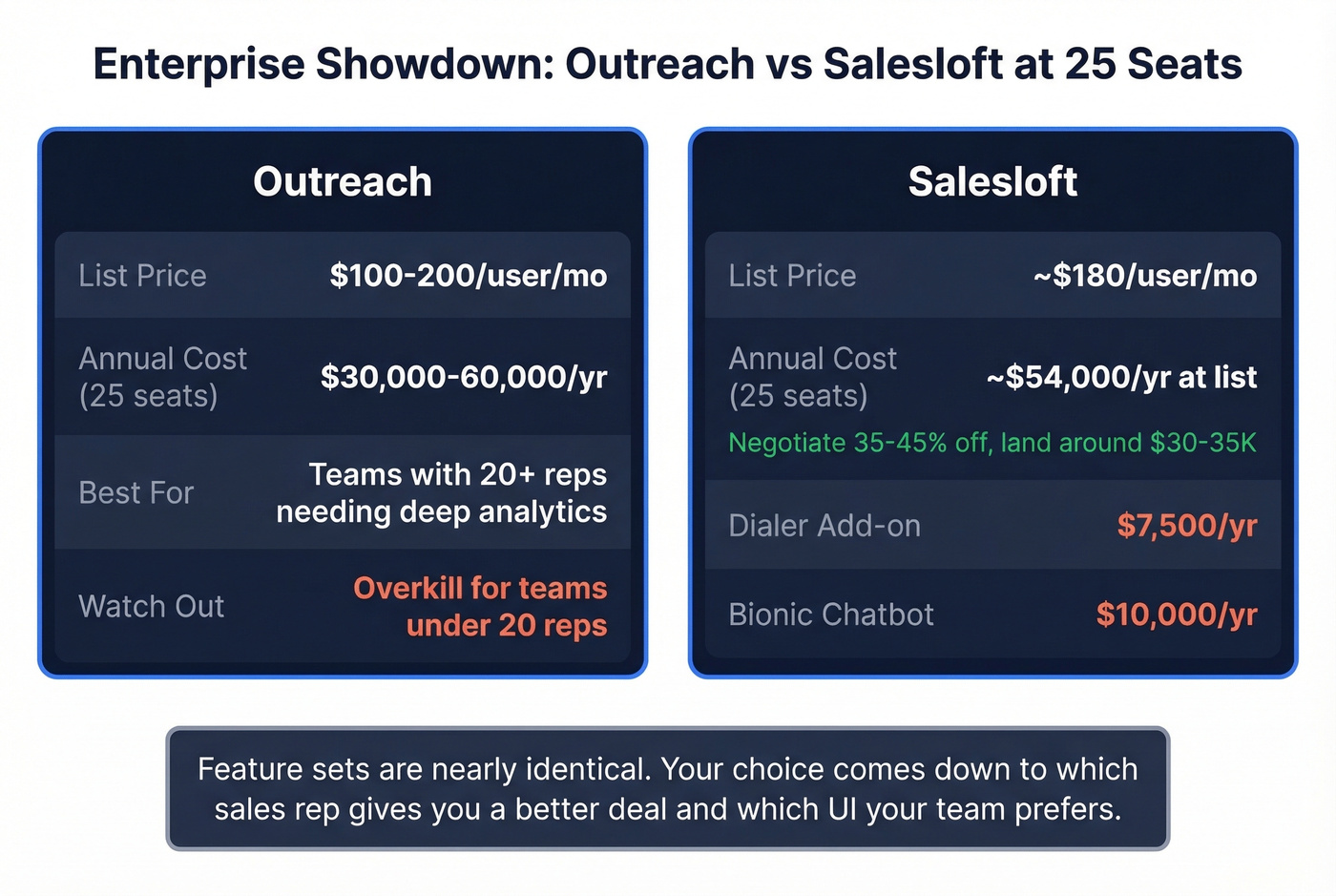
Salesloft competes directly with Outreach. The feature sets are nearly identical at this point. Your choice comes down to which sales rep gives you a better deal and which UI your team prefers.
Close
Close starts at $9/mo on annual billing for the Solo plan and bundles CRM + sequences in one clean interface. It's built for solo founders and tiny teams who want simplicity over power. Not the tool for scaling past 5 reps, but excellent for getting started without managing a multi-tool stack.
| Tool | Starting Price | Best For | Key Trade-Off |
|---|---|---|---|
| Prospeo | Free (75/mo) | Data accuracy | Pair with a sequencer |
| Instantly | $30/mo | SMB outbound | Lead data accuracy |
| Lemlist | $63/mo/user | Email-first outreach | Add-ons inflate cost |
| Apollo | Free (100 credits) | All-in-one | Credits expire monthly |
| Smartlead | $32.5/mo | Budget/agencies | Steeper learning curve |
| HubSpot | ~$90/mo | HubSpot users | Not built for high-volume cold outbound |
| Outreach | ~$100-200/user | Enterprise | Opaque pricing |
| Salesloft | ~$180/user (list) | Enterprise | Opaque pricing |
| Close | $9/mo | Solo/small teams | Limited at scale |

Bad data is why your automated sequences bounce. Prospeo's 98% email accuracy and 7-day refresh cycle mean every contact in your sequencer is verified before it sends. Native integrations with Instantly, Lemlist, Smartlead, and Outreach plug directly into your stack.
Stop automating emails to dead inboxes. Fix your data layer first.
Why Data Quality Breaks Your Automation
You loaded 500 contacts from a database, hit send, and 47 bounced in the first hour. Your ESP flagged the domain. Your warmup progress from the last three weeks just evaporated. This isn't hypothetical - it's the most common failure mode in outbound automation, and it has nothing to do with your sequencer or your copy.
The chain reaction is brutal: high bounce rate triggers ISP flags on your sending domain, inbox placement drops, open rates crater, reply rates disappear, and your team blames the tool and starts evaluating alternatives. The tool wasn't the problem. The data was.
A proper 5-step verification process catches the contacts that other databases let through - catch-all domain handling, spam-trap removal, and honeypot filtering are the specific mechanisms that keep your bounce rate under 2%. We've seen this play out with real teams: Meritt saw their pipeline triple from $100K to $300K per week after switching to verified data, with bounce rates dropping from 35% to under 4%. Snyk's 50-person AE team cut bounces from 35-40% to under 5% and generated 200+ new opportunities per month.
Here's our take: the sequencer is a commodity. They all send emails on a schedule. The data feeding those sequences is what determines whether anyone reads them. No amount of sophisticated automation compensates for emails that never reach an inbox. If you're evaluating email sales automation tools and ignoring data quality, you're optimizing the wrong variable.
If you want a practical workflow for building lists that won't bounce, follow a modern sales prospecting techniques playbook and use how to generate an email list as your checklist.
Snyk's 50 AEs cut bounce rates from 35-40% to under 5% and grew AE-sourced pipeline 180% - by switching to Prospeo's verified data. At $0.01/email with 300M+ profiles and 30+ targeting filters, it's the cheapest insurance your automation actually works.
Pair your sequencer with data that won't wreck your domain reputation.
Deliverability Setup Checklist
No tool saves you if your infrastructure is broken. Here's the baseline every outbound team needs before sending a single cold email.
Authentication (non-negotiable)
SPF, DKIM, and DMARC must be configured for every sending domain. Without these, you're going to spam. Period. You also need an RFC 8058 one-click unsubscribe header - Google, Yahoo, and Microsoft now require this for bulk senders. Set up a custom tracking domain via CNAME to isolate your reputation from shared tracking pools.
Domain strategy
Never send cold email from your primary business domain. Buy secondary domains - variations of your brand name work fine. Run 2-3 inboxes per domain, capped at 10-15 emails per day per inbox. That's your infrastructure math: to send 100 emails/day, you need roughly 3-4 domains with 2-3 inboxes each.
Warmup and ramp
Warm new domains for 14 days minimum, 21 days recommended. Keep warmup running even after you start sending real campaigns. Start at 5-10 emails/day per inbox and increase gradually over 4-6 weeks. Predictable daily volumes matter more than total volume - sudden spikes in sending are the fastest way to trigger spam filters.
Ongoing monitoring
Keep spam complaints under 0.3% and bounces under 2%. Target 80%+ inbox placement and verify it regularly - tools like mail-tester.com and GlockApps give you visibility into where your emails actually land.
If you want to go deeper on infrastructure, use this guide to tracking domain setup and safe email velocity limits.
Pricing Reality Check
Picture this: you're a VP of Sales evaluating tools for a 5-rep team. Every vendor's pricing page shows a number that bears little resemblance to what you'll actually pay.
Instantly's $30/mo headline gets you the Outreach product only. Add their Leads database ($47-97/mo) and CRM ($37.90-$77.60/mo on annual billing) and you're at roughly $115-205/mo for a single user's worth of functionality spread across three subscriptions. For 5 reps, budget roughly $575-1,155/mo depending on billing and tiers.
Lemlist's Multichannel Expert at $87/mo/user looks straightforward until you add deliverability protection ($20/user), an extra sender ($9), and a calling number ($15). Realistic cost per rep: about $131/mo. Team of 5: $655-755/mo - not the $435 you'd calculate from the base price.
Apollo at $79/mo/user (Professional) for 5 seats runs $395/mo, but credits expire monthly. If your team has an uneven prospecting cadence, you're either wasting credits or hitting overages. Budget $395-745/mo depending on usage patterns.
Salesloft won't give you a number until you sit through a discovery call, but a 25-seat Advanced deal lists at $54K/year. Negotiate hard - 35-45% off list is typical, landing around $30-35K. For 5 seats, expect roughly $10,800/year at list before discounts.
| Tool | Advertised "From" | Realistic Monthly (5 reps) | What's Missing |
|---|---|---|---|
| Instantly | $30/mo | $575-1,155 | Leads + CRM separate |
| Lemlist | $63/mo/user | $655-755 | Add-ons for full multichannel |
| Apollo | $49/mo/user | $395-745 | Credits expire, overages |
| Salesloft | "Contact Sales" | ~$10,800/yr (list) | Dialer add-on extra |
| Prospeo (data) | Free | $50-100 | Pair with a sequencer |
How to Choose Your B2B Stack
You don't need nine tools. You need three: a sequencer, a data provider, and a CRM.
Solo or freelancer: Close ($9/mo) or Smartlead ($32.5/mo) for sequencing, plus a free-tier data provider for verified contacts. Total cost under $50/mo.
SMB (2-10 reps): Instantly or Lemlist for sequencing, plus a dedicated verification layer for data. Budget $200-700/mo depending on volume and channel mix.
Mid-market (10-50 reps): Lemlist or Apollo for sequencing. Apollo works here if you want the all-in-one simplicity, but pair it with a verification provider to catch the accuracy gaps. At this scale, the difference between 79% and 98% email accuracy means hundreds of fewer bounces per month.
Enterprise (50+ reps): Outreach or Salesloft for sequencing and analytics, plus enterprise-grade data. At this scale, the accuracy difference translates to thousands of fewer bounces per month and measurably better domain health.
Stop evaluating sequencers and start evaluating your data. The sending tool is a commodity - they all fire emails on a schedule. The data feeding those sequences is what determines whether anyone reads them.
FAQ
What's the difference between email sales automation and marketing automation?
Sales automation tools like Instantly, Lemlist, and Outreach send personalized outbound sequences to prospects who haven't opted in. Marketing automation platforms like Mailchimp and Klaviyo send newsletters and drip campaigns to opted-in subscribers. They require different tools, different compliance approaches, and different deliverability strategies - don't use a marketing tool for cold outbound.
How many cold emails can I send per day?
Cap each inbox at 10-15 emails per day and use 2-3 inboxes per domain. To send 100 emails/day, you need roughly 3-4 domains with 2-3 inboxes each. Scale gradually over 4-6 weeks - ramping too fast is the fastest way to land in spam.
Do I need a separate domain for cold outreach?
Yes, always. Never send cold email from your primary business domain. Buy secondary domains (variations of your brand), set up SPF/DKIM/DMARC on each, and warm them for 14-21 days before sending real campaigns. This protects your main domain's reputation if something goes wrong.
Why do my cold emails land in spam?
Usually one of three causes: missing authentication (SPF/DKIM/DMARC not configured), high bounce rates from unverified data, or sending too much volume too fast. Fix the data first - verify emails before you send, keep bounces under 2%, and protect your sender reputation.
What's a good free option for sales data?
Prospeo's free tier includes 75 verified emails per month at 98% accuracy - enough for solo founders or small teams testing outbound. Apollo offers 100 free credits monthly but at lower accuracy. For teams that need reliable data without a contract, a free data plan paired with a budget sequencer like Smartlead ($32.5/mo) keeps total cost under $50/mo.